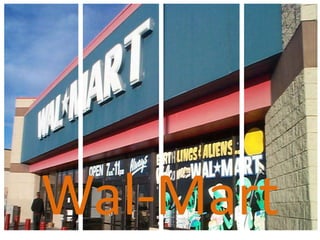
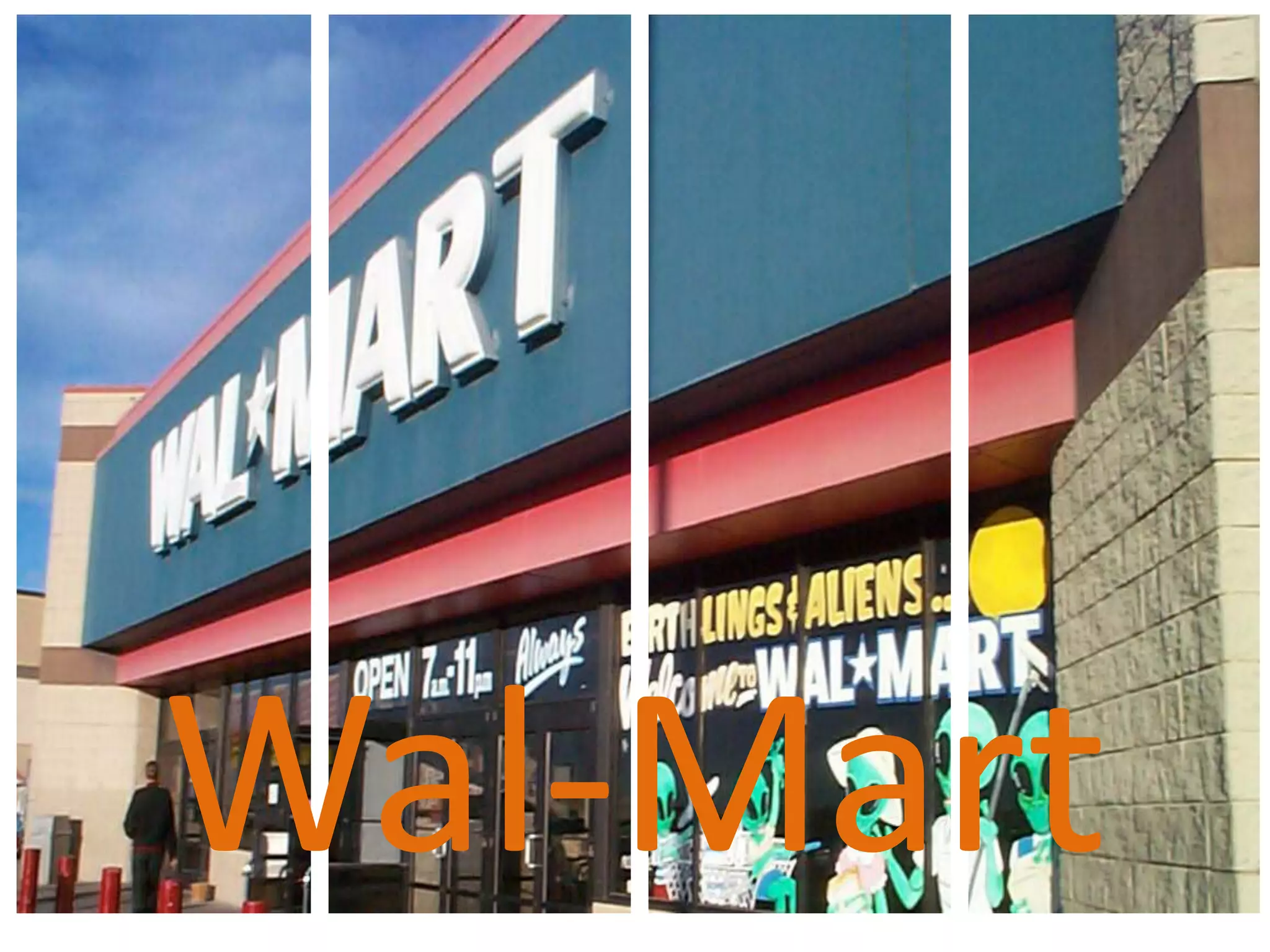
Wal-Mart
Discount Retailing in the United States Began in the mid - 1950sWal-Mart, Kmart, Target - Started in 1962Stagnated during the 1970s1980s –                Kmart – largest discount retailer                Wal-Mart – Second largest                Innovations – Denser display, UPC scanning                Hypermarket failed evolved smaller format
Continued…1990s-     Came Supercenter2001-    Supercenters to account for more than 1 billion        dollars    Blurred the traditional boundaries between    discount retailers and traditional markets 2002-    Kmart, biggest retail bankruptcy ever
Wal-Mart Stores, Inc. Headquarter – Bentonville2003             Stores - 4,688            Area   - 561 million square feet             73% stores - located in united states
Sam WaltonBorn on 29 march 1918 in Kingfisher, Oklahoma            Good athlete            Student leader            Entrepreneur1945 – First variety format franchised Ben Franklin
1962 – First Discount city store in Rogers, Arkansas
David Glass – Said...
Sam overcame early problem and took company public in 1970 & raised $3.3 mCont.…Hired Senior executives including David GlassInstalled private satellite network – 1980s Obsessed with work1988 – CEO - David Glass – 2000 – Lee Scott
Retailing FormatsDiscount StoreSupercenterNeighborhood Markets Sam’s Club
ProcurementExpenses – should not exceed 1% value of purchases
Backward integration – Saved 2-3% on goods
Early 1990s – EDIs
Sam time – Retail Link                         Data ware house consisted 250 terabyte of analytic database                     - Less than 10 minutesAugust 1997 to July 1998 – left to work for Amazon.com
Continued..Supply and Demand information helped
8% products – out of stock
1/3 Goods – Down prices
Included top 75% - strategic decisions
Small shared suppliers – Poor performed
Large  shared supplier – Better performed
Wal-Mart - P & G’s largest customerContinued..Wal-Mart – China’s single largest importerChina’s eighth largest trading partner, ahead of Russia and Britain28-40% - Cost reduction on imports of high velocity friendsChild labor issueEarly 2003 - Sweetshop retailer of the year
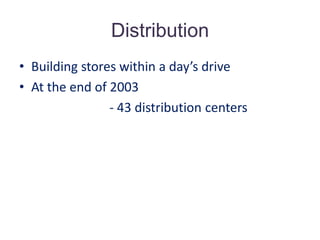
DistributionBuilding stores within a day’s driveAt the end of 2003                            - 43 distribution centers
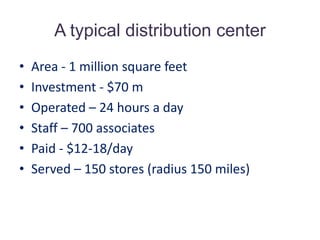
A typical distribution centerArea - 1 million square feet Investment - $70 mOperated – 24 hours a dayStaff – 700 associatesPaid - $12-18/dayServed – 150 stores (radius 150 miles)
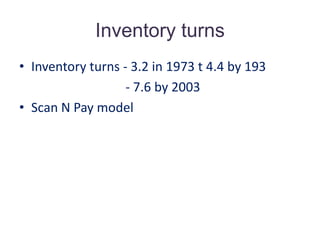
Inventory turnsInventory turns - 3.2 in 1973 t 4.4 by 193                                 - 7.6 by 2003Scan N Pay model
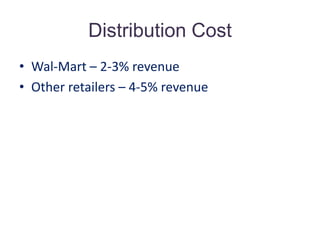
Distribution CostWal-Mart – 2-3% revenueOther retailers – 4-5% revenue
McLane A wholesale distributer acquired in 1990Sold to Berkshire HathawayLost - $1.29 b on volume of $22 b
Merchandising and MarketingProduct AssortmentPricingOther Marketing
Merchandising and MarketingWalton’s life with merchandising.Merchandising principle:Achieving very high sales per square foot by offering broad assortment of merchandise at constantly low prices in cheap but cheerful stores.
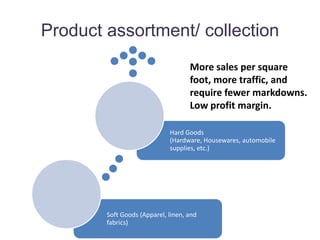
Product assortment/ collectionMore sales per square foot, more traffic, and require fewer markdowns. Low profit margin.
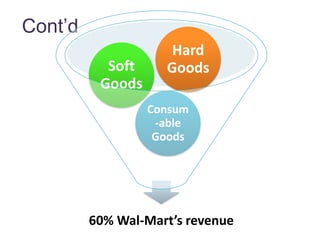
Cont’d
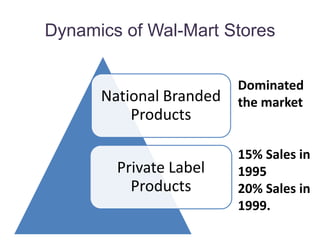
Dynamics of Wal-Mart StoresDominated the market15% Sales in 1995 20% Sales in 1999.
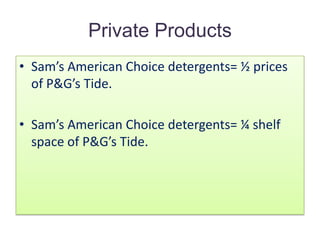
Private ProductsSam’s American Choice detergents= ½ prices of P&G’s Tide.Sam’s American Choice detergents= ¼ shelf space of P&G’s Tide.
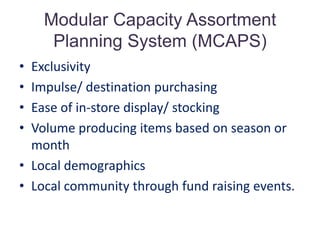
Modular Capacity Assortment Planning System (MCAPS)ExclusivityImpulse/ destination purchasingEase of in-store display/ stockingVolume producing items based on season or monthLocal demographicsLocal community through fund raising events.
Cont’dMerchandising mixLoss of non-purchaser accounted to $9 billion per year
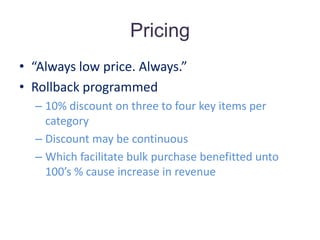
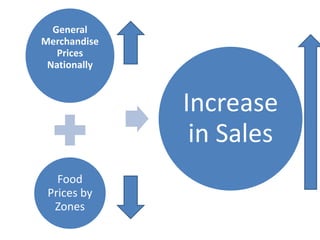
Pricing“Always low price. Always.”Rollback programmed10% discount on three to four key items per categoryDiscount may be continuousWhich facilitate bulk purchase benefitted unto 100’s % cause increase in revenue
Price-WarManagers were allowed to match or beat the lowest competing price (Max. 5%)Wal-Mart makes price checks99.8% of Kmart Stores98.7% of Target Stores (10-15% Premium charge)
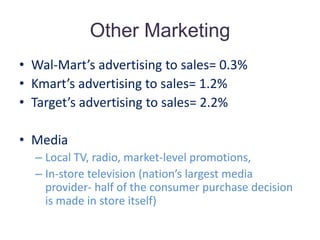
Other MarketingWal-Mart’s advertising to sales= 0.3%Kmart’s advertising to sales= 1.2%Target’s advertising to sales= 2.2%MediaLocal TV, radio, market-level promotions,In-store television (nation’s largest media provider- half of the consumer purchase decision is made in store itself)
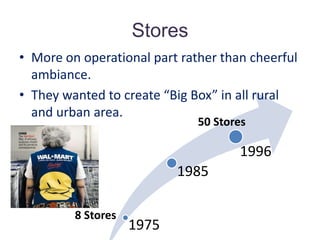
StoresMore on operational part rather than cheerful ambiance.They wanted to create “Big Box” in all rural and urban area.50 Stores8 Stores
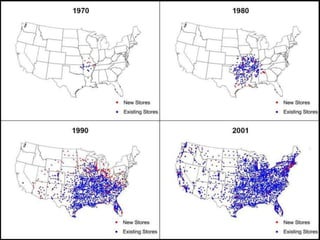
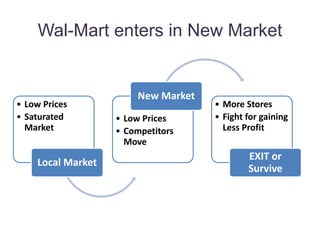
Wal-Mart enters in New Market
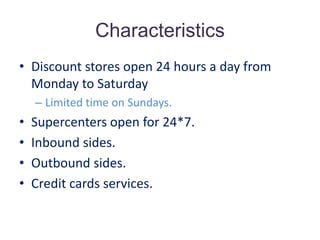
CharacteristicsDiscount stores open 24 hours a day from Monday to SaturdayLimited time on Sundays.Supercenters open for 24*7.Inbound sides.Outbound sides.Credit cards services.
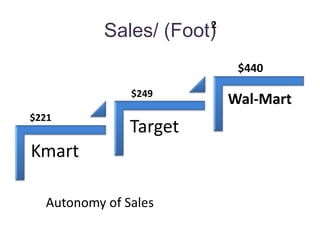
Sales/ (Foot)2$440$249$221Autonomy of Sales
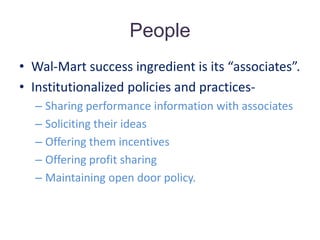
PeopleWal-Mart success ingredient is its “associates”.Institutionalized policies and practices-Sharing performance information with associatesSoliciting their ideasOffering them incentivesOffering profit sharingMaintaining open door policy.
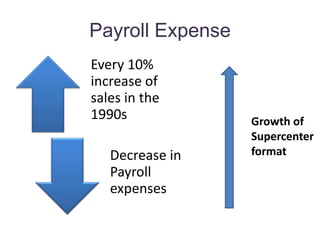
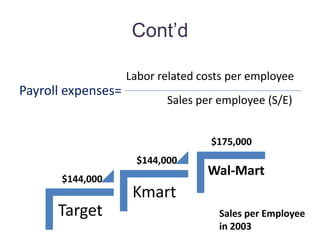
Payroll ExpenseGrowth of Supercenter format
Cont’dPayroll expenses= Labor related costs per employeeSales per employee (S/E)$175,000$144,000$144,000 Sales per Employee in 2003
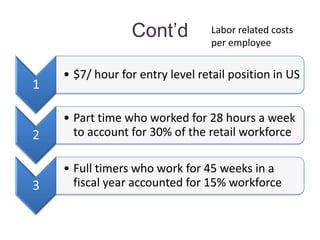
Cont’dLabor related costs per employee
Store within a STOREReceive detail information in salesReceive detail information in profitsAdjusting the merchandising mixBeing reward for the results
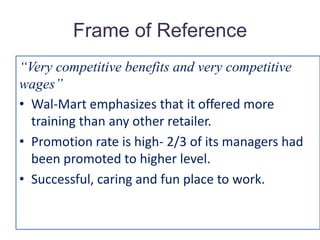
Frame of Reference“Very competitive benefits and very competitive wages”Wal-Mart emphasizes that it offered more training than any other retailer.Promotion rate is high- 2/3 of its managers had been promoted to higher level.Successful, caring and fun place to work.
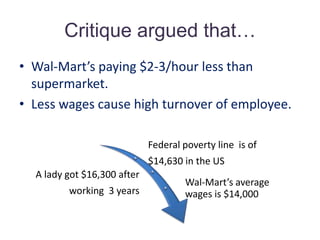
Critique argued that…Wal-Mart’s paying $2-3/hour less than supermarket.Less wages cause high turnover of employee.
Cont’dHealth insurance benefits to over 90% employees.2.2 million employees base is necessary to maintain.2/3 of hourly employees are female, they hold 1/3 of store management jobs and 15% store management position.
ManagementWhat management practices made Walmart Giant?
1.Responsibility & trust- Learned from variety store business
2.Establising check & control-Facilitated by technology
3. Commitment to work
“Commit to your business. Believe in it more than anybody else. I think I overcome every single one of my shortcomings by the sheer passion I brought to work.”                  - From Sam Walton’s Autobiography
4. Strategic analysis

Wal Mart Case Study