Walmart stores’
discount operations-
Case analysis
Group-2
Ashish Dhand (19DM245)
Olivia Mukherjee(19DM129)
Pulkita Vyas (19DM147)
Romani Banerjee (19DM167)
Sourabh (19DM187)
Shreyansh Singh (19DM206)
Tanveer Ahmed(19DM225)
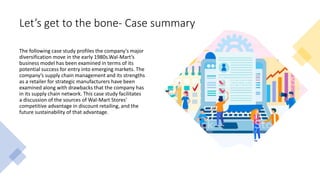
Let’s get to the bone- Case summary
The following case study profiles the company's major
diversification move in the early 1980s.Wal-Mart’s
business model has been examined in terms of its
potential success for entry into emerging markets. The
company’s supply chain management and its strengths
as a retailer for strategic manufacturers have been
examined along with drawbacks that the company has
in its supply chain network. This case study facilitates
a discussion of the sources of Wal-Mart Stores'
competitive advantage in discount retailing, and the
future sustainability of that advantage.
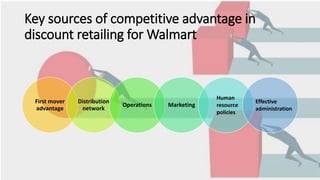
Key sources of competitive advantage in
discount retailing for Walmart
First mover
advantage
Distribution
network
Operations Marketing
Human
resource
policies
Effective
administration
Is Walmart’s
competitive advantage
sustainable enough?
Sustainable because of-
• Geographical Monopoly in untapped areas, establishing first mover advantage :
-One third of WM’s stores were located strategically claiming 10-12% of total retail sales.
-Large store spaces of upto 30000 sq. ft. in sparsely populated towns
• Unparalleled Store operations,Seamless Distribution, Vendor relations and JIT Strategy:
-36 merchandise departments, inventory turns of over 4.5, computerized inventory stocking
-Uniform Product Code system in all stores by 1988
-Didn’t take more than one fifth of its volume from one vendor (less than 2.8% of total
purchase)
-Just in time stock replenishment using centralised systems linked to vendors
Marketing Theme : “We sell for less”
-High sales from price sensitive categories- health, beauty aids, homeware and appliances.
They sold the concept of low prices (10.4% lower than K-mart but 7.6% lower than Target)
-CAD for merchandize suggestions based on 100 factors
Employee Relations: “We care about our people”
-Profit sharing and several other incentives to satisfy employees, store managers comes
from WM’s pretax profit
Combination of operational effectiveness and Strategy makes WalMart’s Competitive
Advantage Sustainable
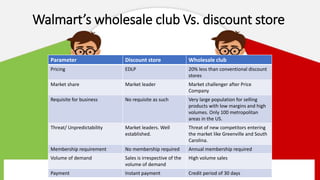
Walmart’s wholesale club Vs. discount store
Parameter Discount store Wholesale club
Pricing EDLP 20% less than conventional discount
stores
Market share Market leader Market challenger after Price
Company
Requisite for business No requisite as such Very large population for selling
products with low margins and high
volumes. Only 100 metropolitan
areas in the US.
Threat/ Unpredictability Market leaders. Well
established.
Threat of new competitors entering
the market like Greenville and South
Carolina.
Membership requirement No membership required Annual membership required
Volume of demand Sales is irrespective of the
volume of demand
High volume sales
Payment Instant payment Credit period of 30 days
FIN.

Case study- Walmart

  • 1.
    Walmart stores’ discount operations- Caseanalysis Group-2 Ashish Dhand (19DM245) Olivia Mukherjee(19DM129) Pulkita Vyas (19DM147) Romani Banerjee (19DM167) Sourabh (19DM187) Shreyansh Singh (19DM206) Tanveer Ahmed(19DM225)
  • 2.
    Let’s get tothe bone- Case summary The following case study profiles the company's major diversification move in the early 1980s.Wal-Mart’s business model has been examined in terms of its potential success for entry into emerging markets. The company’s supply chain management and its strengths as a retailer for strategic manufacturers have been examined along with drawbacks that the company has in its supply chain network. This case study facilitates a discussion of the sources of Wal-Mart Stores' competitive advantage in discount retailing, and the future sustainability of that advantage.
  • 3.
    Key sources ofcompetitive advantage in discount retailing for Walmart First mover advantage Distribution network Operations Marketing Human resource policies Effective administration
  • 4.
    Is Walmart’s competitive advantage sustainableenough? Sustainable because of- • Geographical Monopoly in untapped areas, establishing first mover advantage : -One third of WM’s stores were located strategically claiming 10-12% of total retail sales. -Large store spaces of upto 30000 sq. ft. in sparsely populated towns • Unparalleled Store operations,Seamless Distribution, Vendor relations and JIT Strategy: -36 merchandise departments, inventory turns of over 4.5, computerized inventory stocking -Uniform Product Code system in all stores by 1988 -Didn’t take more than one fifth of its volume from one vendor (less than 2.8% of total purchase) -Just in time stock replenishment using centralised systems linked to vendors
  • 5.
    Marketing Theme :“We sell for less” -High sales from price sensitive categories- health, beauty aids, homeware and appliances. They sold the concept of low prices (10.4% lower than K-mart but 7.6% lower than Target) -CAD for merchandize suggestions based on 100 factors Employee Relations: “We care about our people” -Profit sharing and several other incentives to satisfy employees, store managers comes from WM’s pretax profit Combination of operational effectiveness and Strategy makes WalMart’s Competitive Advantage Sustainable
  • 6.
    Walmart’s wholesale clubVs. discount store Parameter Discount store Wholesale club Pricing EDLP 20% less than conventional discount stores Market share Market leader Market challenger after Price Company Requisite for business No requisite as such Very large population for selling products with low margins and high volumes. Only 100 metropolitan areas in the US. Threat/ Unpredictability Market leaders. Well established. Threat of new competitors entering the market like Greenville and South Carolina. Membership requirement No membership required Annual membership required Volume of demand Sales is irrespective of the volume of demand High volume sales Payment Instant payment Credit period of 30 days
  • 7.

Editor's Notes

  • #6 focus strategy. A marketing strategy in which a company concentrates its resources on entering or expanding in a narrow market or industry segment. A focus strategy is usually employed where the company knows its segment and has products to competitively satisfy its needs. It's an approach that a business takes to develop a unique product or service that customers will find better than or in another way distinctive from products or services offered by competitors. Differentiation strategy is a way for a business to distinguish itself from the competition. focus strategy. A marketing strategy in which a company concentrates its resources on entering or expanding in a narrow market or industry segment. A focus strategy is usually employed where the company knows its segment and has products to competitively satisfy its needs. It's an approach that a business takes to develop a unique product or service that customers will find better than or in another way distinctive from products or services offered by competitors. Differentiation strategy is a way for a business to distinguish itself from the competition.