Wearable technologies:
what's brewing in the lab?
http://www.sussex.ac.uk/strc/research/wearable
Dr. Daniel Roggen
Wearable Technologies Lab
Sensor Technologies Research Centre
University of Sussex
500 London police officers will be equipped
with Taser wearable cameras
[1] http://thenextweb.com/uk/2014/05/08/500-london-police-officers-will-equipped-taser-wearable-
cameras-today/
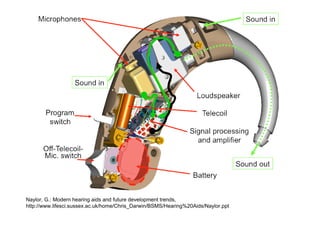
Naylor, G.: Modern hearing aids and future development trends,
http://www.lifesci.sussex.ac.uk/home/Chris_Darwin/BSMS/Hearing%20Aids/Naylor.ppt
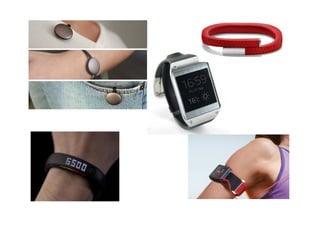
Wearable form factor
dictated by an application
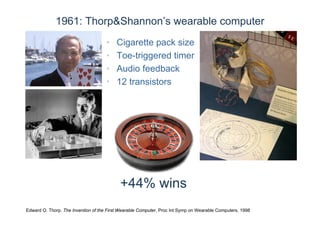
1961: Thorp&Shannon’s wearable computer
Edward O. Thorp. The Invention of the First Wearable Computer, Proc Int Symp on Wearable Computers, 1998
+44% wins
• Cigarette pack size
• Toe-triggered timer
• Audio feedback
• 12 transistors
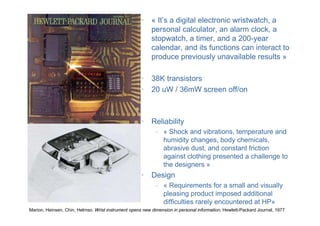
Marion, Heinsen, Chin, Helmso. Wrist instrument opens new dimension in personal information, Hewlett-Packard Journal, 1977
• « It’s a digital electronic wristwatch, a
personal calculator, an alarm clock, a
stopwatch, a timer, and a 200-year
calendar, and its functions can interact to
produce previously unavailable results »
• 38K transistors
• 20 uW / 36mW screen off/on
• Reliability
– « Shock and vibrations, temperature and
humidity changes, body chemicals,
abrasive dust, and constant friction
against clothing presented a challenge to
the designers »
• Design
– « Requirements for a small and visually
pleasing product imposed additional
difficulties rarely encountered at HP»
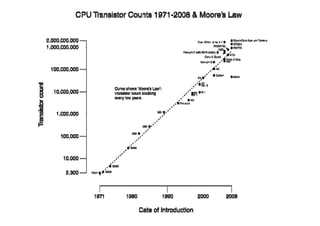
Wearables driven by
miniaturization
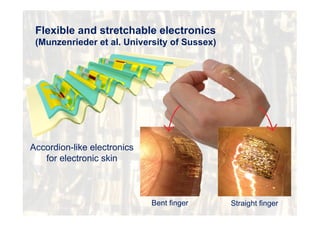
Flexible and stretchable electronics
(Munzenrieder et al. University of Sussex)
Bent finger Straight finger
Accordion-like electronics
for electronic skin
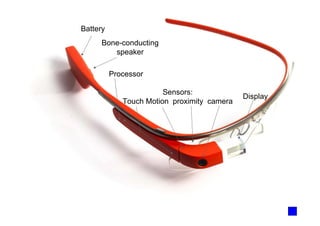
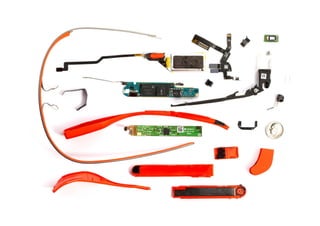
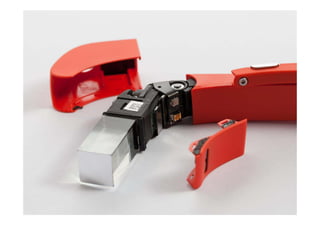
Processor
Battery
Display
Sensors:
Touch Motion proximity camera
Bone-conducting
speaker
A new definition of wearables:
« Smart assistant »
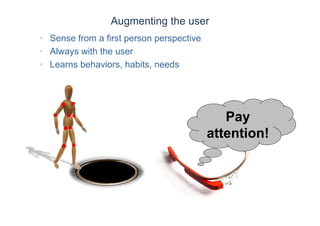
Pay
attention!
Augmenting the user
• Sense from a first person perspective
• Always with the user
• Learns behaviors, habits, needs
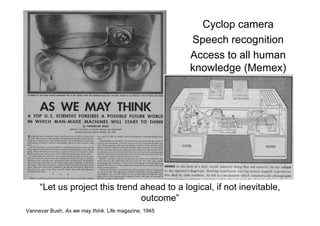
Vannevar Bush, As we may think. Life magazine, 1945
Cyclop camera
Speech recognition
Access to all human
knowledge (Memex)
“Let us project this trend ahead to a logical, if not inevitable,
outcome”
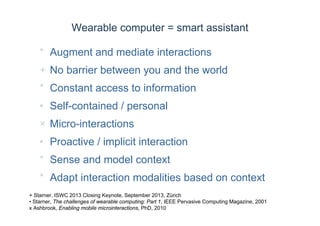
Wearable computer = smart assistant
* Augment and mediate interactions
+ No barrier between you and the world
* Constant access to information
• Self-contained / personal
× Micro-interactions
• Proactive / implicit interaction
* Sense and model context
* Adapt interaction modalities based on context
+ Starner, ISWC 2013 Closing Keynote, September 2013, Zürich
• Starner, The challenges of wearable computing: Part 1, IEEE Pervasive Computing Magazine, 2001
x Ashbrook, Enabling mobile microinteractions, PhD, 2010
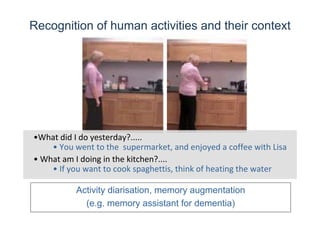
•What did I do yesterday?.....
• What am I doing in the kitchen?....
• You went to the  supermarket, and enjoyed a coffee with Lisa
• If you want to cook spaghettis, think of heating the water
Recognition of human activities and their context
Activity diarisation, memory augmentation
(e.g. memory assistant for dementia)
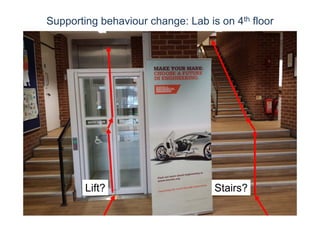
Supporting behaviour change: Lab is on 4th floor
Stairs?Lift?
Sensing and recognising
activities
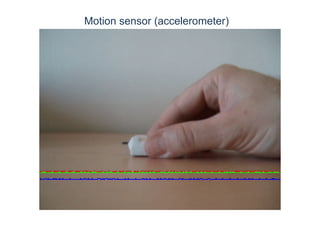
Motion sensor (accelerometer)
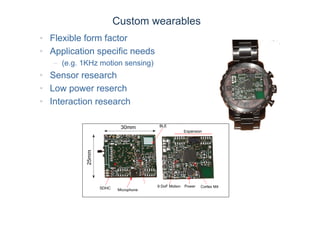
Custom wearables
• Flexible form factor
• Application specific needs
– (e.g. 1KHz motion sensing)
• Sensor research
• Low power reserch
• Interaction research
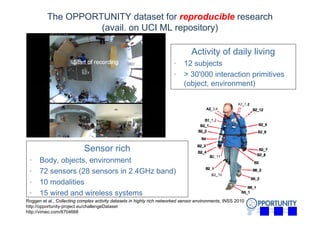
Activities of daily living
The OPPORTUNITY dataset for reproducible research
(avail. on UCI ML repository)
Activity of daily living
• 12 subjects
• > 30'000 interaction primitives
(object, environment)
Roggen et al., Collecting complex activity datasets in highly rich networked sensor environments, INSS 2010
http://opportunity-project.eu/challengeDataset
http://vimeo.com/8704668
Sensor rich
• Body, objects, environment
• 72 sensors (28 sensors in 2.4GHz band)
• 10 modalities
• 15 wired and wireless systems
Low-level activity
models (primitives)
Design-time: Training phase
Optimize
Sensor data
Annotations
High-level activity
models
Optimize
Context
Activity
Reasoning
Symbolic processing
Activity-aware
application
A1, p1, t1
A2, p2, t2
A3, p3, t3
A4, p4, t4
t
[1] Roggen et al., Wearable Computing: Designing and Sharing Activity-Recognition Systems Across Platforms, IEEE Robotics&Automation Magazine, 2011
Runtime: Recognition phase
FS2 P2
S1 P1
S0 P0
S3 P3
S4
P4
S0
S1
S2
S3
S4
F1
F2
F3
F0 C0
C1
C2
Preprocessing
Sensor sampling Segmentation
Feature extraction
Classification
Decision fusion
R
Null class
rejection
Subsymbolic processing
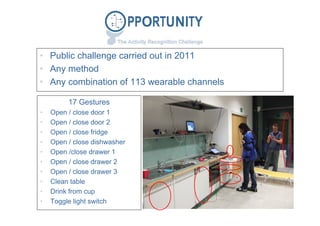
• Public challenge carried out in 2011
• Any method
• Any combination of 113 wearable channels
17 Gestures
• Open / close door 1
• Open / close door 2
• Open / close fridge
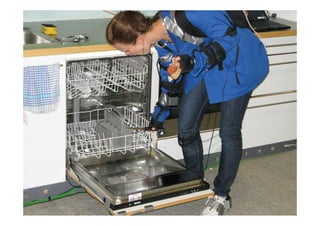
• Open / close dishwasher
• Open /close drawer 1
• Open / close drawer 2
• Open / close drawer 3
• Clean table
• Drink from cup
• Toggle light switch
Method Performance
LDA 0.25
QDA 0.24
NCC 0.19
1NN 0.55
3NN 0.56
UP 0.22
NStar 0.65
SStar 0.70
CStar 0.77
2011 results [1]
[1] Chavarriaga et al., The Opportunity challenge: A benchmark database for
on-body sensor-based activity recognition, Pattern recognition letters, 2013
[2] Ordones Morales et al., Deep LSTM recurrent neural networks for
multimodal wearable activity recognition, In preparation
ConvLSTM [2] 0.86 2015 results
+9%
“Deep learning”
Parkinson’s assistance
EC grant Nr FP6-018474-2 EC grant FP7-288516
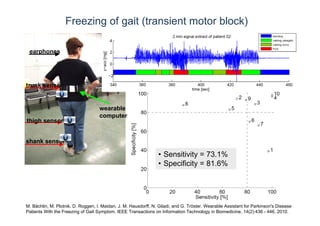
M. Bächlin, M. Plotnik, D. Roggen, I. Maidan, J. M. Hausdorff, N. Giladi, and G. Tröster. Wearable Assistant for Parkinson's Disease
Patients With the Freezing of Gait Symptom. IEEE Transactions on Information Technology in Biomedicine, 14(2):436 - 446, 2010.
Freezing of gait (transient motor block)
thigh sensor
shank sensor
trunk sensor
earphones
wearable
computer
• Sensitivity = 73.1%
• Specificity = 81.6%
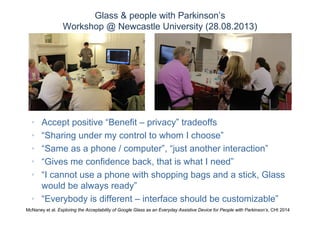
Glass & people with Parkinson’s
Workshop @ Newcastle University (28.08.2013)
• Accept positive “Benefit – privacy” tradeoffs
• “Sharing under my control to whom I choose”
• “Same as a phone / computer”, “just another interaction”
• “Gives me confidence back, that is what I need”
• “I cannot use a phone with shopping bags and a stick, Glass
would be always ready”
• “Everybody is different – interface should be customizable”
McNaney et al. Exploring the Acceptability of Google Glass as an Everyday Assistive Device for People with Parkinson’s, CHI 2014
Contextual support in the
assembly line
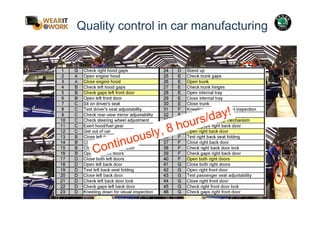
Quality control in car manufacturing
Continuously, 8 hours/day!
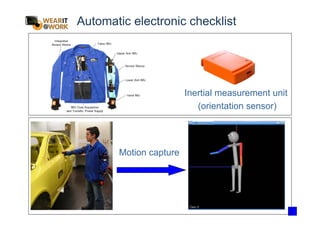
Automatic electronic checklist
Inertial measurement unit
(orientation sensor)
Motion capture
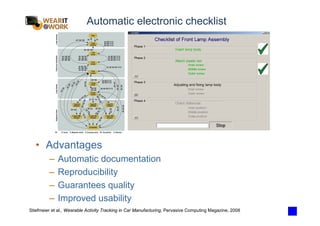
Stiefmeier et al., Wearable Activity Tracking in Car Manufacturing, Pervasive Computing Magazine, 2008
Automatic electronic checklist
• Advantages
– Automatic documentation
– Reproducibility
– Guarantees quality
– Improved usability
Learning
Micro-learning (Tin Man Labs, LLC)
Passive haptic learning for rehabilitation
Crowd behaviour analytics
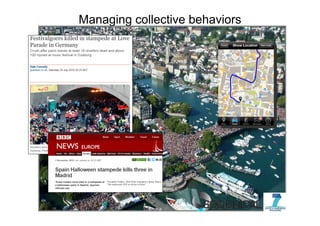
Managing collective behaviors
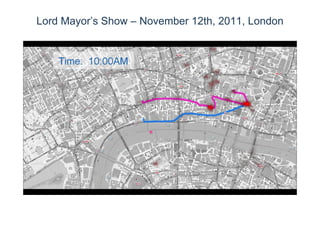
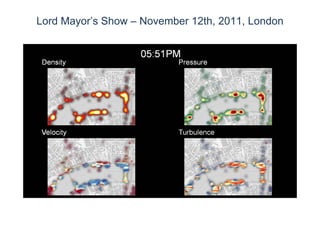
Lord Mayor’s Show – November 12th, 2011, London
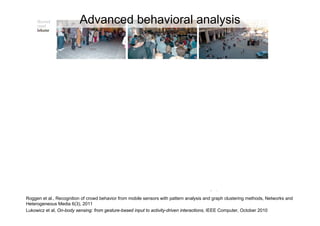
Roggen et al., Recognition of crowd behavior from mobile sensors with pattern analysis and graph clustering methods, Networks and
Heterogeneous Media 6(3), 2011
Lukowicz et al, On-body sensing: from gesture-based input to activity-driven interactions, IEEE Computer, October 2010
Advanced behavioral analysis
Sports
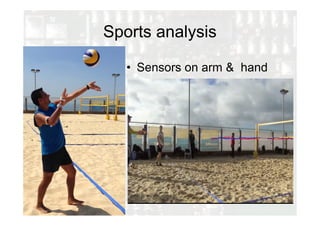
Sports analysis
• Sensors on arm & hand
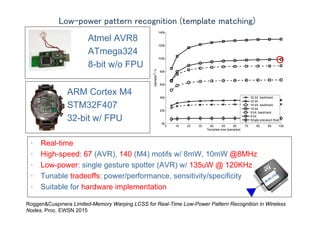
Low-power pattern recognition (template matching)
Atmel AVR8
ATmega324
8-bit w/o FPU
ARM Cortex M4
STM32F407
32-bit w/ FPU
• Real-time
• High-speed: 67 (AVR), 140 (M4) motifs w/ 8mW, 10mW @8MHz
• Low-power: single gesture spotter (AVR) w/ 135uW @ 120KHz
• Tunable tradeoffs: power/performance, sensitivity/specificity
• Suitable for hardware implementation
LM-W
LCSS
Roggen&Cuspinera Limited-Memory Warping LCSS for Real-Time Low-Power Pattern Recognition in Wireless
Nodes, Proc. EWSN 2015
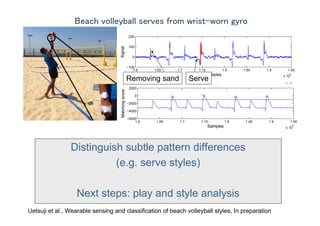
Beach volleyball serves from wrist-worn gyro
Removing sand Serve
Distinguish subtle pattern differences
(e.g. serve styles)
Next steps: play and style analysis
Uetsuji et al., Wearable sensing and classification of beach volleyball styles, In preparation
Insight into research
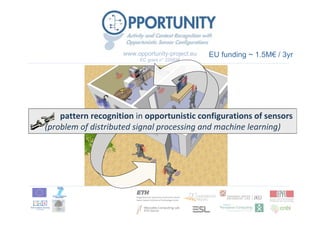
www.opportunity-project.eu
EC grant n° 225938
pattern recognition in opportunistic configurations of sensors
(problem of distributed signal processing and machine learning)
EU funding ~ 1.5M€ / 3yr
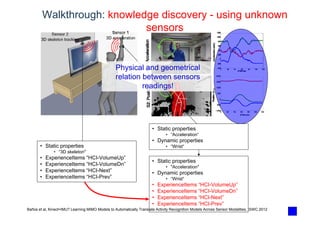
Walkthrough: knowledge discovery - using unknown
sensors
• Static properties
• “3D skeleton"
• ExperienceItems “HCI-VolumeUp”
• ExperienceItems “HCI-VolumeDn”
• ExperienceItems “HCI-Next”
• ExperienceItems “HCI-Prev”
• Static properties
• “Acceleration“
• Dynamic properties
• “Wrist“
Physical and geometrical
relation between sensors
readings!
• Static properties
• "Acceleration"
• Dynamic properties
• “Wrist“
• ExperienceItems “HCI-VolumeUp”
• ExperienceItems “HCI-VolumeDn”
• ExperienceItems “HCI-Next”
• ExperienceItems “HCI-Prev”
Baños et al, Kinect=IMU? Learning MIMO Models to Automatically Translate Activity Recognition Models Across Sensor Modalities, ISWC 2012
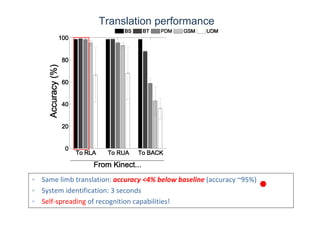
Translation performance
• Same limb translation: accuracy <4% below baseline (accuracy ~95%)
• System identification: 3 seconds
• Self‐spreading of recognition capabilities!
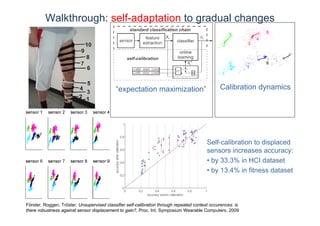
Walkthrough: self-adaptation to gradual changes
Förster, Roggen, Tröster, Unsupervised classifier self-calibration through repeated context occurences: is
there robustness against sensor displacement to gain?, Proc. Int. Symposium Wearable Computers, 2009
Calibration dynamics
Self-calibration to displaced
sensors increases accuracy:
• by 33.3% in HCI dataset
• by 13.4% in fitness dataset
“expectation maximization”
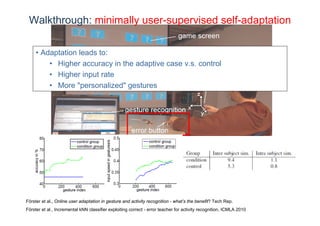
Walkthrough: minimally user-supervised self-adaptation
• Adaptation leads to:
• Higher accuracy in the adaptive case v.s. control
• Higher input rate
• More "personalized" gestures
Förster et al., Online user adaptation in gesture and activity recognition - what’s the benefit? Tech Rep.
Förster et al., Incremental kNN classifier exploiting correct - error teacher for activity recognition, ICMLA 2010
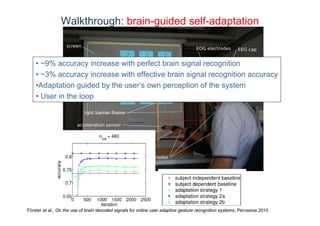
Förster et al., On the use of brain decoded signals for online user adaptive gesture recognition systems, Pervasive 2010
Walkthrough: brain-guided self-adaptation
• ~9% accuracy increase with perfect brain signal recognition
• ~3% accuracy increase with effective brain signal recognition accuracy
•Adaptation guided by the user’s own perception of the system
• User in the loop
Conclusion!
What is it that makes a device a "wearable"?
Always with the user
Personalised
Autonomous
Preempt needs
Augments our capabilities!
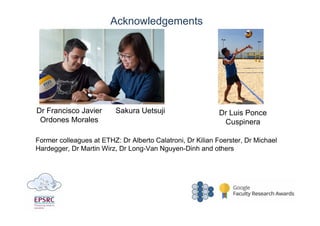
Acknowledgements
Sakura Uetsuji Dr Luis Ponce
Cuspinera
Former colleagues at ETHZ: Dr Alberto Calatroni, Dr Kilian Foerster, Dr Michael
Hardegger, Dr Martin Wirz, Dr Long-Van Nguyen-Dinh and others
Dr Francisco Javier
Ordones Morales

Wearable technologies: what's brewing in the lab?

  • 1.
    Wearable technologies: what's brewingin the lab? http://www.sussex.ac.uk/strc/research/wearable Dr. Daniel Roggen Wearable Technologies Lab Sensor Technologies Research Centre University of Sussex
  • 2.
    500 London policeofficers will be equipped with Taser wearable cameras [1] http://thenextweb.com/uk/2014/05/08/500-london-police-officers-will-equipped-taser-wearable- cameras-today/
  • 3.
    Naylor, G.: Modernhearing aids and future development trends, http://www.lifesci.sussex.ac.uk/home/Chris_Darwin/BSMS/Hearing%20Aids/Naylor.ppt
  • 4.
  • 5.
    1961: Thorp&Shannon’s wearablecomputer Edward O. Thorp. The Invention of the First Wearable Computer, Proc Int Symp on Wearable Computers, 1998 +44% wins • Cigarette pack size • Toe-triggered timer • Audio feedback • 12 transistors
  • 6.
    Marion, Heinsen, Chin,Helmso. Wrist instrument opens new dimension in personal information, Hewlett-Packard Journal, 1977 • « It’s a digital electronic wristwatch, a personal calculator, an alarm clock, a stopwatch, a timer, and a 200-year calendar, and its functions can interact to produce previously unavailable results » • 38K transistors • 20 uW / 36mW screen off/on • Reliability – « Shock and vibrations, temperature and humidity changes, body chemicals, abrasive dust, and constant friction against clothing presented a challenge to the designers » • Design – « Requirements for a small and visually pleasing product imposed additional difficulties rarely encountered at HP»
  • 7.
  • 10.
    Flexible and stretchableelectronics (Munzenrieder et al. University of Sussex) Bent finger Straight finger Accordion-like electronics for electronic skin
  • 11.
  • 15.
    A new definitionof wearables: « Smart assistant »
  • 16.
    Pay attention! Augmenting the user •Sense from a first person perspective • Always with the user • Learns behaviors, habits, needs
  • 17.
    Vannevar Bush, Aswe may think. Life magazine, 1945 Cyclop camera Speech recognition Access to all human knowledge (Memex) “Let us project this trend ahead to a logical, if not inevitable, outcome”
  • 18.
    Wearable computer =smart assistant * Augment and mediate interactions + No barrier between you and the world * Constant access to information • Self-contained / personal × Micro-interactions • Proactive / implicit interaction * Sense and model context * Adapt interaction modalities based on context + Starner, ISWC 2013 Closing Keynote, September 2013, Zürich • Starner, The challenges of wearable computing: Part 1, IEEE Pervasive Computing Magazine, 2001 x Ashbrook, Enabling mobile microinteractions, PhD, 2010
  • 19.
    •What did I do yesterday?..... •What am I doing in the kitchen?.... • You went to the  supermarket, and enjoyed a coffee with Lisa • If you want to cook spaghettis, think of heating the water Recognition of human activities and their context Activity diarisation, memory augmentation (e.g. memory assistant for dementia)
  • 20.
    Supporting behaviour change:Lab is on 4th floor Stairs?Lift?
  • 21.
  • 22.
  • 23.
    Custom wearables • Flexibleform factor • Application specific needs – (e.g. 1KHz motion sensing) • Sensor research • Low power reserch • Interaction research
  • 24.
  • 25.
    The OPPORTUNITY datasetfor reproducible research (avail. on UCI ML repository) Activity of daily living • 12 subjects • > 30'000 interaction primitives (object, environment) Roggen et al., Collecting complex activity datasets in highly rich networked sensor environments, INSS 2010 http://opportunity-project.eu/challengeDataset http://vimeo.com/8704668 Sensor rich • Body, objects, environment • 72 sensors (28 sensors in 2.4GHz band) • 10 modalities • 15 wired and wireless systems
  • 26.
    Low-level activity models (primitives) Design-time:Training phase Optimize Sensor data Annotations High-level activity models Optimize Context Activity Reasoning Symbolic processing Activity-aware application A1, p1, t1 A2, p2, t2 A3, p3, t3 A4, p4, t4 t [1] Roggen et al., Wearable Computing: Designing and Sharing Activity-Recognition Systems Across Platforms, IEEE Robotics&Automation Magazine, 2011 Runtime: Recognition phase FS2 P2 S1 P1 S0 P0 S3 P3 S4 P4 S0 S1 S2 S3 S4 F1 F2 F3 F0 C0 C1 C2 Preprocessing Sensor sampling Segmentation Feature extraction Classification Decision fusion R Null class rejection Subsymbolic processing
  • 27.
    • Public challengecarried out in 2011 • Any method • Any combination of 113 wearable channels 17 Gestures • Open / close door 1 • Open / close door 2 • Open / close fridge • Open / close dishwasher • Open /close drawer 1 • Open / close drawer 2 • Open / close drawer 3 • Clean table • Drink from cup • Toggle light switch
  • 28.
    Method Performance LDA 0.25 QDA0.24 NCC 0.19 1NN 0.55 3NN 0.56 UP 0.22 NStar 0.65 SStar 0.70 CStar 0.77 2011 results [1] [1] Chavarriaga et al., The Opportunity challenge: A benchmark database for on-body sensor-based activity recognition, Pattern recognition letters, 2013 [2] Ordones Morales et al., Deep LSTM recurrent neural networks for multimodal wearable activity recognition, In preparation ConvLSTM [2] 0.86 2015 results +9% “Deep learning”
  • 30.
  • 31.
    EC grant NrFP6-018474-2 EC grant FP7-288516
  • 32.
    M. Bächlin, M.Plotnik, D. Roggen, I. Maidan, J. M. Hausdorff, N. Giladi, and G. Tröster. Wearable Assistant for Parkinson's Disease Patients With the Freezing of Gait Symptom. IEEE Transactions on Information Technology in Biomedicine, 14(2):436 - 446, 2010. Freezing of gait (transient motor block) thigh sensor shank sensor trunk sensor earphones wearable computer • Sensitivity = 73.1% • Specificity = 81.6%
  • 33.
    Glass & peoplewith Parkinson’s Workshop @ Newcastle University (28.08.2013) • Accept positive “Benefit – privacy” tradeoffs • “Sharing under my control to whom I choose” • “Same as a phone / computer”, “just another interaction” • “Gives me confidence back, that is what I need” • “I cannot use a phone with shopping bags and a stick, Glass would be always ready” • “Everybody is different – interface should be customizable” McNaney et al. Exploring the Acceptability of Google Glass as an Everyday Assistive Device for People with Parkinson’s, CHI 2014
  • 34.
    Contextual support inthe assembly line
  • 35.
    Quality control incar manufacturing Continuously, 8 hours/day!
  • 36.
    Automatic electronic checklist Inertialmeasurement unit (orientation sensor) Motion capture
  • 37.
    Stiefmeier et al.,Wearable Activity Tracking in Car Manufacturing, Pervasive Computing Magazine, 2008 Automatic electronic checklist • Advantages – Automatic documentation – Reproducibility – Guarantees quality – Improved usability
  • 38.
  • 39.
  • 40.
    Passive haptic learningfor rehabilitation
  • 41.
  • 42.
  • 43.
    Lord Mayor’s Show– November 12th, 2011, London
  • 44.
    Lord Mayor’s Show– November 12th, 2011, London
  • 45.
    Roggen et al.,Recognition of crowd behavior from mobile sensors with pattern analysis and graph clustering methods, Networks and Heterogeneous Media 6(3), 2011 Lukowicz et al, On-body sensing: from gesture-based input to activity-driven interactions, IEEE Computer, October 2010 Advanced behavioral analysis
  • 46.
  • 47.
  • 48.
    Low-power pattern recognition(template matching) Atmel AVR8 ATmega324 8-bit w/o FPU ARM Cortex M4 STM32F407 32-bit w/ FPU • Real-time • High-speed: 67 (AVR), 140 (M4) motifs w/ 8mW, 10mW @8MHz • Low-power: single gesture spotter (AVR) w/ 135uW @ 120KHz • Tunable tradeoffs: power/performance, sensitivity/specificity • Suitable for hardware implementation LM-W LCSS Roggen&Cuspinera Limited-Memory Warping LCSS for Real-Time Low-Power Pattern Recognition in Wireless Nodes, Proc. EWSN 2015
  • 49.
    Beach volleyball servesfrom wrist-worn gyro Removing sand Serve Distinguish subtle pattern differences (e.g. serve styles) Next steps: play and style analysis Uetsuji et al., Wearable sensing and classification of beach volleyball styles, In preparation
  • 50.
  • 51.
    www.opportunity-project.eu EC grant n°225938 pattern recognition in opportunistic configurations of sensors (problem of distributed signal processing and machine learning) EU funding ~ 1.5M€ / 3yr
  • 52.
    Walkthrough: knowledge discovery- using unknown sensors • Static properties • “3D skeleton" • ExperienceItems “HCI-VolumeUp” • ExperienceItems “HCI-VolumeDn” • ExperienceItems “HCI-Next” • ExperienceItems “HCI-Prev” • Static properties • “Acceleration“ • Dynamic properties • “Wrist“ Physical and geometrical relation between sensors readings! • Static properties • "Acceleration" • Dynamic properties • “Wrist“ • ExperienceItems “HCI-VolumeUp” • ExperienceItems “HCI-VolumeDn” • ExperienceItems “HCI-Next” • ExperienceItems “HCI-Prev” Baños et al, Kinect=IMU? Learning MIMO Models to Automatically Translate Activity Recognition Models Across Sensor Modalities, ISWC 2012
  • 53.
    Translation performance • Samelimb translation: accuracy <4% below baseline (accuracy ~95%) • System identification: 3 seconds • Self‐spreading of recognition capabilities!
  • 54.
    Walkthrough: self-adaptation togradual changes Förster, Roggen, Tröster, Unsupervised classifier self-calibration through repeated context occurences: is there robustness against sensor displacement to gain?, Proc. Int. Symposium Wearable Computers, 2009 Calibration dynamics Self-calibration to displaced sensors increases accuracy: • by 33.3% in HCI dataset • by 13.4% in fitness dataset “expectation maximization”
  • 55.
    Walkthrough: minimally user-supervisedself-adaptation • Adaptation leads to: • Higher accuracy in the adaptive case v.s. control • Higher input rate • More "personalized" gestures Förster et al., Online user adaptation in gesture and activity recognition - what’s the benefit? Tech Rep. Förster et al., Incremental kNN classifier exploiting correct - error teacher for activity recognition, ICMLA 2010
  • 56.
    Förster et al.,On the use of brain decoded signals for online user adaptive gesture recognition systems, Pervasive 2010 Walkthrough: brain-guided self-adaptation • ~9% accuracy increase with perfect brain signal recognition • ~3% accuracy increase with effective brain signal recognition accuracy •Adaptation guided by the user’s own perception of the system • User in the loop
  • 57.
  • 58.
    What is itthat makes a device a "wearable"? Always with the user Personalised Autonomous Preempt needs Augments our capabilities!
  • 59.
    Acknowledgements Sakura Uetsuji DrLuis Ponce Cuspinera Former colleagues at ETHZ: Dr Alberto Calatroni, Dr Kilian Foerster, Dr Michael Hardegger, Dr Martin Wirz, Dr Long-Van Nguyen-Dinh and others Dr Francisco Javier Ordones Morales