Linux seccomp(2) vs OpenBSD pledge(2)
Giovanni Bechis
<giovanni@openbsd.org>
Open Source Summit Europe 2017, Prague
About Me
sys admin and developer @SNB
OpenBSD hacker for ∼ 10 years
random patches in random open source software (amavisd-new,
courier-imap, cyrus-sasl, memcached, ...)
Mitigations
stack protector
stack buffer underrun detection
ASLR (Address space layout randomization)
prevents exploitation of memory corruption vulnerabilities
WˆX
priv-sep and priv-drop
dangerous system calls
Disable system calls a process should not call
SE Linux
systrace
Capsicum
seccomp(2)
pledge(2)
Linux seccomp(2)
first version in Linux 2.6.12 (2005)
filters enabled via /proc/$PID/seccomp
in Linux 3.5 (2012) ”filter” mode has been added (”seccomp2”)
can control which syscall are permitted via a BPF ”program”
some programs are using seccomp(2) (Chrome, OpenSSH, vsftpd,
systemd, Firefox, Docker, LXC, ...)
in Linux 3.8 (2013) via /proc/$PID/status we can obtain the seccomp(2)
status (if, for example, seccomp(2) is disabled)
in Linux 3.17 (2014) seccomp(2) system call has been added as a
superset of prctl(2)
OpenBSD pledge(2)
introduced in OpenBSD 5.8 (2015) as tame(2), than renamed to
pledge(2)
still under development, some new features are coming
in OpenBSD pledge(2) cannot be disabled
around 500 programs with pledge(2) support in base
around 50 ports patched to have pledge(2) support (unzip, mutt,
memcached, chromium, ...)
seccomp(2) vs pledge(2)
approaching the ”syscalls” problem
study the program
figure out all syscalls the program needs
”promise” only the operations that are really needed
strace(1) or ktrace(1) and gdb(1) if something goes wrong
seccomp(2) vs pledge(2)
program is annotated with pledge(2)/seccomp(2) calls/promises
kernel enforces annotations and kills/reports the program that does not
respect promises
seccomp(2) vs pledge(2)
#include <linux/seccomp.h>
#include <linux/filter.h>
#include <linux/audit.h>
#include <linux/signal.h>
#include <sys/ptrace.h>
int seccomp(unsigned int operation, unsigned int flags, void *args);
#include <unistd.h>
int pledge(const char *promises, const char *paths[]);
seccomp(2) vs pledge(2)
$ wc -l seccomp/hello-seccomp.c seccomp/seccomp-bpf.h
58 seccomp/hello-seccomp.c
34 seccomp/seccomp-bpf.h
92 total
$ wc -l pledge/hello-pledge.c
17 pledge/hello-pledge.c
seccomp(2) vs pledge(2)
#define _GNU_SOURCE 1
#include <stdio.h>
#include <stddef.h>
#include <stdlib.h>
#include <unistd.h>
[...]
static int install_syscall_filter(void)
{
struct sock_filter filter[] = {
VALIDATE_ARCHITECTURE,
EXAMINE_SYSCALL,
[...]
KILL_PROCESS,
};
struct sock_fprog prog = {
.len = (unsigned short)(sizeof(filter)/sizeof(filter[0])),
.filter = filter,
};
if (prctl(PR_SET_NO_NEW_PRIVS, 1, 0, 0, 0)) {
perror("prctl(NO_NEW_PRIVS)");
goto failed;
}
if (prctl(PR_SET_SECCOMP, SECCOMP_MODE_FILTER, &prog)) {
perror("prctl(SECCOMP)");
goto failed;
}
return 0;
}
int main(int argc, char **argv) {
FILE *fd;
if((install_syscall_filter()) == 0) {
printf("Hello !n");
if((fd = fopen("/etc/passwd", "r"))) {
printf("Passwd file openedn");
}
fclose(fd);
return 0;
} else {
return 1;
}
seccomp(2) vs pledge(2)
#include <stdio.h>
#include <unistd.h>
int main(int argc, char **argv) {
FILE *fd;
if(pledge("stdio", NULL) != -1) {
printf("Hello !n");
if((fd = fopen("/etc/passwd", "r"))) {
printf("Passwd file openedn");
}
fclose(fd);
return 0;
} else {
return 1;
}
}
seccomp(2) permitted syscalls
#include <linux/seccomp.h>
#include <linux/filter.h>
#include <linux/audit.h>
#include <linux/signal.h>
#include <sys/ptrace.h>
int seccomp(unsigned int operation, unsigned int flags, void *args);
every single syscall available could be allowed
pledge(2) promises
#include <unistd.h>
int pledge(const char *promises, const char *paths[]);
””: exit(2)
stdio: malloc + rw stdio
rpath, wpath, cpath, tmppath: open files
fattr: explicit changes to ”fd” (chmod & friends)
unix, inet: open sockets
dns: dns requests
route: routing operations
sendfd: sends file descriptors via sendmsg(2)
recvfd: receive file descriptors via recvmsg(2)
getpw: passwd/group file access
ioctl: small subset of ioctls is permitted
tty: subset of ioctl for tty operations
proc: fork(2), vfork(2), kill(2) and other processes related operations
exec: execve(2) is allowed to create another process which will be unpledged
settime: allows to set the system time
pf: allows a subset of ioctl(2) operations on pf(4) device
seccomp(2) reporting
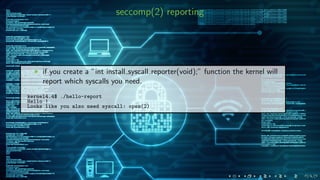
if you create a ”int install syscall reporter(void);” function the kernel will
report which syscalls you need.
kernel4.4$ ./hello-report
Hello !
Looks like you also need syscall: open(2)
seccomp(2) reporting
#include "syscall-reporter.h"
#include "syscall-names.h"
const char * const msg_needed = "Looks like you also need syscall: ";
int install_syscall_reporter(void)
{
struct sigaction act;
sigset_t mask;
memset(&act, 0, sizeof(act));
sigemptyset(&mask);
sigaddset(&mask, SIGSYS);
act.sa_sigaction = &reporter;
act.sa_flags = SA_SIGINFO;
if (sigaction(SIGSYS, &act, NULL) < 0) {
perror("sigaction");
return -1;
}
if (sigprocmask(SIG_UNBLOCK, &mask, NULL)) {
perror("sigprocmask");
return -1;
}
return 0;
}
seccomp(2) reporting
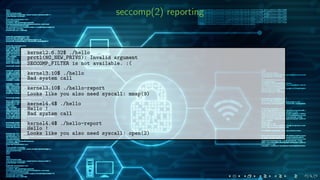
kernel2.6.32$ ./hello
prctl(NO_NEW_PRIVS): Invalid argument
SECCOMP_FILTER is not available. :(
kernel3.10$ ./hello
Bad system call
kernel3.10$ ./hello-report
Looks like you also need syscall: mmap(9)
kernel4.4$ ./hello
Hello !
Bad system call
kernel4.4$ ./hello-report
Hello !
Looks like you also need syscall: open(2)
pledge(2) reporting
openbsd6.2$ ./hello
Hello !
Abort trap (core dumped)
seccomp(2) logging
dmesg(1) and rsyslogd(8)
Oct 12 16:02:56 ubuntu kernel: auditd: type:1326 audit(1507816976.188:30):
auid=1000 uid=1000 gid=1000 ses=1 subj=system_u:system_r:kernel_t:s0 pid=1227
comm="hello" exe="/home/test/src/hello" sig=31 arch=c000003e syscall=2 compat=0
ip=0x7fbb3ab75010 code=0x0
Oct 12 16:02:56 ubuntu audit[1227]: SECCOMP auid=1000 uid=1000 gid=1000 ses=1
subj=system_u:system_r:kernel_t:s0 pid=1227 comm="hello"
exe="/home/test/src/hello" sig=31 arch=c000003e syscall=2 compat=0
ip=0x7fbb3ab75010 code=0x0
pledge(2) logging
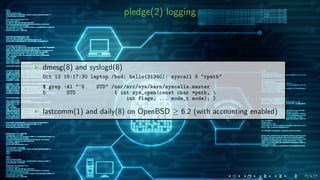
dmesg(8) and syslogd(8)
Oct 12 16:17:30 laptop /bsd: hello(31340): syscall 5 "rpath"
$ grep -A1 "^5 STD" /usr/src/sys/kern/syscalls.master
5 STD { int sys_open(const char *path, 
int flags, ... mode_t mode); }
lastcomm(1) and daily(8) on OpenBSD ≥ 6.2 (with accounting enabled)
pledge(2) logging
rm - giovanni ttyp1 0.00 secs Sat Jun 17 15:56 (0:00:00.00)
ls - giovanni ttyp1 0.00 secs Sat Jun 17 15:56 (0:00:00.00)
rm - giovanni ttyp1 0.00 secs Sat Jun 17 15:56 (0:00:00.00)
hello -DXP giovanni ttyp1 0.00 secs Sat Jun 17 15:56 (0:00:00.16)
cc - giovanni ttyp1 0.00 secs Sat Jun 17 15:56 (0:00:00.64)
pledge(2) logging
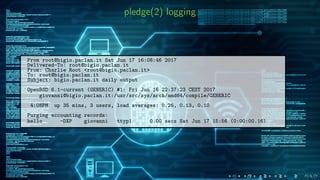
From root@bigio.paclan.it Sat Jun 17 16:08:46 2017
Delivered-To: root@bigio.paclan.it
From: Charlie Root <root@bigio.paclan.it>
To: root@bigio.paclan.it
Subject: bigio.paclan.it daily output
OpenBSD 6.1-current (GENERIC) #1: Fri Jun 16 22:37:23 CEST 2017
giovanni@bigio.paclan.it:/usr/src/sys/arch/amd64/compile/GENERIC
4:08PM up 35 mins, 3 users, load averages: 0.26, 0.13, 0.10
Purging accounting records:
hello -DXP giovanni ttyp1 0.00 secs Sat Jun 17 15:56 (0:00:00.16)
adding pledge(1) support to ∼ 500 programs
Index: worms.c
===================================================================
RCS file: /var/cvs/src/games/worms/worms.c,v
retrieving revision 1.22
retrieving revision 1.23
diff -u -p -r1.22 -r1.23
--- worms.c 18 Feb 2015 23:16:08 -0000 1.22
+++ worms.c 21 Nov 2015 05:29:42 -0000 1.23
@@ -1,4 +1,4 @@
-/* $OpenBSD: worms.c,v 1.22 2015/02/18 23:16:08 tedu Exp $ */
+/* $OpenBSD: worms.c,v 1.23 2015/11/21 05:29:42 deraadt Exp $ */
/*
* Copyright (c) 1980, 1993
@@ -182,6 +182,9 @@ main(int argc, char *argv[])
struct termios term;
speed_t speed;
time_t delay = 0;
+
+ if (pledge("stdio rpath tty", NULL) == -1)
+ err(1, "pledge");
/* set default delay based on terminal baud rate */
if (tcgetattr(STDOUT_FILENO, &term) == 0 &&
[memcached] adding seccomp support
#include "config.h"
#include <seccomp.h>
#include <errno.h>
#include <stdlib.h>
#include "memcached.h"
// In the future when the system is more tested this could be switched
// to SCMP_ACT_KILL instead.
#define DENY_ACTION SCMP_ACT_ERRNO(EACCES)
void drop_privileges(void) {
scmp_filter_ctx ctx = seccomp_init(DENY_ACTION);
if (ctx == NULL) {
return;
}
int rc = 0;
rc |= seccomp_rule_add(ctx, SCMP_ACT_ALLOW, SCMP_SYS(sigreturn), 0);
rc |= seccomp_rule_add(ctx, SCMP_ACT_ALLOW, SCMP_SYS(futex), 0);
rc |= seccomp_rule_add(ctx, SCMP_ACT_ALLOW, SCMP_SYS(epoll_wait), 0);
rc |= seccomp_rule_add(ctx, SCMP_ACT_ALLOW, SCMP_SYS(accept4), 0);
rc |= seccomp_rule_add(ctx, SCMP_ACT_ALLOW, SCMP_SYS(accept), 0);
rc |= seccomp_rule_add(ctx, SCMP_ACT_ALLOW, SCMP_SYS(write), 0);
rc |= seccomp_rule_add(ctx, SCMP_ACT_ALLOW, SCMP_SYS(fstat), 0);
rc |= seccomp_rule_add(ctx, SCMP_ACT_ALLOW, SCMP_SYS(mmap), 0);
rc |= seccomp_rule_add(ctx, SCMP_ACT_ALLOW, SCMP_SYS(munmap), 0);
rc |= seccomp_rule_add(ctx, SCMP_ACT_ALLOW, SCMP_SYS(shmctl), 0);
rc |= seccomp_rule_add(ctx, SCMP_ACT_ALLOW, SCMP_SYS(exit_group), 0);
#ifdef MEMCACHED_DEBUG
rc |= seccomp_rule_add(ctx, SCMP_ACT_ALLOW, SCMP_SYS(open), 0);
rc |= seccomp_rule_add(ctx, SCMP_ACT_ALLOW, SCMP_SYS(fcntl), 0);
rc |= seccomp_rule_add(ctx, SCMP_ACT_ALLOW, SCMP_SYS(read), 0);
rc |= seccomp_rule_add(ctx, SCMP_ACT_ALLOW, SCMP_SYS(lseek), 0);
rc |= seccomp_rule_add(ctx, SCMP_ACT_ALLOW, SCMP_SYS(close), 0);
#endif
if (rc != 0) {
goto fail;
}
rc = seccomp_load(ctx);
if (rc < 0) {
goto fail;
}
[...]
}
[memcached] adding pledge support
#include <errno.h>
#include <stdlib.h>
#include <stdio.h>
#include <string.h>
#include <unistd.h>
#include "memcached.h"
/*
* this section of code will drop all (OpenBSD) privileges including
* those normally granted to all userland process (basic privileges). The
* effect of this is that after running this code, the process will not able
* to fork(), exec(), etc. See pledge(2) for more information.
*/
void drop_privileges() {
extern char *__progname;
if (settings.socketpath != NULL) {
if (pledge("stdio unix", NULL) == -1) {
fprintf(stderr, "%s: pledge: %sn", __progname, strerror(errno));
exit(EXIT_FAILURE);
}
} else {
if (pledge("stdio inet", NULL) == -1) {
fprintf(stderr, "%s: pledge: %sn", __progname, strerror(errno));
exit(EXIT_FAILURE);
}
}
}
what to do if something goes wrong ?
prctl(PR_SET_NO_PRIVS,1, 0, 0, 0) = 0
prctl(PR_SET_SECCOMP, SECCOMP_MODE_FILTER, {len = 19, filter = 0x7fffc3349260})
= 0
fstat(1, {st_mode=S_IFCHR|0600, st_rdev=makedev(4, 1), ...}) = 0
ioctl(1, TCGETS, {B38400 opost isig icanon echo ...}) = 0
brk(NULL)
brk(0xd83000)
write(1, "Hello !n", 8Hello !
) = 8
+++ Killed by SYGSYS +++
Bad system call (core dumped)
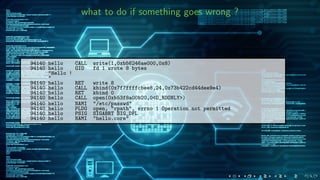
what to do if something goes wrong ?
94140 hello CALL write(1,0xb56246ae000,0x8)
94140 hello GIO fd 1 wrote 8 bytes
"Hello !
"
94140 hello RET write 8
94140 hello CALL kbind(0x7f7ffffcbee8,24,0x73b422cd44dee9e4)
94140 hello RET kbind 0
94140 hello CALL open(0xb53f8a00b20,0<O_RDONLY>)
94140 hello NAMI "/etc/passwd"
94140 hello PLDG open, "rpath", errno 1 Operation not permitted
94140 hello PSIG SIGABRT SIG_DFL
94140 hello NAMI "hello.core"
what to do if something goes wrong ?
$ gdb hello hello.core
GNU gdb 6.3
Copyright 2004 Free Software Foundation, Inc.
GDB is free software, covered by the GNU General Public License, and you are
welcome to change it and/or distribute copies of it under certain conditions.
Type "show copying" to see the conditions.
There is absolutely no warranty for GDB. Type "show warranty" for details.
This GDB was configured as "amd64-unknown-openbsd6.1"...
Core was generated by ‘hello’.
Program terminated with signal 6, Aborted.
Loaded symbols for /home/data/ossummit_2017/src/hello
Reading symbols from /usr/lib/libc.so.89.5...done.
Loaded symbols for /usr/lib/libc.so.89.5
Reading symbols from /usr/libexec/ld.so...done.
Loaded symbols for /usr/libexec/ld.so
#0 0x000009f584a507aa in _thread_sys_open () at {standard input}:5
5 {standard input}: No such file or directory.
in {standard input}
(gdb) bt
#0 0x000009f584a507aa in _thread_sys_open () at {standard input}:5
#1 0x000009f584a3f559 in *_libc_open_cancel (path=Variable "path" is not available.
)
at /usr/src/lib/libc/sys/w_open.c:36
#2 0x000009f584aaab82 in *_libc_fopen (file=0x9f2b8b00b20 "/etc/passwd",
mode=Variable "mode" is not available.
) at /usr/src/lib/libc/stdio/fopen.c:54
#3 0x000009f2b8a005dc in main (argc=1, argv=0x7f7ffffc3c58) at hello.c:8
Current language: auto; currently asm
(gdb)
don’t you speak ”C” ?
import sys, os
from seccomp import *
f = SyscallFilter(defaction=KILL)
f.add_rule(ALLOW, "exit_group")
f.add_rule(ALLOW, "rt_sigaction")
f.add_rule(ALLOW, "brk")
f.add_rule(ALLOW, "open")
f.add_rule(ALLOW, "write", Arg(0, EQ, sys.stdout.fileno()))
f.load()
tmp_fd = os.open(’/tmp/test.txt’, os.O_WRONLY)
os.write(tmp_fd, ’Hello, worldn’)
don’t you speak ”C” ?
use OpenBSD::Pledge;
my $file = "/usr/share/dict/words";
pledge(qw( rpath )) || die "Unable to pledge: $!";
open my $fh, ’<’, $file or die "Unable to open $file: $!n";
while ( readline($fh) ) {
print if /pledge/i;
}
close $fh;
system("ls");
The future ?
seccomp(2) vs pledge(2) - Bibliography
http://man7.org/linux/man-pages/man2/seccomp.2.html
https://man.openbsd.org/pledge.2
https://wiki.mozilla.org/Security/Sandbox/Seccomp
https://github.com/aggsol/linux-pledge
https://github.com/seccomp/libseccomp
https://github.com/afresh1/OpenBSD-Pledge

Linux seccomp(2) vs OpenBSD pledge(2)

  • 1.
    Linux seccomp(2) vsOpenBSD pledge(2) Giovanni Bechis <giovanni@openbsd.org> Open Source Summit Europe 2017, Prague
  • 2.
    About Me sys adminand developer @SNB OpenBSD hacker for ∼ 10 years random patches in random open source software (amavisd-new, courier-imap, cyrus-sasl, memcached, ...)
  • 3.
    Mitigations stack protector stack bufferunderrun detection ASLR (Address space layout randomization) prevents exploitation of memory corruption vulnerabilities WˆX priv-sep and priv-drop
  • 4.
    dangerous system calls Disablesystem calls a process should not call SE Linux systrace Capsicum seccomp(2) pledge(2)
  • 5.
    Linux seccomp(2) first versionin Linux 2.6.12 (2005) filters enabled via /proc/$PID/seccomp in Linux 3.5 (2012) ”filter” mode has been added (”seccomp2”) can control which syscall are permitted via a BPF ”program” some programs are using seccomp(2) (Chrome, OpenSSH, vsftpd, systemd, Firefox, Docker, LXC, ...) in Linux 3.8 (2013) via /proc/$PID/status we can obtain the seccomp(2) status (if, for example, seccomp(2) is disabled) in Linux 3.17 (2014) seccomp(2) system call has been added as a superset of prctl(2)
  • 6.
    OpenBSD pledge(2) introduced inOpenBSD 5.8 (2015) as tame(2), than renamed to pledge(2) still under development, some new features are coming in OpenBSD pledge(2) cannot be disabled around 500 programs with pledge(2) support in base around 50 ports patched to have pledge(2) support (unzip, mutt, memcached, chromium, ...)
  • 7.
    seccomp(2) vs pledge(2) approachingthe ”syscalls” problem study the program figure out all syscalls the program needs ”promise” only the operations that are really needed strace(1) or ktrace(1) and gdb(1) if something goes wrong
  • 8.
    seccomp(2) vs pledge(2) programis annotated with pledge(2)/seccomp(2) calls/promises kernel enforces annotations and kills/reports the program that does not respect promises
  • 9.
    seccomp(2) vs pledge(2) #include<linux/seccomp.h> #include <linux/filter.h> #include <linux/audit.h> #include <linux/signal.h> #include <sys/ptrace.h> int seccomp(unsigned int operation, unsigned int flags, void *args); #include <unistd.h> int pledge(const char *promises, const char *paths[]);
  • 10.
    seccomp(2) vs pledge(2) $wc -l seccomp/hello-seccomp.c seccomp/seccomp-bpf.h 58 seccomp/hello-seccomp.c 34 seccomp/seccomp-bpf.h 92 total $ wc -l pledge/hello-pledge.c 17 pledge/hello-pledge.c
  • 11.
    seccomp(2) vs pledge(2) #define_GNU_SOURCE 1 #include <stdio.h> #include <stddef.h> #include <stdlib.h> #include <unistd.h> [...] static int install_syscall_filter(void) { struct sock_filter filter[] = { VALIDATE_ARCHITECTURE, EXAMINE_SYSCALL, [...] KILL_PROCESS, }; struct sock_fprog prog = { .len = (unsigned short)(sizeof(filter)/sizeof(filter[0])), .filter = filter, }; if (prctl(PR_SET_NO_NEW_PRIVS, 1, 0, 0, 0)) { perror("prctl(NO_NEW_PRIVS)"); goto failed; } if (prctl(PR_SET_SECCOMP, SECCOMP_MODE_FILTER, &prog)) { perror("prctl(SECCOMP)"); goto failed; } return 0; } int main(int argc, char **argv) { FILE *fd; if((install_syscall_filter()) == 0) { printf("Hello !n"); if((fd = fopen("/etc/passwd", "r"))) { printf("Passwd file openedn"); } fclose(fd); return 0; } else { return 1; }
  • 12.
    seccomp(2) vs pledge(2) #include<stdio.h> #include <unistd.h> int main(int argc, char **argv) { FILE *fd; if(pledge("stdio", NULL) != -1) { printf("Hello !n"); if((fd = fopen("/etc/passwd", "r"))) { printf("Passwd file openedn"); } fclose(fd); return 0; } else { return 1; } }
  • 13.
    seccomp(2) permitted syscalls #include<linux/seccomp.h> #include <linux/filter.h> #include <linux/audit.h> #include <linux/signal.h> #include <sys/ptrace.h> int seccomp(unsigned int operation, unsigned int flags, void *args); every single syscall available could be allowed
  • 14.
    pledge(2) promises #include <unistd.h> intpledge(const char *promises, const char *paths[]); ””: exit(2) stdio: malloc + rw stdio rpath, wpath, cpath, tmppath: open files fattr: explicit changes to ”fd” (chmod & friends) unix, inet: open sockets dns: dns requests route: routing operations sendfd: sends file descriptors via sendmsg(2) recvfd: receive file descriptors via recvmsg(2) getpw: passwd/group file access ioctl: small subset of ioctls is permitted tty: subset of ioctl for tty operations proc: fork(2), vfork(2), kill(2) and other processes related operations exec: execve(2) is allowed to create another process which will be unpledged settime: allows to set the system time pf: allows a subset of ioctl(2) operations on pf(4) device
  • 15.
    seccomp(2) reporting if youcreate a ”int install syscall reporter(void);” function the kernel will report which syscalls you need. kernel4.4$ ./hello-report Hello ! Looks like you also need syscall: open(2)
  • 16.
    seccomp(2) reporting #include "syscall-reporter.h" #include"syscall-names.h" const char * const msg_needed = "Looks like you also need syscall: "; int install_syscall_reporter(void) { struct sigaction act; sigset_t mask; memset(&act, 0, sizeof(act)); sigemptyset(&mask); sigaddset(&mask, SIGSYS); act.sa_sigaction = &reporter; act.sa_flags = SA_SIGINFO; if (sigaction(SIGSYS, &act, NULL) < 0) { perror("sigaction"); return -1; } if (sigprocmask(SIG_UNBLOCK, &mask, NULL)) { perror("sigprocmask"); return -1; } return 0; }
  • 17.
    seccomp(2) reporting kernel2.6.32$ ./hello prctl(NO_NEW_PRIVS):Invalid argument SECCOMP_FILTER is not available. :( kernel3.10$ ./hello Bad system call kernel3.10$ ./hello-report Looks like you also need syscall: mmap(9) kernel4.4$ ./hello Hello ! Bad system call kernel4.4$ ./hello-report Hello ! Looks like you also need syscall: open(2)
  • 18.
  • 19.
    seccomp(2) logging dmesg(1) andrsyslogd(8) Oct 12 16:02:56 ubuntu kernel: auditd: type:1326 audit(1507816976.188:30): auid=1000 uid=1000 gid=1000 ses=1 subj=system_u:system_r:kernel_t:s0 pid=1227 comm="hello" exe="/home/test/src/hello" sig=31 arch=c000003e syscall=2 compat=0 ip=0x7fbb3ab75010 code=0x0 Oct 12 16:02:56 ubuntu audit[1227]: SECCOMP auid=1000 uid=1000 gid=1000 ses=1 subj=system_u:system_r:kernel_t:s0 pid=1227 comm="hello" exe="/home/test/src/hello" sig=31 arch=c000003e syscall=2 compat=0 ip=0x7fbb3ab75010 code=0x0
  • 20.
    pledge(2) logging dmesg(8) andsyslogd(8) Oct 12 16:17:30 laptop /bsd: hello(31340): syscall 5 "rpath" $ grep -A1 "^5 STD" /usr/src/sys/kern/syscalls.master 5 STD { int sys_open(const char *path, int flags, ... mode_t mode); } lastcomm(1) and daily(8) on OpenBSD ≥ 6.2 (with accounting enabled)
  • 21.
    pledge(2) logging rm -giovanni ttyp1 0.00 secs Sat Jun 17 15:56 (0:00:00.00) ls - giovanni ttyp1 0.00 secs Sat Jun 17 15:56 (0:00:00.00) rm - giovanni ttyp1 0.00 secs Sat Jun 17 15:56 (0:00:00.00) hello -DXP giovanni ttyp1 0.00 secs Sat Jun 17 15:56 (0:00:00.16) cc - giovanni ttyp1 0.00 secs Sat Jun 17 15:56 (0:00:00.64)
  • 22.
    pledge(2) logging From root@bigio.paclan.itSat Jun 17 16:08:46 2017 Delivered-To: root@bigio.paclan.it From: Charlie Root <root@bigio.paclan.it> To: root@bigio.paclan.it Subject: bigio.paclan.it daily output OpenBSD 6.1-current (GENERIC) #1: Fri Jun 16 22:37:23 CEST 2017 giovanni@bigio.paclan.it:/usr/src/sys/arch/amd64/compile/GENERIC 4:08PM up 35 mins, 3 users, load averages: 0.26, 0.13, 0.10 Purging accounting records: hello -DXP giovanni ttyp1 0.00 secs Sat Jun 17 15:56 (0:00:00.16)
  • 23.
    adding pledge(1) supportto ∼ 500 programs Index: worms.c =================================================================== RCS file: /var/cvs/src/games/worms/worms.c,v retrieving revision 1.22 retrieving revision 1.23 diff -u -p -r1.22 -r1.23 --- worms.c 18 Feb 2015 23:16:08 -0000 1.22 +++ worms.c 21 Nov 2015 05:29:42 -0000 1.23 @@ -1,4 +1,4 @@ -/* $OpenBSD: worms.c,v 1.22 2015/02/18 23:16:08 tedu Exp $ */ +/* $OpenBSD: worms.c,v 1.23 2015/11/21 05:29:42 deraadt Exp $ */ /* * Copyright (c) 1980, 1993 @@ -182,6 +182,9 @@ main(int argc, char *argv[]) struct termios term; speed_t speed; time_t delay = 0; + + if (pledge("stdio rpath tty", NULL) == -1) + err(1, "pledge"); /* set default delay based on terminal baud rate */ if (tcgetattr(STDOUT_FILENO, &term) == 0 &&
  • 24.
    [memcached] adding seccompsupport #include "config.h" #include <seccomp.h> #include <errno.h> #include <stdlib.h> #include "memcached.h" // In the future when the system is more tested this could be switched // to SCMP_ACT_KILL instead. #define DENY_ACTION SCMP_ACT_ERRNO(EACCES) void drop_privileges(void) { scmp_filter_ctx ctx = seccomp_init(DENY_ACTION); if (ctx == NULL) { return; } int rc = 0; rc |= seccomp_rule_add(ctx, SCMP_ACT_ALLOW, SCMP_SYS(sigreturn), 0); rc |= seccomp_rule_add(ctx, SCMP_ACT_ALLOW, SCMP_SYS(futex), 0); rc |= seccomp_rule_add(ctx, SCMP_ACT_ALLOW, SCMP_SYS(epoll_wait), 0); rc |= seccomp_rule_add(ctx, SCMP_ACT_ALLOW, SCMP_SYS(accept4), 0); rc |= seccomp_rule_add(ctx, SCMP_ACT_ALLOW, SCMP_SYS(accept), 0); rc |= seccomp_rule_add(ctx, SCMP_ACT_ALLOW, SCMP_SYS(write), 0); rc |= seccomp_rule_add(ctx, SCMP_ACT_ALLOW, SCMP_SYS(fstat), 0); rc |= seccomp_rule_add(ctx, SCMP_ACT_ALLOW, SCMP_SYS(mmap), 0); rc |= seccomp_rule_add(ctx, SCMP_ACT_ALLOW, SCMP_SYS(munmap), 0); rc |= seccomp_rule_add(ctx, SCMP_ACT_ALLOW, SCMP_SYS(shmctl), 0); rc |= seccomp_rule_add(ctx, SCMP_ACT_ALLOW, SCMP_SYS(exit_group), 0); #ifdef MEMCACHED_DEBUG rc |= seccomp_rule_add(ctx, SCMP_ACT_ALLOW, SCMP_SYS(open), 0); rc |= seccomp_rule_add(ctx, SCMP_ACT_ALLOW, SCMP_SYS(fcntl), 0); rc |= seccomp_rule_add(ctx, SCMP_ACT_ALLOW, SCMP_SYS(read), 0); rc |= seccomp_rule_add(ctx, SCMP_ACT_ALLOW, SCMP_SYS(lseek), 0); rc |= seccomp_rule_add(ctx, SCMP_ACT_ALLOW, SCMP_SYS(close), 0); #endif if (rc != 0) { goto fail; } rc = seccomp_load(ctx); if (rc < 0) { goto fail; } [...] }
  • 25.
    [memcached] adding pledgesupport #include <errno.h> #include <stdlib.h> #include <stdio.h> #include <string.h> #include <unistd.h> #include "memcached.h" /* * this section of code will drop all (OpenBSD) privileges including * those normally granted to all userland process (basic privileges). The * effect of this is that after running this code, the process will not able * to fork(), exec(), etc. See pledge(2) for more information. */ void drop_privileges() { extern char *__progname; if (settings.socketpath != NULL) { if (pledge("stdio unix", NULL) == -1) { fprintf(stderr, "%s: pledge: %sn", __progname, strerror(errno)); exit(EXIT_FAILURE); } } else { if (pledge("stdio inet", NULL) == -1) { fprintf(stderr, "%s: pledge: %sn", __progname, strerror(errno)); exit(EXIT_FAILURE); } } }
  • 26.
    what to doif something goes wrong ? prctl(PR_SET_NO_PRIVS,1, 0, 0, 0) = 0 prctl(PR_SET_SECCOMP, SECCOMP_MODE_FILTER, {len = 19, filter = 0x7fffc3349260}) = 0 fstat(1, {st_mode=S_IFCHR|0600, st_rdev=makedev(4, 1), ...}) = 0 ioctl(1, TCGETS, {B38400 opost isig icanon echo ...}) = 0 brk(NULL) brk(0xd83000) write(1, "Hello !n", 8Hello ! ) = 8 +++ Killed by SYGSYS +++ Bad system call (core dumped)
  • 27.
    what to doif something goes wrong ? 94140 hello CALL write(1,0xb56246ae000,0x8) 94140 hello GIO fd 1 wrote 8 bytes "Hello ! " 94140 hello RET write 8 94140 hello CALL kbind(0x7f7ffffcbee8,24,0x73b422cd44dee9e4) 94140 hello RET kbind 0 94140 hello CALL open(0xb53f8a00b20,0<O_RDONLY>) 94140 hello NAMI "/etc/passwd" 94140 hello PLDG open, "rpath", errno 1 Operation not permitted 94140 hello PSIG SIGABRT SIG_DFL 94140 hello NAMI "hello.core"
  • 28.
    what to doif something goes wrong ? $ gdb hello hello.core GNU gdb 6.3 Copyright 2004 Free Software Foundation, Inc. GDB is free software, covered by the GNU General Public License, and you are welcome to change it and/or distribute copies of it under certain conditions. Type "show copying" to see the conditions. There is absolutely no warranty for GDB. Type "show warranty" for details. This GDB was configured as "amd64-unknown-openbsd6.1"... Core was generated by ‘hello’. Program terminated with signal 6, Aborted. Loaded symbols for /home/data/ossummit_2017/src/hello Reading symbols from /usr/lib/libc.so.89.5...done. Loaded symbols for /usr/lib/libc.so.89.5 Reading symbols from /usr/libexec/ld.so...done. Loaded symbols for /usr/libexec/ld.so #0 0x000009f584a507aa in _thread_sys_open () at {standard input}:5 5 {standard input}: No such file or directory. in {standard input} (gdb) bt #0 0x000009f584a507aa in _thread_sys_open () at {standard input}:5 #1 0x000009f584a3f559 in *_libc_open_cancel (path=Variable "path" is not available. ) at /usr/src/lib/libc/sys/w_open.c:36 #2 0x000009f584aaab82 in *_libc_fopen (file=0x9f2b8b00b20 "/etc/passwd", mode=Variable "mode" is not available. ) at /usr/src/lib/libc/stdio/fopen.c:54 #3 0x000009f2b8a005dc in main (argc=1, argv=0x7f7ffffc3c58) at hello.c:8 Current language: auto; currently asm (gdb)
  • 29.
    don’t you speak”C” ? import sys, os from seccomp import * f = SyscallFilter(defaction=KILL) f.add_rule(ALLOW, "exit_group") f.add_rule(ALLOW, "rt_sigaction") f.add_rule(ALLOW, "brk") f.add_rule(ALLOW, "open") f.add_rule(ALLOW, "write", Arg(0, EQ, sys.stdout.fileno())) f.load() tmp_fd = os.open(’/tmp/test.txt’, os.O_WRONLY) os.write(tmp_fd, ’Hello, worldn’)
  • 30.
    don’t you speak”C” ? use OpenBSD::Pledge; my $file = "/usr/share/dict/words"; pledge(qw( rpath )) || die "Unable to pledge: $!"; open my $fh, ’<’, $file or die "Unable to open $file: $!n"; while ( readline($fh) ) { print if /pledge/i; } close $fh; system("ls");
  • 31.
  • 32.
    seccomp(2) vs pledge(2)- Bibliography http://man7.org/linux/man-pages/man2/seccomp.2.html https://man.openbsd.org/pledge.2 https://wiki.mozilla.org/Security/Sandbox/Seccomp https://github.com/aggsol/linux-pledge https://github.com/seccomp/libseccomp https://github.com/afresh1/OpenBSD-Pledge