Peer   Groups Stephanie Scharf CEHS 200: Chapter 8 Nov. 3, 2008
Main Points: Purpose Evolution of Interaction Peer Groups and Play Organization Behavior Influences Acceptance vs. Rejection Positive and Negative Outcomes
Peers equals, individuals who are usually of the same gender, age, and social status and who share interests
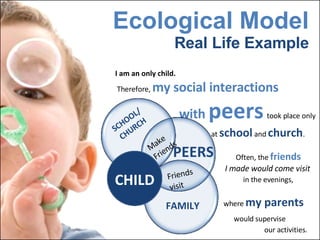
Ecological Model Real Life Example I am an only child. Therefore,  my social interactions  with  peers   took place only  at  school  and  church .   Often, the  friends     I made would come visit in the evenings,      where  my parents    would supervise    our activities. Friends visit Make Friends CHILD PEERS FAMILY SCHOOL/ CHURCH
Purpose of Peer Groups
Satisfy certain belonging needs Often preferred to other socializing agents Influence social, cognitive and psychological development Influence development of morals and values Interaction provides instruction on acceptable behavior.
Social Support – resources provided by others in times of need Validation for the self Encouragement to try new things Opportunities for comparison Enable self-disclosure Provide identity
Evolution of Peer Interaction
Infancy/Toddlerhood First feel belonging and develop  attachment to parents Capable of simple interactions  distinguishing self from others Progress from emotional to  behavioral interactions By 3.5 can be socially involved  with peers Friendship: momentary  playmateship
Early Childhood Parenting styles affect opportunity  for social interactions Deal with more complex issues such  as power, compliance, cooperation,  and conflict Interaction increases and becomes  more complex, forming groups Friendship: one-way assistance
Middle Childhood School age children experience increase  in social interaction Peer group attractive because opportunity  for independence from family Enjoy the closeness and sharing of emotions Group provides identity models Peer interaction more than 30% of their time Activities become gender-specific and  reflect culture Friendship: Two-way, fair-weather  cooperation; intimate, mutually  shared relationships
Adolescence Develop “best friends” and base friendships  off closeness of the relationship Peer group activities escalate Turn to group for “what’s hot now” “ hang out”, talk, watch TV, listen to music,  play video games, be seen, see who else is  “hanging” with whom, wait for  something to happen Friendship: autonomous  interdependent friendships
Peer Groups and Play
Help learn about environment Imaginary situations governed  by social rules Acceptable way to express  emotions and impulses Practice skills necessary  for adult life
Peer Group Organization
Cliques mutually connected by doing things together Crowds loosely organized reference groups of cliques
Ways Peer Groups Influence Behavior
Reinforcement giving attention and  acceptance Modeling imitation, conformity Punishment teasing, physical aggression, rejection Apprenticeship the “expert” helps the “novice”
Stratify some individuals more  dominant and other  submissive Develop norms standards that serve as  guidelines Frustration and competition  contribute to hostility Competition between groups fosters cohesiveness within groups Intergroup hostility can often be reduced by working towards a common goal
Adult influence How adults mediate the  social interaction within a  peer group – competitive  or cooperative – influences  children’s behavior Adult leadership style  influences socialization
Peer Acceptance Versus Rejection
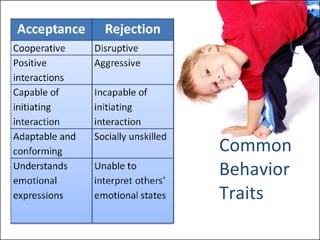
Common Behavior Traits
Positive Peer Group Outcomes
Collaboration Tutoring Counseling Neighborhood affects  positive or negative effects
Negative Peer Group Outcomes
Bullies and Victims Gangs
Bully Characteristics Domination Physically stronger Impulsive, low frustration  tolerance, easily angered Rule-breakers Show little empathy Positive self-concept Antisocial  behavior
Victim Characteristics Physically weaker Show fear of pain Poor physical coordination Cautious, sensitive, quiet, passive, submissive, shy Anxious, insecure, unhappy Negative self-concept Relate better  to adults than peers
What to do? Intervention with  bullies that do not reinforce harassment Intervention with victims  to alter negative self-concept and to respond in nonreinforcing ways to threats
Gang group of people who form an allegiance for a common purpose and engage in unlawful or criminal activity
Reasons Gangs Form Racism Socioeconomics Family structure Belief system
Peer   Groups Stephanie Scharf CEHS 200: Chapter 8 Nov. 3, 2008

Peer Groups

  • 1.
    Peer Groups Stephanie Scharf CEHS 200: Chapter 8 Nov. 3, 2008
  • 2.
    Main Points: PurposeEvolution of Interaction Peer Groups and Play Organization Behavior Influences Acceptance vs. Rejection Positive and Negative Outcomes
  • 3.
    Peers equals, individualswho are usually of the same gender, age, and social status and who share interests
  • 4.
    Ecological Model RealLife Example I am an only child. Therefore, my social interactions with peers took place only at school and church . Often, the friends I made would come visit in the evenings, where my parents would supervise our activities. Friends visit Make Friends CHILD PEERS FAMILY SCHOOL/ CHURCH
  • 5.
  • 6.
    Satisfy certain belongingneeds Often preferred to other socializing agents Influence social, cognitive and psychological development Influence development of morals and values Interaction provides instruction on acceptable behavior.
  • 7.
    Social Support –resources provided by others in times of need Validation for the self Encouragement to try new things Opportunities for comparison Enable self-disclosure Provide identity
  • 8.
    Evolution of PeerInteraction
  • 9.
    Infancy/Toddlerhood First feelbelonging and develop attachment to parents Capable of simple interactions distinguishing self from others Progress from emotional to behavioral interactions By 3.5 can be socially involved with peers Friendship: momentary playmateship
  • 10.
    Early Childhood Parentingstyles affect opportunity for social interactions Deal with more complex issues such as power, compliance, cooperation, and conflict Interaction increases and becomes more complex, forming groups Friendship: one-way assistance
  • 11.
    Middle Childhood Schoolage children experience increase in social interaction Peer group attractive because opportunity for independence from family Enjoy the closeness and sharing of emotions Group provides identity models Peer interaction more than 30% of their time Activities become gender-specific and reflect culture Friendship: Two-way, fair-weather cooperation; intimate, mutually shared relationships
  • 12.
    Adolescence Develop “bestfriends” and base friendships off closeness of the relationship Peer group activities escalate Turn to group for “what’s hot now” “ hang out”, talk, watch TV, listen to music, play video games, be seen, see who else is “hanging” with whom, wait for something to happen Friendship: autonomous interdependent friendships
  • 13.
  • 14.
    Help learn aboutenvironment Imaginary situations governed by social rules Acceptable way to express emotions and impulses Practice skills necessary for adult life
  • 15.
  • 16.
    Cliques mutually connectedby doing things together Crowds loosely organized reference groups of cliques
  • 17.
    Ways Peer GroupsInfluence Behavior
  • 18.
    Reinforcement giving attentionand acceptance Modeling imitation, conformity Punishment teasing, physical aggression, rejection Apprenticeship the “expert” helps the “novice”
  • 19.
    Stratify some individualsmore dominant and other submissive Develop norms standards that serve as guidelines Frustration and competition contribute to hostility Competition between groups fosters cohesiveness within groups Intergroup hostility can often be reduced by working towards a common goal
  • 20.
    Adult influence Howadults mediate the social interaction within a peer group – competitive or cooperative – influences children’s behavior Adult leadership style influences socialization
  • 21.
  • 22.
  • 23.
  • 24.
    Collaboration Tutoring CounselingNeighborhood affects positive or negative effects
  • 25.
  • 26.
  • 27.
    Bully Characteristics DominationPhysically stronger Impulsive, low frustration tolerance, easily angered Rule-breakers Show little empathy Positive self-concept Antisocial behavior
  • 28.
    Victim Characteristics Physicallyweaker Show fear of pain Poor physical coordination Cautious, sensitive, quiet, passive, submissive, shy Anxious, insecure, unhappy Negative self-concept Relate better to adults than peers
  • 29.
    What to do?Intervention with bullies that do not reinforce harassment Intervention with victims to alter negative self-concept and to respond in nonreinforcing ways to threats
  • 30.
    Gang group ofpeople who form an allegiance for a common purpose and engage in unlawful or criminal activity
  • 31.
    Reasons Gangs FormRacism Socioeconomics Family structure Belief system
  • 32.
    Peer Groups Stephanie Scharf CEHS 200: Chapter 8 Nov. 3, 2008