VVIP CIRCUIT HOUSE
INTRODUCTION:
 Architect: SUNIL PATIL AND ASSOCIATES
 AREA: 10540 M²
 Year: 2014
 Rated by: GRIHA 5 STAR
 Green building consultants: ENVIRONMENTAL
DESIGN SOLUTIONS
 Location: PUNE,MAHARASTRA
 Climate: WARM AND HUMID
 VVIP Circuit house is government guest house
which accommodates VIP, VVIP officials, ministers
and a large number of visitors.
 Circuit houses mainly function as official
destinations to carry out various official
government activities and hence it automatically
reduces the scope for leisure activities in this
building.
SITE, CONTEXT AND CLIMATE:
• The site has existing buildings – VIP Rest-
house built in post modernist style.
• east side -golf course.
• Being in cantonment area, the project has
restriction of ground +2 floor building.
• It forms a part of the tropical monsoon land,
and therefore shows a significant seasonal
variation in temperature as well as rainfall
conditions.
• Climatically, the western region of Pune is cool
whereas the eastern part is hot & dry.
Pune city falls in between the zone of hot &
dry & wet-humid region.
• Temperature:12°C to 37°C.
• Rainfall: 600 to 700 mm, Maximum rainfall:
from June to September every year.
DESIGN CONCEPT:
 attempt to calibrate the
architectural style of
government building with the
time – Contemporary
vernacular architecture.
 The planning is derived from
vernacular architecture
 The shaded courtyard,
 transition spaces like passages
and terraces,
 jalis in form of louvers carry
vernacular ethos in highly
contemporary architectural
style
 the climate, the site and time
are basic parameters of design
for this project leading to the
contemporary vernacular
architectural style.
Transition spaces Shaded courtyard
EVOLUTION OF FORM:
GREEN FEATURES:
1. Orientation and planning
2. Shaded courtyard
3. Passive cooling strategy
4. Climate responsive building envelope
5. Transition spaces
6. Water management
7. Eco-friendly materials
8. Helipad
9. Artwork
10. Energy efficiency
1) ORIENTATION & PLANNING:
• Orientation: East-West.
• Residential zone: north and south
• solar radiations can be cut with the help of shading devices yet allowing good
ventilation.
• West side: intermittent spaces.
• short time span: the harsh western sun does not affect the occupants directly.
• east side: dining area, morning sun is taken care of by the overhangs.
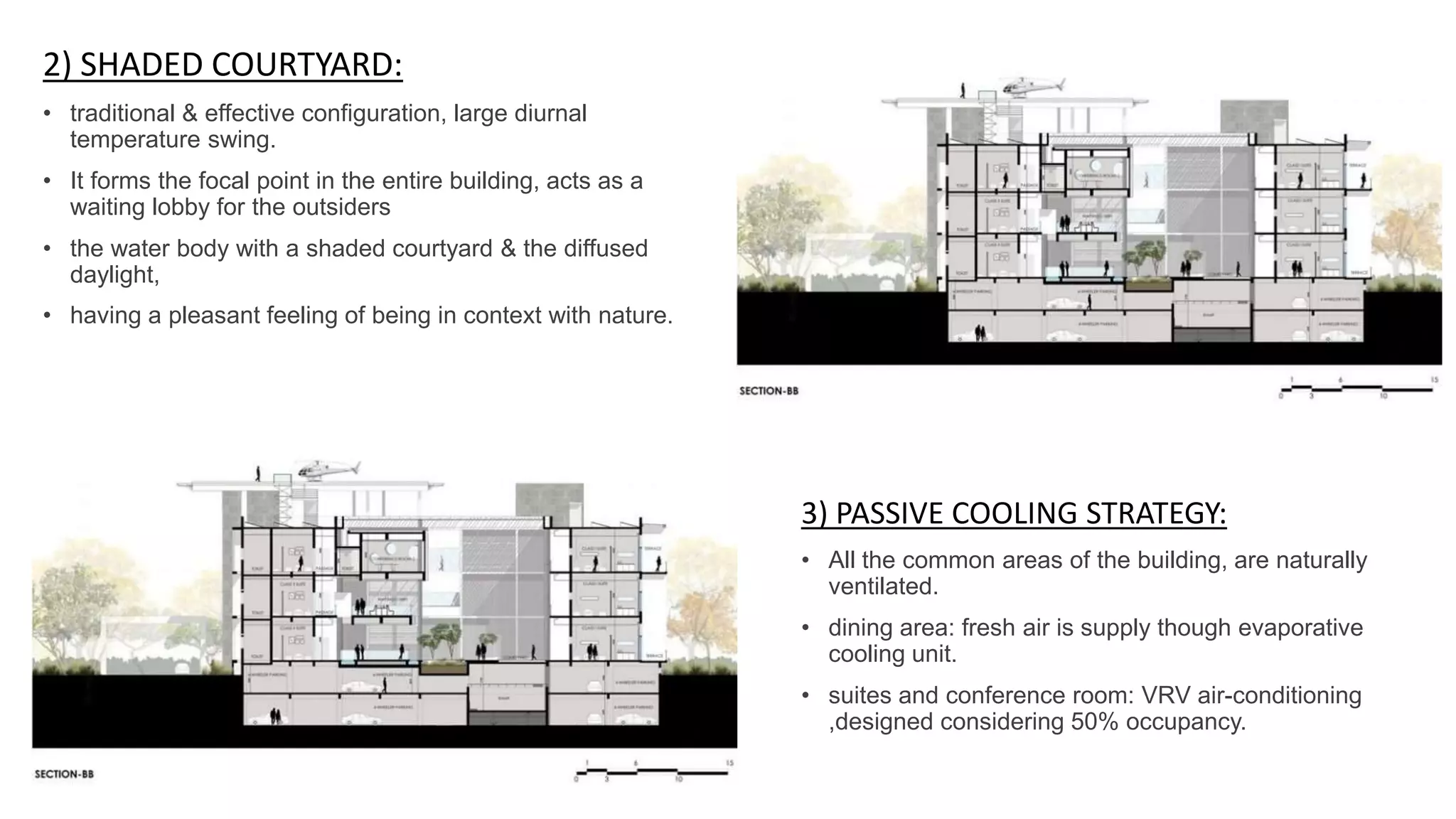
2) SHADED COURTYARD:
• traditional & effective configuration, large diurnal
temperature swing.
• It forms the focal point in the entire building, acts as a
waiting lobby for the outsiders
• the water body with a shaded courtyard & the diffused
daylight,
• having a pleasant feeling of being in context with nature.
3) PASSIVE COOLING STRATEGY:
• All the common areas of the building, are naturally
ventilated.
• dining area: fresh air is supply though evaporative
cooling unit.
• suites and conference room: VRV air-conditioning
,designed considering 50% occupancy.
4) CLIMATE RESPONSIVE BUILDING ENVELOPE:
• East façade: critical for morning hours
• Sun shading devices are designed
South façade: Exposed to the harsh winter sun, resulting in heat gain and
glare.
• Terraces are designed as a buffer between inner and outer skin.
• Louvers are used to allow light and achieve thermal environmental
comfort
North façade: Least direct solar radiation and direct sunlight -
hence preferred for suites. Overhangs cater to summer sun
West façade: critical as receives maximum solar radiation
Most façade is dead and ancillary spaces planned
Conference on this side use for shorter time with vertical louver
6) WATER MANAGEMENT:
• Reduction in irrigation water demand by 48%
• Sewage treatment plant, treated water is used for irrigation
• Use of efficient water fixtures 50% saving in water
• Waste water has been utilized for landscape irrigation
Water body is designed as part of the courtyard and placed in between reception and dinging
area. It is a continuation of water body in the exterior landscape and adds to the ambiance
both visually and physiologically. Waiting area created on various levels for visitors and other
conference room is planned on the second floor
5) TRANSITION SPACES:
• Act as a buffers between outside & inside
• Play an important role in harsh climates
• Different forms: courtyard, verandas, loggia, balconies, corridors
• Very close to the outside environment but are protected from sun % rain.
• Suites on south side have terrace on exterior façade then passage and courtyard
7) ECO-FRIENDLY MATERIALS:
1. AAC blocks – wall, reduction in non-structural weight of building,
Fixed with adhesive, no curing
2. Recycled ceramic tiles-flooring in suites
3. Granite – public areas
4. Efficient glass-minimized solar heat gain & maximized daylight area
5. Effective roof insulation- heat gain reduced
6. Utilization of fly ash in reinforced concrete and masonry mortar is up
to 35%
7. Exposed concerete-permenant finish, avoid repeated maintenance
requirement
8) HELIPAD:
• 24m dia helipad
• Lessen the security expenses as well as traffic congestion caused during the
arrivals of VIPs
9) ARTWORK:
• 225 pieces of art which include paintings, sculptures, mural, wall arts
• Based on theme: care for earth and nature
• Message is passed through the art by 30 local artists.
1
3
4
5
6
1
7
2
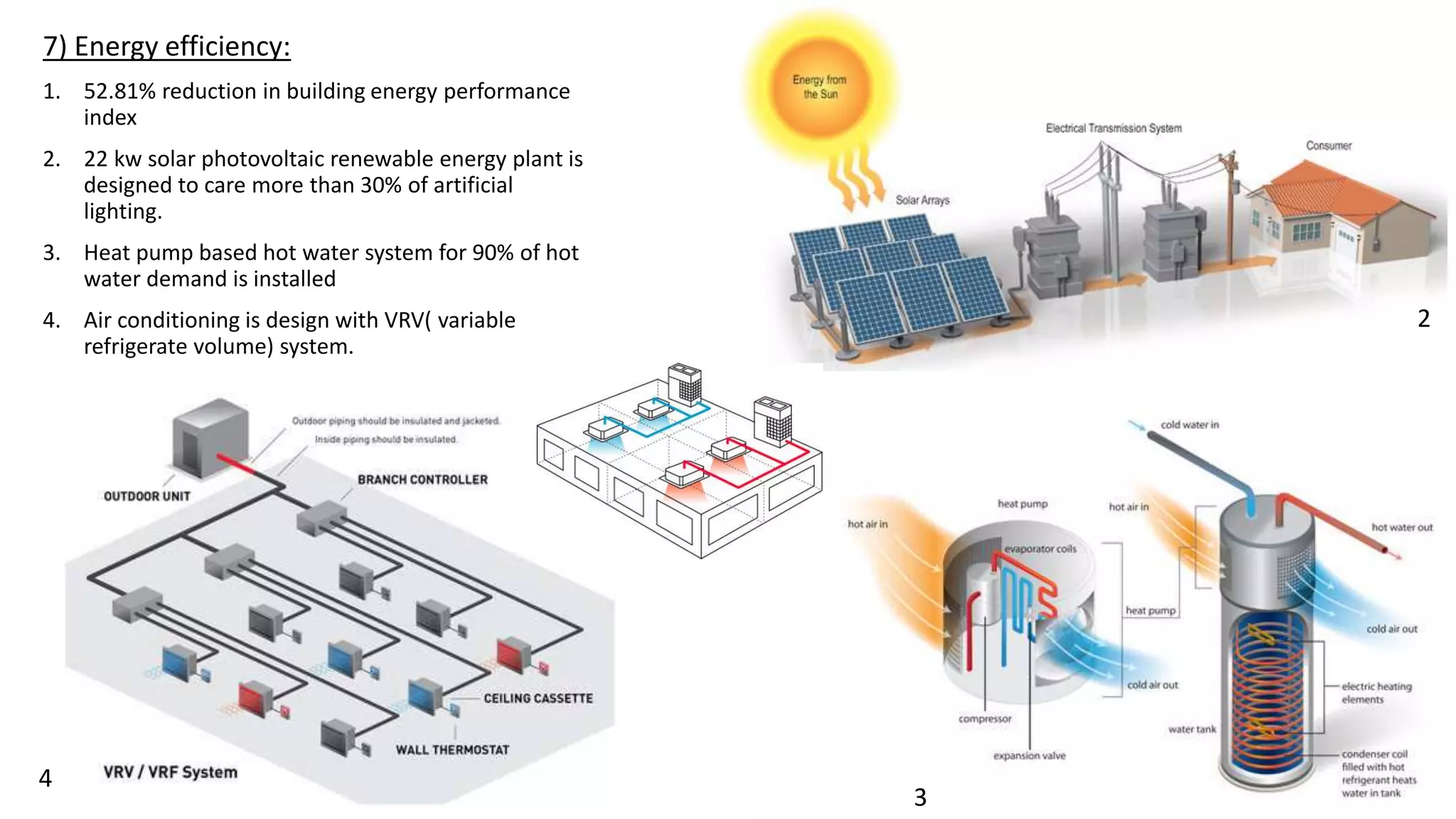
7) Energy efficiency:
1. 52.81% reduction in building energy performance
index
2. 22 kw solar photovoltaic renewable energy plant is
designed to care more than 30% of artificial
lighting.
3. Heat pump based hot water system for 90% of hot
water demand is installed
4. Air conditioning is design with VRV( variable
refrigerate volume) system.
2
3
4
LANDSCAPE AND ECOLOGY:
• Seamlessly merges with spaces
• Front landscape connect with golf course
• Continuity maintained through bamboo plantation in the court
• Seating: pebbles courts
• Water body: add ambience both mentally and physically
• Harmony wit existing trees and new trees help in maintain
ecology
• Hard paving: reduced by 58.6% by introducing grass pavers which
heals in minimalizing heat island effect
• 100% outdoor lighting is created by rev=enable energy system.
• Bibliography:
• www.e-architect.co.uk
• www.archdaily.com
• Worldarchitect
• www10.aeccafe.com

Vvip circuit house

  • 1.
  • 2.
    INTRODUCTION:  Architect: SUNILPATIL AND ASSOCIATES  AREA: 10540 M²  Year: 2014  Rated by: GRIHA 5 STAR  Green building consultants: ENVIRONMENTAL DESIGN SOLUTIONS  Location: PUNE,MAHARASTRA  Climate: WARM AND HUMID  VVIP Circuit house is government guest house which accommodates VIP, VVIP officials, ministers and a large number of visitors.  Circuit houses mainly function as official destinations to carry out various official government activities and hence it automatically reduces the scope for leisure activities in this building.
  • 3.
    SITE, CONTEXT ANDCLIMATE: • The site has existing buildings – VIP Rest- house built in post modernist style. • east side -golf course. • Being in cantonment area, the project has restriction of ground +2 floor building. • It forms a part of the tropical monsoon land, and therefore shows a significant seasonal variation in temperature as well as rainfall conditions. • Climatically, the western region of Pune is cool whereas the eastern part is hot & dry. Pune city falls in between the zone of hot & dry & wet-humid region. • Temperature:12°C to 37°C. • Rainfall: 600 to 700 mm, Maximum rainfall: from June to September every year.
  • 4.
    DESIGN CONCEPT:  attemptto calibrate the architectural style of government building with the time – Contemporary vernacular architecture.  The planning is derived from vernacular architecture  The shaded courtyard,  transition spaces like passages and terraces,  jalis in form of louvers carry vernacular ethos in highly contemporary architectural style  the climate, the site and time are basic parameters of design for this project leading to the contemporary vernacular architectural style. Transition spaces Shaded courtyard
  • 5.
  • 6.
    GREEN FEATURES: 1. Orientationand planning 2. Shaded courtyard 3. Passive cooling strategy 4. Climate responsive building envelope 5. Transition spaces 6. Water management 7. Eco-friendly materials 8. Helipad 9. Artwork 10. Energy efficiency
  • 7.
    1) ORIENTATION &PLANNING: • Orientation: East-West. • Residential zone: north and south • solar radiations can be cut with the help of shading devices yet allowing good ventilation. • West side: intermittent spaces. • short time span: the harsh western sun does not affect the occupants directly. • east side: dining area, morning sun is taken care of by the overhangs.
  • 8.
    2) SHADED COURTYARD: •traditional & effective configuration, large diurnal temperature swing. • It forms the focal point in the entire building, acts as a waiting lobby for the outsiders • the water body with a shaded courtyard & the diffused daylight, • having a pleasant feeling of being in context with nature. 3) PASSIVE COOLING STRATEGY: • All the common areas of the building, are naturally ventilated. • dining area: fresh air is supply though evaporative cooling unit. • suites and conference room: VRV air-conditioning ,designed considering 50% occupancy.
  • 9.
    4) CLIMATE RESPONSIVEBUILDING ENVELOPE: • East façade: critical for morning hours • Sun shading devices are designed South façade: Exposed to the harsh winter sun, resulting in heat gain and glare. • Terraces are designed as a buffer between inner and outer skin. • Louvers are used to allow light and achieve thermal environmental comfort North façade: Least direct solar radiation and direct sunlight - hence preferred for suites. Overhangs cater to summer sun West façade: critical as receives maximum solar radiation Most façade is dead and ancillary spaces planned Conference on this side use for shorter time with vertical louver
  • 10.
    6) WATER MANAGEMENT: •Reduction in irrigation water demand by 48% • Sewage treatment plant, treated water is used for irrigation • Use of efficient water fixtures 50% saving in water • Waste water has been utilized for landscape irrigation Water body is designed as part of the courtyard and placed in between reception and dinging area. It is a continuation of water body in the exterior landscape and adds to the ambiance both visually and physiologically. Waiting area created on various levels for visitors and other conference room is planned on the second floor 5) TRANSITION SPACES: • Act as a buffers between outside & inside • Play an important role in harsh climates • Different forms: courtyard, verandas, loggia, balconies, corridors • Very close to the outside environment but are protected from sun % rain. • Suites on south side have terrace on exterior façade then passage and courtyard
  • 11.
    7) ECO-FRIENDLY MATERIALS: 1.AAC blocks – wall, reduction in non-structural weight of building, Fixed with adhesive, no curing 2. Recycled ceramic tiles-flooring in suites 3. Granite – public areas 4. Efficient glass-minimized solar heat gain & maximized daylight area 5. Effective roof insulation- heat gain reduced 6. Utilization of fly ash in reinforced concrete and masonry mortar is up to 35% 7. Exposed concerete-permenant finish, avoid repeated maintenance requirement 8) HELIPAD: • 24m dia helipad • Lessen the security expenses as well as traffic congestion caused during the arrivals of VIPs 9) ARTWORK: • 225 pieces of art which include paintings, sculptures, mural, wall arts • Based on theme: care for earth and nature • Message is passed through the art by 30 local artists. 1 3 4 5 6 1 7 2
  • 12.
    7) Energy efficiency: 1.52.81% reduction in building energy performance index 2. 22 kw solar photovoltaic renewable energy plant is designed to care more than 30% of artificial lighting. 3. Heat pump based hot water system for 90% of hot water demand is installed 4. Air conditioning is design with VRV( variable refrigerate volume) system. 2 3 4
  • 13.
    LANDSCAPE AND ECOLOGY: •Seamlessly merges with spaces • Front landscape connect with golf course • Continuity maintained through bamboo plantation in the court • Seating: pebbles courts • Water body: add ambience both mentally and physically • Harmony wit existing trees and new trees help in maintain ecology • Hard paving: reduced by 58.6% by introducing grass pavers which heals in minimalizing heat island effect • 100% outdoor lighting is created by rev=enable energy system.
  • 14.
    • Bibliography: • www.e-architect.co.uk •www.archdaily.com • Worldarchitect • www10.aeccafe.com