Total Quality Management
BY:- Prof. Paramjit singh and Sharanjit kaur
ASSISTANT PROFESSOR
KHALSA COLLEFGE OF EDUCATION,RANJIT
AVENUE,AMRITSAR.
9-2
Quality
 Quality is the ability of a product or
service to consistently meet or exceed
customer expectations.
Quality
Quality is “fitness for use”
(Joseph Juran)
Quality is “conformance to requirements”
(Philip B. Crosby)
Quality of a product or services is its ability to satisfy
the needs and expectations of the customer
Quality is a Journey, not a Destination
9-4
Dimensions of Quality
 Performance - main characteristics of the
product/service
 Aesthetics - appearance, feel, smell,
taste
 Special Features - extra characteristics
 Conformance - how well product/service
conforms to customer’s expectations
 Reliability - consistency of performance
9-5
Dimensions of Quality (Cont’d)
 Durability - useful life of the
product/service
 Perceived Quality - indirect evaluation of
quality (e.g. reputation)
 Serviceability - service after sale
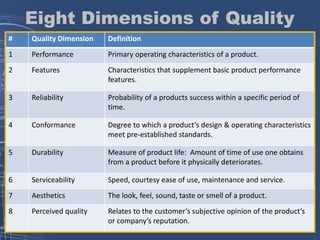
Eight Dimensions of Quality
# Quality Dimension Definition
1 Performance Primary operating characteristics of a product.
2 Features Characteristics that supplement basic product performance
features.
3 Reliability Probability of a products success within a specific period of
time.
4 Conformance Degree to which a product’s design & operating characteristics
meet pre-established standards.
5 Durability Measure of product life: Amount of time of use one obtains
from a product before it physically deteriorates.
6 Serviceability Speed, courtesy ease of use, maintenance and service.
7 Aesthetics The look, feel, sound, taste or smell of a product.
8 Perceived quality Relates to the customer’s subjective opinion of the product’s
or company’s reputation.
1.Performance:
• For aLGtelevision set, the quality of thepicture,
sound and longevity of the picturetube.
2.Features:
• Someof its features include: an all new “My
Channels” app, and accessto an expanded variety
of ultra HD
• USBare supplemental to the basic operating
characteristics.
3.Reliability:
• The degree of dependability and trustworthiness of
the benefit of the LGtelevision set for a long period
of time.
• It will work without interruption or breaking down.
4.Conformance:
• LGTV canprecisely meet all the customerneeds
5.Durability:
• The length of time that a LGTVperforms before a
replacement becomes necessary. The durability of
home appliances canrange from 10 to 15years.
6.Serviceability:
• The promptness, courtesy, proficiency and ease in
repair when the LGTVbreaks down and is sent for
repairs.
• Sendrepair requests easily online.
7.Experience :
• the new, smarter features enable its useto be
an easier, simpler, more intuitive than everbefore,
next-generation smart TVplatform.
8.Aesthetics:
• Aesthetic aspect of LGTV it looks smart , good
sounds, clear picture , colors and it is also artistically
attractive.
• An LGTV perceived to me to be high qualityitem.
Performance
Features
Conformance
Dimensions of Quality
Safari should increase speed from 0 to 100km/hr in 15
secs
Mileage : 13.2 kmpl
Convenient for drivers, Power steering, rear Ac vents,
Adjustable seats,central locking, airbags
Car matches manufacturer’s specifications. They
should pass all conformance tests.
There should be no need for repairs
Reliability
All Rights Reserved. Copyright @ 2014 Canopus Business Management Group 1
Experience
Aesthetics
Dimensions of Quality
Service
7
Resistant to water and rust. Long life
Durability
There should be proper after sales
service.
It should be a top rated car
Exterior and interior design
should be better than
industry standard.
© 2005 Wiley 13
Ways of Improving Quality
 Plan-Do-Study-Act Cycle (PDSA)
 Also called the Deming Wheel after
originator
 Circular, never ending problem solving
process
 Seven Tools of Quality Control
 Tools typically taught to problem solving
teams
© 2005 Wiley 14
PDSA Details
 Plan
 Evaluate current process
 Collect procedures, data, identify problems
 Develop an improvement plan, performance
objectives
 Do
 Implement the plan – trial basis
 Study
 Collect data and evaluate against objectives
 Act
 Communicate the results from trial
 If successful, implement new process
© 2005 Wiley 15
PDSA (continued)
 Cycle is repeated
 After act phase, start planning and repeat process
Total Quality Management
Total Quality Management (TQM)
• Total - made up of the whole
• Quality - degree of excellence a product or
service provides
• Management - act, art or manner of
planning, controlling, directing,….
Therefore, TQM is the art of managing the
whole to achieve excellence.
9-18
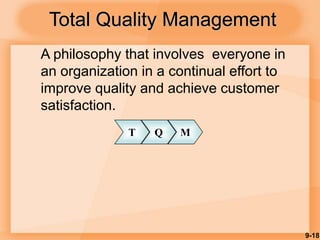
Total Quality Management
A philosophy that involves everyone in
an organization in a continual effort to
improve quality and achieve customer
satisfaction.
T Q M
What’s the goal of TQM?
“DO THE RIGHT THINGS RIGHT THE
FIRST TIME, EVERY TIME.”
Total Quality Management in
EDUCATION
TQM as a management model, with
its emphasis on leadership, strategy,
teamwork, rigorous analysis and
self-assessment, has a universal
message.
 TQM in education has as its
message the idea that every
student has worth and demands the
best possible chance in life
Differences between education
and businesses
 The institution is not a factory.
 The student is not a "product".
 The education of the student is the
product.
 Successful completion of the product
requires the student to participate as a
worker, co managing the learning
process.
TQM IN EDUCATION
INPUT
(People, material, equipment methods)
TRANSFORMATION PROCESS
(Imparting edu. using input resources)
Output
U.G, P.G, PH.D
RSEOURCE PERSONS
SCHOLARS
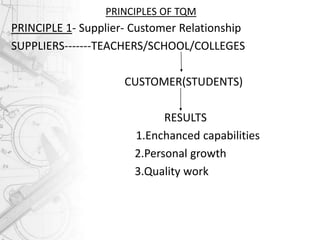
PRINCIPLES OF TQM
PRINCIPLE 1- Supplier- Customer Relationship
SUPPLIERS-------TEACHERS/SCHOOL/COLLEGES
CUSTOMER(STUDENTS)
RESULTS
1.Enchanced capabilities
2.Personal growth
3.Quality work
PRINCIPLE -2 CONTINOUS IMPROVEMENT
Administration
Work in collaboration with staff
Customers(students/teacher)
Result
Continuous improvement in students’ strength,
learning styles and intelligence)
• PRINCIPLE -3 RECOGNITION OF ORGANIZATION
• Teacher and students are less to blame for failure
than the system
• Continual improvement in learning process would
replace “teach and test mode” with innovative
methods of learning
• PRINCIPLE -4 LEADERSHIP
• Success of TQM is the responsibility of top
management
• Leadership and team work go hand in hand
• Lack of communication create burden on failure of
TQM
BASIC ELEMENTS OF
TQM
3
INTEGRITY
TRUST
TEAMWORK
LEADERSHIP
COMMUNICATION
ETHICS
TRAINING
RECOGNITION
THE EIGHT
ELEMENTS OF
T. Q. M.
AREA OF WORK IN TQM IN EDUCATION
AREA OF WORK
• PLANNING
Academic calendar, lesson plans, timetable
• ORGANIZATION
Organisation of instructional work, office work, co-curricular activities
• TEACHING
Maxims, ICT, internet, a/v aids
• GUIDANCE
Selection of books, use of library, solving their problems,
parents and higher authorities
• HUMAN REALTIONS
Relations with staff, headmaster, parents, students,
community
• EVALUATION
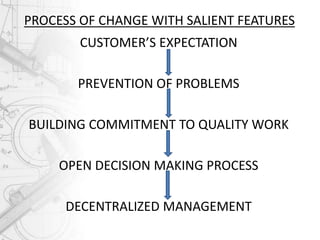
PROCESS OF CHANGE WITH SALIENT FEATURES
CUSTOMER’S EXPECTATION
PREVENTION OF PROBLEMS
BUILDING COMMITMENT TO QUALITY WORK
OPEN DECISION MAKING PROCESS
DECENTRALIZED MANAGEMENT
A.E. Wiggam
Tqm-total quality management

Tqm-total quality management

  • 1.
    Total Quality Management BY:-Prof. Paramjit singh and Sharanjit kaur ASSISTANT PROFESSOR KHALSA COLLEFGE OF EDUCATION,RANJIT AVENUE,AMRITSAR.
  • 2.
    9-2 Quality  Quality isthe ability of a product or service to consistently meet or exceed customer expectations.
  • 3.
    Quality Quality is “fitnessfor use” (Joseph Juran) Quality is “conformance to requirements” (Philip B. Crosby) Quality of a product or services is its ability to satisfy the needs and expectations of the customer Quality is a Journey, not a Destination
  • 4.
    9-4 Dimensions of Quality Performance - main characteristics of the product/service  Aesthetics - appearance, feel, smell, taste  Special Features - extra characteristics  Conformance - how well product/service conforms to customer’s expectations  Reliability - consistency of performance
  • 5.
    9-5 Dimensions of Quality(Cont’d)  Durability - useful life of the product/service  Perceived Quality - indirect evaluation of quality (e.g. reputation)  Serviceability - service after sale
  • 6.
    Eight Dimensions ofQuality # Quality Dimension Definition 1 Performance Primary operating characteristics of a product. 2 Features Characteristics that supplement basic product performance features. 3 Reliability Probability of a products success within a specific period of time. 4 Conformance Degree to which a product’s design & operating characteristics meet pre-established standards. 5 Durability Measure of product life: Amount of time of use one obtains from a product before it physically deteriorates. 6 Serviceability Speed, courtesy ease of use, maintenance and service. 7 Aesthetics The look, feel, sound, taste or smell of a product. 8 Perceived quality Relates to the customer’s subjective opinion of the product’s or company’s reputation.
  • 7.
    1.Performance: • For aLGtelevisionset, the quality of thepicture, sound and longevity of the picturetube. 2.Features: • Someof its features include: an all new “My Channels” app, and accessto an expanded variety of ultra HD • USBare supplemental to the basic operating characteristics.
  • 8.
    3.Reliability: • The degreeof dependability and trustworthiness of the benefit of the LGtelevision set for a long period of time. • It will work without interruption or breaking down. 4.Conformance: • LGTV canprecisely meet all the customerneeds
  • 9.
    5.Durability: • The lengthof time that a LGTVperforms before a replacement becomes necessary. The durability of home appliances canrange from 10 to 15years. 6.Serviceability: • The promptness, courtesy, proficiency and ease in repair when the LGTVbreaks down and is sent for repairs. • Sendrepair requests easily online.
  • 10.
    7.Experience : • thenew, smarter features enable its useto be an easier, simpler, more intuitive than everbefore, next-generation smart TVplatform. 8.Aesthetics: • Aesthetic aspect of LGTV it looks smart , good sounds, clear picture , colors and it is also artistically attractive. • An LGTV perceived to me to be high qualityitem.
  • 11.
    Performance Features Conformance Dimensions of Quality Safarishould increase speed from 0 to 100km/hr in 15 secs Mileage : 13.2 kmpl Convenient for drivers, Power steering, rear Ac vents, Adjustable seats,central locking, airbags Car matches manufacturer’s specifications. They should pass all conformance tests. There should be no need for repairs Reliability All Rights Reserved. Copyright @ 2014 Canopus Business Management Group 1
  • 12.
    Experience Aesthetics Dimensions of Quality Service 7 Resistantto water and rust. Long life Durability There should be proper after sales service. It should be a top rated car Exterior and interior design should be better than industry standard.
  • 13.
    © 2005 Wiley13 Ways of Improving Quality  Plan-Do-Study-Act Cycle (PDSA)  Also called the Deming Wheel after originator  Circular, never ending problem solving process  Seven Tools of Quality Control  Tools typically taught to problem solving teams
  • 14.
    © 2005 Wiley14 PDSA Details  Plan  Evaluate current process  Collect procedures, data, identify problems  Develop an improvement plan, performance objectives  Do  Implement the plan – trial basis  Study  Collect data and evaluate against objectives  Act  Communicate the results from trial  If successful, implement new process
  • 15.
    © 2005 Wiley15 PDSA (continued)  Cycle is repeated  After act phase, start planning and repeat process
  • 16.
  • 17.
    Total Quality Management(TQM) • Total - made up of the whole • Quality - degree of excellence a product or service provides • Management - act, art or manner of planning, controlling, directing,…. Therefore, TQM is the art of managing the whole to achieve excellence.
  • 18.
    9-18 Total Quality Management Aphilosophy that involves everyone in an organization in a continual effort to improve quality and achieve customer satisfaction. T Q M
  • 19.
    What’s the goalof TQM? “DO THE RIGHT THINGS RIGHT THE FIRST TIME, EVERY TIME.”
  • 20.
  • 21.
    TQM as amanagement model, with its emphasis on leadership, strategy, teamwork, rigorous analysis and self-assessment, has a universal message.  TQM in education has as its message the idea that every student has worth and demands the best possible chance in life
  • 22.
    Differences between education andbusinesses  The institution is not a factory.  The student is not a "product".  The education of the student is the product.  Successful completion of the product requires the student to participate as a worker, co managing the learning process.
  • 23.
    TQM IN EDUCATION INPUT (People,material, equipment methods) TRANSFORMATION PROCESS (Imparting edu. using input resources) Output U.G, P.G, PH.D RSEOURCE PERSONS SCHOLARS
  • 24.
    PRINCIPLES OF TQM PRINCIPLE1- Supplier- Customer Relationship SUPPLIERS-------TEACHERS/SCHOOL/COLLEGES CUSTOMER(STUDENTS) RESULTS 1.Enchanced capabilities 2.Personal growth 3.Quality work
  • 25.
    PRINCIPLE -2 CONTINOUSIMPROVEMENT Administration Work in collaboration with staff Customers(students/teacher) Result Continuous improvement in students’ strength, learning styles and intelligence)
  • 26.
    • PRINCIPLE -3RECOGNITION OF ORGANIZATION • Teacher and students are less to blame for failure than the system • Continual improvement in learning process would replace “teach and test mode” with innovative methods of learning • PRINCIPLE -4 LEADERSHIP • Success of TQM is the responsibility of top management • Leadership and team work go hand in hand • Lack of communication create burden on failure of TQM
  • 27.
  • 28.
  • 29.
    AREA OF WORKIN TQM IN EDUCATION AREA OF WORK • PLANNING Academic calendar, lesson plans, timetable • ORGANIZATION Organisation of instructional work, office work, co-curricular activities • TEACHING Maxims, ICT, internet, a/v aids • GUIDANCE Selection of books, use of library, solving their problems, parents and higher authorities • HUMAN REALTIONS Relations with staff, headmaster, parents, students, community • EVALUATION
  • 30.
    PROCESS OF CHANGEWITH SALIENT FEATURES CUSTOMER’S EXPECTATION PREVENTION OF PROBLEMS BUILDING COMMITMENT TO QUALITY WORK OPEN DECISION MAKING PROCESS DECENTRALIZED MANAGEMENT
  • 31.