ALMANA GROUP OF HOSPITALS
VENOUS THROMBOEMBOLISM
VTE
DAMMAM
Dr. AHMED ELAMIN AWADELKARIM
MEDICAL RESIDENT
AHMEDELAMINELSIDDIG
OBJECTIVES
 Overview of VTE.
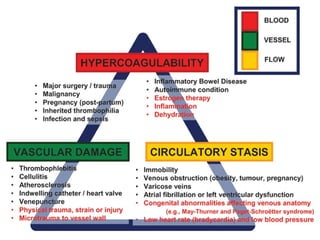
 Risk factors.
 Scoring systems.
 DVT diagnosis and management.
 PE diagnosis and management.
 Special situations.
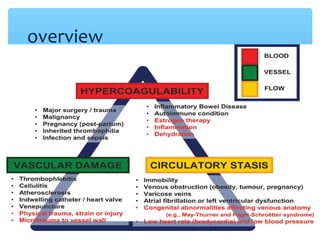
overview
Medical education does not exist to provide students with
away of making living, but to ensure the health of the
community.
Rudolf Calr Virchow
overview
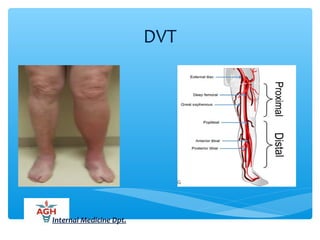
DVT
Internal Medicine Dpt.
DVT
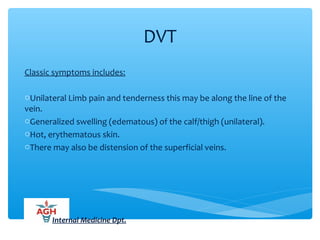
Classic symptoms includes:
oUnilateral Limb pain and tenderness this may be along the line of the
vein.
oGeneralized swelling (edematous) of the calf/thigh (unilateral).
oHot, erythematous skin.
oThere may also be distension of the superficial veins.
Internal Medicine Dpt.
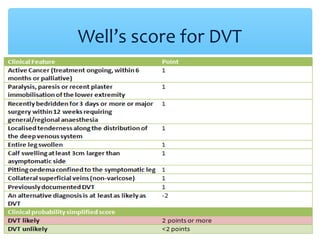
Well’s score for DVT
Internal Medicine Dpt.
DIFFERENTIAL DIAGNOSIS
•Muscle strain/hematoma
•Popliteal cyst
•Lymphedema
•Cellulitis
•Fracture
•Chronic venous insufficiency
•Proximal venous compression (e.g. tumor)
•Congestive heart failure
Internal Medicine Dpt.
D-DIMER
negative- DVT is highly unlikely (High sensitivity).
However
 positive- it DOES NOT CONFIRM DVT 
may be raised in patients with liver disease
rheumatoid disease
Inflammation
Cancer
Trauma
pregnancy
recent surgery
Internal Medicine Dpt.
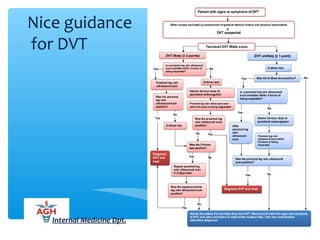
Nice guidance
for DVT
Internal Medicine Dpt.
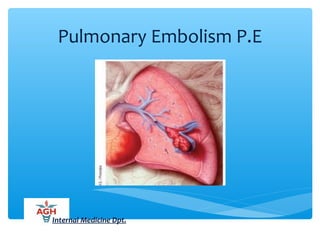
Pulmonary Embolism P.E
Internal Medicine Dpt.
OVERVIEW
600.000 case per year.
50.000 deaths per year.
Tests is done too much …negative.
Most of cases are missed ….autopsy.
Internal Medicine Dpt.
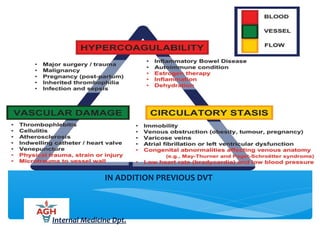
IN ADDITION PREVIOUS DVT
Internal Medicine Dpt.
OVERVIEW
Clot travels from deep veins, RV then pulmonary arteries
Blood flow obstructed
Tissue necrosis
Symptoms result
Internal Medicine Dpt.
PRESENTATION
Shortness of breath
Chest pain (+/- pleuritic)
Syncope
Hemoptysis
May mimic pneumonia (if lung infarction)
Tachycardia
Hypoxia
Elevated JVP (or distended jugular veins)
DVT symptoms
Internal Medicine Dpt.
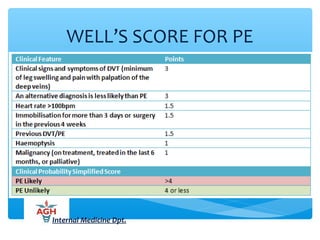
WELL’S SCORE FOR PE
Internal Medicine Dpt.
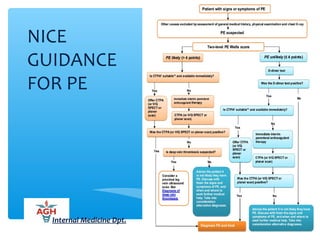
NICE
GUIDANCE
FOR PE
Internal Medicine Dpt.
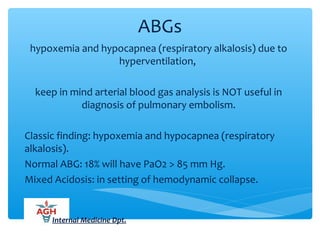
ABGs
hypoxemia and hypocapnea (respiratory alkalosis) due to
hyperventilation,
keep in mind arterial blood gas analysis is NOT useful in
diagnosis of pulmonary embolism.
Classic finding: hypoxemia and hypocapnea (respiratory
alkalosis).
Normal ABG: 18% will have PaO2 > 85 mm Hg.
Mixed Acidosis: in setting of hemodynamic collapse.
Internal Medicine Dpt.
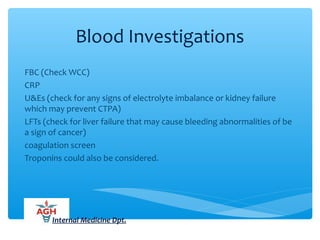
Blood Investigations
FBC (Check WCC)
CRP
U&Es (check for any signs of electrolyte imbalance or kidney failure
which may prevent CTPA)
LFTs (check for liver failure that may cause bleeding abnormalities of be
a sign of cancer)
coagulation screen
Troponins could also be considered.
Internal Medicine Dpt.
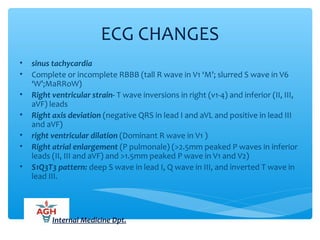
ECG CHANGES
• sinus tachycardia
• Complete or incomplete RBBB (tall R wave in V1 ‘M’; slurred S wave in V6
‘W’;MaRRoW)
• Right ventricular strain- T wave inversions in right (v1-4) and inferior (II, III,
aVF) leads
• Right axis deviation (negative QRS in lead I and aVL and positive in lead III
and aVF)
• right ventricular dilation (Dominant R wave in V1 )
• Right atrial enlargement (P pulmonale) (>2.5mm peaked P waves in inferior
leads (II, III and aVF) and >1.5mm peaked P wave in V1 and V2)
• S1Q3T3 pattern: deep S wave in lead I, Q wave in III, and inverted T wave in
lead III.
Internal Medicine Dpt.
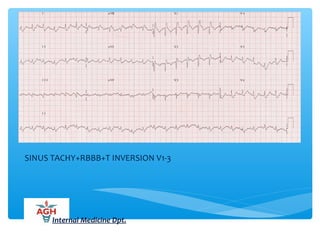
SINUS TACHY+RBBB+T INVERSION V1-3
Internal Medicine Dpt.
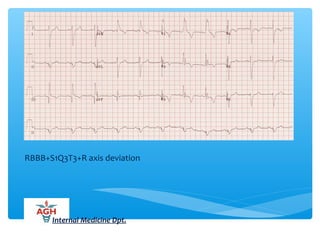
RBBB+S1Q3T3+R axis deviation
Internal Medicine Dpt.
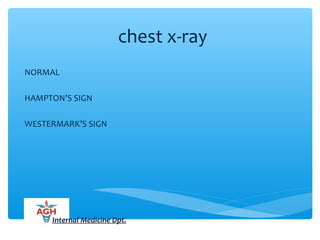
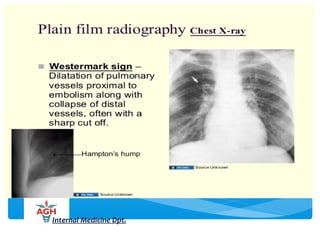
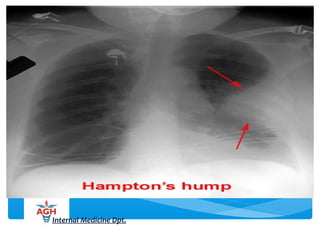
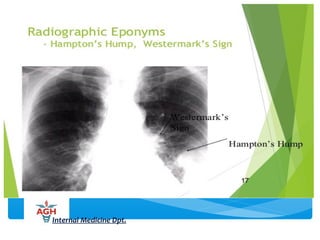
chest x-ray
NORMAL
HAMPTON’S SIGN
WESTERMARK’S SIGN
Internal Medicine Dpt.
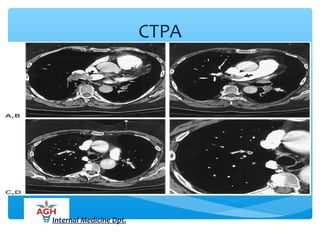
CTPA
Internal Medicine Dpt.
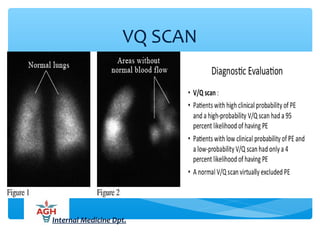
VQ SCAN
Internal Medicine Dpt.
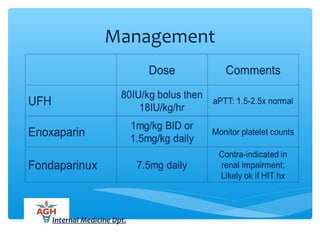
Management
Internal Medicine Dpt.
Management
Internal Medicine Dpt.
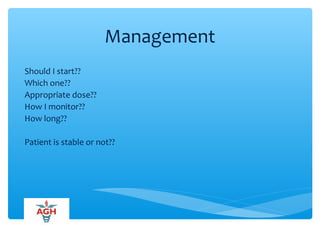
Management
Should I start??
Which one??
Appropriate dose??
How I monitor??
How long??
Patient is stable or not??
Management
For massive PE, thrombolyse unless there are any contraindications
Alteplase 50mg stat IV (if imminent cardiac arrest) or 10mg stat IV then
90mg infusion over 120mins
Contraindications include
Major surgery/trauma in previous 2 weeks; aortic dissection; acute
internal bleeding; known cerebral tumour; hx of cerebral
bleed/AVM; prolonged/traumatic CPR; pregnancy
Relative CI include BP>180/110mmHg; severe renal/liver failure;
INR>1.5 from warfarin use or liver disease; current use of warfarin
with unknown INR; current use of rivaroxiban; stroke/TIA in last 12
months
Internal Medicine Dpt.
Management
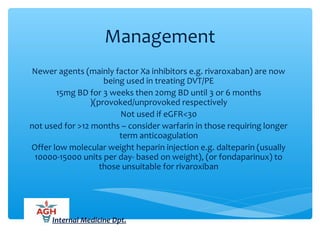
Newer agents (mainly factor Xa inhibitors e.g. rivaroxaban) are now
being used in treating DVT/PE
15mg BD for 3 weeks then 20mg BD until 3 or 6 months
(provoked/unprovoked respectively(
Not used if eGFR<30
not used for >12 months – consider warfarin in those requiring longer
term anticoagulation
Offer low molecular weight heparin injection e.g. dalteparin (usually
10000-15000 units per day- based on weight), (or fondaparinux) to
those unsuitable for rivaroxiban
Internal Medicine Dpt.
Management
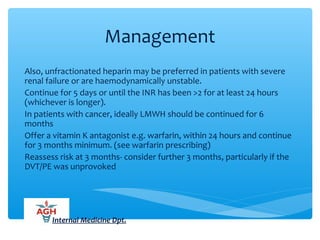
Also, unfractionated heparin may be preferred in patients with severe
renal failure or are haemodynamically unstable.
Continue for 5 days or until the INR has been >2 for at least 24 hours
(whichever is longer).
In patients with cancer, ideally LMWH should be continued for 6
months
Offer a vitamin K antagonist e.g. warfarin, within 24 hours and continue
for 3 months minimum. (see warfarin prescribing)
Reassess risk at 3 months- consider further 3 months, particularly if the
DVT/PE was unprovoked
Internal Medicine Dpt.
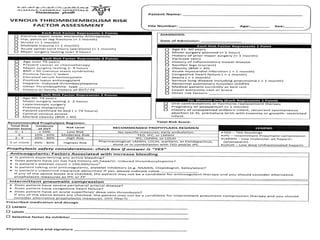
PREVENTION
AGH POLICY
Internal Medicine Dpt.
THANK YOU
FOLLOW AHMEDELAMINELSIDDIG
Internal Medicine Dpt.

VTE VENOUS THROMBOEMBOLISM

  • 1.
    ALMANA GROUP OFHOSPITALS VENOUS THROMBOEMBOLISM VTE DAMMAM Dr. AHMED ELAMIN AWADELKARIM MEDICAL RESIDENT AHMEDELAMINELSIDDIG
  • 2.
    OBJECTIVES  Overview ofVTE.  Risk factors.  Scoring systems.  DVT diagnosis and management.  PE diagnosis and management.  Special situations.
  • 3.
    overview Medical education doesnot exist to provide students with away of making living, but to ensure the health of the community. Rudolf Calr Virchow
  • 4.
  • 5.
  • 6.
    DVT Classic symptoms includes: oUnilateralLimb pain and tenderness this may be along the line of the vein. oGeneralized swelling (edematous) of the calf/thigh (unilateral). oHot, erythematous skin. oThere may also be distension of the superficial veins. Internal Medicine Dpt.
  • 8.
    Well’s score forDVT Internal Medicine Dpt.
  • 9.
    DIFFERENTIAL DIAGNOSIS •Muscle strain/hematoma •Poplitealcyst •Lymphedema •Cellulitis •Fracture •Chronic venous insufficiency •Proximal venous compression (e.g. tumor) •Congestive heart failure Internal Medicine Dpt.
  • 10.
    D-DIMER negative- DVT ishighly unlikely (High sensitivity). However  positive- it DOES NOT CONFIRM DVT  may be raised in patients with liver disease rheumatoid disease Inflammation Cancer Trauma pregnancy recent surgery Internal Medicine Dpt.
  • 11.
  • 12.
  • 13.
    OVERVIEW 600.000 case peryear. 50.000 deaths per year. Tests is done too much …negative. Most of cases are missed ….autopsy. Internal Medicine Dpt.
  • 14.
    IN ADDITION PREVIOUSDVT Internal Medicine Dpt.
  • 15.
    OVERVIEW Clot travels fromdeep veins, RV then pulmonary arteries Blood flow obstructed Tissue necrosis Symptoms result Internal Medicine Dpt.
  • 16.
    PRESENTATION Shortness of breath Chestpain (+/- pleuritic) Syncope Hemoptysis May mimic pneumonia (if lung infarction) Tachycardia Hypoxia Elevated JVP (or distended jugular veins) DVT symptoms Internal Medicine Dpt.
  • 17.
    WELL’S SCORE FORPE Internal Medicine Dpt.
  • 18.
  • 19.
    ABGs hypoxemia and hypocapnea(respiratory alkalosis) due to hyperventilation, keep in mind arterial blood gas analysis is NOT useful in diagnosis of pulmonary embolism. Classic finding: hypoxemia and hypocapnea (respiratory alkalosis). Normal ABG: 18% will have PaO2 > 85 mm Hg. Mixed Acidosis: in setting of hemodynamic collapse. Internal Medicine Dpt.
  • 20.
    Blood Investigations FBC (CheckWCC) CRP U&Es (check for any signs of electrolyte imbalance or kidney failure which may prevent CTPA) LFTs (check for liver failure that may cause bleeding abnormalities of be a sign of cancer) coagulation screen Troponins could also be considered. Internal Medicine Dpt.
  • 21.
    ECG CHANGES • sinustachycardia • Complete or incomplete RBBB (tall R wave in V1 ‘M’; slurred S wave in V6 ‘W’;MaRRoW) • Right ventricular strain- T wave inversions in right (v1-4) and inferior (II, III, aVF) leads • Right axis deviation (negative QRS in lead I and aVL and positive in lead III and aVF) • right ventricular dilation (Dominant R wave in V1 ) • Right atrial enlargement (P pulmonale) (>2.5mm peaked P waves in inferior leads (II, III and aVF) and >1.5mm peaked P wave in V1 and V2) • S1Q3T3 pattern: deep S wave in lead I, Q wave in III, and inverted T wave in lead III. Internal Medicine Dpt.
  • 22.
    SINUS TACHY+RBBB+T INVERSIONV1-3 Internal Medicine Dpt.
  • 23.
  • 24.
  • 25.
  • 26.
  • 27.
  • 28.
  • 29.
  • 30.
  • 31.
  • 32.
    Management Should I start?? Whichone?? Appropriate dose?? How I monitor?? How long?? Patient is stable or not??
  • 33.
    Management For massive PE,thrombolyse unless there are any contraindications Alteplase 50mg stat IV (if imminent cardiac arrest) or 10mg stat IV then 90mg infusion over 120mins Contraindications include Major surgery/trauma in previous 2 weeks; aortic dissection; acute internal bleeding; known cerebral tumour; hx of cerebral bleed/AVM; prolonged/traumatic CPR; pregnancy Relative CI include BP>180/110mmHg; severe renal/liver failure; INR>1.5 from warfarin use or liver disease; current use of warfarin with unknown INR; current use of rivaroxiban; stroke/TIA in last 12 months Internal Medicine Dpt.
  • 34.
    Management Newer agents (mainlyfactor Xa inhibitors e.g. rivaroxaban) are now being used in treating DVT/PE 15mg BD for 3 weeks then 20mg BD until 3 or 6 months (provoked/unprovoked respectively( Not used if eGFR<30 not used for >12 months – consider warfarin in those requiring longer term anticoagulation Offer low molecular weight heparin injection e.g. dalteparin (usually 10000-15000 units per day- based on weight), (or fondaparinux) to those unsuitable for rivaroxiban Internal Medicine Dpt.
  • 35.
    Management Also, unfractionated heparinmay be preferred in patients with severe renal failure or are haemodynamically unstable. Continue for 5 days or until the INR has been >2 for at least 24 hours (whichever is longer). In patients with cancer, ideally LMWH should be continued for 6 months Offer a vitamin K antagonist e.g. warfarin, within 24 hours and continue for 3 months minimum. (see warfarin prescribing) Reassess risk at 3 months- consider further 3 months, particularly if the DVT/PE was unprovoked Internal Medicine Dpt.
  • 36.
  • 38.