Diagnostic and Therapeutic 
Approach to Venous 
Thromboembolism 
Dr. Mark Choi, MD 
General Internal Medicine 
Abbotsford Regional Hospital and Cancer 
Centre
Disclosure 
 Bayer Inc.
Pulmonary Embolism 
 VTE incidence in total population is 
~100/100 000 patients/year 
 1/3 of VTE cases are PE 
 Acute PE has an estimated 30-day 
mortality ranging from 5 to 30%1 
 Causes ~300,000 deaths in the 
United States and over 500,000 
deaths in Europe per year2,3 
 In the EU, more than twice as 
many people die from VTE than 
from AIDS, breast cancer, prostate 
cancer and transportation 
accidents combined3 
296,370 
543,454 
• Régie de l'assurance maladie du Québec 
(RAMQ) retrospective health database 
review study suggests that the overall 
incidence of first definite or probable PE 
event is 4.5/10,000 person-years4 
• 15,700 annual incident cases of PE 
across Canada4
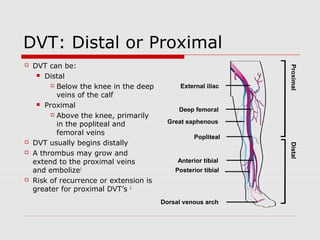
DVT: Distal or Proximal 
 DVT can be: 
 Distal 
 Below the knee in the deep 
veins of the calf 
 Proximal 
 Above the knee, primarily 
in the popliteal and 
femoral veins 
 DVT usually begins distally 
 A thrombus may grow and 
extend to the proximal veins 
and embolize1 
 Risk of recurrence or extension is 
greater for proximal DVT’s 2 
External iliac 
Deep femoral 
Great saphenous 
Popliteal 
Anterior tibial 
Posterior tibial 
Dorsal venous arch 
Distal Proximal
Venous Thromboembolism 
 Deep Vein Thrombosis 
 Diagnostic Algorithm / Wells Criteria for DVT 
 Are isolated distal DVTs treated the same way as above 
knee DVTs? 
 Are superficial vein thromboses ever treated with OAC? 
 Iatrogenic venous thrombosis 
 Treatment and its duration 
 Congenital workup 
 Pulmonary Embolism 
 Diagnostic Algorithm / Wells Criteria for PE 
 Is CT chest always superior to VQ scan? 
 What is the VQ criteria? 
 Treatment Options 
 Warfarin vs. NOACs (dabigatran and rivaroxaban) 
 Pros and Cons of NOACs
Deep Vein Thrombosis
Diagnostic Approach 
Scarvelis D , and Wells P S CMAJ 2006;175:1087-1092
Well’s Criteria for DVT 
 1 point each for below: 
 Paralysis, paresis or recent orthopedic casting of lower 
extremity 
 Recently bedridden (> 3 days) or major Sx within 4 
weeks 
 Localized tenderness in deep vein system 
 Swelling of entire leg 
 Calf swelling 3cm greater than other leg (measured 10cm 
below the tibial tuberosity) 
 Pitting edema greater in the symptomatic leg 
 Collateral non-varicosesuperficial veins 
 Active cancer or cancer treated within 6 months 
 -2 points for alternative more likely diagnosis (baker’s cyst, 
cellulitis, muscle damage, SVT, post-thrombotic syndrome, 
inguinal lymphadenopathy, external venous compression)
Isolated Distal DVT 
 Conflicting studies. Extension to proximal veins noted 
in 4 to 16% of patients without treatment; 7 to 10% of 
PE’s found to have isolated distal DVTs 
 Issues: 
 Fewer late sequelae than proximal DVT 
 Operator dependent 
 Less sensitive than proximal vein examination 
 Major risk factor for extension was active cancer 
 Isolated distal DVT had lower rate of recurrence 
whereas bilateral distal DVT had same recurrence as 
proximal DVT 
 Current guideline: treat for 3 months
Superficial Vein Thrombosis 
 Treatment 
 Elevation of affected limb 
 Warm and cold compresses 
 Topical or oral NSAID’s 
 Encourage ambulation 
 Treat pts with OAC (3 months) in higher 
risk for extension 
 High risk features: 
 Affected vein segment > 5cm, 
saphenofemoral/saphenopopliteal junction, < 
5cm to deep venous system, medical risk factors 
 Chest. 2008;133(6 Suppl):454S
Catheter-related venous 
thrombosis 
 Risk of thrombosis present with central 
(CVCs) and peripheral catheters (PICCs) 
 Most patients are asymptomatic 
 Higher risks of thrombosis with PICCs (both 
peripheral and central venous thrombsis) 
 RFs for CRVT = mal-positioned catheter, 
larger diameter catheters, active cancer, 
prior hx of DVT, hormonal therapy and 
congenital VTE predisposition
Catheter-related venous 
thrombosis 
 Superficial phlebitis 
 Remove catheter 
 Elevate affected limb 
 Warm or cold compresses 
 Topical or oral NSAIDs 
 Repeat U/S in 1 week in patients with RF’s 
 Upper extremity DVT 
 OAC as long as the catheter is in situ and 
consider longer depending on RFs 
 If OAC is discontinued, repeat U/S to look for 
extension in patients with RFs
Treatment of proximal/distal DVT 
 Provoked DVT = treat for 3 months 
 Unprovoked DVT = treat for 3 months and 
consider longer 
 Rebound DVT = Risk roughly 20% in 2 years 
after discontinuation of OAC. 
 Follow-up Baseline DVT and d-dimer necessary 
at the end of treatment with OAC in order to 
differentiate between recurrent DVT and post-thrombotic 
syndrome if his/her symptoms 
return 
 Congenital workup = reserved for unprovoked 
VTE’s in younger patients or strong family 
history of VTE
Pulmonary Embolism
Pulmonary Embolism 
 Diagnostic approach that we are used to: 
RYU JH, SWENSEN SJ, OLSON EJ, PELLIKKA PA. DIAGNOSIS OF PULMONARY EMBOLISM WITH 
USE OF COMPUTED TOMOGRAPHIC ANGIOGRAPHY. MAYO CLIN PROC 2001;76:63.
Wells Criteria for PE 
 Alternative diagnosis less likely than PE 3.0 
 Signs or symptoms of DVT 3.0 
 History of PE or DVT 1.5 
 Immobilization for at least 3 days or surgery 1.5 
in the previous month 
 Heart rate >100 beats/min 1.5 
 Hemoptysis 1.0 
 Active cancer (treatment ongoing, within 1.0 
previous 6 months or palliative) 
 For high sensitivity D-dimer: 
Low probability: <2 points 
Intermediate probability: 2–6 points 
High probability: ≥6 points
Is CT chest superior to VQ scan? 
 Initial VQ study showed good 
sensitivity and specificity to the gold 
standard (pulmonary angiogram) 
 CTPA compared to VQ study and 
deemed non-inferior to VQ for 
diagnosis of PE
Pros and Cons of CT Chest 
 CT chest with IV contrast 
 Pros 
 Non-inferior to VQ scan in diagnosis of PE 
 May catch other pulmonary findings (pneumonia, mass, 
emphysema, ILD etc) 
 Cons 
 Radiation exposure (ei. Pregnancy) 
 Risk of contrast-induced nephropathy in kidney dz 
 May give indeterminate findings 
 Patient may move during the study 
 IV contrast timed incorrectly 
 Incidental findings of isolated subsegmental PE may 
lead to over-treatment 
 Potential risk of allergy to IV contrast dye
Pros and Cons of VQ Scan 
 VQ Scan 
 Pros 
 Good sensitivity and specificity in comparison to gold 
standard (pulmonary angiogram) 
 May catch other pulmonary findings (focal 
consolidation) 
 Safe in kidney disease 
 Relatively small radiation exposure (equiv ~ 5 CXRs) 
 Cons 
 May give indeterminate findings 
 If performed in patients with chronic cardiac or 
pulmonary disease 
 Availability: nuclear medicine open daytime Mon to Fri 
in most tertiary centres
Radiation Exposure 
 64-slice CTPA delivers 50-60mSv to 
the breast 
 V/Q Scan delivers only 0.28-0.9mSv 
 In comparison, a 2-view 
mammogram is associated with 3mSv 
 Radiation exposure to female breast 
is 70 to 100-fold greater in CTPA vs. 
V/Q scan 
Einstein AJ. Estimating risk of cancer associated with radiation exposure from 64-slice CT angiography. JAMA. 2007; 298: 317-323 
Parker MS. Female breast radiation exposure during CT pulmonary angiography. Am J Radiol. 2005. 185: 1229-1233 
Cook JV. Radiation from CT and perfusion scanning in prengnancy 
Task Group on Control of Radiation Dose in CT: a report of the International Commission on Radiological Protection. AnnICRP 2000;30:7-45
Radiation Exposure 
 There is non-negligible increase in 
lifetime attributable risk of cancer, 
particularly to the breasts of young 
women 
 1 in 143 for a 20-year-old woman 
 1 in 284 for a 40-year-old woman 
 There is also increased odds of lung 
cancer in both gender 
Einstein AJ. Estimating risk of cancer associated with radiation exposure from 64-slice CT angiography. JAMA. 2007; 298: 317-323
When do physicians choose VQ 
Scan? 
 In the setting of decreased eGFR 
 Known IV contrast allergy 
 When CTPA result is indeterminate 
 Pregnancy and Post-Partum 
 Because it causes less radiation
So when is V/Q scan more appropriate to 
order over a CT scan? 
 younger population 
 female population 
 no other intrathoracic disease is 
suspected 
 decreased eGFR 
 Pregnancy/Post Partum 
 Consider in those meeting the “VQ 
criteria”
The VQ Criteria 
 There are 2 VQ Criteria 
 A normal CXR 
 No history of chronic lung disease or 
congestive heart failure 
 If above 2 criteria are met, it is very 
unlikely that the VQ scan will give an 
indeterminate finding
V/Q vs. CTPE Study 
 Data on all CT and V/Q scans performed to 
assess for PE in St. Michael's Hospital 
(SMH) inpatients over 2-year period 
collected 
 Exclusion 
 CT scans ordered at hours when V/Q scan is 
unavailable (weeknights, weekends and 
holidays) were excluded 
 CT scans looking for PE and other diagnoses 
were excluded 
 CT scans ordered on intensive care patients 
were excluded.
V/Q vs. CTPE Study 
 29.2% of CTPE studies met the V/Q 
criteria
Reasons for choosing V/Q Scan
V/Q Scan as primary imaging 
modality 
 Only half (14 of 28) of these studies 
met the VQ Criteria
V/Q vs. CTPE study conclusion 
 V/Q scan under-utilized in patients 
meeting V/Q criteria 
 Not using the V/Q criteria leads to 
many indeterminate findings
Preferred Algorithm 
Pre-test Probability using Dichotomized Well’s Score 
Low (4 or less) High (5 or higher) 
D-dimer Normal CXR and no hx of 
cardiopulmonary disease 
Low (< 500) High (>500) Yes No 
PE ruled out 
VQ Scan 
Renal Dysfunction or 
IV contrast allergy 
Yes No 
CT Scan 
If either test indeterminate
Case Scenarios
Case 1 
 29 year-old female with acute left-sided 
pleuritic chest pain with dyspnea and 
palpitations. No leg symptoms 
 PMH: none; FmHx: none 
 HR 120bpm. Afebrile. SpO2 86% on RA 
 Investigation: 
 ECG = sinus tachy 
 CXR PA+lateral = nil acute 
 D-dimer 1200 
 Imaging Modality?
Case 2 
 75 year old with acute right-sided pleuritic 
chest pain, wheezing and SOB. No leg 
symptoms 
 PMH: COPD, HTN. 
 HR = 105bpm, temp 39.1C SpO2 82% on 
RA, Resp: bilateral wheezing 
 Investigation 
 CXR = new right middle lobe consolidation 
 D-dimer = 790 
 Cr = 180 
 Imaging Modality?
Case 3 
 45 year-old woman with acute right-sided 
pleuritic chest pain with SOB. No leg symptoms 
 PMH: CHF (35%), HTN , chol, DM 
 HR: 109 bpm, temp = 36.5C, Sp02 = 88% RA 
 Investigation: 
 CXR = cardiomegaly, trace bilateral effusion 
 ECG = rapid AF 
 D-dimer = >4000 
 Cr = 80 
 Imaging Modality?
Case 4 
 45 year-old woman with acute right-sided 
pleuritic chest pain with SOB. No leg 
symptoms 
 PMH: CHF (35%), HTN , chol, DM 
 HR: 109 bpm, temp = 36.5C 
 Investigation: 
 CXR = cardiomegaly, trace bilateral effusion 
 ECG = rapid AF 
 D-dimer = >4000 
 Cr = 220 
 Imaging Modality?
Treatment Options
Treatment Options 
 Warfarin 
 vitamin K antagonist 
 IV heparin 
 binds AT and inactivates fXa and prevents conversion of 
fibrinogen to fibrin 
 LMWH 
 binds AT and inactivates fXa 
 fondaparinux 
 enhances the anti-Xa activity of AT by 300-fold 
 NOAC’s 
 Dabigatran (direct thrombin inhibitor) 
 Rivaroxaban (direct factor Xa inhibitor) 
 Apixaban (not approved in Canada for treatment of PE or DVT 
yet) 
 IVC filter 
 Intravenous thrombolytics
Warfarin is Highly Effective for the 
Prevention of Stroke in AF or Recurrent VTE 
Stroke Prevention in Atrial 
Fibrillation 
Treatment of Venous 
Thromboembolism (VTE) 
Standard Care: Warfarin (INR 2.0-3.0) Standard Care: Warfarin (INR 2.0-3.0), 
initial parenteral anticoagulation until INR >2 
Chance of recurrent VTE in 
first 3 months 
47% 
If proximal DVT inadequately treated3 
1 
1 
2 
<2% 
If adequate anticoagulant 
response is achieved4 
1. Hart et al Ann Intern Med. 2007;146:857-867; 2. Connolly et al. Lancet. 2006;367:1903-12; 3. Line B. Semin Nucl Med. 2001;31:90–101 4. Kearon C. Circulation 2003;107:I22–I30.
Properties of an Ideal Anticoagulant vs. 
Currently Available Agents 
IDEAL LMWH UFH VKA NOAC 
Oral 
No significant food/drug 
interactions 
Predictable response 
No requirement for 
coagulation monitoring 
Fixed dosing 
No HIT 
Cost 
Reversible 
HIT: Heparin induced thrombocytopenia 
?
Canadian Approvals of New Oral 
Anticoagulants 
Rivaroxaban 
VTE prophylaxis 
following THR/TKR 
2008 2009 2010 2011 
2012 2013 
Dabigatran 
VTE prophylaxis 
following THR/TKR 
Health Canada NOC database: http://webprod5.hc-sc.gc.ca/noc-ac/index-eng.jsp 
Apixaban 
VTE prophylaxis 
following THR/TKR 
Dabigatran 
Stroke prevention 
in AF 
Rivaroxaban 
Stroke prevention 
in AF 
Rivaroxaban 
Treatment and secondary prevention 
of DVT (2012) and PE (2013) 
New oral anticoagulants 
Dabigatran 
Treatment and 
secondary 
prevention of DVT 
Apixaban and PE 
Stroke prevention 
in AF 
2014
Novel Oral Anticoagulants – 
Pharmacological Properties 
Characteristic Rivaroxaban1 Dabigatran2 Apixaban3 
Target Factor Xa Factor IIa Factor Xa 
Dosing OD BID BID 
Bioavailability, % 80-100%* 6.5% 50% 
Half-life 5-13h 12-14 h 8-15 h 
Renal clearance 
(unchanged 
~33% 85% 27%† 
bioavailable drug) 
Cmax 2-4 h 1-2 h 3-4 h 
Bridging with 
No Yes No 
LMWH 
* When the 15mg and 20mg dose is taken with food 
† Factoring in the absolute bioavailability of apixaban, ~ 50 % of the systemically available dose is eliminated in urine 
1. Xarelto® PM, June 2013; 2. Pradaxa ® PM November, 2012; 3. Eliquis® PM November, 2012; 
4. FDA Eliquis Drug Approval Package, Clinical Pharmacology/Biopharmaceutics Review
New Oral Anticoagulants: Total Drug Exposure 
(AUC) with Declining Renal Function 
Rivaroxaban 
(33% cleared renally*)1 
Dabigatran 
(85% cleared renally)2 
Apixaban 
(27% cleared renally†)3 
* active drug 
† Factoring in the absolute bioavailability of apixaban, ~ 50 % of the systemically available dose is eliminated in urine 
1. Xarelto® PM, June 2013; 2. Pradaxa ® PM November, 2012; 3. Eliquis® PM November, 2012; 
4. FDA Eliquis Drug Approval Package, Clinical Pharmacology/Biopharmaceutics Review
Landmark DVT/PE Trials 
Phase II Phase III 
Rivaroxaban 
Oral, direct Factor Xa 
inhibitor 
EINSTEIN DVT2 
Rivaroxaban vs LMWH/UFH 
followed by VKA 
ODIXa-DVT3 
Rivaroxaban vs enoxaparin 
followed by VKA 
EINSTEIN DVT/PE5,6 
Rivaroxaban for 3, 6 or 12 months vs enoxaparin for ≥5 days 
followed by VKA for 3, 6, or 12 months 
EINSTEIN EXT5 
Pre-treatment with rivaroxaban or VKA for 6 or 
12 months followed by rivaroxaban or placebo for 6 or 12 months 
Dabigatran 
Oral, direct thrombin 
inhibitor 
RE-COVER7 & RE-COVER II8 
5–10 days pre-treatment with LMWH bridging to dabigatran or VKA 
for 6 months 
RE-MEDY9 
3–6 months’ treatment with approved anticoagulant; switch to 
dabigatran or VKA 
RE-SONATE10 
6–18 months’ VKA treatment followed by 6 months dabigatran or 
placebo 
Apixaban 
Oral, direct Factor Xa 
inhibitor 
Botticelli-DVT4 
Apixaban vs LMWH or 
fondaparinux followed 
by VKA 
AMPLIFY1 
Apixaban 10 mg bid followed by 5 mg bid for 6 months vs. 
enoxaparin followed by VKA 
AMPLIFY-EXT11 
Apixaban 2.5 mg bid or 5 mg bid for extended 12 months period vs 
placebo 
Bridging with LMWH and duration of treatment are the main differences between the trials 
The following slides summarize trial results with NOACs in VTE treatment 
Not intended as cross-trial comparison 
1. http://clinicaltrials.gov; 2. Buller HR et al. Blood 2008; 3. Agnelli GA, et al. Circulation 2007; 4. Büller HR, et al. J Thromb Haemost 2008; 5. The EINSTEIN Investigators. N Engl 
J Med 2010; 6. The EINSTEIN–PE Investigators. N Engl J Med 2012; 7. Schulman S, et al. N Engl J Med 2009; 8. Schulman S, et al. ASH Annual Meeting Abstracts. Blood 2011; 
9. Schulmann S et al. ISTH 2011; 10. Schulman S, et al. ISTH 2011; 11. Agnelli G et al. N Engl J Med 2012; 12. Raskob G et al. J Thromb Haemost. 2013.
VTE treatment Results comparison: pivotal 
phase III clinical trials – Efficacy 
Study drug 
n (%) 
LMWH/ 
VKA 
n (%) 
ARD 
% 
HR 95% CI P 
EINSTEIN 
Pooled 
3, 6, 12 months 
86 (2.1) 95 
(2.3) 
0.2 0.89 0.66- 
1.19 
N-inf 
RE-COVER 
Pooled 
6 months 
(2.7) (2.4) -0.3 1.09 0.77- 
1.54 
N-inf 
AMPLIFY 
6 months 
59 (2.3) 71 
(2.7) 
0.4 0.84 0.60– 
1.18 
N-inf 
Recurrent VTE or VTE-related death 
Hazard ratio 
and 95% CIs 
Favours study 
drug 
Favours 
LMWH/VKA 
* Event during on-treatment period 
Hazard ratio 
and 95% CIs 
Favours study drug Favours 
LMWH/VKA
VTE treatment Results comparison: pivotal 
phase III clinical trials – Safety 
Major Bleeding 
Study 
drug 
n (%) 
LMWH/VK 
A 
n (%) 
ARR 
% 
HR 95% CI P 
EINSTEIN 
Pooled 
3, 6, 12 
Months 
40 (1.0) 72 (1.7) 0.7 0.54 0.37-0.79 Sup. 
RE-COVER 
Pooled 
6 months 
37 (1.4) 51 (2.0) 0.6 0.73 0.48-1.11 N-inf 
AMPLIFY 
6 months 
15 (0.6) 49 (1.8) 1.2 0.31 0.17–0.55 Sup. 
Hazard ratio 
and 95% CIs 
Favours study drug 
Favours 
LMWH/VKA
Summary 
 Main Phase 
 Few differences in trial designs 
 Bridging with LMWH in RE-COVER vs. Single-drug 
approach in EINSTEIN and AMPLIFY 
 Duration of treatment – 6 months in RE-COVER 
and AMPLIFY vs. 3, 6 or 12 months in EINSTEIN 
 OD in EINSTEIN (after initial acute phase for 
EINSTEIN) vs. BID in RE-COVER and AMPLIFY 
 All agents were non-inferior vs. warfarin in 
preventing VTE recurrence 
 Rivaroxaban and apixaban were superior to warfarin 
in reducing major bleeding whereas dabigatran was 
non-inferior
Cost of NOAC’s 
 May apply for Special Authority for the 
treatment of DVT with rivaroxaban. Special 
Authority not approved for dabigatran for 
treatment of DVT or PE. 
 If the patient has reached his/her 
deductible on Pharmacare, rivaroxaban 
does not cost the patient any money 
 Otherwise, cost of rivaroxaban is ~$3/day 
for 20mg po daily. Cost of dabigatran is 
~$3.4/day.
Rivaroxaban vs. Dabigatran 
 No bridging with LMWH required with 
rivaroxaban 
 OD vs. BID dosing 
 Rivaroxaban is superior to warfarin in reducing 
major bleeding events whereas dabigatran is 
non-inferior 
 Rivaroxaban is cheaper; rivaroxaban may be free 
for patients who have reached their deductible 
 Less renally cleared 
 Both irreversible but rivaroxaban has shorter 
half-life
Rivaroxaban vs. Apixaban 
 No bridging needed for both drugs 
 OD vs. BID dosing 
 Both non-inferior to warfarin in 
recurrent VTEs and VTE-related 
deaths 
 Both superior to warfarin in number 
of major bleeding events 
 Both are less renally cleared in 
comparison to dabigatran
Take Away Points 
 Not all SVT are treated conservatively 
 Remember to utilize VQ scans in those who 
meet the VQ criteria 
 Direct Factor Xa inhibitors are superior to 
warfarin in reducing major bleeding risk 
 Bridging not required for rivaroxaban or 
apixaban 
 Your patient’s rivaroxaban cost may be 
covered fully in the treatment of DVT. 
Please use special authority.
Questions? 
 Thank you!

Vte 2014

  • 1.
    Diagnostic and Therapeutic Approach to Venous Thromboembolism Dr. Mark Choi, MD General Internal Medicine Abbotsford Regional Hospital and Cancer Centre
  • 2.
  • 3.
    Pulmonary Embolism VTE incidence in total population is ~100/100 000 patients/year  1/3 of VTE cases are PE  Acute PE has an estimated 30-day mortality ranging from 5 to 30%1  Causes ~300,000 deaths in the United States and over 500,000 deaths in Europe per year2,3  In the EU, more than twice as many people die from VTE than from AIDS, breast cancer, prostate cancer and transportation accidents combined3 296,370 543,454 • Régie de l'assurance maladie du Québec (RAMQ) retrospective health database review study suggests that the overall incidence of first definite or probable PE event is 4.5/10,000 person-years4 • 15,700 annual incident cases of PE across Canada4
  • 4.
    DVT: Distal orProximal  DVT can be:  Distal  Below the knee in the deep veins of the calf  Proximal  Above the knee, primarily in the popliteal and femoral veins  DVT usually begins distally  A thrombus may grow and extend to the proximal veins and embolize1  Risk of recurrence or extension is greater for proximal DVT’s 2 External iliac Deep femoral Great saphenous Popliteal Anterior tibial Posterior tibial Dorsal venous arch Distal Proximal
  • 5.
    Venous Thromboembolism Deep Vein Thrombosis  Diagnostic Algorithm / Wells Criteria for DVT  Are isolated distal DVTs treated the same way as above knee DVTs?  Are superficial vein thromboses ever treated with OAC?  Iatrogenic venous thrombosis  Treatment and its duration  Congenital workup  Pulmonary Embolism  Diagnostic Algorithm / Wells Criteria for PE  Is CT chest always superior to VQ scan?  What is the VQ criteria?  Treatment Options  Warfarin vs. NOACs (dabigatran and rivaroxaban)  Pros and Cons of NOACs
  • 6.
  • 7.
    Diagnostic Approach ScarvelisD , and Wells P S CMAJ 2006;175:1087-1092
  • 8.
    Well’s Criteria forDVT  1 point each for below:  Paralysis, paresis or recent orthopedic casting of lower extremity  Recently bedridden (> 3 days) or major Sx within 4 weeks  Localized tenderness in deep vein system  Swelling of entire leg  Calf swelling 3cm greater than other leg (measured 10cm below the tibial tuberosity)  Pitting edema greater in the symptomatic leg  Collateral non-varicosesuperficial veins  Active cancer or cancer treated within 6 months  -2 points for alternative more likely diagnosis (baker’s cyst, cellulitis, muscle damage, SVT, post-thrombotic syndrome, inguinal lymphadenopathy, external venous compression)
  • 9.
    Isolated Distal DVT  Conflicting studies. Extension to proximal veins noted in 4 to 16% of patients without treatment; 7 to 10% of PE’s found to have isolated distal DVTs  Issues:  Fewer late sequelae than proximal DVT  Operator dependent  Less sensitive than proximal vein examination  Major risk factor for extension was active cancer  Isolated distal DVT had lower rate of recurrence whereas bilateral distal DVT had same recurrence as proximal DVT  Current guideline: treat for 3 months
  • 10.
    Superficial Vein Thrombosis  Treatment  Elevation of affected limb  Warm and cold compresses  Topical or oral NSAID’s  Encourage ambulation  Treat pts with OAC (3 months) in higher risk for extension  High risk features:  Affected vein segment > 5cm, saphenofemoral/saphenopopliteal junction, < 5cm to deep venous system, medical risk factors  Chest. 2008;133(6 Suppl):454S
  • 11.
    Catheter-related venous thrombosis  Risk of thrombosis present with central (CVCs) and peripheral catheters (PICCs)  Most patients are asymptomatic  Higher risks of thrombosis with PICCs (both peripheral and central venous thrombsis)  RFs for CRVT = mal-positioned catheter, larger diameter catheters, active cancer, prior hx of DVT, hormonal therapy and congenital VTE predisposition
  • 12.
    Catheter-related venous thrombosis  Superficial phlebitis  Remove catheter  Elevate affected limb  Warm or cold compresses  Topical or oral NSAIDs  Repeat U/S in 1 week in patients with RF’s  Upper extremity DVT  OAC as long as the catheter is in situ and consider longer depending on RFs  If OAC is discontinued, repeat U/S to look for extension in patients with RFs
  • 13.
    Treatment of proximal/distalDVT  Provoked DVT = treat for 3 months  Unprovoked DVT = treat for 3 months and consider longer  Rebound DVT = Risk roughly 20% in 2 years after discontinuation of OAC.  Follow-up Baseline DVT and d-dimer necessary at the end of treatment with OAC in order to differentiate between recurrent DVT and post-thrombotic syndrome if his/her symptoms return  Congenital workup = reserved for unprovoked VTE’s in younger patients or strong family history of VTE
  • 14.
  • 15.
    Pulmonary Embolism Diagnostic approach that we are used to: RYU JH, SWENSEN SJ, OLSON EJ, PELLIKKA PA. DIAGNOSIS OF PULMONARY EMBOLISM WITH USE OF COMPUTED TOMOGRAPHIC ANGIOGRAPHY. MAYO CLIN PROC 2001;76:63.
  • 16.
    Wells Criteria forPE  Alternative diagnosis less likely than PE 3.0  Signs or symptoms of DVT 3.0  History of PE or DVT 1.5  Immobilization for at least 3 days or surgery 1.5 in the previous month  Heart rate >100 beats/min 1.5  Hemoptysis 1.0  Active cancer (treatment ongoing, within 1.0 previous 6 months or palliative)  For high sensitivity D-dimer: Low probability: <2 points Intermediate probability: 2–6 points High probability: ≥6 points
  • 17.
    Is CT chestsuperior to VQ scan?  Initial VQ study showed good sensitivity and specificity to the gold standard (pulmonary angiogram)  CTPA compared to VQ study and deemed non-inferior to VQ for diagnosis of PE
  • 18.
    Pros and Consof CT Chest  CT chest with IV contrast  Pros  Non-inferior to VQ scan in diagnosis of PE  May catch other pulmonary findings (pneumonia, mass, emphysema, ILD etc)  Cons  Radiation exposure (ei. Pregnancy)  Risk of contrast-induced nephropathy in kidney dz  May give indeterminate findings  Patient may move during the study  IV contrast timed incorrectly  Incidental findings of isolated subsegmental PE may lead to over-treatment  Potential risk of allergy to IV contrast dye
  • 19.
    Pros and Consof VQ Scan  VQ Scan  Pros  Good sensitivity and specificity in comparison to gold standard (pulmonary angiogram)  May catch other pulmonary findings (focal consolidation)  Safe in kidney disease  Relatively small radiation exposure (equiv ~ 5 CXRs)  Cons  May give indeterminate findings  If performed in patients with chronic cardiac or pulmonary disease  Availability: nuclear medicine open daytime Mon to Fri in most tertiary centres
  • 20.
    Radiation Exposure 64-slice CTPA delivers 50-60mSv to the breast  V/Q Scan delivers only 0.28-0.9mSv  In comparison, a 2-view mammogram is associated with 3mSv  Radiation exposure to female breast is 70 to 100-fold greater in CTPA vs. V/Q scan Einstein AJ. Estimating risk of cancer associated with radiation exposure from 64-slice CT angiography. JAMA. 2007; 298: 317-323 Parker MS. Female breast radiation exposure during CT pulmonary angiography. Am J Radiol. 2005. 185: 1229-1233 Cook JV. Radiation from CT and perfusion scanning in prengnancy Task Group on Control of Radiation Dose in CT: a report of the International Commission on Radiological Protection. AnnICRP 2000;30:7-45
  • 21.
    Radiation Exposure There is non-negligible increase in lifetime attributable risk of cancer, particularly to the breasts of young women  1 in 143 for a 20-year-old woman  1 in 284 for a 40-year-old woman  There is also increased odds of lung cancer in both gender Einstein AJ. Estimating risk of cancer associated with radiation exposure from 64-slice CT angiography. JAMA. 2007; 298: 317-323
  • 22.
    When do physicianschoose VQ Scan?  In the setting of decreased eGFR  Known IV contrast allergy  When CTPA result is indeterminate  Pregnancy and Post-Partum  Because it causes less radiation
  • 23.
    So when isV/Q scan more appropriate to order over a CT scan?  younger population  female population  no other intrathoracic disease is suspected  decreased eGFR  Pregnancy/Post Partum  Consider in those meeting the “VQ criteria”
  • 24.
    The VQ Criteria  There are 2 VQ Criteria  A normal CXR  No history of chronic lung disease or congestive heart failure  If above 2 criteria are met, it is very unlikely that the VQ scan will give an indeterminate finding
  • 25.
    V/Q vs. CTPEStudy  Data on all CT and V/Q scans performed to assess for PE in St. Michael's Hospital (SMH) inpatients over 2-year period collected  Exclusion  CT scans ordered at hours when V/Q scan is unavailable (weeknights, weekends and holidays) were excluded  CT scans looking for PE and other diagnoses were excluded  CT scans ordered on intensive care patients were excluded.
  • 26.
    V/Q vs. CTPEStudy  29.2% of CTPE studies met the V/Q criteria
  • 27.
  • 28.
    V/Q Scan asprimary imaging modality  Only half (14 of 28) of these studies met the VQ Criteria
  • 29.
    V/Q vs. CTPEstudy conclusion  V/Q scan under-utilized in patients meeting V/Q criteria  Not using the V/Q criteria leads to many indeterminate findings
  • 30.
    Preferred Algorithm Pre-testProbability using Dichotomized Well’s Score Low (4 or less) High (5 or higher) D-dimer Normal CXR and no hx of cardiopulmonary disease Low (< 500) High (>500) Yes No PE ruled out VQ Scan Renal Dysfunction or IV contrast allergy Yes No CT Scan If either test indeterminate
  • 31.
  • 32.
    Case 1 29 year-old female with acute left-sided pleuritic chest pain with dyspnea and palpitations. No leg symptoms  PMH: none; FmHx: none  HR 120bpm. Afebrile. SpO2 86% on RA  Investigation:  ECG = sinus tachy  CXR PA+lateral = nil acute  D-dimer 1200  Imaging Modality?
  • 33.
    Case 2 75 year old with acute right-sided pleuritic chest pain, wheezing and SOB. No leg symptoms  PMH: COPD, HTN.  HR = 105bpm, temp 39.1C SpO2 82% on RA, Resp: bilateral wheezing  Investigation  CXR = new right middle lobe consolidation  D-dimer = 790  Cr = 180  Imaging Modality?
  • 34.
    Case 3 45 year-old woman with acute right-sided pleuritic chest pain with SOB. No leg symptoms  PMH: CHF (35%), HTN , chol, DM  HR: 109 bpm, temp = 36.5C, Sp02 = 88% RA  Investigation:  CXR = cardiomegaly, trace bilateral effusion  ECG = rapid AF  D-dimer = >4000  Cr = 80  Imaging Modality?
  • 35.
    Case 4 45 year-old woman with acute right-sided pleuritic chest pain with SOB. No leg symptoms  PMH: CHF (35%), HTN , chol, DM  HR: 109 bpm, temp = 36.5C  Investigation:  CXR = cardiomegaly, trace bilateral effusion  ECG = rapid AF  D-dimer = >4000  Cr = 220  Imaging Modality?
  • 36.
  • 37.
    Treatment Options Warfarin  vitamin K antagonist  IV heparin  binds AT and inactivates fXa and prevents conversion of fibrinogen to fibrin  LMWH  binds AT and inactivates fXa  fondaparinux  enhances the anti-Xa activity of AT by 300-fold  NOAC’s  Dabigatran (direct thrombin inhibitor)  Rivaroxaban (direct factor Xa inhibitor)  Apixaban (not approved in Canada for treatment of PE or DVT yet)  IVC filter  Intravenous thrombolytics
  • 38.
    Warfarin is HighlyEffective for the Prevention of Stroke in AF or Recurrent VTE Stroke Prevention in Atrial Fibrillation Treatment of Venous Thromboembolism (VTE) Standard Care: Warfarin (INR 2.0-3.0) Standard Care: Warfarin (INR 2.0-3.0), initial parenteral anticoagulation until INR >2 Chance of recurrent VTE in first 3 months 47% If proximal DVT inadequately treated3 1 1 2 <2% If adequate anticoagulant response is achieved4 1. Hart et al Ann Intern Med. 2007;146:857-867; 2. Connolly et al. Lancet. 2006;367:1903-12; 3. Line B. Semin Nucl Med. 2001;31:90–101 4. Kearon C. Circulation 2003;107:I22–I30.
  • 39.
    Properties of anIdeal Anticoagulant vs. Currently Available Agents IDEAL LMWH UFH VKA NOAC Oral No significant food/drug interactions Predictable response No requirement for coagulation monitoring Fixed dosing No HIT Cost Reversible HIT: Heparin induced thrombocytopenia ?
  • 40.
    Canadian Approvals ofNew Oral Anticoagulants Rivaroxaban VTE prophylaxis following THR/TKR 2008 2009 2010 2011 2012 2013 Dabigatran VTE prophylaxis following THR/TKR Health Canada NOC database: http://webprod5.hc-sc.gc.ca/noc-ac/index-eng.jsp Apixaban VTE prophylaxis following THR/TKR Dabigatran Stroke prevention in AF Rivaroxaban Stroke prevention in AF Rivaroxaban Treatment and secondary prevention of DVT (2012) and PE (2013) New oral anticoagulants Dabigatran Treatment and secondary prevention of DVT Apixaban and PE Stroke prevention in AF 2014
  • 41.
    Novel Oral Anticoagulants– Pharmacological Properties Characteristic Rivaroxaban1 Dabigatran2 Apixaban3 Target Factor Xa Factor IIa Factor Xa Dosing OD BID BID Bioavailability, % 80-100%* 6.5% 50% Half-life 5-13h 12-14 h 8-15 h Renal clearance (unchanged ~33% 85% 27%† bioavailable drug) Cmax 2-4 h 1-2 h 3-4 h Bridging with No Yes No LMWH * When the 15mg and 20mg dose is taken with food † Factoring in the absolute bioavailability of apixaban, ~ 50 % of the systemically available dose is eliminated in urine 1. Xarelto® PM, June 2013; 2. Pradaxa ® PM November, 2012; 3. Eliquis® PM November, 2012; 4. FDA Eliquis Drug Approval Package, Clinical Pharmacology/Biopharmaceutics Review
  • 42.
    New Oral Anticoagulants:Total Drug Exposure (AUC) with Declining Renal Function Rivaroxaban (33% cleared renally*)1 Dabigatran (85% cleared renally)2 Apixaban (27% cleared renally†)3 * active drug † Factoring in the absolute bioavailability of apixaban, ~ 50 % of the systemically available dose is eliminated in urine 1. Xarelto® PM, June 2013; 2. Pradaxa ® PM November, 2012; 3. Eliquis® PM November, 2012; 4. FDA Eliquis Drug Approval Package, Clinical Pharmacology/Biopharmaceutics Review
  • 43.
    Landmark DVT/PE Trials Phase II Phase III Rivaroxaban Oral, direct Factor Xa inhibitor EINSTEIN DVT2 Rivaroxaban vs LMWH/UFH followed by VKA ODIXa-DVT3 Rivaroxaban vs enoxaparin followed by VKA EINSTEIN DVT/PE5,6 Rivaroxaban for 3, 6 or 12 months vs enoxaparin for ≥5 days followed by VKA for 3, 6, or 12 months EINSTEIN EXT5 Pre-treatment with rivaroxaban or VKA for 6 or 12 months followed by rivaroxaban or placebo for 6 or 12 months Dabigatran Oral, direct thrombin inhibitor RE-COVER7 & RE-COVER II8 5–10 days pre-treatment with LMWH bridging to dabigatran or VKA for 6 months RE-MEDY9 3–6 months’ treatment with approved anticoagulant; switch to dabigatran or VKA RE-SONATE10 6–18 months’ VKA treatment followed by 6 months dabigatran or placebo Apixaban Oral, direct Factor Xa inhibitor Botticelli-DVT4 Apixaban vs LMWH or fondaparinux followed by VKA AMPLIFY1 Apixaban 10 mg bid followed by 5 mg bid for 6 months vs. enoxaparin followed by VKA AMPLIFY-EXT11 Apixaban 2.5 mg bid or 5 mg bid for extended 12 months period vs placebo Bridging with LMWH and duration of treatment are the main differences between the trials The following slides summarize trial results with NOACs in VTE treatment Not intended as cross-trial comparison 1. http://clinicaltrials.gov; 2. Buller HR et al. Blood 2008; 3. Agnelli GA, et al. Circulation 2007; 4. Büller HR, et al. J Thromb Haemost 2008; 5. The EINSTEIN Investigators. N Engl J Med 2010; 6. The EINSTEIN–PE Investigators. N Engl J Med 2012; 7. Schulman S, et al. N Engl J Med 2009; 8. Schulman S, et al. ASH Annual Meeting Abstracts. Blood 2011; 9. Schulmann S et al. ISTH 2011; 10. Schulman S, et al. ISTH 2011; 11. Agnelli G et al. N Engl J Med 2012; 12. Raskob G et al. J Thromb Haemost. 2013.
  • 44.
    VTE treatment Resultscomparison: pivotal phase III clinical trials – Efficacy Study drug n (%) LMWH/ VKA n (%) ARD % HR 95% CI P EINSTEIN Pooled 3, 6, 12 months 86 (2.1) 95 (2.3) 0.2 0.89 0.66- 1.19 N-inf RE-COVER Pooled 6 months (2.7) (2.4) -0.3 1.09 0.77- 1.54 N-inf AMPLIFY 6 months 59 (2.3) 71 (2.7) 0.4 0.84 0.60– 1.18 N-inf Recurrent VTE or VTE-related death Hazard ratio and 95% CIs Favours study drug Favours LMWH/VKA * Event during on-treatment period Hazard ratio and 95% CIs Favours study drug Favours LMWH/VKA
  • 45.
    VTE treatment Resultscomparison: pivotal phase III clinical trials – Safety Major Bleeding Study drug n (%) LMWH/VK A n (%) ARR % HR 95% CI P EINSTEIN Pooled 3, 6, 12 Months 40 (1.0) 72 (1.7) 0.7 0.54 0.37-0.79 Sup. RE-COVER Pooled 6 months 37 (1.4) 51 (2.0) 0.6 0.73 0.48-1.11 N-inf AMPLIFY 6 months 15 (0.6) 49 (1.8) 1.2 0.31 0.17–0.55 Sup. Hazard ratio and 95% CIs Favours study drug Favours LMWH/VKA
  • 46.
    Summary  MainPhase  Few differences in trial designs  Bridging with LMWH in RE-COVER vs. Single-drug approach in EINSTEIN and AMPLIFY  Duration of treatment – 6 months in RE-COVER and AMPLIFY vs. 3, 6 or 12 months in EINSTEIN  OD in EINSTEIN (after initial acute phase for EINSTEIN) vs. BID in RE-COVER and AMPLIFY  All agents were non-inferior vs. warfarin in preventing VTE recurrence  Rivaroxaban and apixaban were superior to warfarin in reducing major bleeding whereas dabigatran was non-inferior
  • 47.
    Cost of NOAC’s  May apply for Special Authority for the treatment of DVT with rivaroxaban. Special Authority not approved for dabigatran for treatment of DVT or PE.  If the patient has reached his/her deductible on Pharmacare, rivaroxaban does not cost the patient any money  Otherwise, cost of rivaroxaban is ~$3/day for 20mg po daily. Cost of dabigatran is ~$3.4/day.
  • 48.
    Rivaroxaban vs. Dabigatran  No bridging with LMWH required with rivaroxaban  OD vs. BID dosing  Rivaroxaban is superior to warfarin in reducing major bleeding events whereas dabigatran is non-inferior  Rivaroxaban is cheaper; rivaroxaban may be free for patients who have reached their deductible  Less renally cleared  Both irreversible but rivaroxaban has shorter half-life
  • 49.
    Rivaroxaban vs. Apixaban  No bridging needed for both drugs  OD vs. BID dosing  Both non-inferior to warfarin in recurrent VTEs and VTE-related deaths  Both superior to warfarin in number of major bleeding events  Both are less renally cleared in comparison to dabigatran
  • 50.
    Take Away Points  Not all SVT are treated conservatively  Remember to utilize VQ scans in those who meet the VQ criteria  Direct Factor Xa inhibitors are superior to warfarin in reducing major bleeding risk  Bridging not required for rivaroxaban or apixaban  Your patient’s rivaroxaban cost may be covered fully in the treatment of DVT. Please use special authority.
  • 51.