TRAILS ON CORONARY
REVASCULARIZATION
BY DR RAHUL
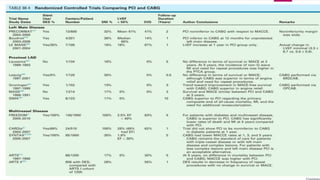
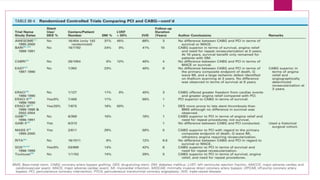
TRAILS COMPARING PCI VS CABG
 the Coronary Artery Surgery Study (CASS)
 Synergy between Percutaneous Coronary Intervention with Taxus and
Cardiac Surgery (SYNTAX)
 Future Revascularization Evaluation in Patients with Diabetes Mellitus:
Optimal Management of Multivessel Disease (FREEDOM)
 Coronary Artery Revascularization in Diabetes (CARDia)
TRAILS ONCAB VS OPCAB
 CORONARY TRAIL
 ROOBY TRAIL
 DOORS TRAIL
 GOPCABE TRAIL
 PRAGUE 6 TRAIL
 SMART STUDY
 PROMOTE PATENCY TRIAL
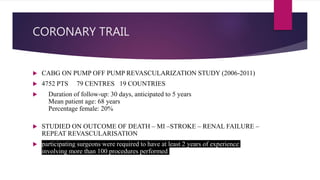
CORONARY TRAIL
 CABG ON PUMP OFF PUMP REVASCULARIZATION STUDY (2006-2011)
 4752 PTS 79 CENTRES 19 COUNTRIES
 Duration of follow-up: 30 days, anticipated to 5 years
Mean patient age: 68 years
Percentage female: 20%
 STUDIED ON OUTCOME OF DEATH – MI –STROKE – RENAL FAILURE –
REPEAT REVASCULARISATION
 participating surgeons were required to have at least 2 years of experience
involving more than 100 procedures performed
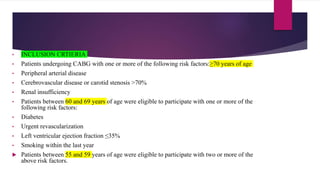
• INCLUSION CRTIERIA
• Patients undergoing CABG with one or more of the following risk factors:≥70 years of age
• Peripheral arterial disease
• Cerebrovascular disease or carotid stenosis >70%
• Renal insufficiency
• Patients between 60 and 69 years of age were eligible to participate with one or more of the
following risk factors:
• Diabetes
• Urgent revascularization
• Left ventricular ejection fraction ≤35%
• Smoking within the last year
 Patients between 55 and 59 years of age were eligible to participate with two or more of the
above risk factors.
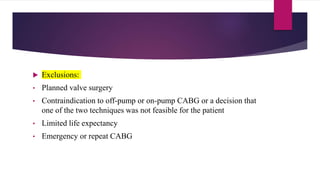
 Exclusions:
• Planned valve surgery
• Contraindication to off-pump or on-pump CABG or a decision that
one of the two techniques was not feasible for the patient
• Limited life expectancy
• Emergency or repeat CABG
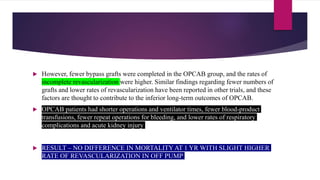
 However, fewer bypass grafts were completed in the OPCAB group, and the rates of
incomplete revascularization were higher. Similar findings regarding fewer numbers of
grafts and lower rates of revascularization have been reported in other trials, and these
factors are thought to contribute to the inferior long-term outcomes of OPCAB.
 OPCAB patients had shorter operations and ventilator times, fewer blood-product
transfusions, fewer repeat operations for bleeding, and lower rates of respiratory
complications and acute kidney injury
 RESULT – NO DIFFERENCE IN MORTALITY AT 1 YR WITH SLIGHT HIGHER
RATE OF REVASCULARIZATION IN OFF PUMP
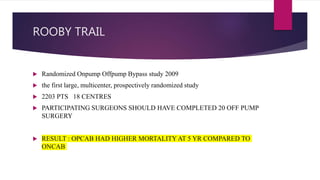
ROOBY TRAIL
 Randomized Onpump Offpump Bypass study 2009
 the first large, multicenter, prospectively randomized study
 2203 PTS 18 CENTRES
 PARTICIPATING SURGEONS SHOULD HAVE COMPLETED 20 OFF PUMP
SURGERY
 RESULT : OPCAB HAD HIGHER MORTALITY AT 5 YR COMPARED TO
ONCAB
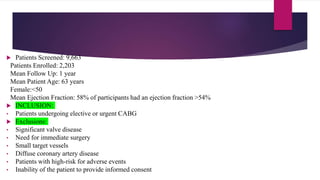
 Patients Screened: 9,663
Patients Enrolled: 2,203
Mean Follow Up: 1 year
Mean Patient Age: 63 years
Female:<50
Mean Ejection Fraction: 58% of participants had an ejection fraction >54%
 INCLUSION:
• Patients undergoing elective or urgent CABG
 Exclusions:
• Significant valve disease
• Need for immediate surgery
• Small target vessels
• Diffuse coronary artery disease
• Patients with high-risk for adverse events
• Inability of the patient to provide informed consent
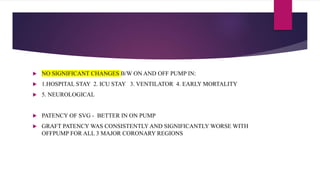
 NO SIGNIFICANT CHANGES B/W ON AND OFF PUMP IN:
 1.HOSPITAL STAY 2. ICU STAY 3. VENTILATOR 4. EARLY MORTALITY
 5. NEUROLOGICAL
 PATENCY OF SVG - BETTER IN ON PUMP
 GRAFT PATENCY WAS CONSISTENTLY AND SIGNIFICANTLY WORSE WITH
OFFPUMP FOR ALL 3 MAJOR CORONARY REGIONS
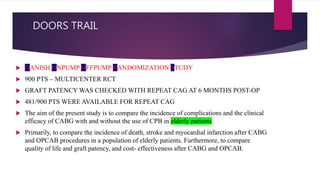
DOORS TRAIL
 DANISH ONPUMP OFFPUMP RANDOMIZATION STUDY
 900 PTS – MULTICENTER RCT
 GRAFT PATENCY WAS CHECKED WITH REPEAT CAG AT 6 MONTHS POST-OP
 481/900 PTS WERE AVAILABLE FOR REPEAT CAG
 The aim of the present study is to compare the incidence of complications and the clinical
efficacy of CABG with and without the use of CPB in elderly patients.
 Primarily, to compare the incidence of death, stroke and myocardial infarction after CABG
and OPCAB procedures in a population of elderly patients. Furthermore, to compare
quality of life and graft patency, and cost- effectiveness after CABG and OPCAB.
Primary Outcome Measures
1. A combined endpoint of death + stroke + myocardial infarction within 30 days from operation
[ Time Frame: 30 days ]
Secondary Outcome Measures :
2. A combined endpoint of death + stroke + myocardial infarction during follow-up [ Time Frame: 3 years ]
3. Patency of bypass grafts assessed by coronary angiography 6 months after the operation [ Time Frame: 6
months ]
4. Total mortality and cardiac mortality during follow-up [ Time Frame: 3 years ]
5. Need of new intervention for cardiac angina during follow-up [ Time Frame: 3 years ]
6. Quality of life assessed by MOS SF-36 and EuroQol questionnaires 6 months and 3 years after the
operation [ Time Frame: 6 months and 3 years ]
7. Total hospital costs and costs of public care provided 6 months and 3 years after the operation and
difference in costs per quality adjusted life year [ Time Frame: 6 months and 3 years ]
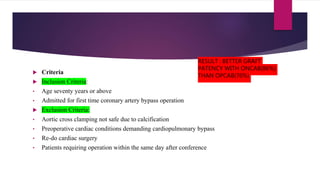
 Criteria
 Inclusion Criteria:
• Age seventy years or above
• Admitted for first time coronary artery bypass operation
 Exclusion Criteria:
• Aortic cross clamping not safe due to calcification
• Preoperative cardiac conditions demanding cardiopulmonary bypass
• Re-do cardiac surgery
• Patients requiring operation within the same day after conference
RESULT : BETTER GRAFT
PATENCY WITH ONCAB(86%)
THAN OPCAB(76%)
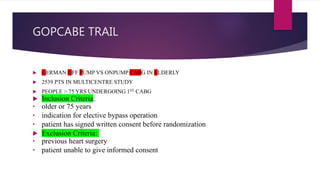
GOPCABE TRAIL
 GERMAN OFF PUMP VS ONPUMP CABG IN ELDERLY
 2539 PTS IN MULTICENTRE STUDY
 PEOPLE > 75 YRS UNDERGOING 1ST CABG
 Inclusion Criteria:
• older or 75 years
• indication for elective bypass operation
• patient has signed written consent before randomization
 Exclusion Criteria:
• previous heart surgery
• patient unable to give informed consent
Primary Outcome Measures
1. All cause mortality [ Time Frame: 1 month and 12 month ]
2. Myocardial infarction [ Time Frame: 1 month and 12 month ]
3. Stroke [ Time Frame: 1 month and 12 month ]
4. Any revascularisation [ Time Frame: 1 month and30 month ]
5. renal failure [ Time Frame: 1 month and 12 month ]
Secondary Outcome Measures
1. Ventilation time [ Time Frame: post op ]
2. blood transfusion [ Time Frame: post op ]
3. length of stay in intensive-care unit [ Time Frame: post op ]
RESULT:
EVEN IN ELDERLY THE RATE OF COMPOSITE
OUTCOME IS SIMILAR WITH OPCAB NOT
SHOWING ANY ADVANTAGE . IN FACT OPCAB
NEEDED MUCH MORE FREQUENT
REVASCULRISATION
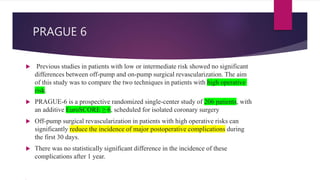
PRAGUE 6
 Previous studies in patients with low or intermediate risk showed no significant
differences between off-pump and on-pump surgical revascularization. The aim
of this study was to compare the two techniques in patients with high operative
risk.
 PRAGUE-6 is a prospective randomized single-center study of 206 patients, with
an additive EuroSCORE ≥ 6, scheduled for isolated coronary surgery
 Off-pump surgical revascularization in patients with high operative risks can
significantly reduce the incidence of major postoperative complications during
the first 30 days.
 There was no statistically significant difference in the incidence of these
complications after 1 year.
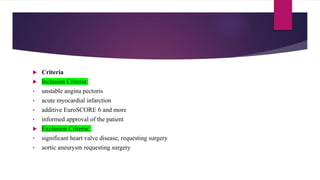
 Criteria
 Inclusion Criteria:
• unstable angina pectoris
• acute myocardial infarction
• additive EuroSCORE 6 and more
• informed approval of the patient
 Exclusion Criteria:
• significant heart valve disease, requesting surgery
• aortic aneurysm requesting surgery
SMART TRAIL
 SURGICAL MANAGEMENT OF ARTERIAL REVASCULARIZATION THERAPIES
TRAIL
 200 PTS UNSELECTED WERE RANDOMLY ASSIGNED FOR OPCAB /
ONPUMP(2000-2001)
 AIM: TO COMPARE LONG TERM SURVIVAL, GRAFT PATENCY, MORTALITY

 RESULT : SIMILAR IN GRAFT PATENCY , REINTERVENTION, LONG TERM
SURVIVAL
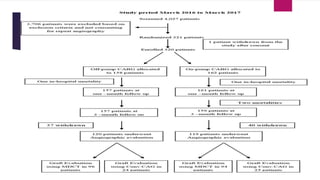
PROMOTE PATENCY TRAIL
 Prospective Randomized comparison of Off-pump and On-pump
Multivessel coronary artery bypass surgery To Evaluate outcomes
and graft patency (PROMOTE )
 CABG at 6 centers by 7 surgeons in India
 320 patients (recruitment ranged from 26 to 56 patients per
surgeon) were enrolled to either on-pump (n = 162) or off-pump
(n = 158)
 Inclusion criteria
 male or female aged ≥ 21 years and ≤ 70 years,
 multivessel CAD, with triple vessel disease or left main coronary artery (LMCA) stenosis,
 Requiring isolated CABG
 left ventricular ejection fraction (LVEF) of ≥ 40%
 Exclusion criteria
 CABG with concomitant procedures
 contra-indications to either off-pump or on-pump CABG
 chronic atrial fibrillation
 serum creatinine > 1.3% mg/dL
 The study demonstrates that there is no significant difference in
overall graft patency rates at 3 months between off-pump and on-
pump CABG groups when performed by experienced surgeons who
have a higher adoption of this strategy..
 At 3 months follow-up, off-pump CABG was associated with a
fewer (major adverse cardiac and cerebrovascular events) MACCE
compared to on-pump CABG.
 THANK YOU

Trails on coronary revascularization

  • 1.
  • 2.
    TRAILS COMPARING PCIVS CABG  the Coronary Artery Surgery Study (CASS)  Synergy between Percutaneous Coronary Intervention with Taxus and Cardiac Surgery (SYNTAX)  Future Revascularization Evaluation in Patients with Diabetes Mellitus: Optimal Management of Multivessel Disease (FREEDOM)  Coronary Artery Revascularization in Diabetes (CARDia)
  • 5.
    TRAILS ONCAB VSOPCAB  CORONARY TRAIL  ROOBY TRAIL  DOORS TRAIL  GOPCABE TRAIL  PRAGUE 6 TRAIL  SMART STUDY  PROMOTE PATENCY TRIAL
  • 6.
    CORONARY TRAIL  CABGON PUMP OFF PUMP REVASCULARIZATION STUDY (2006-2011)  4752 PTS 79 CENTRES 19 COUNTRIES  Duration of follow-up: 30 days, anticipated to 5 years Mean patient age: 68 years Percentage female: 20%  STUDIED ON OUTCOME OF DEATH – MI –STROKE – RENAL FAILURE – REPEAT REVASCULARISATION  participating surgeons were required to have at least 2 years of experience involving more than 100 procedures performed
  • 7.
    • INCLUSION CRTIERIA •Patients undergoing CABG with one or more of the following risk factors:≥70 years of age • Peripheral arterial disease • Cerebrovascular disease or carotid stenosis >70% • Renal insufficiency • Patients between 60 and 69 years of age were eligible to participate with one or more of the following risk factors: • Diabetes • Urgent revascularization • Left ventricular ejection fraction ≤35% • Smoking within the last year  Patients between 55 and 59 years of age were eligible to participate with two or more of the above risk factors.
  • 8.
     Exclusions: • Plannedvalve surgery • Contraindication to off-pump or on-pump CABG or a decision that one of the two techniques was not feasible for the patient • Limited life expectancy • Emergency or repeat CABG
  • 9.
     However, fewerbypass grafts were completed in the OPCAB group, and the rates of incomplete revascularization were higher. Similar findings regarding fewer numbers of grafts and lower rates of revascularization have been reported in other trials, and these factors are thought to contribute to the inferior long-term outcomes of OPCAB.  OPCAB patients had shorter operations and ventilator times, fewer blood-product transfusions, fewer repeat operations for bleeding, and lower rates of respiratory complications and acute kidney injury  RESULT – NO DIFFERENCE IN MORTALITY AT 1 YR WITH SLIGHT HIGHER RATE OF REVASCULARIZATION IN OFF PUMP
  • 10.
    ROOBY TRAIL  RandomizedOnpump Offpump Bypass study 2009  the first large, multicenter, prospectively randomized study  2203 PTS 18 CENTRES  PARTICIPATING SURGEONS SHOULD HAVE COMPLETED 20 OFF PUMP SURGERY  RESULT : OPCAB HAD HIGHER MORTALITY AT 5 YR COMPARED TO ONCAB
  • 11.
     Patients Screened:9,663 Patients Enrolled: 2,203 Mean Follow Up: 1 year Mean Patient Age: 63 years Female:<50 Mean Ejection Fraction: 58% of participants had an ejection fraction >54%  INCLUSION: • Patients undergoing elective or urgent CABG  Exclusions: • Significant valve disease • Need for immediate surgery • Small target vessels • Diffuse coronary artery disease • Patients with high-risk for adverse events • Inability of the patient to provide informed consent
  • 12.
     NO SIGNIFICANTCHANGES B/W ON AND OFF PUMP IN:  1.HOSPITAL STAY 2. ICU STAY 3. VENTILATOR 4. EARLY MORTALITY  5. NEUROLOGICAL  PATENCY OF SVG - BETTER IN ON PUMP  GRAFT PATENCY WAS CONSISTENTLY AND SIGNIFICANTLY WORSE WITH OFFPUMP FOR ALL 3 MAJOR CORONARY REGIONS
  • 13.
    DOORS TRAIL  DANISHONPUMP OFFPUMP RANDOMIZATION STUDY  900 PTS – MULTICENTER RCT  GRAFT PATENCY WAS CHECKED WITH REPEAT CAG AT 6 MONTHS POST-OP  481/900 PTS WERE AVAILABLE FOR REPEAT CAG  The aim of the present study is to compare the incidence of complications and the clinical efficacy of CABG with and without the use of CPB in elderly patients.  Primarily, to compare the incidence of death, stroke and myocardial infarction after CABG and OPCAB procedures in a population of elderly patients. Furthermore, to compare quality of life and graft patency, and cost- effectiveness after CABG and OPCAB.
  • 14.
    Primary Outcome Measures 1.A combined endpoint of death + stroke + myocardial infarction within 30 days from operation [ Time Frame: 30 days ] Secondary Outcome Measures : 2. A combined endpoint of death + stroke + myocardial infarction during follow-up [ Time Frame: 3 years ] 3. Patency of bypass grafts assessed by coronary angiography 6 months after the operation [ Time Frame: 6 months ] 4. Total mortality and cardiac mortality during follow-up [ Time Frame: 3 years ] 5. Need of new intervention for cardiac angina during follow-up [ Time Frame: 3 years ] 6. Quality of life assessed by MOS SF-36 and EuroQol questionnaires 6 months and 3 years after the operation [ Time Frame: 6 months and 3 years ] 7. Total hospital costs and costs of public care provided 6 months and 3 years after the operation and difference in costs per quality adjusted life year [ Time Frame: 6 months and 3 years ]
  • 15.
     Criteria  InclusionCriteria: • Age seventy years or above • Admitted for first time coronary artery bypass operation  Exclusion Criteria: • Aortic cross clamping not safe due to calcification • Preoperative cardiac conditions demanding cardiopulmonary bypass • Re-do cardiac surgery • Patients requiring operation within the same day after conference RESULT : BETTER GRAFT PATENCY WITH ONCAB(86%) THAN OPCAB(76%)
  • 16.
    GOPCABE TRAIL  GERMANOFF PUMP VS ONPUMP CABG IN ELDERLY  2539 PTS IN MULTICENTRE STUDY  PEOPLE > 75 YRS UNDERGOING 1ST CABG  Inclusion Criteria: • older or 75 years • indication for elective bypass operation • patient has signed written consent before randomization  Exclusion Criteria: • previous heart surgery • patient unable to give informed consent
  • 17.
    Primary Outcome Measures 1.All cause mortality [ Time Frame: 1 month and 12 month ] 2. Myocardial infarction [ Time Frame: 1 month and 12 month ] 3. Stroke [ Time Frame: 1 month and 12 month ] 4. Any revascularisation [ Time Frame: 1 month and30 month ] 5. renal failure [ Time Frame: 1 month and 12 month ] Secondary Outcome Measures 1. Ventilation time [ Time Frame: post op ] 2. blood transfusion [ Time Frame: post op ] 3. length of stay in intensive-care unit [ Time Frame: post op ] RESULT: EVEN IN ELDERLY THE RATE OF COMPOSITE OUTCOME IS SIMILAR WITH OPCAB NOT SHOWING ANY ADVANTAGE . IN FACT OPCAB NEEDED MUCH MORE FREQUENT REVASCULRISATION
  • 18.
    PRAGUE 6  Previousstudies in patients with low or intermediate risk showed no significant differences between off-pump and on-pump surgical revascularization. The aim of this study was to compare the two techniques in patients with high operative risk.  PRAGUE-6 is a prospective randomized single-center study of 206 patients, with an additive EuroSCORE ≥ 6, scheduled for isolated coronary surgery  Off-pump surgical revascularization in patients with high operative risks can significantly reduce the incidence of major postoperative complications during the first 30 days.  There was no statistically significant difference in the incidence of these complications after 1 year.
  • 19.
     Criteria  InclusionCriteria: • unstable angina pectoris • acute myocardial infarction • additive EuroSCORE 6 and more • informed approval of the patient  Exclusion Criteria: • significant heart valve disease, requesting surgery • aortic aneurysm requesting surgery
  • 20.
    SMART TRAIL  SURGICALMANAGEMENT OF ARTERIAL REVASCULARIZATION THERAPIES TRAIL  200 PTS UNSELECTED WERE RANDOMLY ASSIGNED FOR OPCAB / ONPUMP(2000-2001)  AIM: TO COMPARE LONG TERM SURVIVAL, GRAFT PATENCY, MORTALITY   RESULT : SIMILAR IN GRAFT PATENCY , REINTERVENTION, LONG TERM SURVIVAL
  • 21.
    PROMOTE PATENCY TRAIL Prospective Randomized comparison of Off-pump and On-pump Multivessel coronary artery bypass surgery To Evaluate outcomes and graft patency (PROMOTE )  CABG at 6 centers by 7 surgeons in India  320 patients (recruitment ranged from 26 to 56 patients per surgeon) were enrolled to either on-pump (n = 162) or off-pump (n = 158)
  • 22.
     Inclusion criteria male or female aged ≥ 21 years and ≤ 70 years,  multivessel CAD, with triple vessel disease or left main coronary artery (LMCA) stenosis,  Requiring isolated CABG  left ventricular ejection fraction (LVEF) of ≥ 40%  Exclusion criteria  CABG with concomitant procedures  contra-indications to either off-pump or on-pump CABG  chronic atrial fibrillation  serum creatinine > 1.3% mg/dL
  • 24.
     The studydemonstrates that there is no significant difference in overall graft patency rates at 3 months between off-pump and on- pump CABG groups when performed by experienced surgeons who have a higher adoption of this strategy..  At 3 months follow-up, off-pump CABG was associated with a fewer (major adverse cardiac and cerebrovascular events) MACCE compared to on-pump CABG.
  • 25.