Linguistics 001: Linguistic
Typology
Part II: Further aspects of
Typology
Recall that
• We are examining some the various ways in
which languages differ
• In the background, the question is how these
differences can be reconciled with the idea
that there is an innate aspect of language
• In our final examples from the last lecture, we
began looking at syntactic typology and word
order
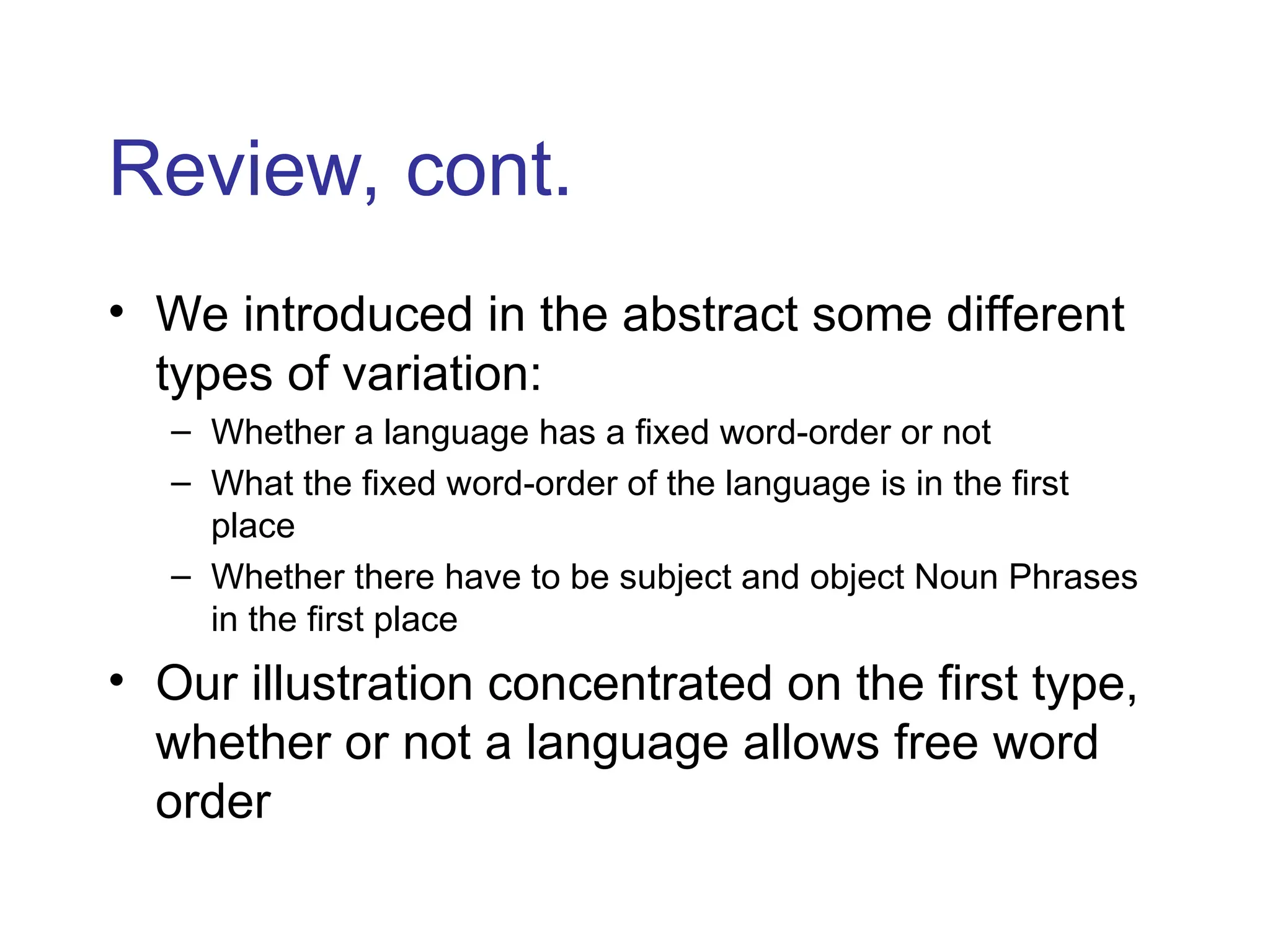
Review, cont.
• We introduced in the abstract some different
types of variation:
– Whether a language has a fixed word-order or not
– What the fixed word-order of the language is in the first
place
– Whether there have to be subject and object Noun Phrases
in the first place
• Our illustration concentrated on the first type,
whether or not a language allows free word
order
Today’s topics
• Word order typology, continued
• Ergativity
• Morphology: Templates…
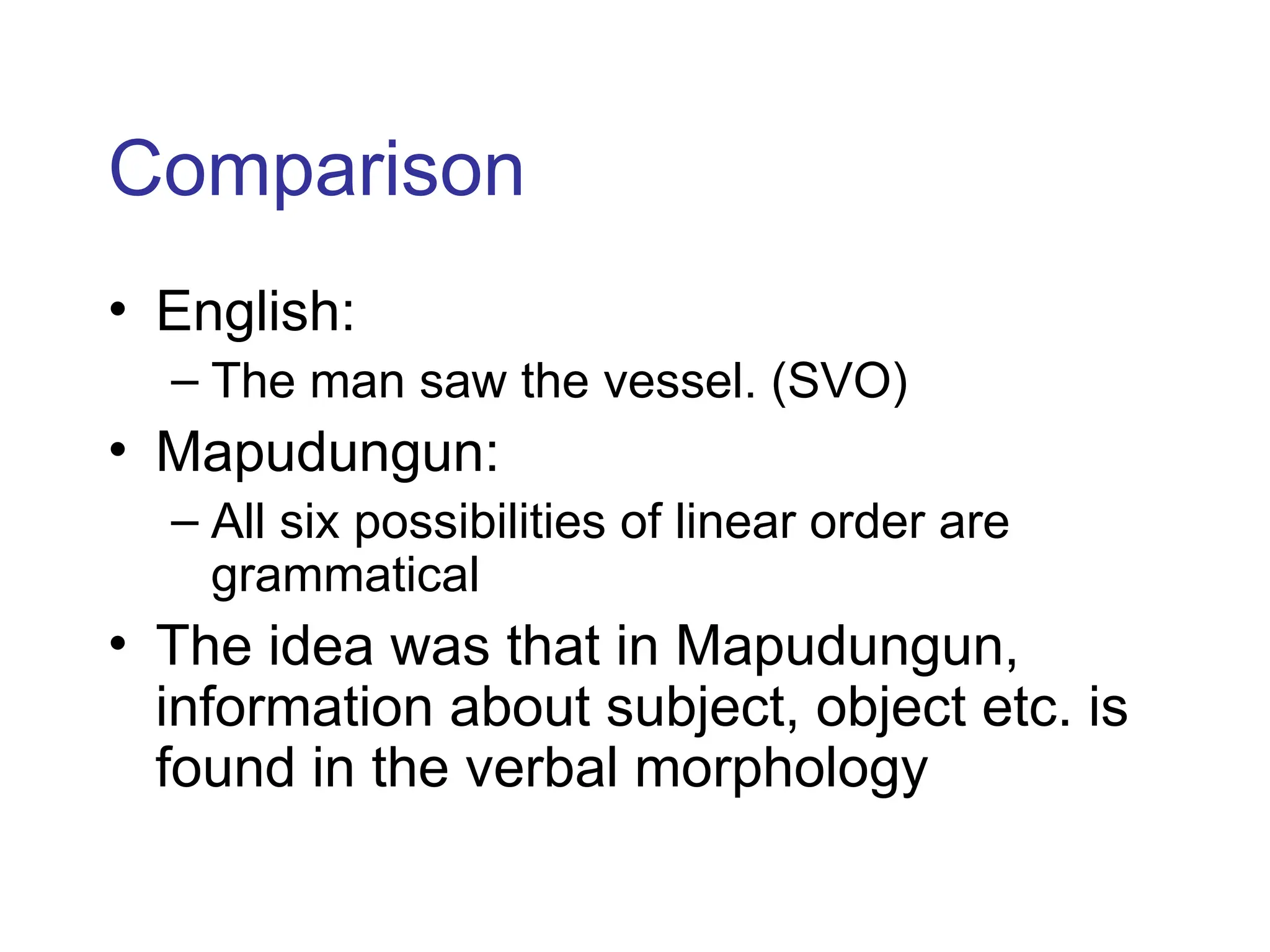
Comparison
• English:
– The man saw the vessel. (SVO)
• Mapudungun:
– All six possibilities of linear order are
grammatical
• The idea was that in Mapudungun,
information about subject, object etc. is
found in the verbal morphology
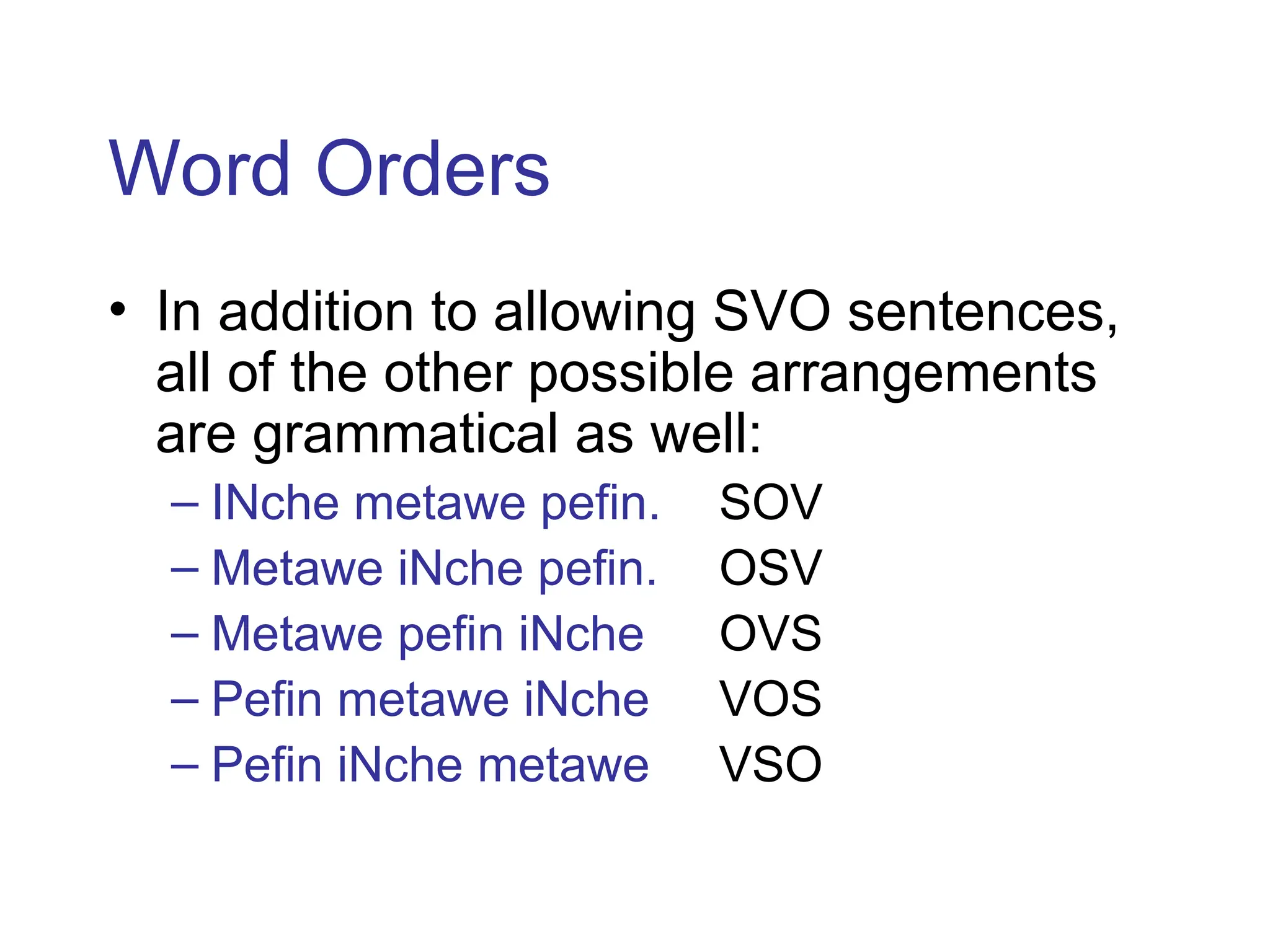
Word Orders
• In addition to allowing SVO sentences,
all of the other possible arrangements
are grammatical as well:
– INche metawe pefin. SOV
– Metawe iNche pefin. OSV
– Metawe pefin iNche OVS
– Pefin metawe iNche VOS
– Pefin iNche metawe VSO
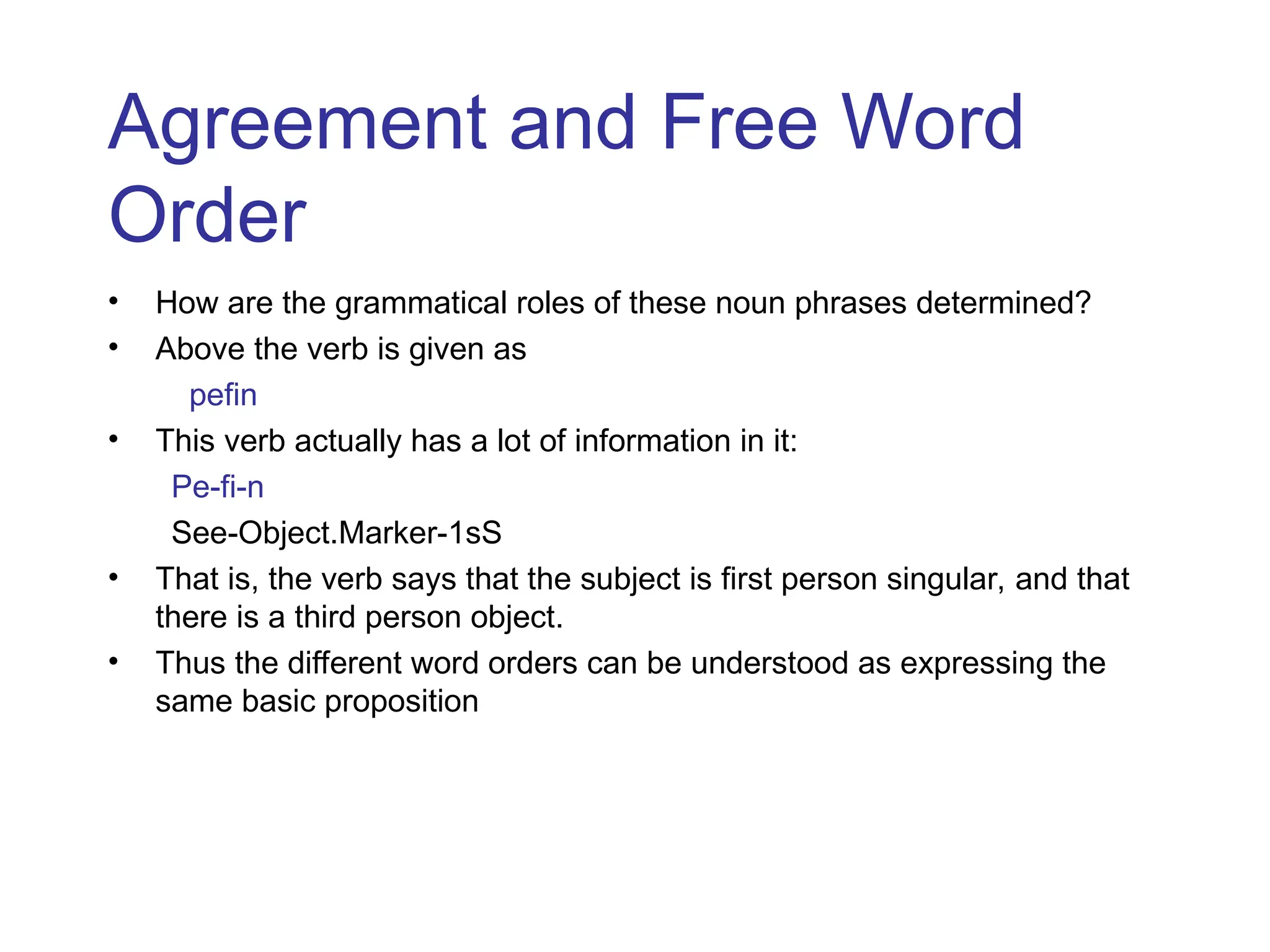
Agreement and Free Word
Order
• How are the grammatical roles of these noun phrases determined?
• Above the verb is given as
pefin
• This verb actually has a lot of information in it:
Pe-fi-n
See-Object.Marker-1sS
• That is, the verb says that the subject is first person singular, and that
there is a third person object.
• Thus the different word orders can be understood as expressing the
same basic proposition
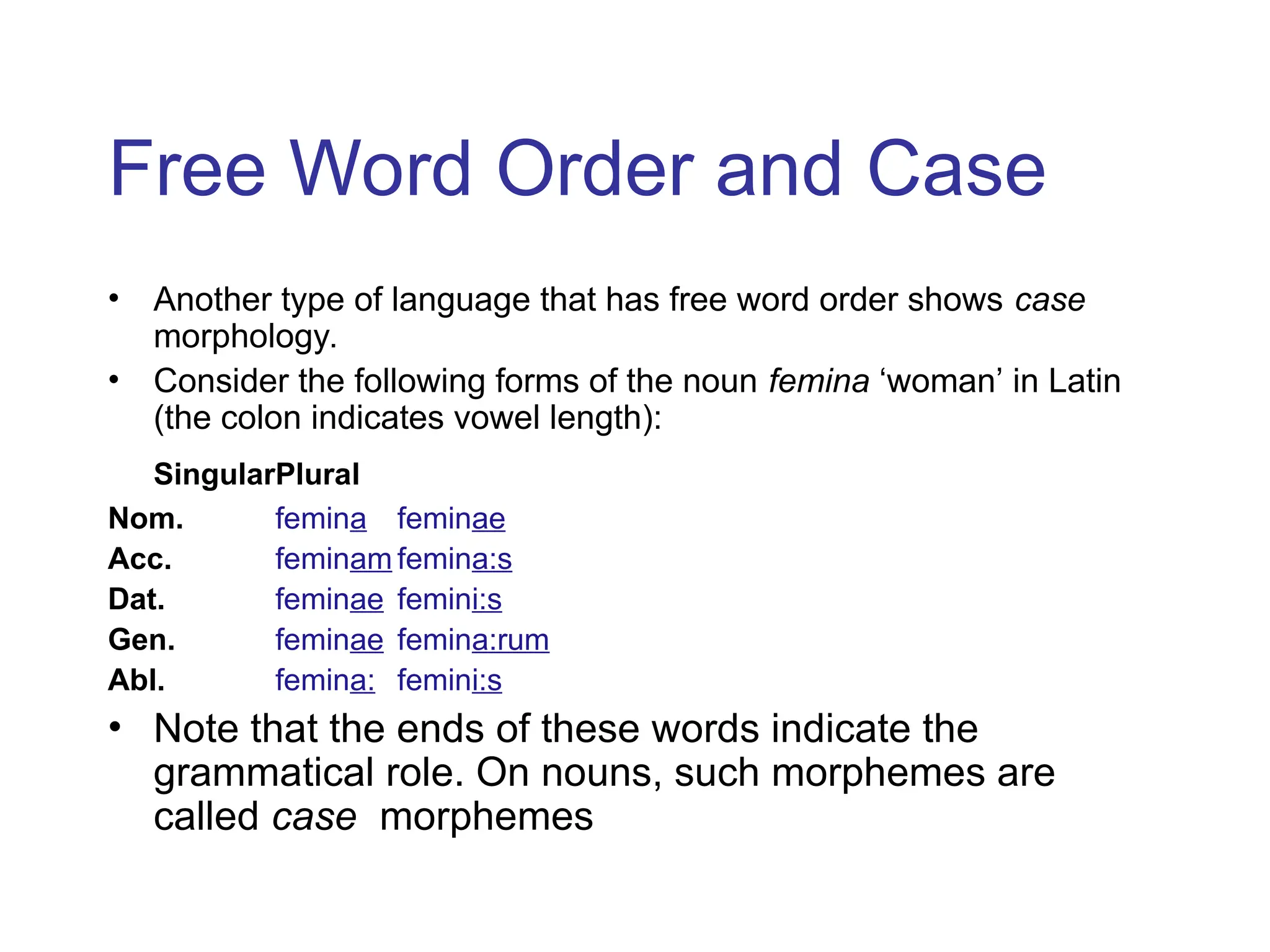
Free Word Order and Case
• Another type of language that has free word order shows case
morphology.
• Consider the following forms of the noun femina ‘woman’ in Latin
(the colon indicates vowel length):
SingularPlural
Nom. femina feminae
Acc. feminam femina:s
Dat. feminae femini:s
Gen. feminae femina:rum
Abl. femina: femini:s
• Note that the ends of these words indicate the
grammatical role. On nouns, such morphemes are
called case morphemes
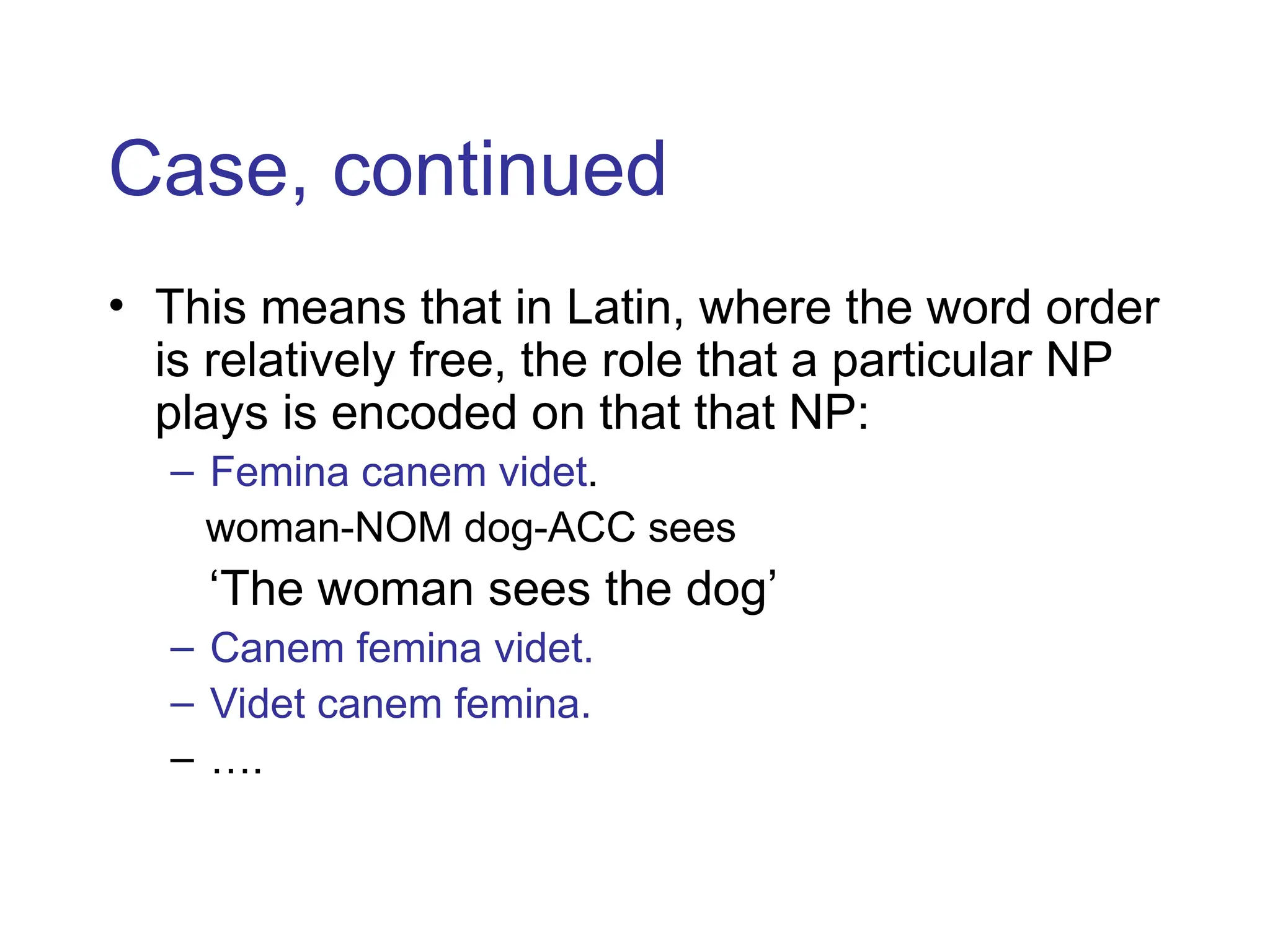
Case, continued
• This means that in Latin, where the word order
is relatively free, the role that a particular NP
plays is encoded on that that NP:
– Femina canem videt.
woman-NOM dog-ACC sees
‘The woman sees the dog’
– Canem femina videt.
– Videt canem femina.
– ….
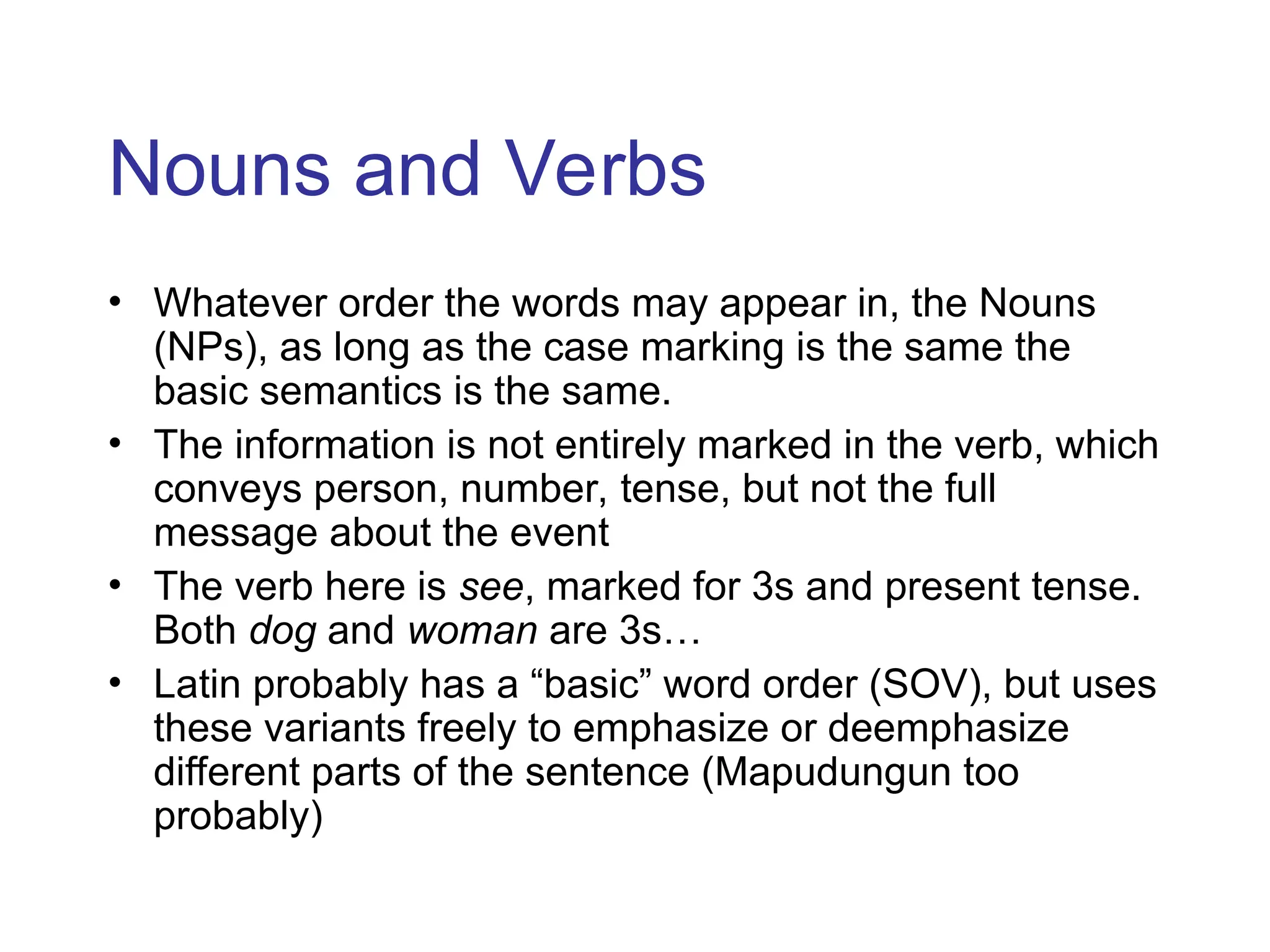
Nouns and Verbs
• Whatever order the words may appear in, the Nouns
(NPs), as long as the case marking is the same the
basic semantics is the same.
• The information is not entirely marked in the verb, which
conveys person, number, tense, but not the full
message about the event
• The verb here is see, marked for 3s and present tense.
Both dog and woman are 3s…
• Latin probably has a “basic” word order (SOV), but uses
these variants freely to emphasize or deemphasize
different parts of the sentence (Mapudungun too
probably)
Back to basic word orders
• As we discussed above, there are some
languages that do not allow free word order
• Languages (of this type) tend to display a
basic word order, which is used in unmarked
circumstances
• Among these, there are again differences in
terms of what order is employed
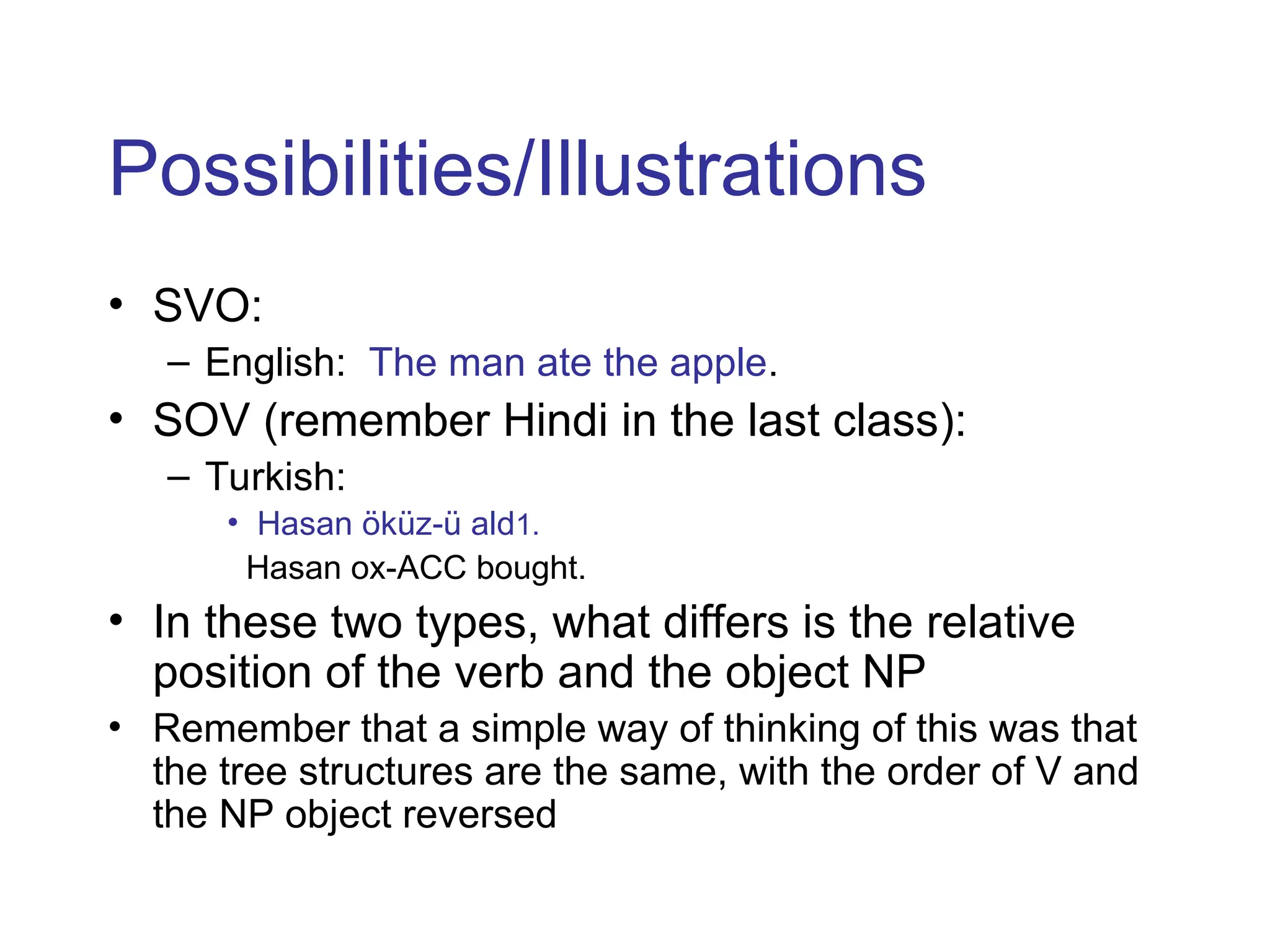
Possibilities/Illustrations
• SVO:
– English: The man ate the apple.
• SOV (remember Hindi in the last class):
– Turkish:
• Hasan öküz-ü ald1.
Hasan ox-ACC bought.
• In these two types, what differs is the relative
position of the verb and the object NP
• Remember that a simple way of thinking of this was that
the tree structures are the same, with the order of V and
the NP object reversed
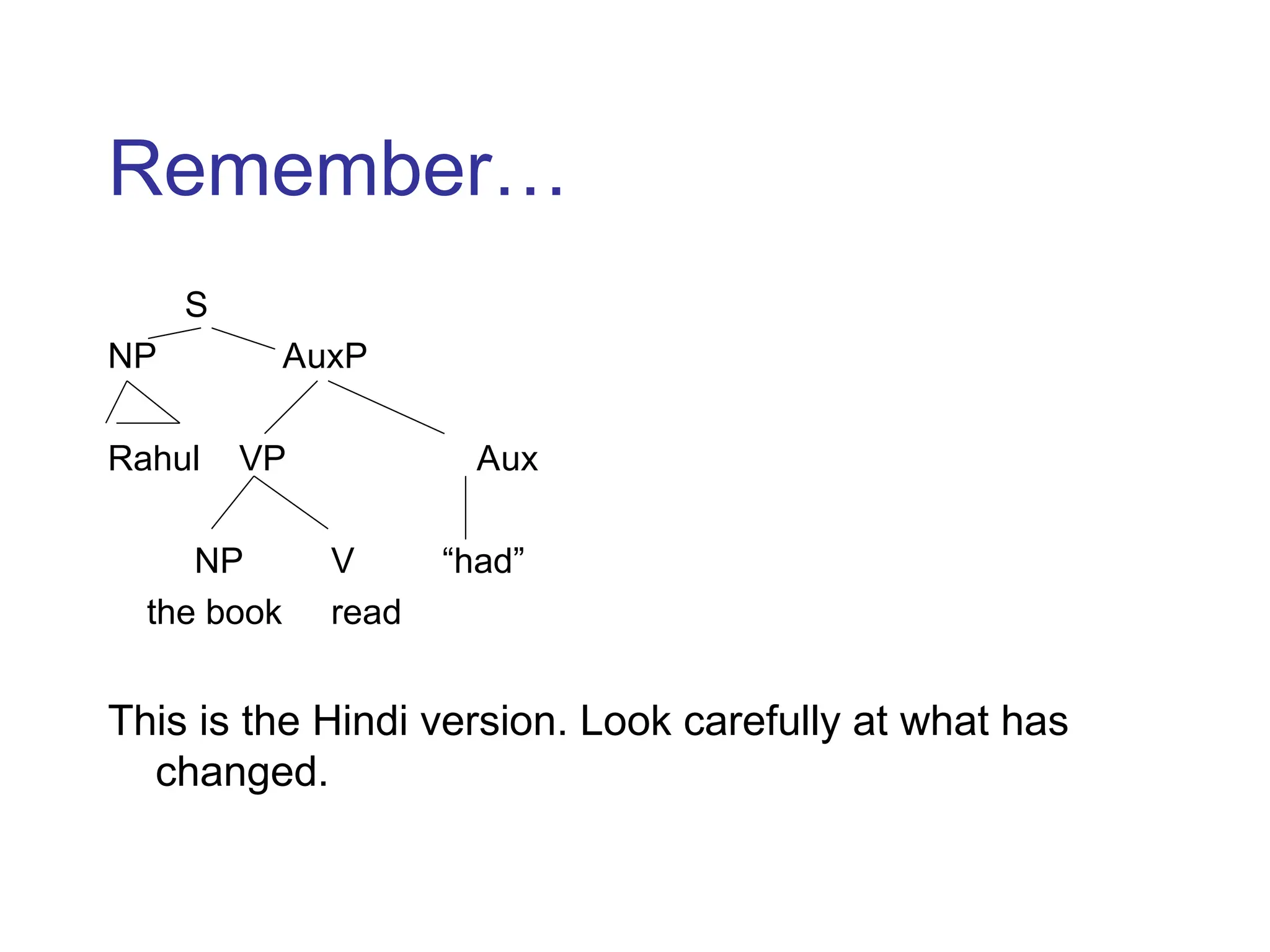
Remember…
S
NP AuxP
Rahul VP Aux
NP V “had”
the book read
This is the Hindi version. Look carefully at what has
changed.
VOS
• Basic VOS Word Order:
– Malagasy (spoken in Madagascar)
• Nahita ny mpianatra ny vehivavy
saw the student the woman
‘The woman saw the student’
• VOS doesn’t provide the same challenge as
VSO, which we discussed last time (draw the
tree…)
• At the same time, it might be the case that this
isn’t just the “subject mirror image” of SVO
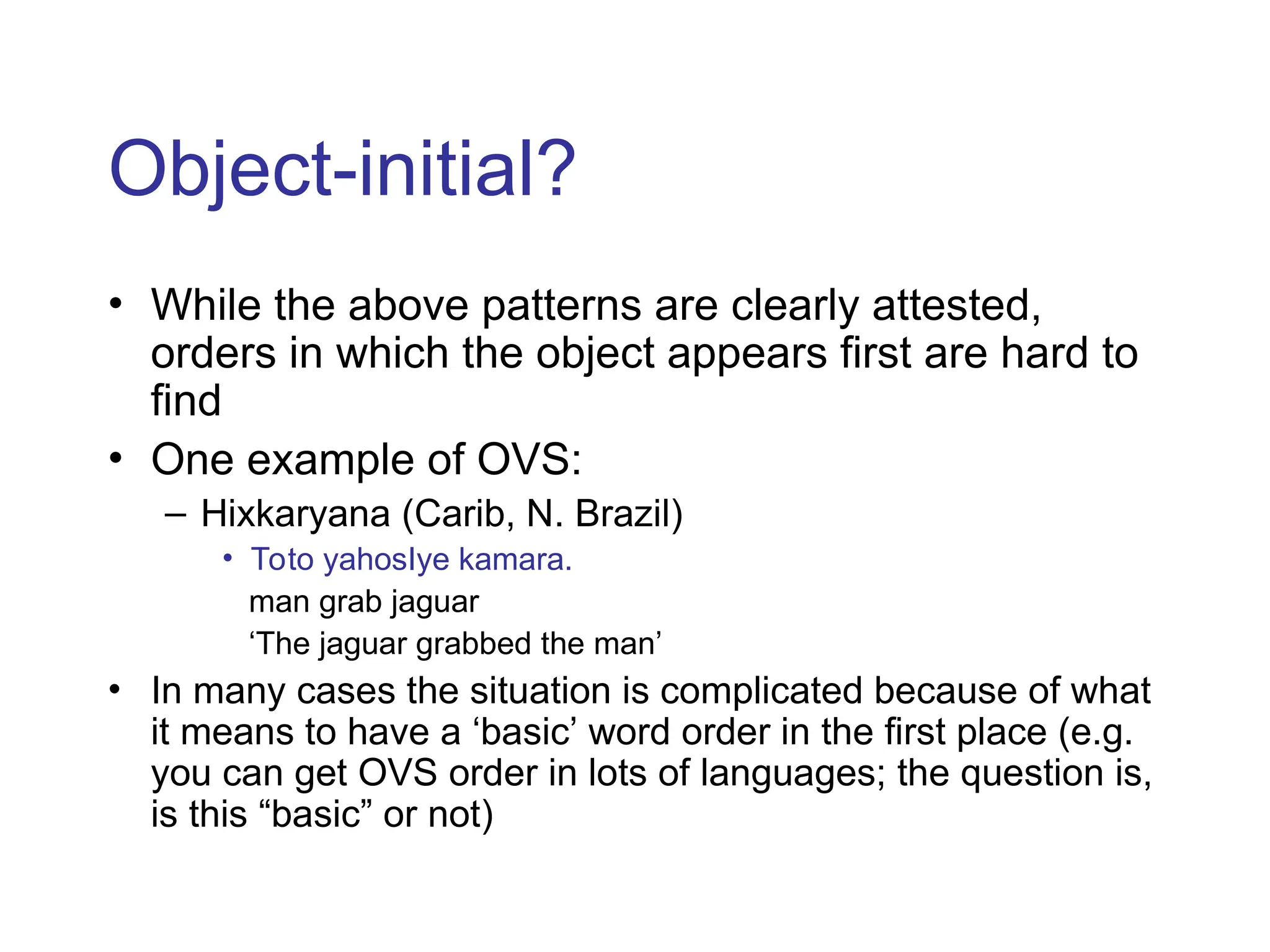
Object-initial?
• While the above patterns are clearly attested,
orders in which the object appears first are hard to
find
• One example of OVS:
– Hixkaryana (Carib, N. Brazil)
• Toto yahosIye kamara.
man grab jaguar
‘The jaguar grabbed the man’
• In many cases the situation is complicated because of what
it means to have a ‘basic’ word order in the first place (e.g.
you can get OVS order in lots of languages; the question is,
is this “basic” or not)
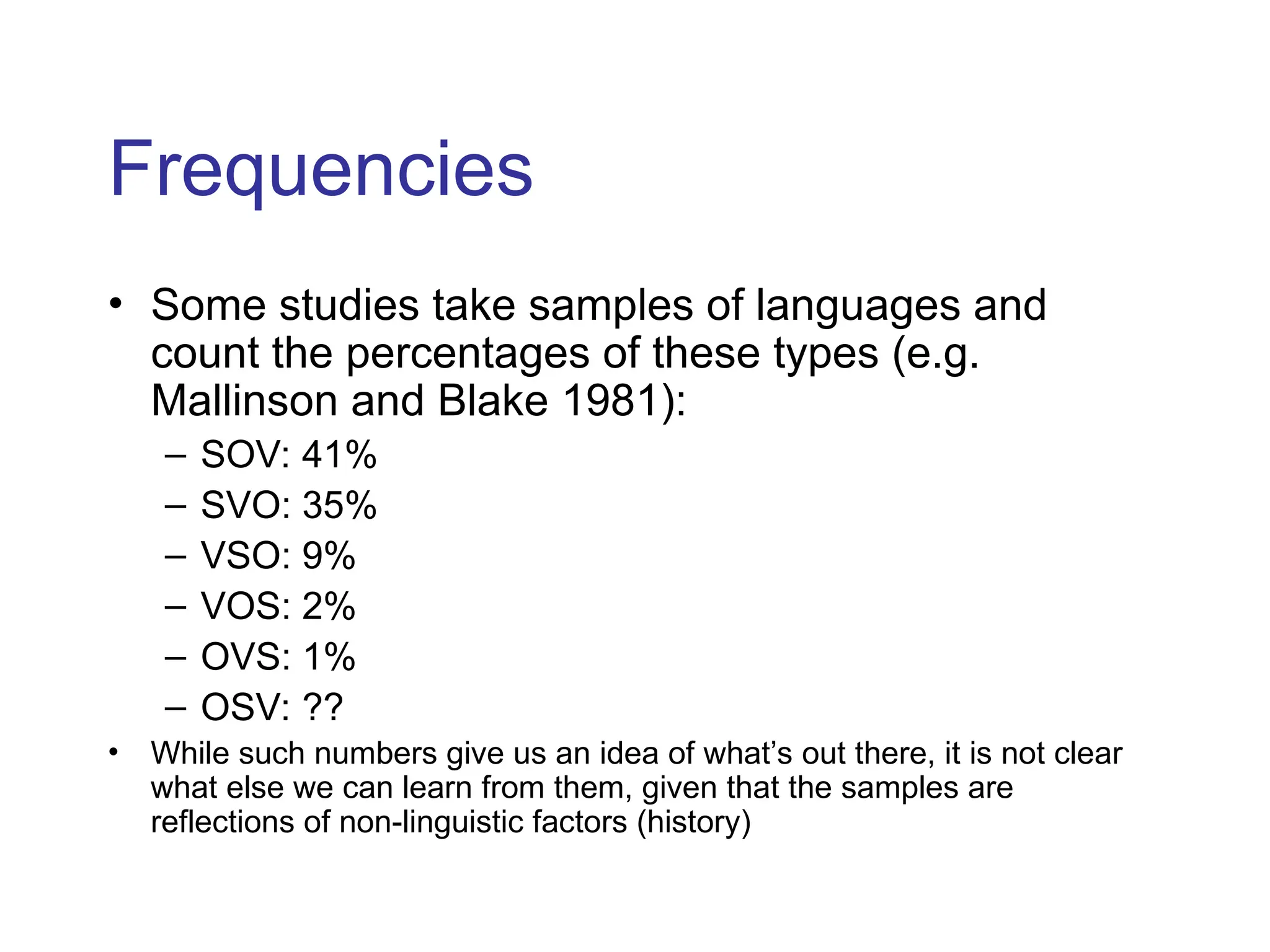
Frequencies
• Some studies take samples of languages and
count the percentages of these types (e.g.
Mallinson and Blake 1981):
– SOV: 41%
– SVO: 35%
– VSO: 9%
– VOS: 2%
– OVS: 1%
– OSV: ??
• While such numbers give us an idea of what’s out there, it is not clear
what else we can learn from them, given that the samples are
reflections of non-linguistic factors (history)
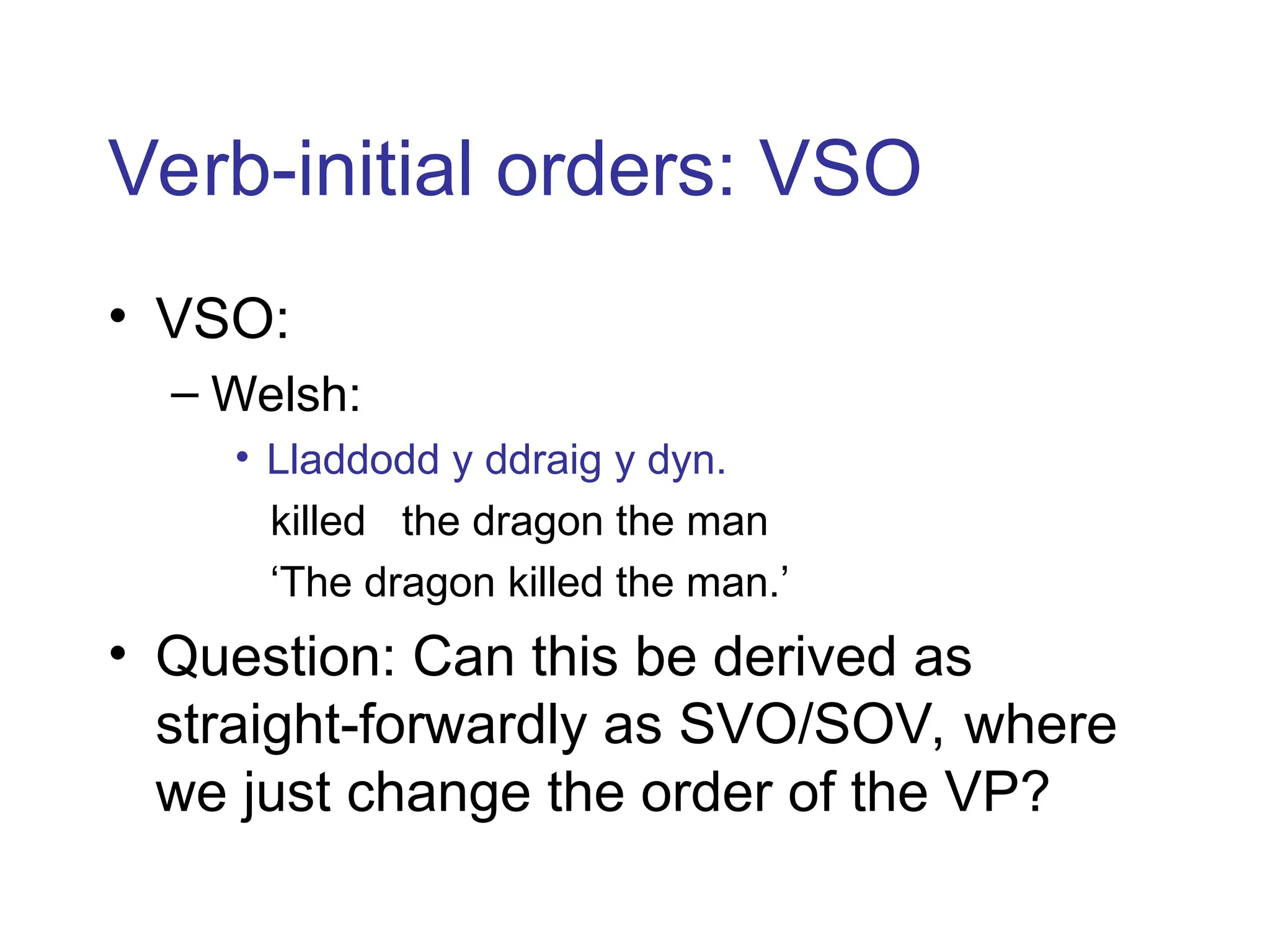
Verb-initial orders: VSO
• VSO:
– Welsh:
• Lladdodd y ddraig y dyn.
killed the dragon the man
‘The dragon killed the man.’
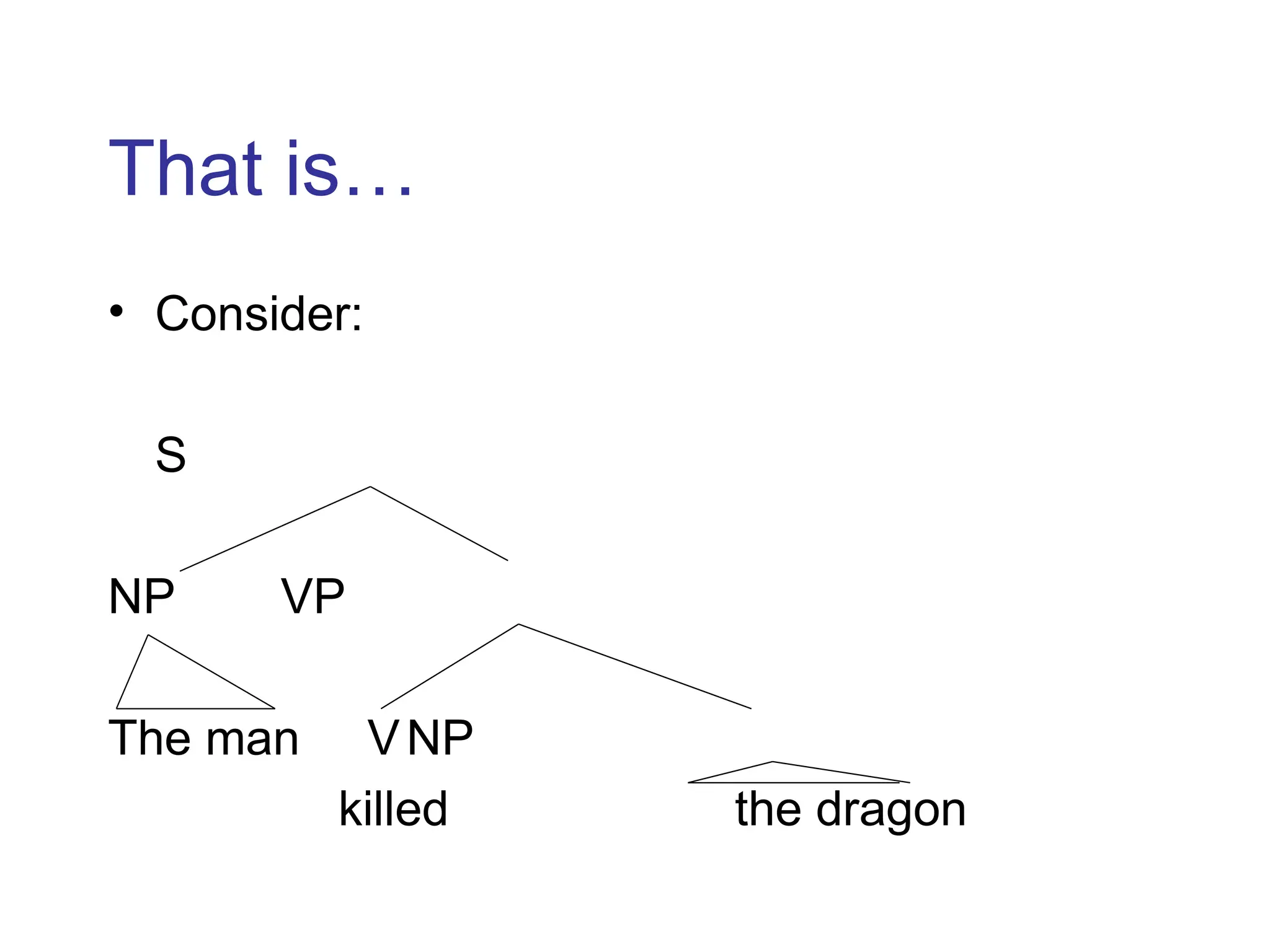
• Question: Can this be derived as
straight-forwardly as SVO/SOV, where
we just change the order of the VP?
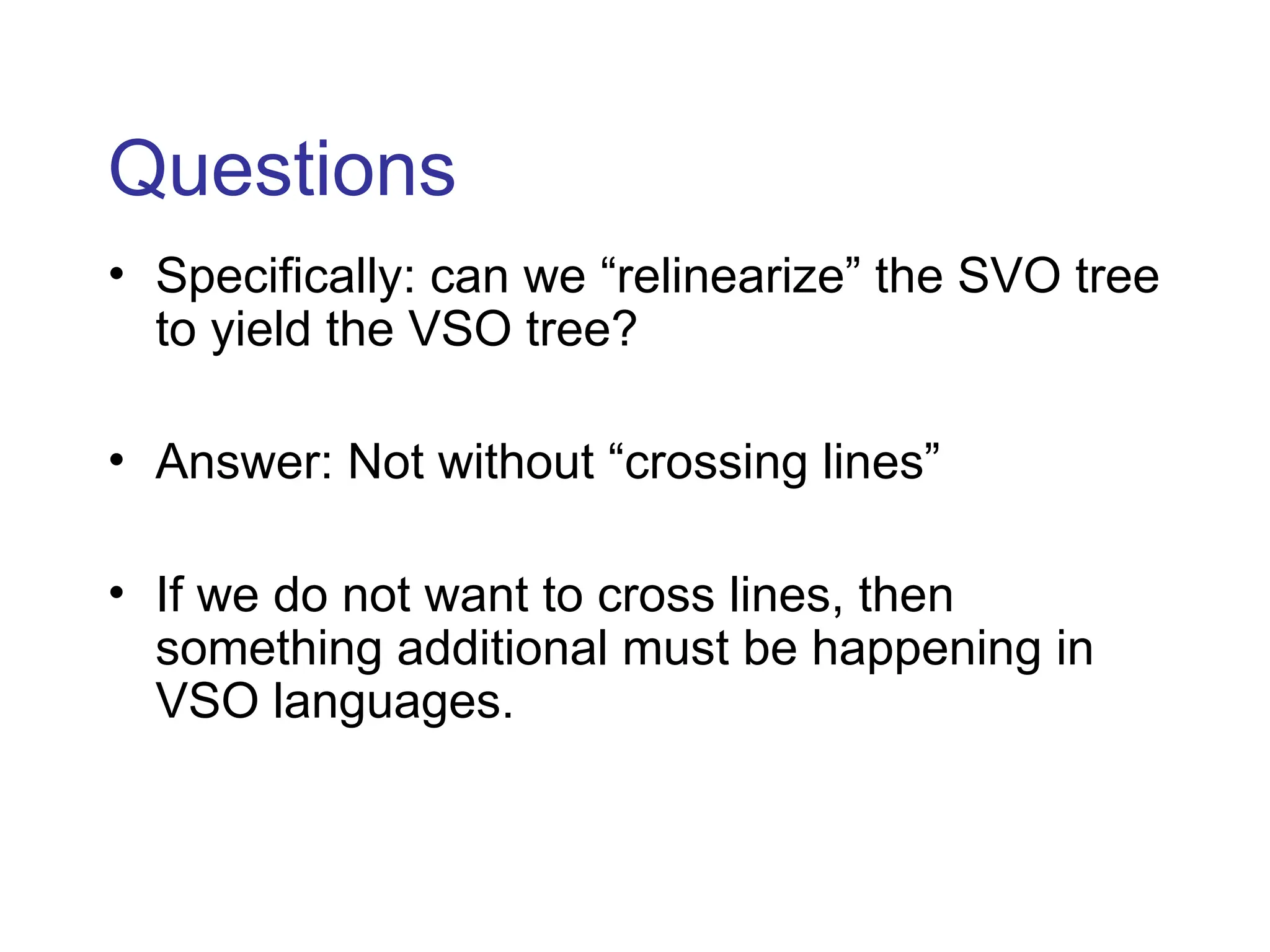
Questions
• Specifically: can we “relinearize” the SVO tree
to yield the VSO tree?
• Answer: Not without “crossing lines”
• If we do not want to cross lines, then
something additional must be happening in
VSO languages.
That is…
• Consider:
S
NP VP
The man VNP
killed the dragon
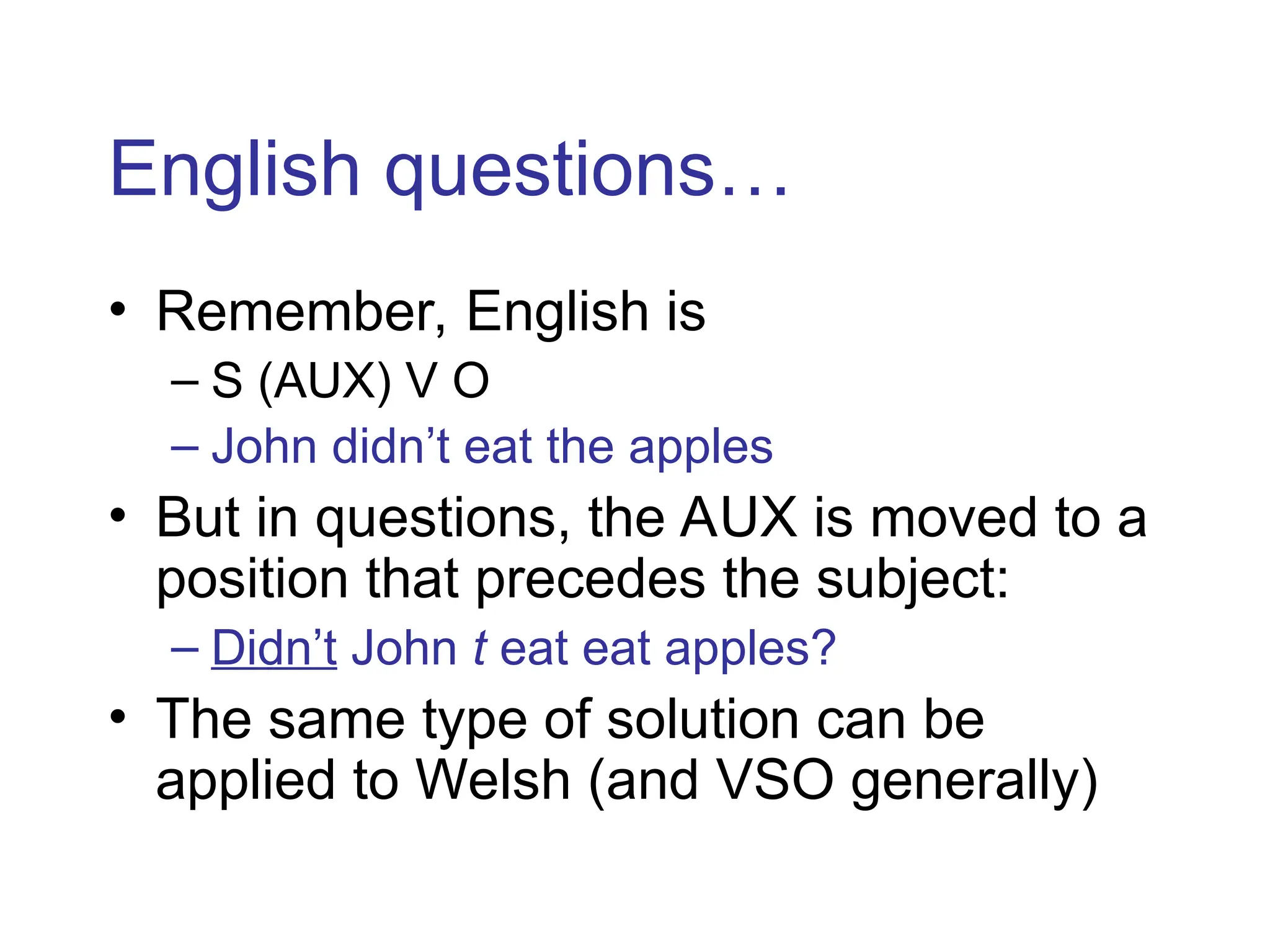
English questions…
• Remember, English is
– S (AUX) V O
– John didn’t eat the apples
• But in questions, the AUX is moved to a
position that precedes the subject:
– Didn’t John t eat eat apples?
• The same type of solution can be
applied to Welsh (and VSO generally)
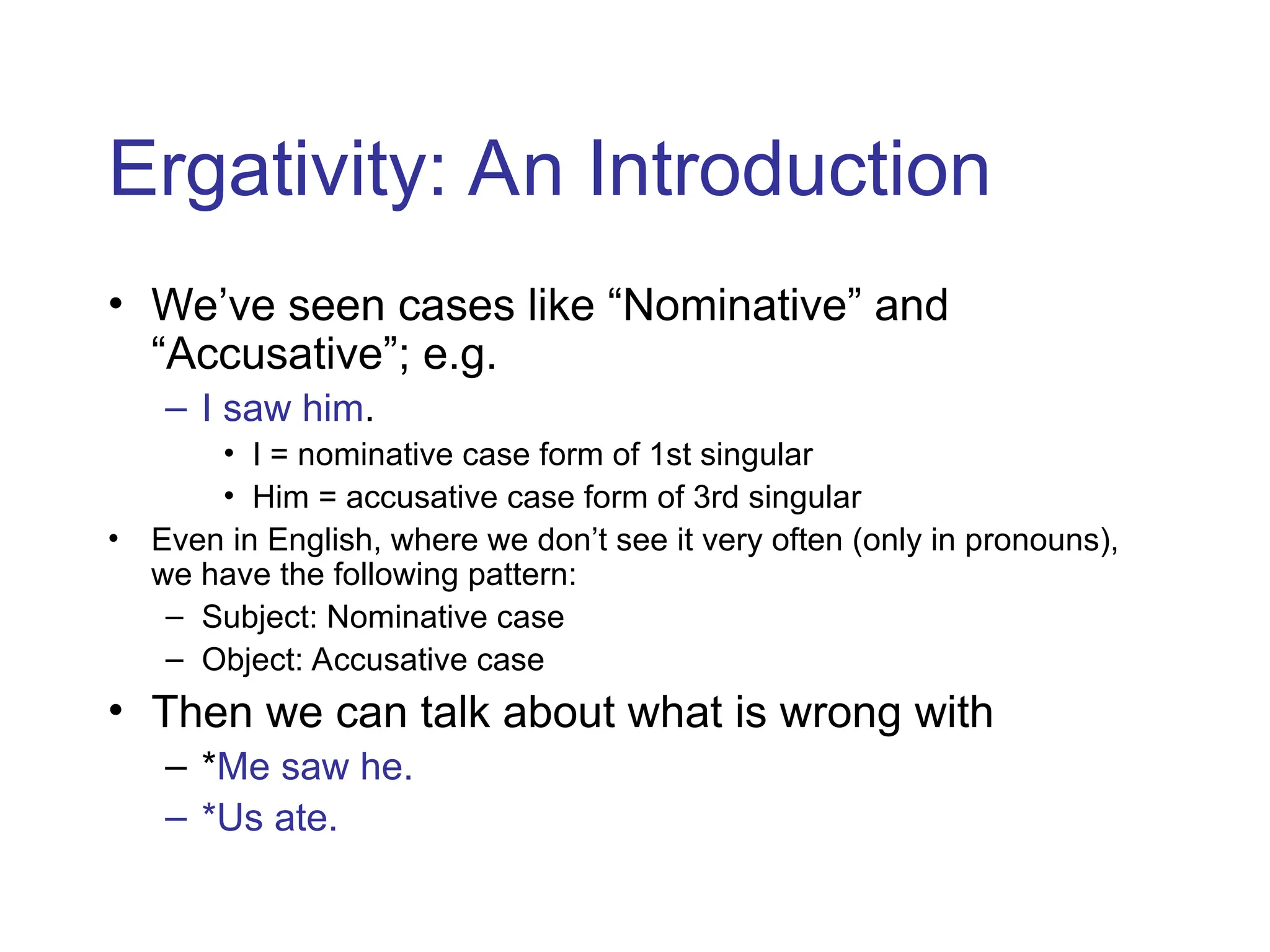
Ergativity: An Introduction
• We’ve seen cases like “Nominative” and
“Accusative”; e.g.
– I saw him.
• I = nominative case form of 1st singular
• Him = accusative case form of 3rd singular
• Even in English, where we don’t see it very often (only in pronouns),
we have the following pattern:
– Subject: Nominative case
– Object: Accusative case
• Then we can talk about what is wrong with
– *Me saw he.
– *Us ate.
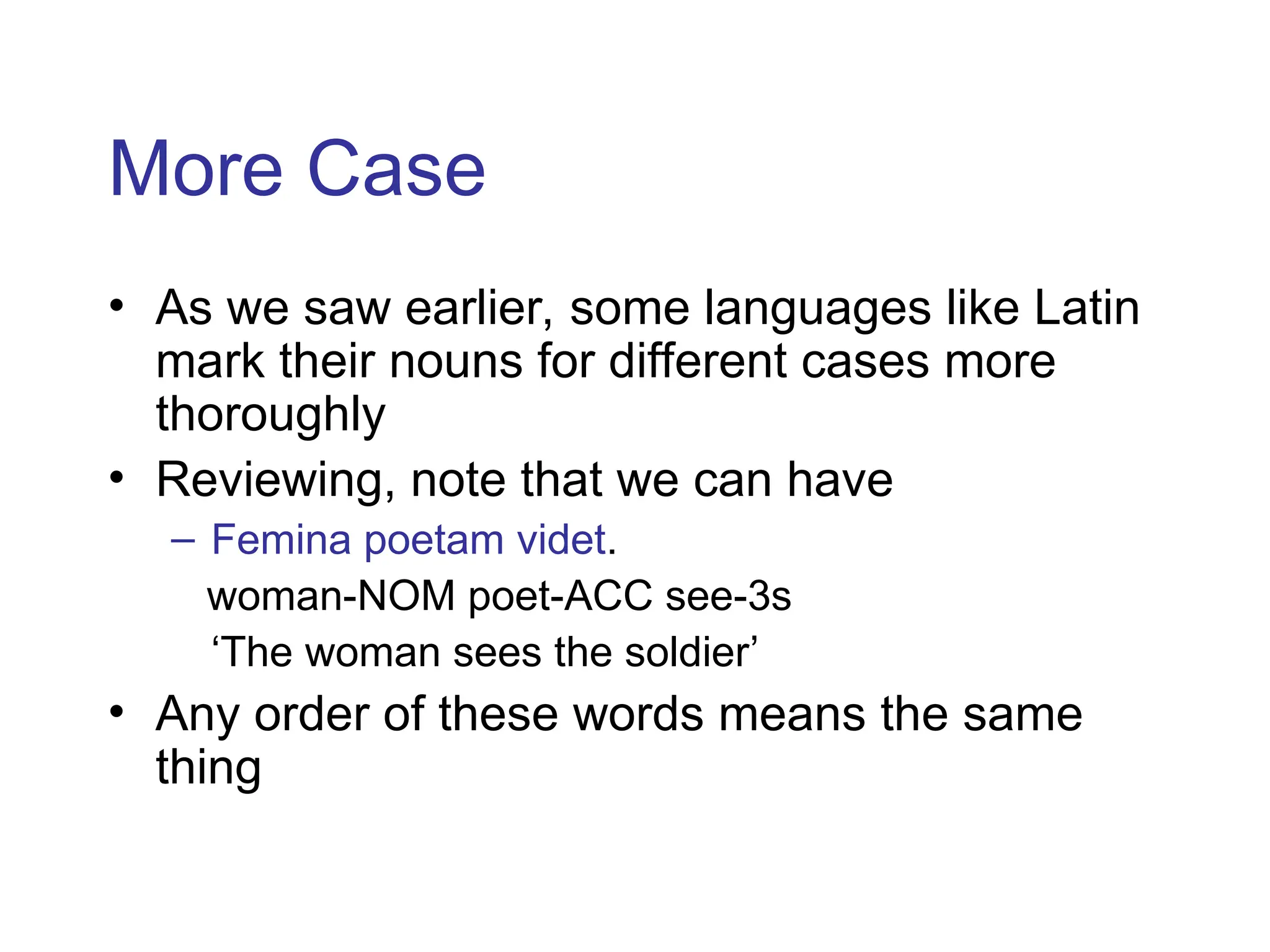
More Case
• As we saw earlier, some languages like Latin
mark their nouns for different cases more
thoroughly
• Reviewing, note that we can have
– Femina poetam videt.
woman-NOM poet-ACC see-3s
‘The woman sees the soldier’
• Any order of these words means the same
thing
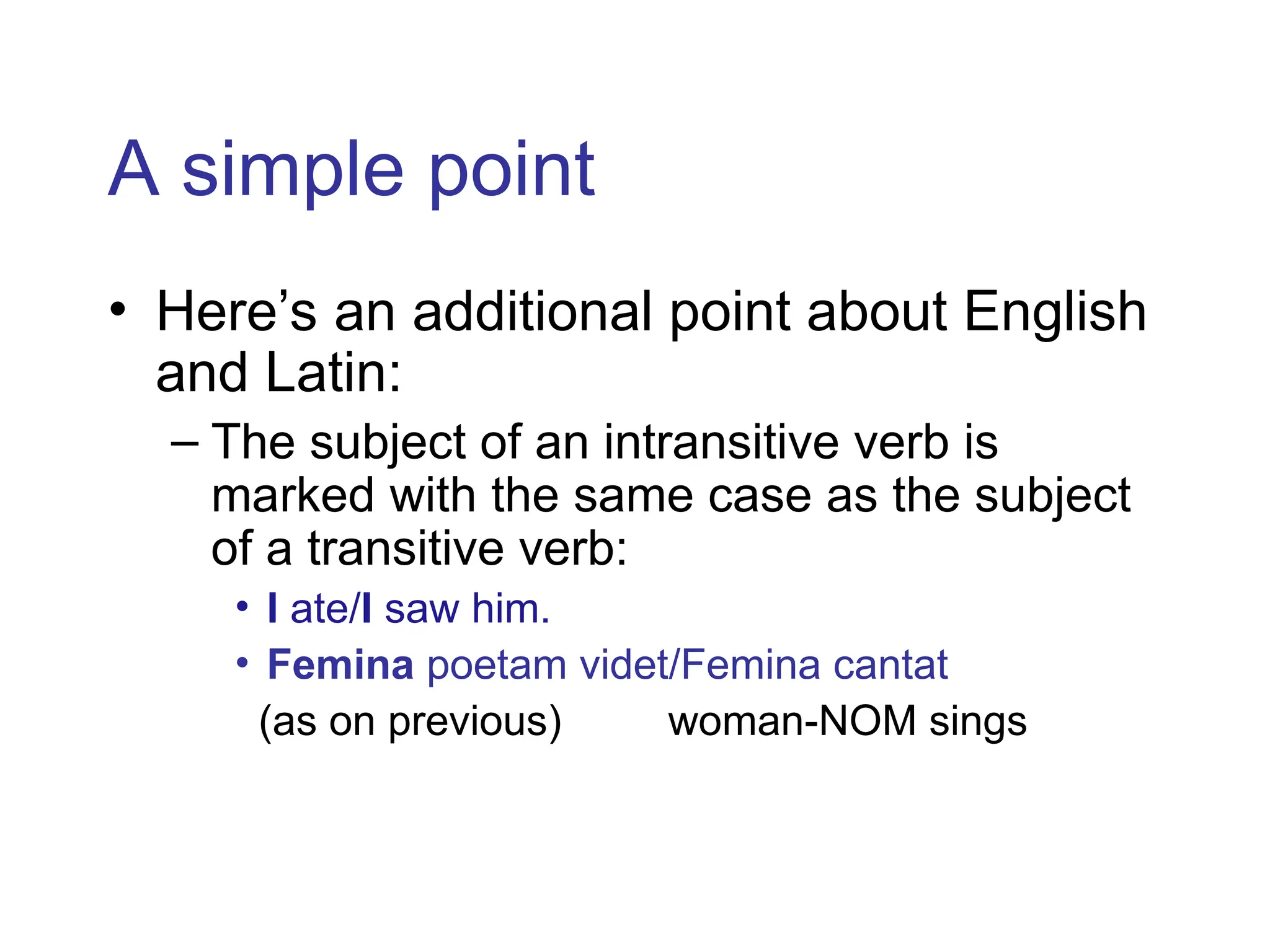
A simple point
• Here’s an additional point about English
and Latin:
– The subject of an intransitive verb is
marked with the same case as the subject
of a transitive verb:
• I ate/I saw him.
• Femina poetam videt/Femina cantat
(as on previous) woman-NOM sings
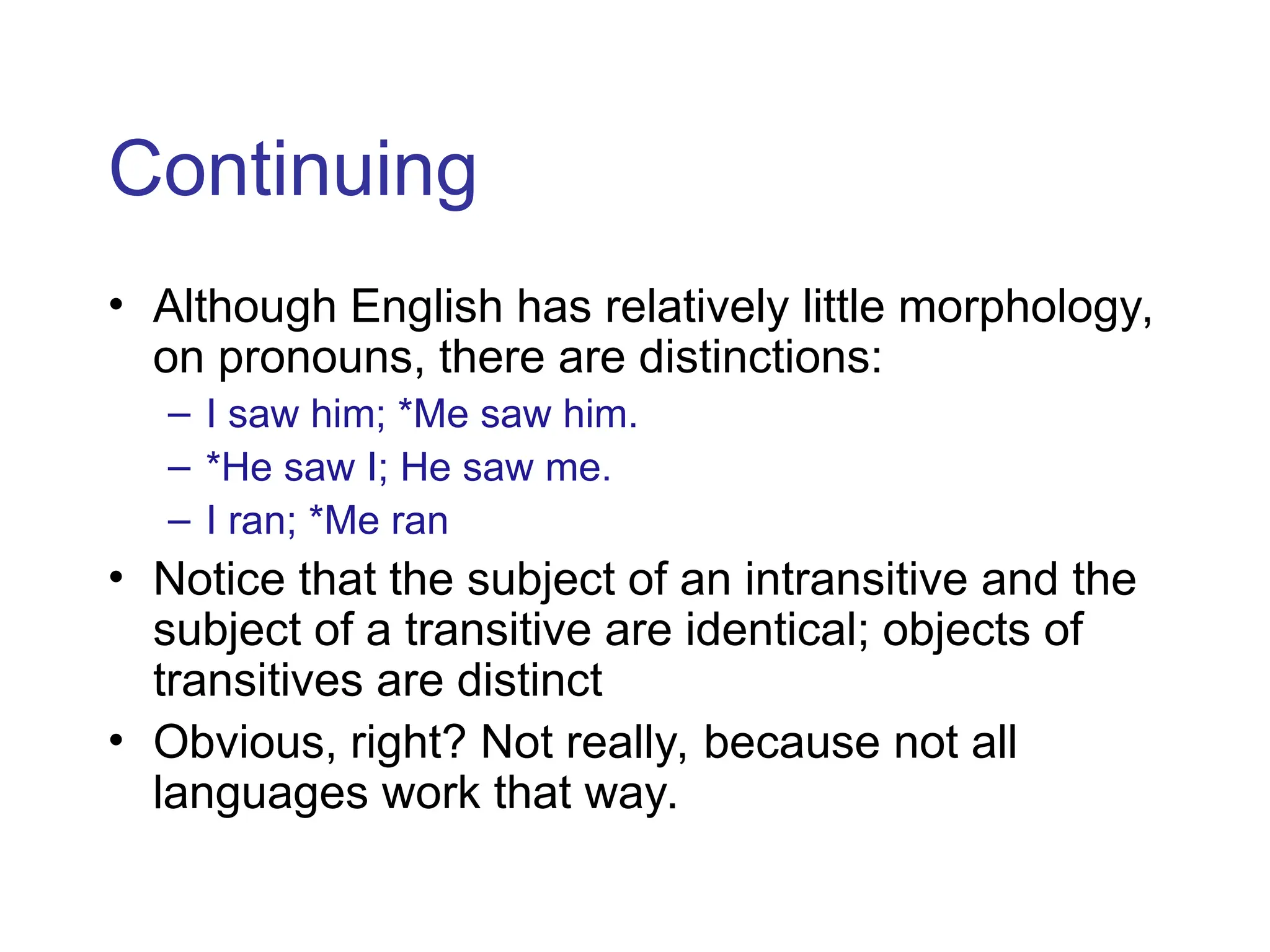
Continuing
• Although English has relatively little morphology,
on pronouns, there are distinctions:
– I saw him; *Me saw him.
– *He saw I; He saw me.
– I ran; *Me ran
• Notice that the subject of an intransitive and the
subject of a transitive are identical; objects of
transitives are distinct
• Obvious, right? Not really, because not all
languages work that way.
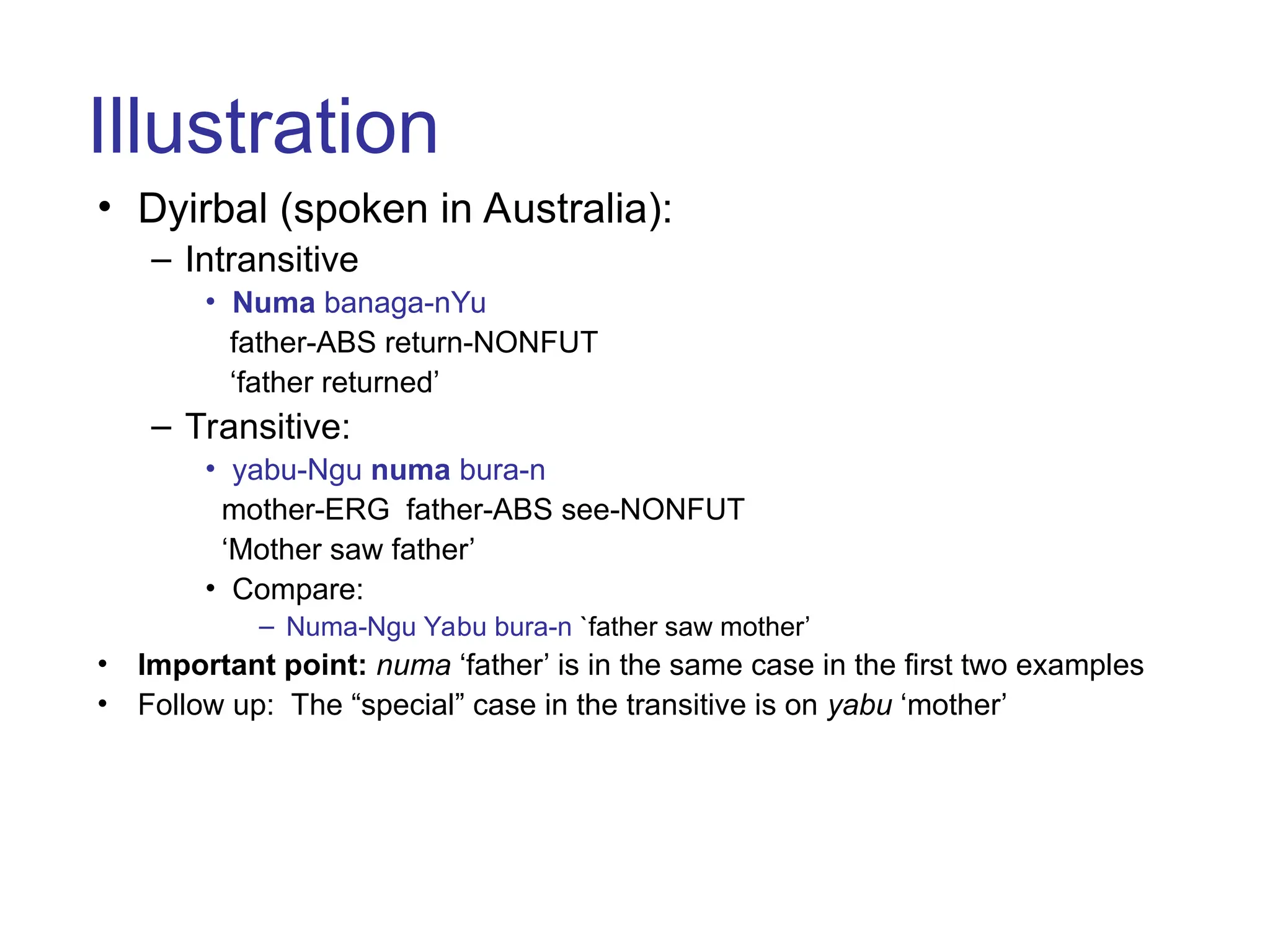
Illustration
• Dyirbal (spoken in Australia):
– Intransitive
• Numa banaga-nYu
father-ABS return-NONFUT
‘father returned’
– Transitive:
• yabu-Ngu numa bura-n
mother-ERG father-ABS see-NONFUT
‘Mother saw father’
• Compare:
– Numa-Ngu Yabu bura-n `father saw mother’
• Important point: numa ‘father’ is in the same case in the first two examples
• Follow up: The “special” case in the transitive is on yabu ‘mother’
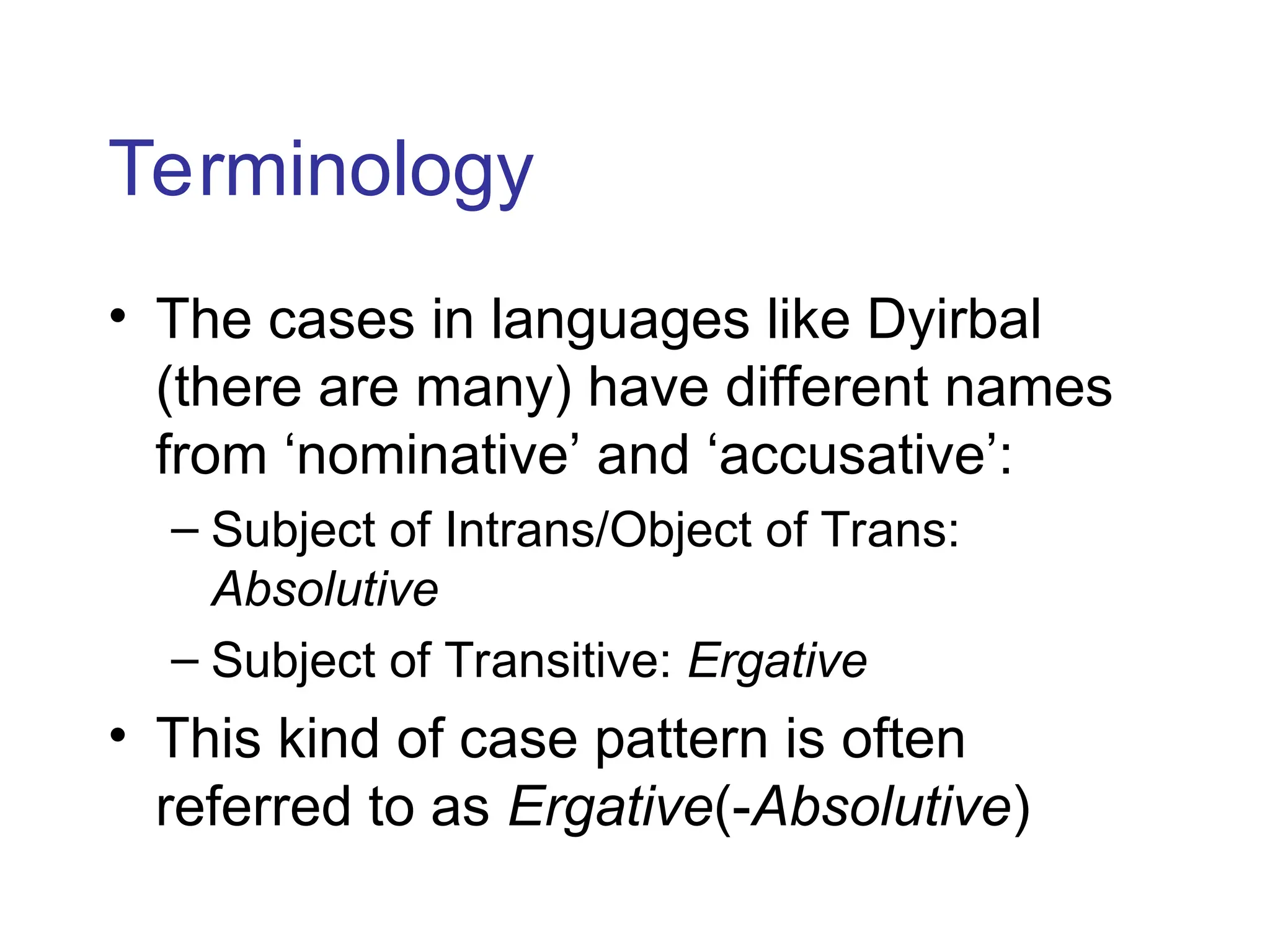
Terminology
• The cases in languages like Dyirbal
(there are many) have different names
from ‘nominative’ and ‘accusative’:
– Subject of Intrans/Object of Trans:
Absolutive
– Subject of Transitive: Ergative
• This kind of case pattern is often
referred to as Ergative(-Absolutive)
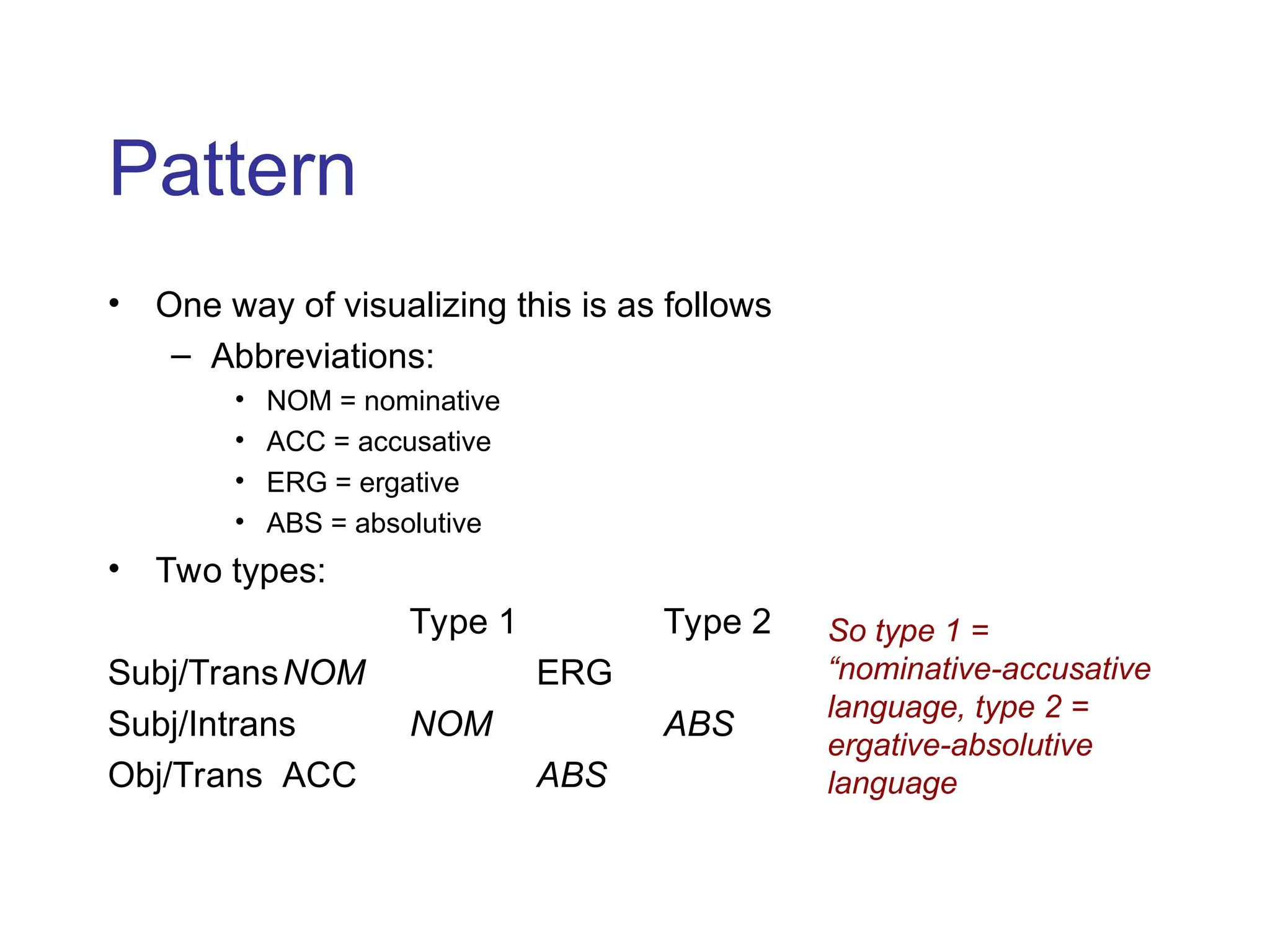
Pattern
• One way of visualizing this is as follows
– Abbreviations:
• NOM = nominative
• ACC = accusative
• ERG = ergative
• ABS = absolutive
• Two types:
Type 1 Type 2
Subj/TransNOM ERG
Subj/Intrans NOM ABS
Obj/Trans ACC ABS
So type 1 =
“nominative-accusative
language, type 2 =
ergative-absolutive
language
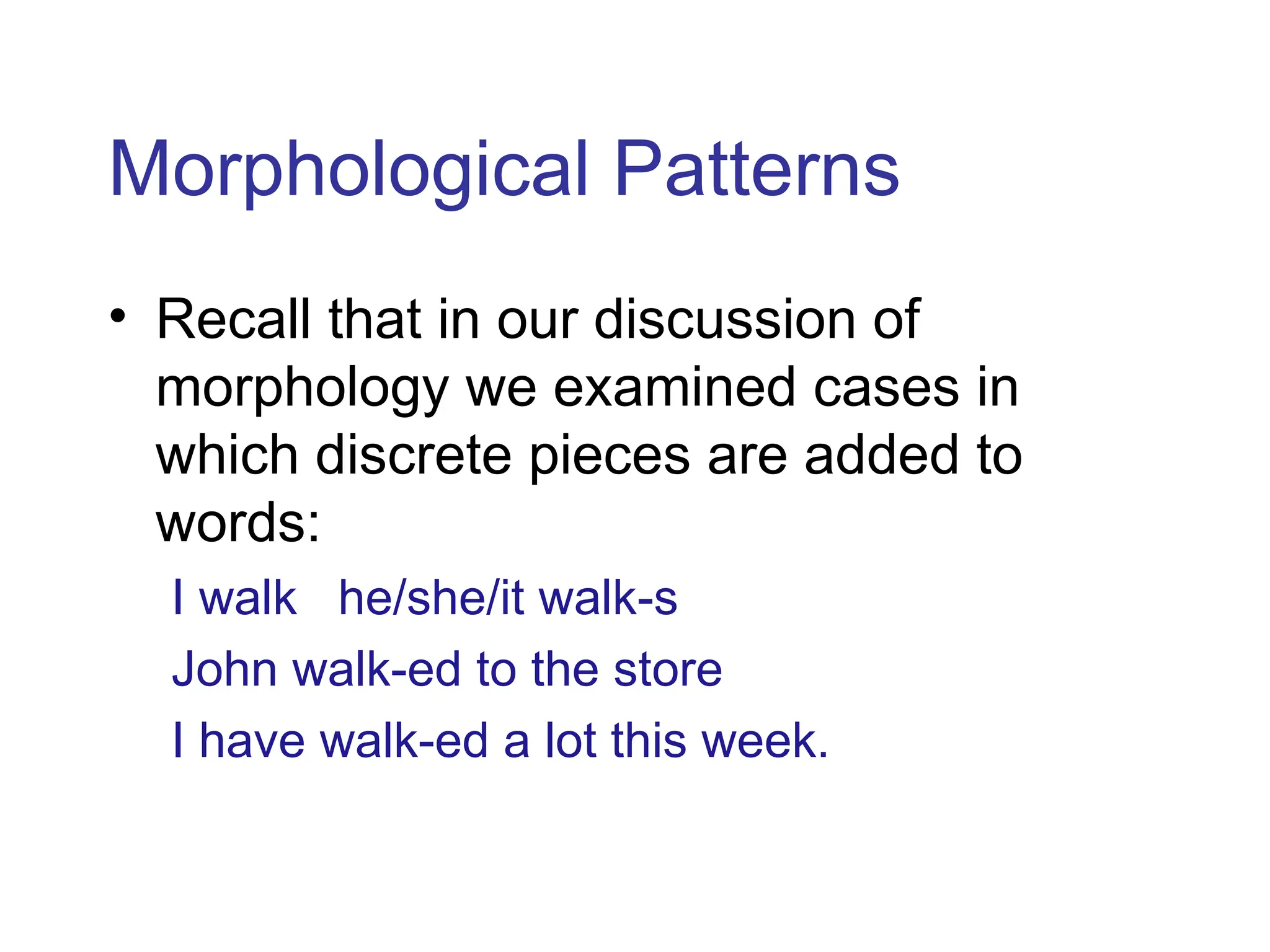
Morphological Patterns
• Recall that in our discussion of
morphology we examined cases in
which discrete pieces are added to
words:
I walk he/she/it walk-s
John walk-ed to the store
I have walk-ed a lot this week.
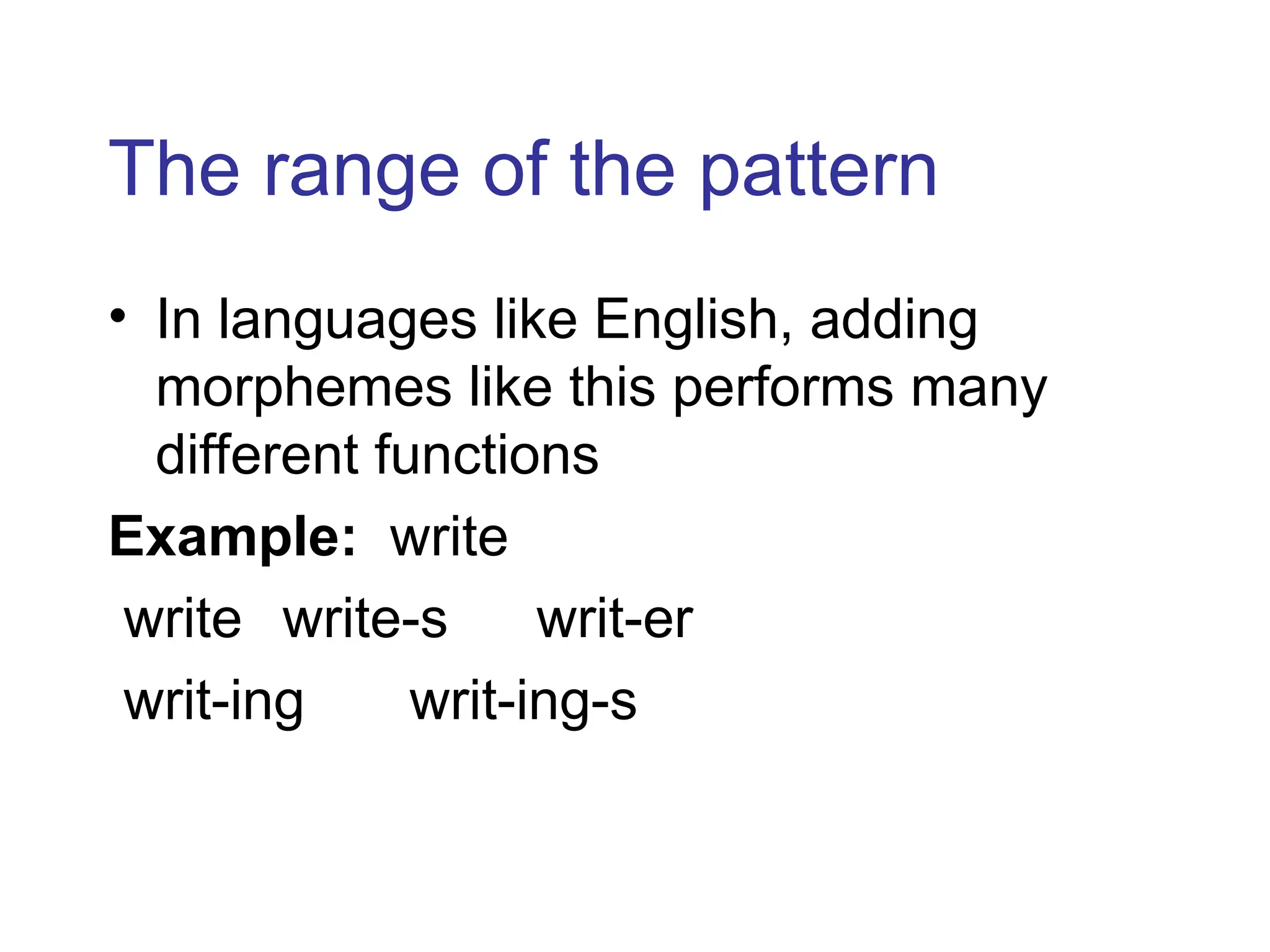
The range of the pattern
• In languages like English, adding
morphemes like this performs many
different functions
Example: write
write write-s writ-er
writ-ing writ-ing-s
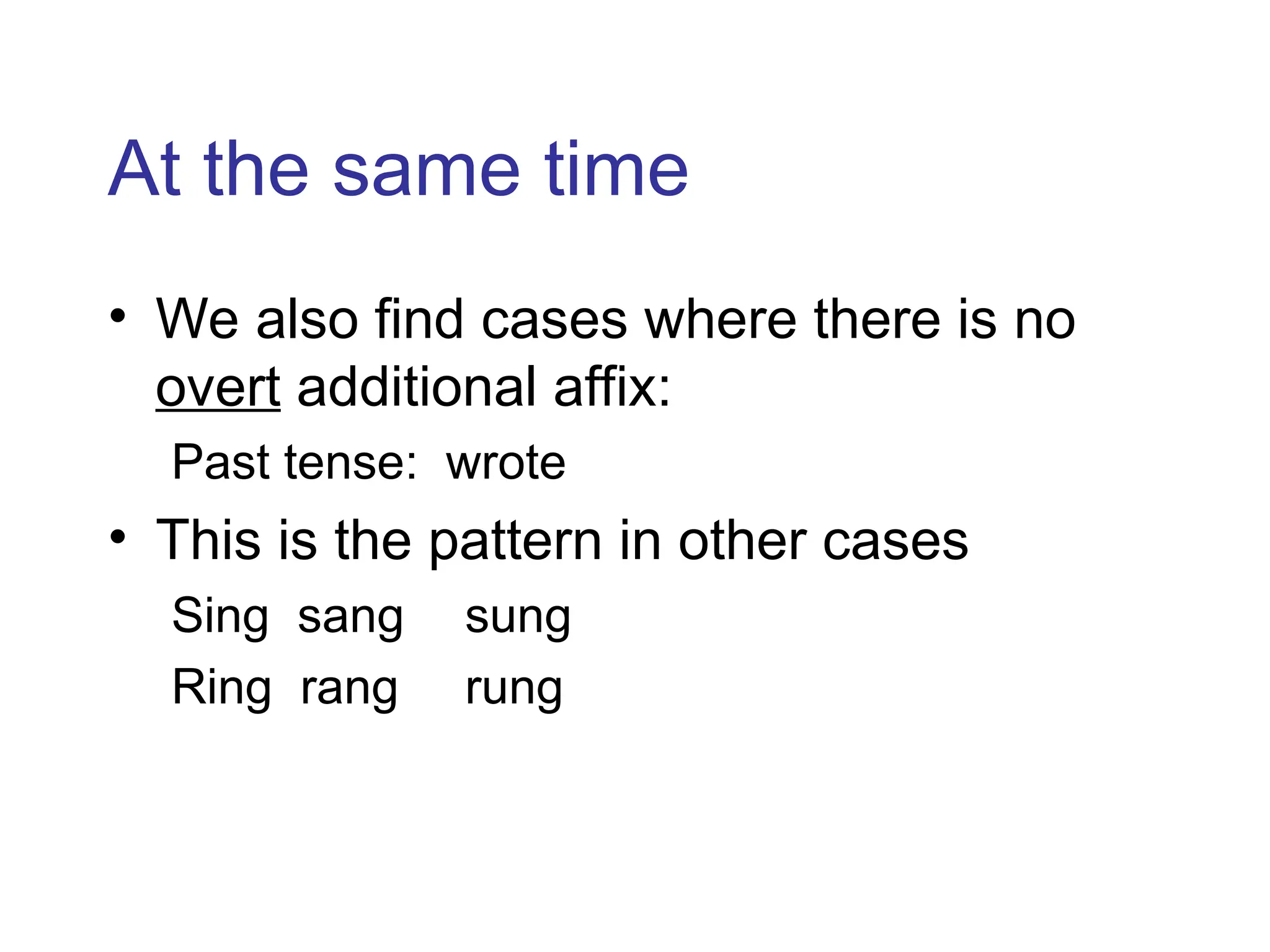
At the same time
• We also find cases where there is no
overt additional affix:
Past tense: wrote
• This is the pattern in other cases
Sing sang sung
Ring rang rung
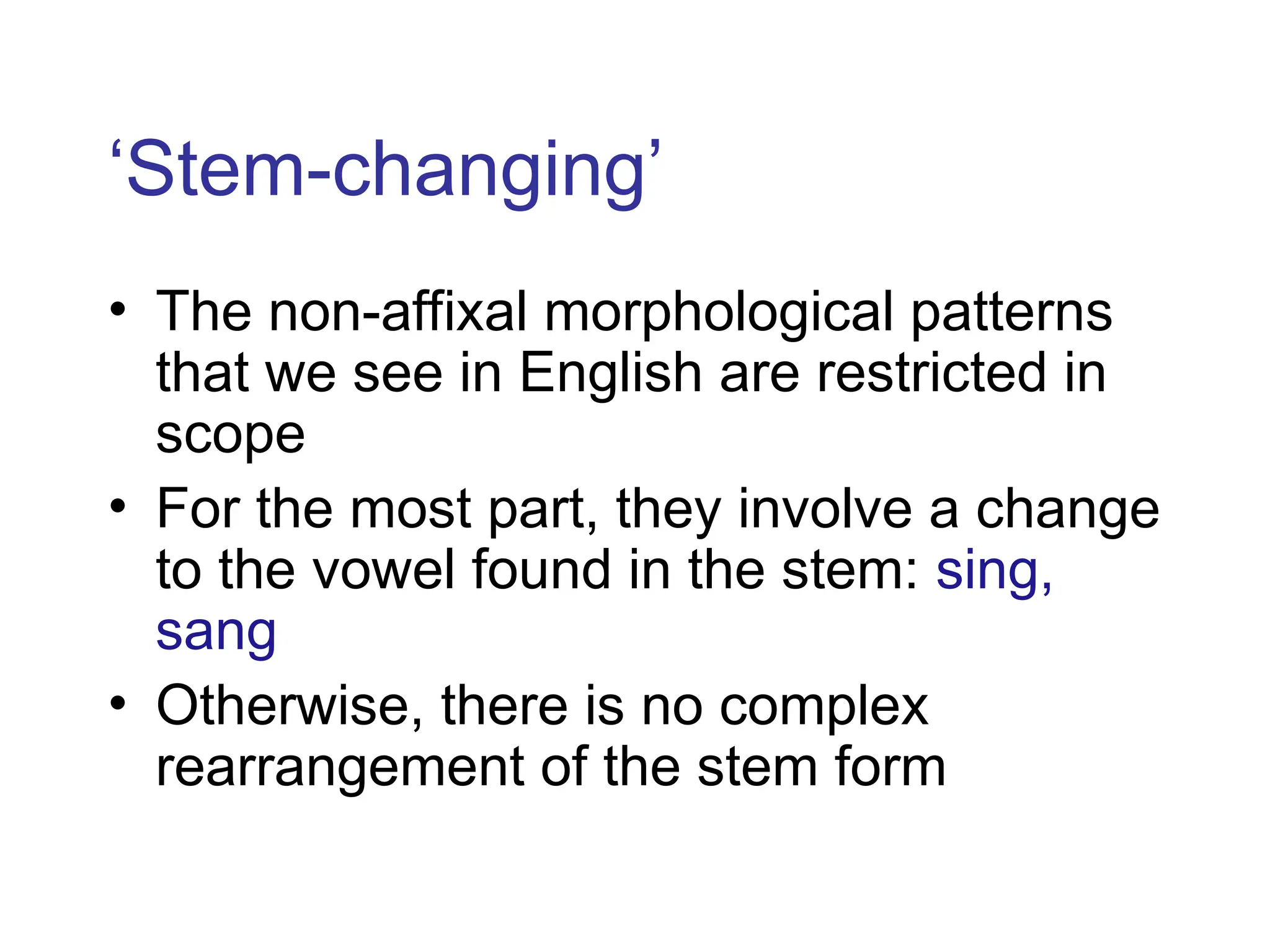
‘Stem-changing’
• The non-affixal morphological patterns
that we see in English are restricted in
scope
• For the most part, they involve a change
to the vowel found in the stem: sing,
sang
• Otherwise, there is no complex
rearrangement of the stem form
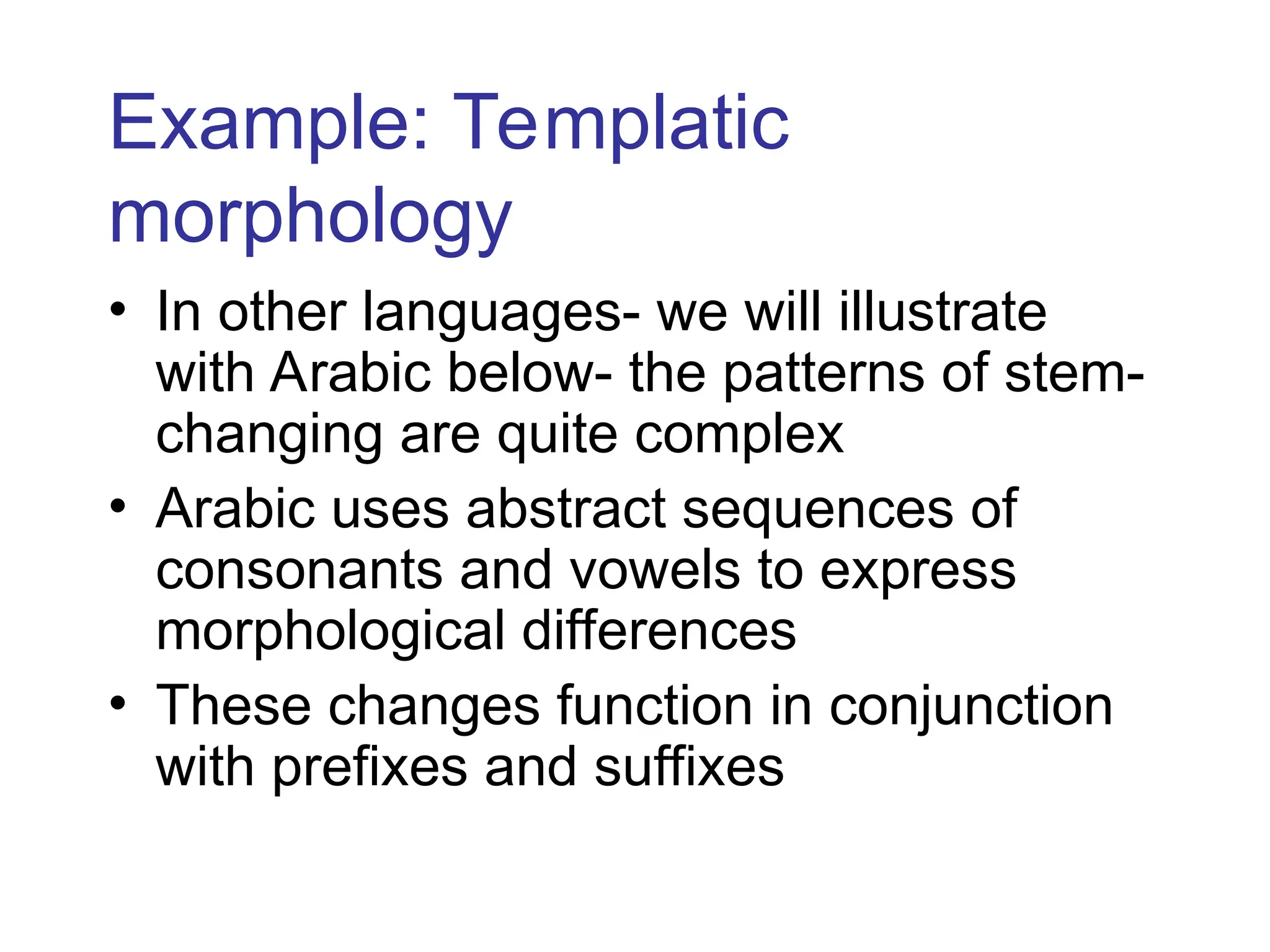
Example: Templatic
morphology
• In other languages- we will illustrate
with Arabic below- the patterns of stem-
changing are quite complex
• Arabic uses abstract sequences of
consonants and vowels to express
morphological differences
• These changes function in conjunction
with prefixes and suffixes
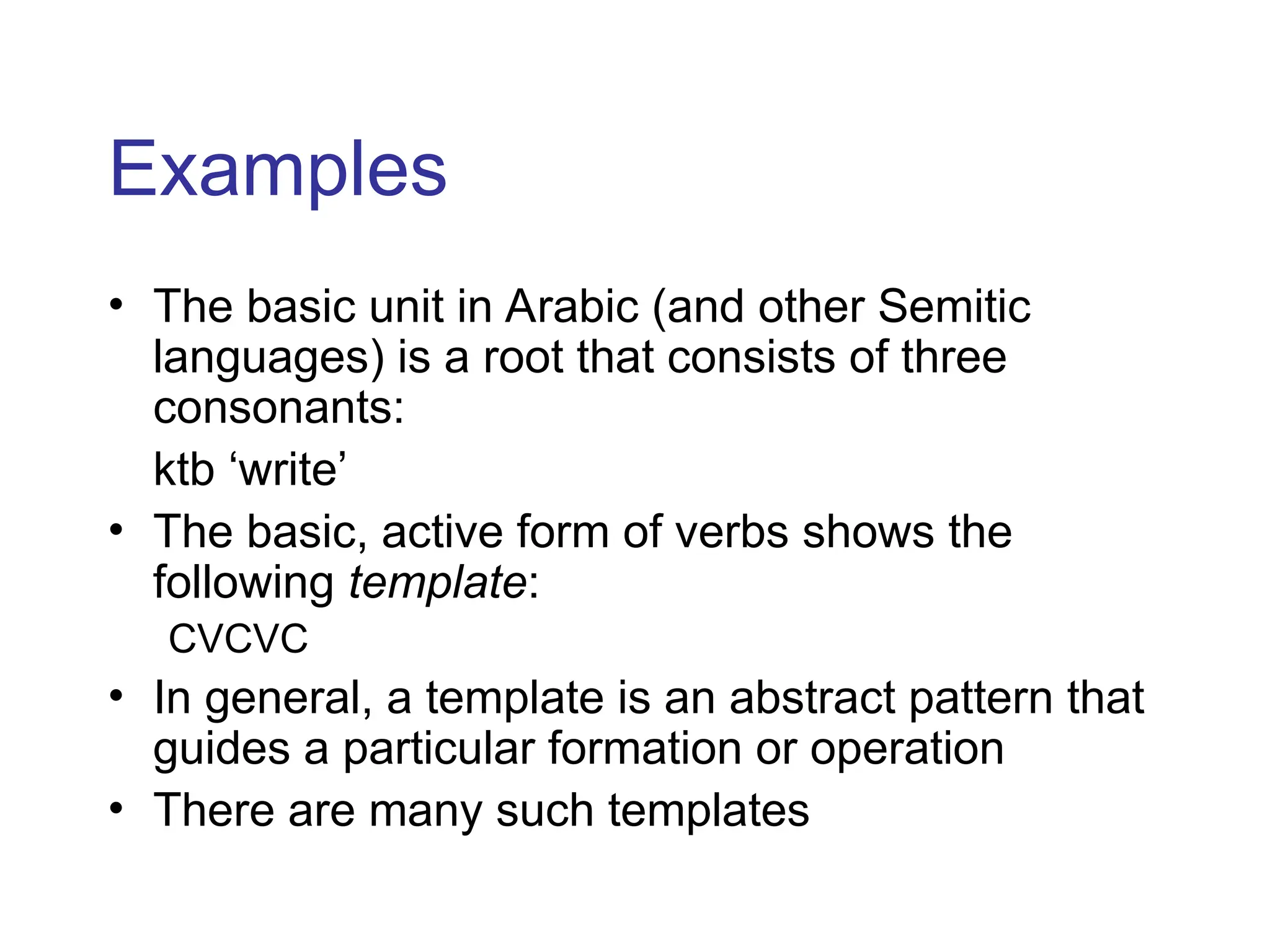
Examples
• The basic unit in Arabic (and other Semitic
languages) is a root that consists of three
consonants:
ktb ‘write’
• The basic, active form of verbs shows the
following template:
CVCVC
• In general, a template is an abstract pattern that
guides a particular formation or operation
• There are many such templates
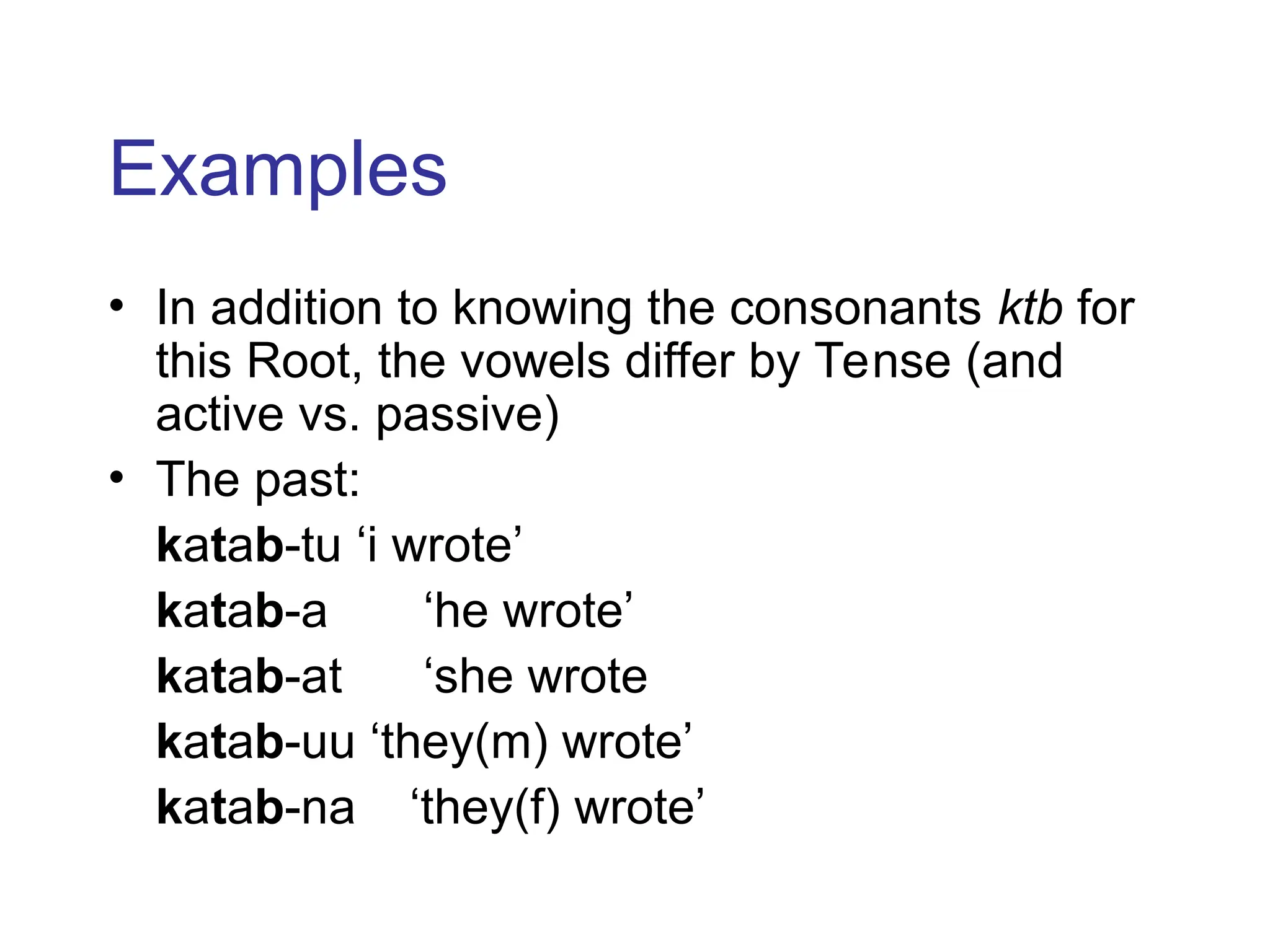
Examples
• In addition to knowing the consonants ktb for
this Root, the vowels differ by Tense (and
active vs. passive)
• The past:
katab-tu ‘i wrote’
katab-a ‘he wrote’
katab-at ‘she wrote
katab-uu ‘they(m) wrote’
katab-na ‘they(f) wrote’
Further examples
• While the active (perfective) above has the
form CVCVC, another type, the imperfective,
has the form
aCCuC
• So:
‘-aktub-u ‘I write’
y-aktub-u ‘he writes’
t-aktub-u ‘she writes’
Etc.
typology ang linguistics principles and typography

  • 1.
    Linguistics 001: Linguistic Typology PartII: Further aspects of Typology
  • 2.
    Recall that • Weare examining some the various ways in which languages differ • In the background, the question is how these differences can be reconciled with the idea that there is an innate aspect of language • In our final examples from the last lecture, we began looking at syntactic typology and word order
  • 3.
    Review, cont. • Weintroduced in the abstract some different types of variation: – Whether a language has a fixed word-order or not – What the fixed word-order of the language is in the first place – Whether there have to be subject and object Noun Phrases in the first place • Our illustration concentrated on the first type, whether or not a language allows free word order
  • 4.
    Today’s topics • Wordorder typology, continued • Ergativity • Morphology: Templates…
  • 5.
    Comparison • English: – Theman saw the vessel. (SVO) • Mapudungun: – All six possibilities of linear order are grammatical • The idea was that in Mapudungun, information about subject, object etc. is found in the verbal morphology
  • 6.
    Word Orders • Inaddition to allowing SVO sentences, all of the other possible arrangements are grammatical as well: – INche metawe pefin. SOV – Metawe iNche pefin. OSV – Metawe pefin iNche OVS – Pefin metawe iNche VOS – Pefin iNche metawe VSO
  • 7.
    Agreement and FreeWord Order • How are the grammatical roles of these noun phrases determined? • Above the verb is given as pefin • This verb actually has a lot of information in it: Pe-fi-n See-Object.Marker-1sS • That is, the verb says that the subject is first person singular, and that there is a third person object. • Thus the different word orders can be understood as expressing the same basic proposition
  • 8.
    Free Word Orderand Case • Another type of language that has free word order shows case morphology. • Consider the following forms of the noun femina ‘woman’ in Latin (the colon indicates vowel length): SingularPlural Nom. femina feminae Acc. feminam femina:s Dat. feminae femini:s Gen. feminae femina:rum Abl. femina: femini:s • Note that the ends of these words indicate the grammatical role. On nouns, such morphemes are called case morphemes
  • 9.
    Case, continued • Thismeans that in Latin, where the word order is relatively free, the role that a particular NP plays is encoded on that that NP: – Femina canem videt. woman-NOM dog-ACC sees ‘The woman sees the dog’ – Canem femina videt. – Videt canem femina. – ….
  • 10.
    Nouns and Verbs •Whatever order the words may appear in, the Nouns (NPs), as long as the case marking is the same the basic semantics is the same. • The information is not entirely marked in the verb, which conveys person, number, tense, but not the full message about the event • The verb here is see, marked for 3s and present tense. Both dog and woman are 3s… • Latin probably has a “basic” word order (SOV), but uses these variants freely to emphasize or deemphasize different parts of the sentence (Mapudungun too probably)
  • 11.
    Back to basicword orders • As we discussed above, there are some languages that do not allow free word order • Languages (of this type) tend to display a basic word order, which is used in unmarked circumstances • Among these, there are again differences in terms of what order is employed
  • 12.
    Possibilities/Illustrations • SVO: – English:The man ate the apple. • SOV (remember Hindi in the last class): – Turkish: • Hasan öküz-ü ald1. Hasan ox-ACC bought. • In these two types, what differs is the relative position of the verb and the object NP • Remember that a simple way of thinking of this was that the tree structures are the same, with the order of V and the NP object reversed
  • 13.
    Remember… S NP AuxP Rahul VPAux NP V “had” the book read This is the Hindi version. Look carefully at what has changed.
  • 14.
    VOS • Basic VOSWord Order: – Malagasy (spoken in Madagascar) • Nahita ny mpianatra ny vehivavy saw the student the woman ‘The woman saw the student’ • VOS doesn’t provide the same challenge as VSO, which we discussed last time (draw the tree…) • At the same time, it might be the case that this isn’t just the “subject mirror image” of SVO
  • 15.
    Object-initial? • While theabove patterns are clearly attested, orders in which the object appears first are hard to find • One example of OVS: – Hixkaryana (Carib, N. Brazil) • Toto yahosIye kamara. man grab jaguar ‘The jaguar grabbed the man’ • In many cases the situation is complicated because of what it means to have a ‘basic’ word order in the first place (e.g. you can get OVS order in lots of languages; the question is, is this “basic” or not)
  • 16.
    Frequencies • Some studiestake samples of languages and count the percentages of these types (e.g. Mallinson and Blake 1981): – SOV: 41% – SVO: 35% – VSO: 9% – VOS: 2% – OVS: 1% – OSV: ?? • While such numbers give us an idea of what’s out there, it is not clear what else we can learn from them, given that the samples are reflections of non-linguistic factors (history)
  • 17.
    Verb-initial orders: VSO •VSO: – Welsh: • Lladdodd y ddraig y dyn. killed the dragon the man ‘The dragon killed the man.’ • Question: Can this be derived as straight-forwardly as SVO/SOV, where we just change the order of the VP?
  • 18.
    Questions • Specifically: canwe “relinearize” the SVO tree to yield the VSO tree? • Answer: Not without “crossing lines” • If we do not want to cross lines, then something additional must be happening in VSO languages.
  • 19.
    That is… • Consider: S NPVP The man VNP killed the dragon
  • 20.
    English questions… • Remember,English is – S (AUX) V O – John didn’t eat the apples • But in questions, the AUX is moved to a position that precedes the subject: – Didn’t John t eat eat apples? • The same type of solution can be applied to Welsh (and VSO generally)
  • 21.
    Ergativity: An Introduction •We’ve seen cases like “Nominative” and “Accusative”; e.g. – I saw him. • I = nominative case form of 1st singular • Him = accusative case form of 3rd singular • Even in English, where we don’t see it very often (only in pronouns), we have the following pattern: – Subject: Nominative case – Object: Accusative case • Then we can talk about what is wrong with – *Me saw he. – *Us ate.
  • 22.
    More Case • Aswe saw earlier, some languages like Latin mark their nouns for different cases more thoroughly • Reviewing, note that we can have – Femina poetam videt. woman-NOM poet-ACC see-3s ‘The woman sees the soldier’ • Any order of these words means the same thing
  • 23.
    A simple point •Here’s an additional point about English and Latin: – The subject of an intransitive verb is marked with the same case as the subject of a transitive verb: • I ate/I saw him. • Femina poetam videt/Femina cantat (as on previous) woman-NOM sings
  • 24.
    Continuing • Although Englishhas relatively little morphology, on pronouns, there are distinctions: – I saw him; *Me saw him. – *He saw I; He saw me. – I ran; *Me ran • Notice that the subject of an intransitive and the subject of a transitive are identical; objects of transitives are distinct • Obvious, right? Not really, because not all languages work that way.
  • 25.
    Illustration • Dyirbal (spokenin Australia): – Intransitive • Numa banaga-nYu father-ABS return-NONFUT ‘father returned’ – Transitive: • yabu-Ngu numa bura-n mother-ERG father-ABS see-NONFUT ‘Mother saw father’ • Compare: – Numa-Ngu Yabu bura-n `father saw mother’ • Important point: numa ‘father’ is in the same case in the first two examples • Follow up: The “special” case in the transitive is on yabu ‘mother’
  • 26.
    Terminology • The casesin languages like Dyirbal (there are many) have different names from ‘nominative’ and ‘accusative’: – Subject of Intrans/Object of Trans: Absolutive – Subject of Transitive: Ergative • This kind of case pattern is often referred to as Ergative(-Absolutive)
  • 27.
    Pattern • One wayof visualizing this is as follows – Abbreviations: • NOM = nominative • ACC = accusative • ERG = ergative • ABS = absolutive • Two types: Type 1 Type 2 Subj/TransNOM ERG Subj/Intrans NOM ABS Obj/Trans ACC ABS So type 1 = “nominative-accusative language, type 2 = ergative-absolutive language
  • 28.
    Morphological Patterns • Recallthat in our discussion of morphology we examined cases in which discrete pieces are added to words: I walk he/she/it walk-s John walk-ed to the store I have walk-ed a lot this week.
  • 29.
    The range ofthe pattern • In languages like English, adding morphemes like this performs many different functions Example: write write write-s writ-er writ-ing writ-ing-s
  • 30.
    At the sametime • We also find cases where there is no overt additional affix: Past tense: wrote • This is the pattern in other cases Sing sang sung Ring rang rung
  • 31.
    ‘Stem-changing’ • The non-affixalmorphological patterns that we see in English are restricted in scope • For the most part, they involve a change to the vowel found in the stem: sing, sang • Otherwise, there is no complex rearrangement of the stem form
  • 32.
    Example: Templatic morphology • Inother languages- we will illustrate with Arabic below- the patterns of stem- changing are quite complex • Arabic uses abstract sequences of consonants and vowels to express morphological differences • These changes function in conjunction with prefixes and suffixes
  • 33.
    Examples • The basicunit in Arabic (and other Semitic languages) is a root that consists of three consonants: ktb ‘write’ • The basic, active form of verbs shows the following template: CVCVC • In general, a template is an abstract pattern that guides a particular formation or operation • There are many such templates
  • 34.
    Examples • In additionto knowing the consonants ktb for this Root, the vowels differ by Tense (and active vs. passive) • The past: katab-tu ‘i wrote’ katab-a ‘he wrote’ katab-at ‘she wrote katab-uu ‘they(m) wrote’ katab-na ‘they(f) wrote’
  • 35.
    Further examples • Whilethe active (perfective) above has the form CVCVC, another type, the imperfective, has the form aCCuC • So: ‘-aktub-u ‘I write’ y-aktub-u ‘he writes’ t-aktub-u ‘she writes’ Etc.