ENGLISH
PHONETIC AND
PHONOLOGY
GROUP 6GROUP 6
Members of group 6
•Nguy n Th Thu Th oễ ị ả
•Lê Th Kim Th oị ả
•Mai Th Huỳnh Nhị ư
•Tăng Qu c Phúố
CONTENTSCONTENTS
•Chapter 3: Long vowels, diphthongs and
triphthongs
•Chapter 4: voicing and consonants
Chapter 3: Long vowels, diphthongs and
triphthongs
•I. Long vowels: /i:, u:, a , , :/.ː ɔː ɜ
• The long vowels are longer than
the short vowels in similar contexts.
• The symbols = one vowel + two dots.
Ex: /i:/ and /i/
1. /i:/
• Mouth: like a smile.
•Tongue touches the sides of
teeth
2. /u:/
•Make a lip into a circle.
•Put tongue up and back.
3. /a /ː
•Open mouth wide.
•Tongue rest in the bottom
of your mouth.
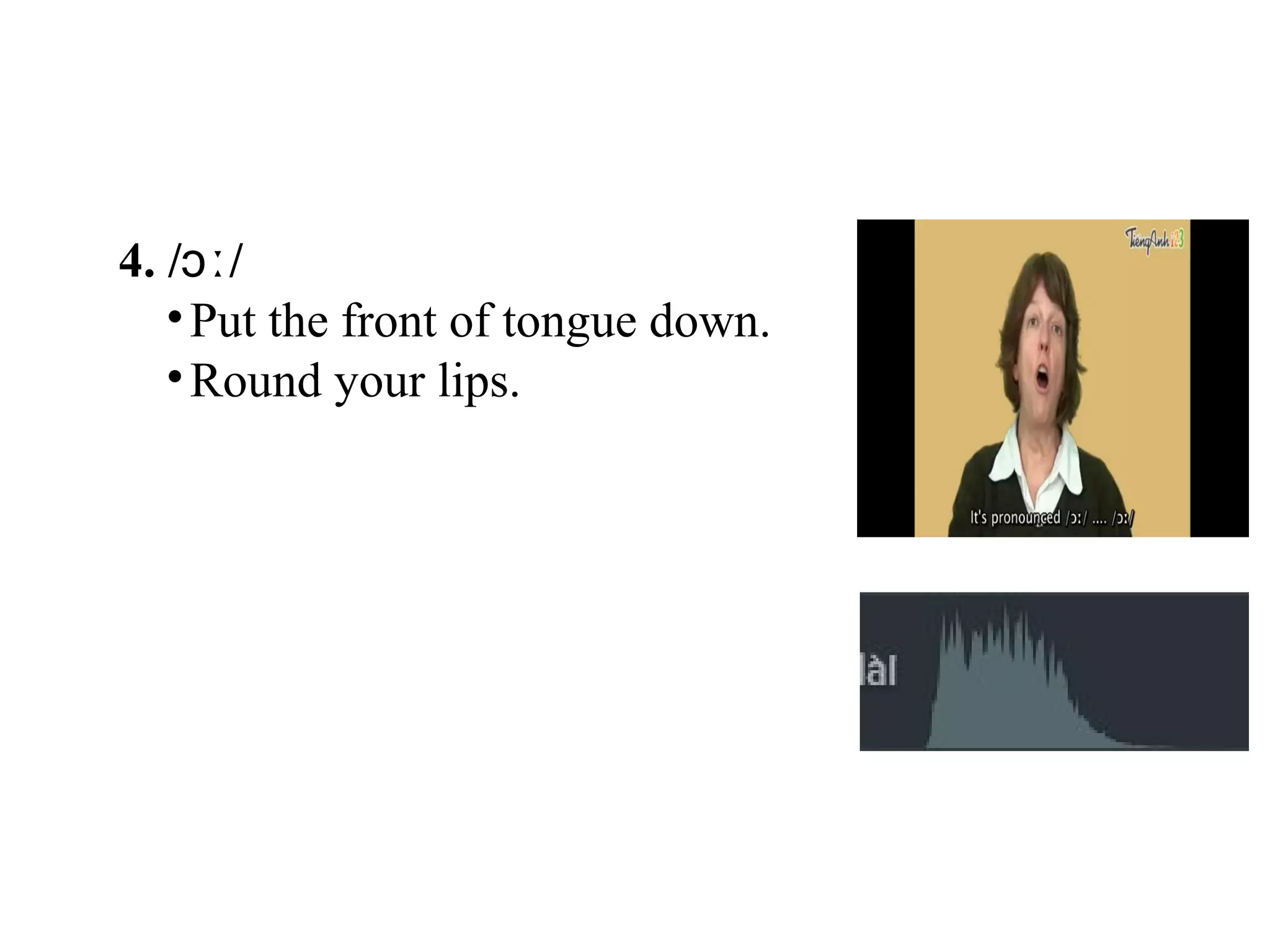
4. / /ɔː
•Put the front of tongue down.
•Round your lips.
5. / :/ɜ
•Mouth and tongue should be
relaxed.
II. Diphthongs:
•consist of a movement or glide from one vowel to
another
Chapter 3: Long vowels, diphthongs
and triphthongs
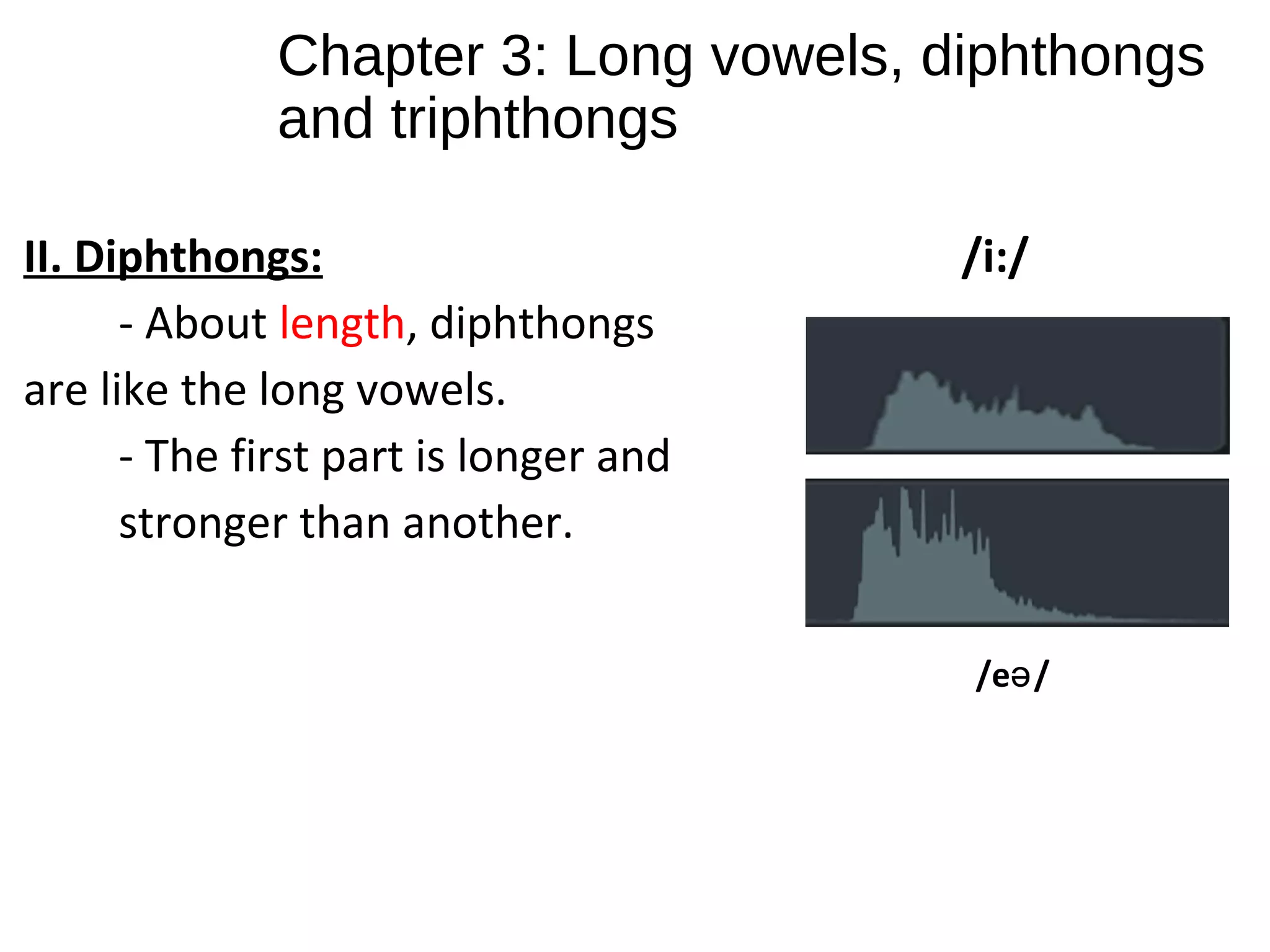
II. Diphthongs: /i:/
- About length, diphthongs
are like the long vowels.
- The first part is longer and
stronger than another.
/e /ə
1. / ə /ɪ
• Firstly, Mouth like a smile
with the / :/ soundɪ
• Then, open mouth
a little to move the /ə/ sound.
2. /eə/
•Firstly, Mouth starts with
the /e/ sound.
•After, lips become less
around and finish with
the /ə/ sound.
3. / ə/ʊ
•Firstly, Mouth closes like to
kiss someone.
•After, mouth slightly opens
to remove to the /ə/ sound.
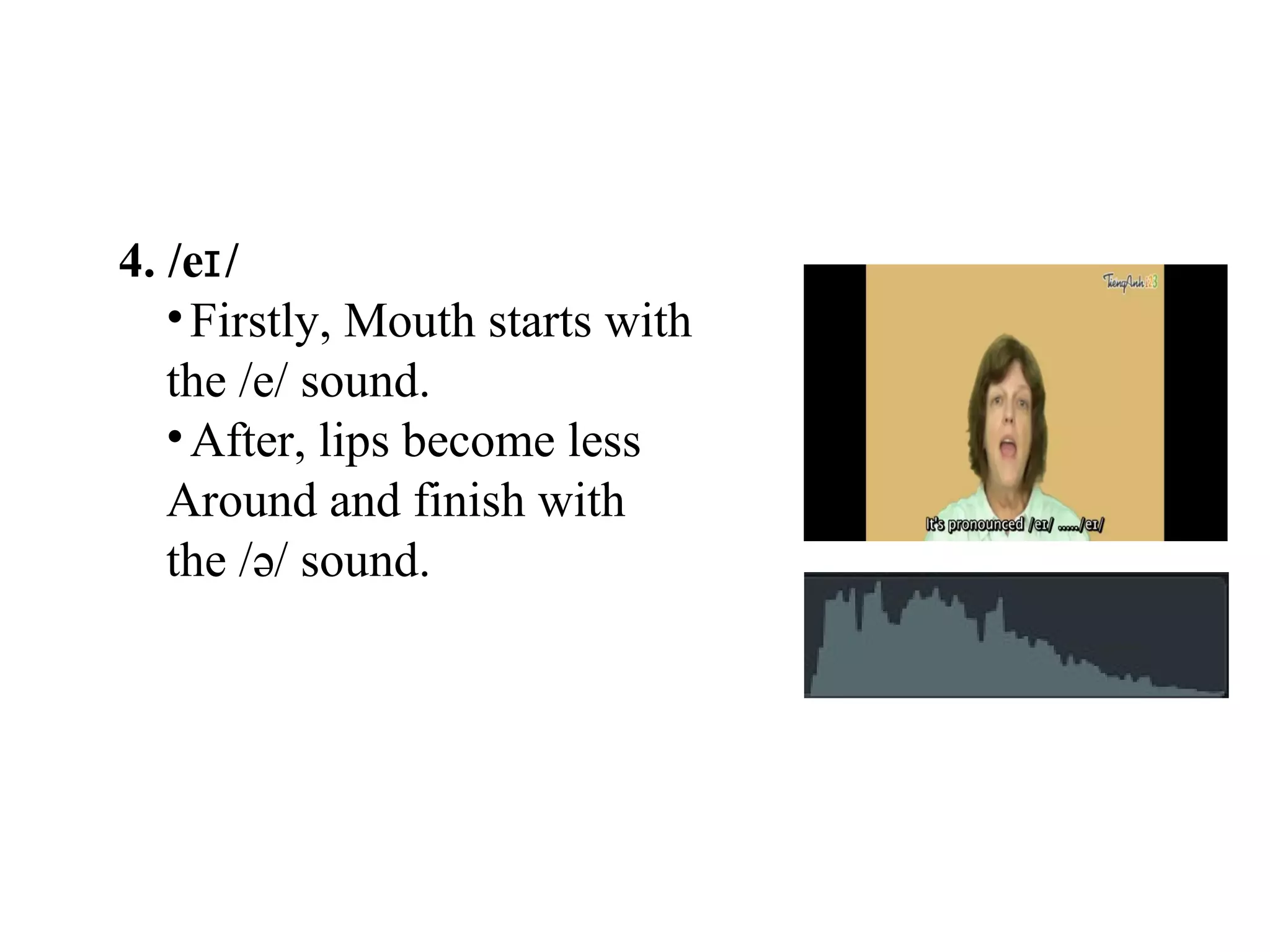
4. /e /ɪ
•Firstly, Mouth starts with
the /e/ sound.
•After, lips become less
Around and finish with
the /ə/ sound.
5. /a /ɪ
•Firstly, place the tongue
in the / a /.
•Then the mouth close a little
to pronounce / /, pronouncedɪ
/a/ long, / / short and fast.ɪ
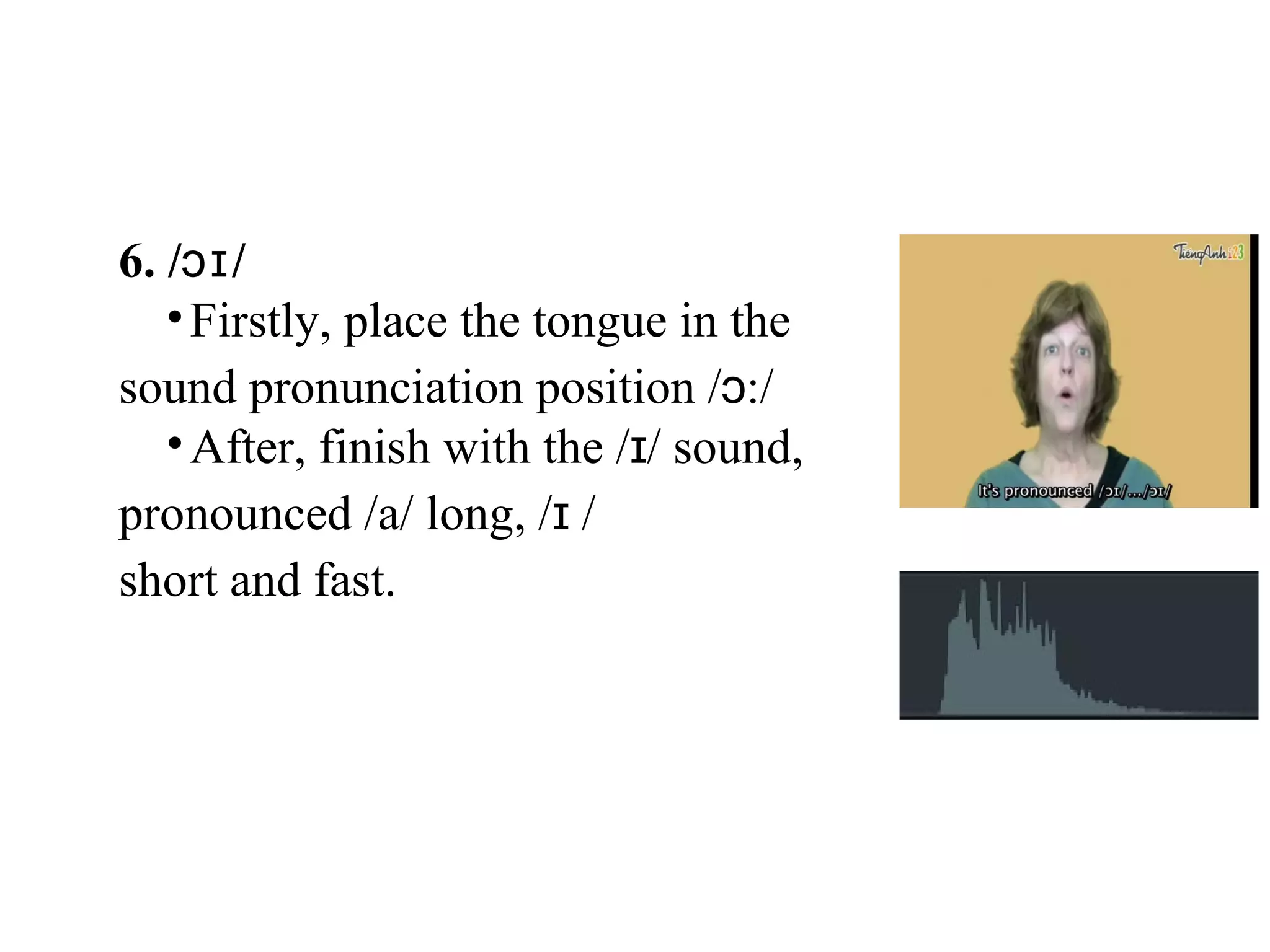
6. / /ɔɪ
•Firstly, place the tongue in the
sound pronunciation position / :/ɔ
•After, finish with the / / sound,ɪ
pronounced /a/ long, / /ɪ
short and fast.
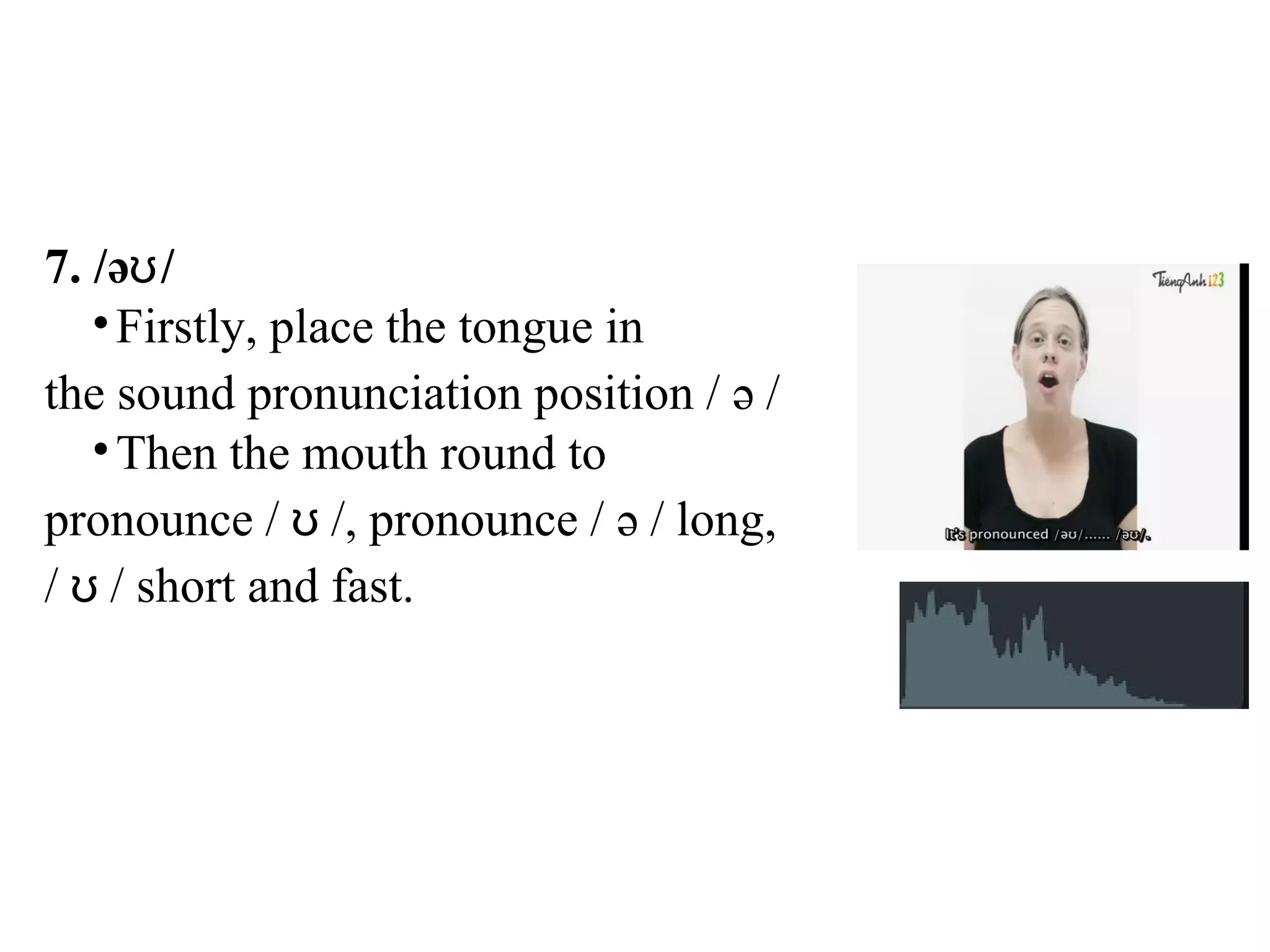
7. /ə /ʊ
•Firstly, place the tongue in
the sound pronunciation position / ə /
•Then the mouth round to
pronounce / /, pronounce / ə / long,ʊ
/ / short and fast.ʊ
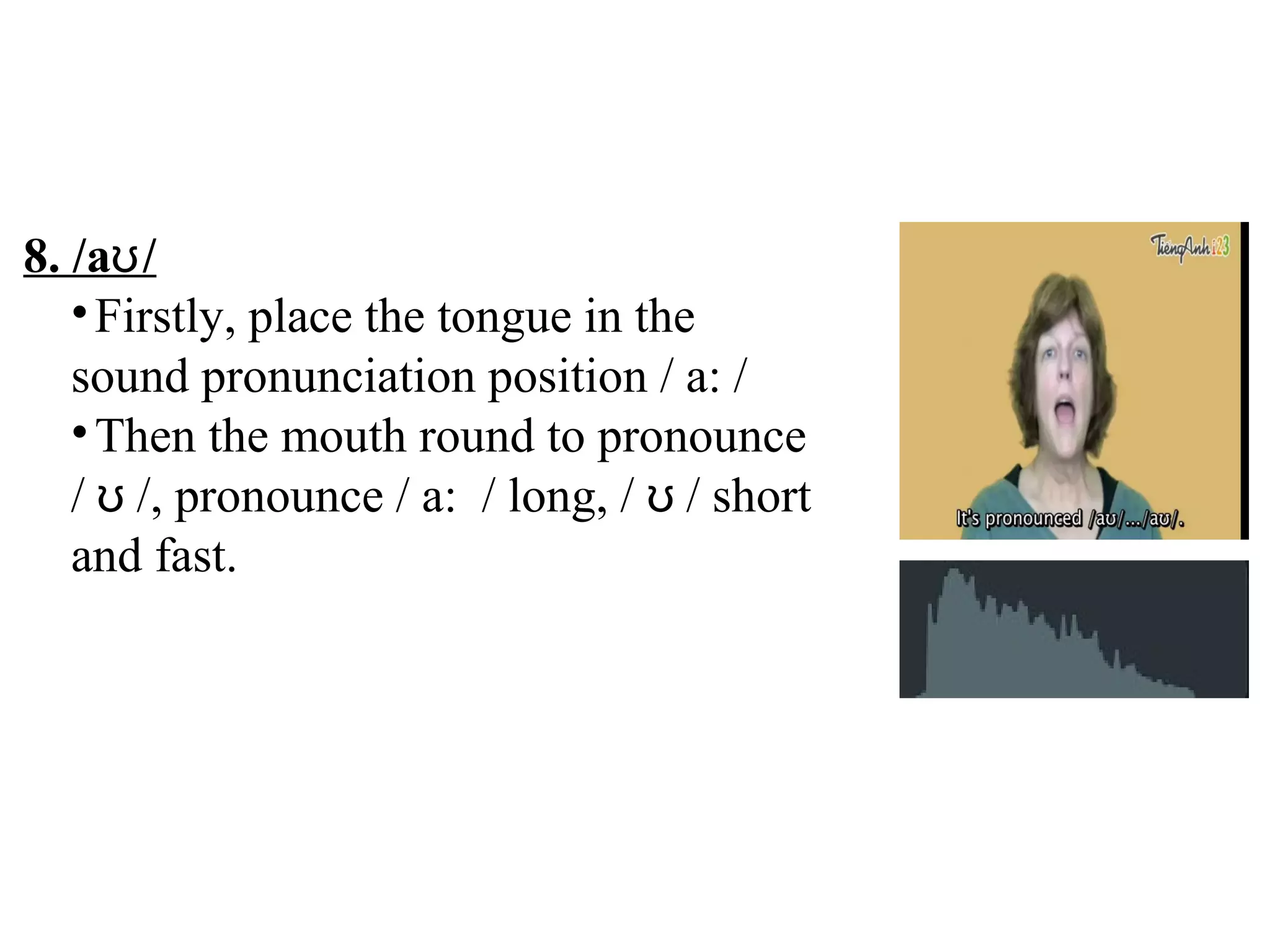
8. /a /ʊ
•Firstly, place the tongue in the
sound pronunciation position / a: /
•Then the mouth round to pronounce
/ /, pronounce / a: / long, / / shortʊ ʊ
and fast.
Chapter 3: Long vowels,
diphthongs and triphthongs
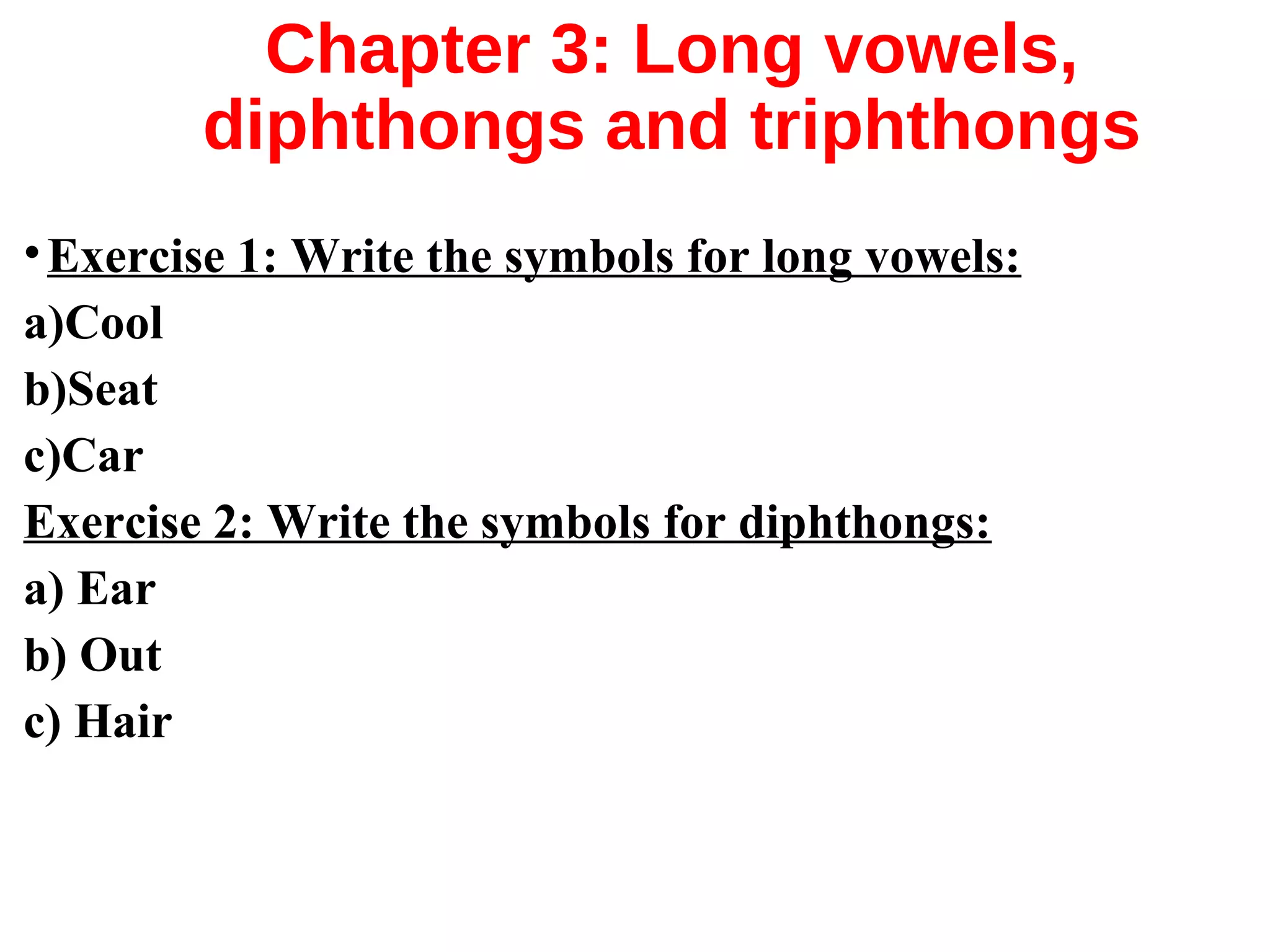
•Exercise 1: Write the symbols for long vowels:
a)Cool
b)Seat
c)Car
Exercise 2: Write the symbols for diphthongs:
a) Ear
b) Out
c) Hair
Chapter 3: Long vowels,
diphthongs and triphthongs
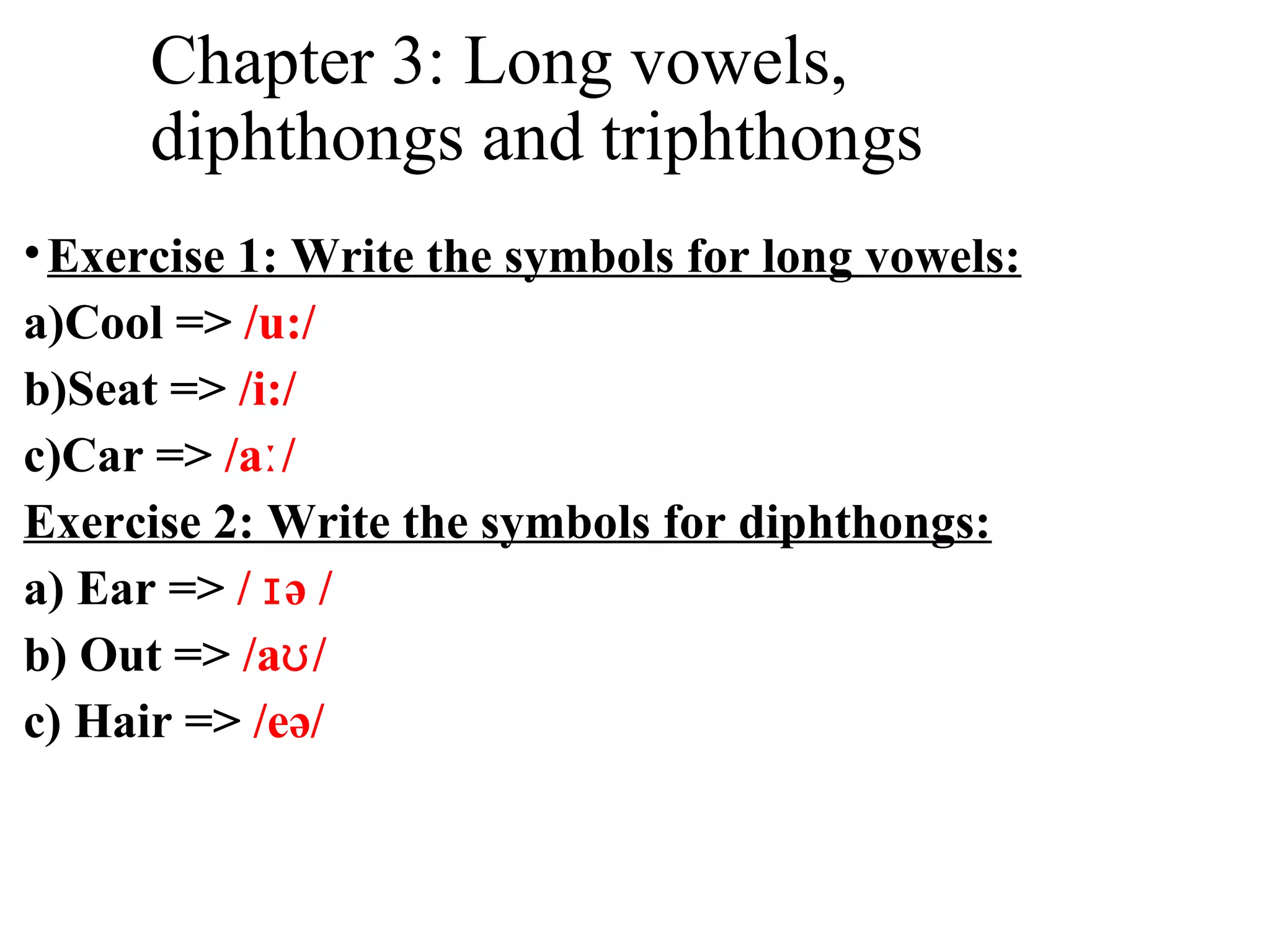
•Exercise 1: Write the symbols for long vowels:
a)Cool => /u:/
b)Seat => /i:/
c)Car => /a /ː
Exercise 2: Write the symbols for diphthongs:
a) Ear => / ə /ɪ
b) Out => /a /ʊ
c) Hair => /eə/
• A triphthong is a glide from one vowel to another
and then to a third, all produced rapidly and
without interruption.
TRIPHTHONGSTRIPHTHONGS
The triphthongs are formed by adding ɚ to five
closing diphthongs.
1. e + = e ( layer, player)ɪ ɚ ɪɚ
2. a + = a ( fire, liar)ɪ ɚ ɪɚ
3. + = ( loyal, royal)ɔɪ ɚ ɔɪɚ
4. ə + = ə ( lower, mower)ʊ ɚ ʊɚ
5. a + = a ( power, hour)ʊ ɚ ʊɚ
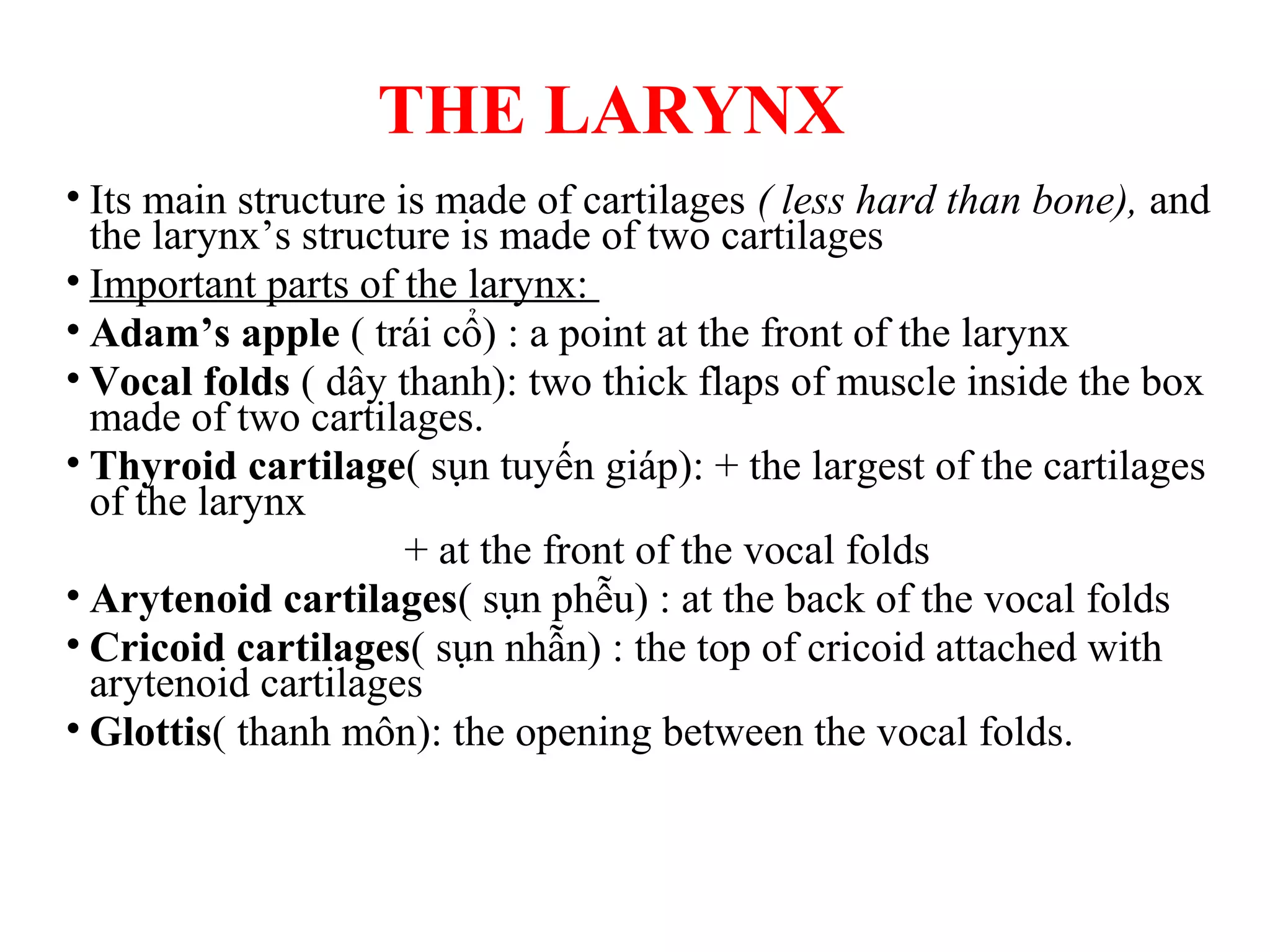
THE LARYNX
• Its main structure is made of cartilages ( less hard than bone), and
the larynx’s structure is made of two cartilages
• Important parts of the larynx:
• Adam’s apple ( trái cổ) : a point at the front of the larynx
• Vocal folds ( dây thanh): two thick flaps of muscle inside the box
made of two cartilages.
• Thyroid cartilage( sụn tuyến giáp): + the largest of the cartilages
of the larynx
+ at the front of the vocal folds
• Arytenoid cartilages( sụn phễu) : at the back of the vocal folds
• Cricoid cartilages( sụn nhẫn) : the top of cricoid attached with
arytenoid cartilages
• Glottis( thanh môn): the opening between the vocal folds.
Four different states of the glottisFour different states of the glottis
4.2 RESPIRATION AND4.2 RESPIRATION AND
VOICINGVOICING
•Respiration and voicing are complex
phenomenon.
•There are many parts of our
body realize these phenomenon.
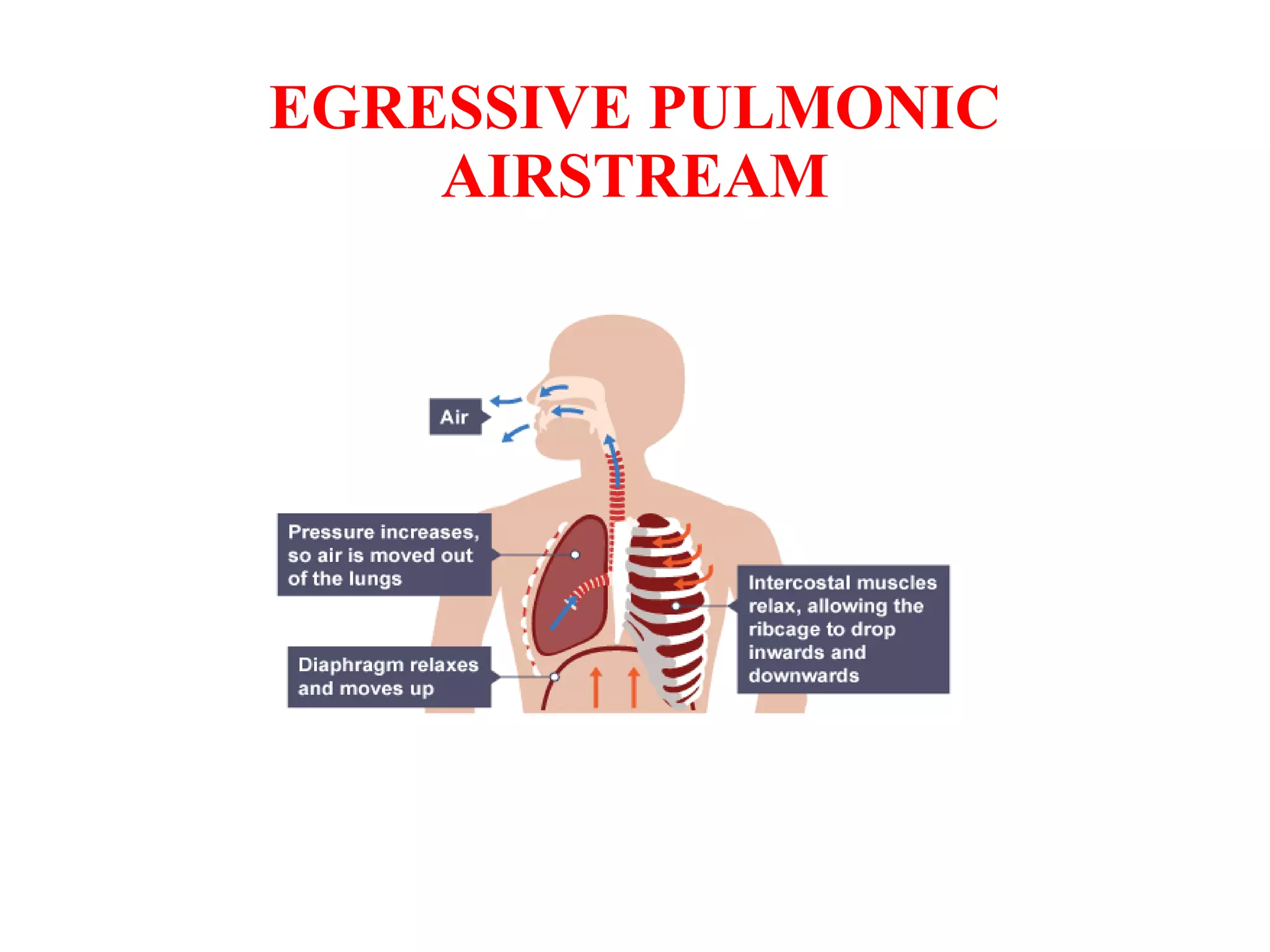
EGRESSIVE PULMONIC
AIRSTREAM
How air is moved in and out of the lungs?
The lungs are like sponges.
Sponge
If the rib cage is lifted upwards and outwards
→ there is more space in the chest for the lungs
→the lungs take more air.
There are some ways to make airflow into and out of the lungs:
•Obstruct the airflow by articulation.
•Form strictures in the vocal tracts.
•If the vocal folds are apart there will be no vibration,
→ no voicing will take place.
•If the vocal folds are intact there will be the voicing and
vibration.
Subglottal pressure:
1. Variations in intensity
2. Variations in frequency
3. Variations in quality
4.3 Plosives
A plosive is a consonant articulation
There are some characteristics:
a)One articulator is moved against another.
b)After the stricture has been formed, it is released, the air
is allowed to escape.
c)The plosive is release → produce a noise ( loud enough
to be heard) called Plosion – a burst of noise.
d)There may be voicing during part or all of the plosive
articulation.
4 phases in the production of plossives:
1. The first: closing phase
2. The second: compression phase
3. The third: release phase
4. The fourth: post- release phase
ENGLISH PLOSIVES
•English has six plosive consonants:
•Voiceless plosive: p, t, k
•Voiced plosive b, d, g
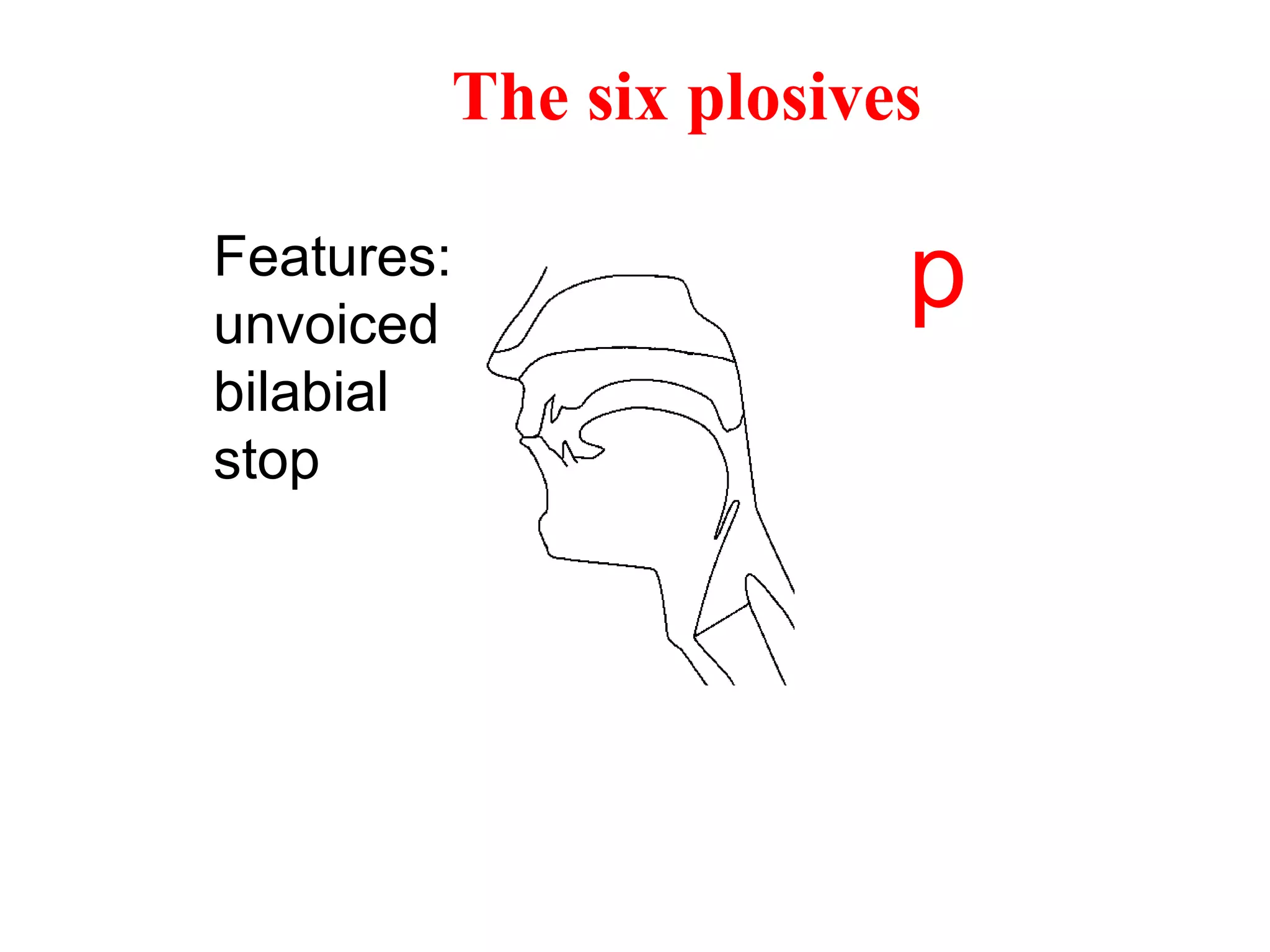
Features:
unvoiced
bilabial
stop
p
The six plosives
Features:
voiced
bilabial
stop
b
The six plosives
Features:
unvoiced
alveolar
stop
t
The six plosives
Features:
voiced
alveolar
stop
d
The six plosives
Features:
unvoiced
velar
stop
k
The six plosives
Features:
voiced
velar
stop
g
The six plosives
Positions of plosives
•Initial position ( CV)
•Medial position (VCV)
•Final position (VC)
Initial position ( CV)
•Closing phase
•P, t, k: no voicing takes place
•B, d, g: no voicing takes place
•Post-realease phase
•P, t, k ( Air escapes through vocal folds, making a
sound like h “aspiration”.)
•B, d, g ( there are no aspiration and vocing
continues)
Difference in the initial positions of
p, t, k and b, d, g.
•Aspiration
•B, d, g cannot be preceded by any consonant
•When P, t, d can be preceded by s, it is unaspirated (
ski, spy,…)
In what circumstances are plosives
aspirated and when they are not?
•Voiceless plosives are /p,k,t/
•Aspiration is a interval of the air heard between the
end of the plosive and the following vowel. It is
represented by the symbol /h
/. Only voiceless
plosives may be aspirated.
•Aspiration may be strong or weak.
Strong aspiration
•Voiceless plosives are strongly aspirated in initial
stressed position
•For example: pen-potato: /ph
en/-/pə’th
eitə /.ʊ
•Exception:
•When t,k,p are preceded by/s/. Ex: pain-
spain /ph
ein/-/spein/
•When they are followed by /l ,r, w, j/. Ex:
Play, pray.
Weak aspiration
•They are weakly aspirated in unstressed syllables
and in final position.
• Ex: pot /ph
ɒt/- tomorrow /t ’m r /ə ɒ əʊ
Medial position (VCV)
•Medial plosive may have the characteristics either of
final or of initial plosives.
Final position (VC)
•B, d, g have little voicing and if there is vocing , it is
at the beginning of the compression phase.
•P, t, k are obviously voiceless.
•The plosion following the release of p, t, t & b, d, g
is very weak and often not audible.
Fortis and Lenis
•Fortis sound is a strongly articulated
•Lenis sound is a weakly articulated
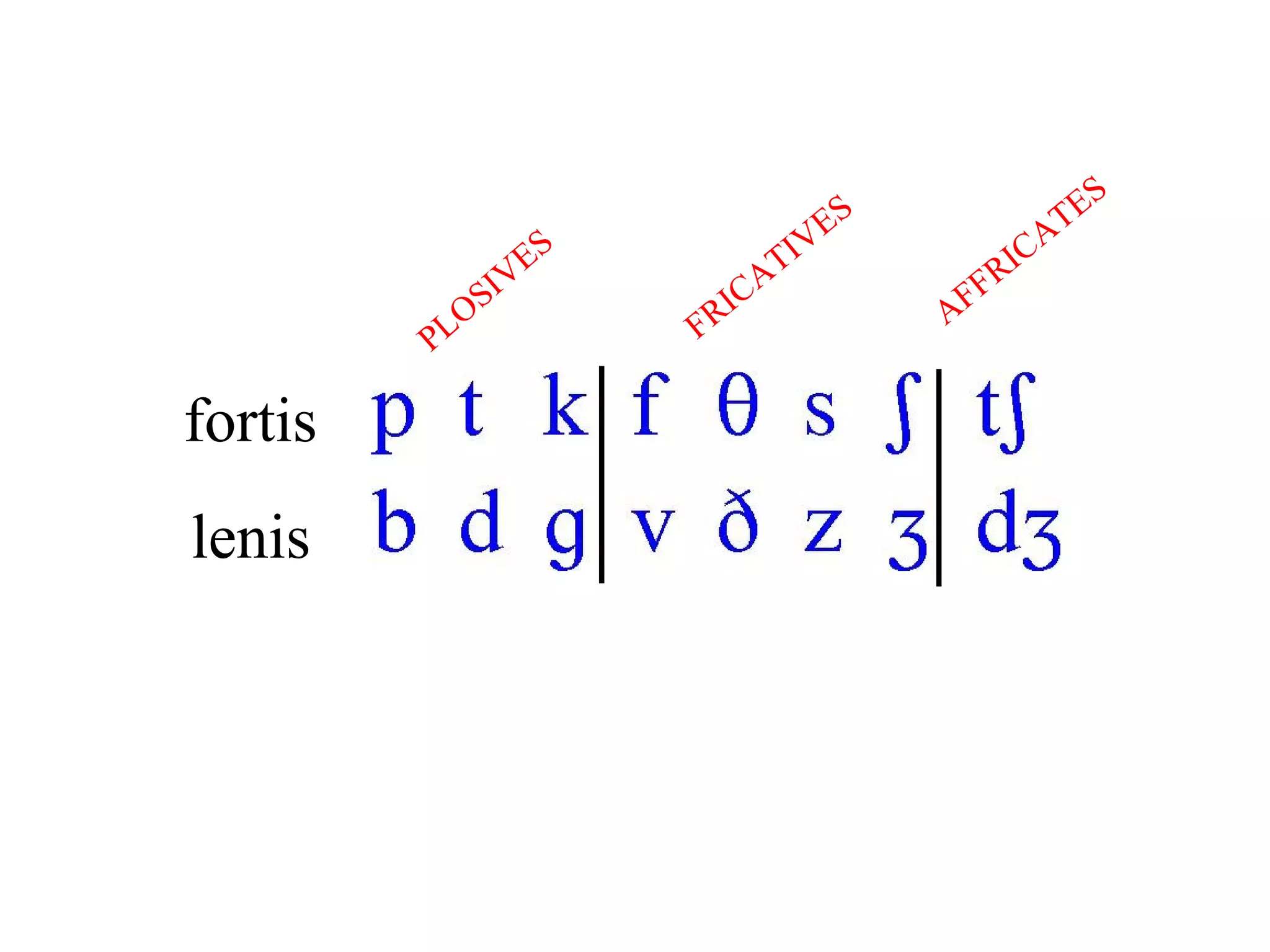
•In English, there are eight fortis-lenis pairs
fortis
lenis
PLOSIVES
FRICATIVES
AFFRICATES
PLACE OF ARTICULATION
Bilabial Alveolar Velar
Fortis
(voiceless)
p t k
Lenis (voiced) b d g
The Fortis and Lenis
distinction
Fortis lenis
• Voicing Unvoiced Voiced
• Length Longer Shorter
• Strength Stronger Weaker
• Aspiration May be aspirated Not aspirated
• Glottalization May be glottalized Not glottalized
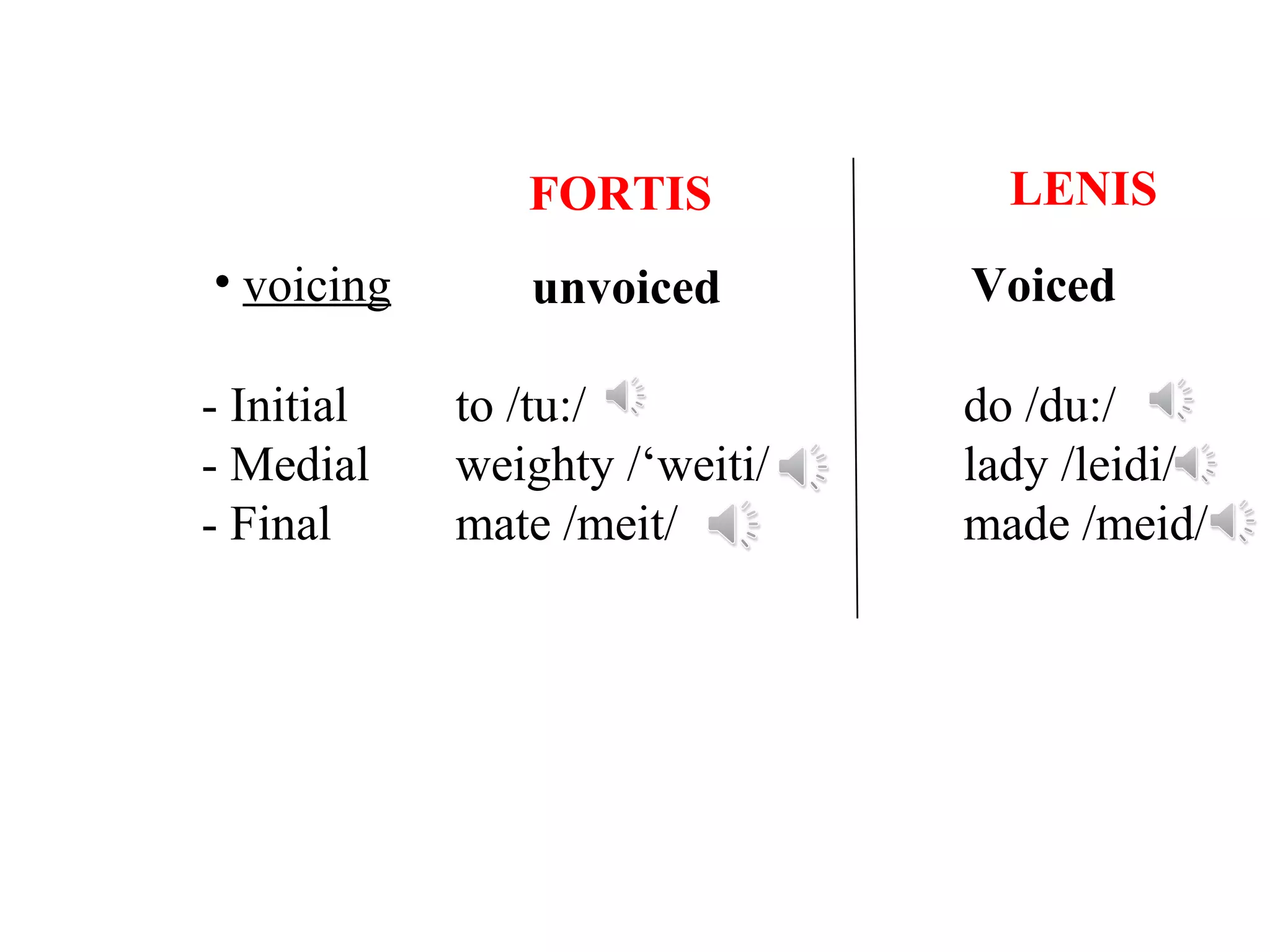
FORTIS LENIS
• voicing unvoiced Voiced
- Initial to /tu:/ do /du:/
- Medial weighty /‘weiti/ lady /leidi/
- Final mate /meit/ made /meid/
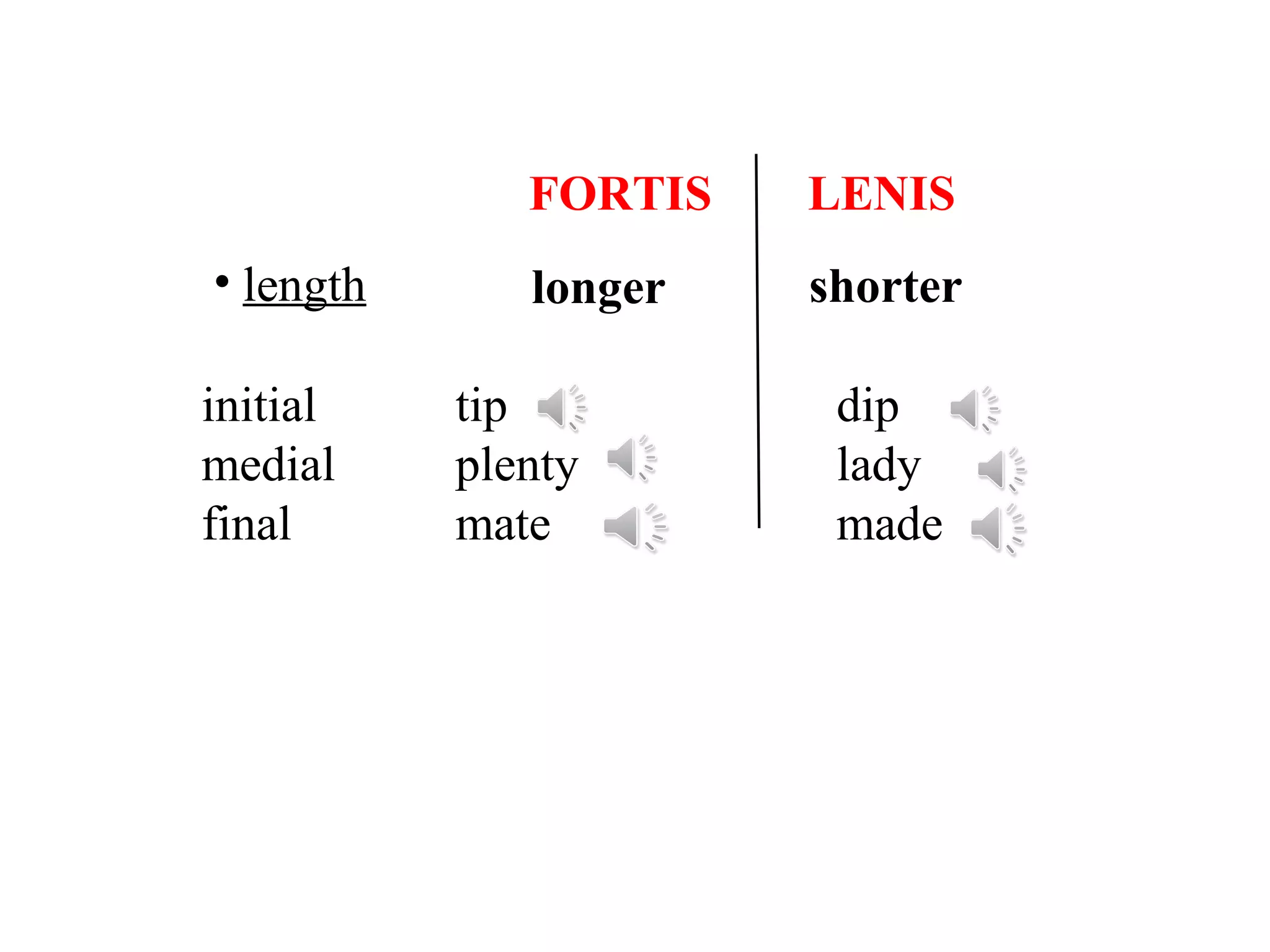
FORTIS LENIS
• length longer shorter
initial tip dip
medial plenty lady
final mate made
FORTIS LENIS
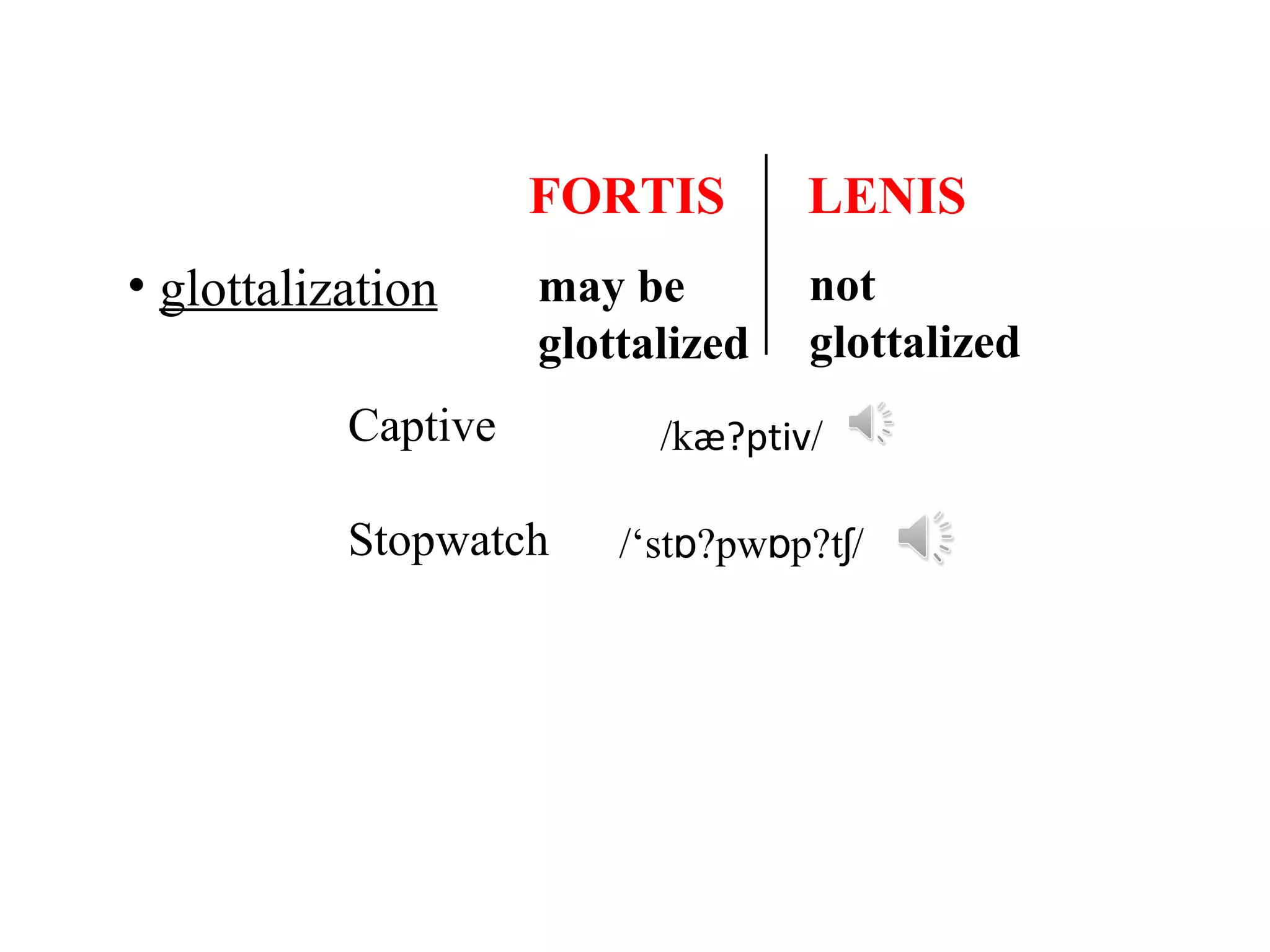
• glottalization may be
glottalized
not
glottalized
Captive
Stopwatch
/kæ?ptiv/
/‘st ?pw p?t /ɒ ɒ ʃ
FORTIS LENIS
• Aspiration may be
aspirated
not
aspirated
cave-gave /keiv/
pie-buy /ph
ai/
/geiv/
/bai/
FORTIS LENIS
• strength stronger weaker
Supper-suber /‘su:pər/
(strong)
/‘su:bə/
(weak)
EXERCISES
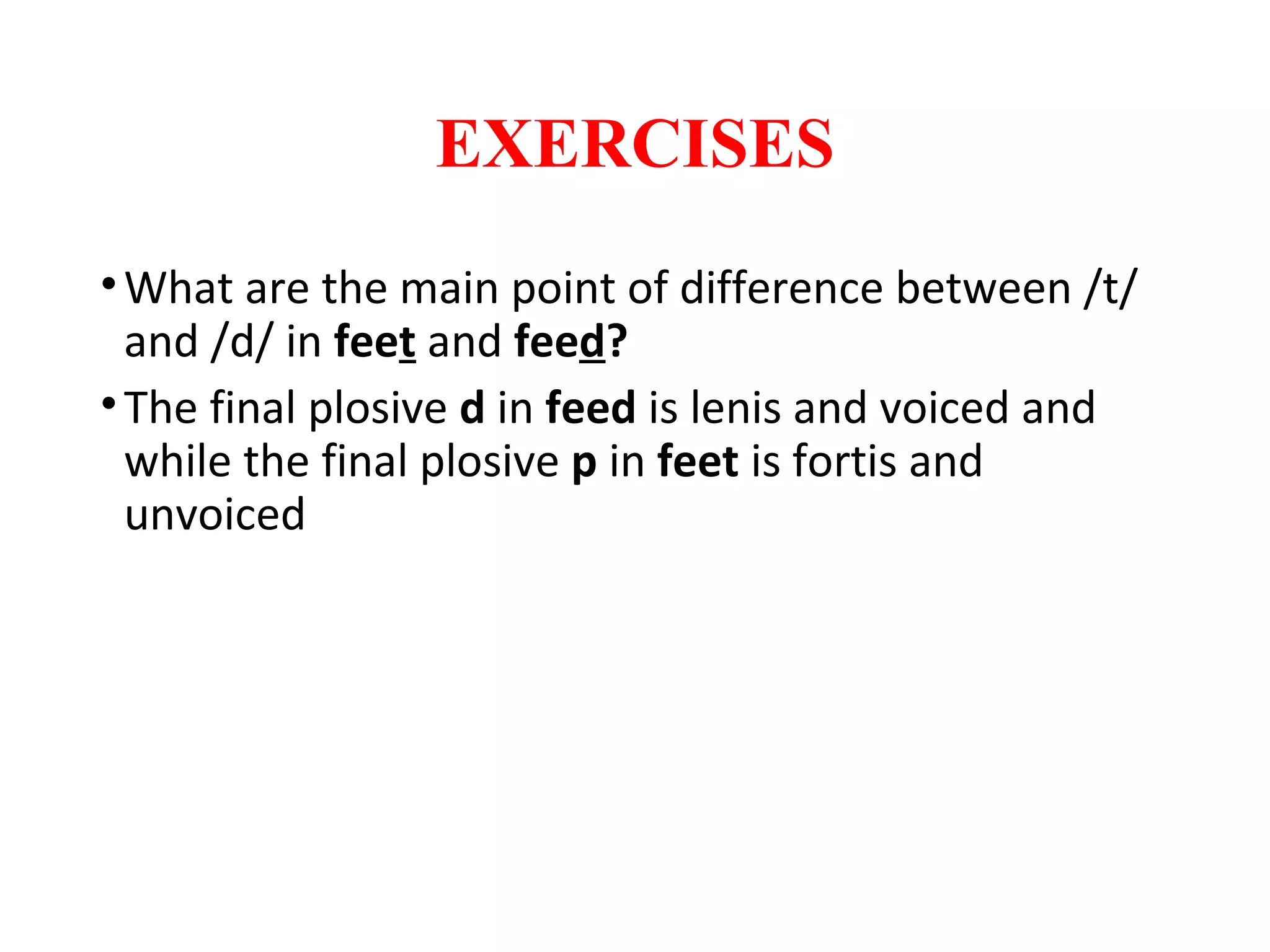
•What are the main point of difference between /t/
and /d/ in feet and feed?
•The final plosive d in feed is lenis and voiced and
while the final plosive p in feet is fortis and
unvoiced
THANK YOU FOR
WATCHING

âM vị học

  • 1.
  • 2.
    Members of group6 •Nguy n Th Thu Th oễ ị ả •Lê Th Kim Th oị ả •Mai Th Huỳnh Nhị ư •Tăng Qu c Phúố
  • 3.
    CONTENTSCONTENTS •Chapter 3: Longvowels, diphthongs and triphthongs •Chapter 4: voicing and consonants
  • 4.
    Chapter 3: Longvowels, diphthongs and triphthongs •I. Long vowels: /i:, u:, a , , :/.ː ɔː ɜ • The long vowels are longer than the short vowels in similar contexts. • The symbols = one vowel + two dots. Ex: /i:/ and /i/
  • 5.
    1. /i:/ • Mouth:like a smile. •Tongue touches the sides of teeth
  • 6.
    2. /u:/ •Make alip into a circle. •Put tongue up and back.
  • 7.
    3. /a /ː •Openmouth wide. •Tongue rest in the bottom of your mouth.
  • 8.
    4. / /ɔː •Putthe front of tongue down. •Round your lips.
  • 9.
    5. / :/ɜ •Mouthand tongue should be relaxed.
  • 10.
    II. Diphthongs: •consist ofa movement or glide from one vowel to another
  • 11.
    Chapter 3: Longvowels, diphthongs and triphthongs II. Diphthongs: /i:/ - About length, diphthongs are like the long vowels. - The first part is longer and stronger than another. /e /ə
  • 12.
    1. / ə/ɪ • Firstly, Mouth like a smile with the / :/ soundɪ • Then, open mouth a little to move the /ə/ sound.
  • 13.
    2. /eə/ •Firstly, Mouthstarts with the /e/ sound. •After, lips become less around and finish with the /ə/ sound.
  • 14.
    3. / ə/ʊ •Firstly,Mouth closes like to kiss someone. •After, mouth slightly opens to remove to the /ə/ sound.
  • 15.
    4. /e /ɪ •Firstly,Mouth starts with the /e/ sound. •After, lips become less Around and finish with the /ə/ sound.
  • 16.
    5. /a /ɪ •Firstly,place the tongue in the / a /. •Then the mouth close a little to pronounce / /, pronouncedɪ /a/ long, / / short and fast.ɪ
  • 17.
    6. / /ɔɪ •Firstly,place the tongue in the sound pronunciation position / :/ɔ •After, finish with the / / sound,ɪ pronounced /a/ long, / /ɪ short and fast.
  • 18.
    7. /ə /ʊ •Firstly,place the tongue in the sound pronunciation position / ə / •Then the mouth round to pronounce / /, pronounce / ə / long,ʊ / / short and fast.ʊ
  • 19.
    8. /a /ʊ •Firstly,place the tongue in the sound pronunciation position / a: / •Then the mouth round to pronounce / /, pronounce / a: / long, / / shortʊ ʊ and fast.
  • 20.
    Chapter 3: Longvowels, diphthongs and triphthongs •Exercise 1: Write the symbols for long vowels: a)Cool b)Seat c)Car Exercise 2: Write the symbols for diphthongs: a) Ear b) Out c) Hair
  • 21.
    Chapter 3: Longvowels, diphthongs and triphthongs •Exercise 1: Write the symbols for long vowels: a)Cool => /u:/ b)Seat => /i:/ c)Car => /a /ː Exercise 2: Write the symbols for diphthongs: a) Ear => / ə /ɪ b) Out => /a /ʊ c) Hair => /eə/
  • 22.
    • A triphthongis a glide from one vowel to another and then to a third, all produced rapidly and without interruption. TRIPHTHONGSTRIPHTHONGS
  • 23.
    The triphthongs areformed by adding ɚ to five closing diphthongs. 1. e + = e ( layer, player)ɪ ɚ ɪɚ 2. a + = a ( fire, liar)ɪ ɚ ɪɚ 3. + = ( loyal, royal)ɔɪ ɚ ɔɪɚ 4. ə + = ə ( lower, mower)ʊ ɚ ʊɚ 5. a + = a ( power, hour)ʊ ɚ ʊɚ
  • 24.
    THE LARYNX • Itsmain structure is made of cartilages ( less hard than bone), and the larynx’s structure is made of two cartilages • Important parts of the larynx: • Adam’s apple ( trái cổ) : a point at the front of the larynx • Vocal folds ( dây thanh): two thick flaps of muscle inside the box made of two cartilages. • Thyroid cartilage( sụn tuyến giáp): + the largest of the cartilages of the larynx + at the front of the vocal folds • Arytenoid cartilages( sụn phễu) : at the back of the vocal folds • Cricoid cartilages( sụn nhẫn) : the top of cricoid attached with arytenoid cartilages • Glottis( thanh môn): the opening between the vocal folds.
  • 25.
    Four different statesof the glottisFour different states of the glottis
  • 26.
    4.2 RESPIRATION AND4.2RESPIRATION AND VOICINGVOICING •Respiration and voicing are complex phenomenon. •There are many parts of our body realize these phenomenon.
  • 27.
  • 28.
    How air ismoved in and out of the lungs? The lungs are like sponges. Sponge
  • 29.
    If the ribcage is lifted upwards and outwards → there is more space in the chest for the lungs →the lungs take more air.
  • 30.
    There are someways to make airflow into and out of the lungs: •Obstruct the airflow by articulation. •Form strictures in the vocal tracts. •If the vocal folds are apart there will be no vibration, → no voicing will take place. •If the vocal folds are intact there will be the voicing and vibration.
  • 31.
    Subglottal pressure: 1. Variationsin intensity 2. Variations in frequency 3. Variations in quality
  • 32.
    4.3 Plosives A plosiveis a consonant articulation There are some characteristics: a)One articulator is moved against another. b)After the stricture has been formed, it is released, the air is allowed to escape. c)The plosive is release → produce a noise ( loud enough to be heard) called Plosion – a burst of noise. d)There may be voicing during part or all of the plosive articulation.
  • 33.
    4 phases inthe production of plossives: 1. The first: closing phase 2. The second: compression phase 3. The third: release phase 4. The fourth: post- release phase
  • 34.
    ENGLISH PLOSIVES •English hassix plosive consonants: •Voiceless plosive: p, t, k •Voiced plosive b, d, g
  • 35.
  • 36.
  • 37.
  • 38.
  • 39.
  • 40.
  • 41.
    Positions of plosives •Initialposition ( CV) •Medial position (VCV) •Final position (VC)
  • 42.
    Initial position (CV) •Closing phase •P, t, k: no voicing takes place •B, d, g: no voicing takes place •Post-realease phase •P, t, k ( Air escapes through vocal folds, making a sound like h “aspiration”.) •B, d, g ( there are no aspiration and vocing continues)
  • 43.
    Difference in theinitial positions of p, t, k and b, d, g. •Aspiration •B, d, g cannot be preceded by any consonant •When P, t, d can be preceded by s, it is unaspirated ( ski, spy,…)
  • 44.
    In what circumstancesare plosives aspirated and when they are not? •Voiceless plosives are /p,k,t/ •Aspiration is a interval of the air heard between the end of the plosive and the following vowel. It is represented by the symbol /h /. Only voiceless plosives may be aspirated. •Aspiration may be strong or weak.
  • 45.
    Strong aspiration •Voiceless plosivesare strongly aspirated in initial stressed position •For example: pen-potato: /ph en/-/pə’th eitə /.ʊ •Exception: •When t,k,p are preceded by/s/. Ex: pain- spain /ph ein/-/spein/ •When they are followed by /l ,r, w, j/. Ex: Play, pray.
  • 46.
    Weak aspiration •They areweakly aspirated in unstressed syllables and in final position. • Ex: pot /ph ɒt/- tomorrow /t ’m r /ə ɒ əʊ
  • 47.
    Medial position (VCV) •Medialplosive may have the characteristics either of final or of initial plosives.
  • 48.
    Final position (VC) •B,d, g have little voicing and if there is vocing , it is at the beginning of the compression phase. •P, t, k are obviously voiceless. •The plosion following the release of p, t, t & b, d, g is very weak and often not audible.
  • 49.
    Fortis and Lenis •Fortissound is a strongly articulated •Lenis sound is a weakly articulated •In English, there are eight fortis-lenis pairs
  • 50.
  • 51.
    PLACE OF ARTICULATION BilabialAlveolar Velar Fortis (voiceless) p t k Lenis (voiced) b d g
  • 52.
    The Fortis andLenis distinction
  • 53.
    Fortis lenis • VoicingUnvoiced Voiced • Length Longer Shorter • Strength Stronger Weaker • Aspiration May be aspirated Not aspirated • Glottalization May be glottalized Not glottalized
  • 54.
    FORTIS LENIS • voicingunvoiced Voiced - Initial to /tu:/ do /du:/ - Medial weighty /‘weiti/ lady /leidi/ - Final mate /meit/ made /meid/
  • 55.
    FORTIS LENIS • lengthlonger shorter initial tip dip medial plenty lady final mate made
  • 56.
    FORTIS LENIS • glottalizationmay be glottalized not glottalized Captive Stopwatch /kæ?ptiv/ /‘st ?pw p?t /ɒ ɒ ʃ
  • 57.
    FORTIS LENIS • Aspirationmay be aspirated not aspirated cave-gave /keiv/ pie-buy /ph ai/ /geiv/ /bai/
  • 58.
    FORTIS LENIS • strengthstronger weaker Supper-suber /‘su:pər/ (strong) /‘su:bə/ (weak)
  • 59.
    EXERCISES •What are themain point of difference between /t/ and /d/ in feet and feed? •The final plosive d in feed is lenis and voiced and while the final plosive p in feet is fortis and unvoiced
  • 60.