1
Kyle Christensen
Ricky Portals
Adrian Leenardo
EE98: LM317 Power Supply
Voltage Regulator Circuit with LM317
2
Table of Contents
Page 1 - Cover Page
Page 2 - Table of Contents
Page 3 - Abstract, Introduction
Page 4 - Schematics
Page 5 - Equations/Theory
Page 6 – Equipment, Completed circuit
Page 7 – Backside of completed circuit, PCB layout
Page 8 - Procedure, Graph
Page 9 - Results
Page 10 - Conclusion
3
Abstract
This project uses the application of the LM317 voltage regulator to create a voltage
regulator supply. Since the component cannot be found, we used the LT1083, a fairly
similar component that shares the same features as the LM317. The predicted voltage
output is shown below and is derived from the LM317’s data sheet. We also ran
simulated output voltages using LT Spice. Lastly, we built the actual circuit and used a
voltmeter to gather physical data.
Introduction
Devices nowadays are all powered and run on batteries that supply a specific voltage.
Some devices require more voltage than others and thus require a different type of
battery. In order to prevent damage to the device when using a battery with a higher
voltage than is required to power the device, a voltage regulator can be used in
conjunction with the input voltage in order to output a specific voltage that will make the
device work. With the use of the voltage regulator it is possible to use a battery with a
higher voltage than is necessary and essentially output a different voltage. The purpose
of this project is to design, build, and test the LM317 using the LT1083 voltage regulator
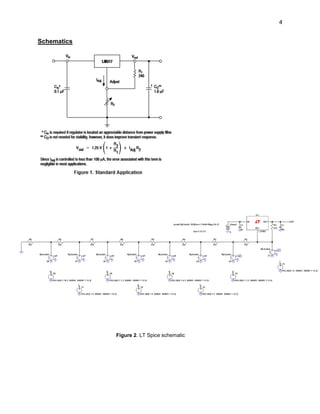
to output different voltages using a 9V battery. Figure 1 below shows the schematic of
the LM317 where Vout is dependent on the value of resistors R1 and R2. In this project
however, we will integrate an 8 pin switchboard to set R2 along with R3, R4, R5, R6,
R7, R8, and R9. This way we can accurately set the resistance values and Vout with the
flip of a simple switch. This design can be seen on the LT Spice schematic shown in
Figure 2.
4
Schematics
Figure 2. LT Spice schematic
5
Equations/Theory
The purpose of the LM317 is to allow control over the input voltage by regulating the
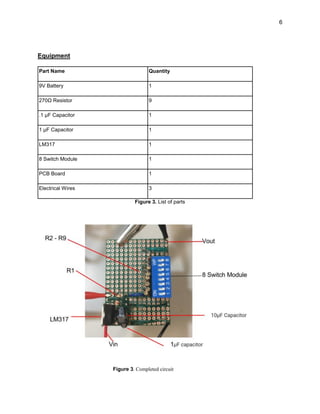
amount of voltage that is input. For our circuit, we have eight resistors connected to a
switch box of 8 switches connected to ground. Also connected are a 1μF and a .1μF
capacitor used to step down the output voltage in increments. This setup allows us to
use a combination of resistors to change the output voltage. By having all eight switches
open, we will reach a maximum output voltage. Meanwhile, opening all of the switches
will gives us the reference voltage, 1.25V. The datasheet for the LM317 voltage
regulator was used to determine the range of 𝑉𝑜𝑢𝑡 and the equation to calculate it. The
theoretical range of the LM317 is 1.2 volts to 37 volts and the maximum output voltage
is 1.25 V less than the input voltage. From Figure 1, we can derive the formula for
output voltage through the characteristics of the LM317 given by the datasheet.
𝑉𝑜𝑢𝑡 − 𝑉𝑎𝑑𝑗 = 1.25 𝑉 where 𝑉𝑎𝑑𝑗 = 1.25 𝑉 + 𝑅2(𝐼 𝑎𝑑𝑗 + 𝐼1) = 1.25 𝑉 + 𝑅2 𝐼1 + 𝑅2 𝐼 𝑎𝑑𝑗
𝐼1 =
1.25 𝑉
𝑅1
which then gives us 𝑉𝑜𝑢𝑡 = 1.25 𝑉 +
1.25×𝑅2
𝑅1
+ 𝑅2 𝐼 𝑎𝑑𝑗
𝑉𝑜𝑢𝑡 = 1.25 𝑉(1 +
𝑅2
𝑅1
) + 𝑅2 𝐼 𝑎𝑑𝑗 The second term is in microvolts andcan be ignored. We
can also replace 𝑅2with 𝑅 𝑒𝑞because our circuit will have more than two resistors.
𝑉𝑜𝑢𝑡 = 1.25 (1 +
𝑅 𝑒𝑞
𝑅1
) (1) % 𝐸𝑟𝑟𝑜𝑟 =
|𝑉 𝑐𝑎𝑙𝑐−𝑉 𝑎𝑐𝑡𝑢𝑎𝑙|
𝑉 𝑐𝑎𝑙𝑐
× 100% (2)
The reference voltage set to 1.25V with a tolerance of .05V. This gives us the following
for our output voltage. Vout < Vin - 1.25. Thus, our maximum output voltage can be
between 7.5 - 7.8V.
6
Equipment
Part Name Quantity
9V Battery 1
270Ω Resistor 9
.1 µF Capacitor 1
1 µF Capacitor 1
LM317 1
8 Switch Module 1
PCB Board 1
Electrical Wires 3
Figure 3. List of parts
Figure 3. Completed circuit
7
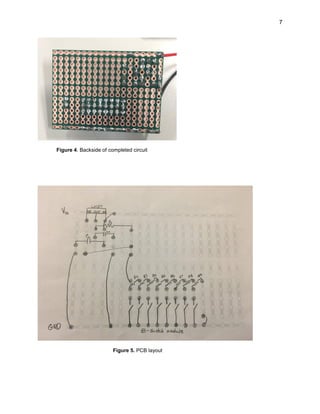
Figure 4. Backside of completed circuit
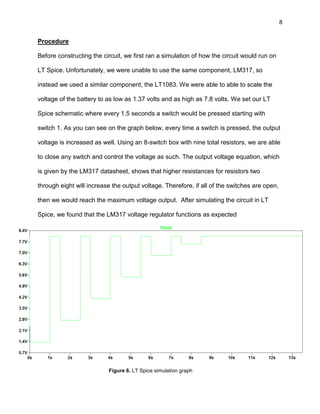
Figure 5. PCB layout
8
Procedure
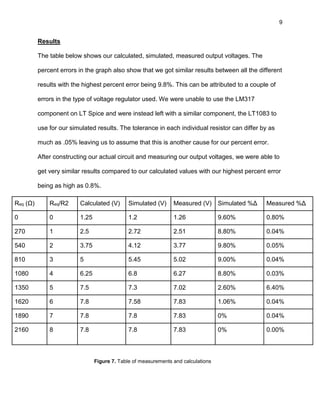
Before constructing the circuit, we first ran a simulation of how the circuit would run on
LT Spice. Unfortunately, we were unable to use the same component, LM317, so
instead we used a similar component, the LT1083. We were able to able to scale the
voltage of the battery to as low as 1.37 volts and as high as 7.8 volts. We set our LT
Spice schematic where every 1.5 seconds a switch would be pressed starting with
switch 1. As you can see on the graph below, every time a switch is pressed, the output
voltage is increased as well. Using an 8-switch box with nine total resistors, we are able
to close any switch and control the voltage as such. The output voltage equation, which
is given by the LM317 datasheet, shows that higher resistances for resistors two
through eight will increase the output voltage. Therefore, if all of the switches are open,
then we would reach the maximum voltage output. After simulating the circuit in LT
Spice, we found that the LM317 voltage regulator functions as expected
Figure 6. LT Spice simulation graph
9
Results
The table below shows our calculated, simulated, measured output voltages. The
percent errors in the graph also show that we got similar results between all the different
results with the highest percent error being 9.8%. This can be attributed to a couple of
errors in the type of voltage regulator used. We were unable to use the LM317
component on LT Spice and were instead left with a similar component, the LT1083 to
use for our simulated results. The tolerance in each individual resistor can differ by as
much as .05% leaving us to assume that this is another cause for our percent error.
After constructing our actual circuit and measuring our output voltages, we were able to
get very similar results compared to our calculated values with our highest percent error
being as high as 0.8%.
Req (Ω) Req/R2 Calculated (V) Simulated (V) Measured (V) Simulated %Δ Measured %Δ
0 0 1.25 1.2 1.26 9.60% 0.80%
270 1 2.5 2.72 2.51 8.80% 0.04%
540 2 3.75 4.12 3.77 9.80% 0.05%
810 3 5 5.45 5.02 9.00% 0.04%
1080 4 6.25 6.8 6.27 8.80% 0.03%
1350 5 7.5 7.3 7.02 2.60% 6.40%
1620 6 7.8 7.58 7.83 1.06% 0.04%
1890 7 7.8 7.8 7.83 0% 0.04%
2160 8 7.8 7.8 7.83 0% 0.00%
Figure 7. Table of measurements and calculations
10
Conclusion
The LM317 (LT1083) voltage regulator is designed to scale an input voltage so the
output can be properly adjusted for the load circuit. It is a reliable voltage regulator for
obtaining the exact voltage output one needs. The circuit we built performed better than
expected, having little difference from our calculated and expected results. In this
project we learned that the reference voltage of the LM317 is dependent on the
resistance of the equivalent resistance in the basic application circuit. In conclusion, our
results were accurate enough and within acceptable percent error to use this circuit as
an adjustable power supply.

Voltage Regulator Circuit with LM317

  • 1.
    1 Kyle Christensen Ricky Portals AdrianLeenardo EE98: LM317 Power Supply Voltage Regulator Circuit with LM317
  • 2.
    2 Table of Contents Page1 - Cover Page Page 2 - Table of Contents Page 3 - Abstract, Introduction Page 4 - Schematics Page 5 - Equations/Theory Page 6 – Equipment, Completed circuit Page 7 – Backside of completed circuit, PCB layout Page 8 - Procedure, Graph Page 9 - Results Page 10 - Conclusion
  • 3.
    3 Abstract This project usesthe application of the LM317 voltage regulator to create a voltage regulator supply. Since the component cannot be found, we used the LT1083, a fairly similar component that shares the same features as the LM317. The predicted voltage output is shown below and is derived from the LM317’s data sheet. We also ran simulated output voltages using LT Spice. Lastly, we built the actual circuit and used a voltmeter to gather physical data. Introduction Devices nowadays are all powered and run on batteries that supply a specific voltage. Some devices require more voltage than others and thus require a different type of battery. In order to prevent damage to the device when using a battery with a higher voltage than is required to power the device, a voltage regulator can be used in conjunction with the input voltage in order to output a specific voltage that will make the device work. With the use of the voltage regulator it is possible to use a battery with a higher voltage than is necessary and essentially output a different voltage. The purpose of this project is to design, build, and test the LM317 using the LT1083 voltage regulator to output different voltages using a 9V battery. Figure 1 below shows the schematic of the LM317 where Vout is dependent on the value of resistors R1 and R2. In this project however, we will integrate an 8 pin switchboard to set R2 along with R3, R4, R5, R6, R7, R8, and R9. This way we can accurately set the resistance values and Vout with the flip of a simple switch. This design can be seen on the LT Spice schematic shown in Figure 2.
  • 4.
  • 5.
    5 Equations/Theory The purpose ofthe LM317 is to allow control over the input voltage by regulating the amount of voltage that is input. For our circuit, we have eight resistors connected to a switch box of 8 switches connected to ground. Also connected are a 1μF and a .1μF capacitor used to step down the output voltage in increments. This setup allows us to use a combination of resistors to change the output voltage. By having all eight switches open, we will reach a maximum output voltage. Meanwhile, opening all of the switches will gives us the reference voltage, 1.25V. The datasheet for the LM317 voltage regulator was used to determine the range of 𝑉𝑜𝑢𝑡 and the equation to calculate it. The theoretical range of the LM317 is 1.2 volts to 37 volts and the maximum output voltage is 1.25 V less than the input voltage. From Figure 1, we can derive the formula for output voltage through the characteristics of the LM317 given by the datasheet. 𝑉𝑜𝑢𝑡 − 𝑉𝑎𝑑𝑗 = 1.25 𝑉 where 𝑉𝑎𝑑𝑗 = 1.25 𝑉 + 𝑅2(𝐼 𝑎𝑑𝑗 + 𝐼1) = 1.25 𝑉 + 𝑅2 𝐼1 + 𝑅2 𝐼 𝑎𝑑𝑗 𝐼1 = 1.25 𝑉 𝑅1 which then gives us 𝑉𝑜𝑢𝑡 = 1.25 𝑉 + 1.25×𝑅2 𝑅1 + 𝑅2 𝐼 𝑎𝑑𝑗 𝑉𝑜𝑢𝑡 = 1.25 𝑉(1 + 𝑅2 𝑅1 ) + 𝑅2 𝐼 𝑎𝑑𝑗 The second term is in microvolts andcan be ignored. We can also replace 𝑅2with 𝑅 𝑒𝑞because our circuit will have more than two resistors. 𝑉𝑜𝑢𝑡 = 1.25 (1 + 𝑅 𝑒𝑞 𝑅1 ) (1) % 𝐸𝑟𝑟𝑜𝑟 = |𝑉 𝑐𝑎𝑙𝑐−𝑉 𝑎𝑐𝑡𝑢𝑎𝑙| 𝑉 𝑐𝑎𝑙𝑐 × 100% (2) The reference voltage set to 1.25V with a tolerance of .05V. This gives us the following for our output voltage. Vout < Vin - 1.25. Thus, our maximum output voltage can be between 7.5 - 7.8V.
  • 6.
    6 Equipment Part Name Quantity 9VBattery 1 270Ω Resistor 9 .1 µF Capacitor 1 1 µF Capacitor 1 LM317 1 8 Switch Module 1 PCB Board 1 Electrical Wires 3 Figure 3. List of parts Figure 3. Completed circuit
  • 7.
    7 Figure 4. Backsideof completed circuit Figure 5. PCB layout
  • 8.
    8 Procedure Before constructing thecircuit, we first ran a simulation of how the circuit would run on LT Spice. Unfortunately, we were unable to use the same component, LM317, so instead we used a similar component, the LT1083. We were able to able to scale the voltage of the battery to as low as 1.37 volts and as high as 7.8 volts. We set our LT Spice schematic where every 1.5 seconds a switch would be pressed starting with switch 1. As you can see on the graph below, every time a switch is pressed, the output voltage is increased as well. Using an 8-switch box with nine total resistors, we are able to close any switch and control the voltage as such. The output voltage equation, which is given by the LM317 datasheet, shows that higher resistances for resistors two through eight will increase the output voltage. Therefore, if all of the switches are open, then we would reach the maximum voltage output. After simulating the circuit in LT Spice, we found that the LM317 voltage regulator functions as expected Figure 6. LT Spice simulation graph
  • 9.
    9 Results The table belowshows our calculated, simulated, measured output voltages. The percent errors in the graph also show that we got similar results between all the different results with the highest percent error being 9.8%. This can be attributed to a couple of errors in the type of voltage regulator used. We were unable to use the LM317 component on LT Spice and were instead left with a similar component, the LT1083 to use for our simulated results. The tolerance in each individual resistor can differ by as much as .05% leaving us to assume that this is another cause for our percent error. After constructing our actual circuit and measuring our output voltages, we were able to get very similar results compared to our calculated values with our highest percent error being as high as 0.8%. Req (Ω) Req/R2 Calculated (V) Simulated (V) Measured (V) Simulated %Δ Measured %Δ 0 0 1.25 1.2 1.26 9.60% 0.80% 270 1 2.5 2.72 2.51 8.80% 0.04% 540 2 3.75 4.12 3.77 9.80% 0.05% 810 3 5 5.45 5.02 9.00% 0.04% 1080 4 6.25 6.8 6.27 8.80% 0.03% 1350 5 7.5 7.3 7.02 2.60% 6.40% 1620 6 7.8 7.58 7.83 1.06% 0.04% 1890 7 7.8 7.8 7.83 0% 0.04% 2160 8 7.8 7.8 7.83 0% 0.00% Figure 7. Table of measurements and calculations
  • 10.
    10 Conclusion The LM317 (LT1083)voltage regulator is designed to scale an input voltage so the output can be properly adjusted for the load circuit. It is a reliable voltage regulator for obtaining the exact voltage output one needs. The circuit we built performed better than expected, having little difference from our calculated and expected results. In this project we learned that the reference voltage of the LM317 is dependent on the resistance of the equivalent resistance in the basic application circuit. In conclusion, our results were accurate enough and within acceptable percent error to use this circuit as an adjustable power supply.