Presented by : Mehraj-ud-din Wani
Roll no.: 30-ERE-2013
Department of Electrical Engineering
SOET,BGSBU(RAJOURI)
Contents
1. Introduction
2. Main principle
3. Nano Chip
4. Working
5. Whole Process
6. Advantages
7. Disadvantages
8. Applications
9. Conclusion
10. References
Introduction
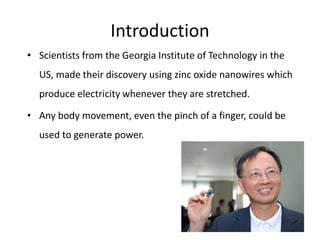
• Scientists from the Georgia Institute of Technology in the
US, made their discovery using zinc oxide nanowires which
produce electricity whenever they are stretched.
• Any body movement, even the pinch of a finger, could be
used to generate power.
Main Principle
• The key to the technology is zinc oxide (ZnO) nanowires. ZnO
nanowires are piezoelectric — they can generate an electric
current when strained or flexed.
Nano Chip
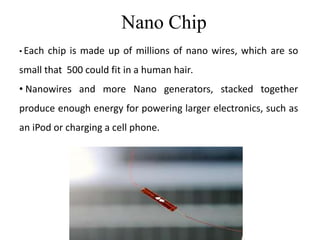
• Each chip is made up of millions of nano wires, which are so
small that 500 could fit in a human hair.
• Nanowires and more Nano generators, stacked together
produce enough energy for powering larger electronics, such as
an iPod or charging a cell phone.
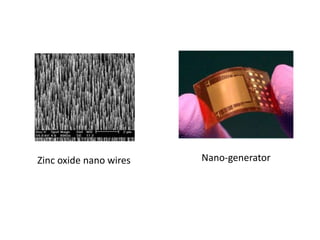
Zinc oxide nano wires Nano-generator
Working
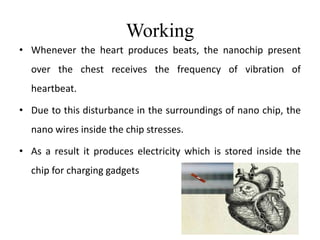
• Whenever the heart produces beats, the nanochip present
over the chest receives the frequency of vibration of
heartbeat.
• Due to this disturbance in the surroundings of nano chip, the
nano wires inside the chip stresses.
• As a result it produces electricity which is stored inside the
chip for charging gadgets
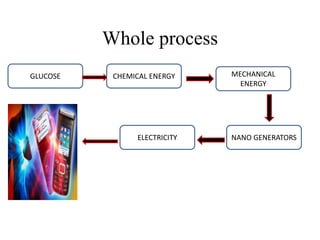
GLUCOSE
ELECTRICITY
MECHANICAL
ENERGY
CHEMICAL ENERGY
NANO GENERATORS
Whole process
Advantages
1. Easy to charge.
2. Power saving.
3. No need of external batteries.
4. Less cost.
5. More efficient.
6. Time consumption.
Disadvantage
1. The problem with humans is that they really don't move
around that much at the kind of frequency needed to
generate a sufficient amount of electricity.
Applications
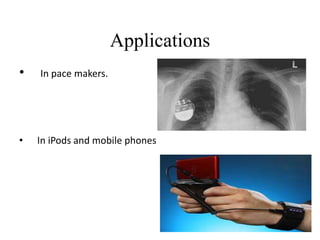
• In pace makers.
• In iPods and mobile phones
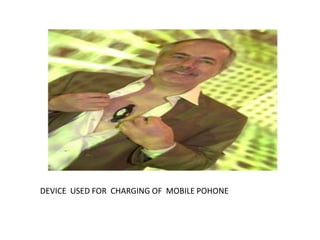
DEVICE USED FOR CHARGING OF MOBILE POHONE
Conclusion
• The plan is to use the human heart to power the devices such
as iPods, mobile phones by eliminating batteries.
• This technology will soon be used to recharge mobiles.
• These are very useful for real life human beings.
References
1. Z.L. Wang, J.H. Song, Piezoelectric nanogenerators based on zinc
oxide nanowire arrays. Science 312, 242–246 (2006)
2. Z.L. Wang, Nanogenerators for self-powered devices and systems.
Georgia Institute of Technology, Smart Tech digital repository ,2011
3. Z.L. Wang, The new field of nanopiezotronics. Mater. Today 10(5),
20–28 (2007)
4. Xudong Wang, “ Department of Materials Science and Engineering,
University of Wisconsin–Madison, WI 53706, USA ―Piezoelectric
nanogenerators—Harvesting ambient mechanical energy at the
nanometer scale”.
References Cont.
5. Jan Holterman,Pim Groen “An introduction to Piezoelectric
Materials and Components”June 2012.
6. B. Y. Sun, M. Qian, and J. Zhang, “Review and prospect on
research for piezoelectric sensors and Dynamometers,” Journal
of Dalian University of Technology, Dalian, vol. 41, no. 2,
2001, pp. 127-133.
7. L. P. Shi, B. Y. Sun, and X. P. Li, “the Application of the
multi-piezoelectric effect to sensor and actuator,” unpublished.
8. F. X. Zhang and L. K. Wang, “Modern piezoelectricity,” vol. ,
Beijing: Science Press, 2003, pp. 149.
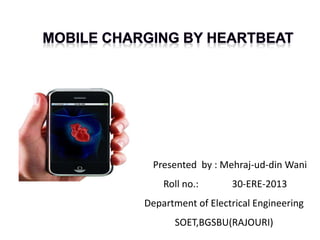
Mobile charging

Mobile charging

  • 1.
    Presented by :Mehraj-ud-din Wani Roll no.: 30-ERE-2013 Department of Electrical Engineering SOET,BGSBU(RAJOURI)
  • 2.
    Contents 1. Introduction 2. Mainprinciple 3. Nano Chip 4. Working 5. Whole Process 6. Advantages 7. Disadvantages 8. Applications 9. Conclusion 10. References
  • 3.
    Introduction • Scientists fromthe Georgia Institute of Technology in the US, made their discovery using zinc oxide nanowires which produce electricity whenever they are stretched. • Any body movement, even the pinch of a finger, could be used to generate power.
  • 4.
    Main Principle • Thekey to the technology is zinc oxide (ZnO) nanowires. ZnO nanowires are piezoelectric — they can generate an electric current when strained or flexed.
  • 5.
    Nano Chip • Eachchip is made up of millions of nano wires, which are so small that 500 could fit in a human hair. • Nanowires and more Nano generators, stacked together produce enough energy for powering larger electronics, such as an iPod or charging a cell phone.
  • 6.
    Zinc oxide nanowires Nano-generator
  • 7.
    Working • Whenever theheart produces beats, the nanochip present over the chest receives the frequency of vibration of heartbeat. • Due to this disturbance in the surroundings of nano chip, the nano wires inside the chip stresses. • As a result it produces electricity which is stored inside the chip for charging gadgets
  • 8.
  • 9.
    Advantages 1. Easy tocharge. 2. Power saving. 3. No need of external batteries. 4. Less cost. 5. More efficient. 6. Time consumption.
  • 10.
    Disadvantage 1. The problemwith humans is that they really don't move around that much at the kind of frequency needed to generate a sufficient amount of electricity.
  • 11.
    Applications • In pacemakers. • In iPods and mobile phones
  • 12.
    DEVICE USED FORCHARGING OF MOBILE POHONE
  • 13.
    Conclusion • The planis to use the human heart to power the devices such as iPods, mobile phones by eliminating batteries. • This technology will soon be used to recharge mobiles. • These are very useful for real life human beings.
  • 14.
    References 1. Z.L. Wang,J.H. Song, Piezoelectric nanogenerators based on zinc oxide nanowire arrays. Science 312, 242–246 (2006) 2. Z.L. Wang, Nanogenerators for self-powered devices and systems. Georgia Institute of Technology, Smart Tech digital repository ,2011 3. Z.L. Wang, The new field of nanopiezotronics. Mater. Today 10(5), 20–28 (2007) 4. Xudong Wang, “ Department of Materials Science and Engineering, University of Wisconsin–Madison, WI 53706, USA ―Piezoelectric nanogenerators—Harvesting ambient mechanical energy at the nanometer scale”.
  • 15.
    References Cont. 5. JanHolterman,Pim Groen “An introduction to Piezoelectric Materials and Components”June 2012. 6. B. Y. Sun, M. Qian, and J. Zhang, “Review and prospect on research for piezoelectric sensors and Dynamometers,” Journal of Dalian University of Technology, Dalian, vol. 41, no. 2, 2001, pp. 127-133. 7. L. P. Shi, B. Y. Sun, and X. P. Li, “the Application of the multi-piezoelectric effect to sensor and actuator,” unpublished. 8. F. X. Zhang and L. K. Wang, “Modern piezoelectricity,” vol. , Beijing: Science Press, 2003, pp. 149.