VOICE RECOGNITION SECURITY
SYSTEMS
K.SANDEEP KUMAR
10L01A0431
Point of View
To implement a
Voice-Recognition Security System
to provide Security to your
System
WHAT IS VOICE RECOGNITION
SYSTEM
•The term voice recognition or speaker identification
refers to finding the identity of "who" is speaking,
rather than what they are saying.
•Recognising the Speaker can simplify the task of
translating speech in systems that have been trained
on a specific person's voice or it can be used to
authenticate or verify the identity of a speaker as
part of a security process
•Personal information like Bank Password,bank
amount,Criminal Data can be secured using voice
Recognition
Why Voice Recognition
Security Systems
•Today’s password is going to be the major factor
which is prone to hackers.
•The password is not enough today to secure the
critical Data.
•These Systems can deliver bio-metric Security
technology to the at low-cost than anyone else in the
industry.
•The system can be supportable across a wide range of
platforms including the Embedded Platforms.
OBJECTIVES
•Construct a Voice Recognition using Matlab.
•This Construction can be done in 4 different
steps.
Background Math
Logical Structure
Hardware/Software Tradeoffs
Program Design
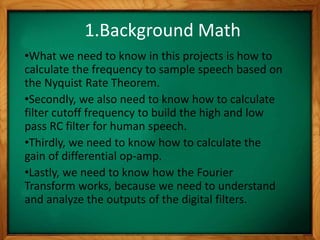
1.Background Math
•What we need to know in this projects is how to
calculate the frequency to sample speech based on
the Nyquist Rate Theorem.
•Secondly, we also need to know how to calculate
filter cutoff frequency to build the high and low
pass RC filter for human speech.
•Thirdly, we need to know how to calculate the
gain of differential op-amp.
•Lastly, we need to know how the Fourier
Transform works, because we need to understand
and analyze the outputs of the digital filters.
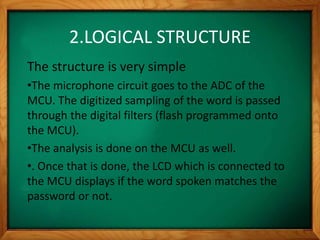
2.LOGICAL STRUCTURE
The structure is very simple
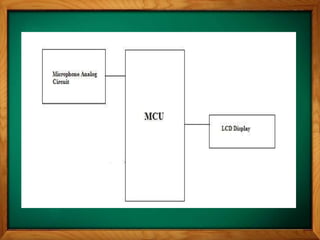
•The microphone circuit goes to the ADC of the
MCU. The digitized sampling of the word is passed
through the digital filters (flash programmed onto
the MCU).
•The analysis is done on the MCU as well.
•. Once that is done, the LCD which is connected to
the MCU displays if the word spoken matches the
password or not.
.
.
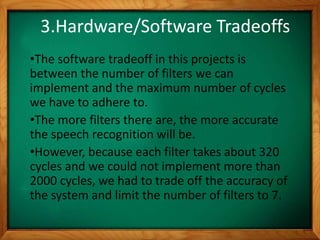
3.Hardware/Software Tradeoffs
•The software tradeoff in this projects is
between the number of filters we can
implement and the maximum number of cycles
we have to adhere to.
•The more filters there are, the more accurate
the speech recognition will be.
•However, because each filter takes about 320
cycles and we could not implement more than
2000 cycles, we had to trade off the accuracy of
the system and limit the number of filters to 7.
4.Program Design
•Because there is not enough memory
(SRAM) on the STK500, we have to deal with
speech analysis during each sample interval.
•The key point of this projects is to how to
design filters and how to implement them.
.
There are two major difficulties we need to
solve:
•First reduce the running time of each filter in
order to get all the finger prints before next
new sample comes. So we have to use fixed-
point algorithm.
•Secondly, set the reasonable cutoff rate for
each filter and number of stages of the filters
I.Speech Spectrum Analysis
•Generally the human speech spectrum is less
than 4000Hz.
•. According to Nyquist theory, the minimum
sampling rate for speech should be
8000samples/second.
•Due to our system is voice-controlled safety
system; it is very helpful to analyze the
speaker's voice before our actual design.
.
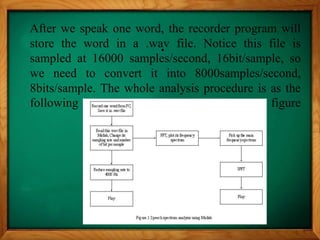
After we speak one word, the recorder program will
store the word in a .wav file. Notice this file is
sampled at 16000 samples/second, 16bit/sample, so
we need to convert it into 8000samples/second,
8bits/sample. The whole analysis procedure is as the
following figure
II.FingerPrint Analysis
•The fingerprint of each filter is an
accumulation of 250 consecutive outputs
square of this filter
•.Basically, different words has different
frequency spectrum, then it has different
fingerprint.
•So we need to calculation the difference of
different words and compare to the
difference of same words to test whether
system can recognize it.
III.Filter Design
we know the frequency range of each filter. So
first we use Matlab to generate their coefficients.
Here we use ChebychevII filter.
•Fs=4000; %Hz
•Fnaq=Fs/2; % Nyquist
•[B0, A0]=cheby2 (2, 20, f0); % LPF
•[B6, A6]=cheby2 (2,20, f6, 'high'); % HPF
•[B1, A1]=cheby2 (2, 20, [f0 f1]); % BPF
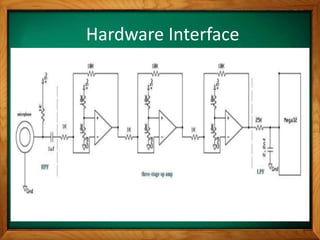
Hardware Interface
Conclusion
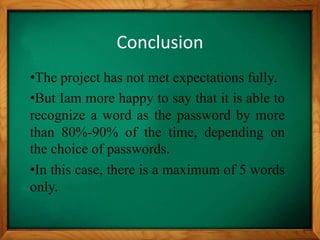
•The project has not met expectations fully.
•But Iam more happy to say that it is able to
recognize a word as the password by more
than 80%-90% of the time, depending on
the choice of passwords.
•In this case, there is a maximum of 5 words
only.
THANK YOU
Any Queries??

Voice recognition security systems

  • 1.
  • 2.
    Point of View Toimplement a Voice-Recognition Security System to provide Security to your System
  • 3.
    WHAT IS VOICERECOGNITION SYSTEM •The term voice recognition or speaker identification refers to finding the identity of "who" is speaking, rather than what they are saying. •Recognising the Speaker can simplify the task of translating speech in systems that have been trained on a specific person's voice or it can be used to authenticate or verify the identity of a speaker as part of a security process •Personal information like Bank Password,bank amount,Criminal Data can be secured using voice Recognition
  • 4.
    Why Voice Recognition SecuritySystems •Today’s password is going to be the major factor which is prone to hackers. •The password is not enough today to secure the critical Data. •These Systems can deliver bio-metric Security technology to the at low-cost than anyone else in the industry. •The system can be supportable across a wide range of platforms including the Embedded Platforms.
  • 5.
    OBJECTIVES •Construct a VoiceRecognition using Matlab. •This Construction can be done in 4 different steps. Background Math Logical Structure Hardware/Software Tradeoffs Program Design
  • 6.
    1.Background Math •What weneed to know in this projects is how to calculate the frequency to sample speech based on the Nyquist Rate Theorem. •Secondly, we also need to know how to calculate filter cutoff frequency to build the high and low pass RC filter for human speech. •Thirdly, we need to know how to calculate the gain of differential op-amp. •Lastly, we need to know how the Fourier Transform works, because we need to understand and analyze the outputs of the digital filters.
  • 7.
    2.LOGICAL STRUCTURE The structureis very simple •The microphone circuit goes to the ADC of the MCU. The digitized sampling of the word is passed through the digital filters (flash programmed onto the MCU). •The analysis is done on the MCU as well. •. Once that is done, the LCD which is connected to the MCU displays if the word spoken matches the password or not.
  • 8.
  • 9.
    3.Hardware/Software Tradeoffs •The softwaretradeoff in this projects is between the number of filters we can implement and the maximum number of cycles we have to adhere to. •The more filters there are, the more accurate the speech recognition will be. •However, because each filter takes about 320 cycles and we could not implement more than 2000 cycles, we had to trade off the accuracy of the system and limit the number of filters to 7.
  • 10.
    4.Program Design •Because thereis not enough memory (SRAM) on the STK500, we have to deal with speech analysis during each sample interval. •The key point of this projects is to how to design filters and how to implement them.
  • 11.
    . There are twomajor difficulties we need to solve: •First reduce the running time of each filter in order to get all the finger prints before next new sample comes. So we have to use fixed- point algorithm. •Secondly, set the reasonable cutoff rate for each filter and number of stages of the filters
  • 12.
    I.Speech Spectrum Analysis •Generallythe human speech spectrum is less than 4000Hz. •. According to Nyquist theory, the minimum sampling rate for speech should be 8000samples/second. •Due to our system is voice-controlled safety system; it is very helpful to analyze the speaker's voice before our actual design.
  • 13.
    . After we speakone word, the recorder program will store the word in a .wav file. Notice this file is sampled at 16000 samples/second, 16bit/sample, so we need to convert it into 8000samples/second, 8bits/sample. The whole analysis procedure is as the following figure
  • 14.
    II.FingerPrint Analysis •The fingerprintof each filter is an accumulation of 250 consecutive outputs square of this filter •.Basically, different words has different frequency spectrum, then it has different fingerprint. •So we need to calculation the difference of different words and compare to the difference of same words to test whether system can recognize it.
  • 15.
    III.Filter Design we knowthe frequency range of each filter. So first we use Matlab to generate their coefficients. Here we use ChebychevII filter. •Fs=4000; %Hz •Fnaq=Fs/2; % Nyquist •[B0, A0]=cheby2 (2, 20, f0); % LPF •[B6, A6]=cheby2 (2,20, f6, 'high'); % HPF •[B1, A1]=cheby2 (2, 20, [f0 f1]); % BPF
  • 16.
  • 17.
    Conclusion •The project hasnot met expectations fully. •But Iam more happy to say that it is able to recognize a word as the password by more than 80%-90% of the time, depending on the choice of passwords. •In this case, there is a maximum of 5 words only.
  • 18.
  • 19.