HELPING CLAIMANTS MAKE
EDUCATED CAREER AND
JOB TARGET DECISIONS
PRESENTED BY:
MARSHALL J. KARP, MA NCC LPC
CAREER COUNSELOR
Career & Job Target Workshop
 Why do career assessment?
 What is a good assessment?
 How to do basic assessment?
 How to make educated career decisions
Why do assessment?
 Improvement
 Accountability
 Goals and Plans
Improvement
 Determine where they are at
 Set timeframes
 Achievement
Sun Tzu
 If you know the enemy and know yourself, you
need not fear the result of a hundred battles.
 If you know yourself but not the enemy, for
every victory gained you will also suffer a
defeat.
 If you know neither the enemy nor yourself,
you will succumb in every battle”
Accountability
 Meeting Expectations
 Clear and Understandable Guidelines
What is assessment?
Assessment is a systematic process of looking
at client achievement by gathering, interpreting
and using information for improvement.
Basic Vocational Assessment
 Verbal
 Written
Verbal Assessment
 What do you want to do?
 Describe your
background/experience/training?
 Why aren’t you doing this?
 Set objectives
 If a realistic and feasible job target, no
need for written assessment
 Set this as a goal
Written Assessments
 Identify potential client goals
 Collect, analyze and interpret data
 Develop a direction in writing
 People are enamored with assessments
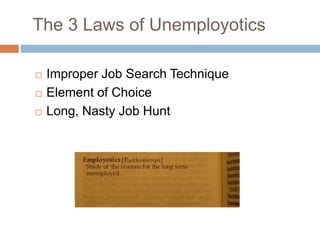
The 3 Laws of Unemployotics
A term coined in late 2010 to describe the
study of the reasons for the long term
unemployed.
I coined it
The 3 Laws of Unemployotics
 Improper Job Search Technique
 Element of Choice
 Long, Nasty Job Hunt
Job Search Technique
 Traditional Versus Non-Traditional
 Waiting for Rescue
 Why Bother?
Element of Choice
 Voluntary
 Non-Voluntary
Long, Nasty Job Hunt
 Doing Everything Correctly
 Really Trying
 Encourage Along
Basic Vocational Assessments
 Interest Inventory
 Transferable Skills
Interest Inventory
 Holland Self-Directed Search
 Matches Interest Areas to Job Titles
 Generates Ideas
 Generates Discussion
 Taking a Step
 People are enamored with assessments
Transferable Skills
 Skills that Move from Environment to
Environment
 Often Referred to as “The Basics”
Transferable Skills Scale
 Breaks Skills Areas Into Categories
 Matches Categories with Job Titles
 Useful with Interview Skills
 Useful with Resume
O*Net Career Interest
Inventory
 U.S. Department of Labor Occupational
Information Network
 Matches interests to job titles
Assessment Goals
 Consistency
 Ideas
 Discussion
 Self-Direction
 Self-Motivation
 Realistic and Feasible Goals
Ultimate Goal
 Develop a Written Ideal Job Description
 Interests
 Transferable Skills
 Physician’s Restrictions
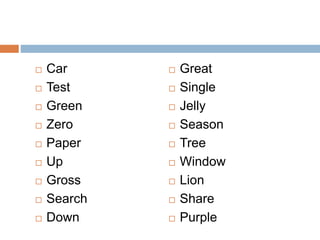
 What is it?
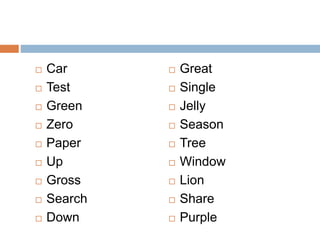
 Car
 Test
 Green
 Zero
 Paper
 Up
 Gross
 Search
 Down
 Great
 Single
 Jelly
 Season
 Tree
 Window
 Lion
 Share
 Purple
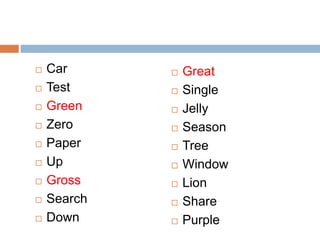
 Car
 Test
 Green
 Zero
 Paper
 Up
 Gross
 Search
 Down
 Great
 Single
 Jelly
 Season
 Tree
 Window
 Lion
 Share
 Purple
 Car
 Test
 Green
 Zero
 Paper
 Up
 Gross
 Search
 Down
 Great
 Single
 Jelly
 Season
 Tree
 Window
 Lion
 Share
 Purple
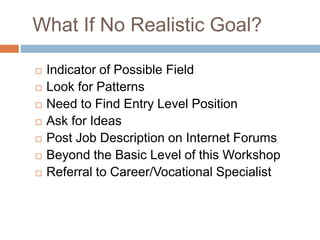
What If No Realistic Goal?
 Indicator of Possible Field
 Look for Patterns
 Need to Find Entry Level Position
 Ask for Ideas
 Post Job Description on Internet Forums
 Beyond the Basic Level of this Workshop
 Referral to Career/Vocational Specialist
Career Exploration
 Books
 Internet
 Information Interviews
Books
 Occupational Outlook Handbook
 Dictionary of Occupational Titles
 O*NET
 Career Books
Internet
 Google Searches
 www.bls.gov/oco
 Occupational Outlook Handbook
 LinkedIn
 U.S. Department of Labor
 http://lmi.state.oh.us
 ODJFS Labor Market Information
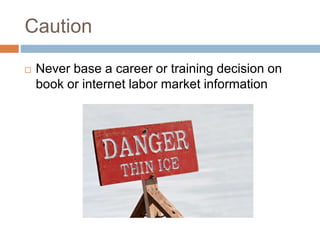
Caution
 Never base a career or training decision on
book or internet labor market information
Employment Projection Limitations
 The projections model also assumes an
unemployment rate of 5.1 percent in 2018.
http://http://www.bls.gov/oco/oco2006.htm
Employment Projection Limitations
 As with all forecasts and projections, Labor
Market Projections are subject to error,
especially if events negate underlying
assumptions.
http://lmi.state.oh.us/proj/projections.htm
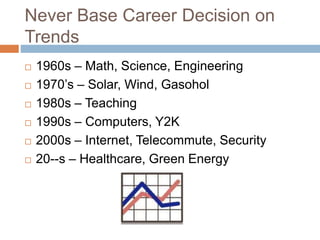
Never Base Career Decision on
Trends
 1960s – Math, Science, Engineering
 1970’s – Solar, Wind, Gasohol
 1980s – Teaching
 1990s – Computers, Y2K
 2000s – Internet, Telecommute, Security
 20--s – Healthcare, Green Energy
Information Interviews
 Talking to people to research the job or
career
 Always have questions prepared in
advance
 Stress this will help make a career/training
decision
 Get names of two other people
 Always send a thank you note
Questions
 What skills are important?
 What personality traits are important?
 What training/school would you suggest?
 How many employees do you have?
 How often do you hire here?
 Is this industry expected to grow?
 Starting salary and after one year?
 What are the physical requirements?
 Names of two other people?
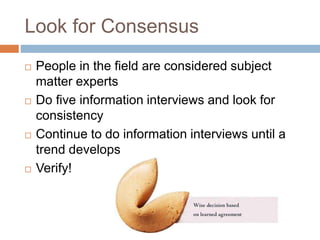
Look for Consensus
 People in the field are considered subject
matter experts
 Do five information interviews and look for
consistency
 Continue to do information interviews until a
trend develops
 Verify!
Making Educated Decisions
 Labor market information is crucial
 Need to know what to expect when done
 Get subject matter experts to lay out the
training/school
Effective Performance Documentation
 Relate to goals
 Focus on the vital few elements to measure
 Foster improvement
 Are well communicated and measurable
 Are reviewed as often as appropriate
 Provide information on level, trend and
comparative/competitive data
 Focus on the long-term well-being of the client
Achievement Blockers
 Fuzzy goals or action strategies
 Incorrect focus
 No agreement on priorities
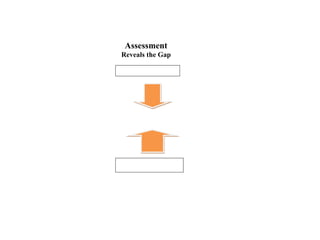
Assessment
Reveals the Gap
Client Start Point
Bridgeing the Gap
Client Goal
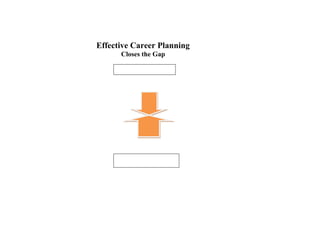
Effective Career Planning
Closes the Gap
Client Start Point
Client Goal
Identify Strategies for Change
 What will you do to reach goal?
 Which program elements could assist?
Remember
 Be flexible, adaptive and prepared to
adjust to change
 There will always be problems
 Things always change (mandates,
circumstance, personal priorities)
 View assessment and goals as an
evolutionary process
Bibliography
 Bureau of Labor Statistics, U.S. Department of Labor, Occupational
Outlook Handbook, 2009-10 Edition
 The O*Net Dictionary of Occupational Titles, Jist Works, Inc.
Indianapolis, IN. 1998
 U.S. Department of Labor, Dictionary of Occupational Titles, Jist
Works, Inc, Indianapolis, IN. 1991
 What Color Is Your Parachute?: A Practical Manual for Job Hunters
and Career Changers, Richard N. Bolles, 2010
 JIST Inc. – (800) 648-JIST
 Handouts are at www.marshalljkarp.com
 Handouts are at www.slideshare.net/marshallkarp
NEED MORE
INFORMATION?
Marshall J. Karp MA NCC LPC
Career Counselor
marshallkarp@hotmail.com

ORA Workshop Presentation

  • 1.
    HELPING CLAIMANTS MAKE EDUCATEDCAREER AND JOB TARGET DECISIONS PRESENTED BY: MARSHALL J. KARP, MA NCC LPC CAREER COUNSELOR
  • 2.
    Career & JobTarget Workshop  Why do career assessment?  What is a good assessment?  How to do basic assessment?  How to make educated career decisions
  • 3.
    Why do assessment? Improvement  Accountability  Goals and Plans
  • 4.
    Improvement  Determine wherethey are at  Set timeframes  Achievement
  • 5.
    Sun Tzu  Ifyou know the enemy and know yourself, you need not fear the result of a hundred battles.  If you know yourself but not the enemy, for every victory gained you will also suffer a defeat.  If you know neither the enemy nor yourself, you will succumb in every battle”
  • 6.
    Accountability  Meeting Expectations Clear and Understandable Guidelines
  • 7.
    What is assessment? Assessmentis a systematic process of looking at client achievement by gathering, interpreting and using information for improvement.
  • 8.
  • 9.
    Verbal Assessment  Whatdo you want to do?  Describe your background/experience/training?  Why aren’t you doing this?  Set objectives  If a realistic and feasible job target, no need for written assessment  Set this as a goal
  • 10.
    Written Assessments  Identifypotential client goals  Collect, analyze and interpret data  Develop a direction in writing  People are enamored with assessments
  • 11.
    The 3 Lawsof Unemployotics A term coined in late 2010 to describe the study of the reasons for the long term unemployed. I coined it
  • 12.
    The 3 Lawsof Unemployotics  Improper Job Search Technique  Element of Choice  Long, Nasty Job Hunt
  • 13.
    Job Search Technique Traditional Versus Non-Traditional  Waiting for Rescue  Why Bother?
  • 14.
    Element of Choice Voluntary  Non-Voluntary
  • 15.
    Long, Nasty JobHunt  Doing Everything Correctly  Really Trying  Encourage Along
  • 16.
    Basic Vocational Assessments Interest Inventory  Transferable Skills
  • 17.
    Interest Inventory  HollandSelf-Directed Search  Matches Interest Areas to Job Titles  Generates Ideas  Generates Discussion  Taking a Step  People are enamored with assessments
  • 18.
    Transferable Skills  Skillsthat Move from Environment to Environment  Often Referred to as “The Basics”
  • 19.
    Transferable Skills Scale Breaks Skills Areas Into Categories  Matches Categories with Job Titles  Useful with Interview Skills  Useful with Resume
  • 20.
    O*Net Career Interest Inventory U.S. Department of Labor Occupational Information Network  Matches interests to job titles
  • 21.
    Assessment Goals  Consistency Ideas  Discussion  Self-Direction  Self-Motivation  Realistic and Feasible Goals
  • 22.
    Ultimate Goal  Developa Written Ideal Job Description  Interests  Transferable Skills  Physician’s Restrictions  What is it?
  • 24.
     Car  Test Green  Zero  Paper  Up  Gross  Search  Down  Great  Single  Jelly  Season  Tree  Window  Lion  Share  Purple
  • 26.
     Car  Test Green  Zero  Paper  Up  Gross  Search  Down  Great  Single  Jelly  Season  Tree  Window  Lion  Share  Purple
  • 28.
     Car  Test Green  Zero  Paper  Up  Gross  Search  Down  Great  Single  Jelly  Season  Tree  Window  Lion  Share  Purple
  • 29.
    What If NoRealistic Goal?  Indicator of Possible Field  Look for Patterns  Need to Find Entry Level Position  Ask for Ideas  Post Job Description on Internet Forums  Beyond the Basic Level of this Workshop  Referral to Career/Vocational Specialist
  • 30.
    Career Exploration  Books Internet  Information Interviews
  • 31.
    Books  Occupational OutlookHandbook  Dictionary of Occupational Titles  O*NET  Career Books
  • 32.
    Internet  Google Searches www.bls.gov/oco  Occupational Outlook Handbook  LinkedIn  U.S. Department of Labor  http://lmi.state.oh.us  ODJFS Labor Market Information
  • 33.
    Caution  Never basea career or training decision on book or internet labor market information
  • 34.
    Employment Projection Limitations The projections model also assumes an unemployment rate of 5.1 percent in 2018. http://http://www.bls.gov/oco/oco2006.htm
  • 35.
    Employment Projection Limitations As with all forecasts and projections, Labor Market Projections are subject to error, especially if events negate underlying assumptions. http://lmi.state.oh.us/proj/projections.htm
  • 36.
    Never Base CareerDecision on Trends  1960s – Math, Science, Engineering  1970’s – Solar, Wind, Gasohol  1980s – Teaching  1990s – Computers, Y2K  2000s – Internet, Telecommute, Security  20--s – Healthcare, Green Energy
  • 37.
    Information Interviews  Talkingto people to research the job or career  Always have questions prepared in advance  Stress this will help make a career/training decision  Get names of two other people  Always send a thank you note
  • 38.
    Questions  What skillsare important?  What personality traits are important?  What training/school would you suggest?  How many employees do you have?  How often do you hire here?  Is this industry expected to grow?  Starting salary and after one year?  What are the physical requirements?  Names of two other people?
  • 39.
    Look for Consensus People in the field are considered subject matter experts  Do five information interviews and look for consistency  Continue to do information interviews until a trend develops  Verify!
  • 40.
    Making Educated Decisions Labor market information is crucial  Need to know what to expect when done  Get subject matter experts to lay out the training/school
  • 41.
    Effective Performance Documentation Relate to goals  Focus on the vital few elements to measure  Foster improvement  Are well communicated and measurable  Are reviewed as often as appropriate  Provide information on level, trend and comparative/competitive data  Focus on the long-term well-being of the client
  • 42.
    Achievement Blockers  Fuzzygoals or action strategies  Incorrect focus  No agreement on priorities
  • 43.
    Assessment Reveals the Gap ClientStart Point Bridgeing the Gap Client Goal
  • 44.
    Effective Career Planning Closesthe Gap Client Start Point Client Goal
  • 45.
    Identify Strategies forChange  What will you do to reach goal?  Which program elements could assist?
  • 46.
    Remember  Be flexible,adaptive and prepared to adjust to change  There will always be problems  Things always change (mandates, circumstance, personal priorities)  View assessment and goals as an evolutionary process
  • 48.
    Bibliography  Bureau ofLabor Statistics, U.S. Department of Labor, Occupational Outlook Handbook, 2009-10 Edition  The O*Net Dictionary of Occupational Titles, Jist Works, Inc. Indianapolis, IN. 1998  U.S. Department of Labor, Dictionary of Occupational Titles, Jist Works, Inc, Indianapolis, IN. 1991  What Color Is Your Parachute?: A Practical Manual for Job Hunters and Career Changers, Richard N. Bolles, 2010  JIST Inc. – (800) 648-JIST  Handouts are at www.marshalljkarp.com  Handouts are at www.slideshare.net/marshallkarp
  • 49.
    NEED MORE INFORMATION? Marshall J.Karp MA NCC LPC Career Counselor marshallkarp@hotmail.com