Virtual Memory This method was created to allow execute processes taht they don't have space in a RAM. So, it does the creation of programs that they are bigger than the RAM.
Each program has its own address space which is divided in sections called pages.
Many systems use a technique called paging.
The address space is divided in units of the same size called pages. The units in the physical memory are called pages frames.
When it's gonna access to the memory and the bit is on 0, it gets a exception of page fault.
The mandate of this exception is gonna determinate the origen of the situation and it has to solve if this is possible.
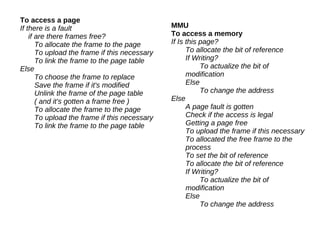
To access a page If there is a fault if are there frames free?  To allocate the frame to the page To upload the frame if this necessary To link the frame to the page table Else To choose the frame to replace Save the frame if it's modified Unlink the frame of the page table ( and it's gotten a frame free )  To allocate the frame to the page To upload the frame if this necessary To link the frame to the page table MMU To access a memory If Is this page? To allocate the bit of reference If Writing? To actualize the bit of  modification Else To change the address Else A page fault is gotten Check if the access is legal Getting a page free To upload the frame if this necessary To allocated the free frame to the  process To set the bit of reference To allocate the bit of reference If Writing? To actualize the bit of  modification Else To change the address
File System Is a means to organize data expected to be retained after a program terminates by providing procedures to store, retrieve and update data, as well as manage the available space on the device(s) which contain it.
Linux supports many different file systems, but common choices for the system disk include the ext* family (such as ext2, ext3 and ext4), XFS, JFS, ReiserFS and btrfs.
An inode is a data structure own file systems traditionally used in UNIX-like operating systems such as Linux.
ext3 It's a file system with a record per day. It's like a journaling.

Vmfs

  • 1.
    Virtual Memory Thismethod was created to allow execute processes taht they don't have space in a RAM. So, it does the creation of programs that they are bigger than the RAM.
  • 2.
    Each program hasits own address space which is divided in sections called pages.
  • 3.
    Many systems usea technique called paging.
  • 4.
    The address spaceis divided in units of the same size called pages. The units in the physical memory are called pages frames.
  • 5.
    When it's gonnaaccess to the memory and the bit is on 0, it gets a exception of page fault.
  • 6.
    The mandate ofthis exception is gonna determinate the origen of the situation and it has to solve if this is possible.
  • 7.
    To access apage If there is a fault if are there frames free? To allocate the frame to the page To upload the frame if this necessary To link the frame to the page table Else To choose the frame to replace Save the frame if it's modified Unlink the frame of the page table ( and it's gotten a frame free ) To allocate the frame to the page To upload the frame if this necessary To link the frame to the page table MMU To access a memory If Is this page? To allocate the bit of reference If Writing? To actualize the bit of modification Else To change the address Else A page fault is gotten Check if the access is legal Getting a page free To upload the frame if this necessary To allocated the free frame to the process To set the bit of reference To allocate the bit of reference If Writing? To actualize the bit of modification Else To change the address
  • 8.
    File System Isa means to organize data expected to be retained after a program terminates by providing procedures to store, retrieve and update data, as well as manage the available space on the device(s) which contain it.
  • 9.
    Linux supports manydifferent file systems, but common choices for the system disk include the ext* family (such as ext2, ext3 and ext4), XFS, JFS, ReiserFS and btrfs.
  • 10.
    An inode isa data structure own file systems traditionally used in UNIX-like operating systems such as Linux.
  • 11.
    ext3 It's afile system with a record per day. It's like a journaling.
  • 12.
    This more usedon Linux. Although, it is being replaced by Ext4.
  • 13.
    Benefit It allowsto update from ext2 to ext3 without lose the data.
  • 14.
    It consumes alow percentage of CPU resources and it's considered the safer file system than other Linux's file system.
  • 15.
  • 16.
  • 17.
  • 18.
  • 19.
  • 20.
  • 21.
  • 22.
  • 23.
  • 24.