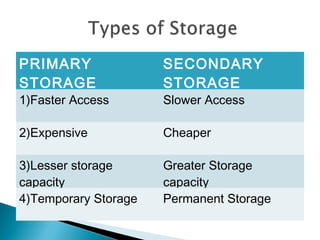
PRIMARY
STORAGE
SECONDARY
STORAGE
1)Faster Access Slower Access
2)Expensive Cheaper
3)Lesser storage
capacity
Greater Storage
capacity
4)Temporary Storage Permanent Storage
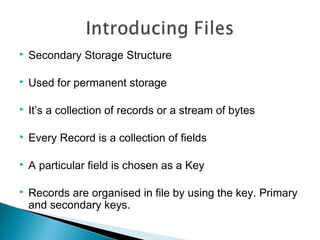
 Secondary Storage Structure
 Used for permanent storage
 It’s a collection of records or a stream of bytes
 Every Record is a collection of fields
 A particular field is chosen as a Key
 Records are organised in file by using the key. Primary
and secondary keys.
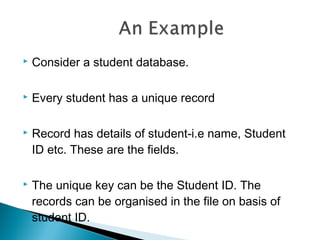
 Consider a student database.
 Every student has a unique record
 Record has details of student-i.e name, Student
ID etc. These are the fields.
 The unique key can be the Student ID. The
records can be organised in the file on basis of
student ID.
 Sometimes data is too large to be stored in main
memory.
 Maintaining permanent record is possible only by
using a secondary storage. Hence files.
 Physical Files:
A collection of bits stored in the secondary storage
device
 Logical File:
A channel that connects he program to the physical
file(Stream).
An example
FILE* out
out=fopen(“sample.txt”,”w”);
Here out is the logical file and sample.txt is the
physical file.
 Opening a File:
A logical file is associated with the physical file
 Closing a File:
The logical file associated with the physical file is freed.
fclose(file pointer);
 Reading from file:
Data present in physical file is read by using the logical file
 Writing to a File
Data can be written to physical file by using the logical file
 Every logical file has a file position pointer.
 When we open a new stream the position pointer
is set to beginning of the file.
 As data is read or written the file position pointer is
moved accordingly.
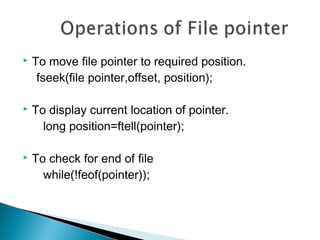
 To move file pointer to required position.
fseek(file pointer,offset, position); 
 To display current location of pointer.
long position=ftell(pointer);
 To check for end of file
while(!feof(pointer));
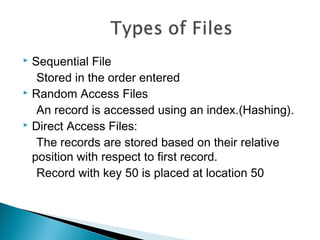
 Sequential File
Stored in the order entered
 Random Access Files
An record is accessed using an index.(Hashing).
 Direct Access Files:
The records are stored based on their relative
position with respect to first record.
Record with key 50 is placed at location 50
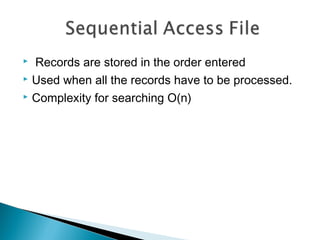
 Records are stored in the order entered
 Used when all the records have to be processed.
 Complexity for searching O(n)
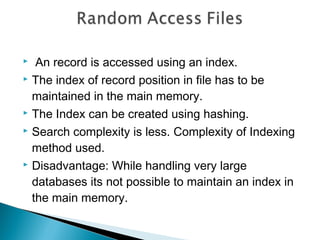
 An record is accessed using an index.
 The index of record position in file has to be
maintained in the main memory.
 The Index can be created using hashing.
 Search complexity is less. Complexity of Indexing
method used.
 Disadvantage: While handling very large
databases its not possible to maintain an index in
the main memory.
 The records are stored based on their relative
position with respect to first record.
 Record with key 50 is placed at location 50
 The search complexity is O(1)
 Disadvantage is a lot of memory is wasted.
 For example if no record has key 100 the position
100 is wasted.

File structures

  • 2.
    PRIMARY STORAGE SECONDARY STORAGE 1)Faster Access SlowerAccess 2)Expensive Cheaper 3)Lesser storage capacity Greater Storage capacity 4)Temporary Storage Permanent Storage
  • 3.
     Secondary StorageStructure  Used for permanent storage  It’s a collection of records or a stream of bytes  Every Record is a collection of fields  A particular field is chosen as a Key  Records are organised in file by using the key. Primary and secondary keys.
  • 4.
     Consider astudent database.  Every student has a unique record  Record has details of student-i.e name, Student ID etc. These are the fields.  The unique key can be the Student ID. The records can be organised in the file on basis of student ID.
  • 5.
     Sometimes datais too large to be stored in main memory.  Maintaining permanent record is possible only by using a secondary storage. Hence files.
  • 6.
     Physical Files: Acollection of bits stored in the secondary storage device  Logical File: A channel that connects he program to the physical file(Stream). An example FILE* out out=fopen(“sample.txt”,”w”); Here out is the logical file and sample.txt is the physical file.
  • 7.
     Opening aFile: A logical file is associated with the physical file  Closing a File: The logical file associated with the physical file is freed. fclose(file pointer);  Reading from file: Data present in physical file is read by using the logical file  Writing to a File Data can be written to physical file by using the logical file
  • 8.
     Every logicalfile has a file position pointer.  When we open a new stream the position pointer is set to beginning of the file.  As data is read or written the file position pointer is moved accordingly.
  • 9.
     To movefile pointer to required position. fseek(file pointer,offset, position);   To display current location of pointer. long position=ftell(pointer);  To check for end of file while(!feof(pointer));
  • 10.
     Sequential File Storedin the order entered  Random Access Files An record is accessed using an index.(Hashing).  Direct Access Files: The records are stored based on their relative position with respect to first record. Record with key 50 is placed at location 50
  • 11.
     Records arestored in the order entered  Used when all the records have to be processed.  Complexity for searching O(n)
  • 12.
     An recordis accessed using an index.  The index of record position in file has to be maintained in the main memory.  The Index can be created using hashing.  Search complexity is less. Complexity of Indexing method used.  Disadvantage: While handling very large databases its not possible to maintain an index in the main memory.
  • 13.
     The recordsare stored based on their relative position with respect to first record.  Record with key 50 is placed at location 50  The search complexity is O(1)  Disadvantage is a lot of memory is wasted.  For example if no record has key 100 the position 100 is wasted.