VITAMINS
By
Dr.S.Maneemegalai
Assistant Professor & Head
Department of Biochemistry
Government Arts and Science College (Women)
[ Formerly Bharathidasan University Constituent
College for Women]
Orathanadu – 614 625
Thanjavur Dt
28.05.2020
Vitamins
Definition:
Vitamins are the naturally occuring
organic compounds required in
minute amounts for the
maintenance and normal growth of
the life.
MACRO NUTRIENTS
• Proteins, Fats and Carbohydrates
• The Proportion of energy supplied is
• Protein 7-15%
• Fats 10-30%
• Carbohydrate 65-80%
2 Main Groups
Classification of Vitamins
• Vitamins are generally classified as water-
soluble vitamins and fat-soluble vitamins.
• I. Fat-Soluble Vitamins
• Vitamin A, D, E and K are fat-soluble
vitamins.
• II. Water-Soluble Vitamins
• Vitamins in B-group and vitamin C are
water-soluble vitamins.
DAILY HUMAN REQUIREMENTS OF
VITAMINS
 Younger one requires higher quantities
 Performance of exercises 
 During ailments 
 Specific conditions of metabolic disorders ( no proper
utilization of vitamins )
 Growing children requires high quantities of Vitamin D
 During Pregnancy and lactation (Vitamin D)
 Under conditions of greater utilization of
carbohydrates B complex requirement 
 Generally Vitamin requirement is not fixed, it depends
on the metabolic activity ( heavy muscular work,
pregnancy and lactation, growing Children).
DAILY HUMAN REQUIREMENTS OF VITAMINS
DEFICIENCIES OF VITAMINS
• PRIMARY: Due to inadequate intake
• SECONDARY: Due to Malabsorption,
increased excretion, allergies, anorexia,
gastrointestinal disorders etc.
Vitamin A
Bright eye Vitamin
• Source:
Liver oils of various Fishes, butter, milk, eggs,
all pigmented (particularly yellow) vegetables
and fruits (carrots, pumpkins, turnips,
pappayas, tomatos, plums, cherries, mangoes)
contain provitamin form of Vitamin A.
Vitamin A is absent from vegetable fats and
oils.
Vitamin A originates in marine algae, then
passes up the food chain to reach the large
carnivorous animals.
Vitamin A
• Requirement
• 5000IU/day
DEFICIENCY
leads to the onset of many diseases.
Keratomalacia (softening of the cornea)
 Phrynoderma or toad skin (hard and horny skin)
and stunted growth.
Nyctalopia or Night blindness.
 Xerophthalmia ( scaly condition of the delicate
membrane covering the eyes)
DEFICIENCY
VITAMIN - D SUNSHINE VITAMIN
Source:
Liver oils of many fishes, egg yolks. Provitamin
form is present in human skin and converted to
active form by irradiating with UV light.
It is required for the calcification of bones and
teeth.
It encourages the absorption of calcium and
phosphates in to the blood.
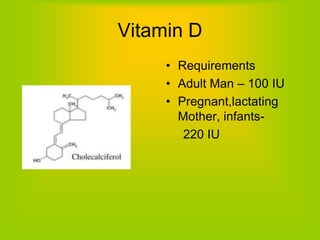
Vitamin D
• Requirements
• Adult Man – 100 IU
• Pregnant,lactating
Mother, infants-
220 IU
DEFICIENCY
 Rickets (childhood)
 Osteomalacia (adult, high among women)-
bones become softer, loss of calcium is greater
than phosphorous.
 Bone deformities, deposition of inorganic
materials on the matrix of bones fail to occur.
VITAMIN - E
ANTISTERILITY FACTOR
 Source: Many plant oils such as wheat germ,
rice, corn, cotton seed, soybean and peanut.
Small amount in meat, milk, eggs, leafy plants
and some fruits.
 It serves as an antioxidant and prevent the
oxidation of various vitamins present in food.
Vitamin E
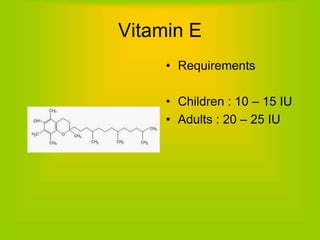
• Requirements
• Children : 10 – 15 IU
• Adults : 20 – 25 IU
DEFICIENCY
 Sterility develops in animals.
 Vitamin E deficiency prevents normal
growth.
VITAMIN - K
COAGULATION VITAMIN
It is called as antihemorrhagic factor.
Source: Green vegetables like Spinach,
cauliflower, cabbage and some intestinal
bacteria.
Vitamin K
DEFICIENCY
 Deficiency causes loss of blood clotting power.
 The infants develop hemorrhage.
 In Man vitamin K deficiency results in steatorrhea
with diminished intestinal absorption of lipids.
VITAMIN - B COMPLEX
VITAMIN - B1 ( THIAMINE)
 Source: All plants and animal foods.
 Cereals, heart, liver and kidney are excellent
sources.
 In cereals the outer layers of seeds are rich in
thiamine.
Thiamine
• Requirements
• Adult : 1.0 mg
• Children: 0.4 – 1.3 mg
DEFICIENCY
Beriberi- Disease of the nervous system leading
to partial paralysis of the extremities, muscular
atrophy, cardiovascular changes and
gastrointestinal disorders.
Symptoms of nervous system- dry beriberi
Symptoms with edema and effusions- wet
beriberi
Symptoms involving heart- acute pernicious
beriberi.
VITAMIN - B2(RIBOFLAVIN)
 Source
 Milk,cheese,egg,liver,kidney,heart and brewers yeast
are excellent sources.
 Cows milk contains about 5 times much riboflavin as
human milk.
 Leafy vegetables are good sources.
 Fruits and root vegetables contain moderate
quantities.
Grains,cereals and milled flour contain low
riboflavin content.
But riboflavin content increases during
germination.
The most important, ordinary cooking
processes do not affect the riboflavin
content of the food.
VITAMIN - B2(RIBOFLAVIN)
Riboflavin
• Requirements
• Children : 1 – 1.8mg
• Adult: 1.5 – 1.8mg
DEFICIENCY
 Cheilosis (fissures at the corners of the mouth
and lips)
 glossitis (inflammation of the tongue)
 corneal vascularisation (bloodshot eyes).
VITAMIN B3(NICOTINIC ACID)
OR
NIACIN
Source:
Widely distributed in nature in plant and
animal tissues.
Dietary tryptophan can be converted to
niacin.
Liver,lean pork,salmon,poultry and red meat
are good sources.
VITAMIN - B3(NICOTINIC ACID)
OR
NIACIN
Source:
Cereals contain only small amounts.
Vegetables and fruits are poor sources.
But milk and egg as such they contain no niacin
but contain tryptophan.
Requirements
• Adults : 17 – 21mg/day
• Infants: 6mg/day
DEFICIENCY
Causes pellagra (skin rough) in man, black
tongue in dogs.
Pellagra is characterized by 3”Ds”-dermatitis of
the exposed parts,diarrhoea and dementia.
The lesions on hand have the appearance of a
glove (Pellagrous glove) Pellagrous boot,
casal necklace.
DEFICIENCY
Coffee is particularly rich in niacin,heavy
coffee drinkers do not develop pellagra,corn
is deficient in tryptophan.Pellagra is greatly
aggravated in persons kept on a corn diet.
VITAMIN - B5(PANTOTHENIC ACID)
• Source:
widespread in nature,yeast,liver and eggs
are the richest sources.
Potatoes,sweatpotatoes,cabbage,cauliflow
er,tomatoes,peanuts contain less amount.
DEFICIENCY
In rats depigmentation of hair.
in human generally no definite deficiency
syndrome has been ascribed to
pantothenic acid.
VITAMIN - B6(PYRIDOXINE)
• Source
Widely distributed in plants and animals.
Rich in cereals (wheat ,rice), peas, carrot,
potatoes, sweat potatoes, bananas,
watermelons and yeasts.
Egg yolk, salmon ,chicken ,fish, beef, pork and
liver,human and cows milk.
Requirements
• Adults: 2mg/day
• Infants: 0.3 – 0.4 mg/day
DEFICIENCY
In infants convulsion, anemia, dermatitis and
gastrointestinal disorders such as nausea and
vomitting.
B6-deficient anemia iron utilization failure and
hemoglobin synthesis affected.
VITAMIN - B7(BIOTIN)
• Source
• Wide range of distribution both in the
animal and the vegetable kingdoms.
Yeast, liver, kidney, milk are rich sources.
• Peanuts and eggs have lesser amount.
Requirements
• Adults: 25 – 30µg/day
• Children: 20 - 40µg/day
DEFICIENCY
Is rare, but feeding egg white leads to
dermatitis, loss of hair, decrease in weight
and edema.
VITAMIN - B9(FOLIC ACID)
• Source
• Widely distributed. Liver, kidney, tuna fish,
salmon, yeast, wheat, dates and spinach.
Root vegetables, sweet potatoes, rice, corn,
tomatoes, banana, pork and lamb contain
little folic acid.
Requirements
• Adults: 400 – 500 µg/day
• Children: 100 – 300µg/day
• Pregnant Woman: 800µg/day
DEFICIENCY
Leads to megaloblastic anemia, glossitis
and gastro intestinal disorders.
VITAMIN - B12
(CYANOCOBALAMIN)
• Source
• Occur only in animals, chief source is liver.
• It is present in milk, meat, eggs, fish, oyster.
• In plants it is present in spirulina.
• Micro organisms synthesize vitamin B12.
Requirements
• Adults: 3µg/day
• Children: 1-2 µg/day
DEFICIENCY
Juvenile pernicious anemia-Adult pernicious
anemia, characterized by RBC becoming
abnormally large and fewer in number.
The patient weakens, loses weight and the
nervous system is also gradually affected.
VITAMIN - C(ASCORBIC ACID)
• Source
 Present in all fresh fruits and vegetables.
 Citrus fruits (such as orange, lemon, lime) gooseberry,
pineapple, guavas, tomatoes, melons, raw cabbage.
 New potatoes contain large amounts.
Requirements
• Adults: 75mg/day
• Infants: 30 mg/day
• Pregnant Women: 100mg/day
DEFICIENCY
Scurvy
It include skin changes, fragility of blood
capillaries, gum decay, tooth loss and
bone fracture.
References
• Text Book of Medical Biochemistry – Dr.MN Chatterjea & Dr.Rana
Shinde
• Text Book of Biochemistry – Dr.G.R.Agarwal and Dr.O.P.Agarwal
• Internet sources
THANK YOU

Vitamins - Overview

  • 1.
    VITAMINS By Dr.S.Maneemegalai Assistant Professor &Head Department of Biochemistry Government Arts and Science College (Women) [ Formerly Bharathidasan University Constituent College for Women] Orathanadu – 614 625 Thanjavur Dt 28.05.2020
  • 2.
    Vitamins Definition: Vitamins are thenaturally occuring organic compounds required in minute amounts for the maintenance and normal growth of the life.
  • 3.
    MACRO NUTRIENTS • Proteins,Fats and Carbohydrates • The Proportion of energy supplied is • Protein 7-15% • Fats 10-30% • Carbohydrate 65-80% 2 Main Groups
  • 4.
    Classification of Vitamins •Vitamins are generally classified as water- soluble vitamins and fat-soluble vitamins. • I. Fat-Soluble Vitamins • Vitamin A, D, E and K are fat-soluble vitamins. • II. Water-Soluble Vitamins • Vitamins in B-group and vitamin C are water-soluble vitamins.
  • 5.
    DAILY HUMAN REQUIREMENTSOF VITAMINS  Younger one requires higher quantities  Performance of exercises   During ailments   Specific conditions of metabolic disorders ( no proper utilization of vitamins )
  • 6.
     Growing childrenrequires high quantities of Vitamin D  During Pregnancy and lactation (Vitamin D)  Under conditions of greater utilization of carbohydrates B complex requirement   Generally Vitamin requirement is not fixed, it depends on the metabolic activity ( heavy muscular work, pregnancy and lactation, growing Children). DAILY HUMAN REQUIREMENTS OF VITAMINS
  • 7.
    DEFICIENCIES OF VITAMINS •PRIMARY: Due to inadequate intake • SECONDARY: Due to Malabsorption, increased excretion, allergies, anorexia, gastrointestinal disorders etc.
  • 8.
    Vitamin A Bright eyeVitamin • Source: Liver oils of various Fishes, butter, milk, eggs, all pigmented (particularly yellow) vegetables and fruits (carrots, pumpkins, turnips, pappayas, tomatos, plums, cherries, mangoes) contain provitamin form of Vitamin A. Vitamin A is absent from vegetable fats and oils. Vitamin A originates in marine algae, then passes up the food chain to reach the large carnivorous animals.
  • 9.
  • 10.
    DEFICIENCY leads to theonset of many diseases. Keratomalacia (softening of the cornea)  Phrynoderma or toad skin (hard and horny skin) and stunted growth.
  • 11.
    Nyctalopia or Nightblindness.  Xerophthalmia ( scaly condition of the delicate membrane covering the eyes) DEFICIENCY
  • 12.
    VITAMIN - DSUNSHINE VITAMIN Source: Liver oils of many fishes, egg yolks. Provitamin form is present in human skin and converted to active form by irradiating with UV light.
  • 13.
    It is requiredfor the calcification of bones and teeth. It encourages the absorption of calcium and phosphates in to the blood.
  • 14.
    Vitamin D • Requirements •Adult Man – 100 IU • Pregnant,lactating Mother, infants- 220 IU
  • 15.
    DEFICIENCY  Rickets (childhood) Osteomalacia (adult, high among women)- bones become softer, loss of calcium is greater than phosphorous.  Bone deformities, deposition of inorganic materials on the matrix of bones fail to occur.
  • 16.
    VITAMIN - E ANTISTERILITYFACTOR  Source: Many plant oils such as wheat germ, rice, corn, cotton seed, soybean and peanut. Small amount in meat, milk, eggs, leafy plants and some fruits.  It serves as an antioxidant and prevent the oxidation of various vitamins present in food.
  • 17.
    Vitamin E • Requirements •Children : 10 – 15 IU • Adults : 20 – 25 IU
  • 18.
    DEFICIENCY  Sterility developsin animals.  Vitamin E deficiency prevents normal growth.
  • 19.
    VITAMIN - K COAGULATIONVITAMIN It is called as antihemorrhagic factor. Source: Green vegetables like Spinach, cauliflower, cabbage and some intestinal bacteria.
  • 20.
  • 21.
    DEFICIENCY  Deficiency causesloss of blood clotting power.  The infants develop hemorrhage.  In Man vitamin K deficiency results in steatorrhea with diminished intestinal absorption of lipids.
  • 22.
    VITAMIN - BCOMPLEX VITAMIN - B1 ( THIAMINE)  Source: All plants and animal foods.  Cereals, heart, liver and kidney are excellent sources.  In cereals the outer layers of seeds are rich in thiamine.
  • 23.
    Thiamine • Requirements • Adult: 1.0 mg • Children: 0.4 – 1.3 mg
  • 24.
    DEFICIENCY Beriberi- Disease ofthe nervous system leading to partial paralysis of the extremities, muscular atrophy, cardiovascular changes and gastrointestinal disorders. Symptoms of nervous system- dry beriberi Symptoms with edema and effusions- wet beriberi Symptoms involving heart- acute pernicious beriberi.
  • 25.
    VITAMIN - B2(RIBOFLAVIN) Source  Milk,cheese,egg,liver,kidney,heart and brewers yeast are excellent sources.  Cows milk contains about 5 times much riboflavin as human milk.  Leafy vegetables are good sources.  Fruits and root vegetables contain moderate quantities.
  • 26.
    Grains,cereals and milledflour contain low riboflavin content. But riboflavin content increases during germination. The most important, ordinary cooking processes do not affect the riboflavin content of the food. VITAMIN - B2(RIBOFLAVIN)
  • 27.
    Riboflavin • Requirements • Children: 1 – 1.8mg • Adult: 1.5 – 1.8mg
  • 28.
    DEFICIENCY  Cheilosis (fissuresat the corners of the mouth and lips)  glossitis (inflammation of the tongue)  corneal vascularisation (bloodshot eyes).
  • 29.
    VITAMIN B3(NICOTINIC ACID) OR NIACIN Source: Widelydistributed in nature in plant and animal tissues. Dietary tryptophan can be converted to niacin. Liver,lean pork,salmon,poultry and red meat are good sources.
  • 30.
    VITAMIN - B3(NICOTINICACID) OR NIACIN Source: Cereals contain only small amounts. Vegetables and fruits are poor sources. But milk and egg as such they contain no niacin but contain tryptophan.
  • 31.
    Requirements • Adults :17 – 21mg/day • Infants: 6mg/day
  • 32.
    DEFICIENCY Causes pellagra (skinrough) in man, black tongue in dogs. Pellagra is characterized by 3”Ds”-dermatitis of the exposed parts,diarrhoea and dementia. The lesions on hand have the appearance of a glove (Pellagrous glove) Pellagrous boot, casal necklace.
  • 33.
    DEFICIENCY Coffee is particularlyrich in niacin,heavy coffee drinkers do not develop pellagra,corn is deficient in tryptophan.Pellagra is greatly aggravated in persons kept on a corn diet.
  • 34.
    VITAMIN - B5(PANTOTHENICACID) • Source: widespread in nature,yeast,liver and eggs are the richest sources. Potatoes,sweatpotatoes,cabbage,cauliflow er,tomatoes,peanuts contain less amount.
  • 35.
    DEFICIENCY In rats depigmentationof hair. in human generally no definite deficiency syndrome has been ascribed to pantothenic acid.
  • 36.
    VITAMIN - B6(PYRIDOXINE) •Source Widely distributed in plants and animals. Rich in cereals (wheat ,rice), peas, carrot, potatoes, sweat potatoes, bananas, watermelons and yeasts. Egg yolk, salmon ,chicken ,fish, beef, pork and liver,human and cows milk.
  • 37.
    Requirements • Adults: 2mg/day •Infants: 0.3 – 0.4 mg/day
  • 38.
    DEFICIENCY In infants convulsion,anemia, dermatitis and gastrointestinal disorders such as nausea and vomitting. B6-deficient anemia iron utilization failure and hemoglobin synthesis affected.
  • 39.
    VITAMIN - B7(BIOTIN) •Source • Wide range of distribution both in the animal and the vegetable kingdoms. Yeast, liver, kidney, milk are rich sources. • Peanuts and eggs have lesser amount.
  • 40.
    Requirements • Adults: 25– 30µg/day • Children: 20 - 40µg/day
  • 41.
    DEFICIENCY Is rare, butfeeding egg white leads to dermatitis, loss of hair, decrease in weight and edema.
  • 42.
    VITAMIN - B9(FOLICACID) • Source • Widely distributed. Liver, kidney, tuna fish, salmon, yeast, wheat, dates and spinach. Root vegetables, sweet potatoes, rice, corn, tomatoes, banana, pork and lamb contain little folic acid.
  • 43.
    Requirements • Adults: 400– 500 µg/day • Children: 100 – 300µg/day • Pregnant Woman: 800µg/day
  • 44.
    DEFICIENCY Leads to megaloblasticanemia, glossitis and gastro intestinal disorders.
  • 45.
    VITAMIN - B12 (CYANOCOBALAMIN) •Source • Occur only in animals, chief source is liver. • It is present in milk, meat, eggs, fish, oyster. • In plants it is present in spirulina. • Micro organisms synthesize vitamin B12.
  • 46.
  • 47.
    DEFICIENCY Juvenile pernicious anemia-Adultpernicious anemia, characterized by RBC becoming abnormally large and fewer in number. The patient weakens, loses weight and the nervous system is also gradually affected.
  • 48.
    VITAMIN - C(ASCORBICACID) • Source  Present in all fresh fruits and vegetables.  Citrus fruits (such as orange, lemon, lime) gooseberry, pineapple, guavas, tomatoes, melons, raw cabbage.  New potatoes contain large amounts.
  • 49.
    Requirements • Adults: 75mg/day •Infants: 30 mg/day • Pregnant Women: 100mg/day
  • 50.
    DEFICIENCY Scurvy It include skinchanges, fragility of blood capillaries, gum decay, tooth loss and bone fracture.
  • 51.
    References • Text Bookof Medical Biochemistry – Dr.MN Chatterjea & Dr.Rana Shinde • Text Book of Biochemistry – Dr.G.R.Agarwal and Dr.O.P.Agarwal • Internet sources
  • 52.