NUTRITIONAL
PROBLEMS AND
PROGRAMMES IN
Presented by,
Koyena Sarkar
BHA 1st year
PCHA
CONTENTS
1. Nutritional problems in India
2. National Nutritional
Programmes
3.National nutritional policy
3. National Nutritional
Monitoring Bureau
OBJECTIVES
1. List out the causes of nutritional
problems
2. Understand the nutritional
problems in India
3. Know about the National
Nutritional Programmes in India
4. Gain knowledge about the national
INTRODUCTION
India has the second most populous country
in the World next to China.
Among its population majority of the people
belongs to rural community and they are from
low socio-economic status, illiteracy and lack
of basic human needs.
From the nutritional point of view majority are
undernourished and only a small group are
well fed.
The high income groups are suffering from
the diseases of over nourishment.
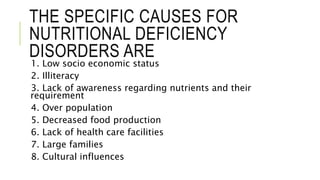
THE SPECIFIC CAUSES FOR
NUTRITIONAL DEFICIENCY
DISORDERS ARE
1. Low socio economic status
2. Illiteracy
3. Lack of awareness regarding nutrients and their
requirement
4. Over population
5. Decreased food production
6. Lack of health care facilities
7. Large families
8. Cultural influences
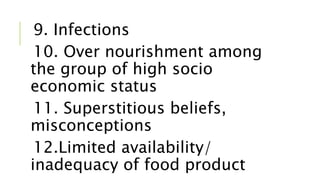
9. Infections
10. Over nourishment among
the group of high socio
economic status
11. Superstitious beliefs,
misconceptions
12.Limited availability/
inadequacy of food product
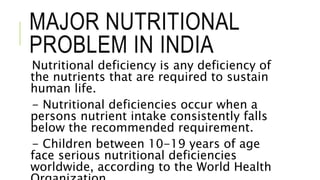
MAJOR NUTRITIONAL
PROBLEM IN INDIA
Nutritional deficiency is any deficiency of
the nutrients that are required to sustain
human life.
- Nutritional deficiencies occur when a
persons nutrient intake consistently falls
below the recommended requirement.
- Children between 10-19 years of age
face serious nutritional deficiencies
worldwide, according to the World Health
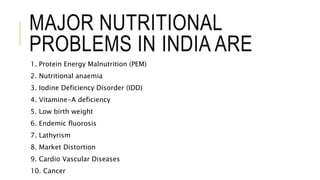
MAJOR NUTRITIONAL
PROBLEMS IN INDIA ARE
1. Protein Energy Malnutrition (PEM)
2. Nutritional anaemia
3. Iodine Deficiency Disorder (IDD)
4. Vitamine-A deficiency
5. Low birth weight
6. Endemic fluorosis
7. Lathyrism
8. Market Distortion
9. Cardio Vascular Diseases
10. Cancer
1. PROTEIN ENERGY
MALNUTRITIONMalnutrition is a significant loss of lean tissue or
inadequate diet for a prolonged period in the
setting of severe stress.
It is a significant component of many diseases.
Malnutrition is more common in India.
One in every three malnourished children in the
world lives in India.
Malnutrition limits development and the capacity to
learn.
It also costs lives: about 50 percent of all childhood
deaths are attributed to malnutrition.
In India, around 46 percent of all
children below the age of three are
too small for their age, 47 percent are
underweight and at least 16 percent
are wasted.
Many of these children are severely
malnourished.
The prevalence of malnutrition varies
across states, with Madhya Pradesh
recording the highest rate (55 per
2. ANAEMIA
Every age group is vulnerable to iron-deficiency anaemia.
In children, anaemia can causes a 5-10 point deficiency in IQ
and hamper growth and language development.
In adolescents, it leads to a fall in academic performance with a
dip in memory and concentration levels.
It can also lead to physical exhaustion and susceptibility to
infection.
Available studies on prevalence of nutritional anemia in India
show that 65% infant and toddlers, 60% 1-6 years of age , 88%
adolescent girls (3.3% has hemoglobin <7 gm./dl; severe
anemia) and 85% pregnant women (9.9% having severe anemia.
The prevalence of anemia was maeginally higher in lactating
women as compared to pregnancy.
The commonest is iron deficiency anemia.
The current situation in India is:
One in every two Indian women (56%) suffers from some form
of anaemia.
4 out of every 5 children in the age of 6-35 months suffer from
anaemia
20% of the maternal deaths are due to anaemia and anaemia
indirectly contributes to another 40% of maternal deaths
Maternal mortality staggeringly high at 454 per every 1,00,000
live births
Results not commensurate with the 30 years of efforts by the
Indian government.
3. VITAMIN ‘A’
DEFICIENCYVitamin A is necessary for good eyesight.
In children, Vitamin A deficiency causes loss of eyesight.
If this deficiency is very severe, it may lead to permanent
blindness.
In our country every year 30,000 children lose eye sight due to
Vitamin A deficiency.
Vitamin A deficiency symptoms are seen more severely in
children of age group 1 to 5 years.
It is estimated that there are 12.5 million economically blind
persons in India.
4. IODINE DEFICIENCY
DISORDERS
Iodine Deficiency Disorders (IDD) has been recognized as a public health
problem in India since mid-twenties.
IDD is not only a problem in sub-Himalayan region but also in reverine and
costal areas.
According to Union Ministry of Health it is estimated that 71 million
populations are suffering from endemic goiter and about 8.8 million people
have mental / motor handicap due to iodine deficiency.
Statistics furnished by the ministry of health and family welfare in its report
tabulated during 2011 revealed that 1.3 crore people in UP alone were
suffering from IDD.
The figures of Madhya pradesh and Bihar stood at 0.82 crore and 0.62 crore
respectively.
The spread of IDD is far and wide with poverty being a key driver.
5.LOW BIRTH
WEIGHTMore than 20 million infants are born each year
weighing less than 2,500 grams (5.5 pounds),
accounting for 17 per cent of all births in the
developing world – a rate more than double the level
in industrialized countries (7 per cent).
Infants with low birth weight are at higher risk of
dying their early months and years.
Those who survive are liable to have an impaired
immune system and may suffer a higher incidence of
such chronic illnesses as diabetes and heart disease in
later life.
6.FLUOROSISFluorosis is a disease caused due to excessive
ingestion of fluoride.
Fluorosis are compounds of fluorine.
Flurine is the 13th most abundant element available in
the earth crust.
As the surface water passes through the fluoride rich
rocks it carries fluoride with it, hence most of the
fluoride is founding in ground water than surface
water.
Permissible limit of fluoride: WHO is only 1.0 mg/L as
a safe limit for human consumption whereas several
In India, the problem has reached
alarming proportions affecting at
least 17 states of India.
Out of those 5 are hyper endemic,
where 50-100% districts are
affected viz. Andhra Pradesh,
Tamil Nadu, Uttar Pradesh,
Gujarat, Rajasthan.
In Rajasthan the Banka Patti area
7.LATHYRISM
Lathyrism disease occurs by consuming large
quantities of Lathyrus sativus (Kesari dhal)
Lathyrism in human is referred as Neurolathyrism.
The disease presents as Crippling disease of
nervous system characterized by gradually
developing spastic paralysis of lower limbs.
It contains a toxin called Beta oxalyl amino Alanine
(BOAA) Lathyrus Kesari Dhal is good source of
protein.
It is relatively cheaper.
For example, many governments
subsidize farming activities, which makes
farming economically feasible for many
farmers.
The subsidies paid to farmers create
artificially high supply levels, which will
eventually lead to price declines if the
goods are not subsequently purchased by
the government or sold to another nation.
Although this type of intervention is not
economically efficient, it does help ensure
8.MARKET
DISTORTIONAn economic economic scenario that occurs when
there is an intervention in a given market by a
governing body.
The intervention may take the form of price ceilings,
price floors or tax subsides.
Market distortions create market failures, which is not
an economically ideal situation.
There is a tradeoff that regulators must make when
deciding to intervene in any given marketplace.
Although the intervention will create market failures, it
For example, many governments
subsidize farming activities, which makes
farming economically feasible for many
farmers.
The subsidies paid to farmers create
artificially high supply levels, which will
eventually lead to price declines if the
goods are not subsequently purchased by
the government or sold to another nation.
Although this type of intervention is not
economically efficient, it does help ensure
9.OBESITY
It the most Prevalent from of malnutrition.
Abnormal growth of adipose tissue due to
enlargement of fat cells (hypertrophic), Increase in no.
of fat cells (hyperplasic) or Combinition of both.
India is now in the grip of obesity epidemics and the
trend needs to be immediately arrested by taxing junk
food, restricting food labelling clearer etc.
Currently, almost 1 in 5 men and over 1 in 6 women
are overweight.
In some urban areas, the rates are as high as 40%.
10.CARDIO VASCULAR
DISEASECardio Vascular diseases classified as one of the Food habit
related illness.
Change in food habits and lifestyle has increased the risk of
CVD in Indian population mostly in Middle Class and upper
middle class groups.
The World Health Organisation (WHO) and reports published in
medical journals like Lancet and Indian Heart Journal, suggest
that by 2010 there would be close to 100 million cardiac
patients in India.
It is 30 million now.
WHO has also estimated that by 2010, India will have 60% of
On an average, about 2 million patients in India
currently undergo cardio-vascular surgical
procedure every year.
“Unless we are able to predict and detect
cardiac disease in high-risk patients, the
situation will only aggravate,” warns Dr. Rabin
Chakraborty, chief of cardiology, Apollo
Gleneagles Hospital.
While 4% of the Indian population suffered from
heart diseases in 1980, it rose to 10% in 2003.
Deaths due to heart ailments also increased
from 14 deaths per one lakh people in 1985 to
11.CANCERRecent times have seen an increase in the incidence of
cancer.
This is mainly attributed to urbanization,
industrialization, lifestyle changes, population growth
and increased life span (in turn leading to an increase
in the elderly population).
In India, the life expectancy at birth has steadily risen
from 45 years in 1971 to 62 years in 1991, indicating
a shift in the demographic profile.
It is estimated that life expectancy of the Indian
population will increase to 70 years by 2021-25.
Cancer prevalence in India is estimated to be
around 2.5 million, with over 8,00,000 new cases
and 5,50,000 deaths occurring each year due to
this disease.
More than 70% of the case report for diagonostic
and treatment services in the advanced stages of
the disease, which has lead to a poor survival and
high mortality rate.
80% of cancer occurs due to environmental factors
Dietary fat- positive correlation with Colon cancer
is inversely related Micro nutrients- Lack of
Vitamin C & Vitamin A
Arise the rik of stomach cancer and lung cancer.
Aflatoxin associated with bladder cancer Alcohol-

Nutritional problems and programmes in india

  • 1.
    NUTRITIONAL PROBLEMS AND PROGRAMMES IN Presentedby, Koyena Sarkar BHA 1st year PCHA
  • 2.
    CONTENTS 1. Nutritional problemsin India 2. National Nutritional Programmes 3.National nutritional policy 3. National Nutritional Monitoring Bureau
  • 3.
    OBJECTIVES 1. List outthe causes of nutritional problems 2. Understand the nutritional problems in India 3. Know about the National Nutritional Programmes in India 4. Gain knowledge about the national
  • 4.
    INTRODUCTION India has thesecond most populous country in the World next to China. Among its population majority of the people belongs to rural community and they are from low socio-economic status, illiteracy and lack of basic human needs. From the nutritional point of view majority are undernourished and only a small group are well fed. The high income groups are suffering from the diseases of over nourishment.
  • 5.
    THE SPECIFIC CAUSESFOR NUTRITIONAL DEFICIENCY DISORDERS ARE 1. Low socio economic status 2. Illiteracy 3. Lack of awareness regarding nutrients and their requirement 4. Over population 5. Decreased food production 6. Lack of health care facilities 7. Large families 8. Cultural influences
  • 6.
    9. Infections 10. Overnourishment among the group of high socio economic status 11. Superstitious beliefs, misconceptions 12.Limited availability/ inadequacy of food product
  • 7.
    MAJOR NUTRITIONAL PROBLEM ININDIA Nutritional deficiency is any deficiency of the nutrients that are required to sustain human life. - Nutritional deficiencies occur when a persons nutrient intake consistently falls below the recommended requirement. - Children between 10-19 years of age face serious nutritional deficiencies worldwide, according to the World Health
  • 8.
    MAJOR NUTRITIONAL PROBLEMS ININDIA ARE 1. Protein Energy Malnutrition (PEM) 2. Nutritional anaemia 3. Iodine Deficiency Disorder (IDD) 4. Vitamine-A deficiency 5. Low birth weight 6. Endemic fluorosis 7. Lathyrism 8. Market Distortion 9. Cardio Vascular Diseases 10. Cancer
  • 9.
    1. PROTEIN ENERGY MALNUTRITIONMalnutritionis a significant loss of lean tissue or inadequate diet for a prolonged period in the setting of severe stress. It is a significant component of many diseases. Malnutrition is more common in India. One in every three malnourished children in the world lives in India. Malnutrition limits development and the capacity to learn. It also costs lives: about 50 percent of all childhood deaths are attributed to malnutrition.
  • 10.
    In India, around46 percent of all children below the age of three are too small for their age, 47 percent are underweight and at least 16 percent are wasted. Many of these children are severely malnourished. The prevalence of malnutrition varies across states, with Madhya Pradesh recording the highest rate (55 per
  • 11.
    2. ANAEMIA Every agegroup is vulnerable to iron-deficiency anaemia. In children, anaemia can causes a 5-10 point deficiency in IQ and hamper growth and language development. In adolescents, it leads to a fall in academic performance with a dip in memory and concentration levels. It can also lead to physical exhaustion and susceptibility to infection. Available studies on prevalence of nutritional anemia in India show that 65% infant and toddlers, 60% 1-6 years of age , 88% adolescent girls (3.3% has hemoglobin <7 gm./dl; severe anemia) and 85% pregnant women (9.9% having severe anemia.
  • 12.
    The prevalence ofanemia was maeginally higher in lactating women as compared to pregnancy. The commonest is iron deficiency anemia. The current situation in India is: One in every two Indian women (56%) suffers from some form of anaemia. 4 out of every 5 children in the age of 6-35 months suffer from anaemia 20% of the maternal deaths are due to anaemia and anaemia indirectly contributes to another 40% of maternal deaths Maternal mortality staggeringly high at 454 per every 1,00,000 live births Results not commensurate with the 30 years of efforts by the Indian government.
  • 13.
    3. VITAMIN ‘A’ DEFICIENCYVitaminA is necessary for good eyesight. In children, Vitamin A deficiency causes loss of eyesight. If this deficiency is very severe, it may lead to permanent blindness. In our country every year 30,000 children lose eye sight due to Vitamin A deficiency. Vitamin A deficiency symptoms are seen more severely in children of age group 1 to 5 years. It is estimated that there are 12.5 million economically blind persons in India.
  • 14.
    4. IODINE DEFICIENCY DISORDERS IodineDeficiency Disorders (IDD) has been recognized as a public health problem in India since mid-twenties. IDD is not only a problem in sub-Himalayan region but also in reverine and costal areas. According to Union Ministry of Health it is estimated that 71 million populations are suffering from endemic goiter and about 8.8 million people have mental / motor handicap due to iodine deficiency. Statistics furnished by the ministry of health and family welfare in its report tabulated during 2011 revealed that 1.3 crore people in UP alone were suffering from IDD. The figures of Madhya pradesh and Bihar stood at 0.82 crore and 0.62 crore respectively. The spread of IDD is far and wide with poverty being a key driver.
  • 15.
    5.LOW BIRTH WEIGHTMore than20 million infants are born each year weighing less than 2,500 grams (5.5 pounds), accounting for 17 per cent of all births in the developing world – a rate more than double the level in industrialized countries (7 per cent). Infants with low birth weight are at higher risk of dying their early months and years. Those who survive are liable to have an impaired immune system and may suffer a higher incidence of such chronic illnesses as diabetes and heart disease in later life.
  • 16.
    6.FLUOROSISFluorosis is adisease caused due to excessive ingestion of fluoride. Fluorosis are compounds of fluorine. Flurine is the 13th most abundant element available in the earth crust. As the surface water passes through the fluoride rich rocks it carries fluoride with it, hence most of the fluoride is founding in ground water than surface water. Permissible limit of fluoride: WHO is only 1.0 mg/L as a safe limit for human consumption whereas several
  • 17.
    In India, theproblem has reached alarming proportions affecting at least 17 states of India. Out of those 5 are hyper endemic, where 50-100% districts are affected viz. Andhra Pradesh, Tamil Nadu, Uttar Pradesh, Gujarat, Rajasthan. In Rajasthan the Banka Patti area
  • 18.
    7.LATHYRISM Lathyrism disease occursby consuming large quantities of Lathyrus sativus (Kesari dhal) Lathyrism in human is referred as Neurolathyrism. The disease presents as Crippling disease of nervous system characterized by gradually developing spastic paralysis of lower limbs. It contains a toxin called Beta oxalyl amino Alanine (BOAA) Lathyrus Kesari Dhal is good source of protein. It is relatively cheaper.
  • 19.
    For example, manygovernments subsidize farming activities, which makes farming economically feasible for many farmers. The subsidies paid to farmers create artificially high supply levels, which will eventually lead to price declines if the goods are not subsequently purchased by the government or sold to another nation. Although this type of intervention is not economically efficient, it does help ensure
  • 20.
    8.MARKET DISTORTIONAn economic economicscenario that occurs when there is an intervention in a given market by a governing body. The intervention may take the form of price ceilings, price floors or tax subsides. Market distortions create market failures, which is not an economically ideal situation. There is a tradeoff that regulators must make when deciding to intervene in any given marketplace. Although the intervention will create market failures, it
  • 21.
    For example, manygovernments subsidize farming activities, which makes farming economically feasible for many farmers. The subsidies paid to farmers create artificially high supply levels, which will eventually lead to price declines if the goods are not subsequently purchased by the government or sold to another nation. Although this type of intervention is not economically efficient, it does help ensure
  • 22.
    9.OBESITY It the mostPrevalent from of malnutrition. Abnormal growth of adipose tissue due to enlargement of fat cells (hypertrophic), Increase in no. of fat cells (hyperplasic) or Combinition of both. India is now in the grip of obesity epidemics and the trend needs to be immediately arrested by taxing junk food, restricting food labelling clearer etc. Currently, almost 1 in 5 men and over 1 in 6 women are overweight. In some urban areas, the rates are as high as 40%.
  • 23.
    10.CARDIO VASCULAR DISEASECardio Vasculardiseases classified as one of the Food habit related illness. Change in food habits and lifestyle has increased the risk of CVD in Indian population mostly in Middle Class and upper middle class groups. The World Health Organisation (WHO) and reports published in medical journals like Lancet and Indian Heart Journal, suggest that by 2010 there would be close to 100 million cardiac patients in India. It is 30 million now. WHO has also estimated that by 2010, India will have 60% of
  • 24.
    On an average,about 2 million patients in India currently undergo cardio-vascular surgical procedure every year. “Unless we are able to predict and detect cardiac disease in high-risk patients, the situation will only aggravate,” warns Dr. Rabin Chakraborty, chief of cardiology, Apollo Gleneagles Hospital. While 4% of the Indian population suffered from heart diseases in 1980, it rose to 10% in 2003. Deaths due to heart ailments also increased from 14 deaths per one lakh people in 1985 to
  • 25.
    11.CANCERRecent times haveseen an increase in the incidence of cancer. This is mainly attributed to urbanization, industrialization, lifestyle changes, population growth and increased life span (in turn leading to an increase in the elderly population). In India, the life expectancy at birth has steadily risen from 45 years in 1971 to 62 years in 1991, indicating a shift in the demographic profile. It is estimated that life expectancy of the Indian population will increase to 70 years by 2021-25.
  • 26.
    Cancer prevalence inIndia is estimated to be around 2.5 million, with over 8,00,000 new cases and 5,50,000 deaths occurring each year due to this disease. More than 70% of the case report for diagonostic and treatment services in the advanced stages of the disease, which has lead to a poor survival and high mortality rate. 80% of cancer occurs due to environmental factors Dietary fat- positive correlation with Colon cancer is inversely related Micro nutrients- Lack of Vitamin C & Vitamin A Arise the rik of stomach cancer and lung cancer. Aflatoxin associated with bladder cancer Alcohol-