HomocysteineHomocysteine
Tapeshwar Yadav
(Lecturer)
BMLT, DNHE,
M.Sc. Medical Biochemistry
2
IntroductionIntroduction
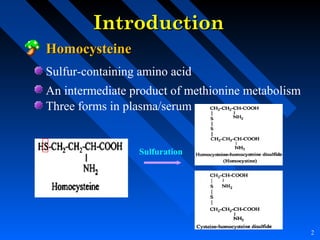
HomocysteineHomocysteine
Sulfur-containing amino acid
Three forms in plasma/serum
Sulfuration
An intermediate product of methionine metabolism
3
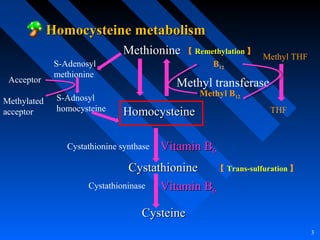
MethionineMethionine
HomocysteineHomocysteine
CystathionineCystathionine
CysteineCysteine
Cystathionine synthase
Cystathioninase
Vitamin BVitamin B66
Methyl transferase
Homocysteine metabolismHomocysteine metabolism
S-Adenosyl
methionine
S-Adnosyl
homocysteine
Acceptor
Methylated
acceptor
【 Remethylation 】
【 Trans-sulfuration 】
B12
Methyl B12
Methyl THF
THF
4
Increase Homocysteine concentrationIncrease Homocysteine concentration
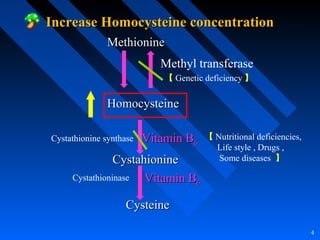
MethionineMethionine
HomocysteineHomocysteine
CystahionineCystahionine
CysteineCysteine
Cystathionine synthase
Cystathioninase
Vitamin BVitamin B66
Methyl transferase
【 Nutritional deficiencies,
Life style , Drugs ,
Some diseases 】
【 Genetic deficiency 】
HomocysteinuriasHomocysteinurias
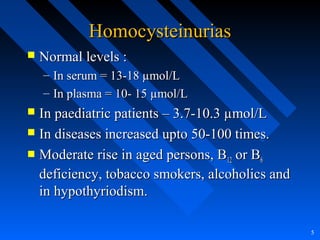
 Normal levels :Normal levels :
– In serum = 13-18 µmol/LIn serum = 13-18 µmol/L
– In plasma = 10- 15 µmol/LIn plasma = 10- 15 µmol/L
 In paediatric patients – 3.7-10.3 µmol/LIn paediatric patients – 3.7-10.3 µmol/L
 In diseases increased upto 50-100 times.In diseases increased upto 50-100 times.
 Moderate rise in aged persons, BModerate rise in aged persons, B1212 or Bor B66
deficiency, tobacco smokers, alcoholics anddeficiency, tobacco smokers, alcoholics and
in hypothyriodism.in hypothyriodism.
5
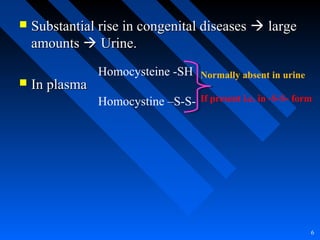
 Substantial rise in congenital diseasesSubstantial rise in congenital diseases  largelarge
amountsamounts  Urine.Urine.
 In plasmaIn plasma
6
Homocysteine -SH
Homocystine –S-S-
Normally absent in urine
If present i.e. in -S-S- form
Homocysteinuria Type I :Homocysteinuria Type I :
 Enzyme deficiency is CystathionineEnzyme deficiency is Cystathionine ββ--
Synthase.Synthase.
 Increased methionine & homocysteine inIncreased methionine & homocysteine in
PlasmaPlasma  cysteine↓cysteine↓
 Increased methionine & homocystine inIncreased methionine & homocystine in
urine.urine.
7
Symptoms :Symptoms :
 Mental retardationMental retardation
 Charley chaplin gaitCharley chaplin gait
 Skeletal deformitiesSkeletal deformities
 EyesEyes
– Ectopia lentisEctopia lentis
– MyopiaMyopia
– Glaucoma.Glaucoma.
8
 HomocysteineHomocysteine  activation of Hagemanactivation of Hageman
factorfactor  ↑↑platelet adhesivenessplatelet adhesiveness  lifelife
threatening intravascular thrombosis.threatening intravascular thrombosis.
 Cyanide nitroprusside test +ve (urine)Cyanide nitroprusside test +ve (urine)
 Urinary homocysteine > 300 mg/24 hours.Urinary homocysteine > 300 mg/24 hours.
 Plasma homocysteine & methioninePlasma homocysteine & methionine ↑.↑.
 Treatment :Treatment : Diet low in methionine, rich inDiet low in methionine, rich in
cysteine.cysteine.
 Some times affinity of apoenzyme toSome times affinity of apoenzyme to
coenzyme ↓. Large quantities of PLPcoenzyme ↓. Large quantities of PLP
coenzyme.coenzyme.
9
Homocysteinuria II :Homocysteinuria II :
 Deficiency of NDeficiency of N55
-N-N1010
methylene THF reductase.methylene THF reductase.
 ↓↓Methionine synthesis.Methionine synthesis.
 ↑↑Homocystine in urine.Homocystine in urine.
 Behavioral changes, vascular abnormalities.Behavioral changes, vascular abnormalities.
Treatment :Treatment : Folate supplementation.Folate supplementation.
10
Homocysteinuria III :Homocysteinuria III :
 Low NLow N55
methyl THF HMT.methyl THF HMT.
 Inability to synthesize Methyl cobalamine.Inability to synthesize Methyl cobalamine.
Homocysteinuria IV :Homocysteinuria IV :
 Defective intestinal absorption of cobalamin.Defective intestinal absorption of cobalamin.
 ↑↑Homocysteine &↓MethionineHomocysteine &↓Methionine
 Urine contains homocystine.Urine contains homocystine.
11
Cystathioninuria:Cystathioninuria:
 Deficiency of Cystathioninase.Deficiency of Cystathioninase.
 AR; Anemia, Thrombocytopenia,AR; Anemia, Thrombocytopenia,
Endocrinopathies.Endocrinopathies.
 AcquiredAcquired BB66 deficiency.deficiency.
 In liver diseases and afterIn liver diseases and after ThyroxineThyroxine
administration.administration.
Diagnosis :Diagnosis : Cyanide nitroprusside test –ve ;Cyanide nitroprusside test –ve ;
cystathionine in urine.cystathionine in urine.
Treatment :Treatment : BB66 administration (200-400mg/day)administration (200-400mg/day)
12
Acquired hyperhomocysteinemias :Acquired hyperhomocysteinemias :
 Nutritional deficiency of vitamin BNutritional deficiency of vitamin B1212, Folate &, Folate &
BB66..
 Metabolic-chronic renal diseases,Metabolic-chronic renal diseases,
hypothyroidism ,drug induced-folate, Bhypothyroidism ,drug induced-folate, B1212, B, B66
antagonists.antagonists.
 Estrogen antagonists, nitric oxide antagonists.Estrogen antagonists, nitric oxide antagonists.
13
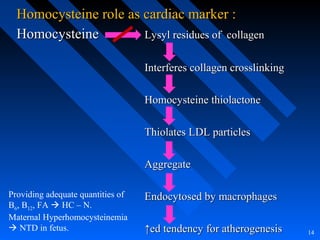
Homocysteine role as cardiac marker :Homocysteine role as cardiac marker :
HomocysteineHomocysteine Lysyl residues of collagenLysyl residues of collagen
Interferes collagen crosslinkingInterferes collagen crosslinking
Homocysteine thiolactoneHomocysteine thiolactone
Thiolates LDL particlesThiolates LDL particles
AggregateAggregate
Endocytosed by macrophagesEndocytosed by macrophages
↑↑ed tendency for atherogenesised tendency for atherogenesis 14
Providing adequate quantities of
B6, B12, FA  HC – N.
Maternal Hyperhomocysteinemia
 NTD in fetus.
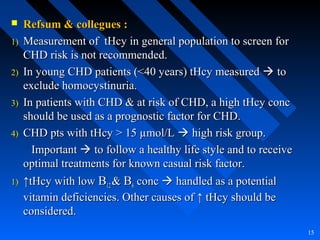
 Refsum & collegues :Refsum & collegues :
1)1) Measurement of tHcy in general population to screen forMeasurement of tHcy in general population to screen for
CHD risk is not recommended.CHD risk is not recommended.
2)2) In young CHD patients (<40 years) tHcy measuredIn young CHD patients (<40 years) tHcy measured  toto
exclude homocystinuria.exclude homocystinuria.
3)3) In patients with CHD & at risk of CHD, a high tHcy concIn patients with CHD & at risk of CHD, a high tHcy conc
should be used as a prognostic factor for CHD.should be used as a prognostic factor for CHD.
4)4) CHD pts with tHcy > 15 µmol/LCHD pts with tHcy > 15 µmol/L  high risk group.high risk group.
ImportantImportant  to follow a healthy life style and to receiveto follow a healthy life style and to receive
optimal treatments for known casual risk factor.optimal treatments for known casual risk factor.
1)1) ↑↑tHcy with lowtHcy with low BB1212 && BB66 concconc  handled as a potentialhandled as a potential
vitamin deficiencies. Other causes of ↑ tHcy should bevitamin deficiencies. Other causes of ↑ tHcy should be
considered.considered.
15
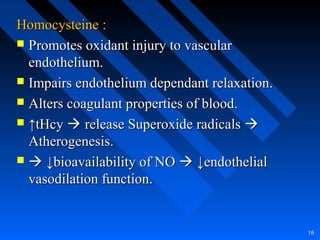
Homocysteine :Homocysteine :
 Promotes oxidant injury to vascularPromotes oxidant injury to vascular
endothelium.endothelium.
 Impairs endothelium dependant relaxation.Impairs endothelium dependant relaxation.
 Alters coagulant properties of blood.Alters coagulant properties of blood.
 ↑↑tHcytHcy  release Superoxide radicalsrelease Superoxide radicals 
Atherogenesis.Atherogenesis.
  ↓↓bioavailability of NObioavailability of NO  ↓endothelial↓endothelial
vasodilation function.vasodilation function.
16
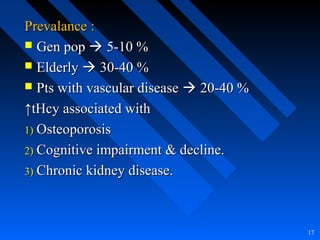
Prevalance :Prevalance :
 Gen popGen pop  5-10 %5-10 %
 ElderlyElderly  30-40 %30-40 %
 Pts with vascular diseasePts with vascular disease  20-40 %20-40 %
↑↑tHcy associated withtHcy associated with
1)1) OsteoporosisOsteoporosis
2)2) Cognitive impairment & decline.Cognitive impairment & decline.
3)3) Chronic kidney disease.Chronic kidney disease.
17
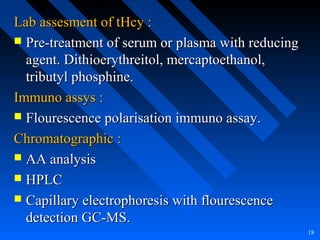
Lab assesment of tHcy :Lab assesment of tHcy :
 Pre-treatment of serum or plasma with reducingPre-treatment of serum or plasma with reducing
agent. Dithioerythreitol, mercaptoethanol,agent. Dithioerythreitol, mercaptoethanol,
tributyl phosphine.tributyl phosphine.
Immuno assys :Immuno assys :
 Flourescence polarisation immuno assay.Flourescence polarisation immuno assay.
Chromatographic :Chromatographic :
 AA analysisAA analysis
 HPLCHPLC
 Capillary electrophoresis with flourescenceCapillary electrophoresis with flourescence
detection GC-MS.detection GC-MS.
18
19
StudiesStudies
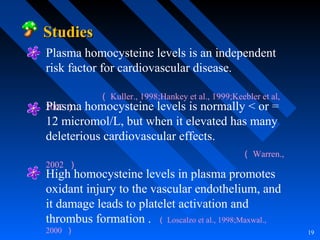
Plasma homocysteine levels is an independent
risk factor for cardiovascular disease.
( Kuller., 1998;Hankey et al., 1999;Keebler et al,
2002 )Plasma homocysteine levels is normally < or =
12 micromol/L, but when it elevated has many
deleterious cardiovascular effects.
( Warren.,
2002 )
High homocysteine levels in plasma promotes
oxidant injury to the vascular endothelium, and
it damage leads to platelet activation and
thrombus formation . ( Loscalzo et al., 1998;Maxwal.,
2000 )
20
StudiesStudies
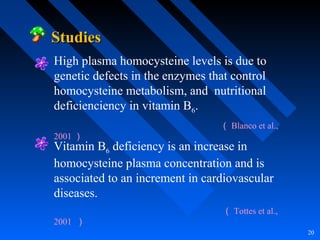
Vitamin B6 deficiency is an increase in
homocysteine plasma concentration and is
associated to an increment in cardiovascular
diseases.
( Tottes et al.,
2001 )
High plasma homocysteine levels is due to
genetic defects in the enzymes that control
homocysteine metabolism, and nutritional
deficienciency in vitamin B6.
( Blanco et al.,
2001 )
21
Thank you
for your attention.

Homocysteine

  • 1.
  • 2.
    2 IntroductionIntroduction HomocysteineHomocysteine Sulfur-containing amino acid Threeforms in plasma/serum Sulfuration An intermediate product of methionine metabolism
  • 3.
    3 MethionineMethionine HomocysteineHomocysteine CystathionineCystathionine CysteineCysteine Cystathionine synthase Cystathioninase Vitamin BVitaminB66 Vitamin BVitamin B66 Methyl transferase Homocysteine metabolismHomocysteine metabolism S-Adenosyl methionine S-Adnosyl homocysteine Acceptor Methylated acceptor 【 Remethylation 】 【 Trans-sulfuration 】 B12 Methyl B12 Methyl THF THF
  • 4.
    4 Increase Homocysteine concentrationIncreaseHomocysteine concentration MethionineMethionine HomocysteineHomocysteine CystahionineCystahionine CysteineCysteine Cystathionine synthase Cystathioninase Vitamin BVitamin B66 Vitamin BVitamin B66 Methyl transferase 【 Nutritional deficiencies, Life style , Drugs , Some diseases 】 【 Genetic deficiency 】
  • 5.
    HomocysteinuriasHomocysteinurias  Normal levels:Normal levels : – In serum = 13-18 µmol/LIn serum = 13-18 µmol/L – In plasma = 10- 15 µmol/LIn plasma = 10- 15 µmol/L  In paediatric patients – 3.7-10.3 µmol/LIn paediatric patients – 3.7-10.3 µmol/L  In diseases increased upto 50-100 times.In diseases increased upto 50-100 times.  Moderate rise in aged persons, BModerate rise in aged persons, B1212 or Bor B66 deficiency, tobacco smokers, alcoholics anddeficiency, tobacco smokers, alcoholics and in hypothyriodism.in hypothyriodism. 5
  • 6.
     Substantial risein congenital diseasesSubstantial rise in congenital diseases  largelarge amountsamounts  Urine.Urine.  In plasmaIn plasma 6 Homocysteine -SH Homocystine –S-S- Normally absent in urine If present i.e. in -S-S- form
  • 7.
    Homocysteinuria Type I:Homocysteinuria Type I :  Enzyme deficiency is CystathionineEnzyme deficiency is Cystathionine ββ-- Synthase.Synthase.  Increased methionine & homocysteine inIncreased methionine & homocysteine in PlasmaPlasma  cysteine↓cysteine↓  Increased methionine & homocystine inIncreased methionine & homocystine in urine.urine. 7
  • 8.
    Symptoms :Symptoms : Mental retardationMental retardation  Charley chaplin gaitCharley chaplin gait  Skeletal deformitiesSkeletal deformities  EyesEyes – Ectopia lentisEctopia lentis – MyopiaMyopia – Glaucoma.Glaucoma. 8
  • 9.
     HomocysteineHomocysteine activation of Hagemanactivation of Hageman factorfactor  ↑↑platelet adhesivenessplatelet adhesiveness  lifelife threatening intravascular thrombosis.threatening intravascular thrombosis.  Cyanide nitroprusside test +ve (urine)Cyanide nitroprusside test +ve (urine)  Urinary homocysteine > 300 mg/24 hours.Urinary homocysteine > 300 mg/24 hours.  Plasma homocysteine & methioninePlasma homocysteine & methionine ↑.↑.  Treatment :Treatment : Diet low in methionine, rich inDiet low in methionine, rich in cysteine.cysteine.  Some times affinity of apoenzyme toSome times affinity of apoenzyme to coenzyme ↓. Large quantities of PLPcoenzyme ↓. Large quantities of PLP coenzyme.coenzyme. 9
  • 10.
    Homocysteinuria II :HomocysteinuriaII :  Deficiency of NDeficiency of N55 -N-N1010 methylene THF reductase.methylene THF reductase.  ↓↓Methionine synthesis.Methionine synthesis.  ↑↑Homocystine in urine.Homocystine in urine.  Behavioral changes, vascular abnormalities.Behavioral changes, vascular abnormalities. Treatment :Treatment : Folate supplementation.Folate supplementation. 10
  • 11.
    Homocysteinuria III :HomocysteinuriaIII :  Low NLow N55 methyl THF HMT.methyl THF HMT.  Inability to synthesize Methyl cobalamine.Inability to synthesize Methyl cobalamine. Homocysteinuria IV :Homocysteinuria IV :  Defective intestinal absorption of cobalamin.Defective intestinal absorption of cobalamin.  ↑↑Homocysteine &↓MethionineHomocysteine &↓Methionine  Urine contains homocystine.Urine contains homocystine. 11
  • 12.
    Cystathioninuria:Cystathioninuria:  Deficiency ofCystathioninase.Deficiency of Cystathioninase.  AR; Anemia, Thrombocytopenia,AR; Anemia, Thrombocytopenia, Endocrinopathies.Endocrinopathies.  AcquiredAcquired BB66 deficiency.deficiency.  In liver diseases and afterIn liver diseases and after ThyroxineThyroxine administration.administration. Diagnosis :Diagnosis : Cyanide nitroprusside test –ve ;Cyanide nitroprusside test –ve ; cystathionine in urine.cystathionine in urine. Treatment :Treatment : BB66 administration (200-400mg/day)administration (200-400mg/day) 12
  • 13.
    Acquired hyperhomocysteinemias :Acquiredhyperhomocysteinemias :  Nutritional deficiency of vitamin BNutritional deficiency of vitamin B1212, Folate &, Folate & BB66..  Metabolic-chronic renal diseases,Metabolic-chronic renal diseases, hypothyroidism ,drug induced-folate, Bhypothyroidism ,drug induced-folate, B1212, B, B66 antagonists.antagonists.  Estrogen antagonists, nitric oxide antagonists.Estrogen antagonists, nitric oxide antagonists. 13
  • 14.
    Homocysteine role ascardiac marker :Homocysteine role as cardiac marker : HomocysteineHomocysteine Lysyl residues of collagenLysyl residues of collagen Interferes collagen crosslinkingInterferes collagen crosslinking Homocysteine thiolactoneHomocysteine thiolactone Thiolates LDL particlesThiolates LDL particles AggregateAggregate Endocytosed by macrophagesEndocytosed by macrophages ↑↑ed tendency for atherogenesised tendency for atherogenesis 14 Providing adequate quantities of B6, B12, FA  HC – N. Maternal Hyperhomocysteinemia  NTD in fetus.
  • 15.
     Refsum &collegues :Refsum & collegues : 1)1) Measurement of tHcy in general population to screen forMeasurement of tHcy in general population to screen for CHD risk is not recommended.CHD risk is not recommended. 2)2) In young CHD patients (<40 years) tHcy measuredIn young CHD patients (<40 years) tHcy measured  toto exclude homocystinuria.exclude homocystinuria. 3)3) In patients with CHD & at risk of CHD, a high tHcy concIn patients with CHD & at risk of CHD, a high tHcy conc should be used as a prognostic factor for CHD.should be used as a prognostic factor for CHD. 4)4) CHD pts with tHcy > 15 µmol/LCHD pts with tHcy > 15 µmol/L  high risk group.high risk group. ImportantImportant  to follow a healthy life style and to receiveto follow a healthy life style and to receive optimal treatments for known casual risk factor.optimal treatments for known casual risk factor. 1)1) ↑↑tHcy with lowtHcy with low BB1212 && BB66 concconc  handled as a potentialhandled as a potential vitamin deficiencies. Other causes of ↑ tHcy should bevitamin deficiencies. Other causes of ↑ tHcy should be considered.considered. 15
  • 16.
    Homocysteine :Homocysteine : Promotes oxidant injury to vascularPromotes oxidant injury to vascular endothelium.endothelium.  Impairs endothelium dependant relaxation.Impairs endothelium dependant relaxation.  Alters coagulant properties of blood.Alters coagulant properties of blood.  ↑↑tHcytHcy  release Superoxide radicalsrelease Superoxide radicals  Atherogenesis.Atherogenesis.   ↓↓bioavailability of NObioavailability of NO  ↓endothelial↓endothelial vasodilation function.vasodilation function. 16
  • 17.
    Prevalance :Prevalance : Gen popGen pop  5-10 %5-10 %  ElderlyElderly  30-40 %30-40 %  Pts with vascular diseasePts with vascular disease  20-40 %20-40 % ↑↑tHcy associated withtHcy associated with 1)1) OsteoporosisOsteoporosis 2)2) Cognitive impairment & decline.Cognitive impairment & decline. 3)3) Chronic kidney disease.Chronic kidney disease. 17
  • 18.
    Lab assesment oftHcy :Lab assesment of tHcy :  Pre-treatment of serum or plasma with reducingPre-treatment of serum or plasma with reducing agent. Dithioerythreitol, mercaptoethanol,agent. Dithioerythreitol, mercaptoethanol, tributyl phosphine.tributyl phosphine. Immuno assys :Immuno assys :  Flourescence polarisation immuno assay.Flourescence polarisation immuno assay. Chromatographic :Chromatographic :  AA analysisAA analysis  HPLCHPLC  Capillary electrophoresis with flourescenceCapillary electrophoresis with flourescence detection GC-MS.detection GC-MS. 18
  • 19.
    19 StudiesStudies Plasma homocysteine levelsis an independent risk factor for cardiovascular disease. ( Kuller., 1998;Hankey et al., 1999;Keebler et al, 2002 )Plasma homocysteine levels is normally < or = 12 micromol/L, but when it elevated has many deleterious cardiovascular effects. ( Warren., 2002 ) High homocysteine levels in plasma promotes oxidant injury to the vascular endothelium, and it damage leads to platelet activation and thrombus formation . ( Loscalzo et al., 1998;Maxwal., 2000 )
  • 20.
    20 StudiesStudies Vitamin B6 deficiencyis an increase in homocysteine plasma concentration and is associated to an increment in cardiovascular diseases. ( Tottes et al., 2001 ) High plasma homocysteine levels is due to genetic defects in the enzymes that control homocysteine metabolism, and nutritional deficienciency in vitamin B6. ( Blanco et al., 2001 )
  • 21.