Learning Related Vision
& Auditory Problems
By Stuart Warren B.Optom, MSc(Optom)
A simple model of learning
requires...
1. Good Input – how we acquire
information
2. Good Output – how we can use that
for reading, maths, spelling & writing
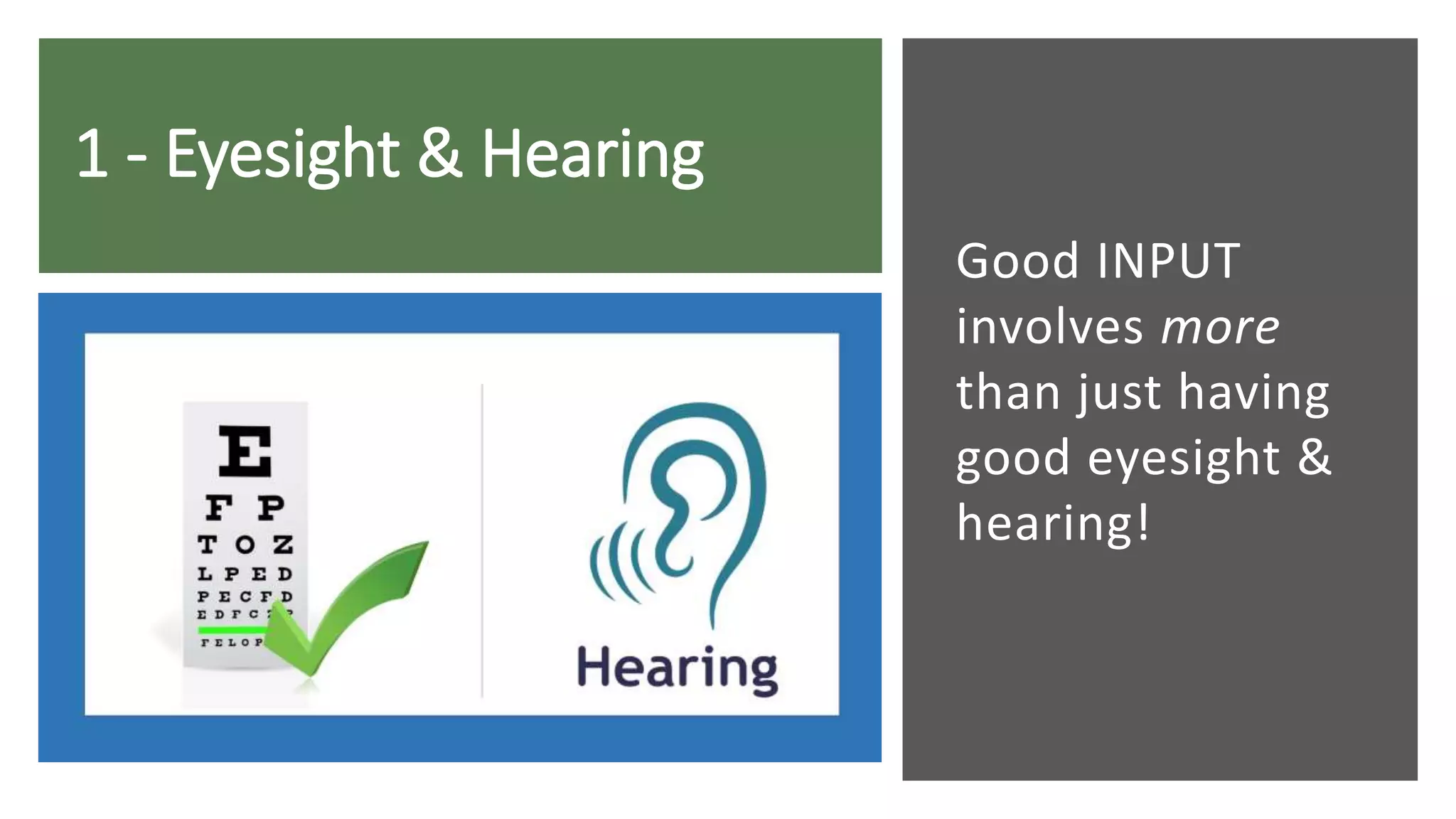
1 - Eyesight & Hearing
Good INPUT
involves more
than just having
good eyesight &
hearing!
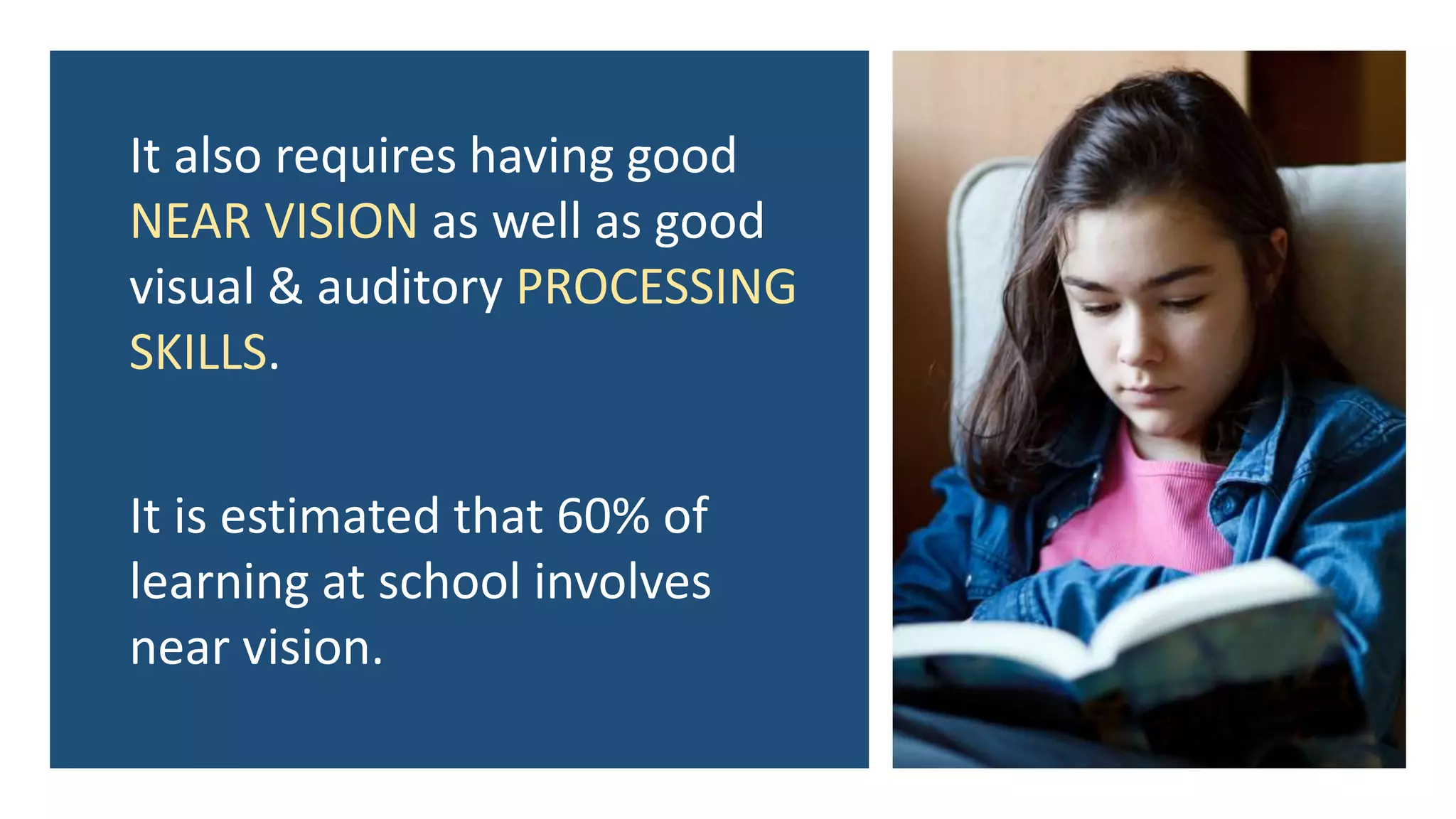
It also requires having good
NEAR VISION as well as good
visual & auditory PROCESSING
SKILLS.
It is estimated that 60% of
learning at school involves
near vision.
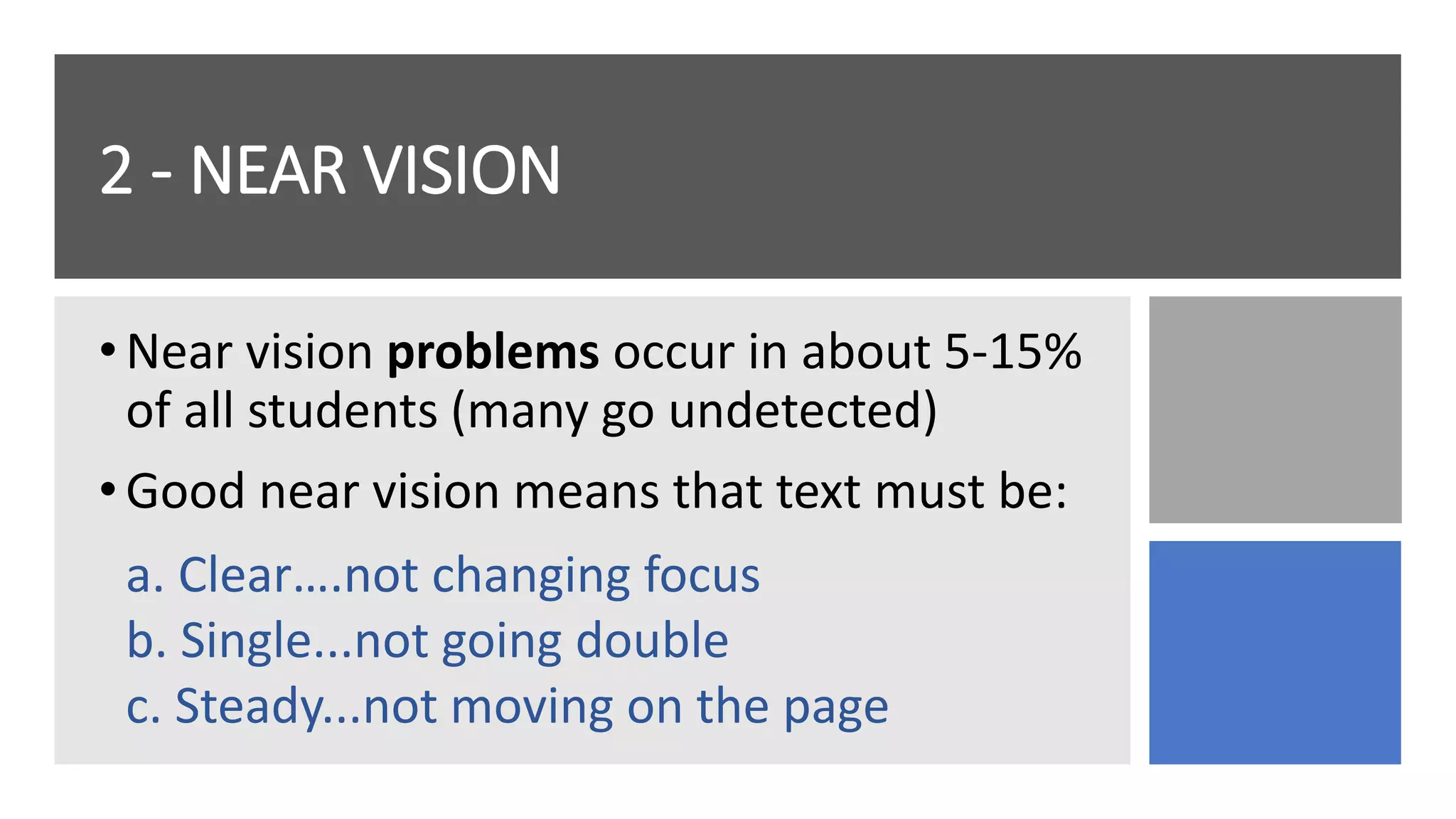
2 - NEAR VISION
•Near vision problems occur in about 5-15%
of all students (many go undetected)
•Good near vision means that text must be:
a. Clear….not changing focus
b. Single...not going double
c. Steady...not moving on the page
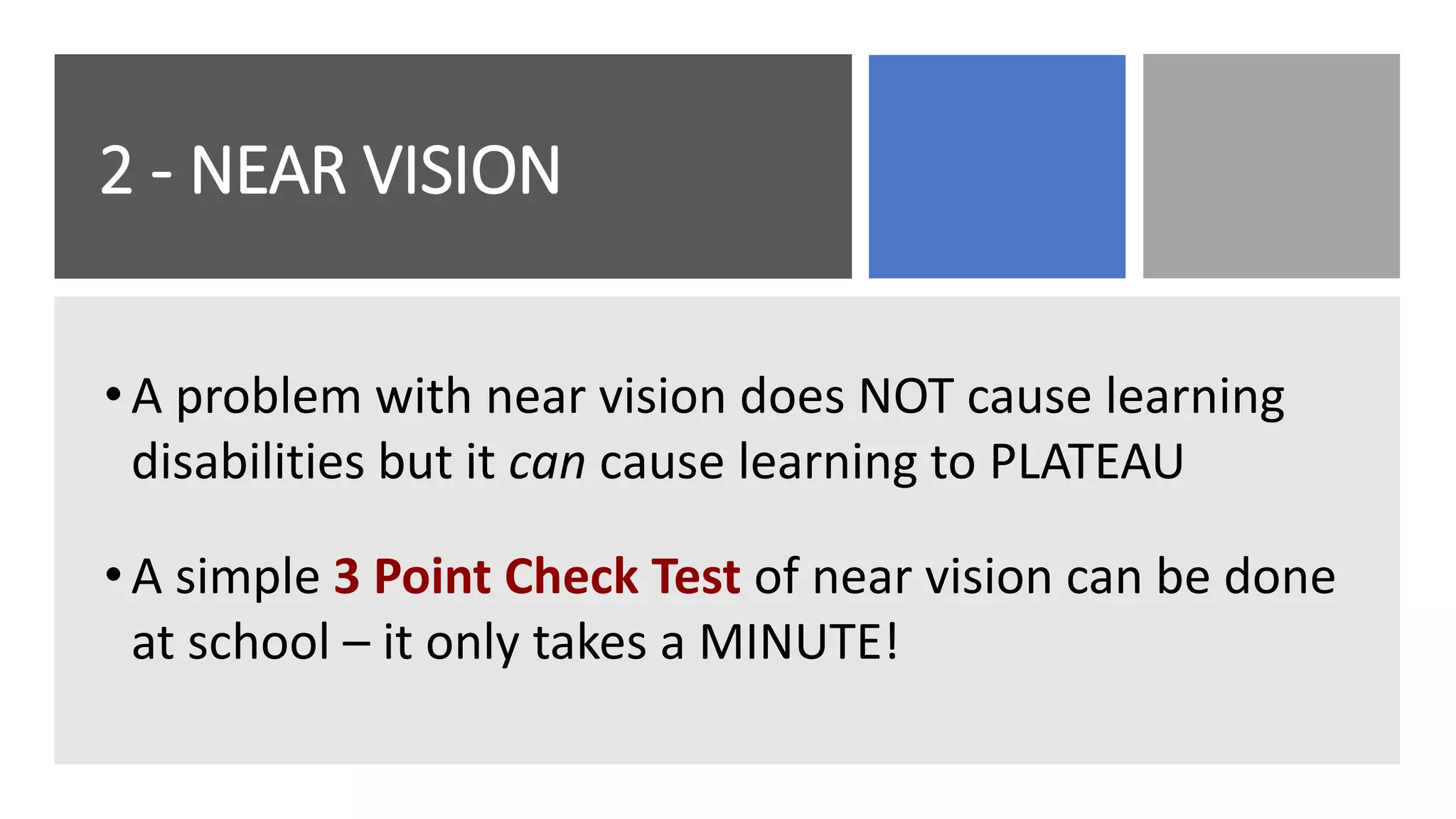
2 - NEAR VISION
•A problem with near vision does NOT cause learning
disabilities but it can cause learning to PLATEAU
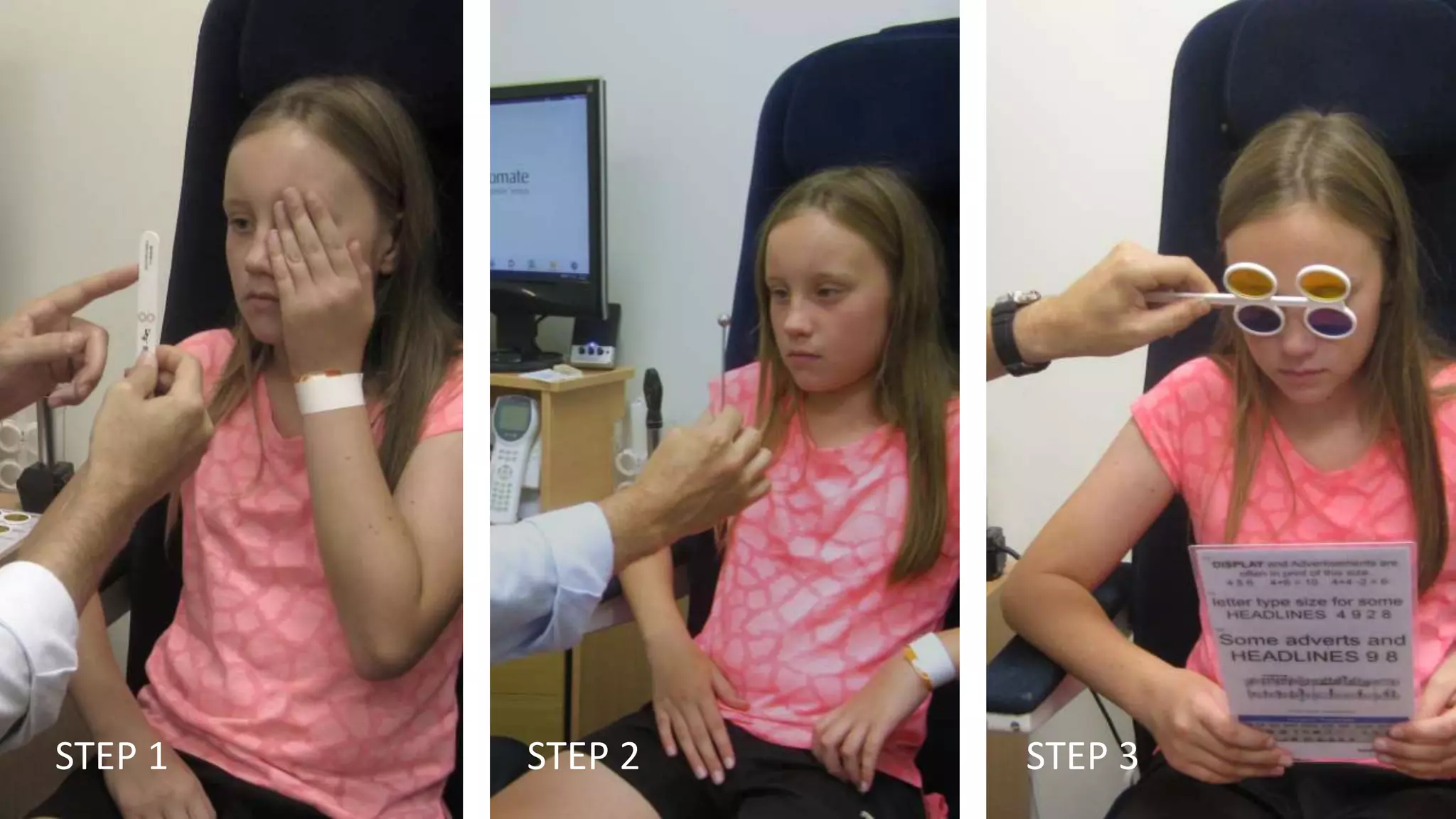
•A simple 3 Point Check Test of near vision can be done
at school – it only takes a MINUTE!
STEP 1 STEP 2 STEP 3
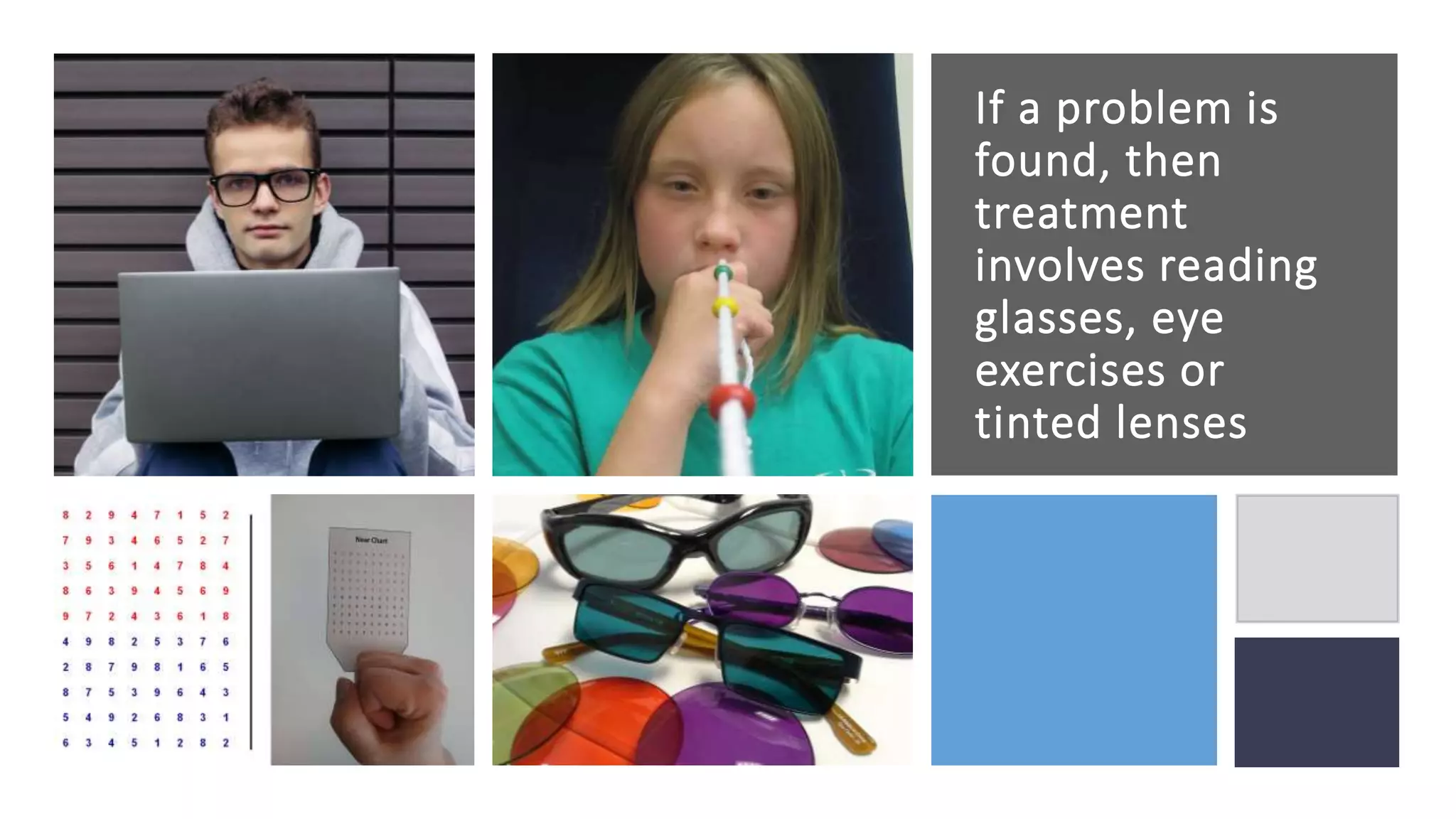
If a problem is
found, then
treatment
involves reading
glasses, eye
exercises or
tinted lenses
•This refers to the analysis of visual and auditory
information so that it can be used for higher cognitive
functions such as reading, spelling & math
•Also known as visual & auditory perceptual skills or
low-level sensory processing skills
•So how common are problems in this area?
3 - Visual & Auditory Processing
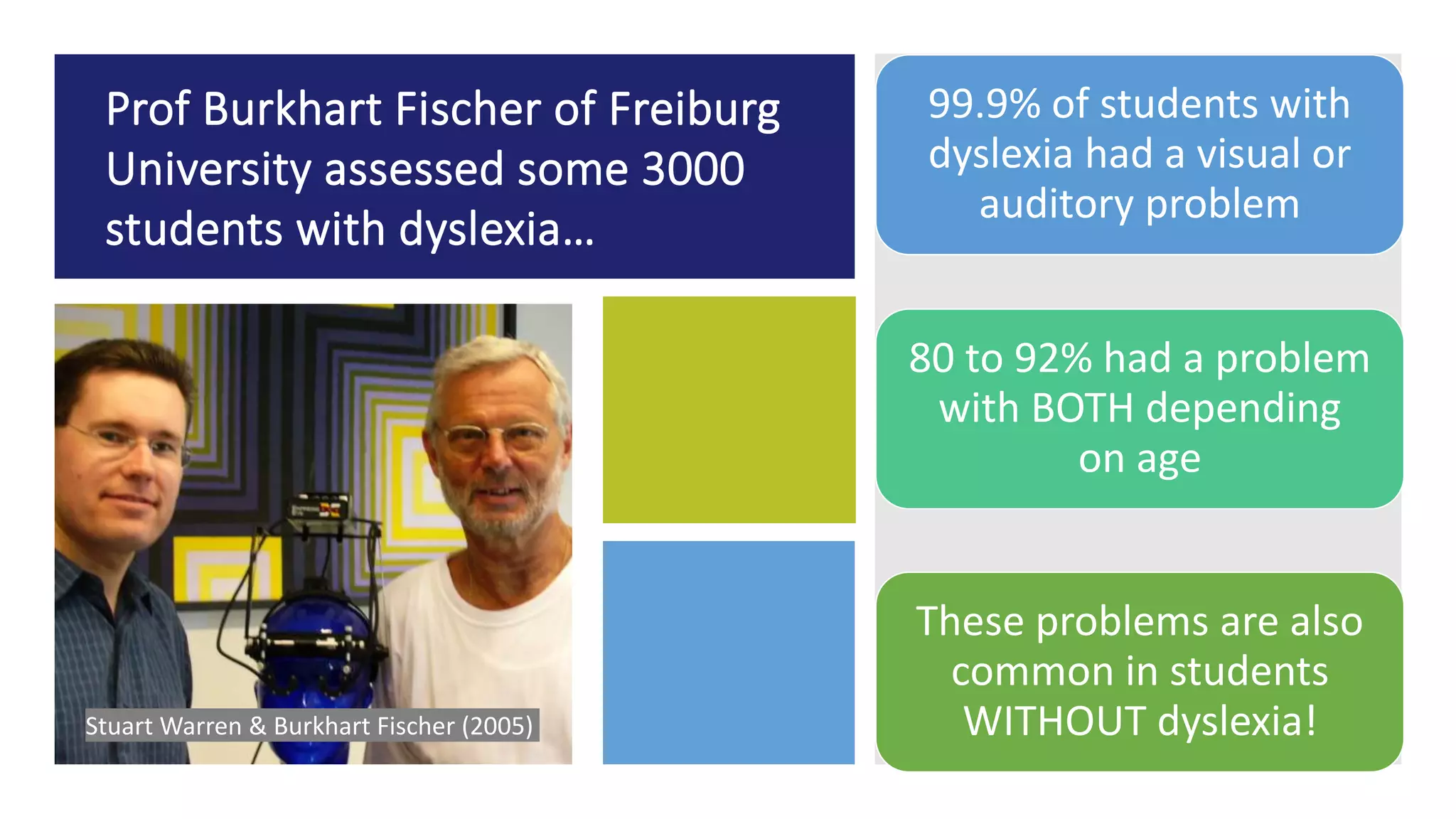
99.9% of students with
dyslexia had a visual or
auditory problem
80 to 92% had a problem
with BOTH depending
on age
These problems are also
common in students
WITHOUT dyslexia!
Stuart Warren & Burkhart Fischer (2005)
Prof Burkhart Fischer of Freiburg
University assessed some 3000
students with dyslexia…
This is not too surprising considering that…
“More than 50 percent of the cortex is devoted
to processing visual information”
- Center for Visual Science
THERE ARE 2 KEY FACTORS:
It’s the RAPID processing skills that
are affected and…
They take a LONG time to develop
RAPID
VISUAL
PROCESSING
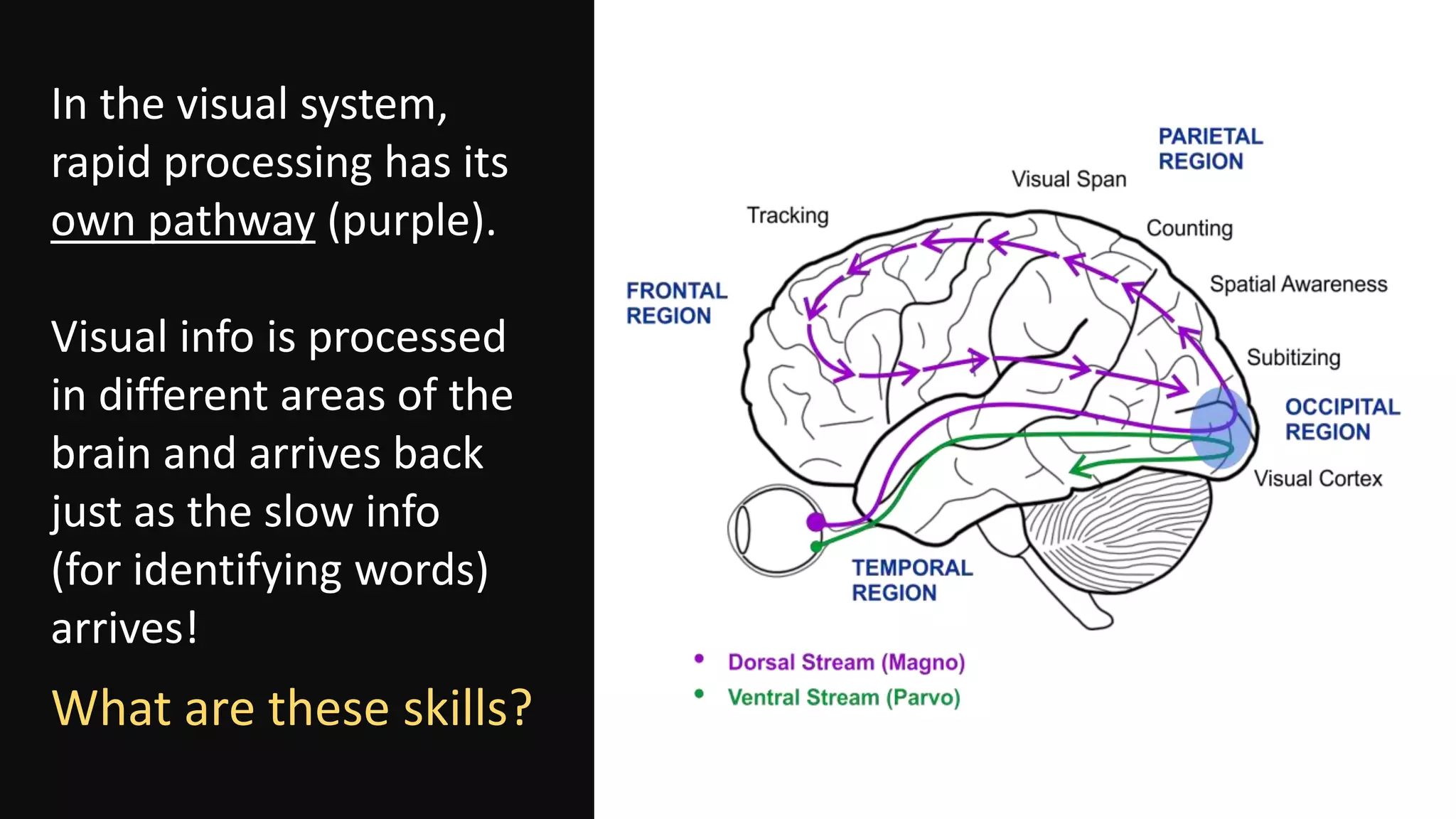
In the visual system,
rapid processing has its
own pathway (purple).
Visual info is processed
in different areas of the
brain and arrives back
just as the slow info
(for identifying words)
arrives!
What are these skills?
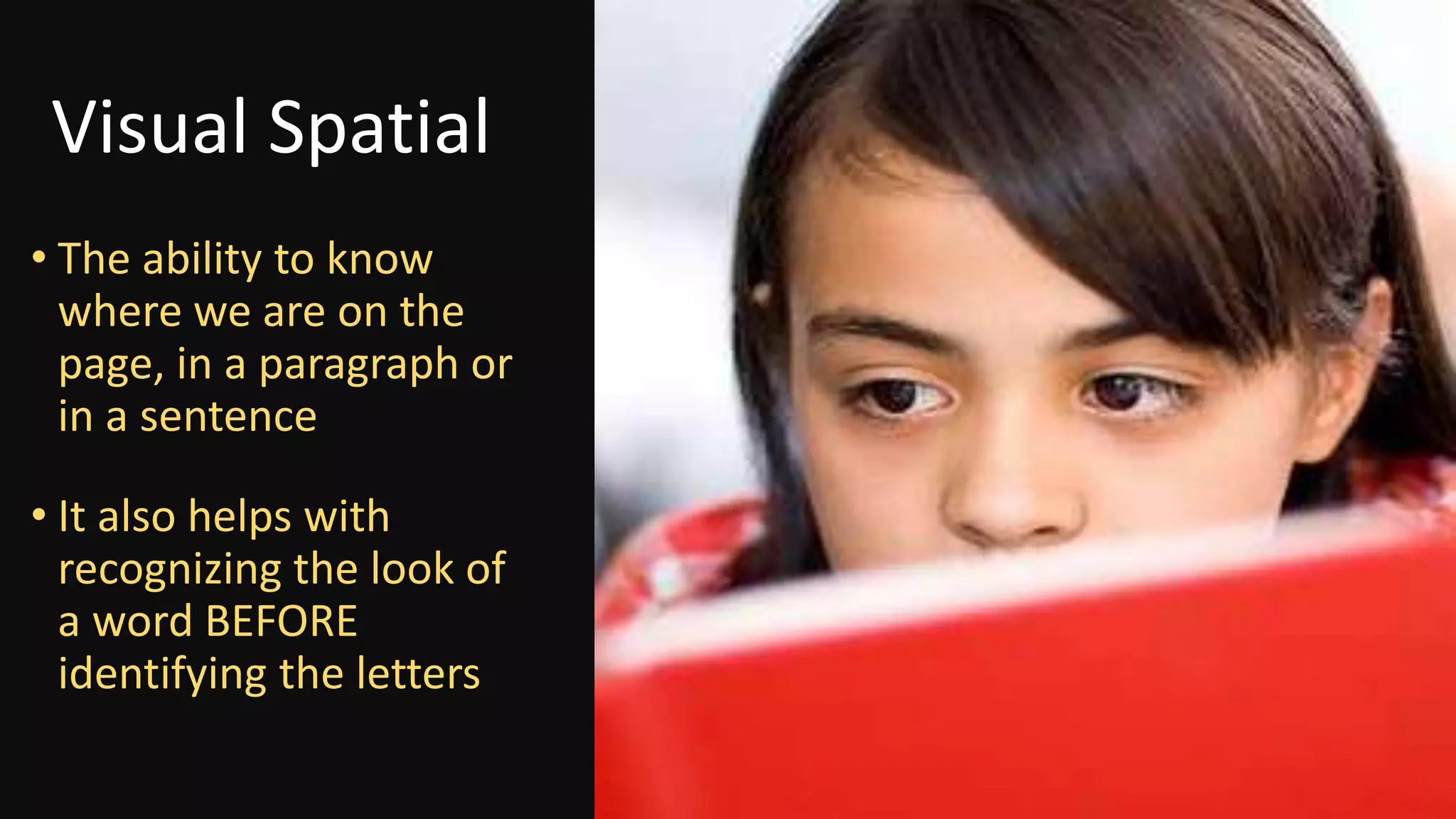
Visual Spatial
• The ability to know
where we are on the
page, in a paragraph or
in a sentence
• It also helps with
recognizing the look of
a word BEFORE
identifying the letters
Yuo cna porbalby raed tihs desptie the msispeillngs.
Visual
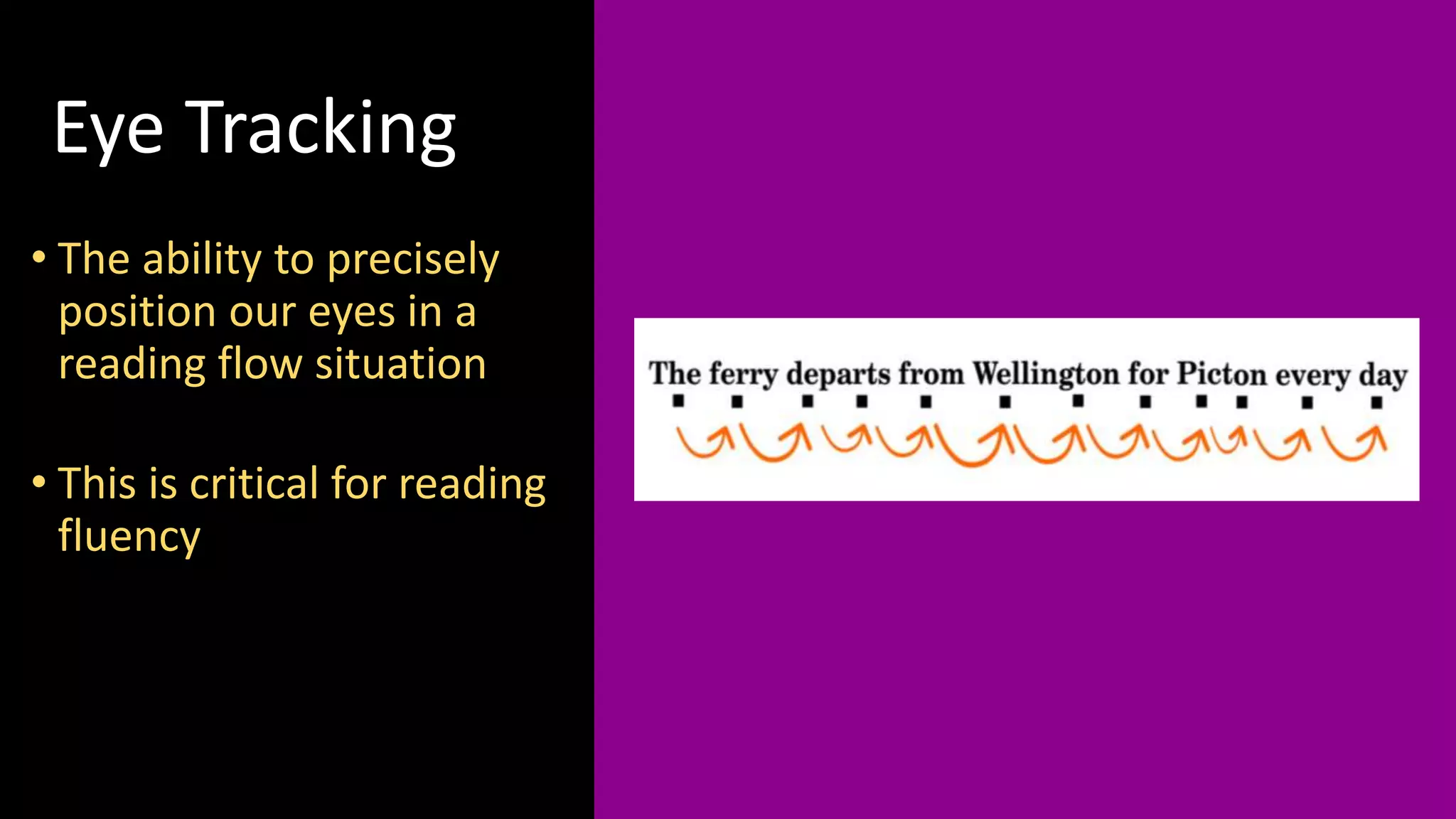
Eye Tracking
• The ability to precisely
position our eyes in a
reading flow situation
• This is critical for reading
fluency
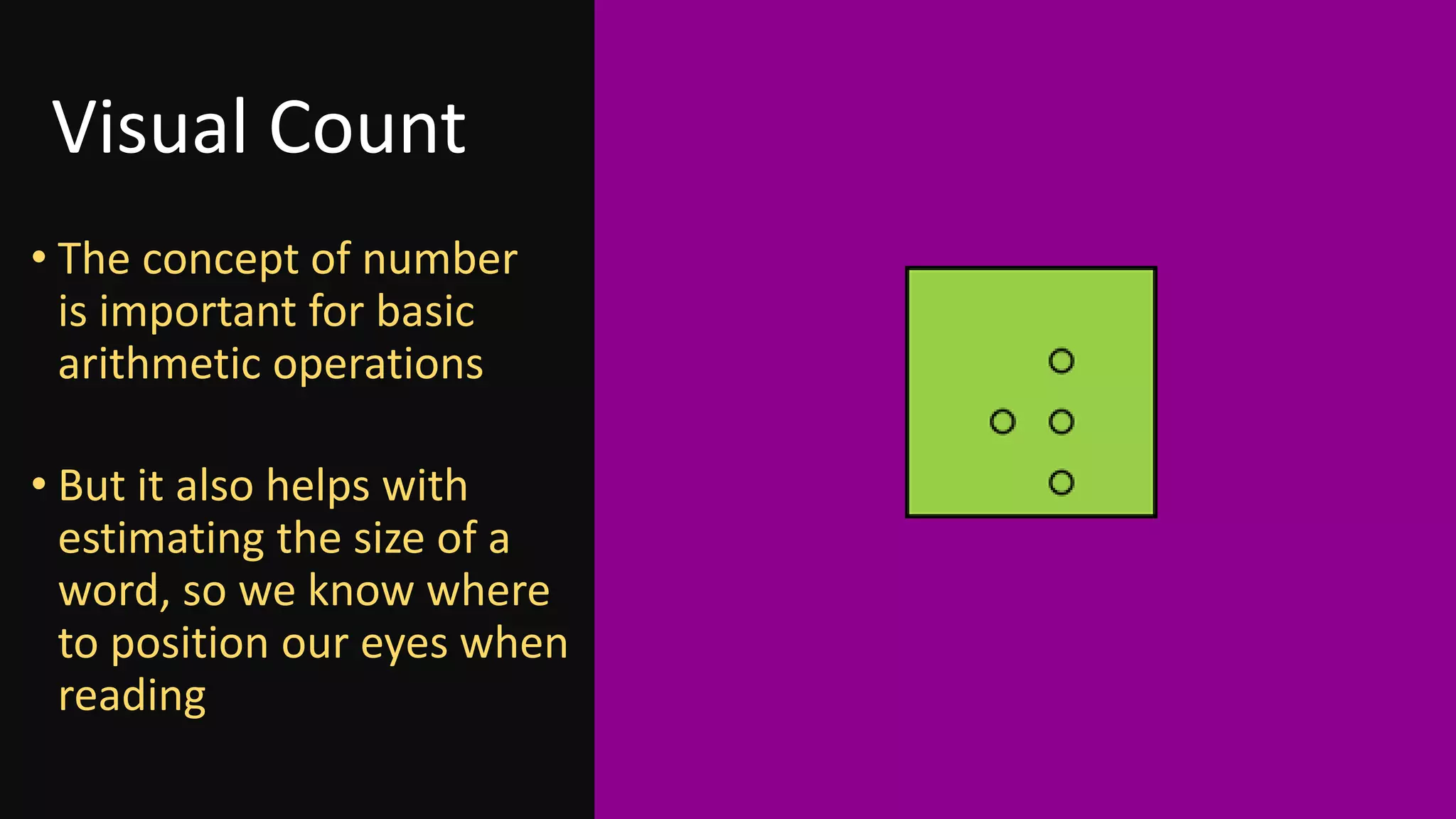
Visual Count
• The concept of number
is important for basic
arithmetic operations
• But it also helps with
estimating the size of a
word, so we know where
to position our eyes when
reading
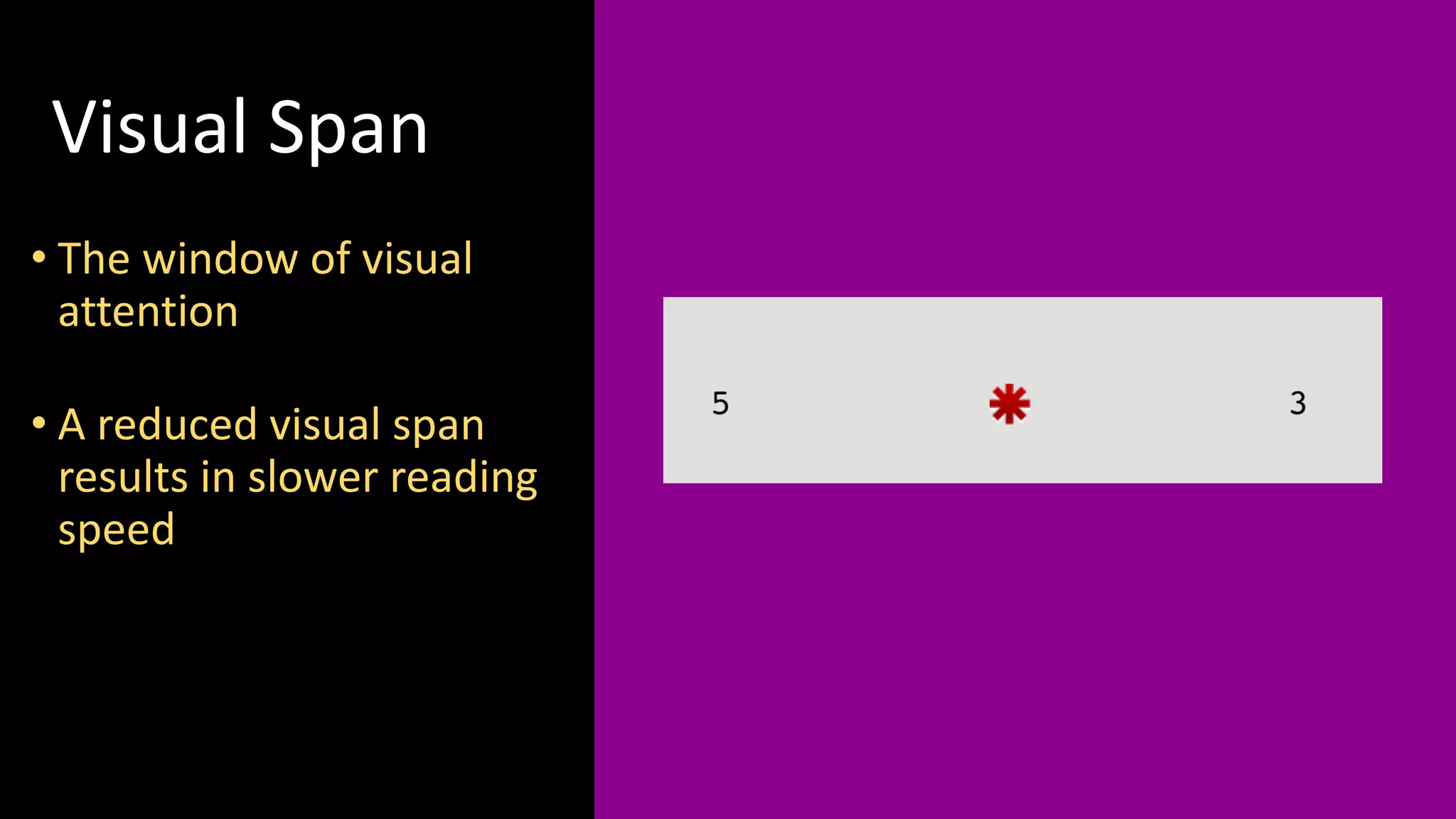
Visual Span
• The window of visual
attention
• A reduced visual span
results in slower reading
speed
Auditory
Discrimination
• The discrimination of
differences in sound such
as the pitch or gaps
between sounds
• Supports spelling and
following verbal
instructions
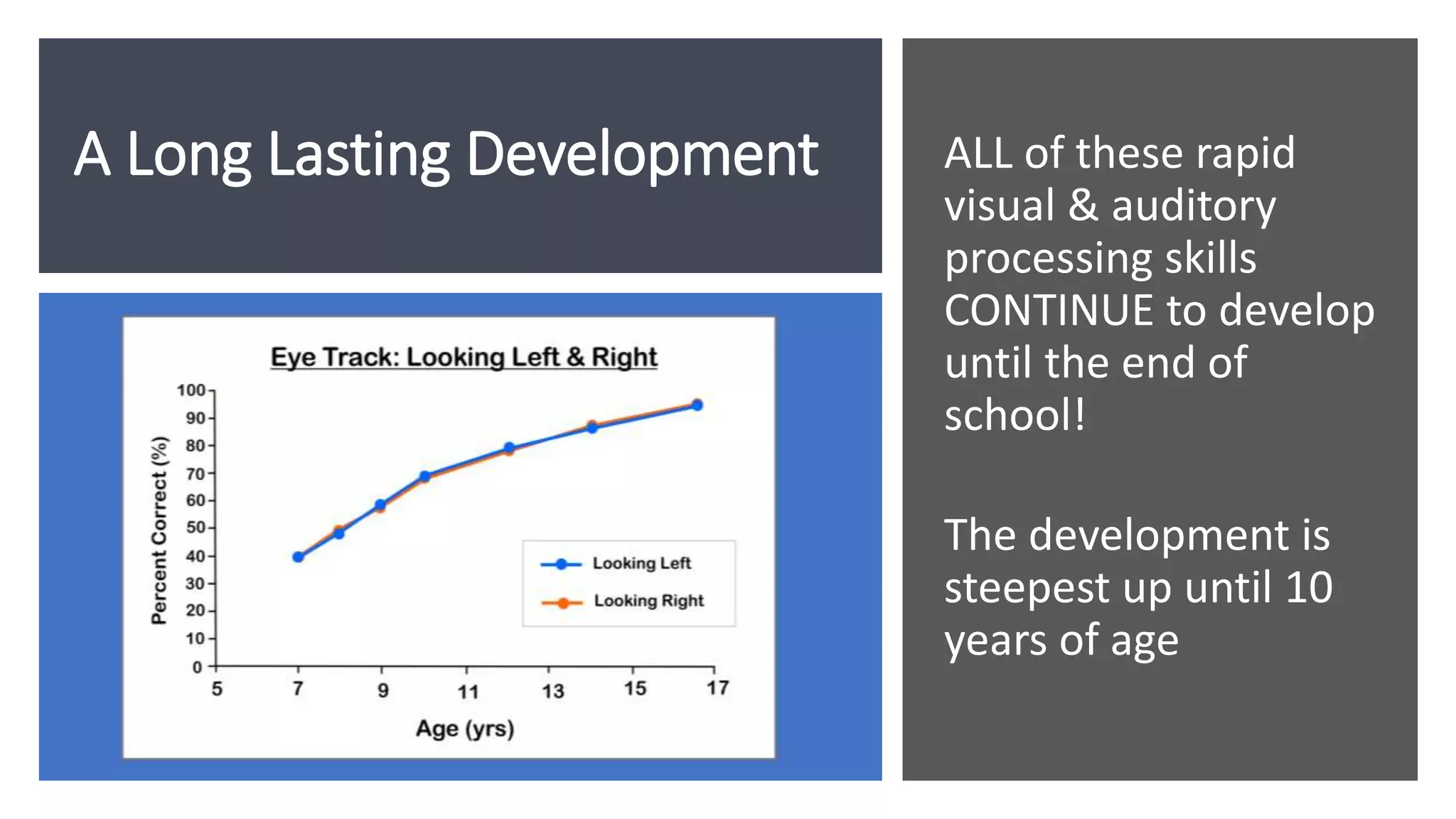
A Long Lasting Development ALL of these rapid
visual & auditory
processing skills
CONTINUE to develop
until the end of
school!
The development is
steepest up until 10
years of age
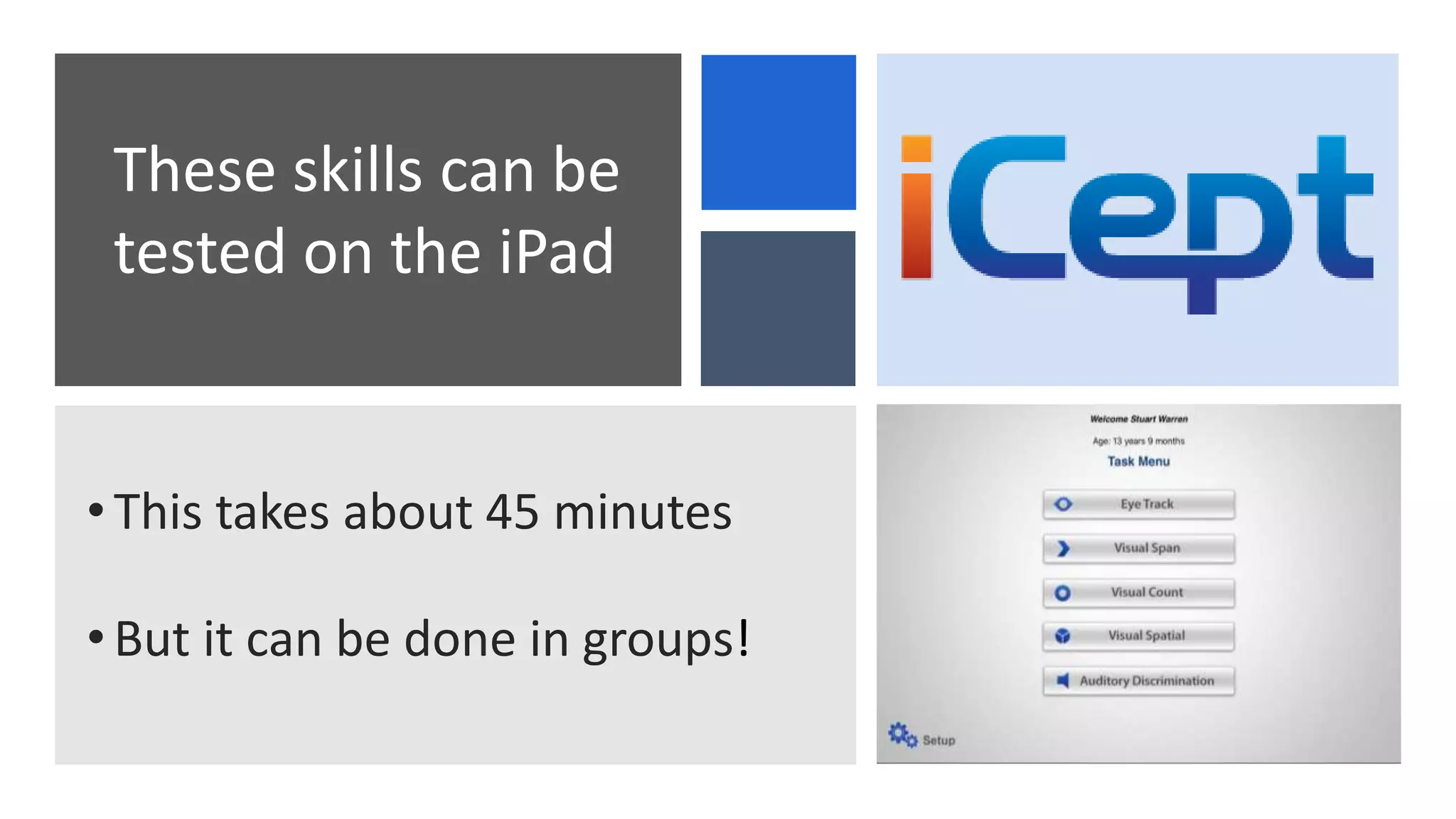
•This takes about 45 minutes
•But it can be done in groups!
These skills can be
tested on the iPad
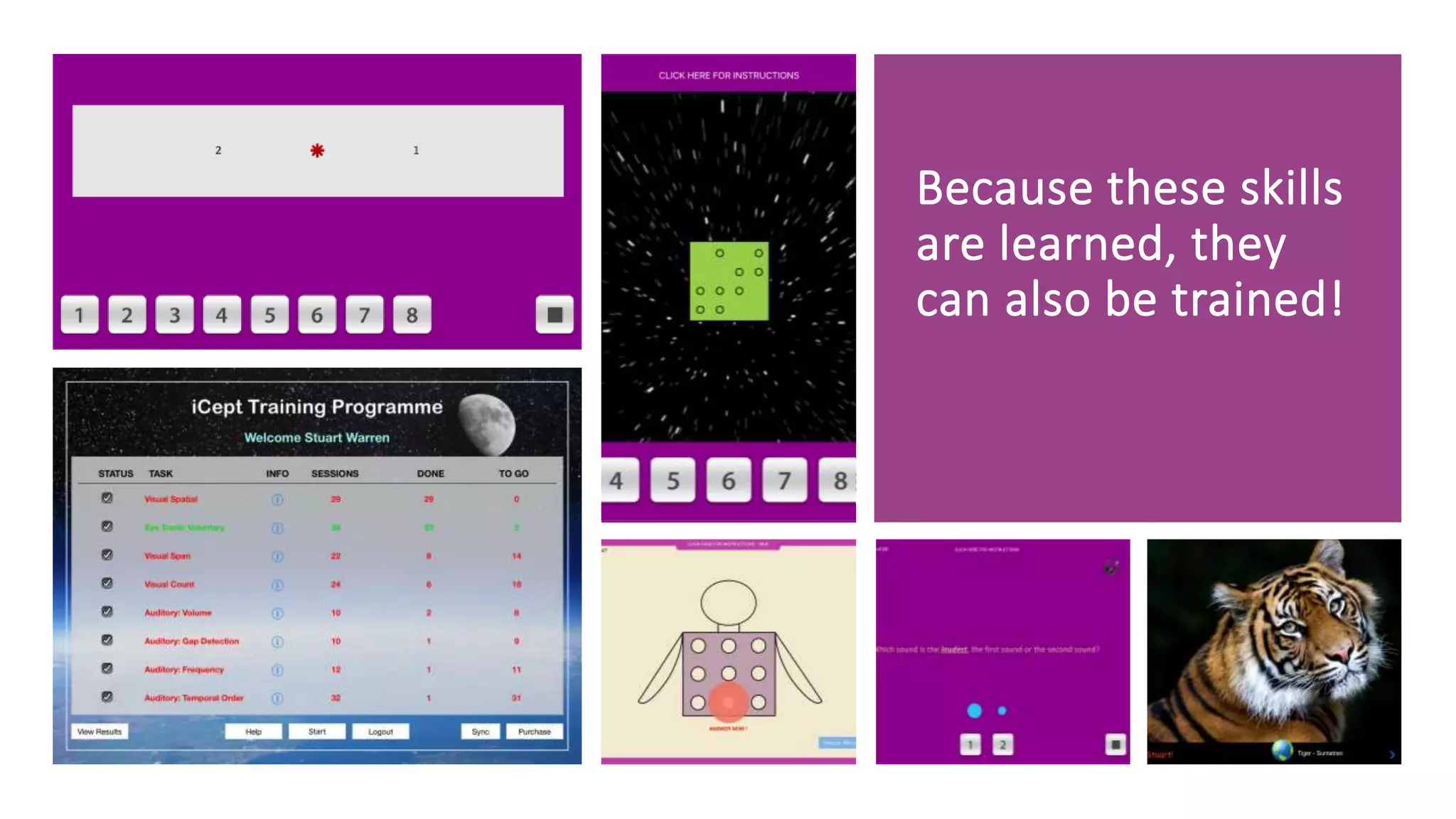
Because these skills
are learned, they
can also be trained!
Who Can Benefit?
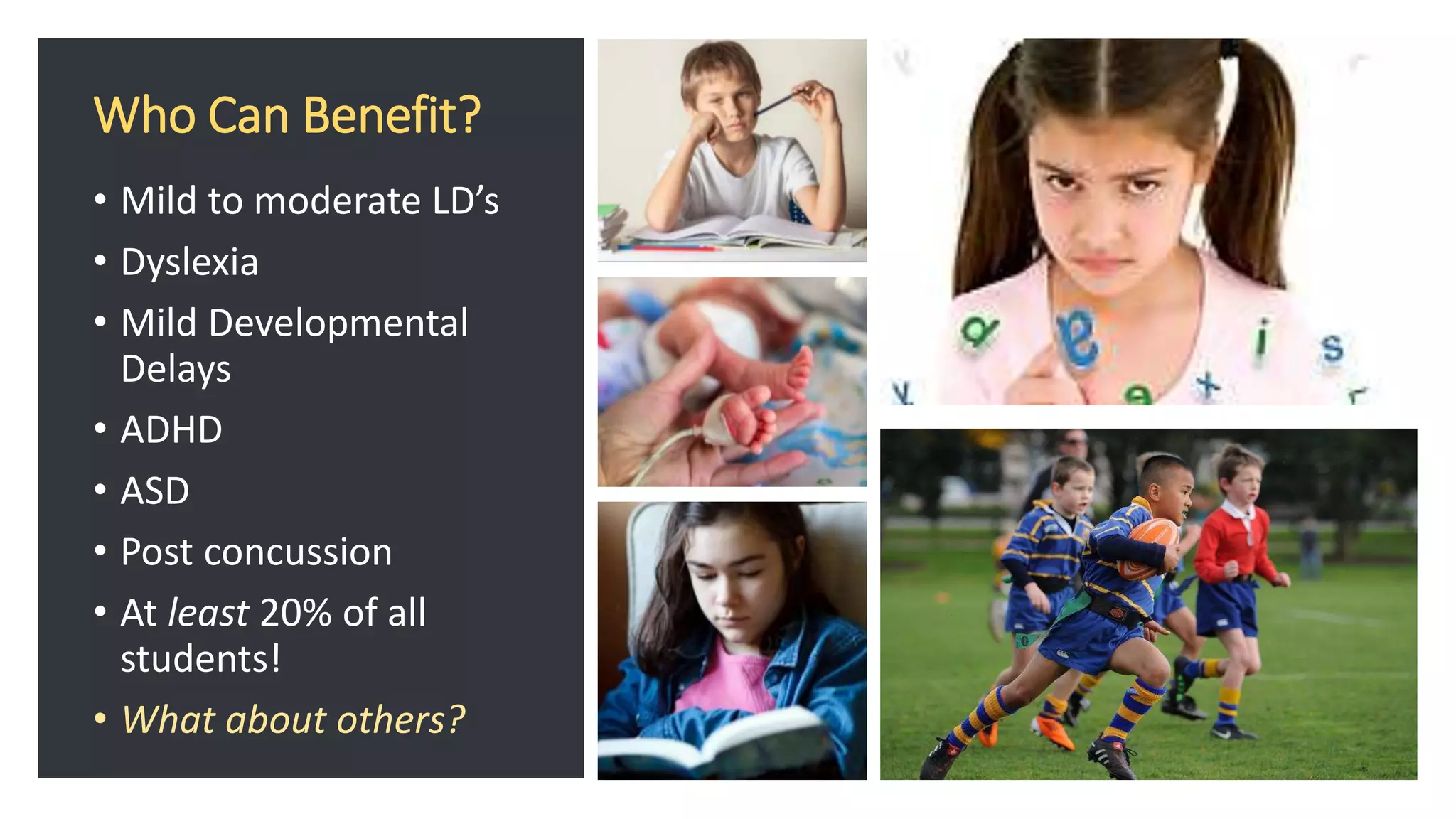
• Mild to moderate LD’s
• Dyslexia
• Mild Developmental
Delays
• ADHD
• ASD
• Post concussion
• At least 20% of all
students!
• What about others?
Improving visual & auditory input
may also help to improve learning
outcomes generally if a weakness is
found at this level.
Training can be done at a low cost per
child and takes around 10 minutes a
day. It does not require changing the
existing educational programme.
What About Traditional
Approaches?
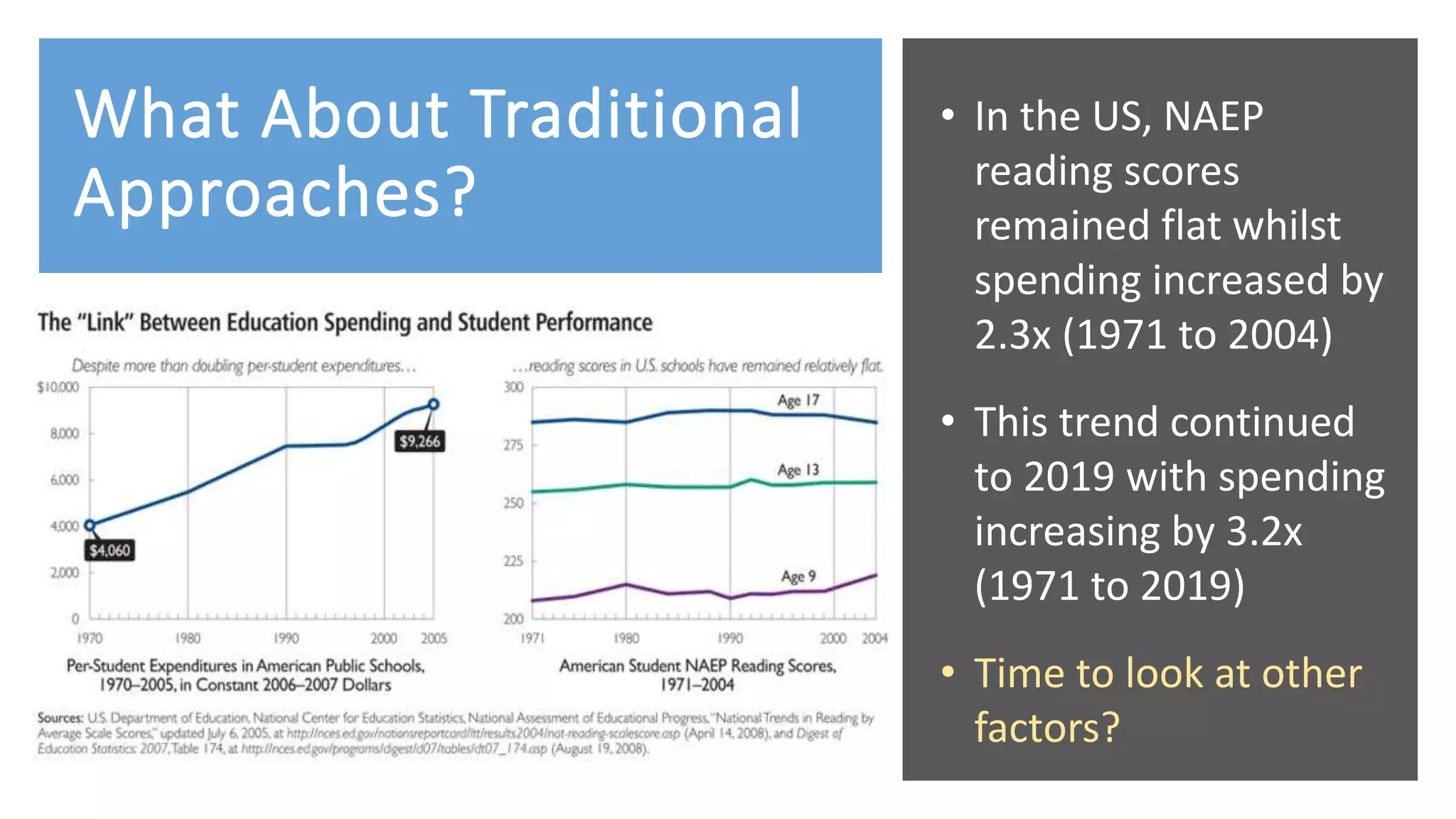
• In the US, NAEP
reading scores
remained flat whilst
spending increased by
2.3x (1971 to 2004)
• This trend continued
to 2019 with spending
increasing by 3.2x
(1971 to 2019)
• Time to look at other
factors?
Limehills School (primary & intermediate)
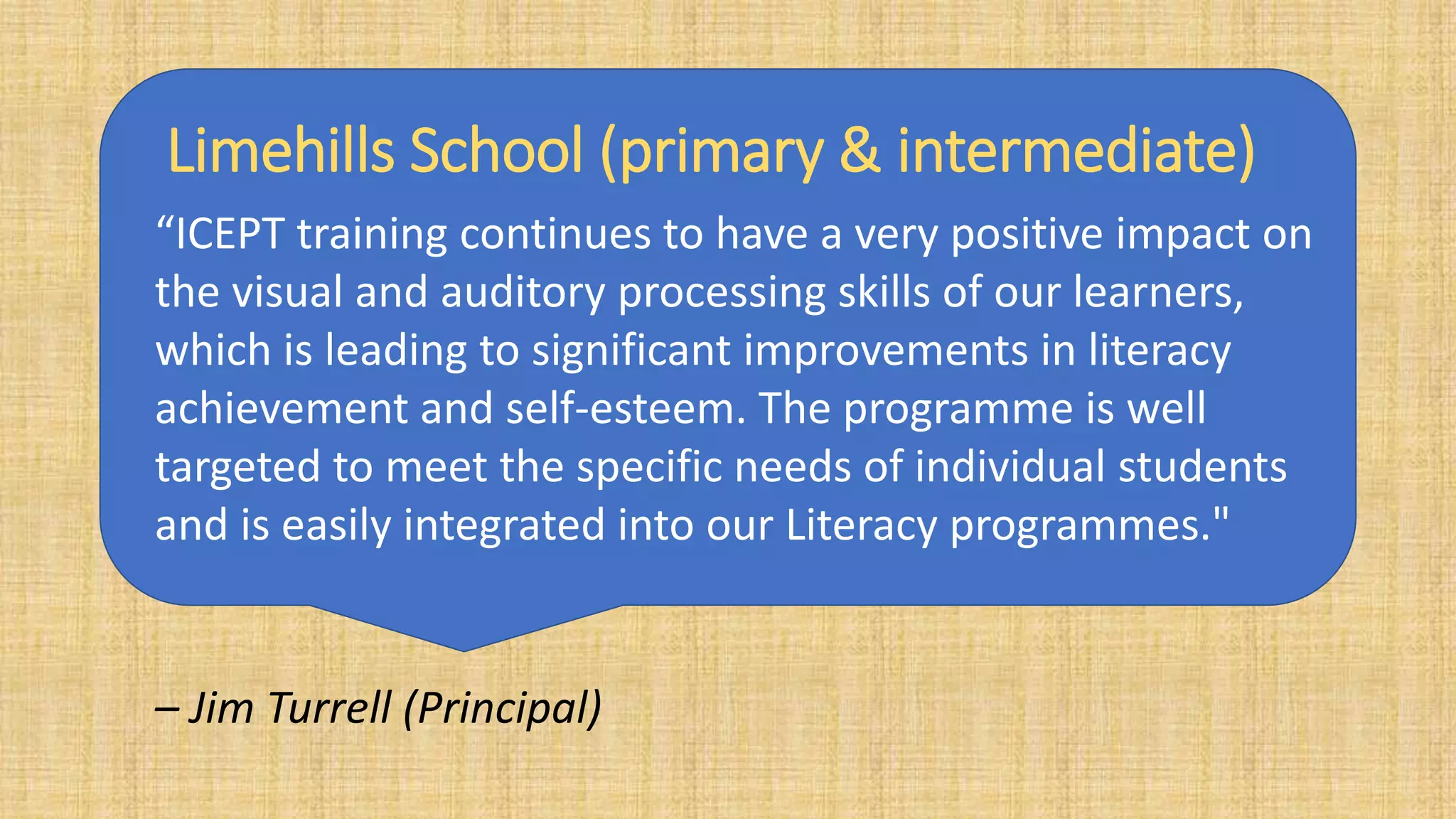
“ICEPT training continues to have a very positive impact on
the visual and auditory processing skills of our learners,
which is leading to significant improvements in literacy
achievement and self-esteem. The programme is well
targeted to meet the specific needs of individual students
and is easily integrated into our Literacy programmes."
– Jim Turrell (Principal)
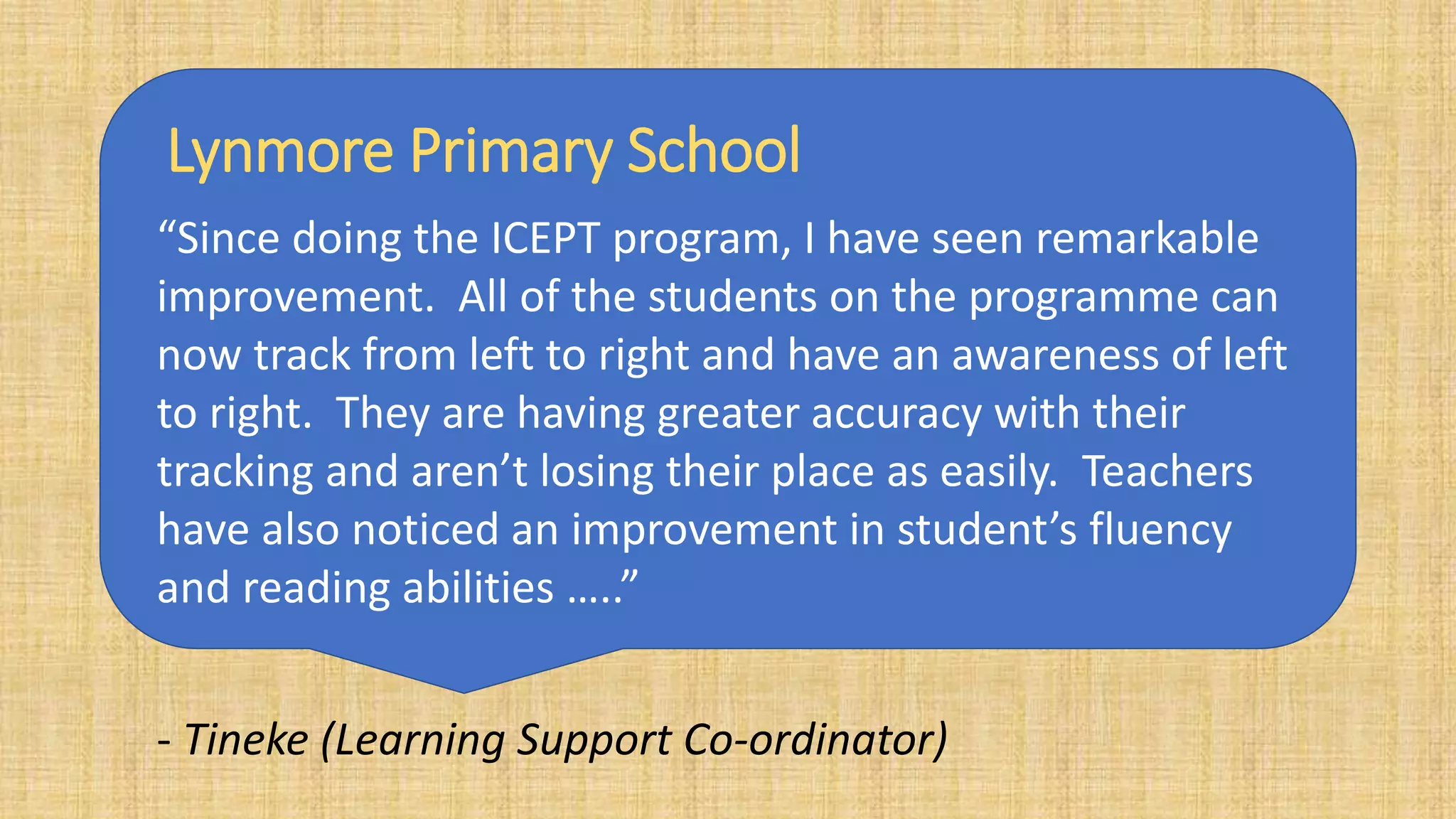
“Since doing the ICEPT program, I have seen remarkable
improvement. All of the students on the programme can
now track from left to right and have an awareness of left
to right. They are having greater accuracy with their
tracking and aren’t losing their place as easily. Teachers
have also noticed an improvement in student’s fluency
and reading abilities …..”
- Tineke (Learning Support Co-ordinator)
Lynmore Primary School
END
For more information
contact Stuart Warren at
info@visionforlearning.co.nz

Learning related visual and auditory problems

  • 1.
    Learning Related Vision &Auditory Problems By Stuart Warren B.Optom, MSc(Optom)
  • 2.
    A simple modelof learning requires... 1. Good Input – how we acquire information 2. Good Output – how we can use that for reading, maths, spelling & writing
  • 3.
    1 - Eyesight& Hearing Good INPUT involves more than just having good eyesight & hearing!
  • 4.
    It also requireshaving good NEAR VISION as well as good visual & auditory PROCESSING SKILLS. It is estimated that 60% of learning at school involves near vision.
  • 5.
    2 - NEARVISION •Near vision problems occur in about 5-15% of all students (many go undetected) •Good near vision means that text must be: a. Clear….not changing focus b. Single...not going double c. Steady...not moving on the page
  • 6.
    2 - NEARVISION •A problem with near vision does NOT cause learning disabilities but it can cause learning to PLATEAU •A simple 3 Point Check Test of near vision can be done at school – it only takes a MINUTE!
  • 7.
    STEP 1 STEP2 STEP 3
  • 8.
    If a problemis found, then treatment involves reading glasses, eye exercises or tinted lenses
  • 9.
    •This refers tothe analysis of visual and auditory information so that it can be used for higher cognitive functions such as reading, spelling & math •Also known as visual & auditory perceptual skills or low-level sensory processing skills •So how common are problems in this area? 3 - Visual & Auditory Processing
  • 10.
    99.9% of studentswith dyslexia had a visual or auditory problem 80 to 92% had a problem with BOTH depending on age These problems are also common in students WITHOUT dyslexia! Stuart Warren & Burkhart Fischer (2005) Prof Burkhart Fischer of Freiburg University assessed some 3000 students with dyslexia…
  • 11.
    This is nottoo surprising considering that… “More than 50 percent of the cortex is devoted to processing visual information” - Center for Visual Science
  • 12.
    THERE ARE 2KEY FACTORS: It’s the RAPID processing skills that are affected and… They take a LONG time to develop
  • 13.
    RAPID VISUAL PROCESSING In the visualsystem, rapid processing has its own pathway (purple). Visual info is processed in different areas of the brain and arrives back just as the slow info (for identifying words) arrives! What are these skills?
  • 14.
    Visual Spatial • Theability to know where we are on the page, in a paragraph or in a sentence • It also helps with recognizing the look of a word BEFORE identifying the letters
  • 15.
    Yuo cna porbalbyraed tihs desptie the msispeillngs.
  • 16.
    Visual Eye Tracking • Theability to precisely position our eyes in a reading flow situation • This is critical for reading fluency
  • 17.
    Visual Count • Theconcept of number is important for basic arithmetic operations • But it also helps with estimating the size of a word, so we know where to position our eyes when reading
  • 18.
    Visual Span • Thewindow of visual attention • A reduced visual span results in slower reading speed
  • 19.
    Auditory Discrimination • The discriminationof differences in sound such as the pitch or gaps between sounds • Supports spelling and following verbal instructions
  • 20.
    A Long LastingDevelopment ALL of these rapid visual & auditory processing skills CONTINUE to develop until the end of school! The development is steepest up until 10 years of age
  • 21.
    •This takes about45 minutes •But it can be done in groups! These skills can be tested on the iPad
  • 22.
    Because these skills arelearned, they can also be trained!
  • 23.
    Who Can Benefit? •Mild to moderate LD’s • Dyslexia • Mild Developmental Delays • ADHD • ASD • Post concussion • At least 20% of all students! • What about others?
  • 24.
    Improving visual &auditory input may also help to improve learning outcomes generally if a weakness is found at this level. Training can be done at a low cost per child and takes around 10 minutes a day. It does not require changing the existing educational programme.
  • 25.
    What About Traditional Approaches? •In the US, NAEP reading scores remained flat whilst spending increased by 2.3x (1971 to 2004) • This trend continued to 2019 with spending increasing by 3.2x (1971 to 2019) • Time to look at other factors?
  • 26.
    Limehills School (primary& intermediate) “ICEPT training continues to have a very positive impact on the visual and auditory processing skills of our learners, which is leading to significant improvements in literacy achievement and self-esteem. The programme is well targeted to meet the specific needs of individual students and is easily integrated into our Literacy programmes." – Jim Turrell (Principal)
  • 27.
    “Since doing theICEPT program, I have seen remarkable improvement. All of the students on the programme can now track from left to right and have an awareness of left to right. They are having greater accuracy with their tracking and aren’t losing their place as easily. Teachers have also noticed an improvement in student’s fluency and reading abilities …..” - Tineke (Learning Support Co-ordinator) Lynmore Primary School
  • 28.
    END For more information contactStuart Warren at info@visionforlearning.co.nz

Editor's Notes

  • #2 Thanks Jill. And thanks for inviting me to share here at the SENCO breakfast about the role of vision in learning & behavioural optometry Impressed at your dedication It may be that you came thinking that…..
  • #9 Glasses Eye exercises Tinted lenses Glasses – Subsidy for CSC (covers consult and much of the cost of glasses) EE – No subsidy Tinted Lenses – referred to an Irlen assessor
  • #12 Up to 80% When it comes to the role of vision in learning this of course is the role of BO
  • #22 iPad Name skills…..
  • #28 Both schools have put 100 students on training Lynmore School >>>>>