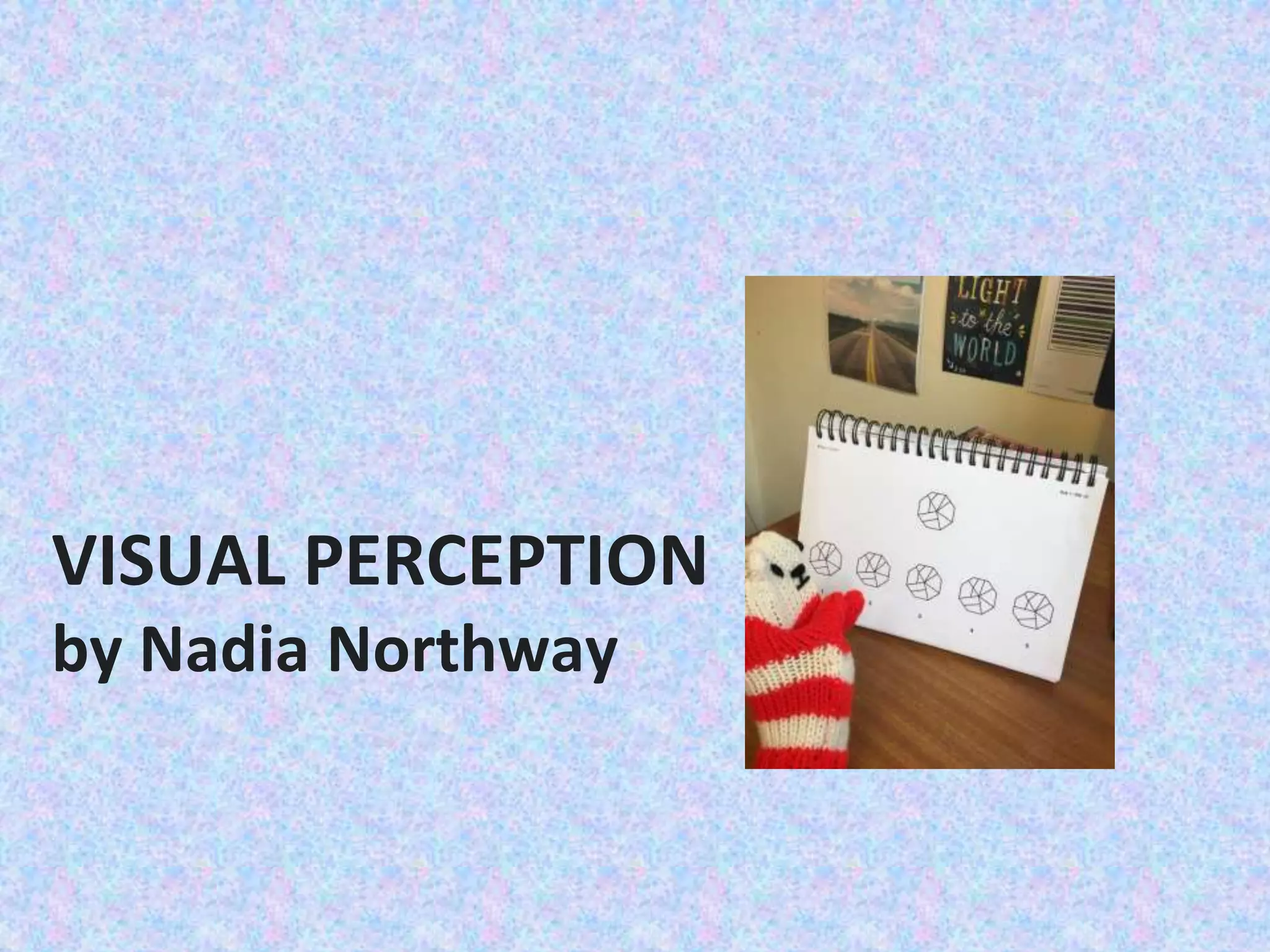
VISUAL PERCEPTION
by Nadia Northway
What is Visual Perception?
• Is the way the brain interprets visual
information.
• A visual perception disorder is a
hindered ability to make sense of
information taken in through the
eyes.
This can be as simple as recognising
faces, shapes or matching socks.
More complex functions include
finding information in busy visual
scenes (copying from the board) and
understanding the complete picture
from fragments of information.
Why should we assess Visual
Perception?
• A Visual Processing Disorder is
characterised by an abnormality in the
brain’s ability to process and interpret
what the eyes see.
• Visual Perception comes under this
definition.
Why should an eye care
professional assess Visual
Perception?
•Allows full investigation
of the child’s visual
difficulties.
•Answers the “why does
my child do that?”
questions.
For example.
• We have all seen that patient who was
referred as losing their place when reading,
skipping words, confusing words etc.
• What do we do if they have normal
BSV/fusion/accommodation/convergence/
saccades/and no visual stress. Discharge?
• What if we could help that child in a simple,
meaningful way.
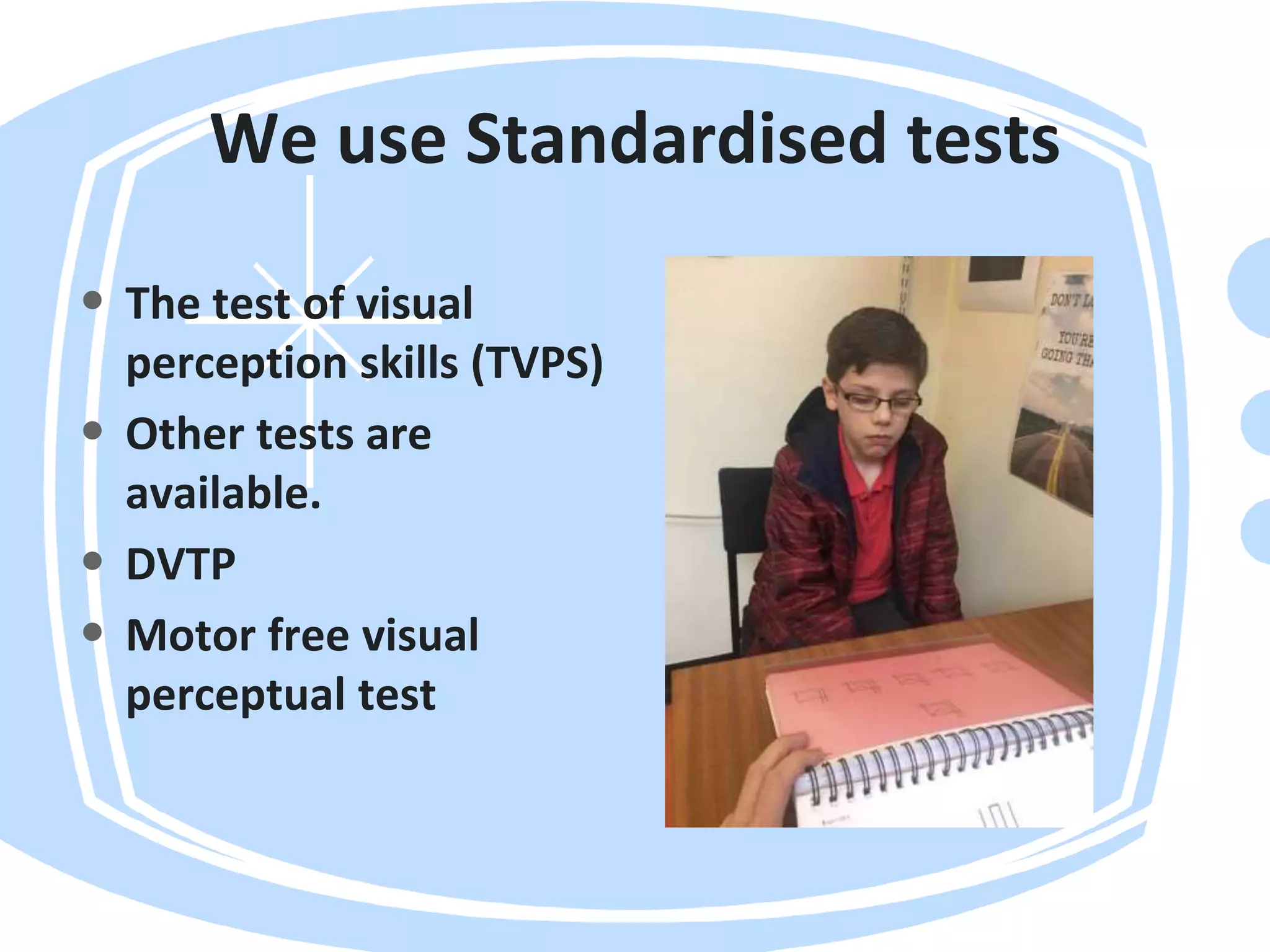
We use Standardised tests
• The test of visual
perception skills (TVPS)
• Other tests are
available.
• DVTP
• Motor free visual
perceptual test
What will we be looking for?
• There are 7 sections that we assess:
– Visual Discrimination
– Visual Memory
– Spatial Relations skills
– Form Constancy skills
– Sequential Memory
– Figure Ground skills
– Visual Closure.
Visual Discrimination
Definition
Visual discrimination is the ability
of the child to be aware of the
exact characteristics and
distinctive features of forms
including shape, orientation, size,
and colour.
What will children experience?
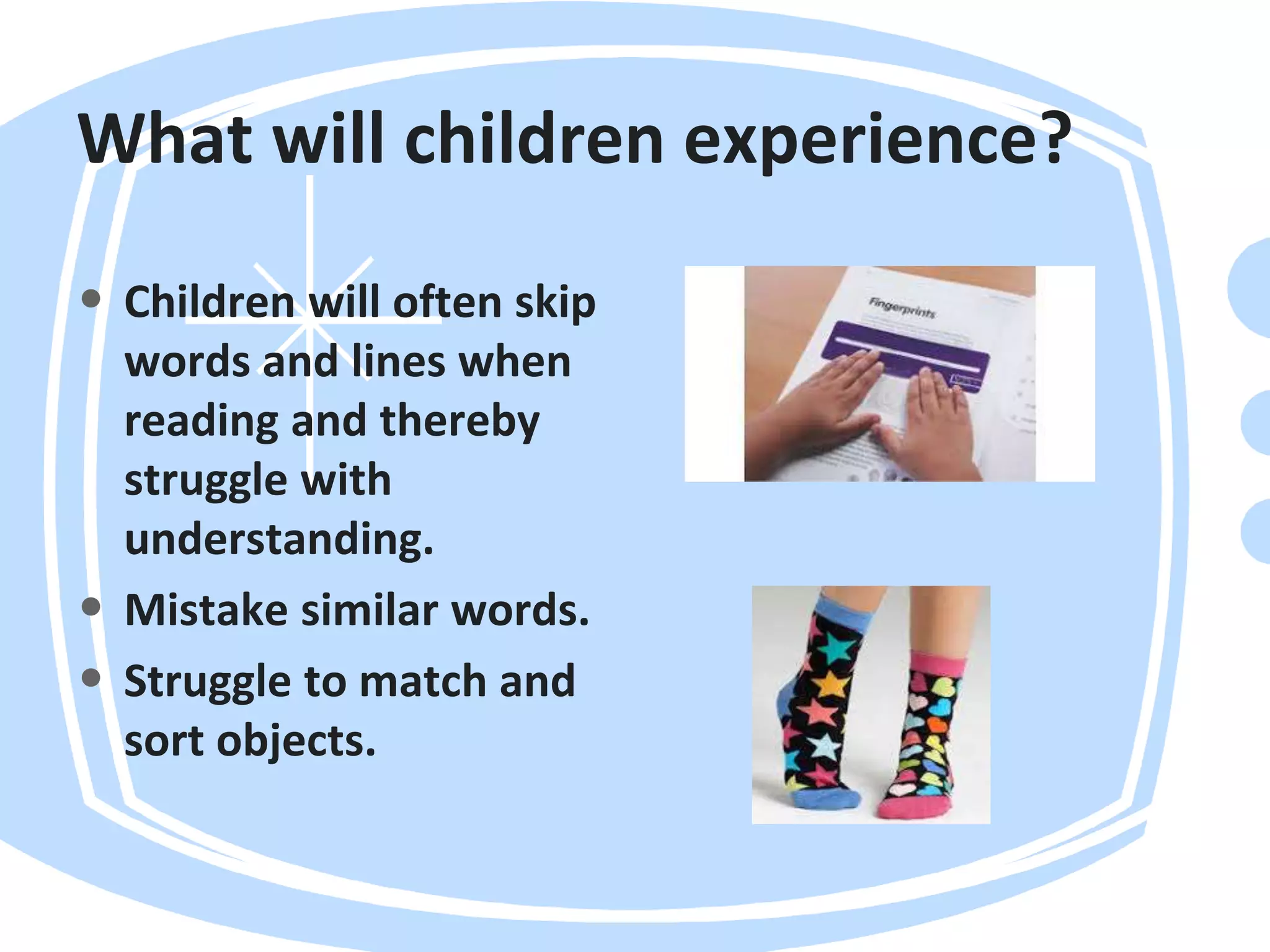
• Children will often skip
words and lines when
reading and thereby
struggle with
understanding.
• Mistake similar words.
• Struggle to match and
sort objects.
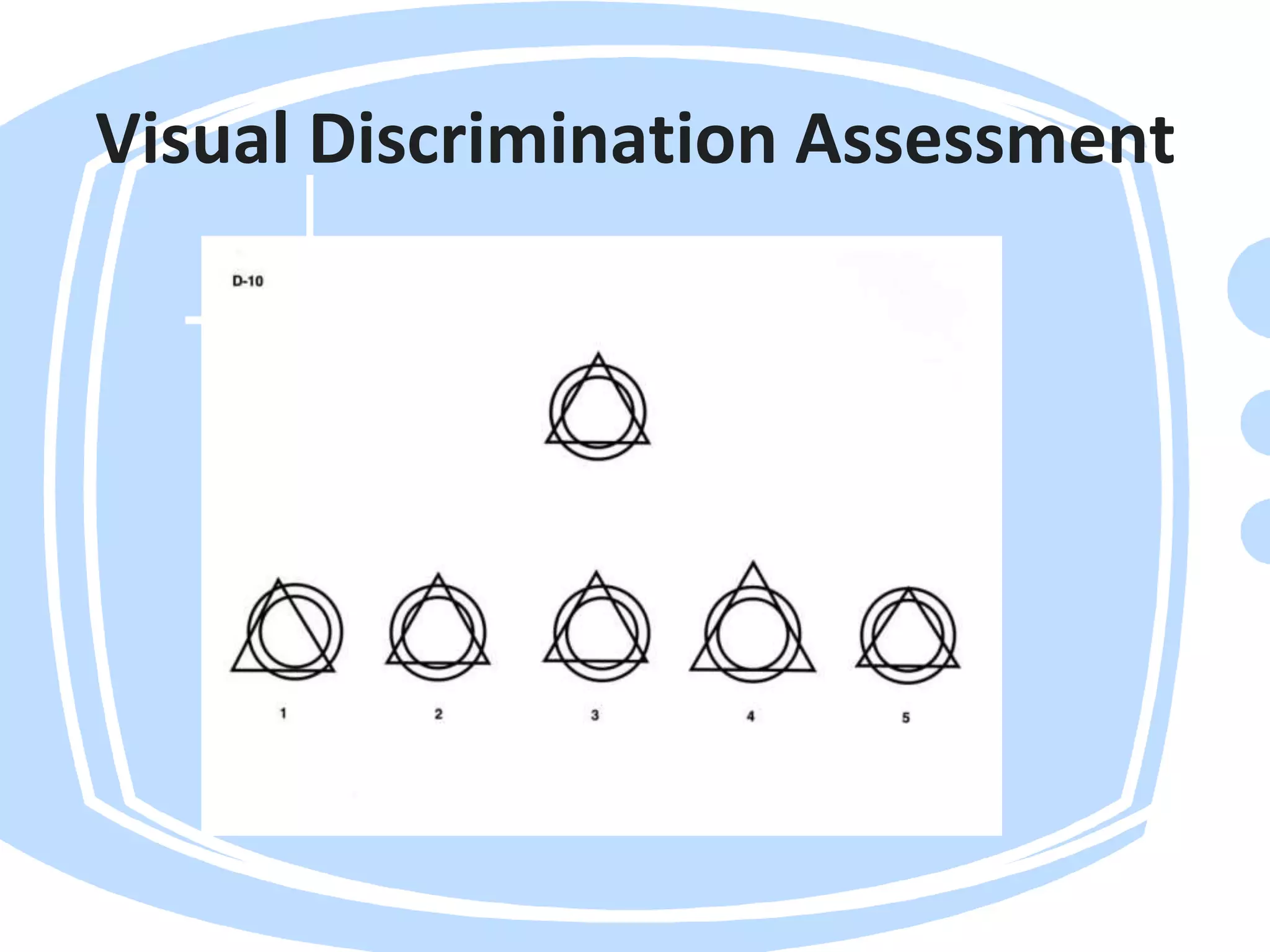
Visual Discrimination Assessment
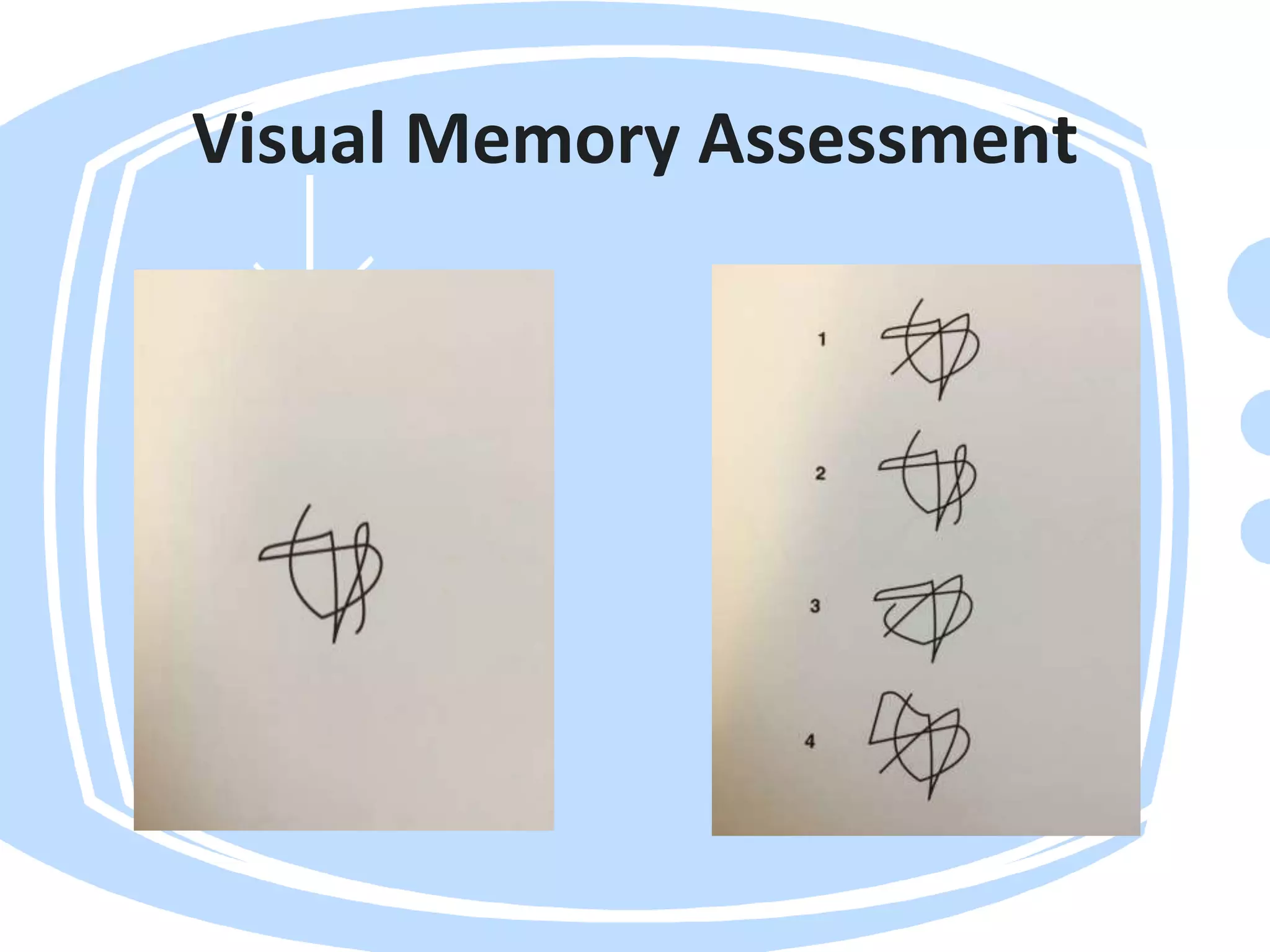
Visual memory
Definition
Visual Memory is the ability to remember for
immediate recall the characteristics of a
given object or form. This skill helps children
remember what they read and see by
adequately processing information through
their short-term memory, from where it is
filtered out into the long-term memory
What will children experience?
• They may whisper to themselves when
reading.
• Struggle with sight words.
• Struggle copying.
• Struggle remembering what they have read.
Visual Memory Assessment
Visual Spatial Relationship
Definition
Visual spatial relationship is the
ability to locate objects in our three
dimensional world using sight. These
skills allow an individual to
develop spatial concepts, such as
right and left, front and back, and up
and down as they relate to our body
and to objects in space
What will children Experience?
• Lose their place when reading.
• Struggle with the order of letters in words or
numbers in maths.
• Struggle with size, distance, volume, order
and time.
• May get lost easily.
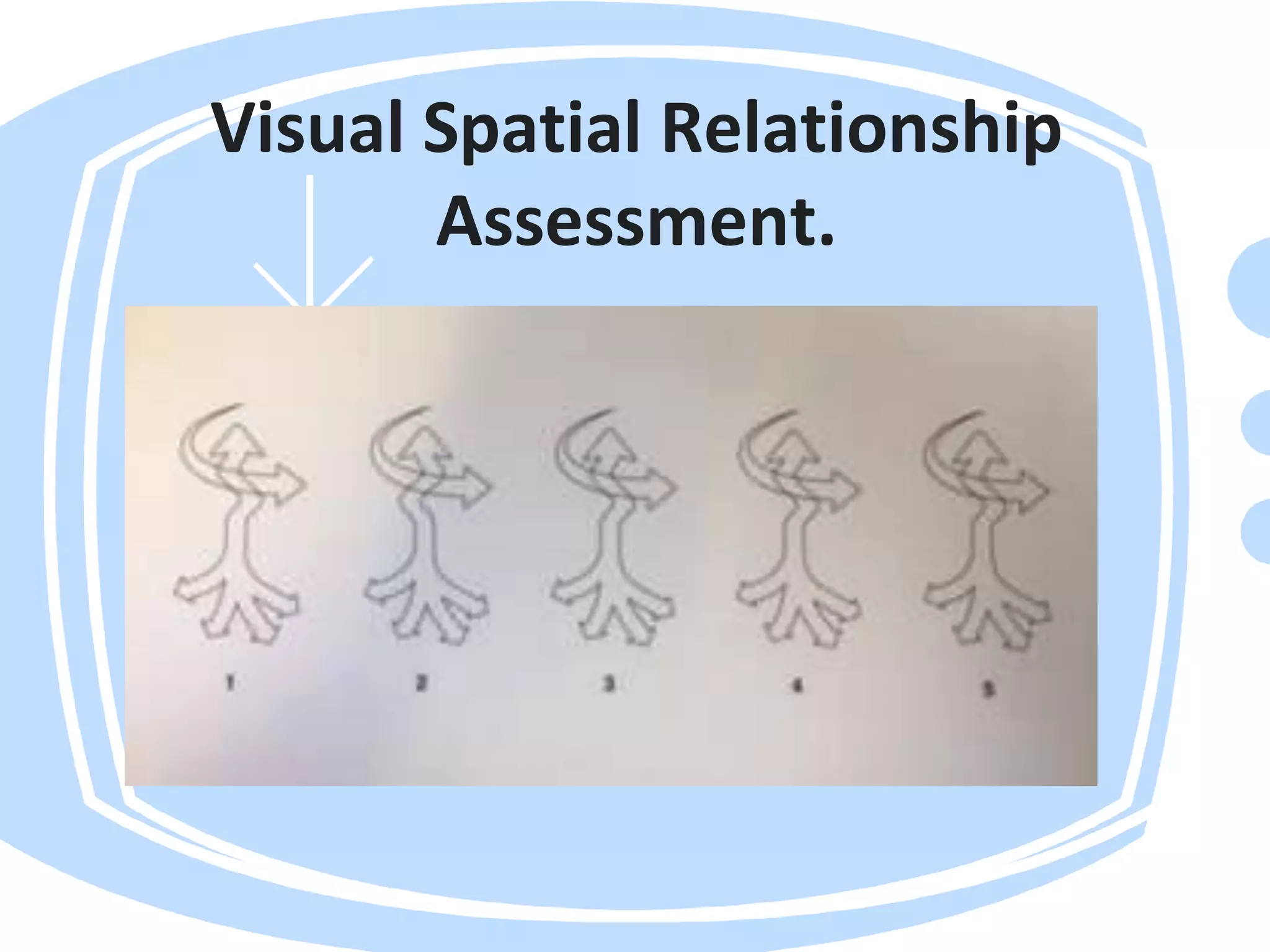
Visual Spatial Relationship
Assessment.
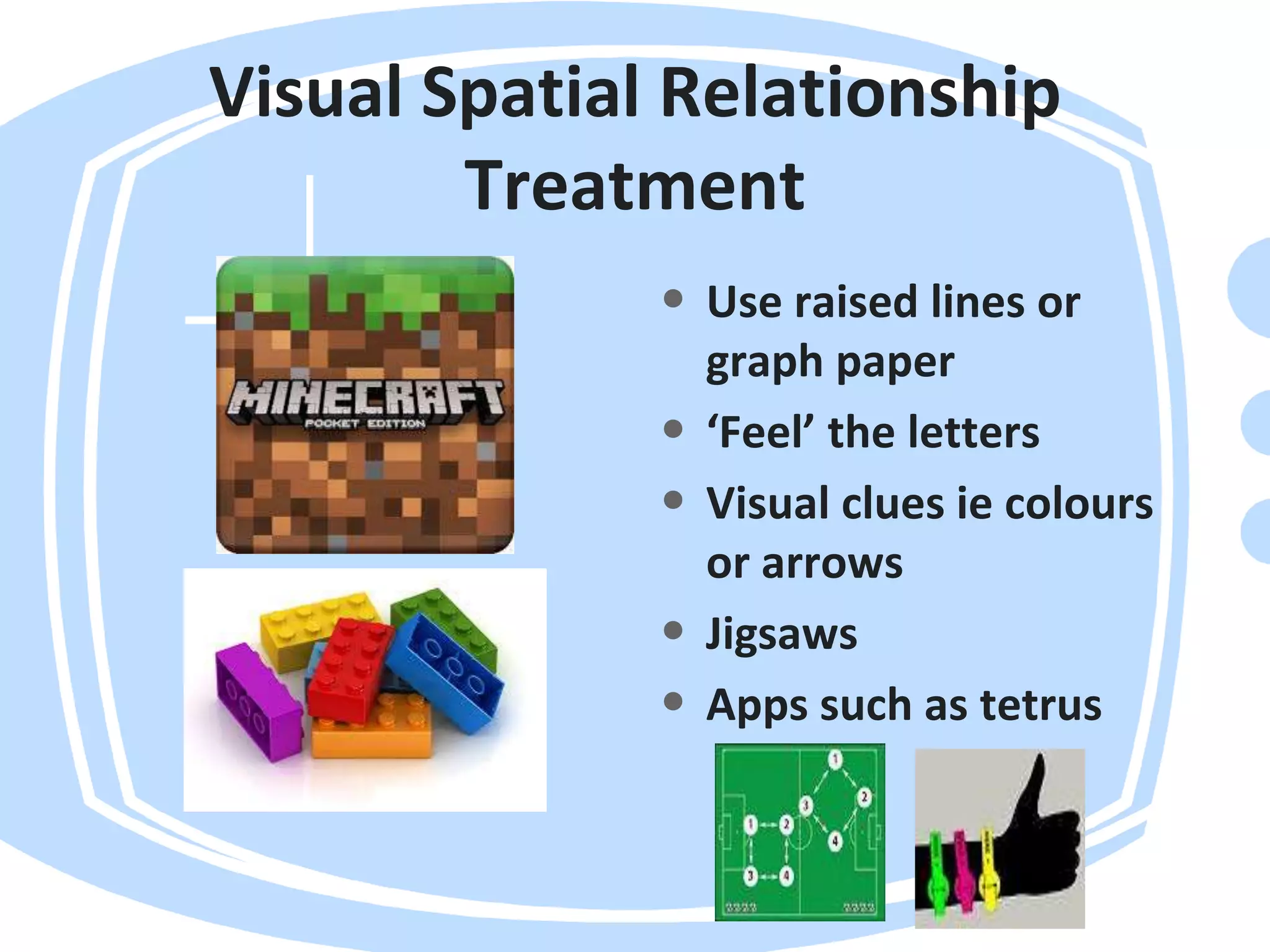
Visual Spatial Relationship
Treatment
• Use raised lines or
graph paper
• ‘Feel’ the letters
• Visual clues ie colours
or arrows
• Jigsaws
• Apps such as tetrus
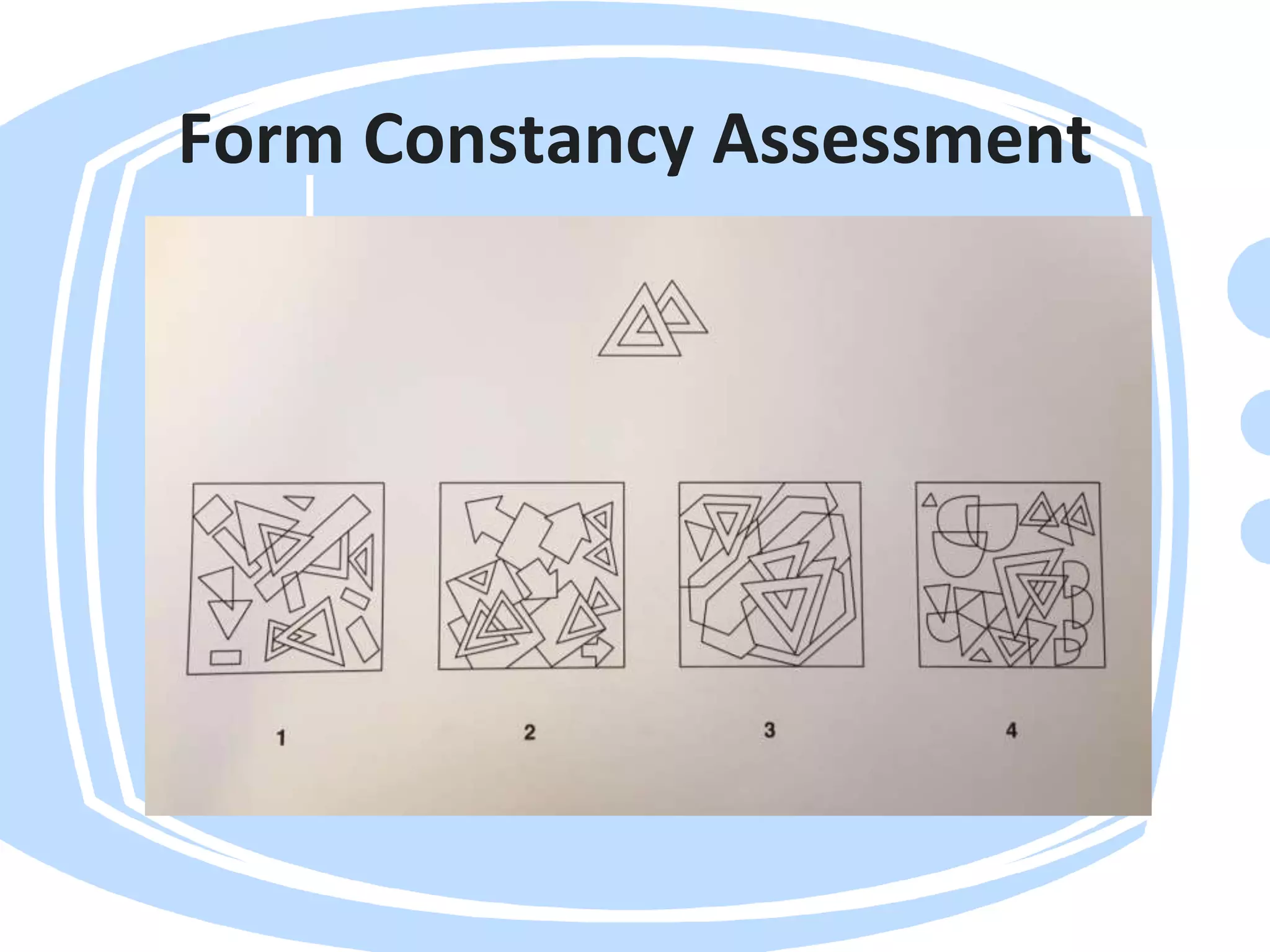
Visual Form Constancy
Definition
Visual Form Constancy is the ability to
recognize objects as they change size, shape,
or orientation. It is the ability to mentally
manipulate forms and visualize the resulting
outcomes. This skill helps children distinguish
differences in size, shape, and orientation
What will children experience?
• Difficulty recognising errors in punctuation.
• Reversing letters.
• Understanding mass and quantity.
• Building things from instructions.
• Difficulty transferring from printed to cursive
or different fonts.
Form Constancy Assessment
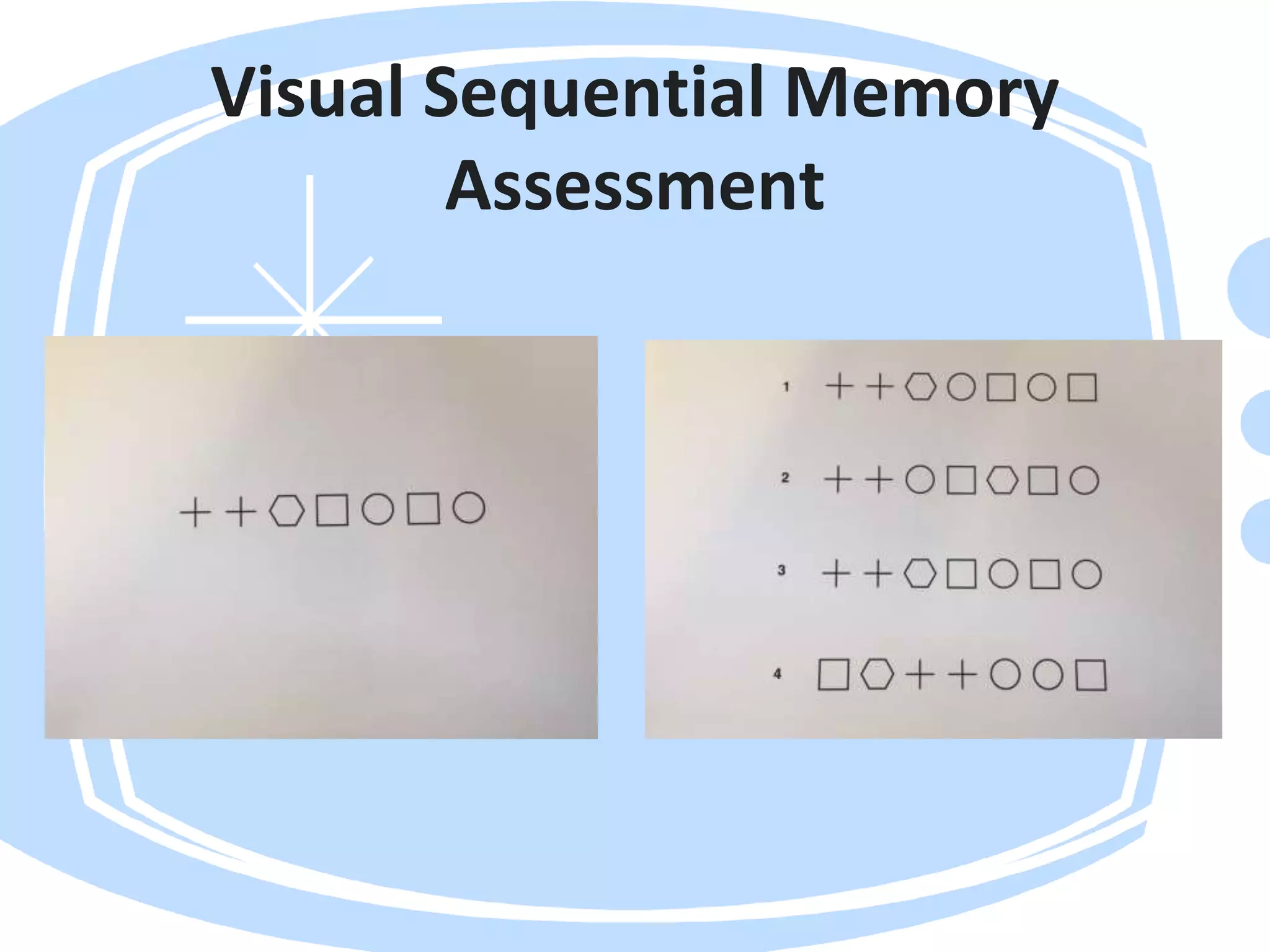
Visual Sequential Memory
Definition
Visual sequential memory is
the ability to remember and
reproduce a sequence of
words, symbols or sentences
in the correct order
What will children experience?
• This skill is particularly important in spelling.
Letter omissions, additions, and/or
transpositions within words are common for
children who struggle with this skill .
• They may forget steps in maths equations.
• Struggle to copy.
Visual Sequential Memory
Assessment
Visual Figure Ground Skills
Definition
Visual figure-ground refers to the
ability to locate and identify
shapes and objects embedded in
a busy visual environment, or the
ability to attend to one activity
without being distracted by other
surrounding stimuli
What will children experience?
Trying to look at this text with a busy
background is almost impossible. For children
with a difficulty in this area even a small
amount of background clutter will be
devastating to their concentration. They will be
distractible and struggle to copy. They will skip
words, lose their place, even lose their
belongings regularly.
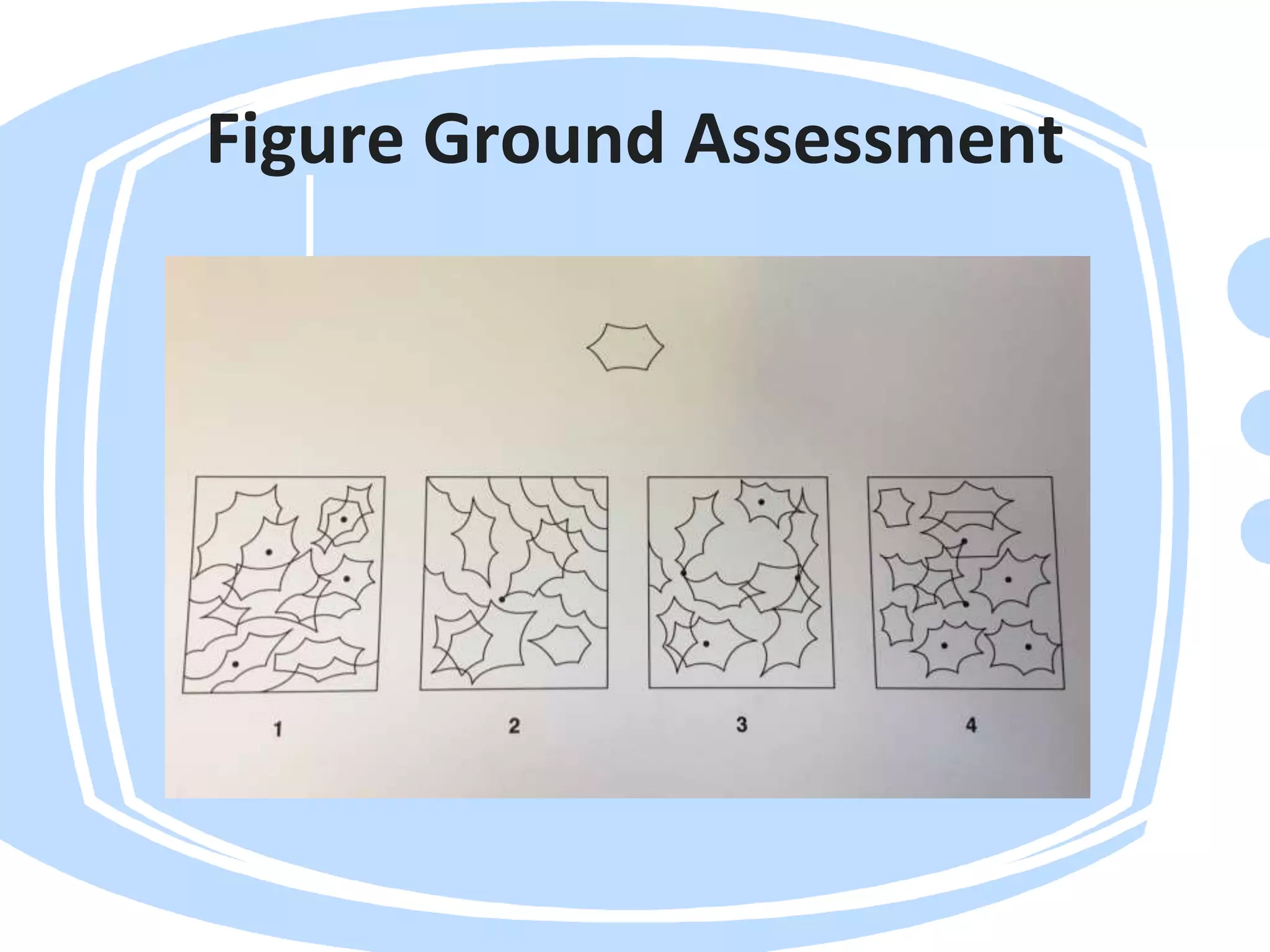
Figure Ground Assessment
Visual Closure Definition
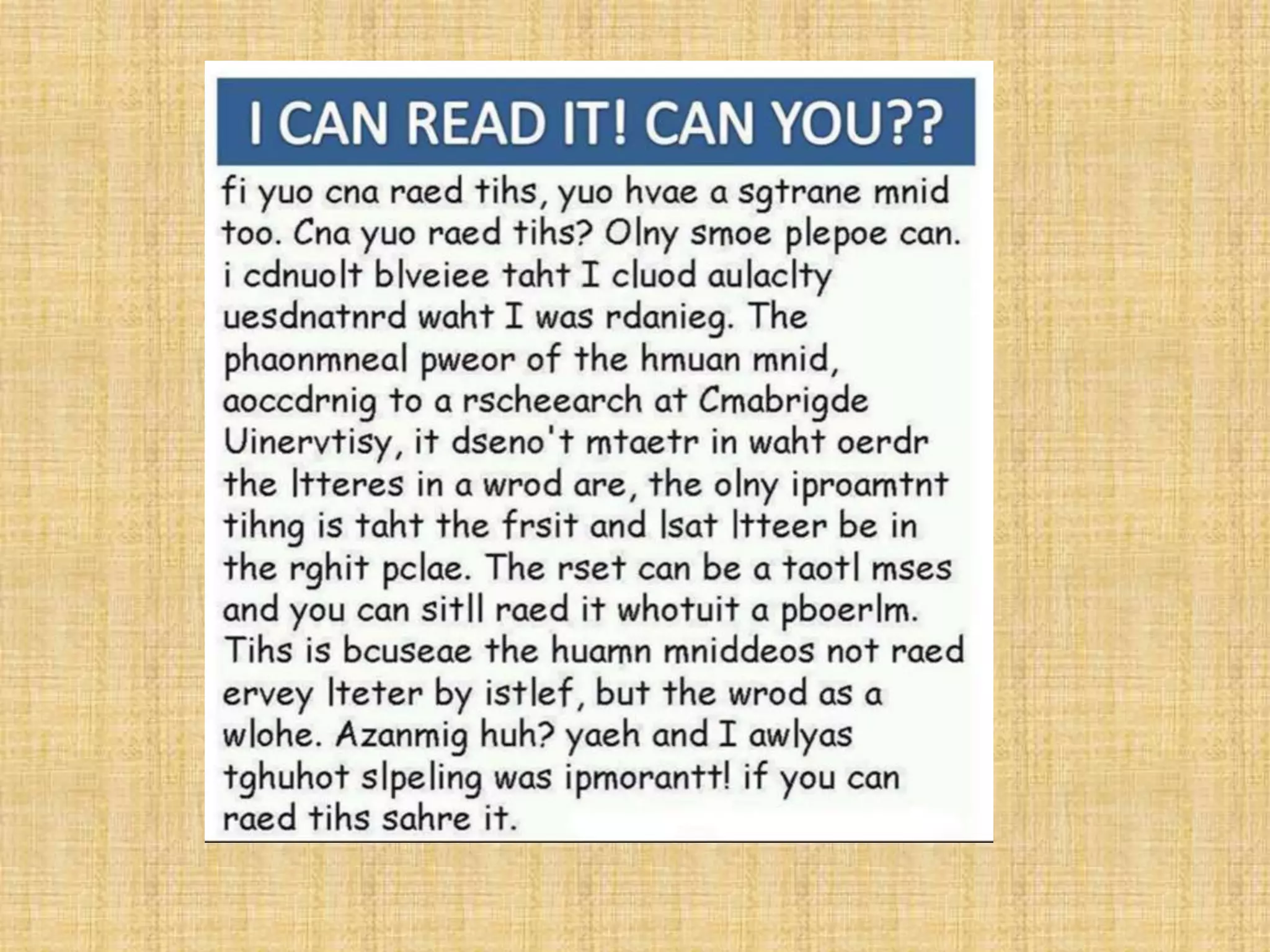
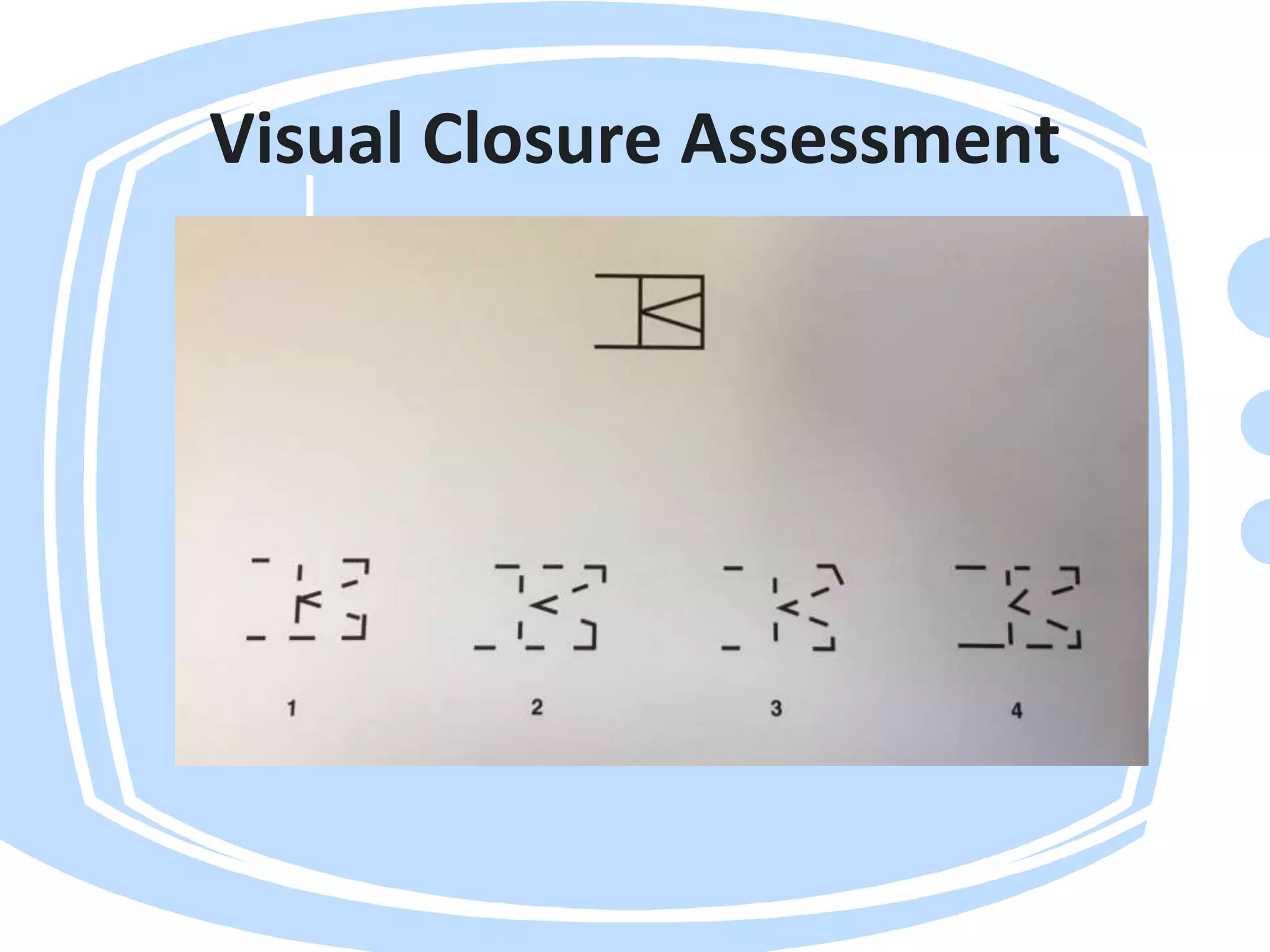
Visual Closure is the ability to visualize a
complete whole picture when given
incomplete information or a partial picture.
This skill helps children read and
comprehend quickly; their eyes don't have to
individually process every letter in every
word for them to quickly recognize the word
by sight
What will children experience?
• Struggle with spelling, reading fluency and
puzzle solving
• They will leave out parts of words.
• They will have slow reading speed.
• Poor word recognition
Visual Closure Assessment
Adequate Visual
Perception is vital for
learning

visual perception basic intro (2).pptx

  • 1.
  • 2.
    What is VisualPerception? • Is the way the brain interprets visual information. • A visual perception disorder is a hindered ability to make sense of information taken in through the eyes.
  • 3.
    This can beas simple as recognising faces, shapes or matching socks. More complex functions include finding information in busy visual scenes (copying from the board) and understanding the complete picture from fragments of information.
  • 4.
    Why should weassess Visual Perception? • A Visual Processing Disorder is characterised by an abnormality in the brain’s ability to process and interpret what the eyes see. • Visual Perception comes under this definition.
  • 5.
    Why should aneye care professional assess Visual Perception? •Allows full investigation of the child’s visual difficulties. •Answers the “why does my child do that?” questions.
  • 6.
    For example. • Wehave all seen that patient who was referred as losing their place when reading, skipping words, confusing words etc. • What do we do if they have normal BSV/fusion/accommodation/convergence/ saccades/and no visual stress. Discharge? • What if we could help that child in a simple, meaningful way.
  • 7.
    We use Standardisedtests • The test of visual perception skills (TVPS) • Other tests are available. • DVTP • Motor free visual perceptual test
  • 8.
    What will webe looking for? • There are 7 sections that we assess: – Visual Discrimination – Visual Memory – Spatial Relations skills – Form Constancy skills – Sequential Memory – Figure Ground skills – Visual Closure.
  • 9.
    Visual Discrimination Definition Visual discriminationis the ability of the child to be aware of the exact characteristics and distinctive features of forms including shape, orientation, size, and colour.
  • 10.
    What will childrenexperience? • Children will often skip words and lines when reading and thereby struggle with understanding. • Mistake similar words. • Struggle to match and sort objects.
  • 11.
  • 12.
    Visual memory Definition Visual Memoryis the ability to remember for immediate recall the characteristics of a given object or form. This skill helps children remember what they read and see by adequately processing information through their short-term memory, from where it is filtered out into the long-term memory
  • 13.
    What will childrenexperience? • They may whisper to themselves when reading. • Struggle with sight words. • Struggle copying. • Struggle remembering what they have read.
  • 14.
  • 15.
    Visual Spatial Relationship Definition Visualspatial relationship is the ability to locate objects in our three dimensional world using sight. These skills allow an individual to develop spatial concepts, such as right and left, front and back, and up and down as they relate to our body and to objects in space
  • 16.
    What will childrenExperience? • Lose their place when reading. • Struggle with the order of letters in words or numbers in maths. • Struggle with size, distance, volume, order and time. • May get lost easily.
  • 17.
  • 18.
    Visual Spatial Relationship Treatment •Use raised lines or graph paper • ‘Feel’ the letters • Visual clues ie colours or arrows • Jigsaws • Apps such as tetrus
  • 19.
    Visual Form Constancy Definition VisualForm Constancy is the ability to recognize objects as they change size, shape, or orientation. It is the ability to mentally manipulate forms and visualize the resulting outcomes. This skill helps children distinguish differences in size, shape, and orientation
  • 20.
    What will childrenexperience? • Difficulty recognising errors in punctuation. • Reversing letters. • Understanding mass and quantity. • Building things from instructions. • Difficulty transferring from printed to cursive or different fonts.
  • 21.
  • 22.
    Visual Sequential Memory Definition Visualsequential memory is the ability to remember and reproduce a sequence of words, symbols or sentences in the correct order
  • 23.
    What will childrenexperience? • This skill is particularly important in spelling. Letter omissions, additions, and/or transpositions within words are common for children who struggle with this skill . • They may forget steps in maths equations. • Struggle to copy.
  • 24.
  • 25.
    Visual Figure GroundSkills Definition Visual figure-ground refers to the ability to locate and identify shapes and objects embedded in a busy visual environment, or the ability to attend to one activity without being distracted by other surrounding stimuli
  • 26.
    What will childrenexperience? Trying to look at this text with a busy background is almost impossible. For children with a difficulty in this area even a small amount of background clutter will be devastating to their concentration. They will be distractible and struggle to copy. They will skip words, lose their place, even lose their belongings regularly.
  • 27.
  • 28.
    Visual Closure Definition VisualClosure is the ability to visualize a complete whole picture when given incomplete information or a partial picture. This skill helps children read and comprehend quickly; their eyes don't have to individually process every letter in every word for them to quickly recognize the word by sight
  • 29.
    What will childrenexperience? • Struggle with spelling, reading fluency and puzzle solving • They will leave out parts of words. • They will have slow reading speed. • Poor word recognition
  • 31.
  • 32.