2nd year MSc. In Fashion Technology
Course name: Retail Management and Technology
Course code: FTec7071
Course manager: Mulat Alubel (PhD)
Presentation title on: Visual Merchandising (Retail store display)
By: Adbaru Esubalew
March 2021 G.C
Bahir Dar
University
Ethiopian Institute of Textile and Fashion
Technology
Content
 About merchandising
 Types of merchandising
 Visual merchandising
 Visual merchandising in apparel sector
 How to create effective visual
merchandising
 Components of merchandising
 Elements of merchandising
 Purpose of visual merchandising
 Challenge of visual merchandising
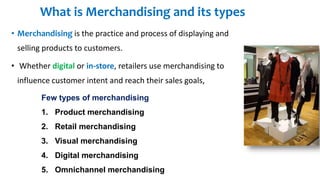
What is Merchandising and its types
• Merchandising is the practice and process of displaying and
selling products to customers.
• Whether digital or in-store, retailers use merchandising to
influence customer intent and reach their sales goals,
Few types of merchandising
1. Product merchandising
2. Retail merchandising
3. Visual merchandising
4. Digital merchandising
5. Omnichannel merchandising
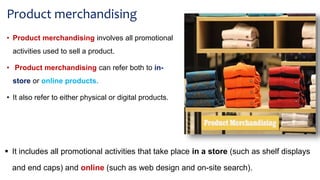
Product merchandising
• Product merchandising involves all promotional
activities used to sell a product.
• Product merchandising can refer both to in-
store or online products.
• It also refer to either physical or digital products.
 It includes all promotional activities that take place in a store (such as shelf displays
and end caps) and online (such as web design and on-site search).
Retail merchandising
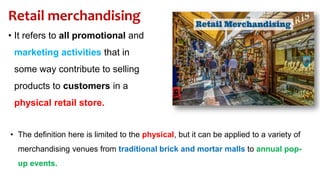
• It refers to all promotional and
marketing activities that in
some way contribute to selling
products to customers in a
physical retail store.
• The definition here is limited to the physical, but it can be applied to a variety of
merchandising venues from traditional brick and mortar malls to annual pop-
up events.
Visual merchandising
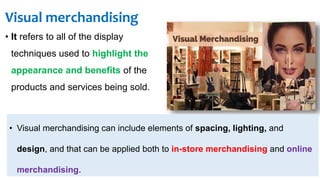
• It refers to all of the display
techniques used to highlight the
appearance and benefits of the
products and services being sold.
• Visual merchandising can include elements of spacing, lighting, and
design, and that can be applied both to in-store merchandising and online
merchandising.
Digital merchandising
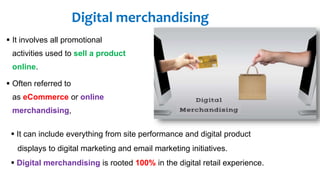
 It involves all promotional
activities used to sell a product
online.
 Often referred to
as eCommerce or online
merchandising,
 It can include everything from site performance and digital product
displays to digital marketing and email marketing initiatives.
 Digital merchandising is rooted 100% in the digital retail experience.
Omnichannel merchandising
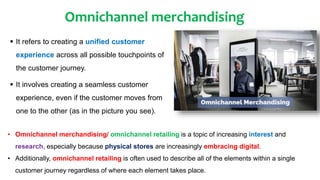
 It refers to creating a unified customer
experience across all possible touchpoints of
the customer journey.
 It involves creating a seamless customer
experience, even if the customer moves from
one to the other (as in the picture you see).
• Omnichannel merchandising/ omnichannel retailing is a topic of increasing interest and
research, especially because physical stores are increasingly embracing digital.
• Additionally, omnichannel retailing is often used to describe all of the elements within a single
customer journey regardless of where each element takes place.
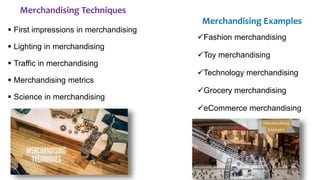
Merchandising Techniques
 First impressions in merchandising
 Lighting in merchandising
 Traffic in merchandising
 Merchandising metrics
 Science in merchandising
Merchandising Examples
Fashion merchandising
Toy merchandising
Technology merchandising
Grocery merchandising
eCommerce merchandising
TYPES OF DISPLAYS IN RETAIL
1. ENTRYWAY DISPLAY, During special times of year, entryway displays are great for
holiday promotions and for showcasing seasonal necessities.
2. FREESTANDING DISPLAY, are great for heavily trafficked areas.
They are great for areas that cannot have large displays, such as aisles in a
supermarket.
3. DUMP BIN, are basically very large containers full of various items.
4. DISPLAY CASE, best example of this is a typical store jewelry counter.
Display cases are also great for electronic items as well as certain types of
sporting equipment.
5. GONDOLA DISPLAY, are easily movable display shelves.
• They allow you to display several different types of items all at once.
• Gondola displays are extremely popular and very large discount retail stores.
6. END CAP, is a great way to utilize the end of an aisle in a store,
• It can help draw your customers into an aisle as well.
7. WINDOW DISPLAY, They are also capable of helping stores retain their
current customers.
8. BANNER DISPLAY, can also highlight products that aren’t in their typical
sales location.
• Banners can be easily moved around the store and are made to last a long time.
Cont.
9. SHELF TALKER, This type of display consists of simple, small, brightly colored vinyl
signage.
• are wonderful because they attach to existing aisle shelves and take up no floor
space.
10. DISPLAY TABLE, Commonly used to display folded clothing items,
• It allows your customer to easily pick up and handle merchandise.
11. MANNEQUIN DISPLAY, mannequins can be a visually stunning display for other
items as well, such as jewelry, scarves, or other accessories.
12. POINT-OF-PURCHASE DISPLAY, A great way to utilize space in your store is to
create point-of-purchase displays near your checkout counters or lines.
Cont.
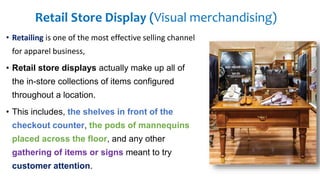
Retail Store Display (Visual merchandising)
• Retailing is one of the most effective selling channel
for apparel business,
• Retail store displays actually make up all of
the in-store collections of items configured
throughout a location.
• This includes, the shelves in front of the
checkout counter, the pods of mannequins
placed across the floor, and any other
gathering of items or signs meant to try
customer attention.
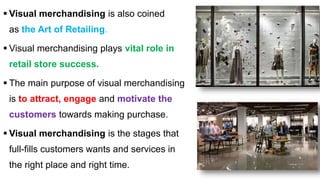
 Visual merchandising is also coined
as the Art of Retailing.
 Visual merchandising plays vital role in
retail store success.
 The main purpose of visual merchandising
is to attract, engage and motivate the
customers towards making purchase.
 Visual merchandising is the stages that
full-fills customers wants and services in
the right place and right time.
Three Forms of Visual Merchandising
A. Retail Store, retail store is to be a physical store rather than virtual.
• The business owner spends millions of dollars on the design and outlook of their
store.
B. Online (Virtual), because of the expansion of digital communication.
• And the flexibility of online transaction the demand for e-commerce is increasing
day by day.
C. Trade Fair, Where for local and international trade fair thousands of business
owner participate,
just to share their product and services.
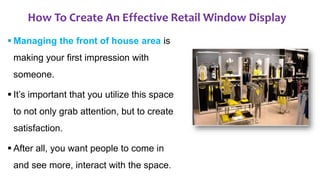
How To Create An Effective Retail Window Display
 Managing the front of house area is
making your first impression with
someone.
 It’s important that you utilize this space
to not only grab attention, but to create
satisfaction.
 After all, you want people to come in
and see more, interact with the space.
Cont.
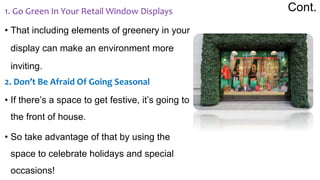
1. Go Green In Your Retail Window Displays
• That including elements of greenery in your
display can make an environment more
inviting.
2. Don’t Be Afraid Of Going Seasonal
• If there’s a space to get festive, it’s going to
the front of house.
• So take advantage of that by using the
space to celebrate holidays and special
occasions!
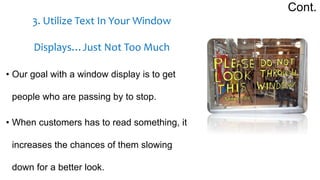
3. Utilize Text In Your Window
Displays…Just Not Too Much
• Our goal with a window display is to get
people who are passing by to stop.
• When customers has to read something, it
increases the chances of them slowing
down for a better look.
Cont.
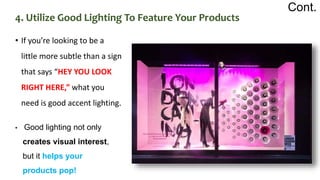
• If you’re looking to be a
little more subtle than a sign
that says “HEY YOU LOOK
RIGHT HERE,” what you
need is good accent lighting.
Cont.
• Good lighting not only
creates visual interest,
but it helps your
products pop!
4. Utilize Good Lighting To Feature Your Products
Visual Merchandising Elements
• Elements of visual merchandising are the tools or techniques used to innovatively
design a store or outlet and differentiate customer experience from the
competitors in the market.
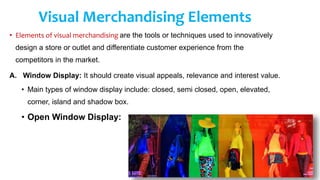
A. Window Display: It should create visual appeals, relevance and interest value.
• Main types of window display include: closed, semi closed, open, elevated,
corner, island and shadow box.
• Open Window Display:
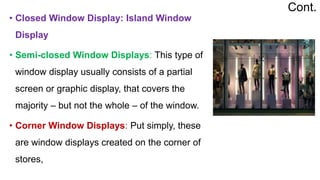
• Closed Window Display: Island Window
Display
• Semi-closed Window Displays: This type of
window display usually consists of a partial
screen or graphic display, that covers the
majority – but not the whole – of the window.
• Corner Window Displays: Put simply, these
are window displays created on the corner of
stores,
Cont.
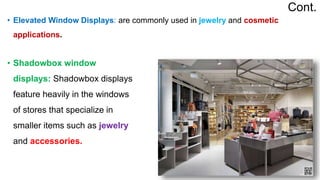
• Shadowbox window
displays: Shadowbox displays
feature heavily in the windows
of stores that specialize in
smaller items such as jewelry
and accessories.
Cont.
• Elevated Window Displays: are commonly used in jewelry and cosmetic
applications.
B. Store Layout: it help to give guideline to increase merchandise and to
create
interest in the product from the customer’s perspective.
C. Store Design: Store design and interior coverings like selection of the wall
covering, carpets, furnishing, shelves and dividers are suggested to be
designed to convey the image which is required to be projected to the
customers.
D. Color: Color is the most powerful elements of the visual merchandising.
• Green signifies health and freshness, orange emits a feeling of friendship, red inspire
energy, black evokes elegance, blue indicates reliability and yellow.
Cont.
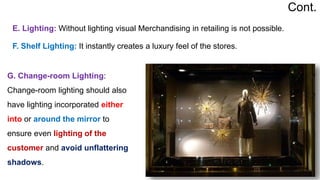
G. Change-room Lighting:
Change-room lighting should also
have lighting incorporated either
into or around the mirror to
ensure even lighting of the
customer and avoid unflattering
shadows.
E. Lighting: Without lighting visual Merchandising in retailing is not possible.
F. Shelf Lighting: It instantly creates a luxury feel of the stores.
Cont.
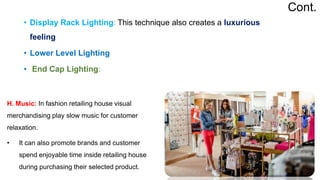
• Display Rack Lighting: This technique also creates a luxurious
feeling
• Lower Level Lighting
• End Cap Lighting:
Cont.
H. Music: In fashion retailing house visual
merchandising play slow music for customer
relaxation.
• It can also promote brands and customer
spend enjoyable time inside retailing house
during purchasing their selected product.
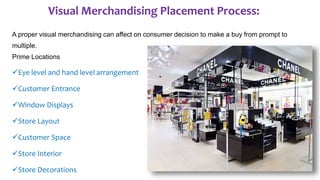
Visual Merchandising Placement Process:
A proper visual merchandising can affect on consumer decision to make a buy from prompt to
multiple.
Prime Locations
Eye level and hand level arrangement
Customer Entrance
Window Displays
Store Layout
Customer Space
Store Interior
Store Decorations
Components of Visual Merchandising
 Merchandise the focal point
 Right choice of colors is vital
 Display themes to appropriately support the product
 Display should complement the retailers other strategies
 Cleanliness
 Change the display settings in frequent intervals
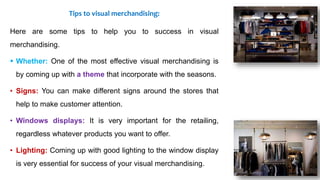
Tips to visual merchandising:
Here are some tips to help you to success in visual
merchandising.
 Whether: One of the most effective visual merchandising is
by coming up with a theme that incorporate with the seasons.
• Signs: You can make different signs around the stores that
help to make customer attention.
• Windows displays: It is very important for the retailing,
regardless whatever products you want to offer.
• Lighting: Coming up with good lighting to the window display
is very essential for success of your visual merchandising.
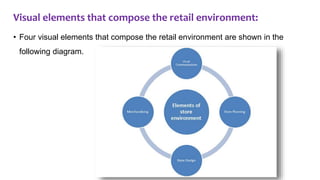
Visual elements that compose the retail environment:
• Four visual elements that compose the retail environment are shown in the
following diagram.
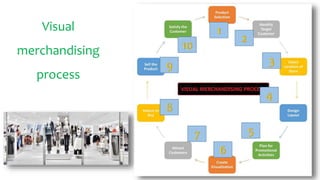
Visual
merchandising
process
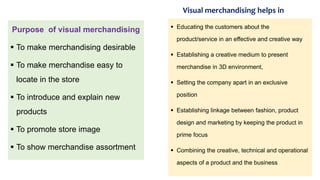
Purpose of visual merchandising
 To make merchandising desirable
 To make merchandise easy to
locate in the store
 To introduce and explain new
products
 To promote store image
 To show merchandise assortment
Visual merchandising helps in
 Educating the customers about the
product/service in an effective and creative way
 Establishing a creative medium to present
merchandise in 3D environment,
 Setting the company apart in an exclusive
position
 Establishing linkage between fashion, product
design and marketing by keeping the product in
prime focus
 Combining the creative, technical and operational
aspects of a product and the business
Significance of Visual Merchandising in Apparel Business
It can help to promote their products.
It helps shoppers locate product more easily.
After completing an enjoyable shopping customers will want to come back again to your store and
purchase more products.
Visual merchandising attracts thus help in customer retention and repurchasing by their services.
That can promote your product as well as brand awareness.
Visual merchandise is not only important for retail but also important for every product.
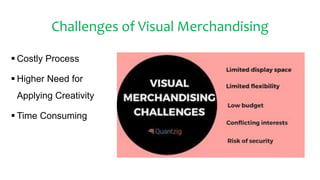
Challenges of Visual Merchandising
 Costly Process
 Higher Need for
Applying Creativity
 Time Consuming
Refernces
• https://reflektion.com/resource/merchandising-types-and-examples/
• https://blog.wiser.com/what-is-visual-merchandising/
• https://www.repsly.com/blog/most-effective-types-retail-displays-explained
• http://blog.hubert.com/resources/hubert-infographics/infographic-5-elements-
merchandising/
• https://smallbusiness.chron.com/visual-merchandising-placement-process-
12616.html
Visual merchendising

Visual merchendising

  • 1.
    2nd year MSc.In Fashion Technology Course name: Retail Management and Technology Course code: FTec7071 Course manager: Mulat Alubel (PhD) Presentation title on: Visual Merchandising (Retail store display) By: Adbaru Esubalew March 2021 G.C Bahir Dar University Ethiopian Institute of Textile and Fashion Technology
  • 2.
    Content  About merchandising Types of merchandising  Visual merchandising  Visual merchandising in apparel sector  How to create effective visual merchandising  Components of merchandising  Elements of merchandising  Purpose of visual merchandising  Challenge of visual merchandising
  • 3.
    What is Merchandisingand its types • Merchandising is the practice and process of displaying and selling products to customers. • Whether digital or in-store, retailers use merchandising to influence customer intent and reach their sales goals, Few types of merchandising 1. Product merchandising 2. Retail merchandising 3. Visual merchandising 4. Digital merchandising 5. Omnichannel merchandising
  • 4.
    Product merchandising • Productmerchandising involves all promotional activities used to sell a product. • Product merchandising can refer both to in- store or online products. • It also refer to either physical or digital products.  It includes all promotional activities that take place in a store (such as shelf displays and end caps) and online (such as web design and on-site search).
  • 5.
    Retail merchandising • Itrefers to all promotional and marketing activities that in some way contribute to selling products to customers in a physical retail store. • The definition here is limited to the physical, but it can be applied to a variety of merchandising venues from traditional brick and mortar malls to annual pop- up events.
  • 6.
    Visual merchandising • Itrefers to all of the display techniques used to highlight the appearance and benefits of the products and services being sold. • Visual merchandising can include elements of spacing, lighting, and design, and that can be applied both to in-store merchandising and online merchandising.
  • 7.
    Digital merchandising  Itinvolves all promotional activities used to sell a product online.  Often referred to as eCommerce or online merchandising,  It can include everything from site performance and digital product displays to digital marketing and email marketing initiatives.  Digital merchandising is rooted 100% in the digital retail experience.
  • 8.
    Omnichannel merchandising  Itrefers to creating a unified customer experience across all possible touchpoints of the customer journey.  It involves creating a seamless customer experience, even if the customer moves from one to the other (as in the picture you see). • Omnichannel merchandising/ omnichannel retailing is a topic of increasing interest and research, especially because physical stores are increasingly embracing digital. • Additionally, omnichannel retailing is often used to describe all of the elements within a single customer journey regardless of where each element takes place.
  • 9.
    Merchandising Techniques  Firstimpressions in merchandising  Lighting in merchandising  Traffic in merchandising  Merchandising metrics  Science in merchandising Merchandising Examples Fashion merchandising Toy merchandising Technology merchandising Grocery merchandising eCommerce merchandising
  • 10.
    TYPES OF DISPLAYSIN RETAIL 1. ENTRYWAY DISPLAY, During special times of year, entryway displays are great for holiday promotions and for showcasing seasonal necessities. 2. FREESTANDING DISPLAY, are great for heavily trafficked areas. They are great for areas that cannot have large displays, such as aisles in a supermarket. 3. DUMP BIN, are basically very large containers full of various items. 4. DISPLAY CASE, best example of this is a typical store jewelry counter. Display cases are also great for electronic items as well as certain types of sporting equipment.
  • 11.
    5. GONDOLA DISPLAY,are easily movable display shelves. • They allow you to display several different types of items all at once. • Gondola displays are extremely popular and very large discount retail stores. 6. END CAP, is a great way to utilize the end of an aisle in a store, • It can help draw your customers into an aisle as well. 7. WINDOW DISPLAY, They are also capable of helping stores retain their current customers. 8. BANNER DISPLAY, can also highlight products that aren’t in their typical sales location. • Banners can be easily moved around the store and are made to last a long time. Cont.
  • 12.
    9. SHELF TALKER,This type of display consists of simple, small, brightly colored vinyl signage. • are wonderful because they attach to existing aisle shelves and take up no floor space. 10. DISPLAY TABLE, Commonly used to display folded clothing items, • It allows your customer to easily pick up and handle merchandise. 11. MANNEQUIN DISPLAY, mannequins can be a visually stunning display for other items as well, such as jewelry, scarves, or other accessories. 12. POINT-OF-PURCHASE DISPLAY, A great way to utilize space in your store is to create point-of-purchase displays near your checkout counters or lines. Cont.
  • 13.
    Retail Store Display(Visual merchandising) • Retailing is one of the most effective selling channel for apparel business, • Retail store displays actually make up all of the in-store collections of items configured throughout a location. • This includes, the shelves in front of the checkout counter, the pods of mannequins placed across the floor, and any other gathering of items or signs meant to try customer attention.
  • 14.
     Visual merchandisingis also coined as the Art of Retailing.  Visual merchandising plays vital role in retail store success.  The main purpose of visual merchandising is to attract, engage and motivate the customers towards making purchase.  Visual merchandising is the stages that full-fills customers wants and services in the right place and right time.
  • 15.
    Three Forms ofVisual Merchandising A. Retail Store, retail store is to be a physical store rather than virtual. • The business owner spends millions of dollars on the design and outlook of their store. B. Online (Virtual), because of the expansion of digital communication. • And the flexibility of online transaction the demand for e-commerce is increasing day by day. C. Trade Fair, Where for local and international trade fair thousands of business owner participate, just to share their product and services.
  • 16.
    How To CreateAn Effective Retail Window Display  Managing the front of house area is making your first impression with someone.  It’s important that you utilize this space to not only grab attention, but to create satisfaction.  After all, you want people to come in and see more, interact with the space.
  • 17.
    Cont. 1. Go GreenIn Your Retail Window Displays • That including elements of greenery in your display can make an environment more inviting. 2. Don’t Be Afraid Of Going Seasonal • If there’s a space to get festive, it’s going to the front of house. • So take advantage of that by using the space to celebrate holidays and special occasions!
  • 18.
    3. Utilize TextIn Your Window Displays…Just Not Too Much • Our goal with a window display is to get people who are passing by to stop. • When customers has to read something, it increases the chances of them slowing down for a better look. Cont.
  • 19.
    • If you’relooking to be a little more subtle than a sign that says “HEY YOU LOOK RIGHT HERE,” what you need is good accent lighting. Cont. • Good lighting not only creates visual interest, but it helps your products pop! 4. Utilize Good Lighting To Feature Your Products
  • 20.
    Visual Merchandising Elements •Elements of visual merchandising are the tools or techniques used to innovatively design a store or outlet and differentiate customer experience from the competitors in the market. A. Window Display: It should create visual appeals, relevance and interest value. • Main types of window display include: closed, semi closed, open, elevated, corner, island and shadow box. • Open Window Display:
  • 21.
    • Closed WindowDisplay: Island Window Display • Semi-closed Window Displays: This type of window display usually consists of a partial screen or graphic display, that covers the majority – but not the whole – of the window. • Corner Window Displays: Put simply, these are window displays created on the corner of stores, Cont.
  • 22.
    • Shadowbox window displays:Shadowbox displays feature heavily in the windows of stores that specialize in smaller items such as jewelry and accessories. Cont. • Elevated Window Displays: are commonly used in jewelry and cosmetic applications.
  • 23.
    B. Store Layout:it help to give guideline to increase merchandise and to create interest in the product from the customer’s perspective. C. Store Design: Store design and interior coverings like selection of the wall covering, carpets, furnishing, shelves and dividers are suggested to be designed to convey the image which is required to be projected to the customers. D. Color: Color is the most powerful elements of the visual merchandising. • Green signifies health and freshness, orange emits a feeling of friendship, red inspire energy, black evokes elegance, blue indicates reliability and yellow. Cont.
  • 24.
    G. Change-room Lighting: Change-roomlighting should also have lighting incorporated either into or around the mirror to ensure even lighting of the customer and avoid unflattering shadows. E. Lighting: Without lighting visual Merchandising in retailing is not possible. F. Shelf Lighting: It instantly creates a luxury feel of the stores. Cont.
  • 25.
    • Display RackLighting: This technique also creates a luxurious feeling • Lower Level Lighting • End Cap Lighting: Cont. H. Music: In fashion retailing house visual merchandising play slow music for customer relaxation. • It can also promote brands and customer spend enjoyable time inside retailing house during purchasing their selected product.
  • 26.
    Visual Merchandising PlacementProcess: A proper visual merchandising can affect on consumer decision to make a buy from prompt to multiple. Prime Locations Eye level and hand level arrangement Customer Entrance Window Displays Store Layout Customer Space Store Interior Store Decorations
  • 27.
    Components of VisualMerchandising  Merchandise the focal point  Right choice of colors is vital  Display themes to appropriately support the product  Display should complement the retailers other strategies  Cleanliness  Change the display settings in frequent intervals
  • 28.
    Tips to visualmerchandising: Here are some tips to help you to success in visual merchandising.  Whether: One of the most effective visual merchandising is by coming up with a theme that incorporate with the seasons. • Signs: You can make different signs around the stores that help to make customer attention. • Windows displays: It is very important for the retailing, regardless whatever products you want to offer. • Lighting: Coming up with good lighting to the window display is very essential for success of your visual merchandising.
  • 29.
    Visual elements thatcompose the retail environment: • Four visual elements that compose the retail environment are shown in the following diagram.
  • 30.
  • 31.
    Purpose of visualmerchandising  To make merchandising desirable  To make merchandise easy to locate in the store  To introduce and explain new products  To promote store image  To show merchandise assortment Visual merchandising helps in  Educating the customers about the product/service in an effective and creative way  Establishing a creative medium to present merchandise in 3D environment,  Setting the company apart in an exclusive position  Establishing linkage between fashion, product design and marketing by keeping the product in prime focus  Combining the creative, technical and operational aspects of a product and the business
  • 32.
    Significance of VisualMerchandising in Apparel Business It can help to promote their products. It helps shoppers locate product more easily. After completing an enjoyable shopping customers will want to come back again to your store and purchase more products. Visual merchandising attracts thus help in customer retention and repurchasing by their services. That can promote your product as well as brand awareness. Visual merchandise is not only important for retail but also important for every product.
  • 33.
    Challenges of VisualMerchandising  Costly Process  Higher Need for Applying Creativity  Time Consuming
  • 34.
    Refernces • https://reflektion.com/resource/merchandising-types-and-examples/ • https://blog.wiser.com/what-is-visual-merchandising/ •https://www.repsly.com/blog/most-effective-types-retail-displays-explained • http://blog.hubert.com/resources/hubert-infographics/infographic-5-elements- merchandising/ • https://smallbusiness.chron.com/visual-merchandising-placement-process- 12616.html

Editor's Notes