• Understanding meaning and importance of visual
merchandising
• History of visual merchandising
• Know the features of good display
• Understand staff responsibility towards visual
merchandising
• Understand the business impact
• Conclusion
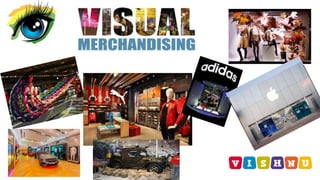
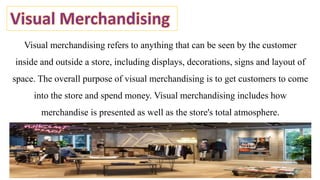
Visual merchandising refers to anything that can be seen by the customer
inside and outside a store, including displays, decorations, signs and layout of
space. The overall purpose of visual merchandising is to get customers to come
into the store and spend money. Visual merchandising includes how
merchandise is presented as well as the store's total atmosphere.
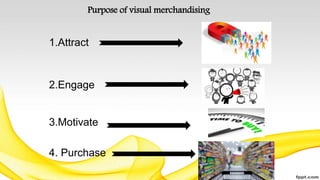
Purpose of visual merchandising
1.Attract
2.Engage
3.Motivate
4. Purchase
• Flooring, such as carpet, tile or marble, which can affect what the customer buys
• Lighting (types and brightness), which can affect how displays appear to customers
• colours, wallpapers and shelving, which affect the overall atmosphere of the store
• Mannequins' clothes and body language that help to convey an overall impression
• Display design, which must be done properly, taking into consideration harmony, lighting,
colour, emphasis, rhythm, proportion and balance - design principles
• Walkways and entries that should blend into the building's overall design
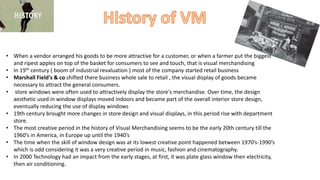
• When a vendor arranged his goods to be more attractive for a customer, or when a farmer put the biggest
and ripest apples on top of the basket for consumers to see and touch, that is visual merchandising
• In 19th century ( boom of industrial revaluation ) most of the company started retail business
• Marshall Field's & co shifted there business whole sale to retail , the visual display of goods became
necessary to attract the general consumers.
• store windows were often used to attractively display the store's merchandise. Over time, the design
aesthetic used in window displays moved indoors and became part of the overall interior store design,
eventually reducing the use of display windows
• 19th century brought more changes in store design and visual displays, in this period rise with department
store.
• The most creative period in the history of Visual Merchandising seems to be the early 20th century till the
1960’s in America, in Europe up until the 1940’s
• The time when the skill of window design was at its lowest creative point happened between 1970’s-1990’s
which is odd considering it was a very creative period in music, fashion and cinematography.
• In 2000 Technology had an impact from the early stages, at first, it was plate glass window then electricity,
then air conditioning.
Why visual presentation
• Improve business productivity
• Boost sale per square foot
• Generate faster turnover rate
• Sell more of most profitable merchandise
• Decrease market down rate
• Increase the amount of average transaction
• Convert a shopper a stopper and walk in rather than a
walk by.
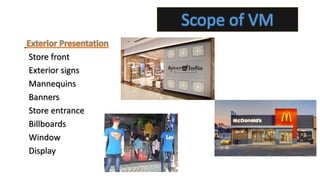
Store front
Exterior signs
Mannequins
Banners
Store entrance
Billboards
Window
Display
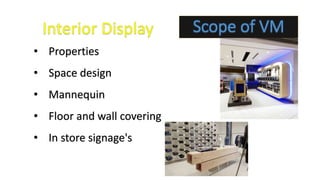
Scope of VM
Scope of VM
• Properties
• Space design
• Mannequin
• Floor and wall covering
• In store signage's
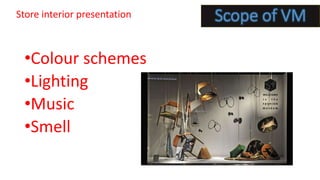
•Colour schemes
•Lighting
•Music
•Smell
Store interior presentation
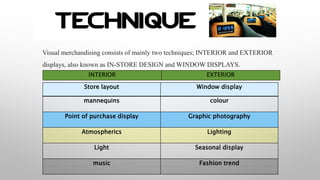
Visual merchandising consists of mainly two techniques; INTERIOR and EXTERIOR
displays, also known as IN-STORE DESIGN and WINDOW DISPLAYS.
INTERIOR EXTERIOR
Store layout Window display
mannequins colour
Point of purchase display Graphic photography
Atmospherics Lighting
Light Seasonal display
music Fashion trend
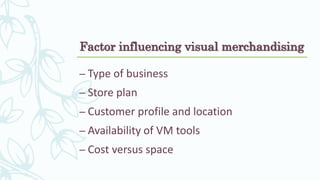
Factor influencing visual merchandising
– Type of business
– Store plan
– Customer profile and location
– Availability of VM tools
– Cost versus space
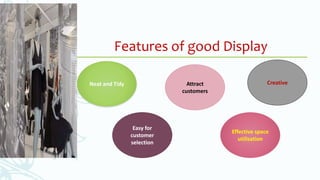
Features of good Display
Neat and Tidy
Easy for
customer
selection
Attract
customers
Creative
Effective space
utilisation
Staff responsibilities towards VM
• Understand how and what product are to be
displayed
• Execute planogram
• Ensure timely display
• Create good them in order to attract customer
• Replenish goods as and when required
• Dust the product kept for display
• Maintain full stock appearance
• Check the replace, expired, damaged solid product
and illegible label and ticket
• Check the packaging of merchandise
• Rotate the product or regular basis
• Monitor display in regular basis
•
• Unique store appearance
• Increase footfall as well as sale
• Promote new trend
• Bring better margin
visual merchandising

visual merchandising

  • 2.
    • Understanding meaningand importance of visual merchandising • History of visual merchandising • Know the features of good display • Understand staff responsibility towards visual merchandising • Understand the business impact • Conclusion
  • 3.
    Visual merchandising refersto anything that can be seen by the customer inside and outside a store, including displays, decorations, signs and layout of space. The overall purpose of visual merchandising is to get customers to come into the store and spend money. Visual merchandising includes how merchandise is presented as well as the store's total atmosphere.
  • 4.
    Purpose of visualmerchandising 1.Attract 2.Engage 3.Motivate 4. Purchase
  • 5.
    • Flooring, suchas carpet, tile or marble, which can affect what the customer buys • Lighting (types and brightness), which can affect how displays appear to customers • colours, wallpapers and shelving, which affect the overall atmosphere of the store • Mannequins' clothes and body language that help to convey an overall impression • Display design, which must be done properly, taking into consideration harmony, lighting, colour, emphasis, rhythm, proportion and balance - design principles • Walkways and entries that should blend into the building's overall design
  • 6.
    • When avendor arranged his goods to be more attractive for a customer, or when a farmer put the biggest and ripest apples on top of the basket for consumers to see and touch, that is visual merchandising • In 19th century ( boom of industrial revaluation ) most of the company started retail business • Marshall Field's & co shifted there business whole sale to retail , the visual display of goods became necessary to attract the general consumers. • store windows were often used to attractively display the store's merchandise. Over time, the design aesthetic used in window displays moved indoors and became part of the overall interior store design, eventually reducing the use of display windows • 19th century brought more changes in store design and visual displays, in this period rise with department store. • The most creative period in the history of Visual Merchandising seems to be the early 20th century till the 1960’s in America, in Europe up until the 1940’s • The time when the skill of window design was at its lowest creative point happened between 1970’s-1990’s which is odd considering it was a very creative period in music, fashion and cinematography. • In 2000 Technology had an impact from the early stages, at first, it was plate glass window then electricity, then air conditioning.
  • 7.
    Why visual presentation •Improve business productivity • Boost sale per square foot • Generate faster turnover rate • Sell more of most profitable merchandise • Decrease market down rate • Increase the amount of average transaction • Convert a shopper a stopper and walk in rather than a walk by.
  • 8.
    Store front Exterior signs Mannequins Banners Storeentrance Billboards Window Display Scope of VM
  • 9.
    Scope of VM •Properties • Space design • Mannequin • Floor and wall covering • In store signage's
  • 10.
  • 11.
    Visual merchandising consistsof mainly two techniques; INTERIOR and EXTERIOR displays, also known as IN-STORE DESIGN and WINDOW DISPLAYS. INTERIOR EXTERIOR Store layout Window display mannequins colour Point of purchase display Graphic photography Atmospherics Lighting Light Seasonal display music Fashion trend
  • 12.
    Factor influencing visualmerchandising – Type of business – Store plan – Customer profile and location – Availability of VM tools – Cost versus space
  • 13.
    Features of goodDisplay Neat and Tidy Easy for customer selection Attract customers Creative Effective space utilisation
  • 14.
    Staff responsibilities towardsVM • Understand how and what product are to be displayed • Execute planogram • Ensure timely display • Create good them in order to attract customer • Replenish goods as and when required • Dust the product kept for display • Maintain full stock appearance • Check the replace, expired, damaged solid product and illegible label and ticket • Check the packaging of merchandise • Rotate the product or regular basis • Monitor display in regular basis •
  • 15.
    • Unique storeappearance • Increase footfall as well as sale • Promote new trend • Bring better margin