S HARNBAS VA UNIVE RS IT Y KALABURAGI
FACULT Y OF BUS INE S S S T UDIE S
AP PAIE T M BA CO - E du
VISUAL MERCHANDISING
Presented by – Mohammed Farooq Azam
Presented to – Prof. Anil Nilangi
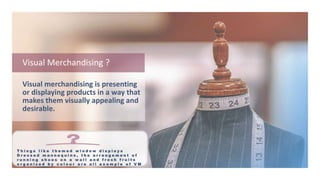
Visual Merchandising ?
Visual merchandising is presenting
or displaying products in a way that
makes them visually appealing and
desirable.
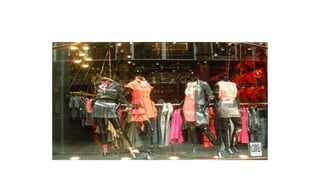
T h i n g s l i k e t h e m e d w i n d o w d i s p l a y s
D r e s s e d m a n n e q u i n s , t h e a r r a n g e m e n t o f
r u n n i n g s h o e s o n a w a l l a n d f r e s h f r u i t s
o r g a n i z e d b y c o l o u r a r e a l l e x a m p l e o f V M
Farooq Azam can you tell us
WHAT IS VISUAL MERCHANDISING IN SIMPLE TERMS
OR IN ONE WORD ?
3
Visual Merchandising in simple term is ____________
Take this slide for a Litter moments
WHO NEEDS A
SUPER HERO
WHEN YOU ARE
VISUAL
MERCHANDISER
12/5/2019
ADD A FOOTER
 Photo of 2017
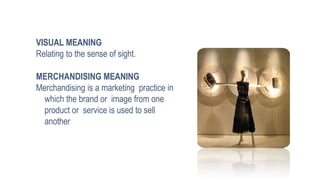
VISUAL MEANING
Relating to the sense of sight.
MERCHANDISING MEANING
Merchandising is a marketing practice in
which the brand or image from one
product or service is used to sell
another
VISUAL MERCHANDISING?
• Coordination of physical elements
in place of business, so that its project the right image to its
customers
• Change a “passive looker into active buyers”
• Responsible for total merchandise
• Overall business image
• Placements of design elements
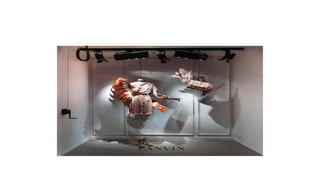
Itis the activity and profession of developing the floor plans
and three dimensional displays in order to maximize their
sales
Thedisplay of products which makes them appealing and
attractive
Itutilizes displays, colors, lighting ,smells and sounds
Contd……..
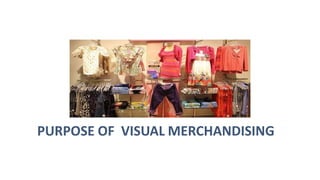
PURPOSE OF VISUAL MERCHANDISING
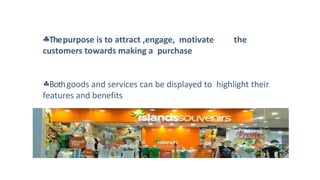
Thepurpose is to attract ,engage, motivate the
customers towards making a purchase
Bothgoods and services can be displayed to highlight their
features and benefits
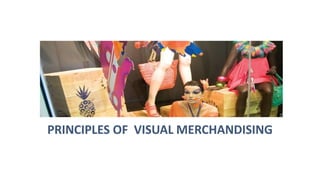
PRINCIPLES OF VISUAL MERCHANDISING
Makeit easier for the customerto
locate the desired category and merchandise
Makeit easier to selfselect
Makeit possible to coordinate andaccessorize
 Educateabout the product in an effective and creative way
Makeproper arrangements in such a way to increase the sale
of unsought goods
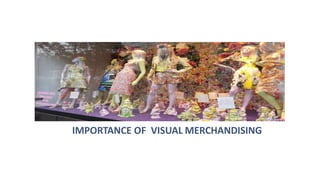
IMPORTANCE OF VISUAL MERCHANDISING
Purposes are to sell products and promote store
image
Shouldalways try to be different, new, and
creative
Changea “passive looker” into an “active buyer”
Enhances brand image
Generatesimpulse sales
Overallbusiness image
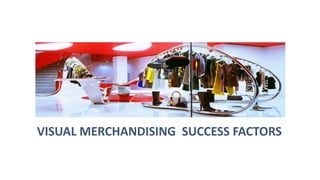
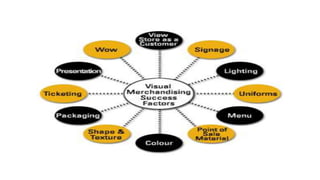
VISUAL MERCHANDISING SUCCESS FACTORS
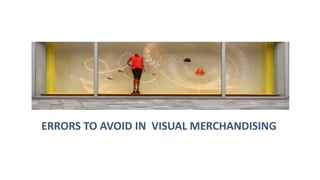
ERRORS TO AVOID IN VISUAL MERCHANDISING
Toomuchsignage
Confusing traffic patterns
Toomuchpropping
Disconnection between exterior window
and store contents
Poor lighting
Nopoint of view
Inconsistency in visual
executions
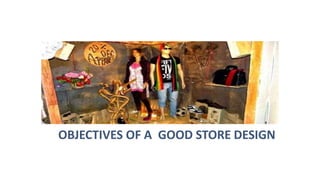
OBJECTIVES OF A GOOD STORE DESIGN
Design should:
be consistent with image and strategy
positively influence consumer behavior
consider costs versus value
beflexible
recognize the needs of the disabled – The
Americans with Disabilities Act
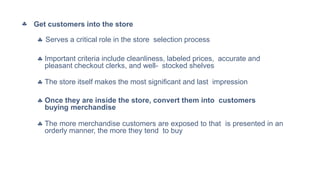
OBJECTIVES OF THE STORE ENVIRONMENT
 Get customers into the store
 Serves a critical role in the store selection process
 Important criteria include cleanliness, labeled prices, accurate and
pleasant checkout clerks, and well- stocked shelves
 The store itself makes the most significant and last impression
 Once they are inside the store, convert them into customers
buying merchandise
 The more merchandise customers are exposed to that is presented in an
orderly manner, the more they tend to buy
APPAREL WALL
PRESENTATION
OF THE MERCHANDISE
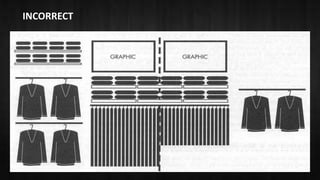
INCORRECT
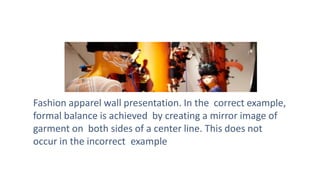
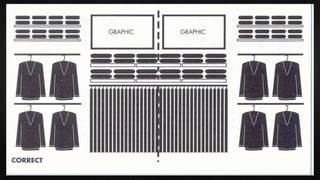
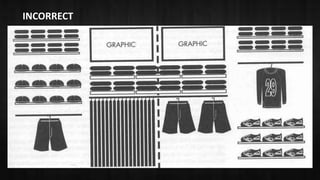
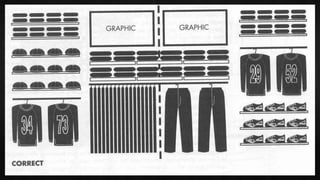
Fashion apparel wall presentation. In the correct example,
formal balance is achieved by creating a mirror image of
garment on both sides of a center line. This does not
occur in the incorrect example
INCORRECT
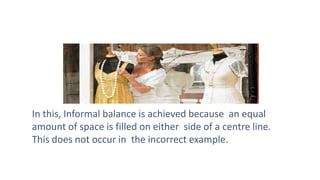
In this, Informal balance is achieved because an equal
amount of space is filled on either side of a centre line.
This does not occur in the incorrect example.
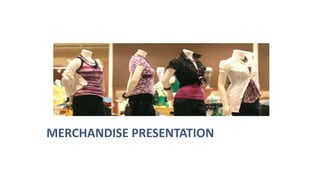
MERCHANDISE PRESENTATION
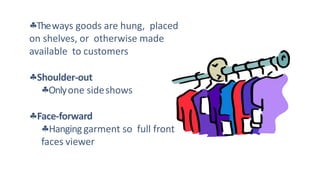
Theways goods are hung, placed
on shelves, or otherwise made
available to customers
Shoulder-out
Onlyone sideshows
Face-forward
Hanginggarment so full front
faces viewer
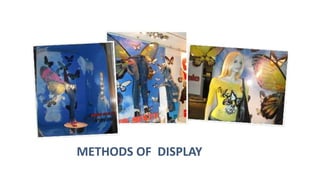
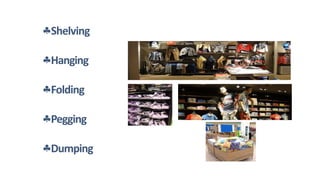
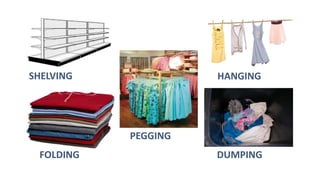
METHODS OF DISPLAY
Shelving
Hanging
Folding
Pegging
Dumping
SHELVING
FOLDING
HANGING
DUMPING
PEGGING








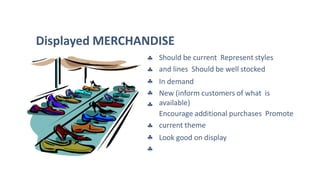
Should be current Represent styles
and lines Should be well stocked
In demand
New (inform customers of what is
available)
Encourage additional purchases Promote
current theme
Look good on display
Displayed MERCHANDISE
ELEMENTS IN VISUAL MERCHANDISING
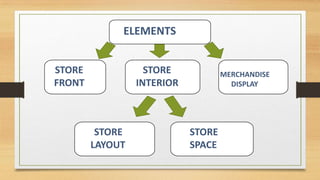
ELEMENTS
STORE
FRONT
STORE
INTERIOR
MERCHANDISE
DISPLAY
STORE
LAYOUT
STORE
SPACE
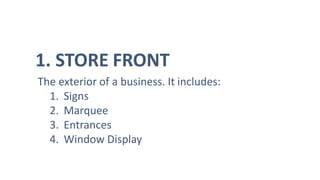
1. STORE FRONT
The exterior of a business. It includes:
1. Signs
2. Marquee
3. Entrances
4. Window Display
SIGNS
There are four different types of signs are:
1.Promotional Signs 2.Location signs
3.Institutional signs 4.Informational signs
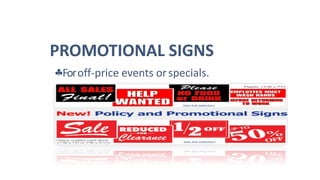
PROMOTIONAL SIGNS
Foroff-price events orspecials.
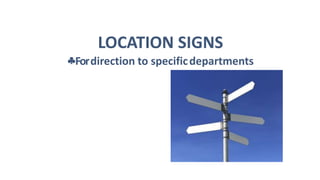
LOCATION SIGNS
Fordirection to specificdepartments
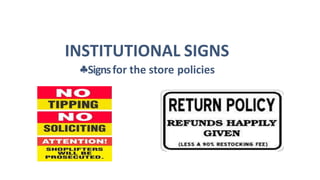
INSTITUTIONAL SIGNS
Signsfor the store policies
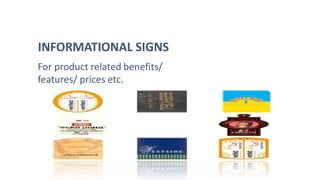
INFORMATIONAL SIGNS
For product related benefits/
features/ prices etc.
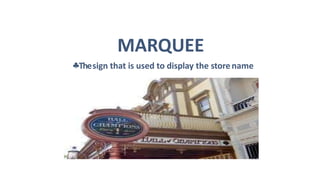
MARQUEE
Thesign that is used to display the storename
Designed with customer convenience and
store security in mind.
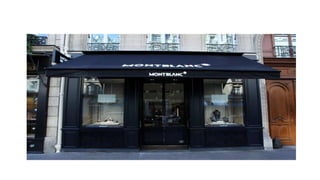
Thereare several types of entrances each
portraying a certain image
ENTRANCES
Push-Pull – full service stores often with fancy
handles
Electronic – Self-serve stores, with carts such as Wal-
Mart, Meijer, Kroger.
ClimateControlled – shopping malls.
TYPES OF ENTRANCES
Revolving – up scale stores
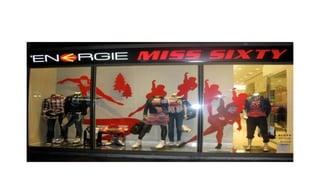
Thestore’s FIRST IMPRESSION with the
customer.
Beginthe selling process even before the
customer enters the store.
Suggeststhe type of merchandise carried in
the store
WINDOW DISPLAYS
1. Promotional – promote the sale of one or more
items by using special lighting and /or props.
Skiwear with fake snow for accents
TYPES OF WINDOW DISPLAYS
2. Institutional – promote store image rather
than specific items. Designed to build
customer good will, show that the business is
interested in the community
TYPES OF WINDOW DISPLAYS
Affectsthe store’s image
Includes items such as:
Floor& wall coverings
Lighting
Colors
Fixtures
STORE INTERIOR
It is important to create a relaxing,
comfortable place for customers to shop
Customers shop longer & are more relaxed
and spend more when they are not pressed by
crowds, delays & long lines
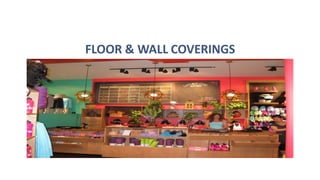
FLOOR & WALL COVERINGS
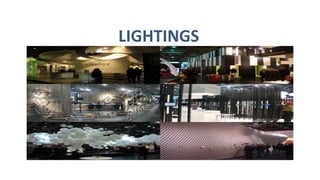
LIGHTINGS
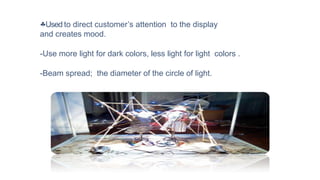
Used to direct customer’s attention to the display
and creates mood.
-Use more light for dark colors, less light for light colors .
-Beam spread; the diameter of the circle of light.
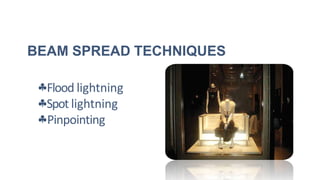
Flood lightning
Spot lightning
Pinpointing
BEAM SPREAD TECHNIQUES
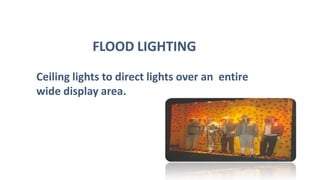
FLOOD LIGHTING
Ceiling lights to direct lights over an entire
wide display area.
SPOT LIGHTING
Focuses attention on specific areas or targeted
items of merchandise
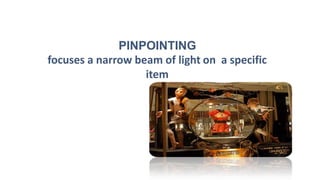
PINPOINTING
focuses a narrow beam of light on a specific
item
more
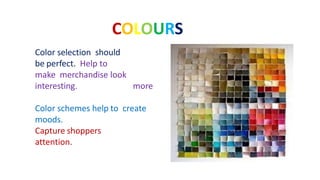
Color selection should
be perfect. Help to
make merchandise look
interesting.
Color schemes help to create
moods.
Capture shoppers
attention.
COLOURS
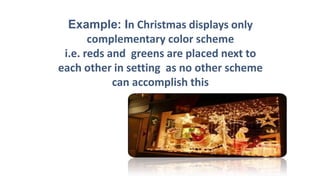
Example: In Christmas displays only
complementary color scheme
i.e. reds and greens are placed next to
each other in setting as no other scheme
can accomplish this
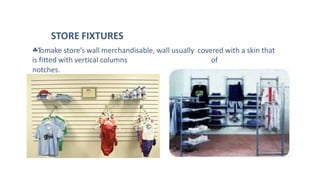
STORE FIXTURES
Tomake store’s wall merchandisable, wall usually covered with a skin that
is fitted with vertical columns of
notches.
Most common types of
fixtures:
Stands
Platforms and Elevations
Round rack
Bin
T-Stand
Fourwayfaceout
TYPES OF FIXTURES
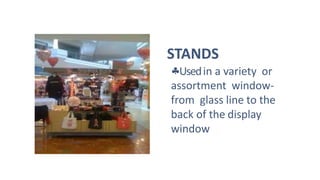
Usedin a variety or
assortment window-
from glass line to the
back of the display
window
STANDS
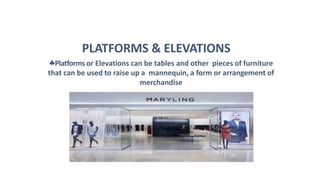
PLATFORMS & ELEVATIONS
Platforms or Elevations can be tables and other pieces of furniture
that can be used to raise up a mannequin, a form or arrangement of
merchandise
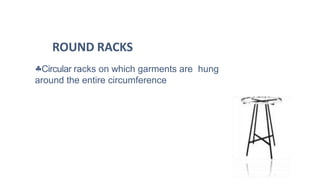
Circular racks on which garments are hung
around the entire circumference
ROUND RACKS
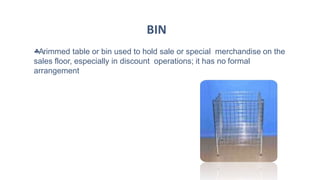
Arimmed table or bin used to hold sale or special merchandise on the
sales floor, especially in discount operations; it has no formal
arrangement
BIN
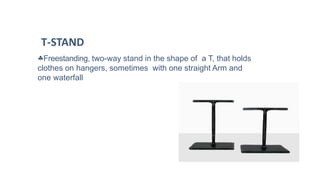
Freestanding, two-way stand in the shape of a T, that holds
clothes on hangers, sometimes with one straight Arm and
one waterfall
T-STAND
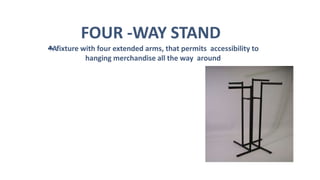
FOUR -WAY STAND
Afixture with four extended arms, that permits accessibility to
hanging merchandise all the way around
Hope I have made you people understand what is Visual
Merchandising and Elements of Visual Merchandising
75
Any Questions ?
76
12/5/2019
ADD A FOOTER
P r e s e n t e d t o – P r o f . A n i l N i l a n g i
Thank you!
Presented by - Mohammed Farooq Azam
Sharnabasva University
Kalaburagi
Faculty Of Business
Studies
Topic covered –
Visual Merchandising

Visual merchandising by farooq azam

  • 1.
    S HARNBAS VAUNIVE RS IT Y KALABURAGI FACULT Y OF BUS INE S S S T UDIE S AP PAIE T M BA CO - E du VISUAL MERCHANDISING Presented by – Mohammed Farooq Azam Presented to – Prof. Anil Nilangi
  • 2.
    Visual Merchandising ? Visualmerchandising is presenting or displaying products in a way that makes them visually appealing and desirable. T h i n g s l i k e t h e m e d w i n d o w d i s p l a y s D r e s s e d m a n n e q u i n s , t h e a r r a n g e m e n t o f r u n n i n g s h o e s o n a w a l l a n d f r e s h f r u i t s o r g a n i z e d b y c o l o u r a r e a l l e x a m p l e o f V M
  • 3.
    Farooq Azam canyou tell us WHAT IS VISUAL MERCHANDISING IN SIMPLE TERMS OR IN ONE WORD ? 3 Visual Merchandising in simple term is ____________
  • 4.
    Take this slidefor a Litter moments WHO NEEDS A SUPER HERO WHEN YOU ARE VISUAL MERCHANDISER 12/5/2019 ADD A FOOTER  Photo of 2017
  • 7.
    VISUAL MEANING Relating tothe sense of sight. MERCHANDISING MEANING Merchandising is a marketing practice in which the brand or image from one product or service is used to sell another
  • 8.
  • 9.
    • Coordination ofphysical elements in place of business, so that its project the right image to its customers • Change a “passive looker into active buyers” • Responsible for total merchandise • Overall business image • Placements of design elements
  • 10.
    Itis the activityand profession of developing the floor plans and three dimensional displays in order to maximize their sales Thedisplay of products which makes them appealing and attractive Itutilizes displays, colors, lighting ,smells and sounds Contd……..
  • 12.
    PURPOSE OF VISUALMERCHANDISING
  • 13.
    Thepurpose is toattract ,engage, motivate the customers towards making a purchase Bothgoods and services can be displayed to highlight their features and benefits
  • 14.
    PRINCIPLES OF VISUALMERCHANDISING
  • 15.
    Makeit easier forthe customerto locate the desired category and merchandise Makeit easier to selfselect Makeit possible to coordinate andaccessorize
  • 16.
     Educateabout theproduct in an effective and creative way Makeproper arrangements in such a way to increase the sale of unsought goods
  • 17.
    IMPORTANCE OF VISUALMERCHANDISING
  • 18.
    Purposes are tosell products and promote store image Shouldalways try to be different, new, and creative Changea “passive looker” into an “active buyer” Enhances brand image Generatesimpulse sales Overallbusiness image
  • 19.
  • 21.
    ERRORS TO AVOIDIN VISUAL MERCHANDISING
  • 22.
    Toomuchsignage Confusing traffic patterns Toomuchpropping Disconnectionbetween exterior window and store contents Poor lighting Nopoint of view Inconsistency in visual executions
  • 23.
    OBJECTIVES OF AGOOD STORE DESIGN
  • 24.
    Design should: be consistentwith image and strategy positively influence consumer behavior consider costs versus value beflexible recognize the needs of the disabled – The Americans with Disabilities Act
  • 25.
    OBJECTIVES OF THESTORE ENVIRONMENT
  • 26.
     Get customersinto the store  Serves a critical role in the store selection process  Important criteria include cleanliness, labeled prices, accurate and pleasant checkout clerks, and well- stocked shelves  The store itself makes the most significant and last impression  Once they are inside the store, convert them into customers buying merchandise  The more merchandise customers are exposed to that is presented in an orderly manner, the more they tend to buy
  • 27.
  • 28.
  • 29.
    Fashion apparel wallpresentation. In the correct example, formal balance is achieved by creating a mirror image of garment on both sides of a center line. This does not occur in the incorrect example
  • 31.
  • 32.
    In this, Informalbalance is achieved because an equal amount of space is filled on either side of a centre line. This does not occur in the incorrect example.
  • 34.
  • 35.
    Theways goods arehung, placed on shelves, or otherwise made available to customers Shoulder-out Onlyone sideshows Face-forward Hanginggarment so full front faces viewer
  • 36.
  • 37.
  • 38.
  • 39.
            Should be currentRepresent styles and lines Should be well stocked In demand New (inform customers of what is available) Encourage additional purchases Promote current theme Look good on display Displayed MERCHANDISE
  • 40.
    ELEMENTS IN VISUALMERCHANDISING
  • 41.
  • 42.
    1. STORE FRONT Theexterior of a business. It includes: 1. Signs 2. Marquee 3. Entrances 4. Window Display
  • 43.
    SIGNS There are fourdifferent types of signs are: 1.Promotional Signs 2.Location signs 3.Institutional signs 4.Informational signs
  • 44.
  • 45.
  • 46.
  • 47.
    INFORMATIONAL SIGNS For productrelated benefits/ features/ prices etc.
  • 48.
    MARQUEE Thesign that isused to display the storename
  • 49.
    Designed with customerconvenience and store security in mind. Thereare several types of entrances each portraying a certain image ENTRANCES
  • 51.
    Push-Pull – fullservice stores often with fancy handles Electronic – Self-serve stores, with carts such as Wal- Mart, Meijer, Kroger. ClimateControlled – shopping malls. TYPES OF ENTRANCES Revolving – up scale stores
  • 52.
    Thestore’s FIRST IMPRESSIONwith the customer. Beginthe selling process even before the customer enters the store. Suggeststhe type of merchandise carried in the store WINDOW DISPLAYS
  • 54.
    1. Promotional –promote the sale of one or more items by using special lighting and /or props. Skiwear with fake snow for accents TYPES OF WINDOW DISPLAYS
  • 55.
    2. Institutional –promote store image rather than specific items. Designed to build customer good will, show that the business is interested in the community TYPES OF WINDOW DISPLAYS
  • 56.
    Affectsthe store’s image Includesitems such as: Floor& wall coverings Lighting Colors Fixtures STORE INTERIOR
  • 57.
    It is importantto create a relaxing, comfortable place for customers to shop Customers shop longer & are more relaxed and spend more when they are not pressed by crowds, delays & long lines
  • 58.
    FLOOR & WALLCOVERINGS
  • 59.
  • 60.
    Used to directcustomer’s attention to the display and creates mood. -Use more light for dark colors, less light for light colors . -Beam spread; the diameter of the circle of light.
  • 61.
  • 62.
    FLOOD LIGHTING Ceiling lightsto direct lights over an entire wide display area.
  • 63.
    SPOT LIGHTING Focuses attentionon specific areas or targeted items of merchandise
  • 64.
    PINPOINTING focuses a narrowbeam of light on a specific item
  • 65.
    more Color selection should beperfect. Help to make merchandise look interesting. Color schemes help to create moods. Capture shoppers attention. COLOURS
  • 66.
    Example: In Christmasdisplays only complementary color scheme i.e. reds and greens are placed next to each other in setting as no other scheme can accomplish this
  • 67.
    STORE FIXTURES Tomake store’swall merchandisable, wall usually covered with a skin that is fitted with vertical columns of notches.
  • 68.
    Most common typesof fixtures: Stands Platforms and Elevations Round rack Bin T-Stand Fourwayfaceout TYPES OF FIXTURES
  • 69.
    Usedin a varietyor assortment window- from glass line to the back of the display window STANDS
  • 70.
    PLATFORMS & ELEVATIONS Platformsor Elevations can be tables and other pieces of furniture that can be used to raise up a mannequin, a form or arrangement of merchandise
  • 71.
    Circular racks onwhich garments are hung around the entire circumference ROUND RACKS
  • 72.
    Arimmed table orbin used to hold sale or special merchandise on the sales floor, especially in discount operations; it has no formal arrangement BIN
  • 73.
    Freestanding, two-way standin the shape of a T, that holds clothes on hangers, sometimes with one straight Arm and one waterfall T-STAND
  • 74.
    FOUR -WAY STAND Afixturewith four extended arms, that permits accessibility to hanging merchandise all the way around
  • 75.
    Hope I havemade you people understand what is Visual Merchandising and Elements of Visual Merchandising 75
  • 76.
  • 77.
    P r es e n t e d t o – P r o f . A n i l N i l a n g i Thank you! Presented by - Mohammed Farooq Azam Sharnabasva University Kalaburagi Faculty Of Business Studies Topic covered – Visual Merchandising