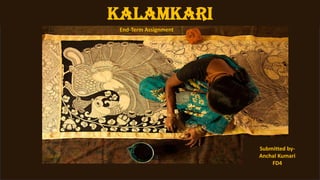
Kalamkari
Submitted by-
Anchal Kumari
FD4
End-Term Assignment
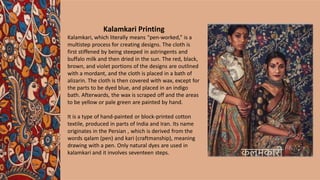
Kalamkari Printing
Kalamkari, which literally means “pen-worked,” is a
multistep process for creating designs. The cloth is
first stiffened by being steeped in astringents and
buffalo milk and then dried in the sun. The red, black,
brown, and violet portions of the designs are outlined
with a mordant, and the cloth is placed in a bath of
alizarin. The cloth is then covered with wax, except for
the parts to be dyed blue, and placed in an indigo
bath. Afterwards, the wax is scraped off and the areas
to be yellow or pale green are painted by hand.
It is a type of hand-painted or block-printed cotton
textile, produced in parts of India and Iran. Its name
originates in the Persian , which is derived from the
words qalam (pen) and kari (craftmanship), meaning
drawing with a pen. Only natural dyes are used in
kalamkari and it involves seventeen steps.
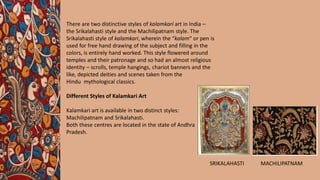
There are two distinctive styles of kalamkari art in India –
the Srikalahasti style and the Machilipatnam style. The
Srikalahasti style of kalamkari, wherein the “kalam” or pen is
used for free hand drawing of the subject and filling in the
colors, is entirely hand worked. This style flowered around
temples and their patronage and so had an almost religious
identity – scrolls, temple hangings, chariot banners and the
like, depicted deities and scenes taken from the
Hindu mythological classics.
Different Styles of Kalamkari Art
Kalamkari art is available in two distinct styles:
Machilipatnam and Srikalahasti.
Both these centres are located in the state of Andhra
Pradesh.
SRIKALAHASTI MACHILIPATNAM
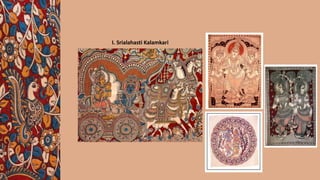
I. Srialahasti Kalamkari
I. Srikalahasti Kalamkari
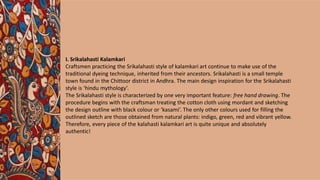
Craftsmen practicing the Srikalahasti style of kalamkari art continue to make use of the
traditional dyeing technique, inherited from their ancestors. Srikalahasti is a small temple
town found in the Chittoor district in Andhra. The main design inspiration for the Srikalahasti
style is ‘hindu mythology’.
The Srikalahasti style is characterized by one very important feature: free hand drawing. The
procedure begins with the craftsman treating the cotton cloth using mordant and sketching
the design outline with black colour or ‘kasami’. The only other colours used for filling the
outlined sketch are those obtained from natural plants: indigo, green, red and vibrant yellow.
Therefore, every piece of the kalahasti kalamkari art is quite unique and absolutely
authentic!
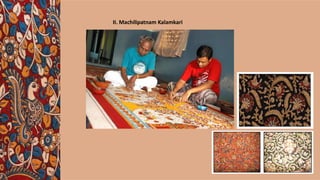
II. Machilipatnam Kalamkari
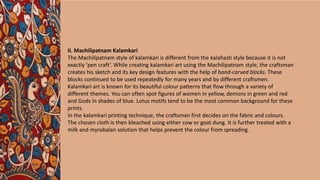
The Machilipatnam style of kalamkari is different from the kalahasti style because it is not
exactly ‘pen craft’. While creating kalamkari art using the Machilipatnam style, the craftsman
creates his sketch and its key design features with the help of hand-carved blocks. These
blocks continued to be used repeatedly for many years and by different craftsmen.
Kalamkari art is known for its beautiful colour patterns that flow through a variety of
different themes. You can often spot figures of women in yellow, demons in green and red
and Gods in shades of blue. Lotus motifs tend to be the most common background for these
prints.
In the kalamkari printing technique, the craftsman first decides on the fabric and colours.
The chosen cloth is then bleached using either cow or goat dung. It is further treated with a
milk and myrobalan solution that helps prevent the colour from spreading.
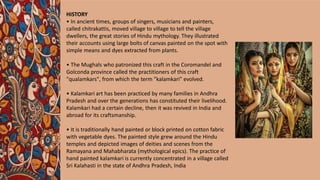
HISTORY
• In ancient times, groups of singers, musicians and painters,
called chitrakattis, moved village to village to tell the village
dwellers, the great stories of Hindu mythology. They illustrated
their accounts using large bolts of canvas painted on the spot with
simple means and dyes extracted from plants.
• The Mughals who patronized this craft in the Coromandel and
Golconda province called the practitioners of this craft
"qualamkars", from which the term "kalamkari" evolved.
• Kalamkari art has been practiced by many families in Andhra
Pradesh and over the generations has constituted their livelihood.
Kalamkari had a certain decline, then it was revived in India and
abroad for its craftsmanship.
• It is traditionally hand painted or block printed on cotton fabric
with vegetable dyes. The painted style grew around the Hindu
temples and depicted images of deities and scenes from the
Ramayana and Mahabharata (mythological epics). The practice of
hand painted kalamkari is currently concentrated in a village called
Sri Kalahasti in the state of Andhra Pradesh, India
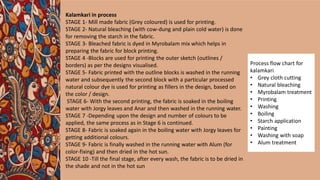
Kalamkari in process
STAGE 1- Mill made fabric (Grey coloured) is used for printing.
STAGE 2- Natural bleaching (with cow-dung and plain cold water) is done
for removing the starch in the fabric.
STAGE 3- Bleached fabric is dyed in Myrobalam mix which helps in
preparing the fabric for block printing.
STAGE 4 -Blocks are used for printing the outer sketch (outlines /
borders) as per the designs visualised.
STAGE 5- Fabric printed with the outline blocks is washed in the running
water and subsequently the second block with a particular processed
natural colour dye is used for printing as fillers in the design, based on
the color / design.
STAGE 6- With the second printing, the fabric is soaked in the boiling
water with Jorgy leaves and Anar and then washed in the running water.
STAGE 7 -Depending upon the design and number of colours to be
applied, the same process as in Stage 6 is continued.
STAGE 8- Fabric is soaked again in the boiling water with Jorgy leaves for
getting additional colours.
STAGE 9- Fabric is finally washed in the running water with Alum (for
color-fixing) and then dried in the hot sun.
STAGE 10 -Till the final stage, after every wash, the fabric is to be dried in
the shade and not in the hot sun
Process flow chart for
kalamkari
• Grey cloth cutting
• Natural bleaching
• Myrobalam treatment
• Printing
• Washing
• Boiling
• Starch application
• Painting
• Washing with soap
• Alum treatment
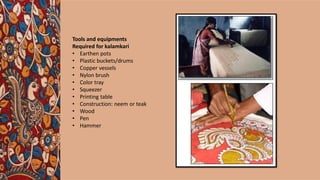
Tools and equipments
Required for kalamkari
• Earthen pots
• Plastic buckets/drums
• Copper vessels
• Nylon brush
• Color tray
• Squeezer
• Printing table
• Construction: neem or teak
• Wood
• Pen
• Hammer
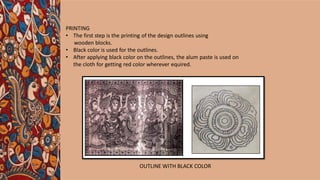
PRINTING
• The first step is the printing of the design outlines using
wooden blocks.
• Black color is used for the outlines.
• After applying black color on the outlines, the alum paste is used on
the cloth for getting red color wherever equired.
OUTLINE WITH BLACK COLOR
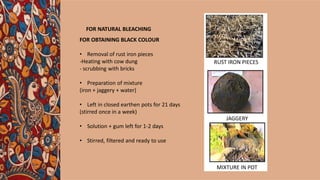
FOR OBTAINING BLACK COLOUR
• Removal of rust iron pieces
-Heating with cow dung
- scrubbing with bricks
• Preparation of mixture
(iron + jaggery + water)
• Left in closed earthen pots for 21 days
(stirred once in a week)
• Solution + gum left for 1-2 days
• Stirred, filtered and ready to use
RUST IRON PIECES
JAGGERY
MIXTURE IN POT
FOR NATURAL BLEACHING
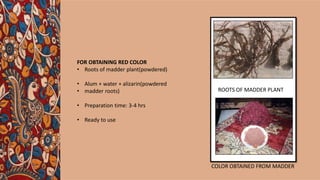
FOR OBTAINING RED COLOR
• Roots of madder plant(powdered)
• Alum + water + alizarin(powdered
• madder roots)
• Preparation time: 3-4 hrs
• Ready to use
ROOTS OF MADDER PLANT
COLOR OBTAINED FROM MADDER
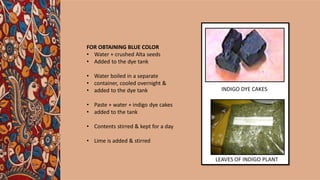
FOR OBTAINING BLUE COLOR
• Water + crushed Alta seeds
• Added to the dye tank
• Water boiled in a separate
• container, cooled overnight &
• added to the dye tank
• Paste + water + indigo dye cakes
• added to the tank
• Contents stirred & kept for a day
• Lime is added & stirred
INDIGO DYE CAKES
LEAVES OF INDIGO PLANT
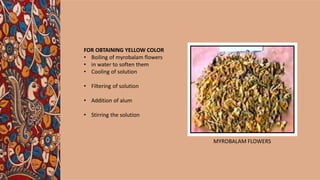
FOR OBTAINING YELLOW COLOR
• Boiling of myrobalam flowers
• in water to soften them
• Cooling of solution
• Filtering of solution
• Addition of alum
• Stirring the solution
MYROBALAM FLOWERS
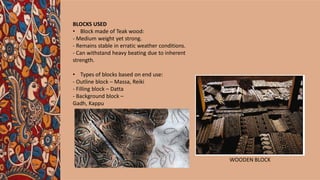
BLOCKS USED
• Block made of Teak wood:
- Medium weight yet strong.
- Remains stable in erratic weather conditions.
- Can withstand heavy beating due to inherent
strength.
• Types of blocks based on end use:
- Outline block – Massa, Reiki
- Filling block – Datta
- Background block –
Gadh, Kappu
WOODEN BLOCK
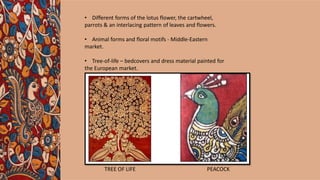
TREE OF LIFE PEACOCK
• Different forms of the lotus flower, the cartwheel,
parrots & an interlacing pattern of leaves and flowers.
• Animal forms and floral motifs - Middle-Eastern
market.
• Tree-of-life – bedcovers and dress material painted for
the European market.
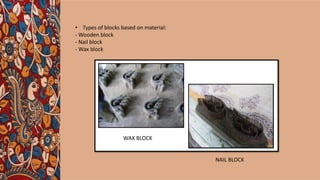
• Types of blocks based on material:
- Wooden block
- Nail block
- Wax block
WAX BLOCK
NAIL BLOCK
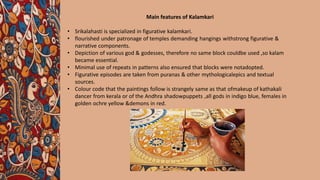
Main features of Kalamkari
• Srikalahasti is specialized in figurative kalamkari.
• flourished under patronage of temples demanding hangings withstrong figurative &
narrative components.
• Depiction of various god & godesses, therefore no same block couldbe used ,so kalam
became essential.
• Minimal use of repeats in patterns also ensured that blocks were notadopted.
• Figurative episodes are taken from puranas & other mythologicalepics and textual
sources.
• Colour code that the paintings follow is strangely same as that ofmakeup of kathakali
dancer from kerala or of the Andhra shadowpuppets ,all gods in indigo blue, females in
golden ochre yellow &demons in red.
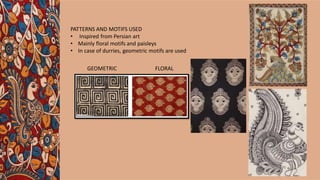
PATTERNS AND MOTIFS USED
• Inspired from Persian art
• Mainly floral motifs and paisleys
• In case of durries, geometric motifs are used
GEOMETRIC FLORAL
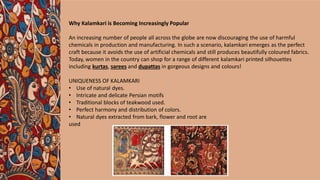
Why Kalamkari is Becoming Increasingly Popular
An increasing number of people all across the globe are now discouraging the use of harmful
chemicals in production and manufacturing. In such a scenario, kalamkari emerges as the perfect
craft because it avoids the use of artificial chemicals and still produces beautifully coloured fabrics.
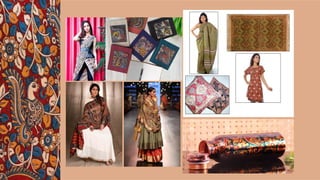
Today, women in the country can shop for a range of different kalamkari printed silhouettes
including kurtas, sarees and dupattas in gorgeous designs and colours!
UNIQUENESS OF KALAMKARI
• Use of natural dyes.
• Intricate and delicate Persian motifs
• Traditional blocks of teakwood used.
• Perfect harmony and distribution of colors.
• Natural dyes extracted from bark, flower and root are
used
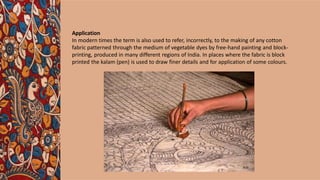
Application
In modern times the term is also used to refer, incorrectly, to the making of any cotton
fabric patterned through the medium of vegetable dyes by free-hand painting and block-
printing, produced in many different regions of India. In places where the fabric is block
printed the kalam (pen) is used to draw finer details and for application of some colours.
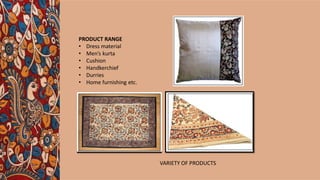
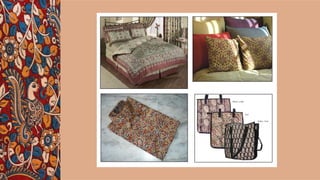
PRODUCT RANGE
• Dress material
• Men’s kurta
• Cushion
• Handkerchief
• Durries
• Home furnishing etc.
VARIETY OF PRODUCTS
Reference
https://en.wikipedia.org/wiki/Kalamkari#:~:text=Kalamkari%20is%20a%
20type%20of,which%20involves%20twenty%2Dthree%20steps.
https://www.scribd.com/presentation/84816731/Kalamkari-Painting-
and-Printing
https://khinkhwab.com/blogs/news/lets-read-about-kalamkari-
beautiful-timeless-art
https://www.unnatisilks.com/kalamkari-introduction-indian-crafts.html
Kalamkari

Kalamkari

  • 1.
  • 2.
    Kalamkari Printing Kalamkari, whichliterally means “pen-worked,” is a multistep process for creating designs. The cloth is first stiffened by being steeped in astringents and buffalo milk and then dried in the sun. The red, black, brown, and violet portions of the designs are outlined with a mordant, and the cloth is placed in a bath of alizarin. The cloth is then covered with wax, except for the parts to be dyed blue, and placed in an indigo bath. Afterwards, the wax is scraped off and the areas to be yellow or pale green are painted by hand. It is a type of hand-painted or block-printed cotton textile, produced in parts of India and Iran. Its name originates in the Persian , which is derived from the words qalam (pen) and kari (craftmanship), meaning drawing with a pen. Only natural dyes are used in kalamkari and it involves seventeen steps.
  • 3.
    There are twodistinctive styles of kalamkari art in India – the Srikalahasti style and the Machilipatnam style. The Srikalahasti style of kalamkari, wherein the “kalam” or pen is used for free hand drawing of the subject and filling in the colors, is entirely hand worked. This style flowered around temples and their patronage and so had an almost religious identity – scrolls, temple hangings, chariot banners and the like, depicted deities and scenes taken from the Hindu mythological classics. Different Styles of Kalamkari Art Kalamkari art is available in two distinct styles: Machilipatnam and Srikalahasti. Both these centres are located in the state of Andhra Pradesh. SRIKALAHASTI MACHILIPATNAM
  • 4.
  • 5.
    I. Srikalahasti Kalamkari Craftsmenpracticing the Srikalahasti style of kalamkari art continue to make use of the traditional dyeing technique, inherited from their ancestors. Srikalahasti is a small temple town found in the Chittoor district in Andhra. The main design inspiration for the Srikalahasti style is ‘hindu mythology’. The Srikalahasti style is characterized by one very important feature: free hand drawing. The procedure begins with the craftsman treating the cotton cloth using mordant and sketching the design outline with black colour or ‘kasami’. The only other colours used for filling the outlined sketch are those obtained from natural plants: indigo, green, red and vibrant yellow. Therefore, every piece of the kalahasti kalamkari art is quite unique and absolutely authentic!
  • 6.
  • 7.
    II. Machilipatnam Kalamkari TheMachilipatnam style of kalamkari is different from the kalahasti style because it is not exactly ‘pen craft’. While creating kalamkari art using the Machilipatnam style, the craftsman creates his sketch and its key design features with the help of hand-carved blocks. These blocks continued to be used repeatedly for many years and by different craftsmen. Kalamkari art is known for its beautiful colour patterns that flow through a variety of different themes. You can often spot figures of women in yellow, demons in green and red and Gods in shades of blue. Lotus motifs tend to be the most common background for these prints. In the kalamkari printing technique, the craftsman first decides on the fabric and colours. The chosen cloth is then bleached using either cow or goat dung. It is further treated with a milk and myrobalan solution that helps prevent the colour from spreading.
  • 8.
    HISTORY • In ancienttimes, groups of singers, musicians and painters, called chitrakattis, moved village to village to tell the village dwellers, the great stories of Hindu mythology. They illustrated their accounts using large bolts of canvas painted on the spot with simple means and dyes extracted from plants. • The Mughals who patronized this craft in the Coromandel and Golconda province called the practitioners of this craft "qualamkars", from which the term "kalamkari" evolved. • Kalamkari art has been practiced by many families in Andhra Pradesh and over the generations has constituted their livelihood. Kalamkari had a certain decline, then it was revived in India and abroad for its craftsmanship. • It is traditionally hand painted or block printed on cotton fabric with vegetable dyes. The painted style grew around the Hindu temples and depicted images of deities and scenes from the Ramayana and Mahabharata (mythological epics). The practice of hand painted kalamkari is currently concentrated in a village called Sri Kalahasti in the state of Andhra Pradesh, India
  • 9.
    Kalamkari in process STAGE1- Mill made fabric (Grey coloured) is used for printing. STAGE 2- Natural bleaching (with cow-dung and plain cold water) is done for removing the starch in the fabric. STAGE 3- Bleached fabric is dyed in Myrobalam mix which helps in preparing the fabric for block printing. STAGE 4 -Blocks are used for printing the outer sketch (outlines / borders) as per the designs visualised. STAGE 5- Fabric printed with the outline blocks is washed in the running water and subsequently the second block with a particular processed natural colour dye is used for printing as fillers in the design, based on the color / design. STAGE 6- With the second printing, the fabric is soaked in the boiling water with Jorgy leaves and Anar and then washed in the running water. STAGE 7 -Depending upon the design and number of colours to be applied, the same process as in Stage 6 is continued. STAGE 8- Fabric is soaked again in the boiling water with Jorgy leaves for getting additional colours. STAGE 9- Fabric is finally washed in the running water with Alum (for color-fixing) and then dried in the hot sun. STAGE 10 -Till the final stage, after every wash, the fabric is to be dried in the shade and not in the hot sun Process flow chart for kalamkari • Grey cloth cutting • Natural bleaching • Myrobalam treatment • Printing • Washing • Boiling • Starch application • Painting • Washing with soap • Alum treatment
  • 10.
    Tools and equipments Requiredfor kalamkari • Earthen pots • Plastic buckets/drums • Copper vessels • Nylon brush • Color tray • Squeezer • Printing table • Construction: neem or teak • Wood • Pen • Hammer
  • 11.
    PRINTING • The firststep is the printing of the design outlines using wooden blocks. • Black color is used for the outlines. • After applying black color on the outlines, the alum paste is used on the cloth for getting red color wherever equired. OUTLINE WITH BLACK COLOR
  • 12.
    FOR OBTAINING BLACKCOLOUR • Removal of rust iron pieces -Heating with cow dung - scrubbing with bricks • Preparation of mixture (iron + jaggery + water) • Left in closed earthen pots for 21 days (stirred once in a week) • Solution + gum left for 1-2 days • Stirred, filtered and ready to use RUST IRON PIECES JAGGERY MIXTURE IN POT FOR NATURAL BLEACHING
  • 13.
    FOR OBTAINING REDCOLOR • Roots of madder plant(powdered) • Alum + water + alizarin(powdered • madder roots) • Preparation time: 3-4 hrs • Ready to use ROOTS OF MADDER PLANT COLOR OBTAINED FROM MADDER
  • 14.
    FOR OBTAINING BLUECOLOR • Water + crushed Alta seeds • Added to the dye tank • Water boiled in a separate • container, cooled overnight & • added to the dye tank • Paste + water + indigo dye cakes • added to the tank • Contents stirred & kept for a day • Lime is added & stirred INDIGO DYE CAKES LEAVES OF INDIGO PLANT
  • 15.
    FOR OBTAINING YELLOWCOLOR • Boiling of myrobalam flowers • in water to soften them • Cooling of solution • Filtering of solution • Addition of alum • Stirring the solution MYROBALAM FLOWERS
  • 16.
    BLOCKS USED • Blockmade of Teak wood: - Medium weight yet strong. - Remains stable in erratic weather conditions. - Can withstand heavy beating due to inherent strength. • Types of blocks based on end use: - Outline block – Massa, Reiki - Filling block – Datta - Background block – Gadh, Kappu WOODEN BLOCK
  • 17.
    TREE OF LIFEPEACOCK • Different forms of the lotus flower, the cartwheel, parrots & an interlacing pattern of leaves and flowers. • Animal forms and floral motifs - Middle-Eastern market. • Tree-of-life – bedcovers and dress material painted for the European market.
  • 18.
    • Types ofblocks based on material: - Wooden block - Nail block - Wax block WAX BLOCK NAIL BLOCK
  • 19.
    Main features ofKalamkari • Srikalahasti is specialized in figurative kalamkari. • flourished under patronage of temples demanding hangings withstrong figurative & narrative components. • Depiction of various god & godesses, therefore no same block couldbe used ,so kalam became essential. • Minimal use of repeats in patterns also ensured that blocks were notadopted. • Figurative episodes are taken from puranas & other mythologicalepics and textual sources. • Colour code that the paintings follow is strangely same as that ofmakeup of kathakali dancer from kerala or of the Andhra shadowpuppets ,all gods in indigo blue, females in golden ochre yellow &demons in red.
  • 20.
    PATTERNS AND MOTIFSUSED • Inspired from Persian art • Mainly floral motifs and paisleys • In case of durries, geometric motifs are used GEOMETRIC FLORAL
  • 21.
    Why Kalamkari isBecoming Increasingly Popular An increasing number of people all across the globe are now discouraging the use of harmful chemicals in production and manufacturing. In such a scenario, kalamkari emerges as the perfect craft because it avoids the use of artificial chemicals and still produces beautifully coloured fabrics. Today, women in the country can shop for a range of different kalamkari printed silhouettes including kurtas, sarees and dupattas in gorgeous designs and colours! UNIQUENESS OF KALAMKARI • Use of natural dyes. • Intricate and delicate Persian motifs • Traditional blocks of teakwood used. • Perfect harmony and distribution of colors. • Natural dyes extracted from bark, flower and root are used
  • 22.
    Application In modern timesthe term is also used to refer, incorrectly, to the making of any cotton fabric patterned through the medium of vegetable dyes by free-hand painting and block- printing, produced in many different regions of India. In places where the fabric is block printed the kalam (pen) is used to draw finer details and for application of some colours.
  • 23.
    PRODUCT RANGE • Dressmaterial • Men’s kurta • Cushion • Handkerchief • Durries • Home furnishing etc. VARIETY OF PRODUCTS
  • 26.