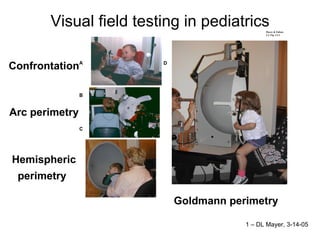
Visual field testing in pediatrics Confrontation  Arc perimetry  Hemispheric perimetry   Goldmann perimetry  1 – DL Mayer, 3-14-05
The Count “eats” the white ball when the infant orients to it (looks at it)   Confrontation with the Count and the white ball 2 – DL Mayer, 3-14-05
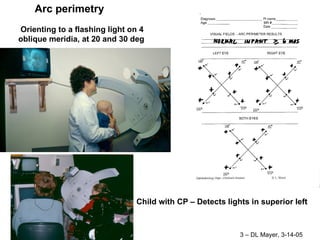
Arc perimetry Orienting to a flashing light on 4  oblique meridia, at 20 and 30 deg Child with CP – Detects lights in superior left 3 – DL Mayer, 3-14-05
Orienting to a flashing light at a fixed extent on one of 24 half meridia   Hemispheric perimetry   4 – DL Mayer, 3-14-05
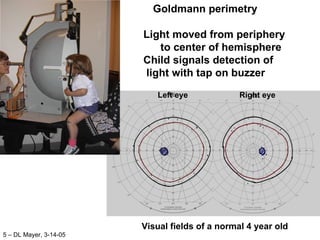
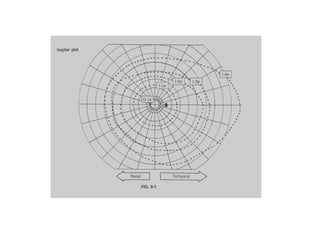
Goldmann perimetry Light moved from periphery  to center of hemisphere  Child signals detection of  light with tap on buzzer Visual fields of a normal 4 year old Left eye  Right eye   5 – DL Mayer, 3-14-05
6 – DL Mayer, 3-14-05
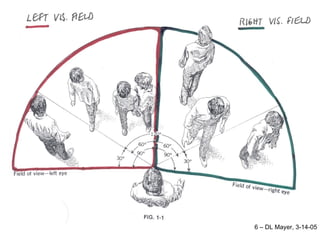
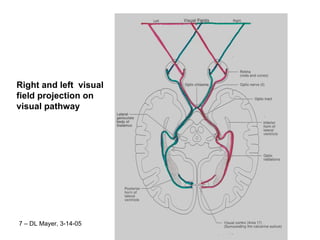
Right and left  visual field projection on visual pathway 7 – DL Mayer, 3-14-05
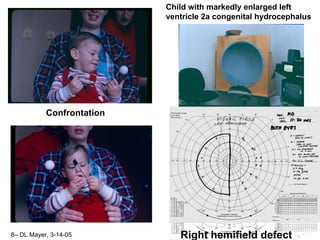
Child with markedly enlarged left ventricle 2a congenital hydrocephalus   Right hemifield defect Confrontation 8– DL Mayer, 3-14-05
Right or left hemifield defects Consequences -  Poor scanning into non-seeing field Reading affected, especially in right field defects Missing objects in non-seeing field Seeing only part of (large) objects Delayed motor skills Compensations - Head turn toward non-seeing field Head thrusting toward non-seeing field Complications – Hemiparesis on side of field defect Hemispatial neglect in addition to field defect 9– DL Mayer, 3-14-05
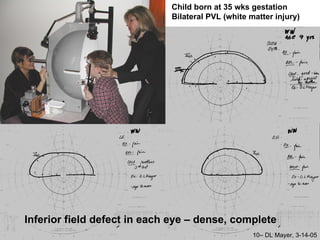
Child born at 35 wks gestation Bilateral PVL (white matter injury) Inferior field defect in each eye – dense, complete 10– DL Mayer, 3-14-05
Inferior field defects Consequences – Poor scanning downward Missing objects in lower fields (e.g. food on table, pictures at bottom of communication board, bumping into things below when walking) Seeing only part of (large) objects Compensations – Head tilts to right and left  Head down posture (when walking, reading) Complications – Spastic diplegia (legs)  11– DL Mayer, 3-14-05
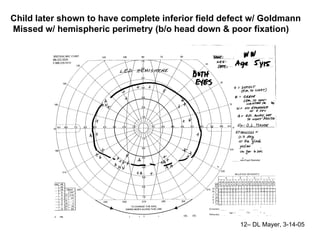
Child later shown to have complete inferior field defect w/ Goldmann  Missed w/ hemispheric perimetry (b/o head down & poor fixation) 12– DL Mayer, 3-14-05
Recommendations for children with major field defects - 1 Services - Teacher of visually impaired Orientation and mobility Further evaluations - Low vision, as appropriate Neuropsychology, for difficulties associated with cerebral damage 13– DL Mayer, 3-14-05
Recommendations for children with major field defects - 2 Compensations - Increasing child’s awareness of space Scanning to increase search field Adaptations –  Positioning child & objects to optimize field & minimize effort Environmental modifications – stairs, furniture, play spaces 14– DL Mayer, 3-14-05
Preterm infant –  bilateral cerebral white matter damage   MRI – 21 months   26 wks GA, 1 lb 15 oz, twin Spastic diplegia, seizures  Mild ROP,  X(T),  VA sc OU 10/20 Complete, dense inferior field defect VFs-7 Goldmann  perimetry, Age 5;8
Missing objects on floor or stumbling over objects while walking;  extreme caution going downstairs Common concerns in children with  inferior field defects   Missing food items in lower field at table or on high chair tray –  “ Where is my milk?” -“Eat your peas!” “Where are they?” Missing pieces in the lower part of a puzzle Missing icons on the bottom of a communication board  Leaning down to get close to paper when writing or drawing Crowding a drawing on the upper part of page  Frequent head tilt down, when head is free in wheelchair, or when walking Missing objects on floor or stumbling over objects while walking  Extreme caution going downstairs, at door thresholds Sideways head tilt for certain activities (e.g. TV viewing), sometimes nearly always when doing fine motor tasks and reading


Visual field testing in pediatrics

  • 1.
    Visual field testingin pediatrics Confrontation Arc perimetry Hemispheric perimetry Goldmann perimetry 1 – DL Mayer, 3-14-05
  • 2.
    The Count “eats”the white ball when the infant orients to it (looks at it) Confrontation with the Count and the white ball 2 – DL Mayer, 3-14-05
  • 3.
    Arc perimetry Orientingto a flashing light on 4 oblique meridia, at 20 and 30 deg Child with CP – Detects lights in superior left 3 – DL Mayer, 3-14-05
  • 4.
    Orienting to aflashing light at a fixed extent on one of 24 half meridia Hemispheric perimetry 4 – DL Mayer, 3-14-05
  • 5.
    Goldmann perimetry Lightmoved from periphery to center of hemisphere Child signals detection of light with tap on buzzer Visual fields of a normal 4 year old Left eye Right eye 5 – DL Mayer, 3-14-05
  • 6.
    6 – DLMayer, 3-14-05
  • 7.
    Right and left visual field projection on visual pathway 7 – DL Mayer, 3-14-05
  • 8.
    Child with markedlyenlarged left ventricle 2a congenital hydrocephalus Right hemifield defect Confrontation 8– DL Mayer, 3-14-05
  • 9.
    Right or lefthemifield defects Consequences - Poor scanning into non-seeing field Reading affected, especially in right field defects Missing objects in non-seeing field Seeing only part of (large) objects Delayed motor skills Compensations - Head turn toward non-seeing field Head thrusting toward non-seeing field Complications – Hemiparesis on side of field defect Hemispatial neglect in addition to field defect 9– DL Mayer, 3-14-05
  • 10.
    Child born at35 wks gestation Bilateral PVL (white matter injury) Inferior field defect in each eye – dense, complete 10– DL Mayer, 3-14-05
  • 11.
    Inferior field defectsConsequences – Poor scanning downward Missing objects in lower fields (e.g. food on table, pictures at bottom of communication board, bumping into things below when walking) Seeing only part of (large) objects Compensations – Head tilts to right and left Head down posture (when walking, reading) Complications – Spastic diplegia (legs) 11– DL Mayer, 3-14-05
  • 12.
    Child later shownto have complete inferior field defect w/ Goldmann Missed w/ hemispheric perimetry (b/o head down & poor fixation) 12– DL Mayer, 3-14-05
  • 13.
    Recommendations for childrenwith major field defects - 1 Services - Teacher of visually impaired Orientation and mobility Further evaluations - Low vision, as appropriate Neuropsychology, for difficulties associated with cerebral damage 13– DL Mayer, 3-14-05
  • 14.
    Recommendations for childrenwith major field defects - 2 Compensations - Increasing child’s awareness of space Scanning to increase search field Adaptations – Positioning child & objects to optimize field & minimize effort Environmental modifications – stairs, furniture, play spaces 14– DL Mayer, 3-14-05
  • 15.
    Preterm infant – bilateral cerebral white matter damage MRI – 21 months 26 wks GA, 1 lb 15 oz, twin Spastic diplegia, seizures Mild ROP, X(T), VA sc OU 10/20 Complete, dense inferior field defect VFs-7 Goldmann perimetry, Age 5;8
  • 16.
    Missing objects onfloor or stumbling over objects while walking; extreme caution going downstairs Common concerns in children with inferior field defects Missing food items in lower field at table or on high chair tray – “ Where is my milk?” -“Eat your peas!” “Where are they?” Missing pieces in the lower part of a puzzle Missing icons on the bottom of a communication board Leaning down to get close to paper when writing or drawing Crowding a drawing on the upper part of page Frequent head tilt down, when head is free in wheelchair, or when walking Missing objects on floor or stumbling over objects while walking Extreme caution going downstairs, at door thresholds Sideways head tilt for certain activities (e.g. TV viewing), sometimes nearly always when doing fine motor tasks and reading
  • 17.
  • 18.