INTERVENTION
FOR CHILDREN
WITH CVI
General strategies
Dr. Sandy Newcomb
snewcomb104@gmail.com
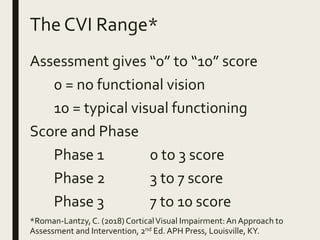
The CVI Range*
Assessment gives “0” to “10” score
0 = no functional vision
10 = typical visual functioning
Score and Phase
Phase 1 0 to 3 score
Phase 2 3 to 7 score
Phase 3 7 to 10 score
*Roman-Lantzy,C. (2018) CorticalVisual Impairment:An Approach to
Assessment and Intervention, 2nd Ed. APH Press, Louisville, KY.
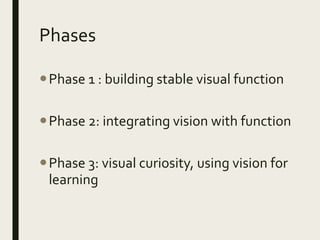
Phases
Phase 1 : building stable visual function
Phase 2: integrating vision with function
Phase 3: visual curiosity, using vision for
learning
Build StableVisual
Functioning
Phase I
■ High level of environmental control
■ Plan times of the day when the child can
practice vision without other demands
■ For each position that child spends time,
place something (from “vision” toys) to look
at
Phase I
■ Use “down” time for vision activities, e.g.
tube feeding
■ Create a box of toys “things Eric will look
at”
■ Use single colored objects/favorite toys
Phase I
■ Use characteristics of familiar objects to
introduce new objects
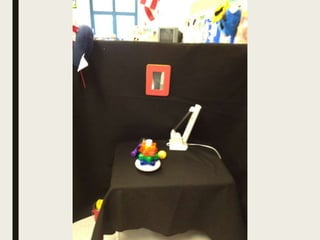
■ Bring items closer and place them on plain
black background
■ Allow child to focus visually without
auditory distraction
■ Present objects in the child’s preferred visual
field
Phase I
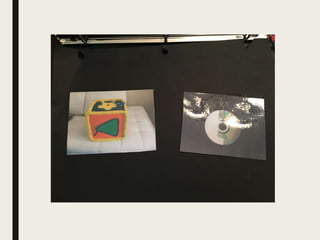
■ Move object slightly/use reflective
materials
■ Use light to initiate looking at an
object/target
■ Place objects where child can look and/or
touch
Sample Phase I materials
■ Lava lamp
■ Rope lights
■ Lighted object by crib/bed
■ Mylar balloon
■ Frame for suspending toys
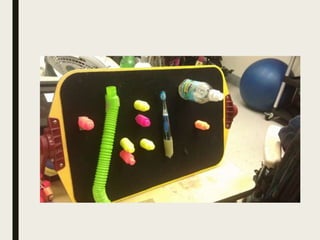
■ Pegboard stand for toys
■ Wind sock
■ Tri-fold boards to block out background
Integrate vision into all
routines
Phase 2
■ Integrate looking into each routine
■ Intervention is overlay in all activities
■ Plan the vision component of the
beginning, middle, and end of all
routines
Phase II
■ Use objects from Phase 1 with expectation
that child will act on materials
■ Functional materials (toothbrush, cup)
child’s favorite color
■ Mylar or shiny materials on switches
Phase II
■ Limit number of objects presented
simultaneously
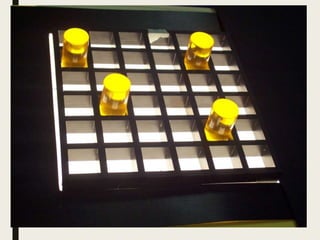
■ Use lightbox to direct visual attention
■ Move highly motivating objects further away
Visual curiosity, using vision
for learning
Phase III
■ Development of visual curiosity
■ Spontaneous use of vision
■ Can now look at self in mirror
■ Can now look at and understand pictures
Phase III
■ Still may have problems in new
environments
■ Remember prior preferences in color,
movement, light, etc when introducing
novel materials
■ Highlight words with color
Phase III
■ Use color as an “anchor” for visual
understanding
■ Highlight picture communication symbols
■ Give visual cue paired with auditory cue
before any action/activity
Phase III
■ Preview environments, teach landmarks
■ Tell the student what to look for in a visual
display or environment
■ If child does not look at something, review
complexity
Phase III
■ Use movement for distance viewing and
scanning choices
■ Use templates to reduce complexity in 2-
dimensional arrays
■ Point out/teach salient features in objects
and pictures
Phase II
■ Touch may initiate looking
■ Use familiar objects in daily routines
■ Shine light on object
■ Introduce photos of favorite objects, first on back-lit
surfaces
■ First books
General intervention
principles
■ Intervention must be intentional
■ Intervention must be precise
■ Expect change
■ Always be aware of the environment
General intervention
strategies
■ Intervention needs to occur in the context of every day life of
the child
■ Children often perform better at home
■ Provide input at the child’s level, NOT above
■ CVI intervention is an approach not a therapy
INTERVENTION
FOR CHILDREN
WITH CVI
By characteristic and phase
Color
■ Use favorite color
■ Use consistency in color
■ Ask parent about what
color child responds to
■ Students may ignore
black and white
■ Use color anchor when
teaching difficult
concepts
■ Make a box of “things
to look at” in the
child’s favorite color
■ Use favorite color for
functional materials
(cup, spoon, etc.)
■ For children at higher
level, use color as a way
to let child know what
to attend to
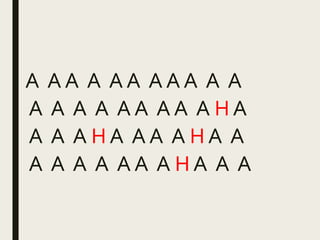
A A H A A A A A A A A A
A A A A A A A A A H A A
A A A H A A A A A A A
A A A A A A A H A A A
A A A A A A A A A A A
A A A A A A A A A H A
A A A H A A A A H A A
A A A A A A A H A A A
Movement
■ May detect movement with peripheral and turn to look with central
vision
■ Reflective objects have movement quality
■ Mirrors are reflective, but watch complexity
■ Use things that naturally move (windsock, balloons, etc.)
■ Use pat-mats
■ Move toy slightly to get child’s attention
■ Use movement to encourage distance viewing
Visual novelty
■ Use characteristics of familiar objects to introduce novel
objects
■ Use familiar objects in a “warm-up session”
■ Present important materials consistently and frequently
■ Highlight novel with familiar color
■ Redundancy is not boring for child with CVI
■ Limit novelty
Latency
■ Wait, WAIT, WAIT
■ Latency will vary across session
■ Latency will vary based on novelty, fields, color, etc.
■ Fatigue, time of day, illness, etc. also affect latency
■ Positioning also affects latency
■ Always consider latency if looking is not automatic for the child
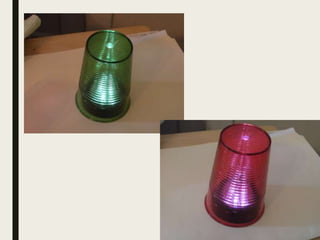
Light gazing
■ Use light as a motivator
■ Use lightbox with children attracted to light
■ Use back-lit tablet (iPad)
■ Be careful about multisensory aspect of lighted toys
■ Position away from light source
■ Watch for windows, overhead lights, ceiling fans
■ Shine light on toy you want child to attend to
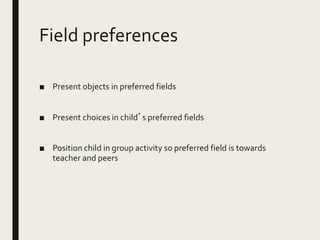
Field preferences
■ Present objects in preferred fields
■ Present choices in child’s preferred fields
■ Position child in group activity so preferred field is towards
teacher and peers
Complexity
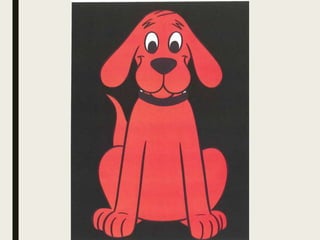
■ Use plain non-reflective background
■ Watch for what is on the wall behind teacher
■ Watch for what you are wearing, use smock or apron
■ Use tri-fold board to simplify parts of a room
■ Use single color objects
■ Limit multisensory toys
■ Watch for noise in background
Complexity con’t.
■ Use more supportive positions for complex vision work
■ Greet child and then be quiet to give time to look. Remember
that faces are very complex
■ Cover trays with black cloth (pillow case)
■ Reduce complexity of vision work when working on more
complex cognitive or communication goals
Complexity con’t.
■ Do not have too many toys out at one time
■ Use child’s verbal skills to help direct where to focus visual
attention
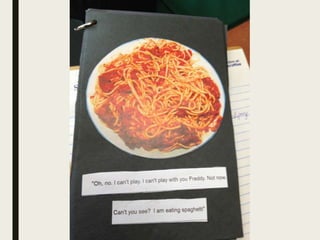
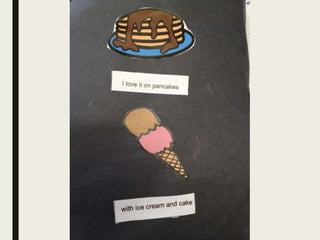
■ Use simple pictures, one per page, plain background
■ Describe salient features of objects
■ Reduce the amount of written information on a page
Complexity con’t.
■ Large print reduces complexity
■ Keep work space uncluttered
■ Hand over hand prompting increases complexity
■ Mirrors also reflect what is behind them which increases
complexity
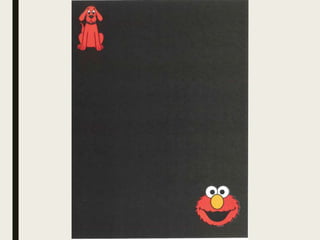
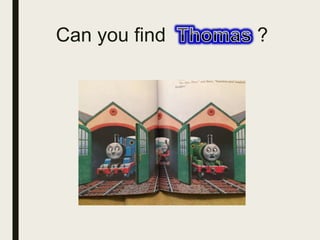
Can you find ?
Distance viewing
■ Distance is a function of complexity
■ Distance viewing usually begins with large moving targets (a
person walking)
■ Use movement, favorite color, favorite toy, etc. to improve
distance viewing
■ Preview environments and teach child what she is looking at
Visual Motor
■ Child may look and look away and reach
■ Position objects so child can act on them
■ Use objects that move when child accidentally touches
■ Use Mylar balloon attached to child’s arm
■ Child may reach for familiar
CVI Progression
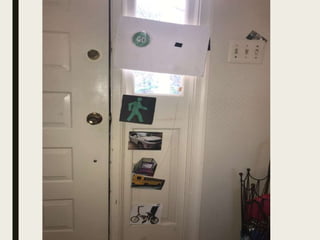
■ How do we get from here to there???

Intervention for Children with CVI

  • 1.
    INTERVENTION FOR CHILDREN WITH CVI Generalstrategies Dr. Sandy Newcomb snewcomb104@gmail.com
  • 2.
    The CVI Range* Assessmentgives “0” to “10” score 0 = no functional vision 10 = typical visual functioning Score and Phase Phase 1 0 to 3 score Phase 2 3 to 7 score Phase 3 7 to 10 score *Roman-Lantzy,C. (2018) CorticalVisual Impairment:An Approach to Assessment and Intervention, 2nd Ed. APH Press, Louisville, KY.
  • 3.
    Phases Phase 1 :building stable visual function Phase 2: integrating vision with function Phase 3: visual curiosity, using vision for learning
  • 4.
  • 5.
    Phase I ■ Highlevel of environmental control ■ Plan times of the day when the child can practice vision without other demands ■ For each position that child spends time, place something (from “vision” toys) to look at
  • 6.
    Phase I ■ Use“down” time for vision activities, e.g. tube feeding ■ Create a box of toys “things Eric will look at” ■ Use single colored objects/favorite toys
  • 7.
    Phase I ■ Usecharacteristics of familiar objects to introduce new objects ■ Bring items closer and place them on plain black background ■ Allow child to focus visually without auditory distraction ■ Present objects in the child’s preferred visual field
  • 8.
    Phase I ■ Moveobject slightly/use reflective materials ■ Use light to initiate looking at an object/target ■ Place objects where child can look and/or touch
  • 9.
    Sample Phase Imaterials ■ Lava lamp ■ Rope lights ■ Lighted object by crib/bed ■ Mylar balloon ■ Frame for suspending toys ■ Pegboard stand for toys ■ Wind sock ■ Tri-fold boards to block out background
  • 10.
  • 11.
    Phase 2 ■ Integratelooking into each routine ■ Intervention is overlay in all activities ■ Plan the vision component of the beginning, middle, and end of all routines
  • 12.
    Phase II ■ Useobjects from Phase 1 with expectation that child will act on materials ■ Functional materials (toothbrush, cup) child’s favorite color ■ Mylar or shiny materials on switches
  • 13.
    Phase II ■ Limitnumber of objects presented simultaneously ■ Use lightbox to direct visual attention ■ Move highly motivating objects further away
  • 14.
    Visual curiosity, usingvision for learning
  • 15.
    Phase III ■ Developmentof visual curiosity ■ Spontaneous use of vision ■ Can now look at self in mirror ■ Can now look at and understand pictures
  • 16.
    Phase III ■ Stillmay have problems in new environments ■ Remember prior preferences in color, movement, light, etc when introducing novel materials ■ Highlight words with color
  • 17.
    Phase III ■ Usecolor as an “anchor” for visual understanding ■ Highlight picture communication symbols ■ Give visual cue paired with auditory cue before any action/activity
  • 18.
    Phase III ■ Previewenvironments, teach landmarks ■ Tell the student what to look for in a visual display or environment ■ If child does not look at something, review complexity
  • 19.
    Phase III ■ Usemovement for distance viewing and scanning choices ■ Use templates to reduce complexity in 2- dimensional arrays ■ Point out/teach salient features in objects and pictures
  • 20.
    Phase II ■ Touchmay initiate looking ■ Use familiar objects in daily routines ■ Shine light on object ■ Introduce photos of favorite objects, first on back-lit surfaces ■ First books
  • 21.
    General intervention principles ■ Interventionmust be intentional ■ Intervention must be precise ■ Expect change ■ Always be aware of the environment
  • 22.
    General intervention strategies ■ Interventionneeds to occur in the context of every day life of the child ■ Children often perform better at home ■ Provide input at the child’s level, NOT above ■ CVI intervention is an approach not a therapy
  • 23.
    INTERVENTION FOR CHILDREN WITH CVI Bycharacteristic and phase
  • 24.
    Color ■ Use favoritecolor ■ Use consistency in color ■ Ask parent about what color child responds to ■ Students may ignore black and white ■ Use color anchor when teaching difficult concepts ■ Make a box of “things to look at” in the child’s favorite color ■ Use favorite color for functional materials (cup, spoon, etc.) ■ For children at higher level, use color as a way to let child know what to attend to
  • 27.
    A A HA A A A A A A A A A A A A A A A A A H A A A A A H A A A A A A A A A A A A A A H A A A
  • 28.
    A A AA A A A A A A A A A A A A A A A A H A A A A H A A A A H A A A A A A A A A H A A A
  • 29.
    Movement ■ May detectmovement with peripheral and turn to look with central vision ■ Reflective objects have movement quality ■ Mirrors are reflective, but watch complexity ■ Use things that naturally move (windsock, balloons, etc.) ■ Use pat-mats ■ Move toy slightly to get child’s attention ■ Use movement to encourage distance viewing
  • 31.
    Visual novelty ■ Usecharacteristics of familiar objects to introduce novel objects ■ Use familiar objects in a “warm-up session” ■ Present important materials consistently and frequently ■ Highlight novel with familiar color ■ Redundancy is not boring for child with CVI ■ Limit novelty
  • 32.
    Latency ■ Wait, WAIT,WAIT ■ Latency will vary across session ■ Latency will vary based on novelty, fields, color, etc. ■ Fatigue, time of day, illness, etc. also affect latency ■ Positioning also affects latency ■ Always consider latency if looking is not automatic for the child
  • 34.
    Light gazing ■ Uselight as a motivator ■ Use lightbox with children attracted to light ■ Use back-lit tablet (iPad) ■ Be careful about multisensory aspect of lighted toys ■ Position away from light source ■ Watch for windows, overhead lights, ceiling fans ■ Shine light on toy you want child to attend to
  • 38.
    Field preferences ■ Presentobjects in preferred fields ■ Present choices in child’s preferred fields ■ Position child in group activity so preferred field is towards teacher and peers
  • 39.
    Complexity ■ Use plainnon-reflective background ■ Watch for what is on the wall behind teacher ■ Watch for what you are wearing, use smock or apron ■ Use tri-fold board to simplify parts of a room ■ Use single color objects ■ Limit multisensory toys ■ Watch for noise in background
  • 40.
    Complexity con’t. ■ Usemore supportive positions for complex vision work ■ Greet child and then be quiet to give time to look. Remember that faces are very complex ■ Cover trays with black cloth (pillow case) ■ Reduce complexity of vision work when working on more complex cognitive or communication goals
  • 41.
    Complexity con’t. ■ Donot have too many toys out at one time ■ Use child’s verbal skills to help direct where to focus visual attention ■ Use simple pictures, one per page, plain background ■ Describe salient features of objects ■ Reduce the amount of written information on a page
  • 42.
    Complexity con’t. ■ Largeprint reduces complexity ■ Keep work space uncluttered ■ Hand over hand prompting increases complexity ■ Mirrors also reflect what is behind them which increases complexity
  • 49.
  • 52.
    Distance viewing ■ Distanceis a function of complexity ■ Distance viewing usually begins with large moving targets (a person walking) ■ Use movement, favorite color, favorite toy, etc. to improve distance viewing ■ Preview environments and teach child what she is looking at
  • 55.
    Visual Motor ■ Childmay look and look away and reach ■ Position objects so child can act on them ■ Use objects that move when child accidentally touches ■ Use Mylar balloon attached to child’s arm ■ Child may reach for familiar
  • 57.
    CVI Progression ■ Howdo we get from here to there???