Illustrated Construction Dictionary BSCI 2300-001 Spring 2009 Chamfer
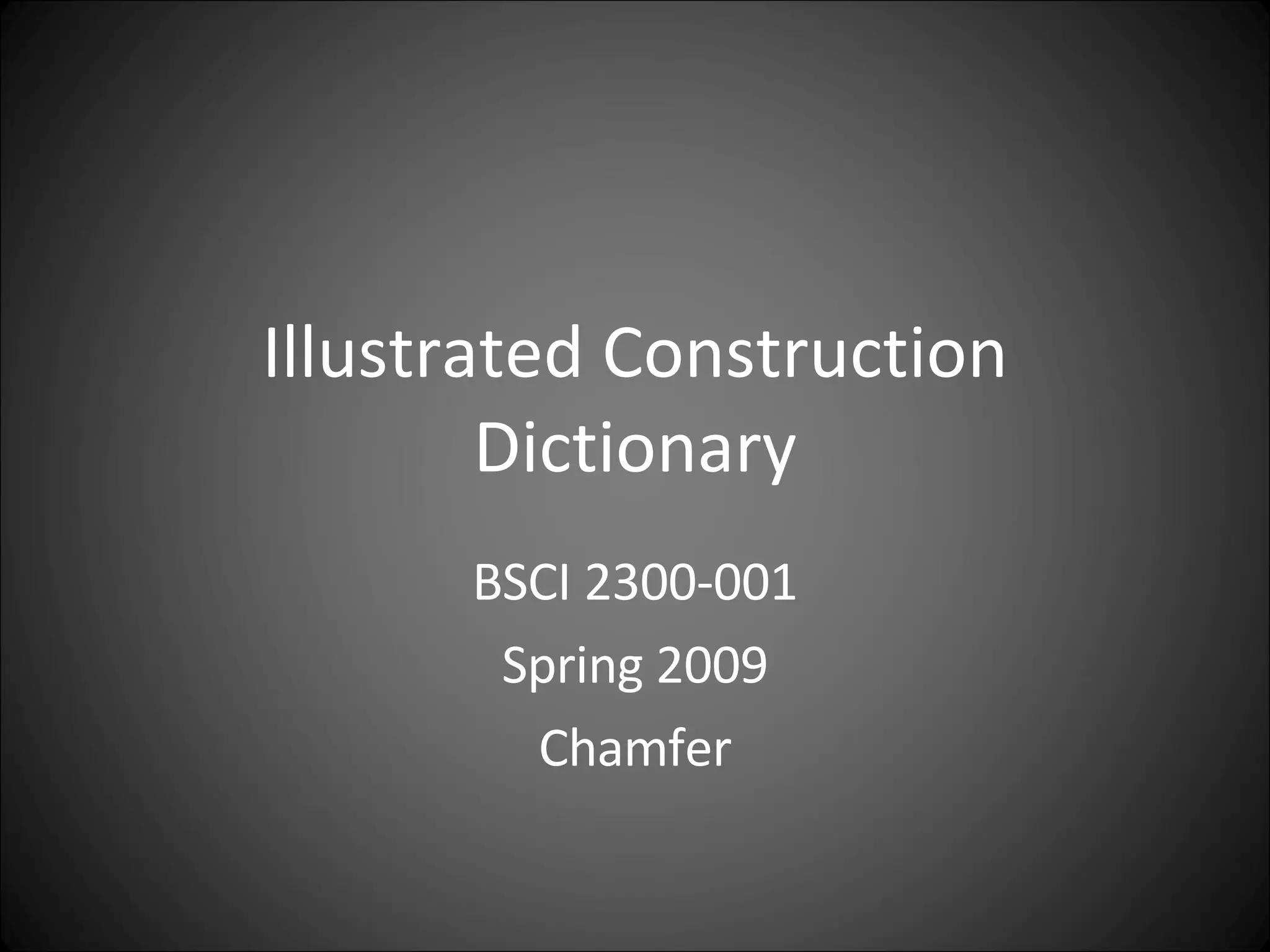
Air Barrier Paper/Air Vapor Barrier A sheet material used as both a vapor retarder and an air barrier.  When carefully taped at joints and sealed at edges, it is very effective.
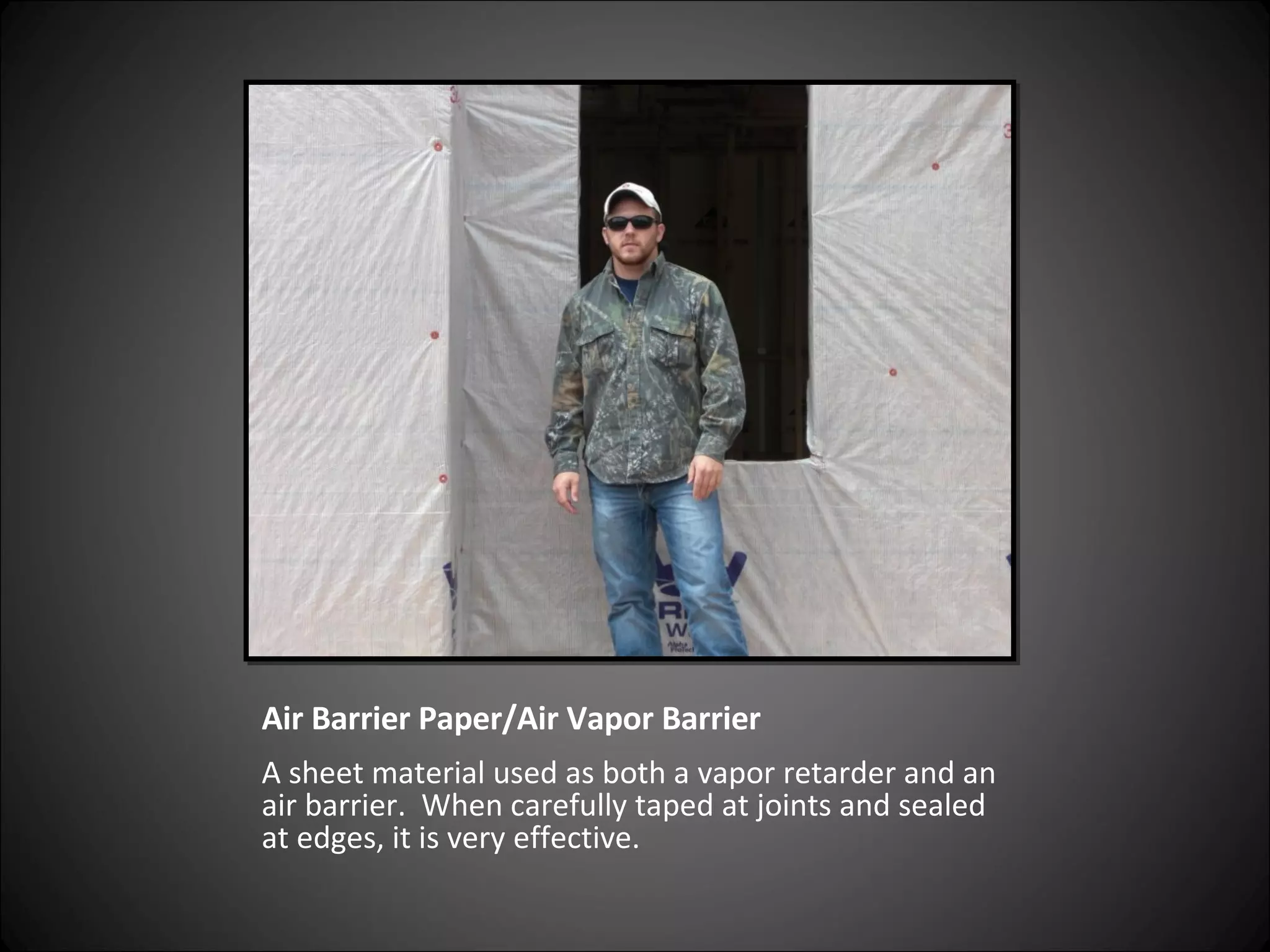
Attic Ventilation Attics are ventilated not only to allow water vapor to escape, but also to keep the house cooler summer by preventing the buildup of solar heat.
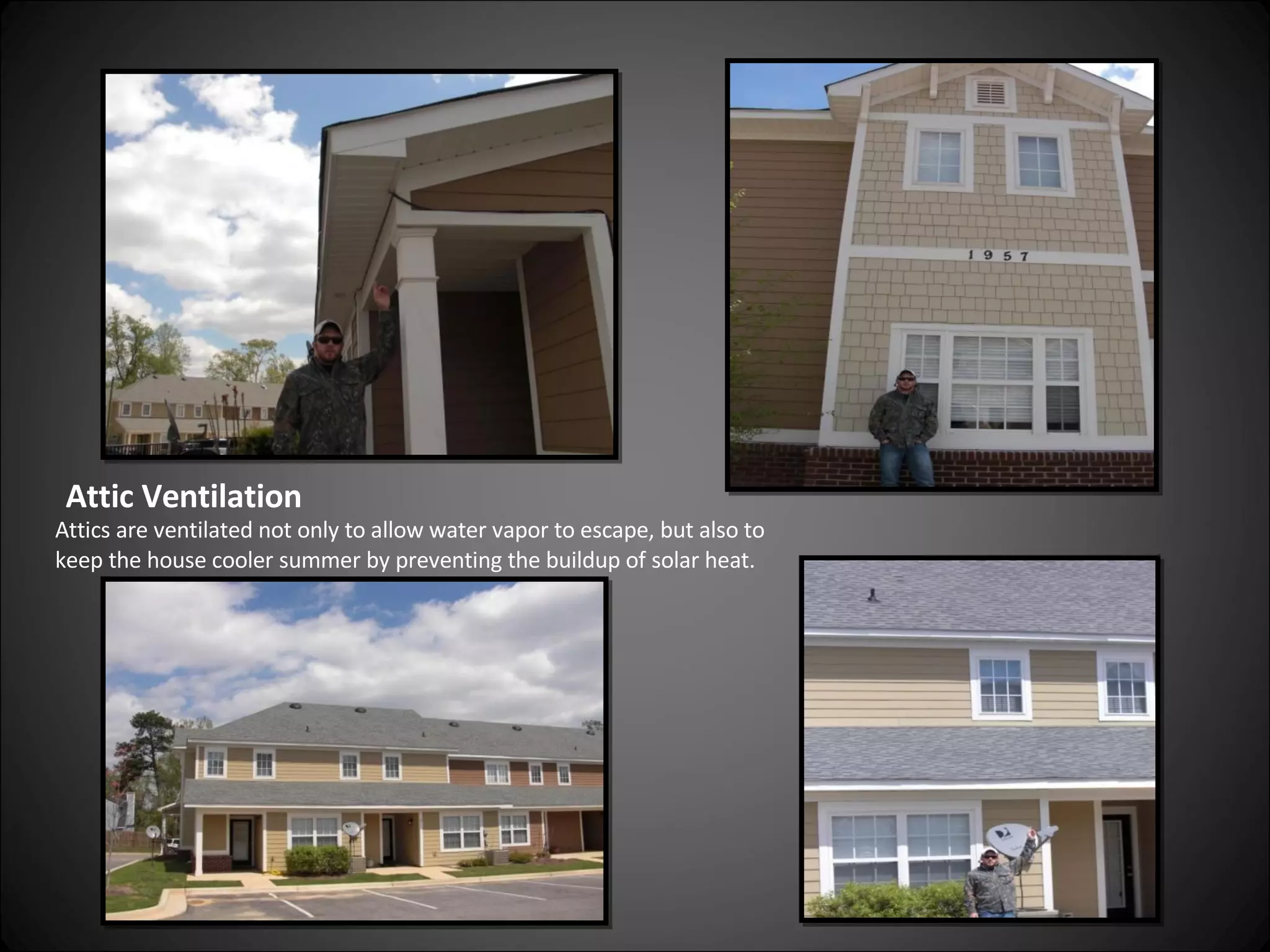
Soffit Vent An opening under the eave of a roof, used to allow air to flow into the attic or the space below the roof sheathing.
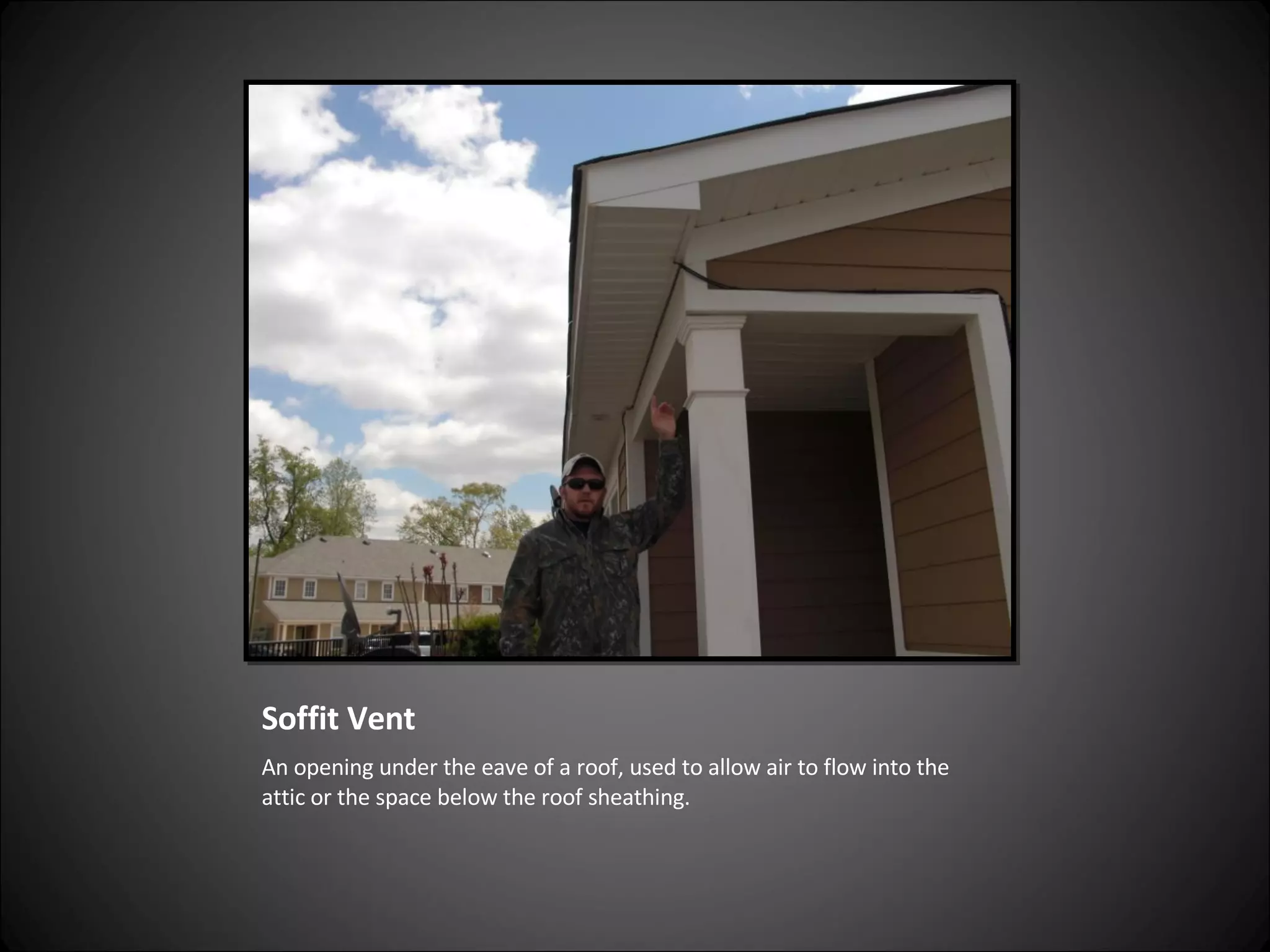
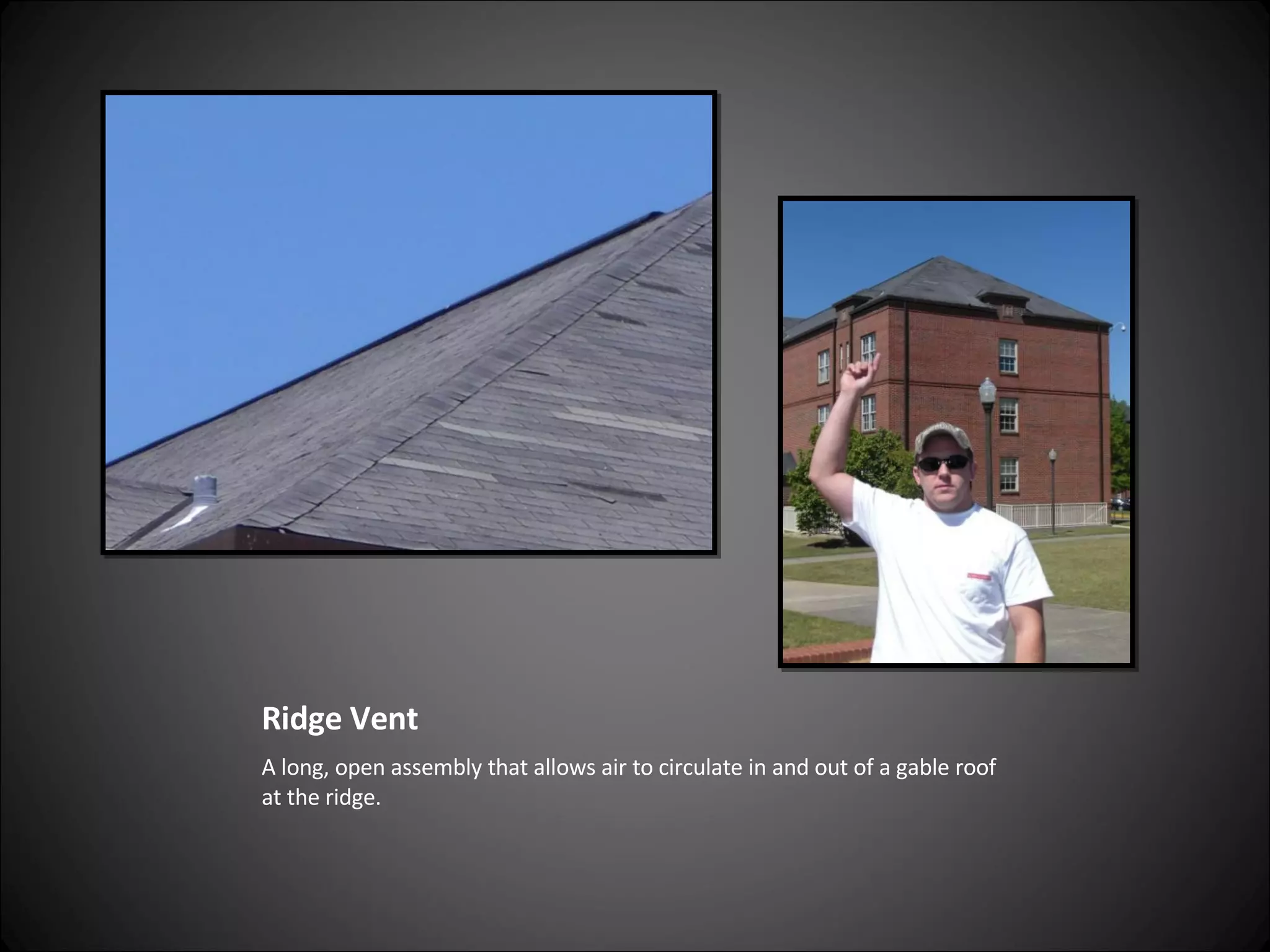
Ridge Vent A long, open assembly that allows air to circulate in and out of a gable roof at the ridge.
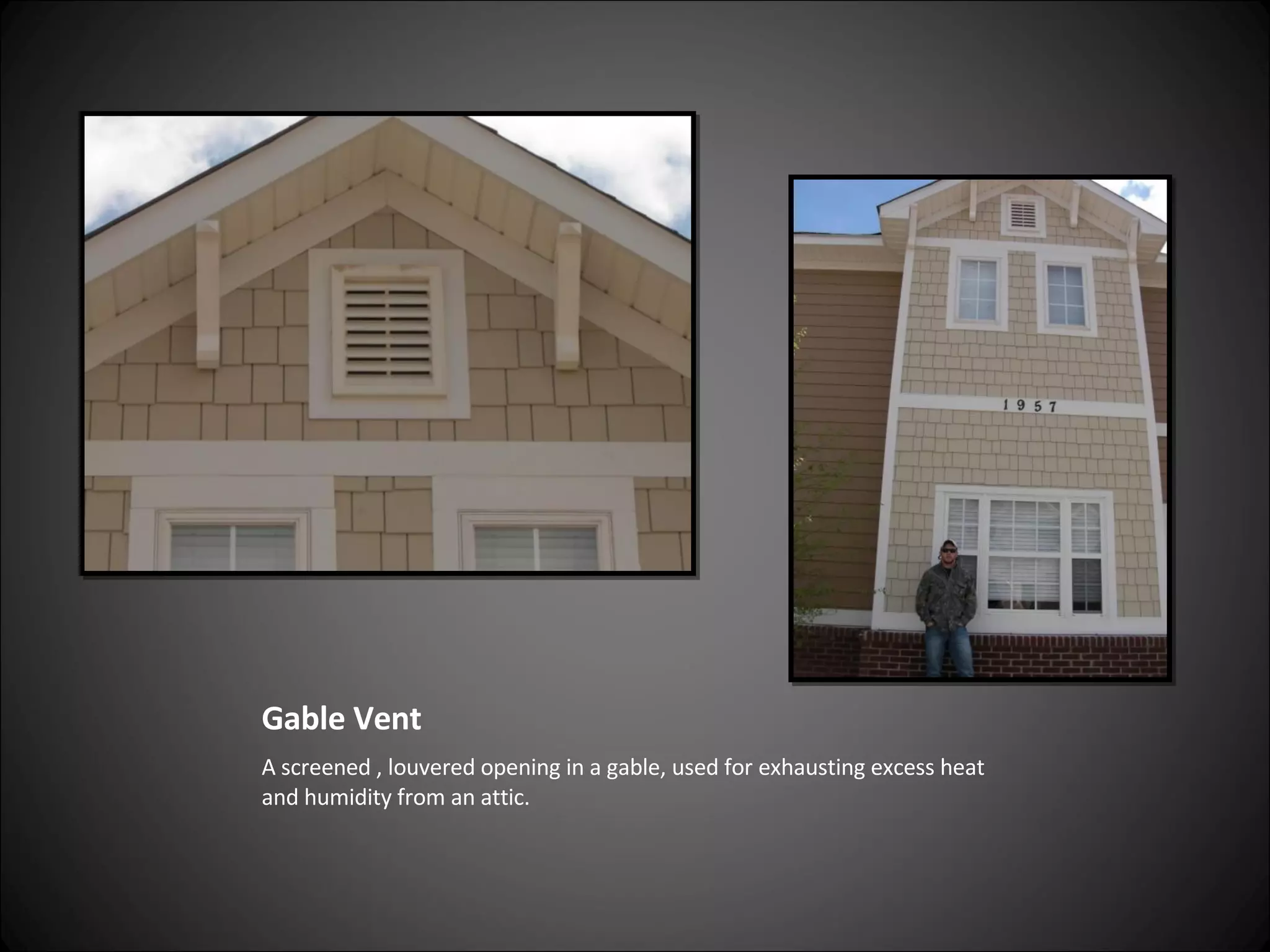
Gable Vent A screened , louvered opening in a gable, used for exhausting excess heat and humidity from an attic.
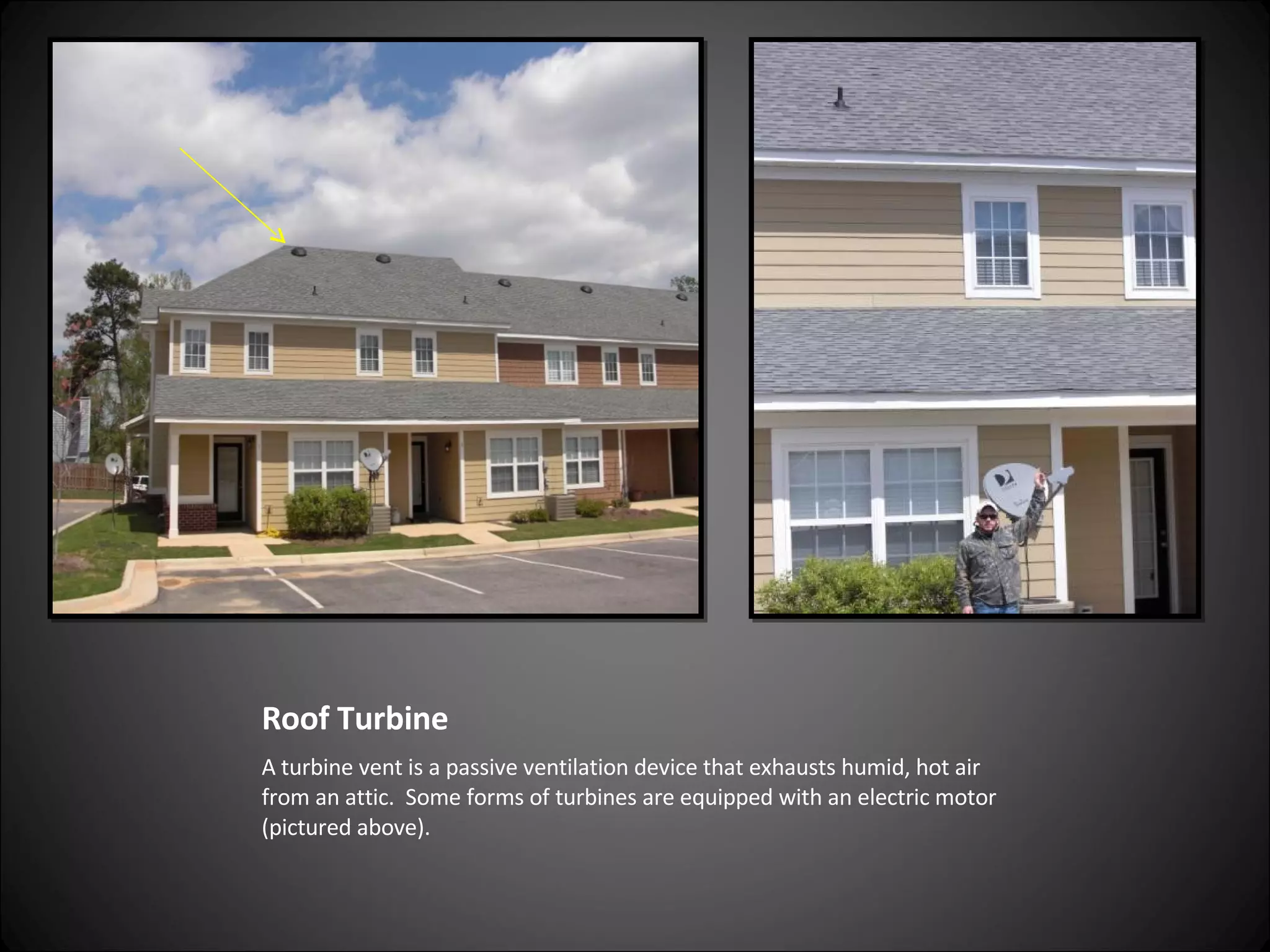
Roof Turbine A turbine vent is a passive ventilation device that exhausts humid, hot air from an attic.  Some forms of turbines are equipped with an electric motor (pictured above).
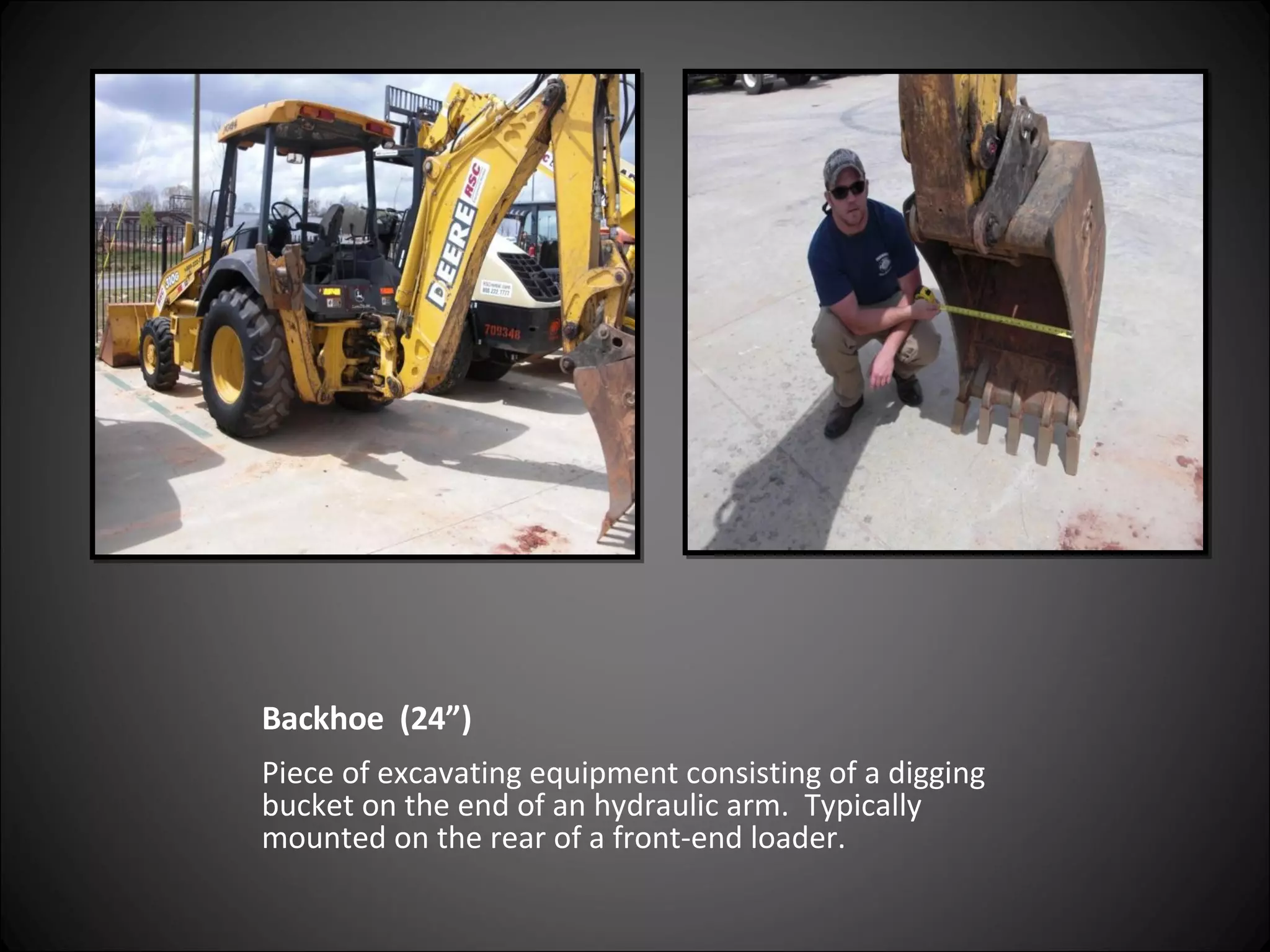
Backhoe  (24”) Piece of excavating equipment consisting of a digging bucket on the end of an hydraulic arm.  Typically mounted on the rear of a front-end loader.
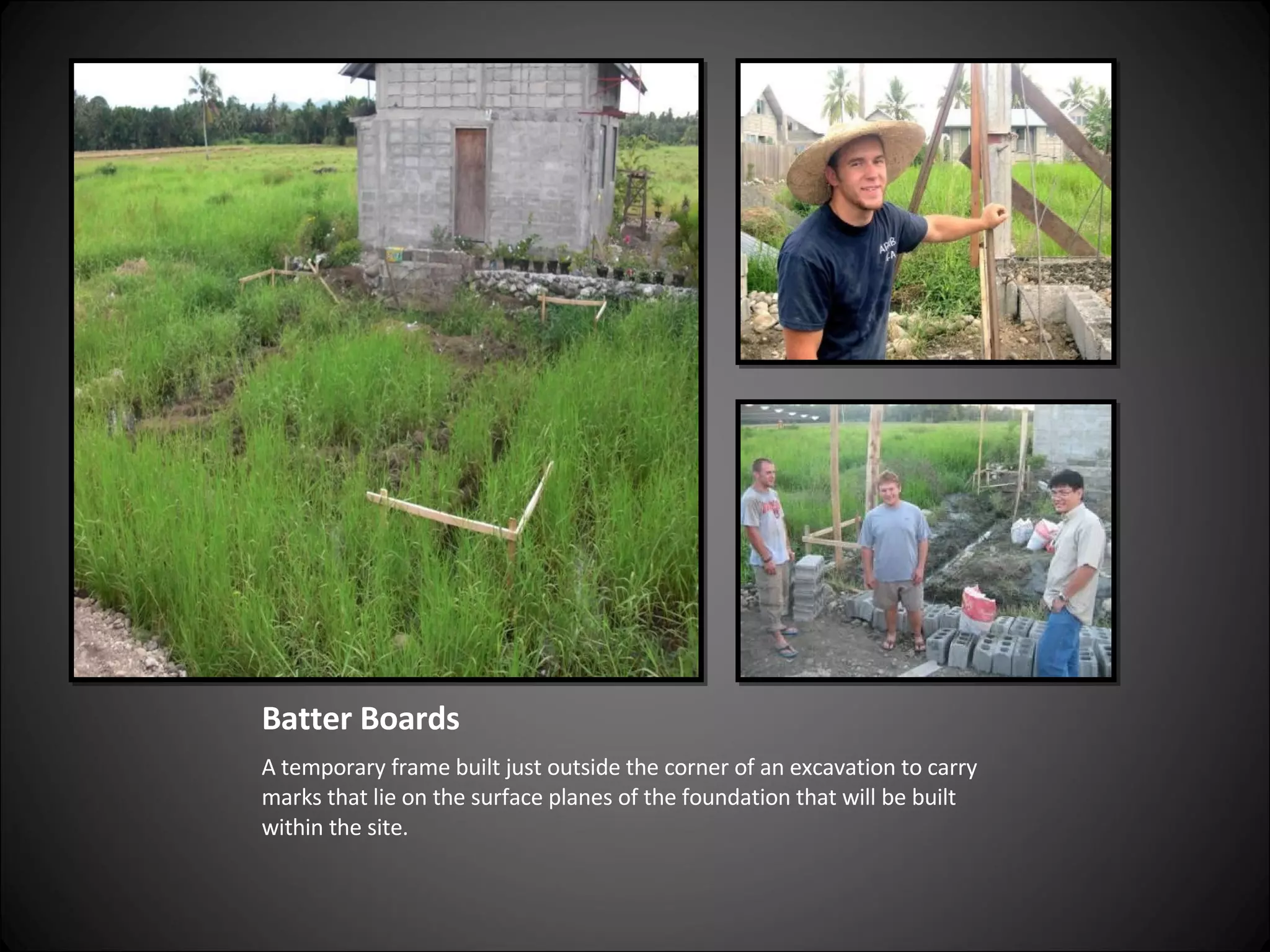
Batter Boards A temporary frame built just outside the corner of an excavation to carry marks that lie on the surface planes of the foundation that will be built within the site.
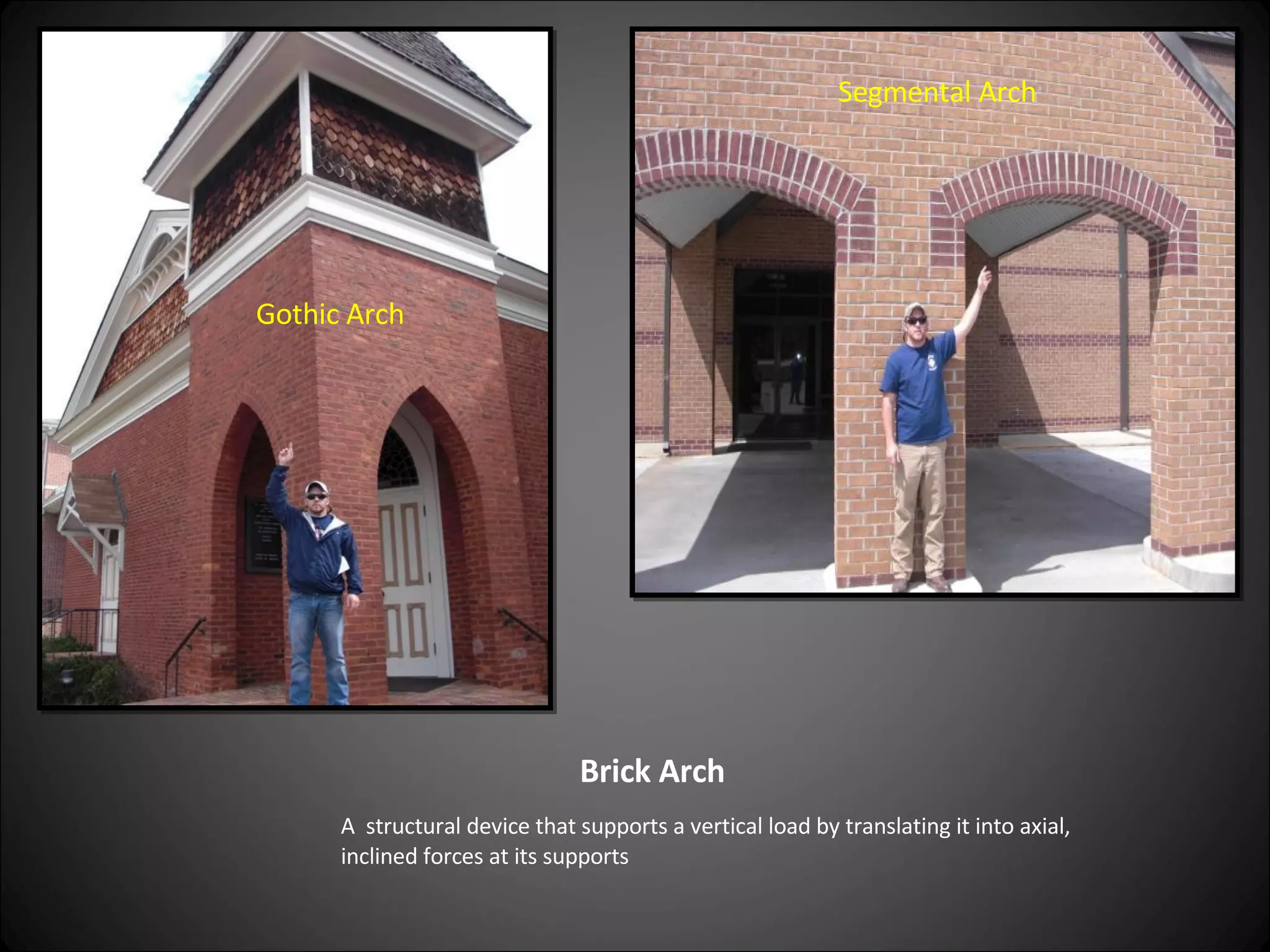
Brick Arch  A  structural device that supports a vertical load by translating it into axial, inclined forces at its supports Segmental Arch Gothic Arch
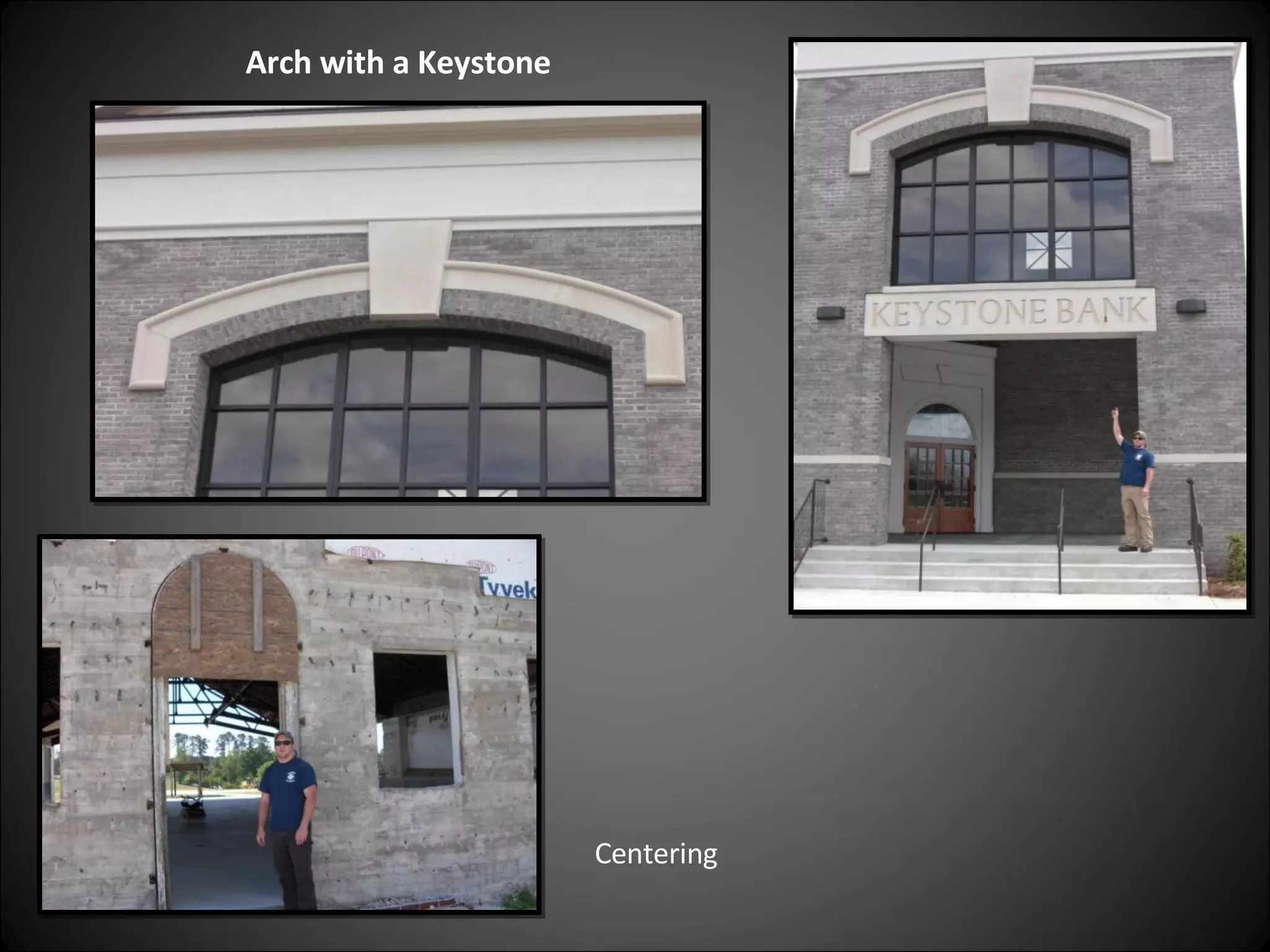
Arch with a Keystone Centering
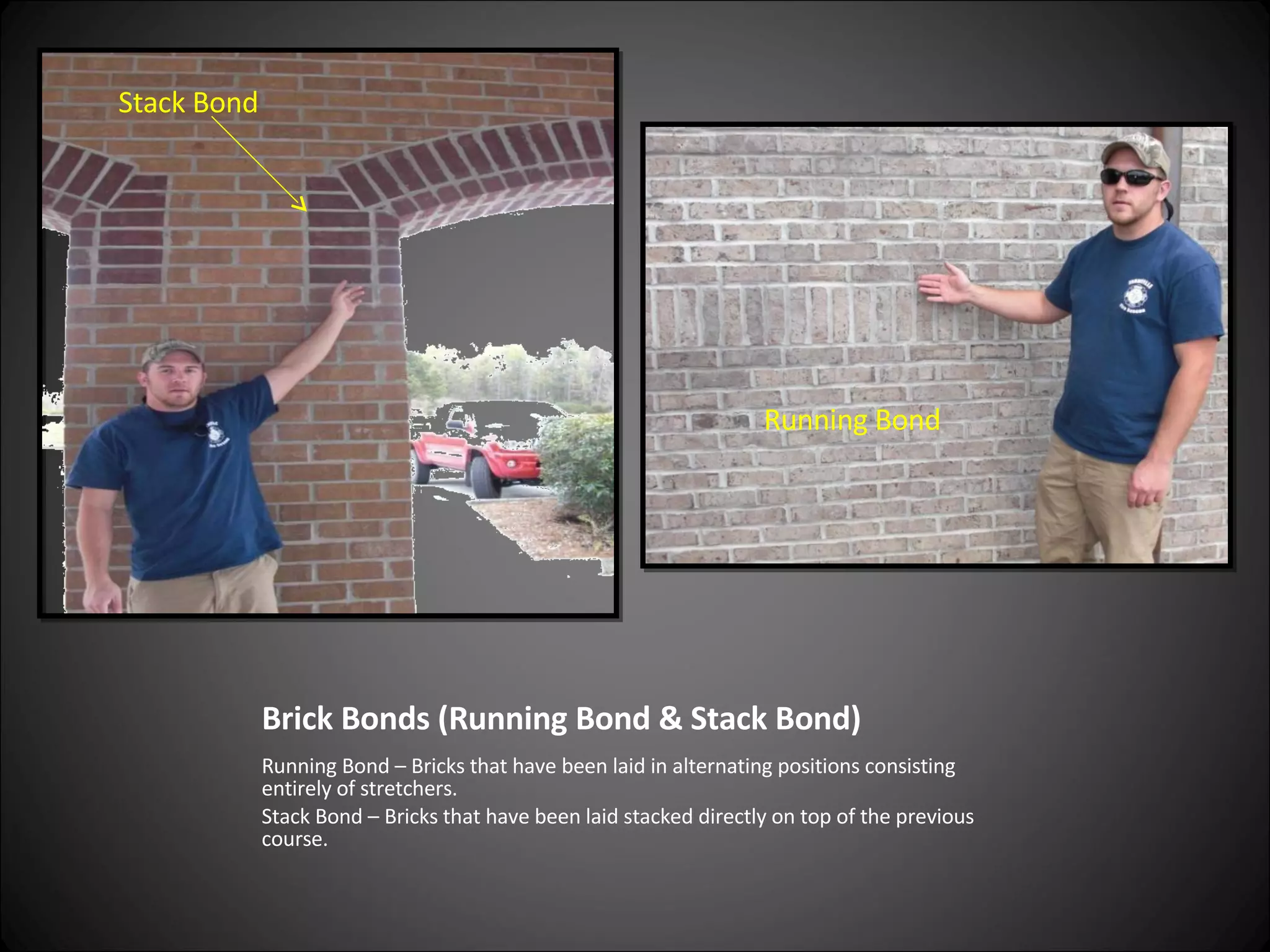
Brick Bonds (Running Bond & Stack Bond) Running Bond – Bricks that have been laid in alternating positions consisting entirely of stretchers. Stack Bond – Bricks that have been laid stacked directly on top of the previous course. Running Bond Stack Bond
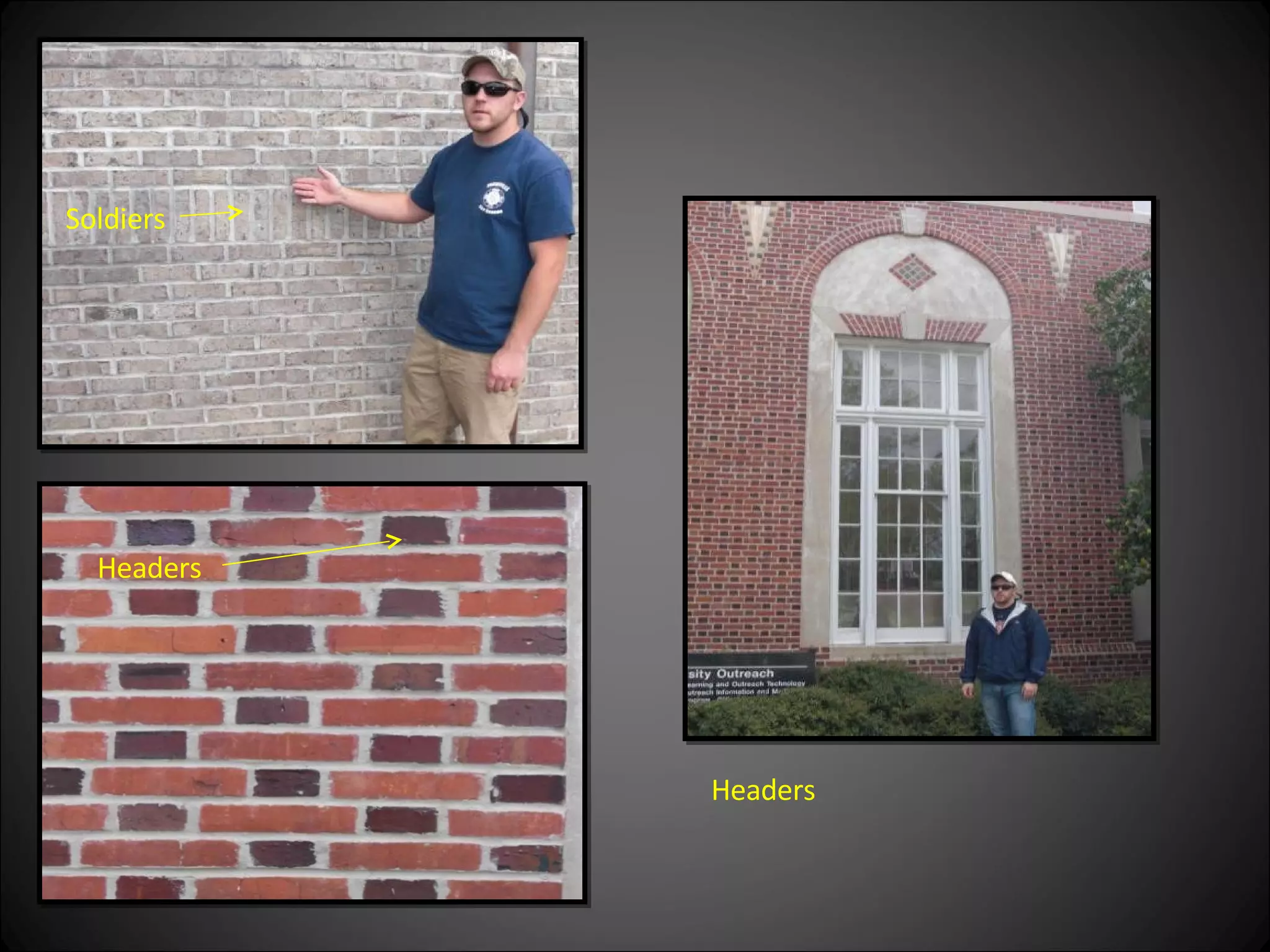
Soldiers Headers Headers
Sailors Rowlocks
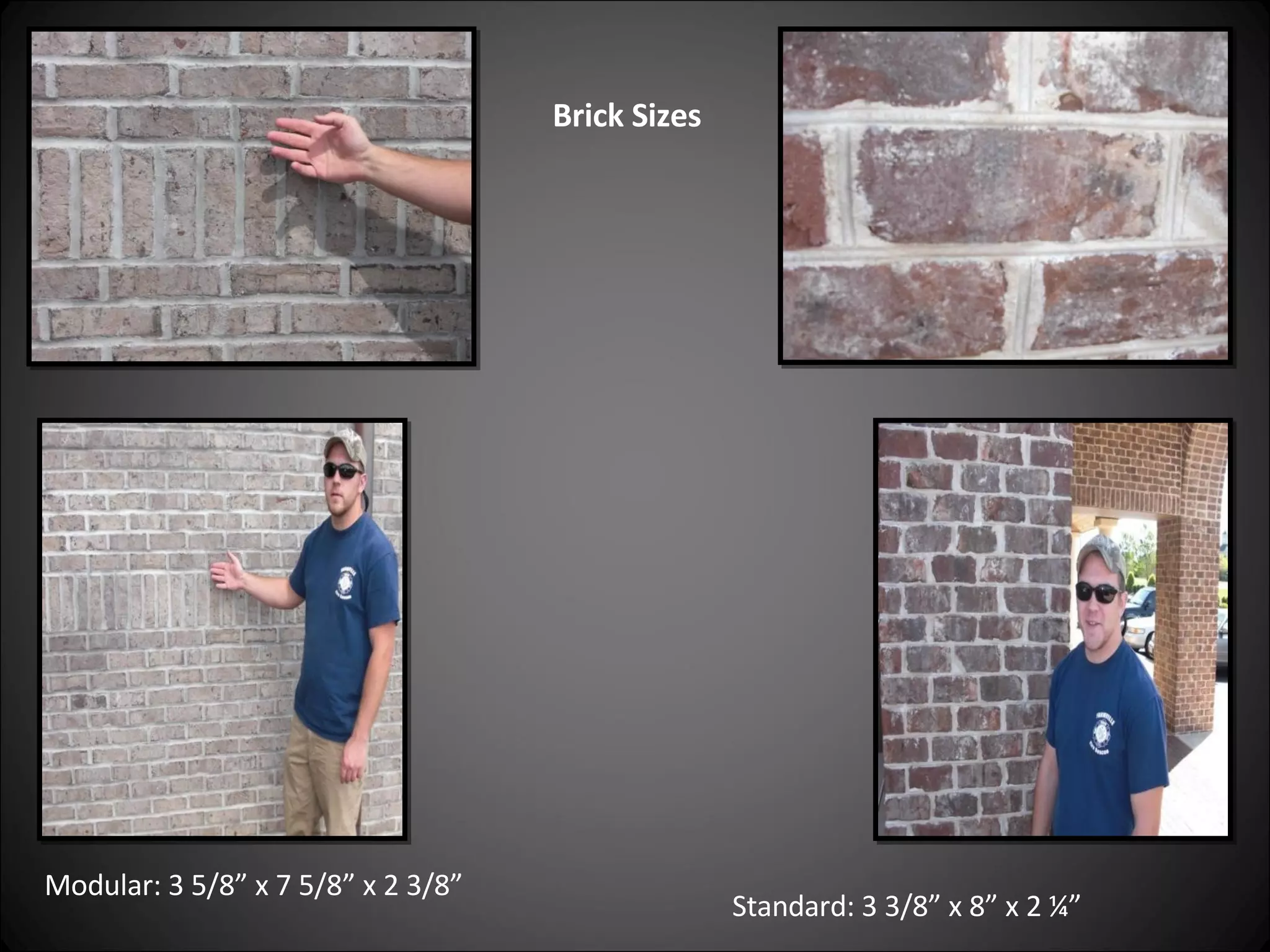
Brick Sizes Modular: 3 5/8” x 7 5/8” x 2 3/8”  Standard: 3 3/8” x 8” x 2 ¼”
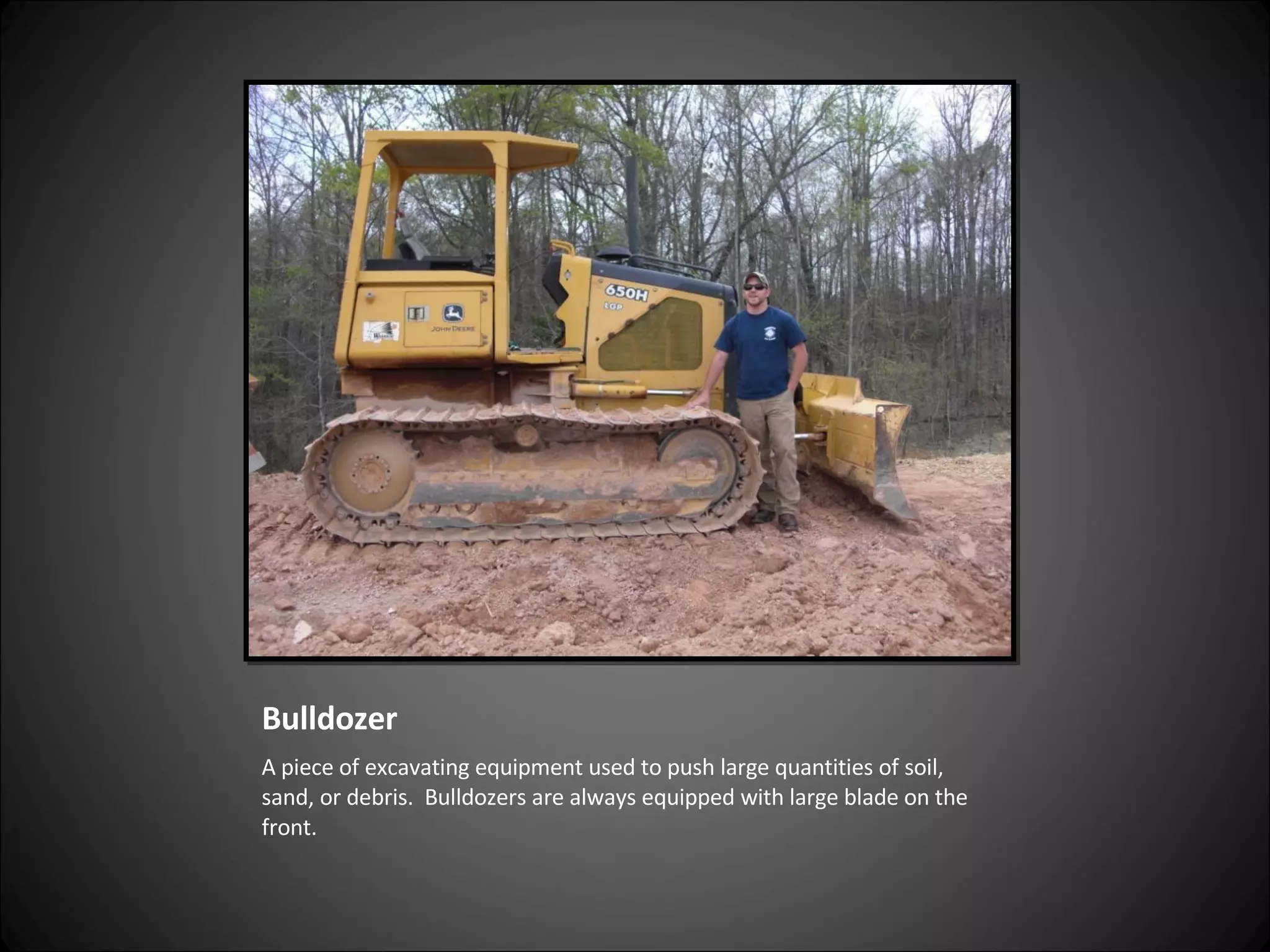
Bulldozer A piece of excavating equipment used to push large quantities of soil, sand, or debris.  Bulldozers are always equipped with large blade on the front.
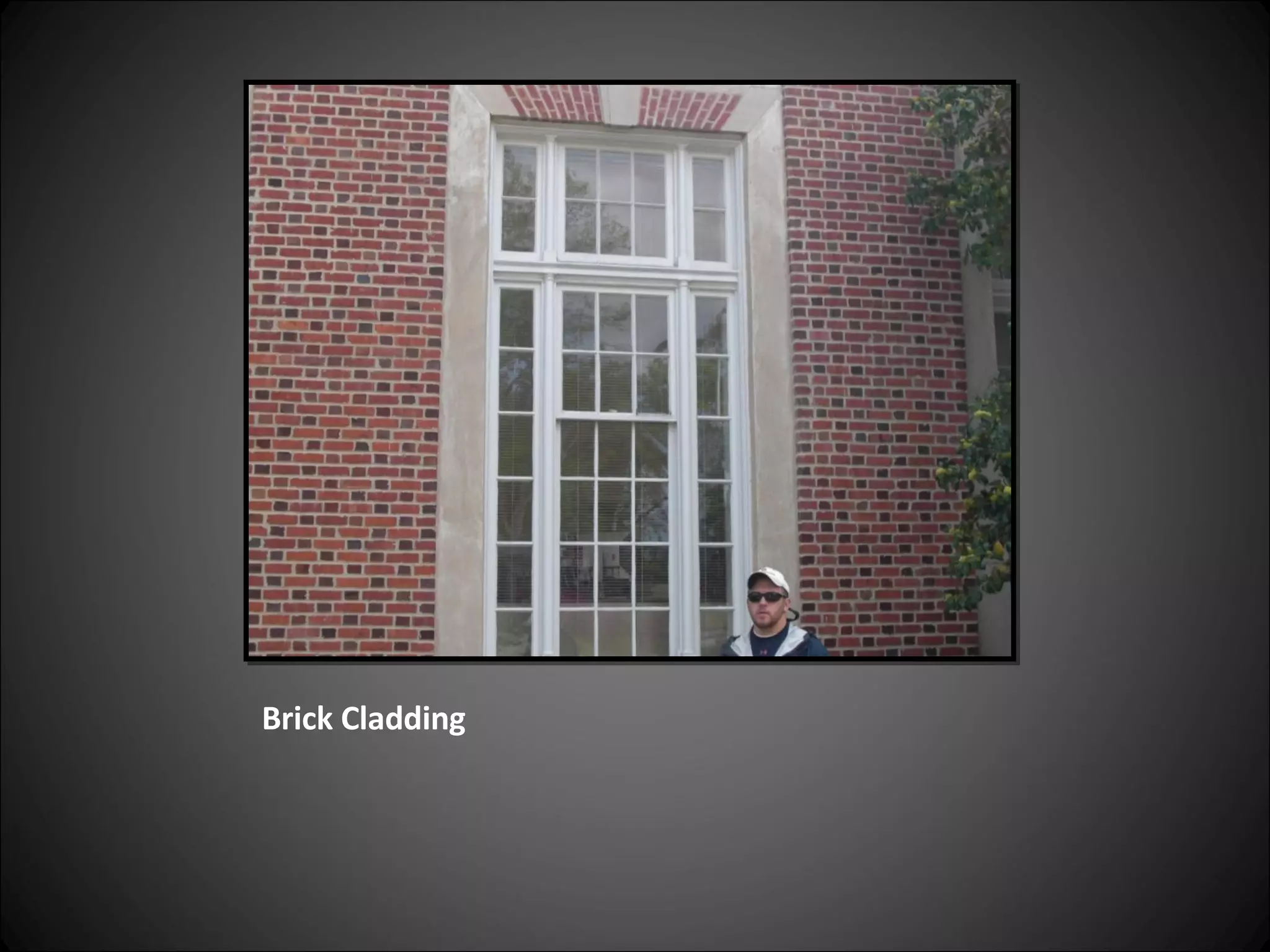
Brick Cladding
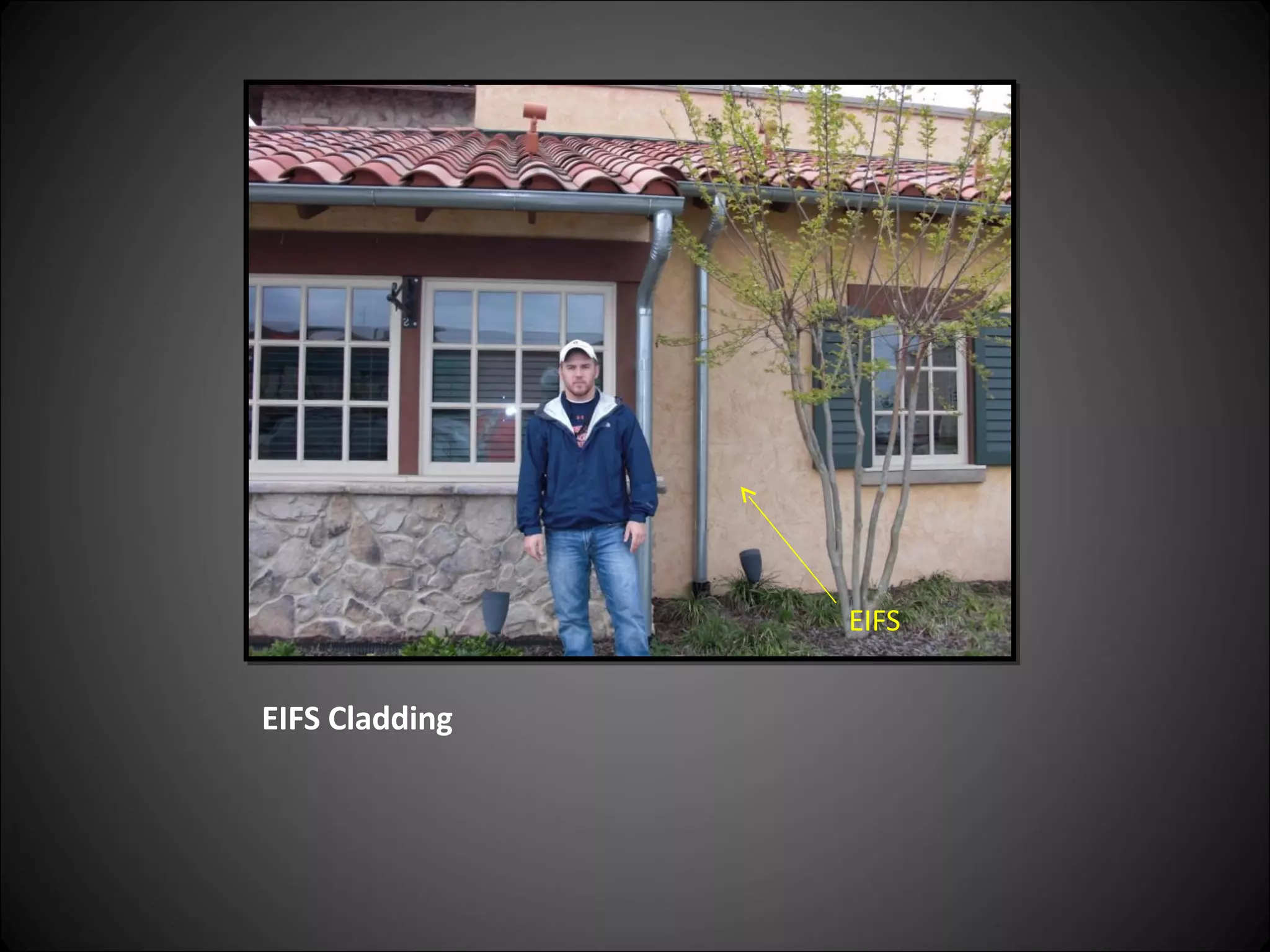
EIFS Cladding EIFS
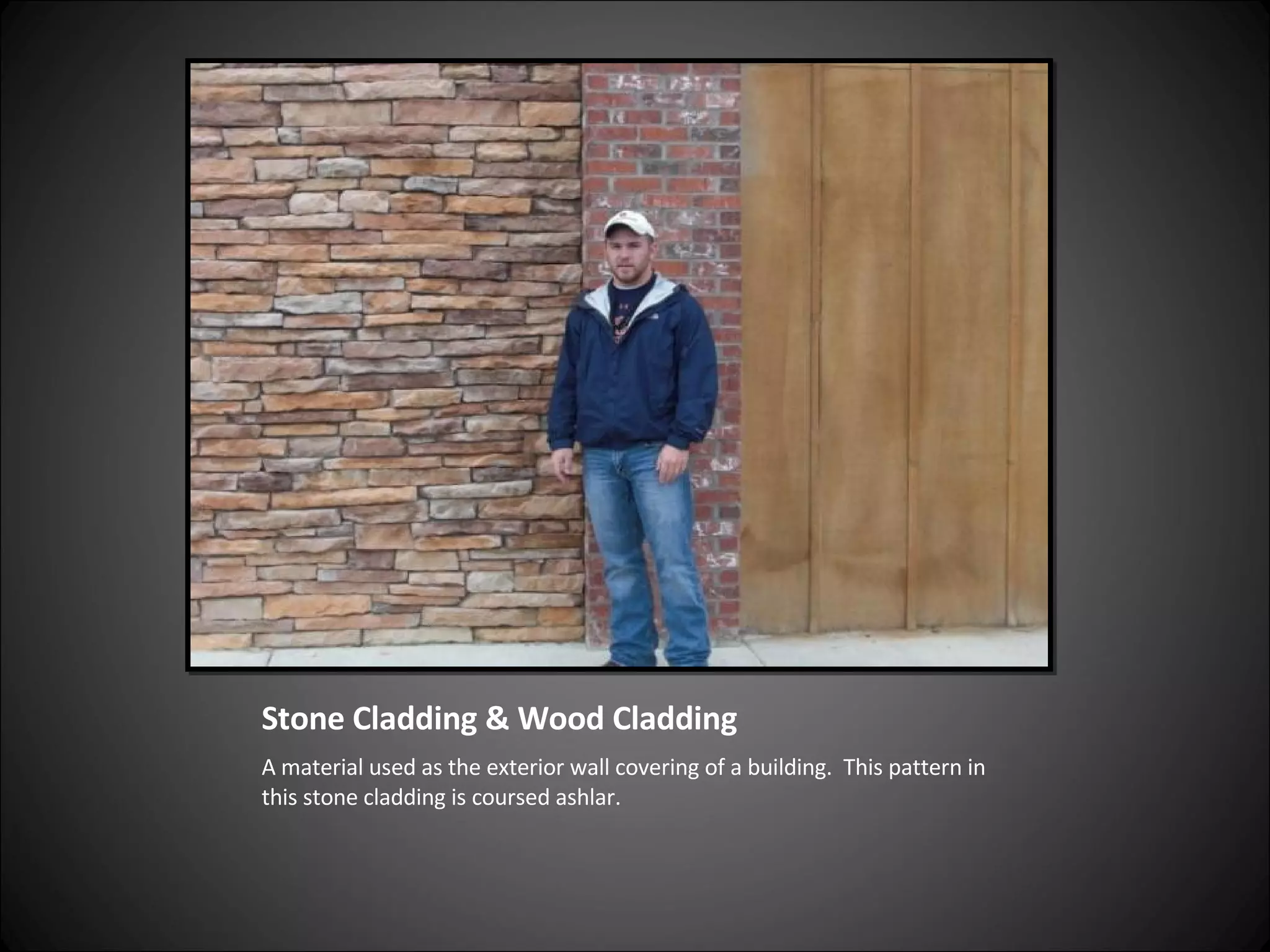
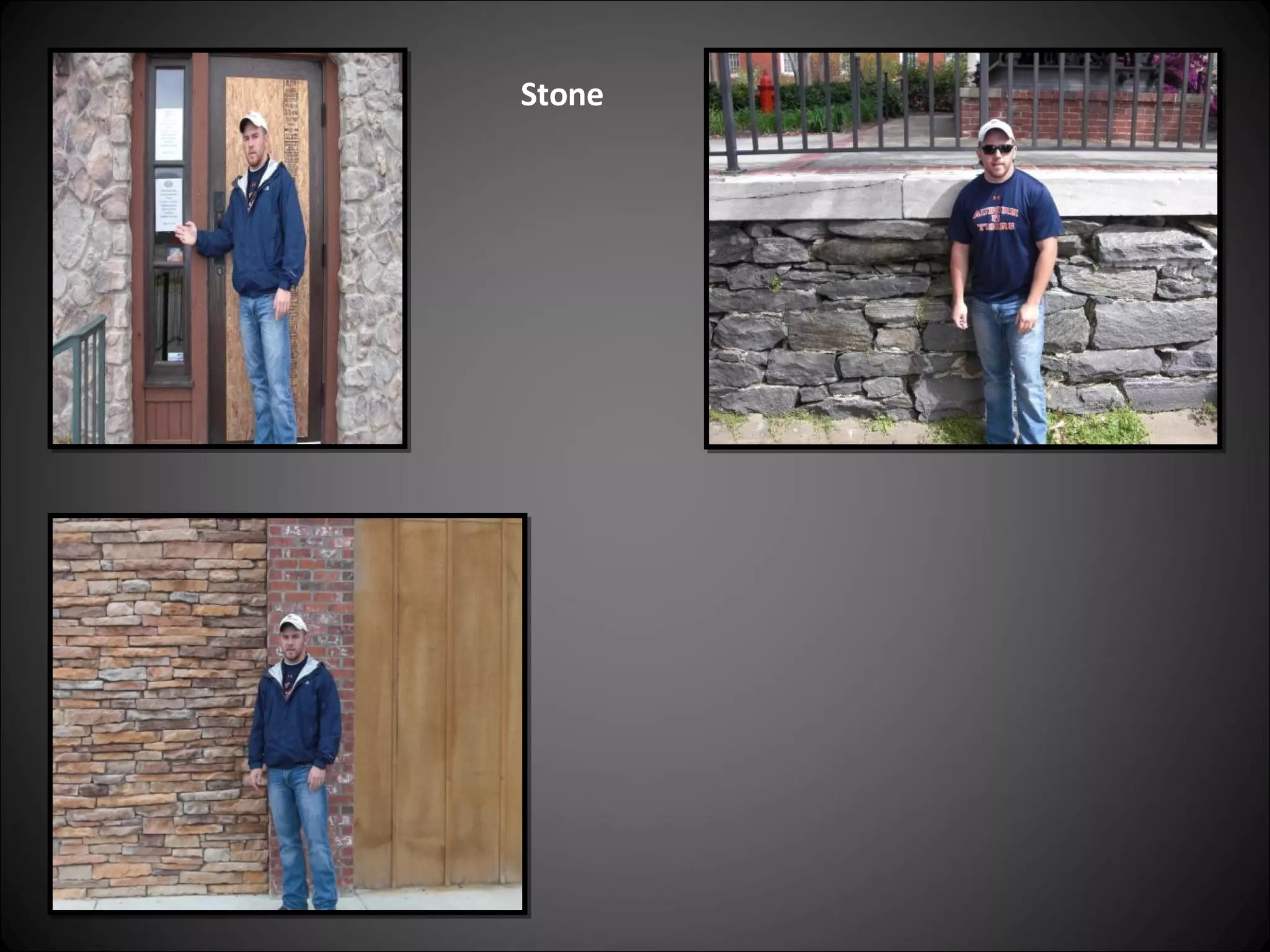
Stone Cladding & Wood Cladding A material used as the exterior wall covering of a building.  This pattern in this stone cladding is coursed ashlar.
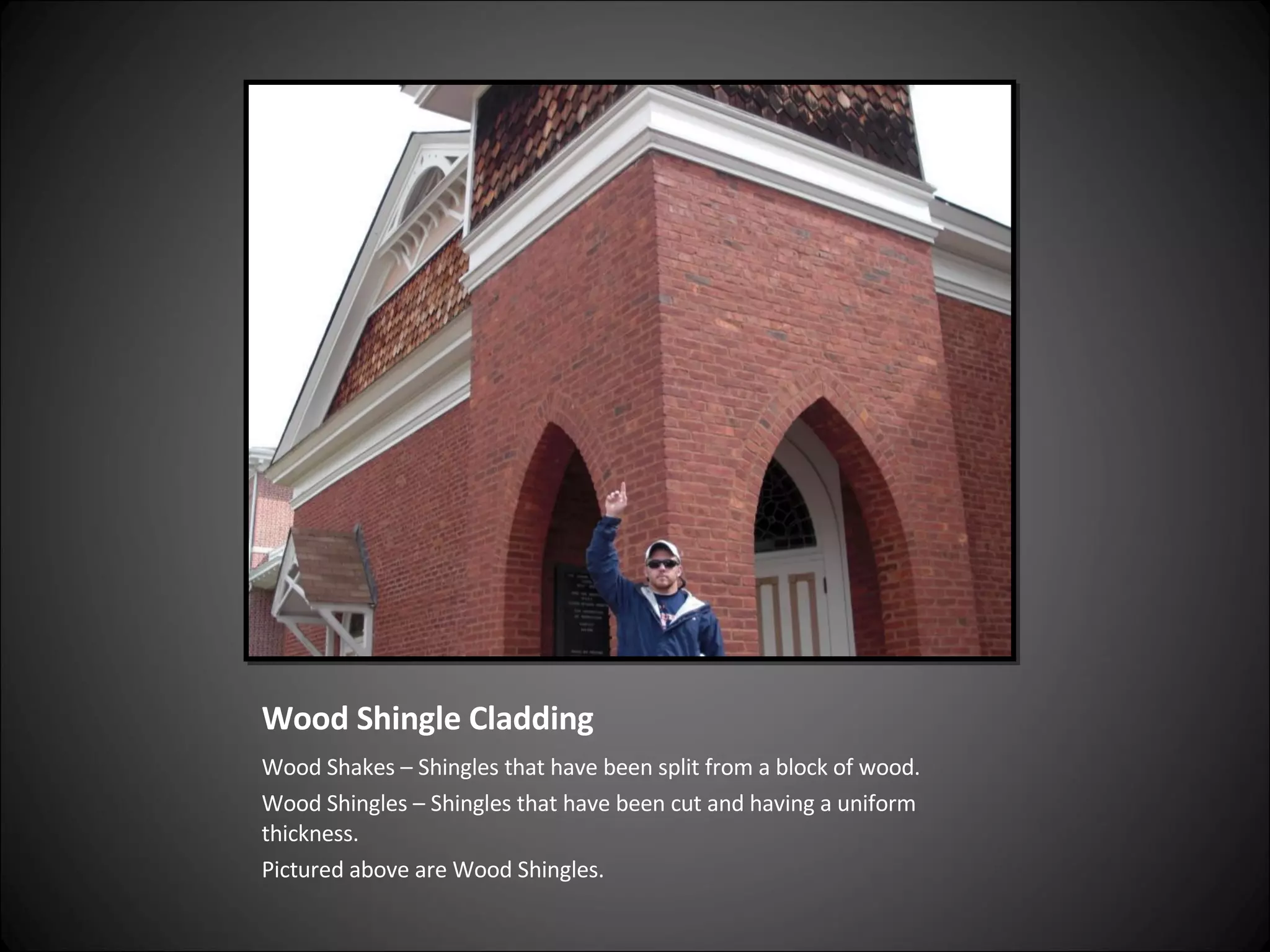
Wood Shingle Cladding Wood Shakes – Shingles that have been split from a block of wood. Wood Shingles – Shingles that have been cut and having a uniform thickness.  Pictured above are Wood Shingles.
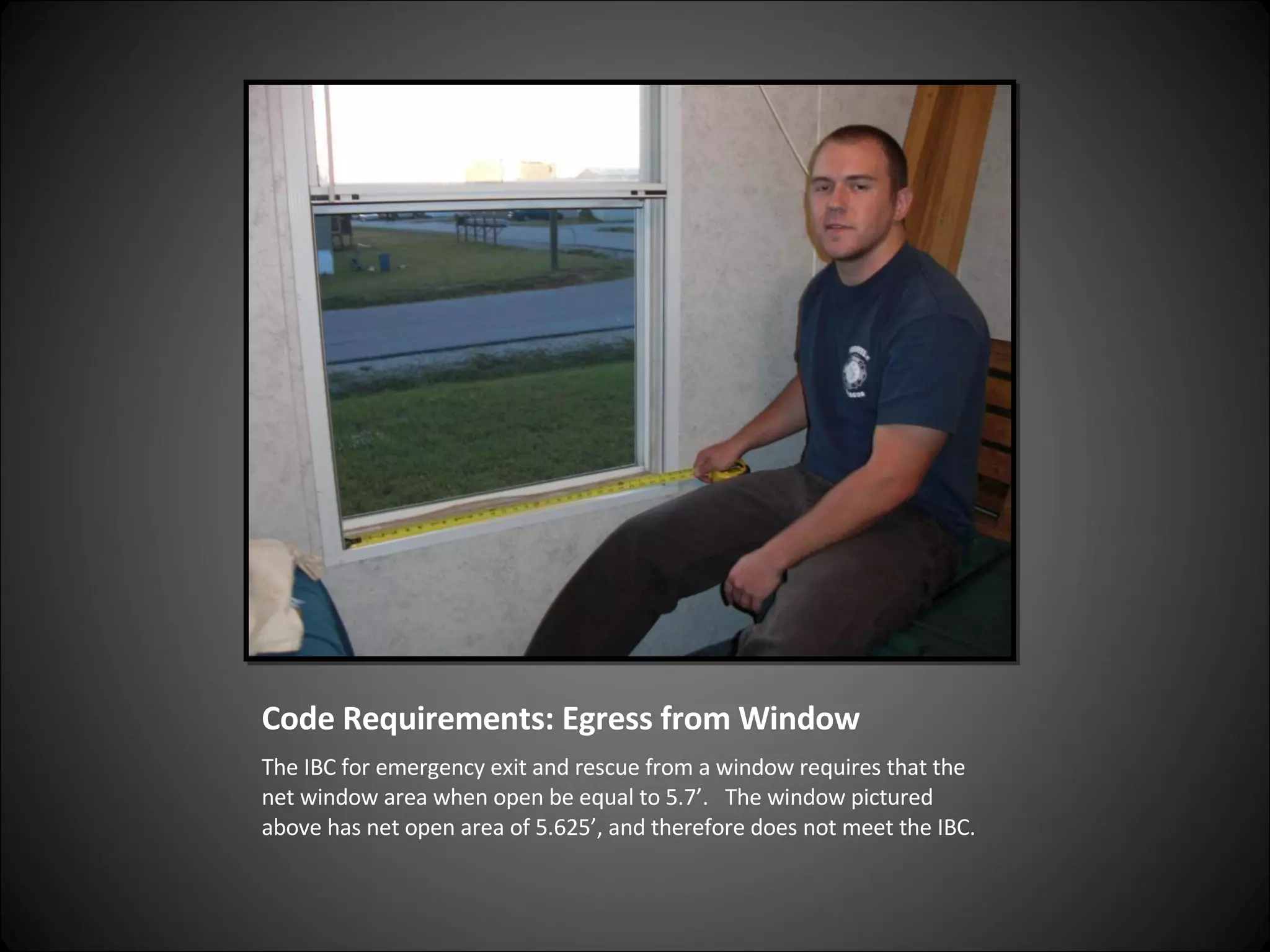
Code Requirements: Egress from Window The IBC for emergency exit and rescue from a window requires that the net window area when open be equal to 5.7’.  The window pictured above has net open area of 5.625’, and therefore does not meet the IBC.
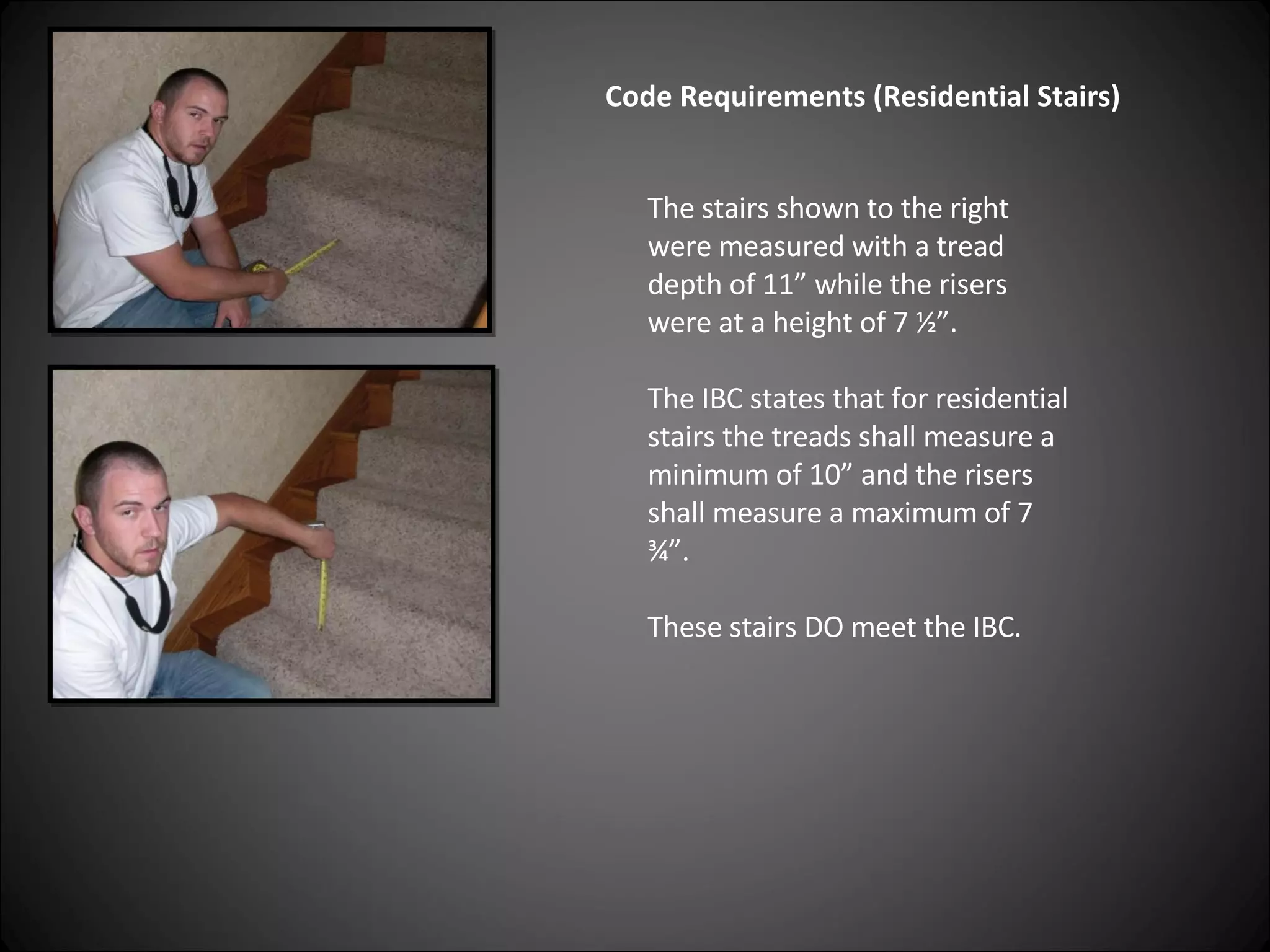
Code Requirements (Residential Stairs) The stairs shown to the right were measured with a tread depth of 11” while the risers were at a height of 7 ½”.  The IBC states that for residential stairs the treads shall measure a minimum of 10” and the risers shall measure a maximum of 7 ¾”.  These stairs DO meet the IBC.
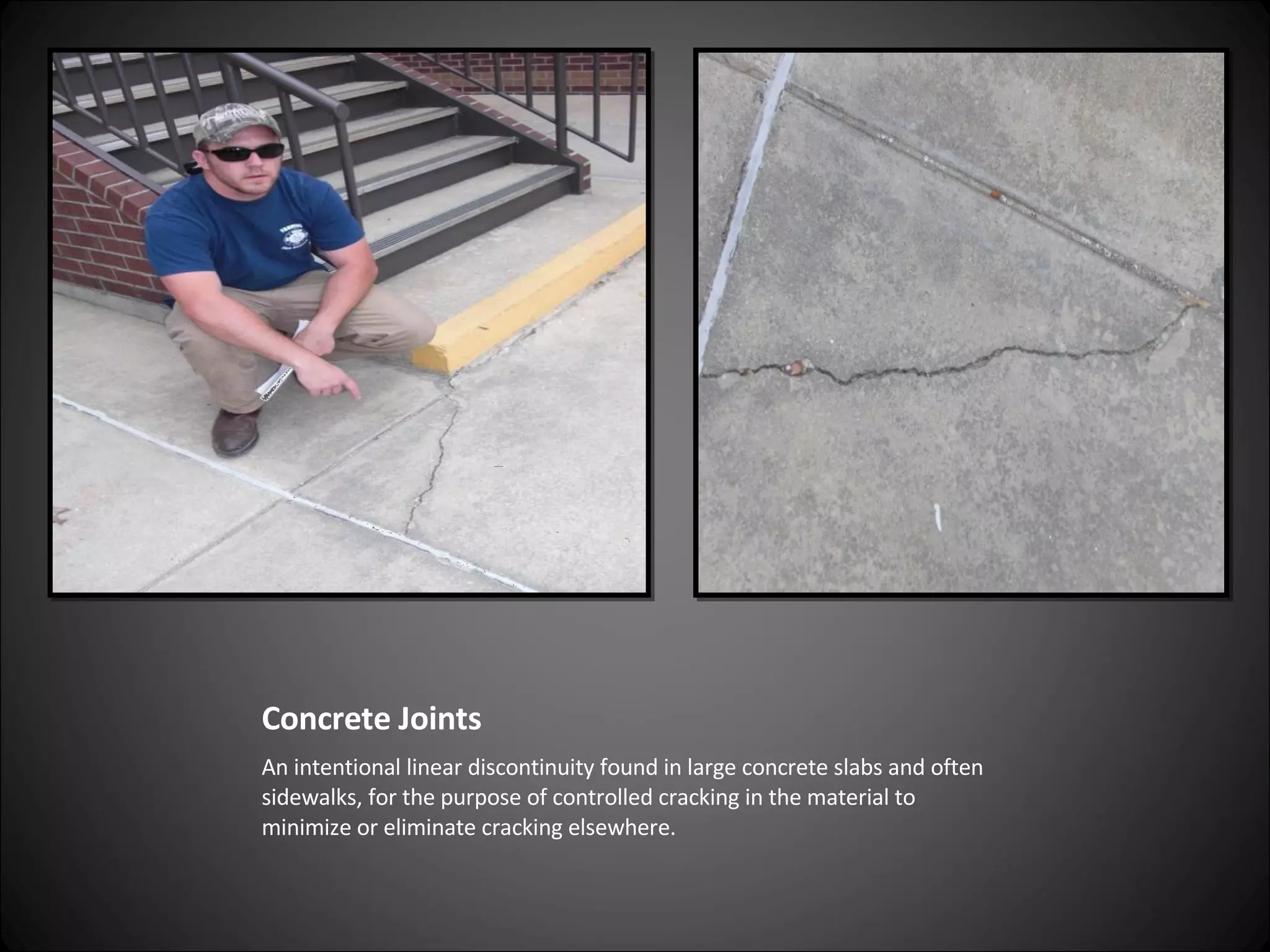
Concrete Joints An intentional linear discontinuity found in large concrete slabs and often sidewalks, for the purpose of controlled cracking in the material to minimize or eliminate cracking elsewhere.
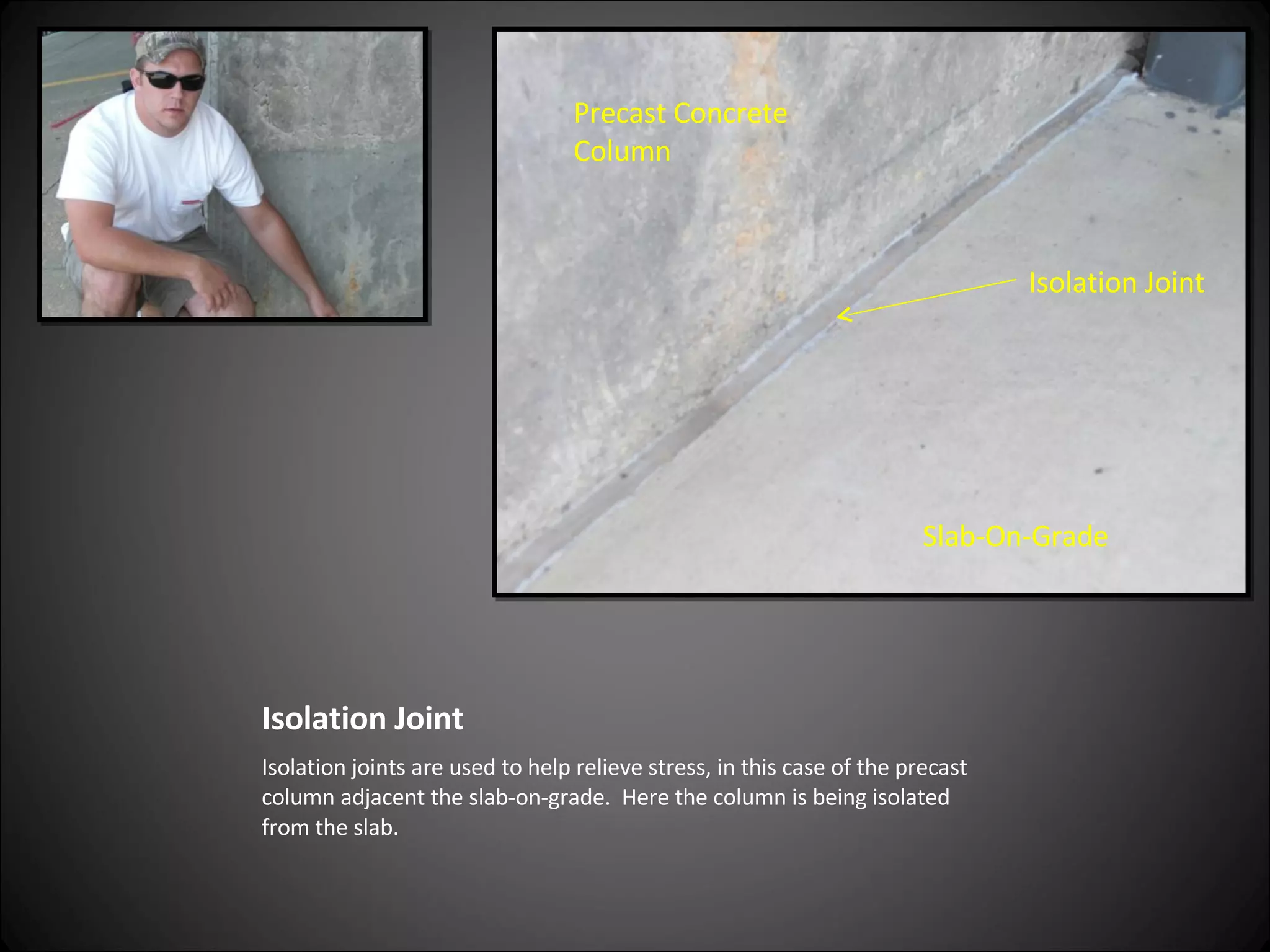
Isolation Joint Isolation joints are used to help relieve stress, in this case of the precast column adjacent the slab-on-grade.  Here the column is being isolated from the slab. Precast Concrete Column Slab-On-Grade Isolation Joint
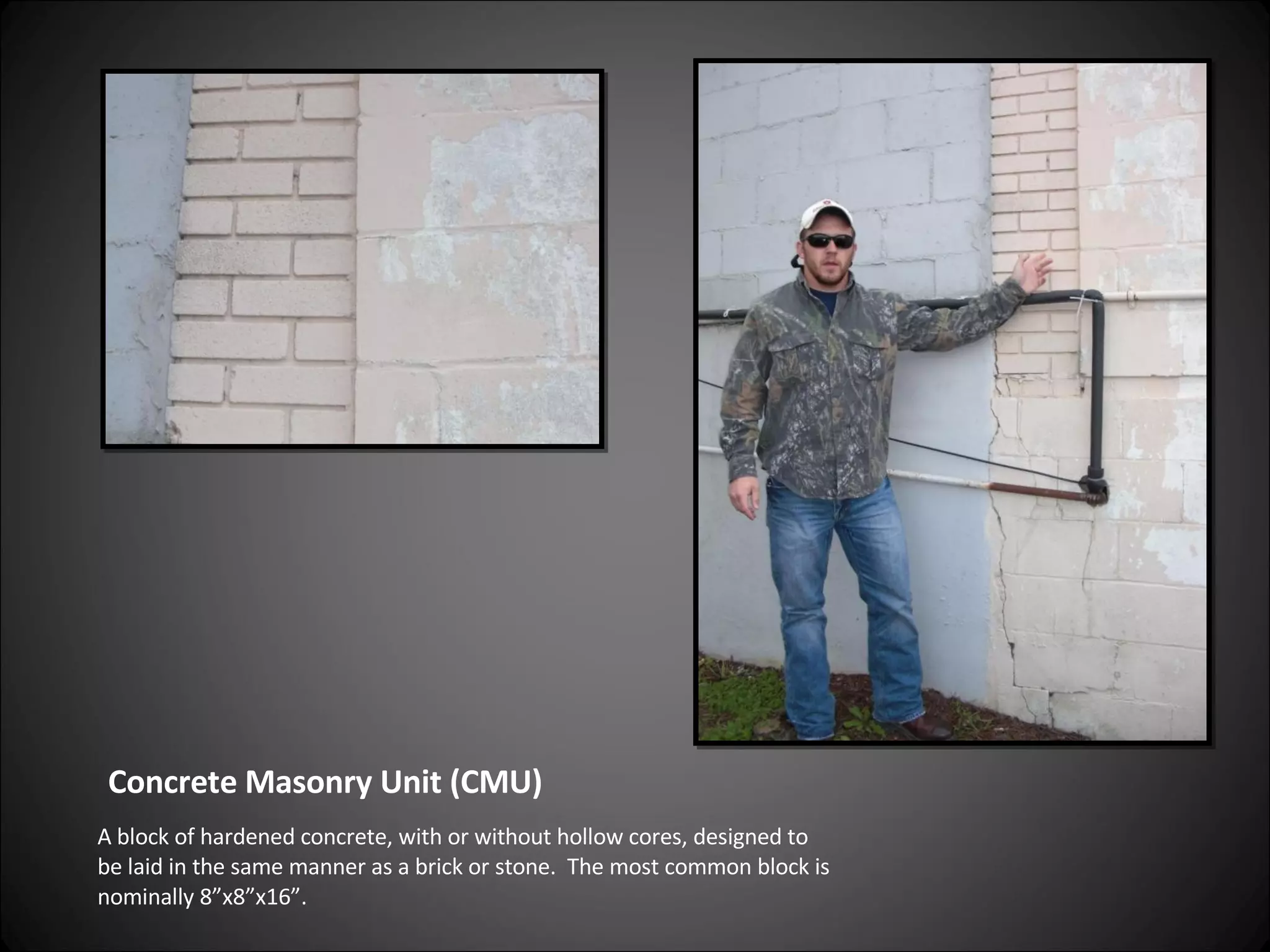
Concrete Masonry Unit (CMU) A block of hardened concrete, with or without hollow cores, designed to be laid in the same manner as a brick or stone.  The most common block is nominally 8”x8”x16”.
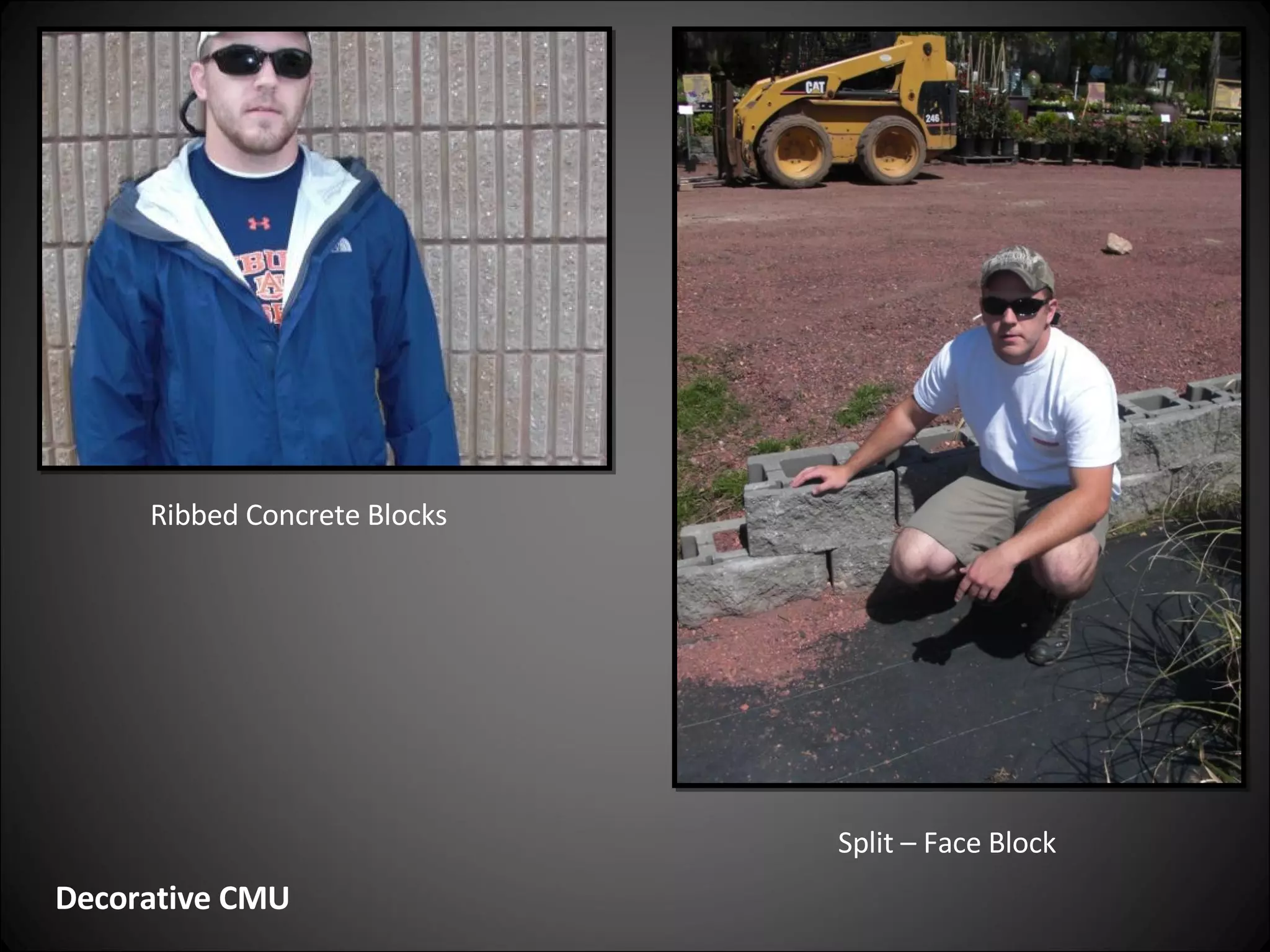
Decorative CMU Ribbed Concrete Blocks Split – Face Block
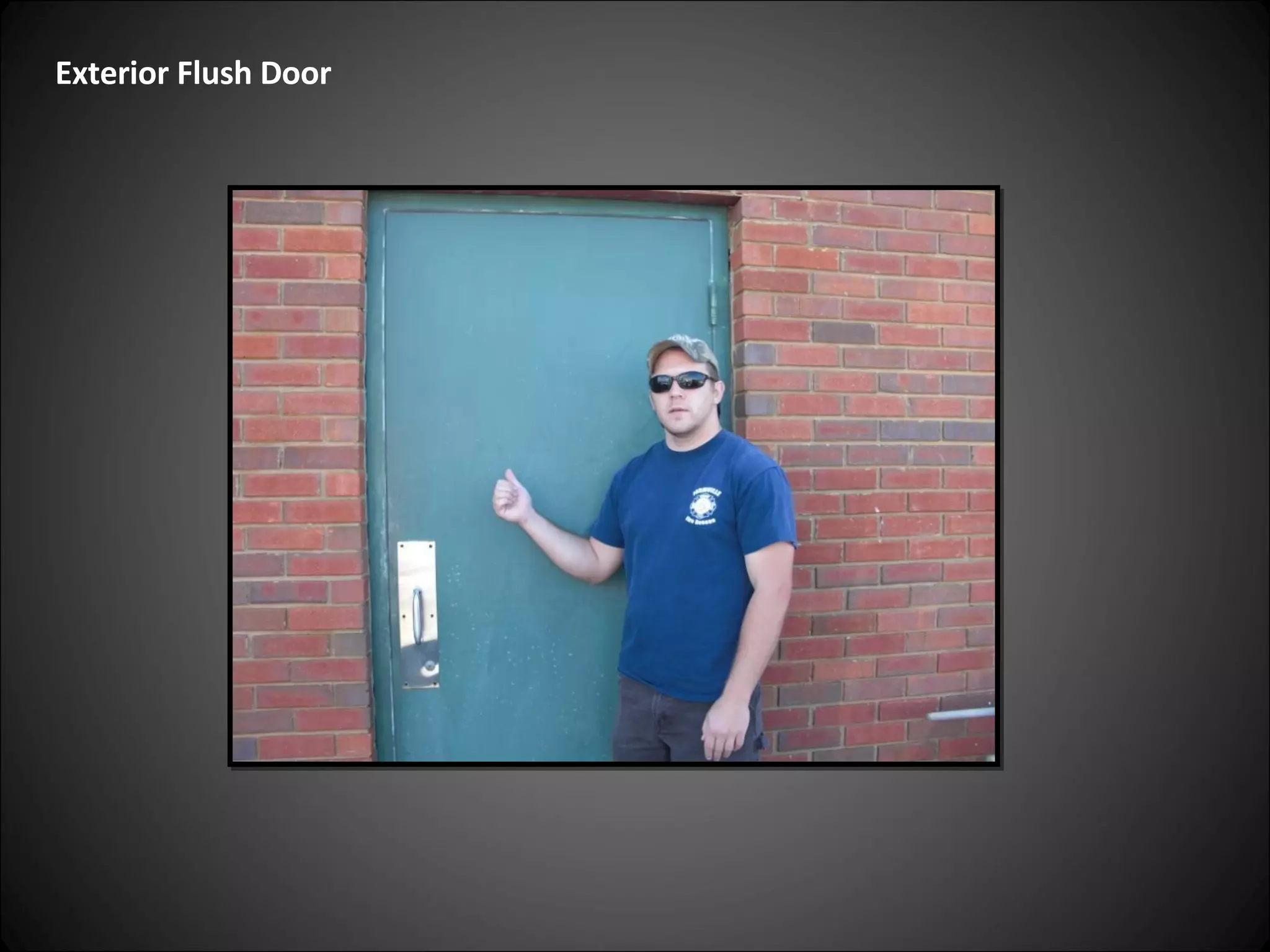
Exterior Flush Door
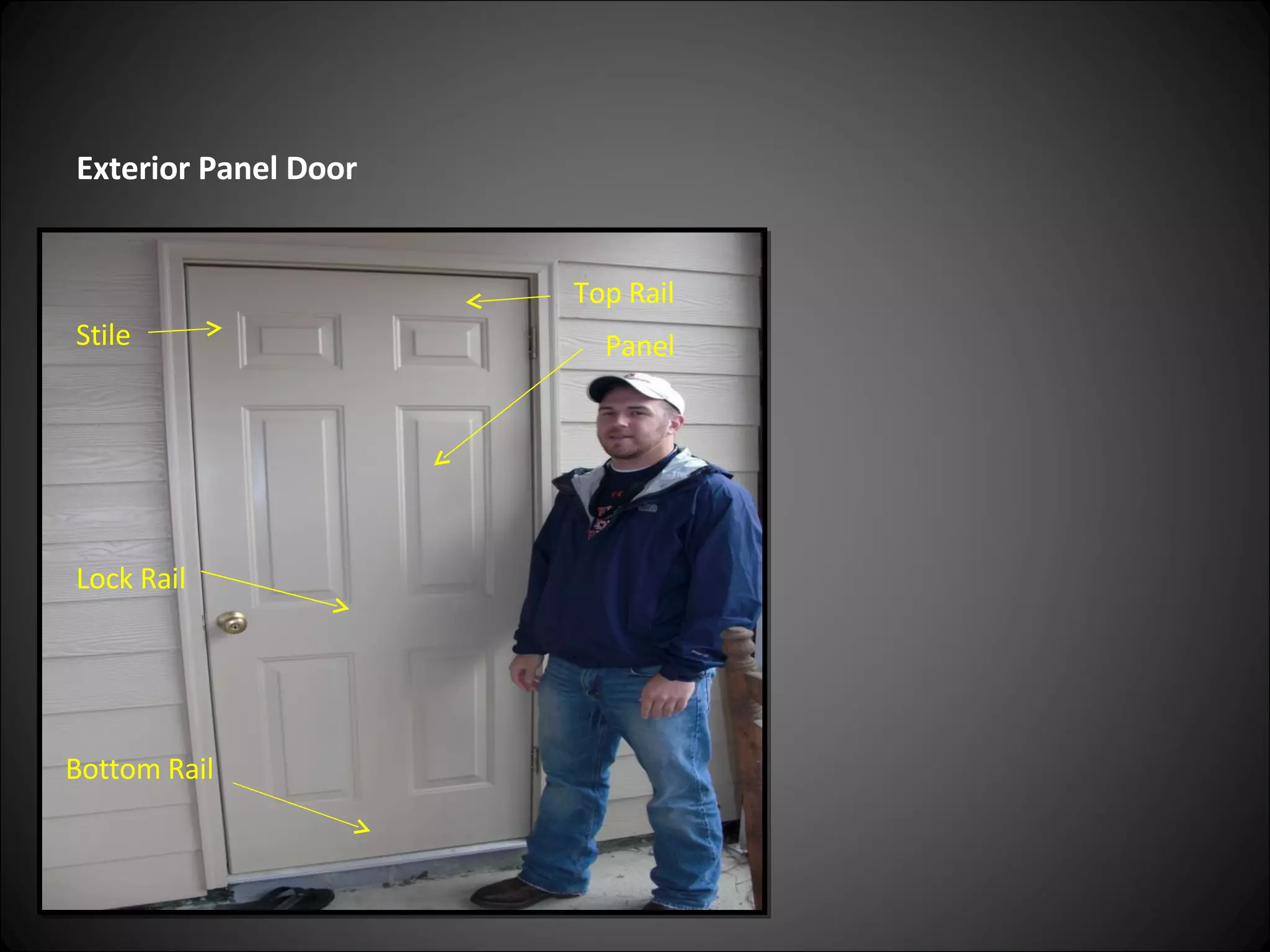
Exterior Panel Door Top Rail Panel Stile Lock Rail Bottom Rail
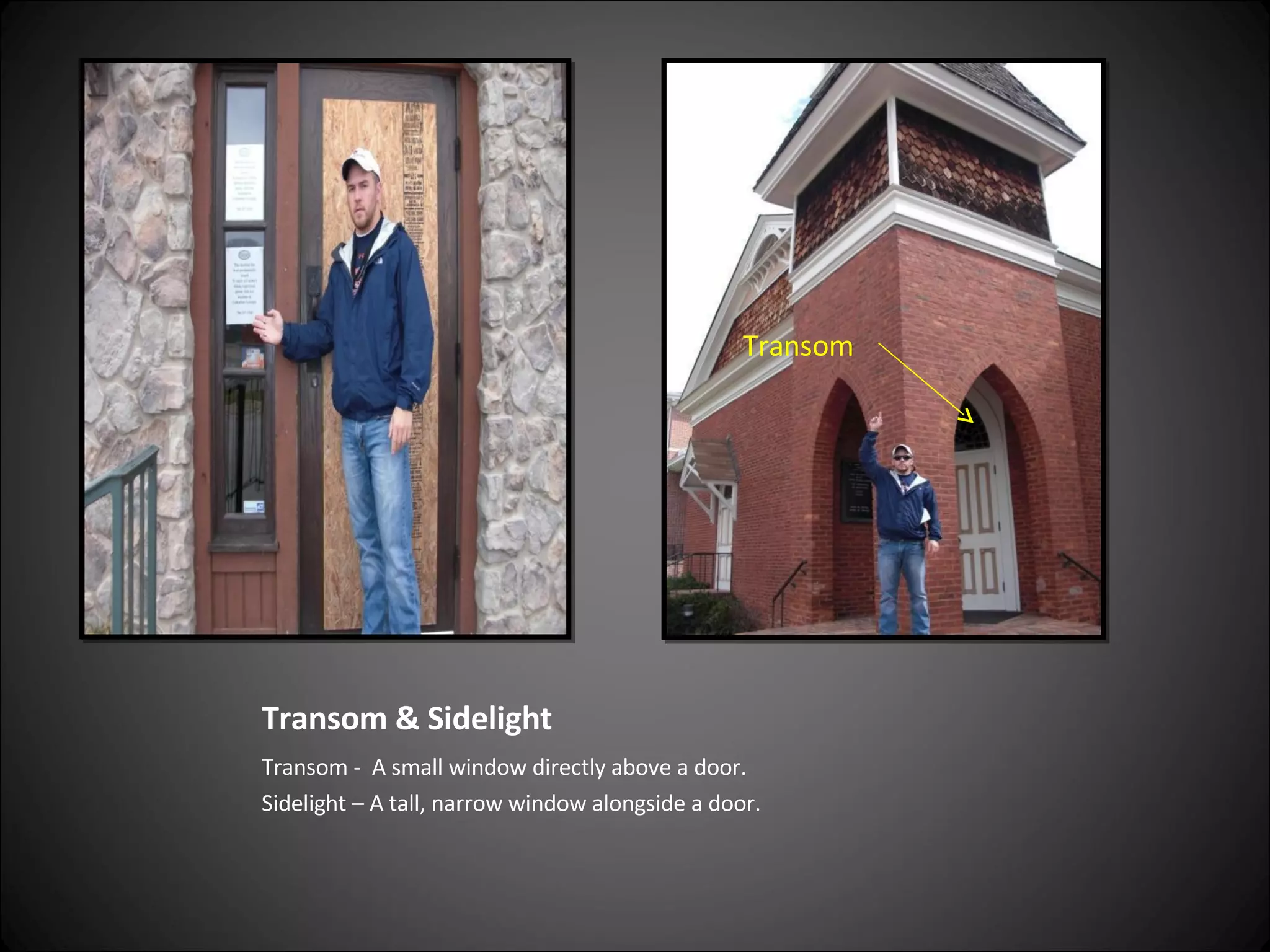
Transom & Sidelight Transom -  A small window directly above a door. Sidelight – A tall, narrow window alongside a door. Transom
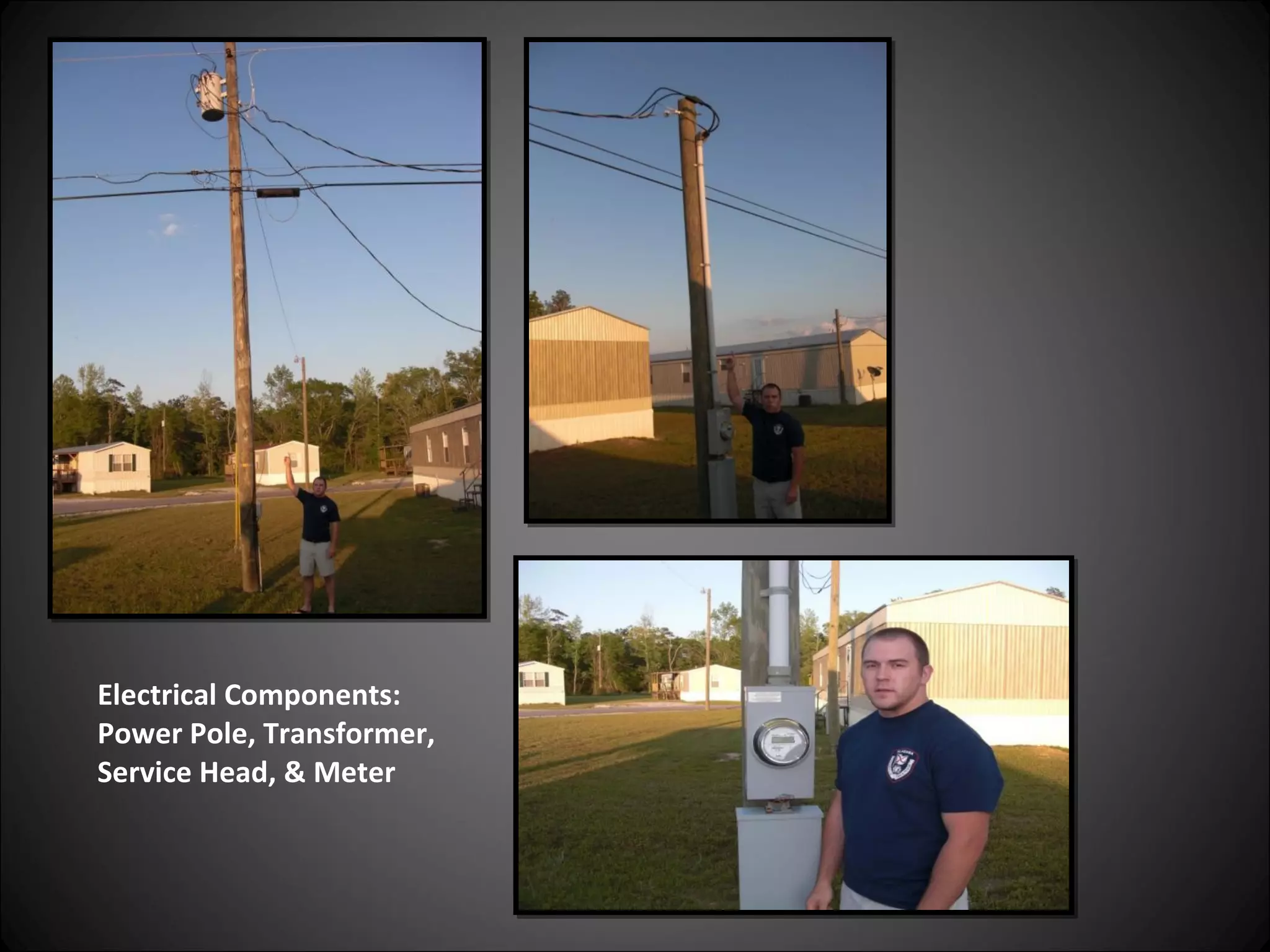
Electrical Components:  Power Pole, Transformer, Service Head, & Meter
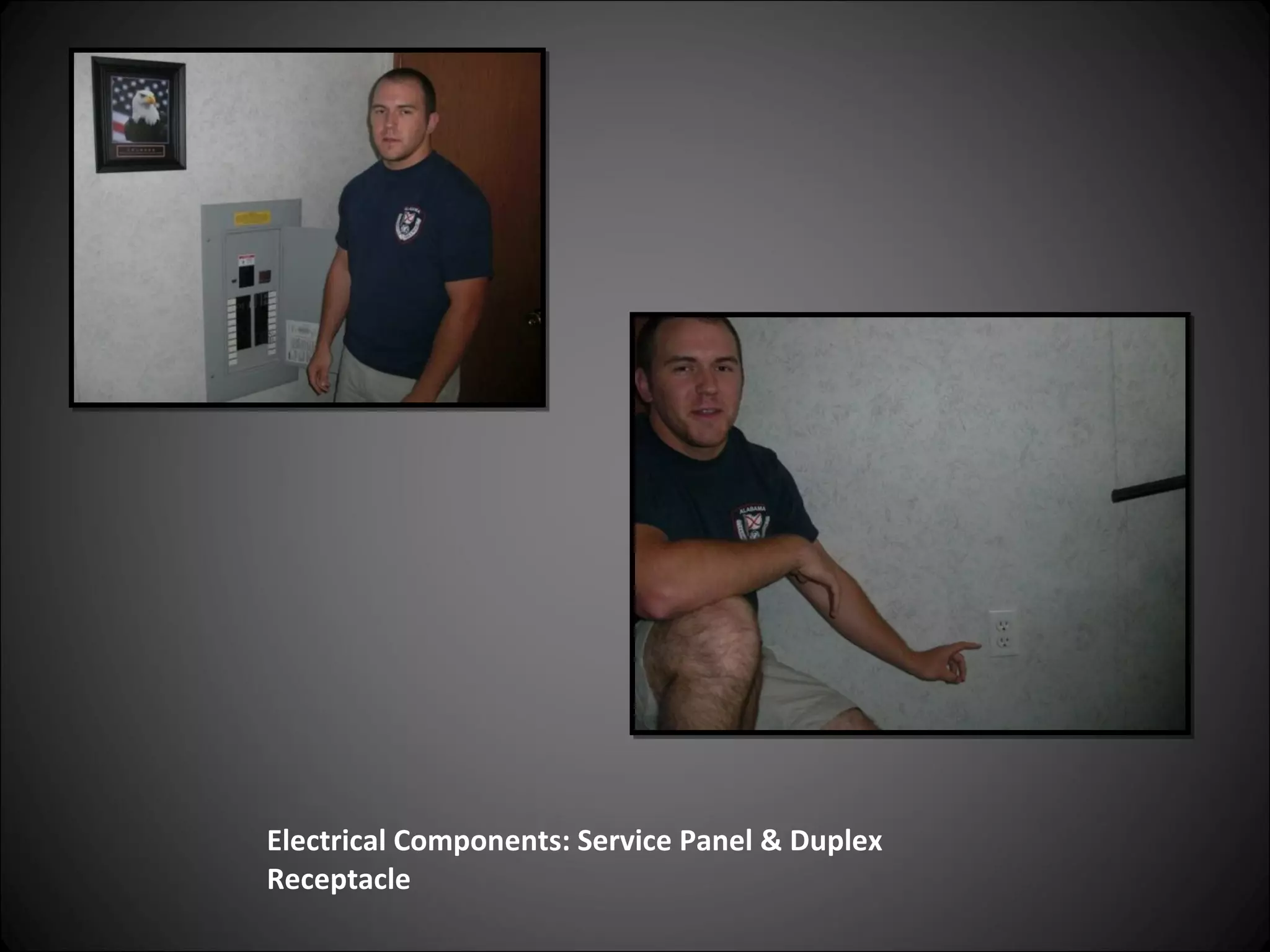
Electrical Components: Service Panel & Duplex Receptacle
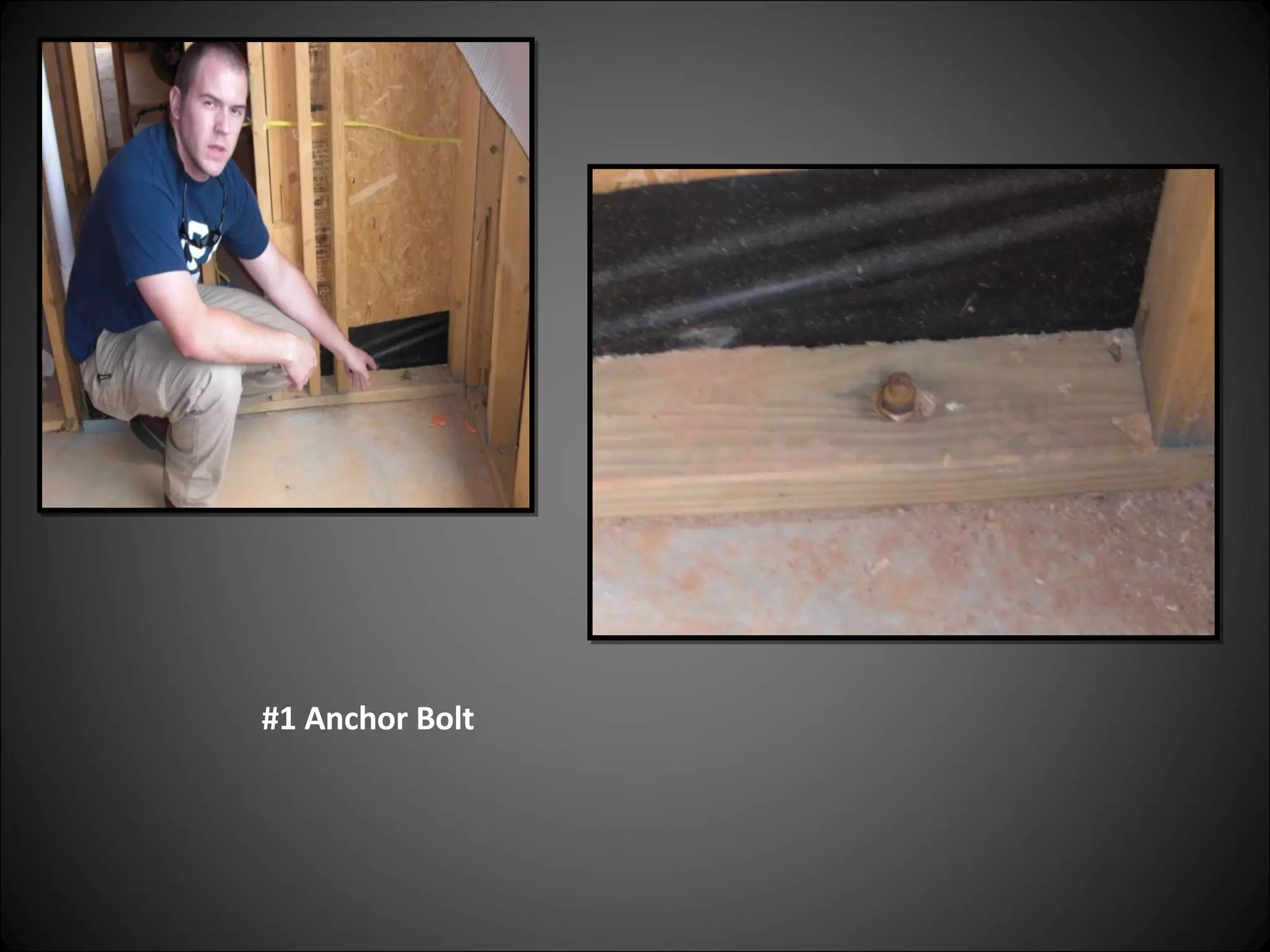
#1 Anchor Bolt
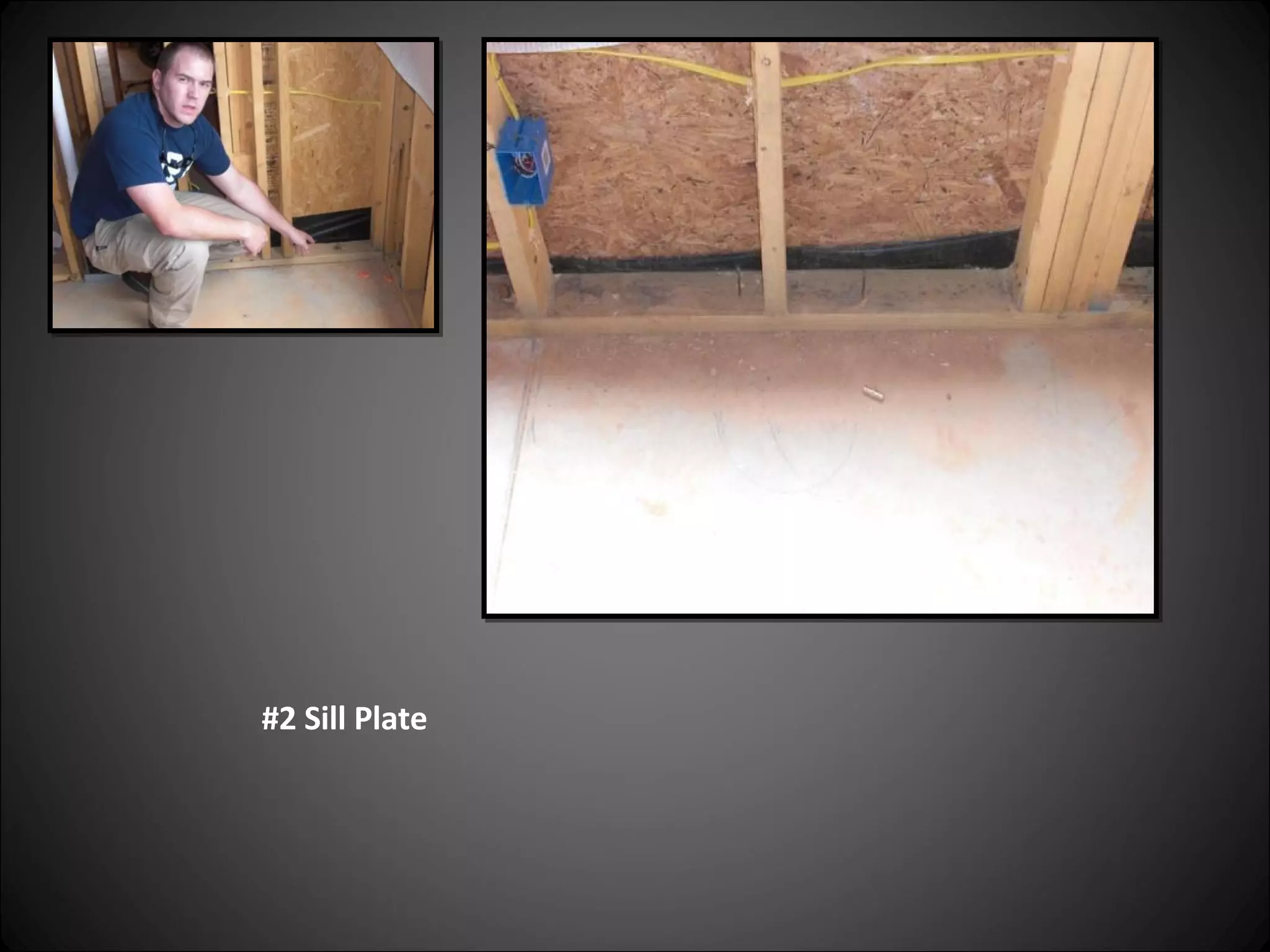
#2 Sill Plate
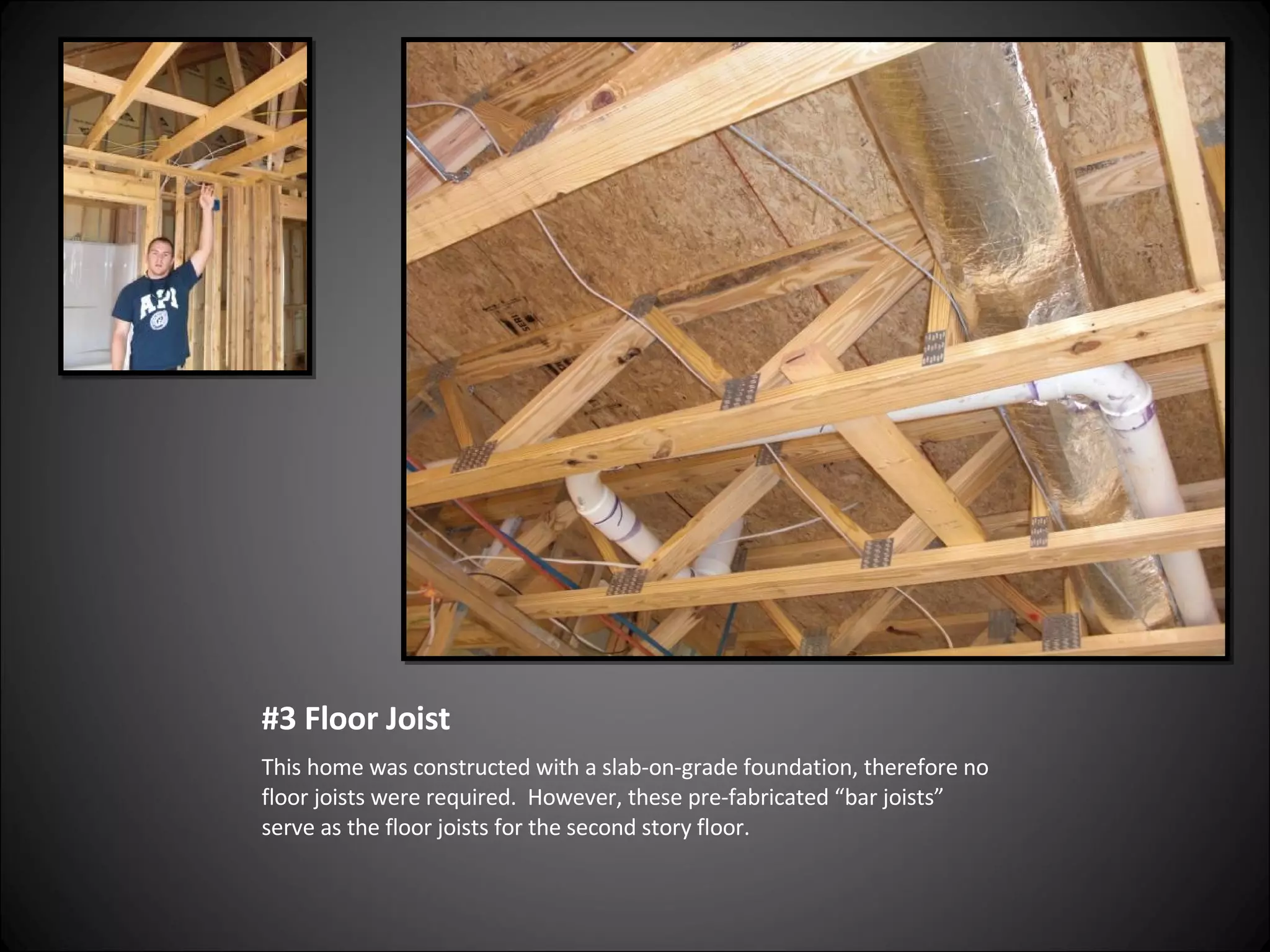
#3 Floor Joist This home was constructed with a slab-on-grade foundation, therefore no floor joists were required.  However, these pre-fabricated “bar joists” serve as the floor joists for the second story floor.
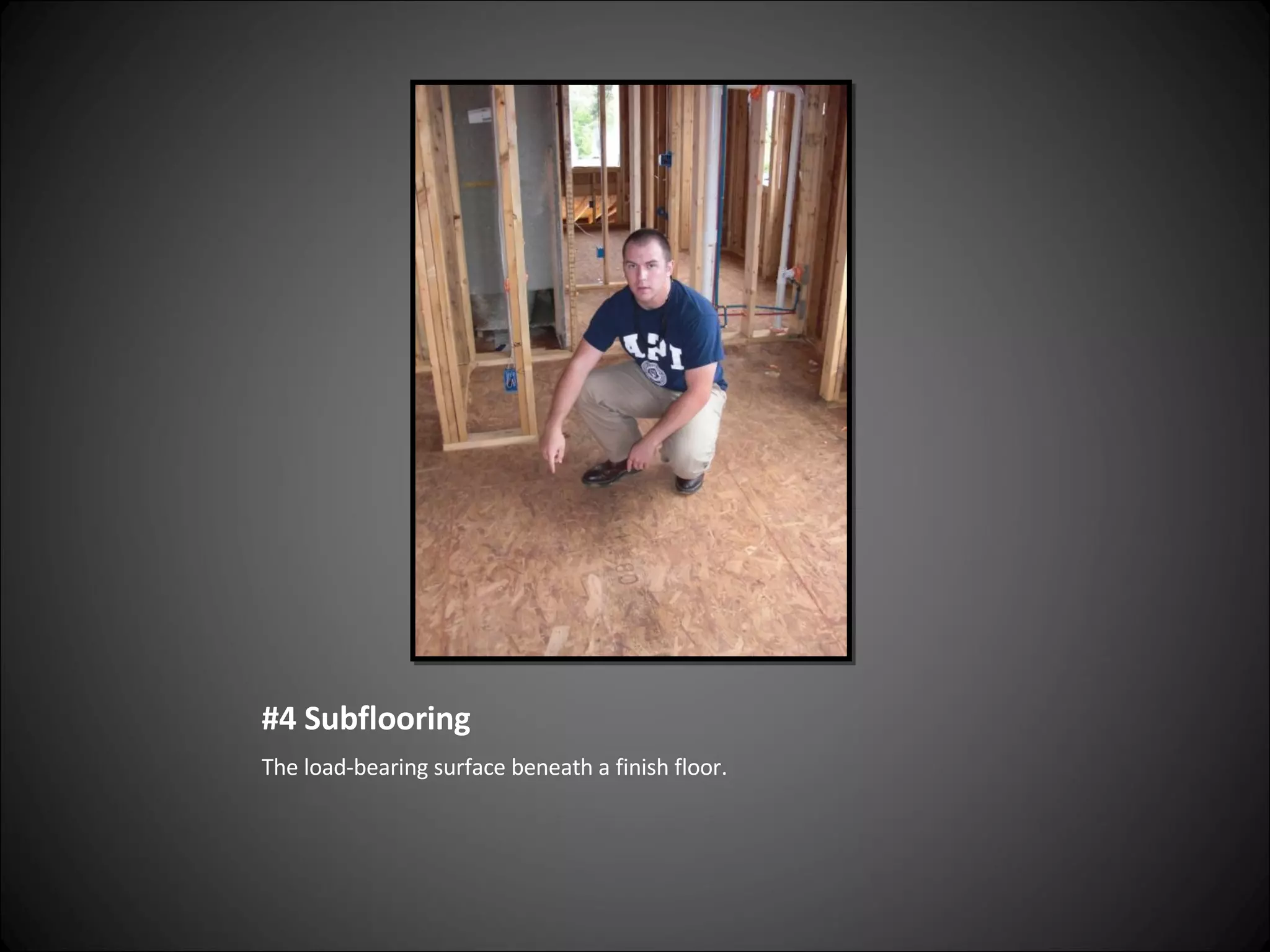
#4 Subflooring The load-bearing surface beneath a finish floor.
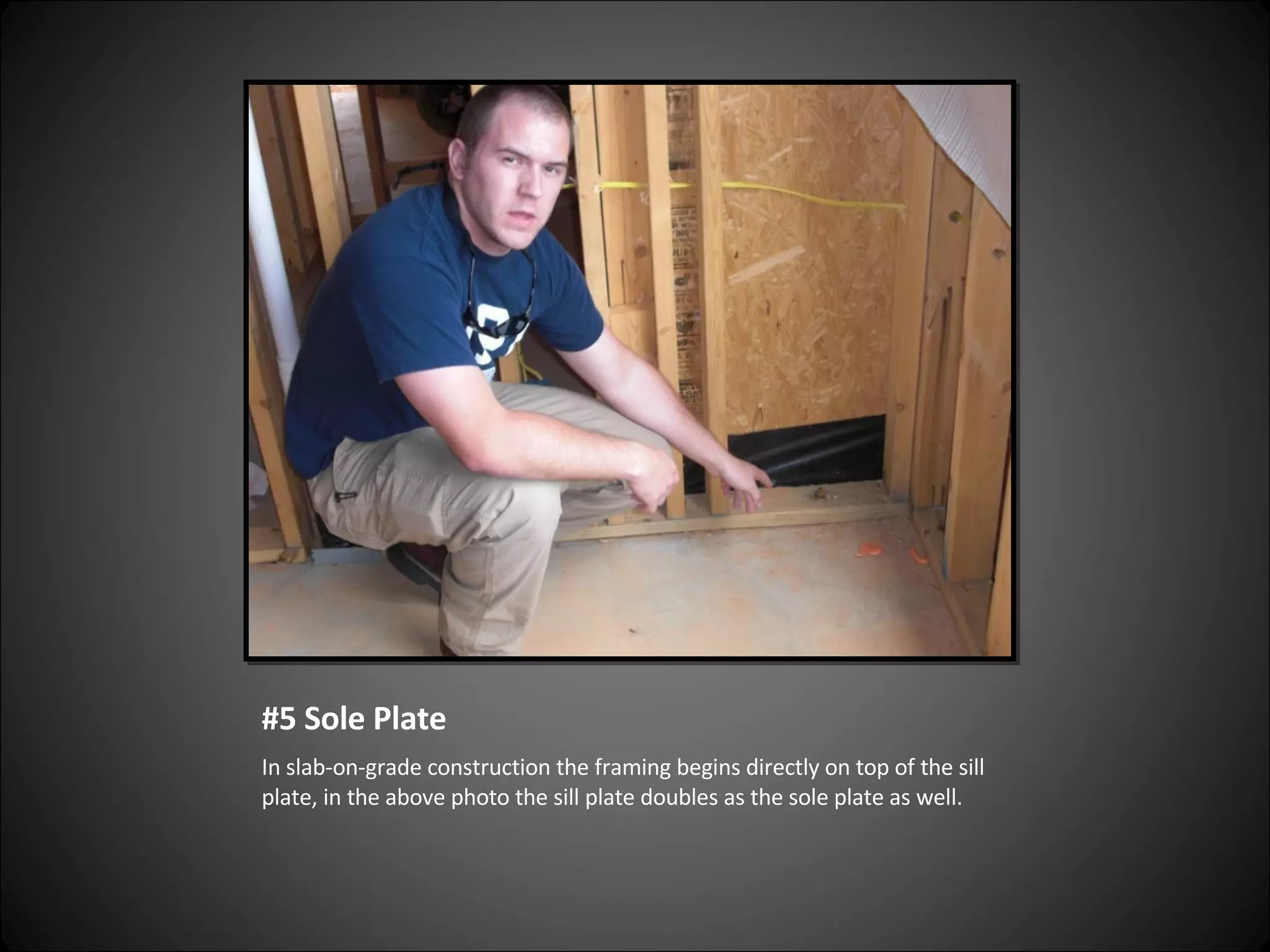
#5 Sole Plate In slab-on-grade construction the framing begins directly on top of the sill plate, in the above photo the sill plate doubles as the sole plate as well.
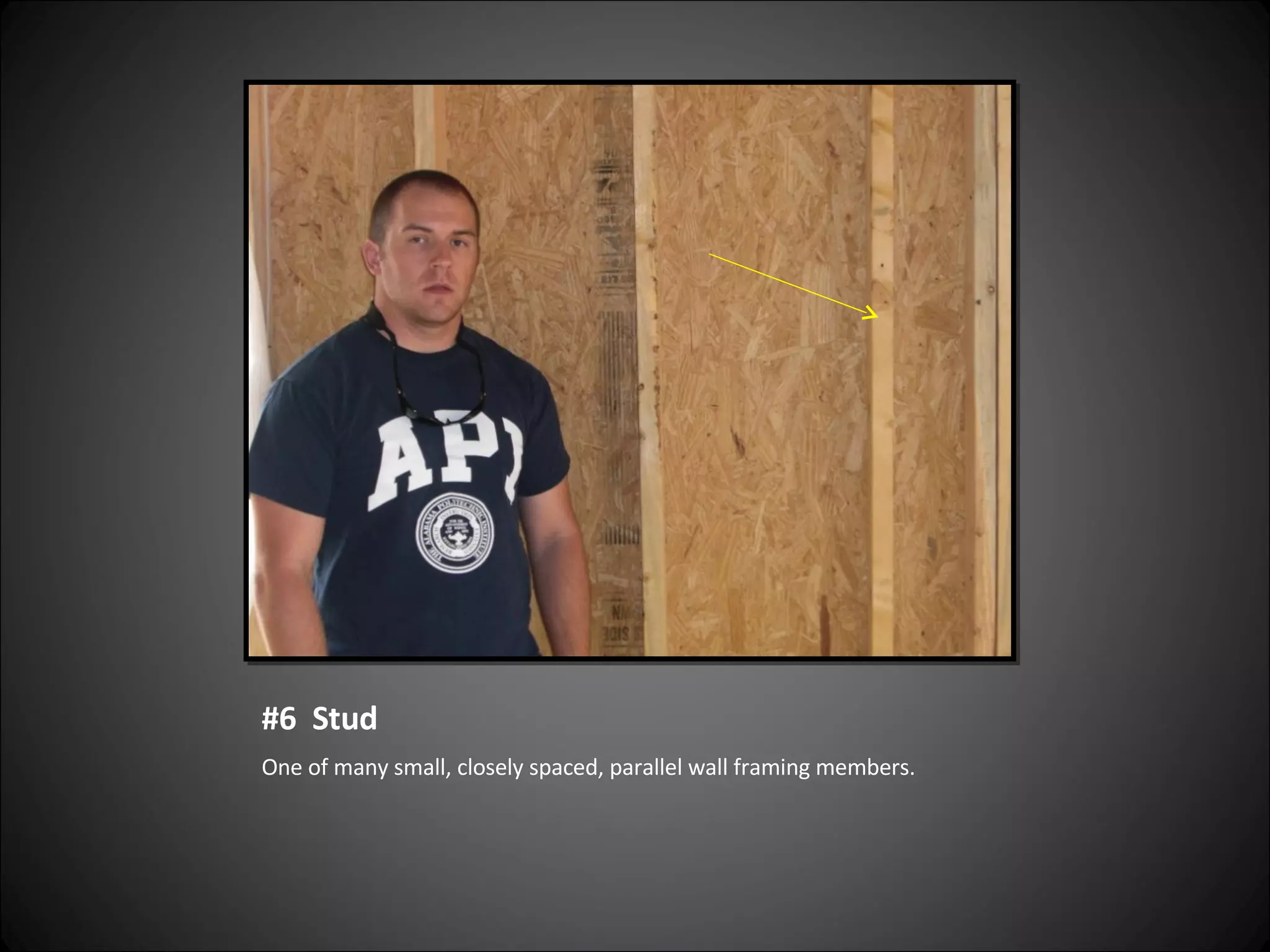
#6  Stud One of many small, closely spaced, parallel wall framing members.
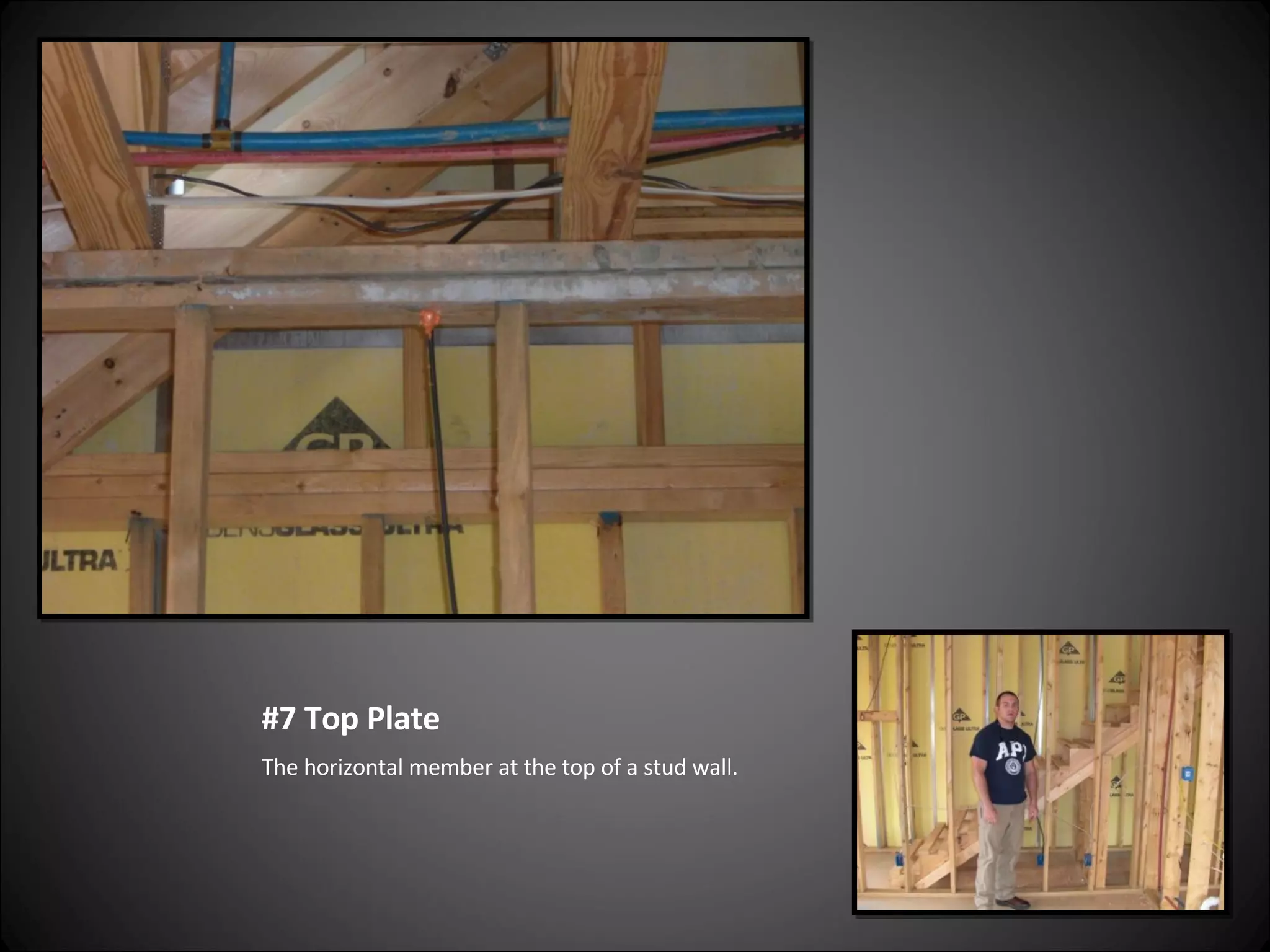
#7 Top Plate The horizontal member at the top of a stud wall.
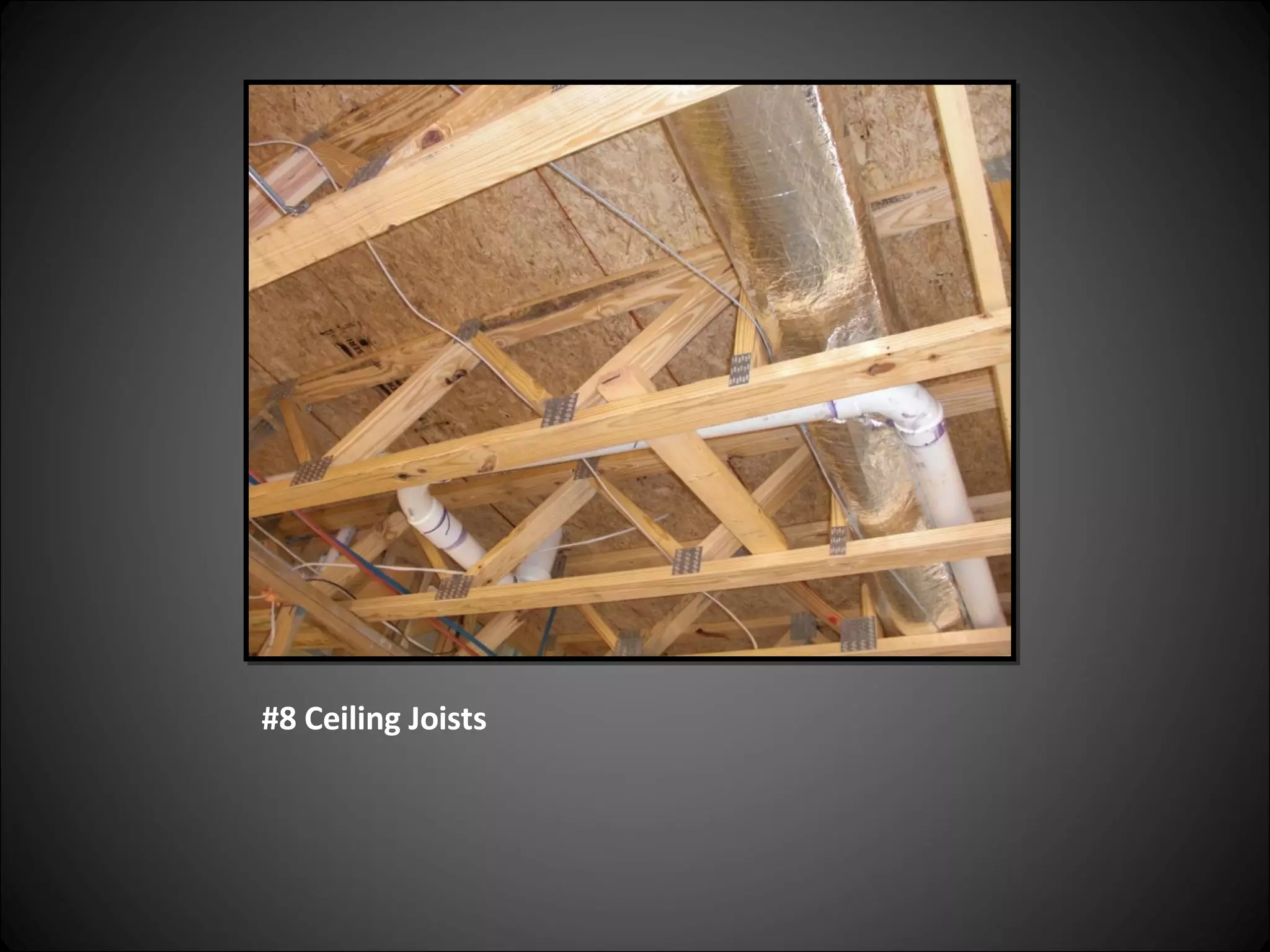
#8 Ceiling Joists
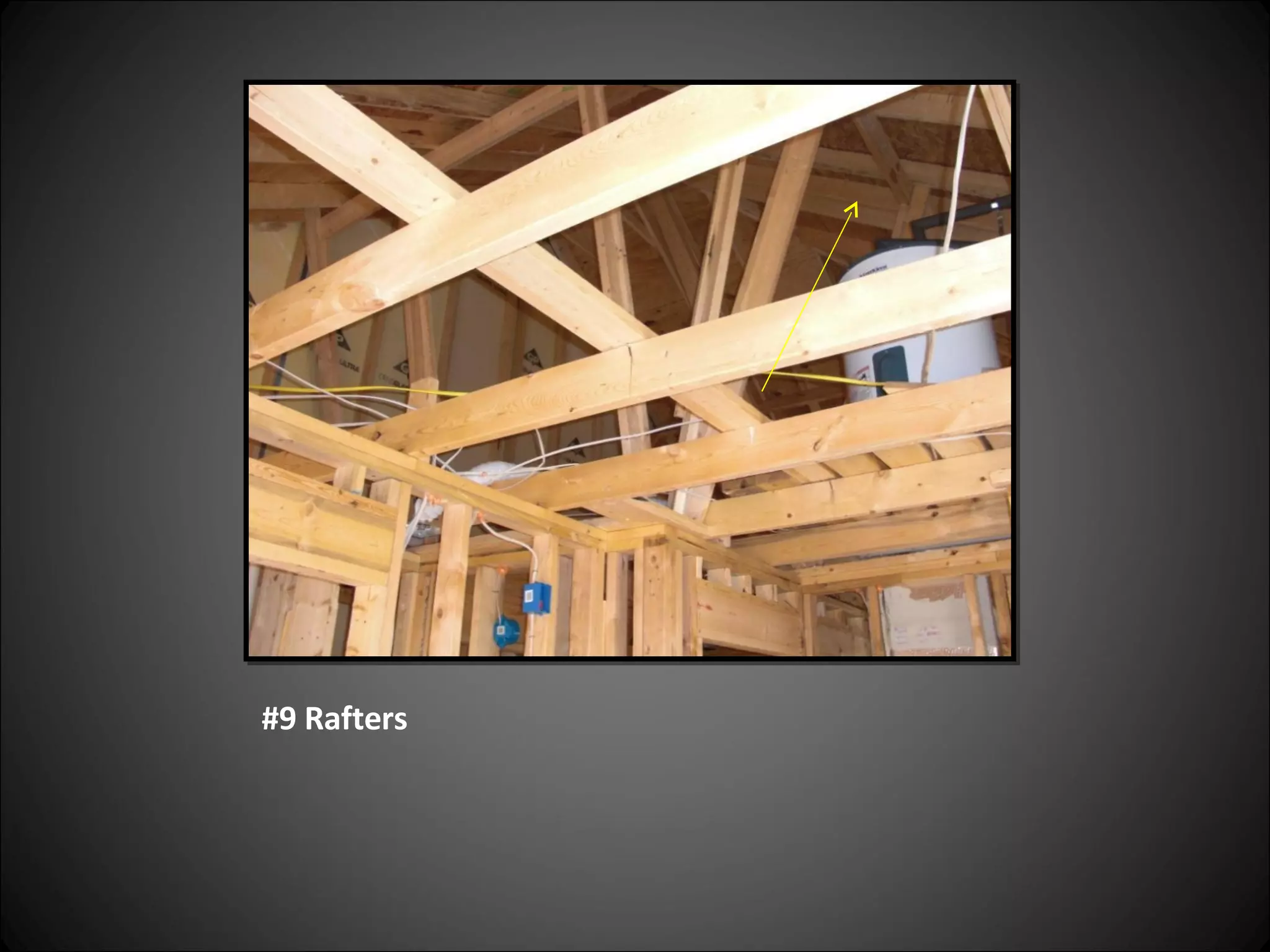
#9 Rafters
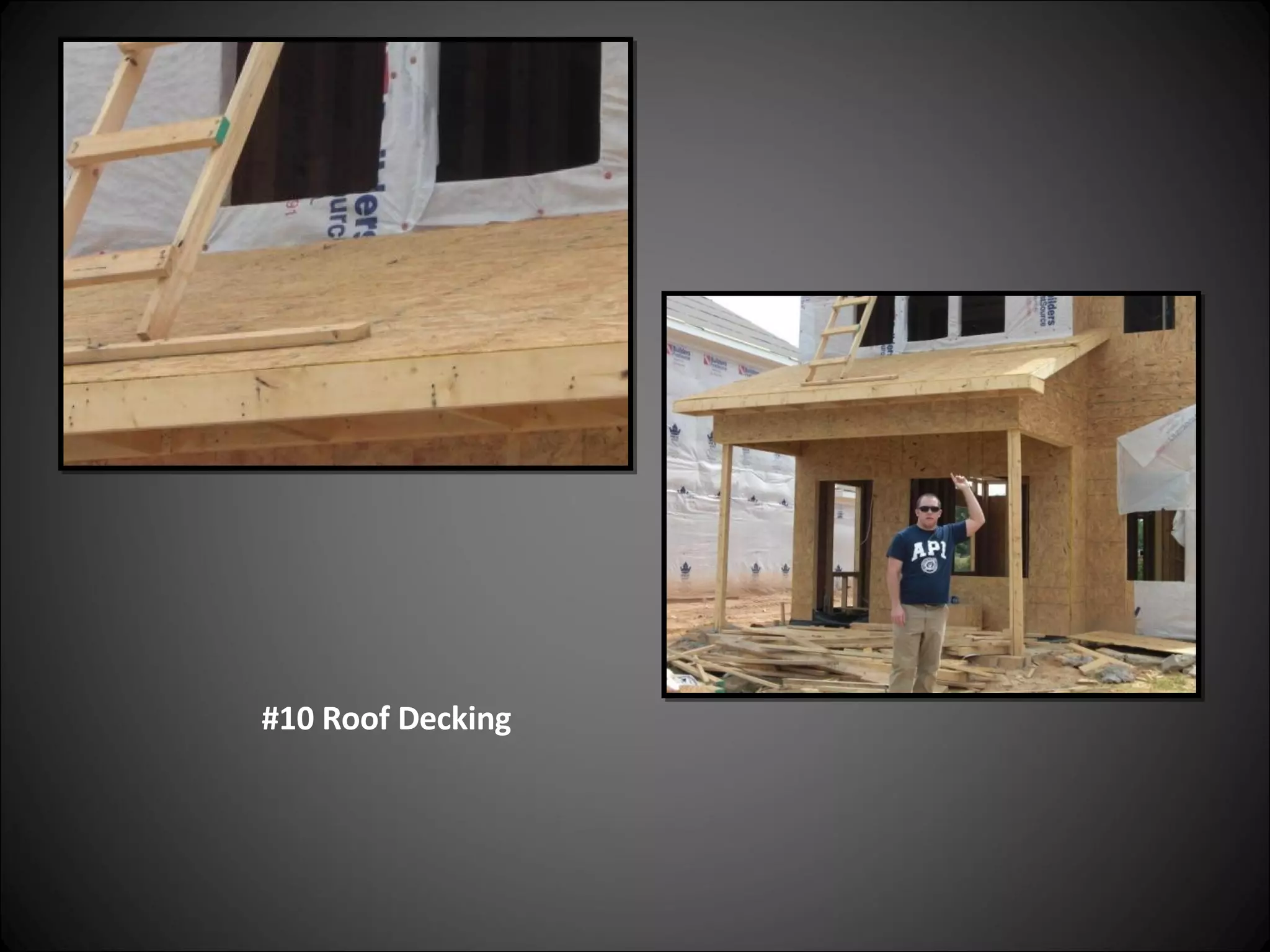
#10 Roof Decking
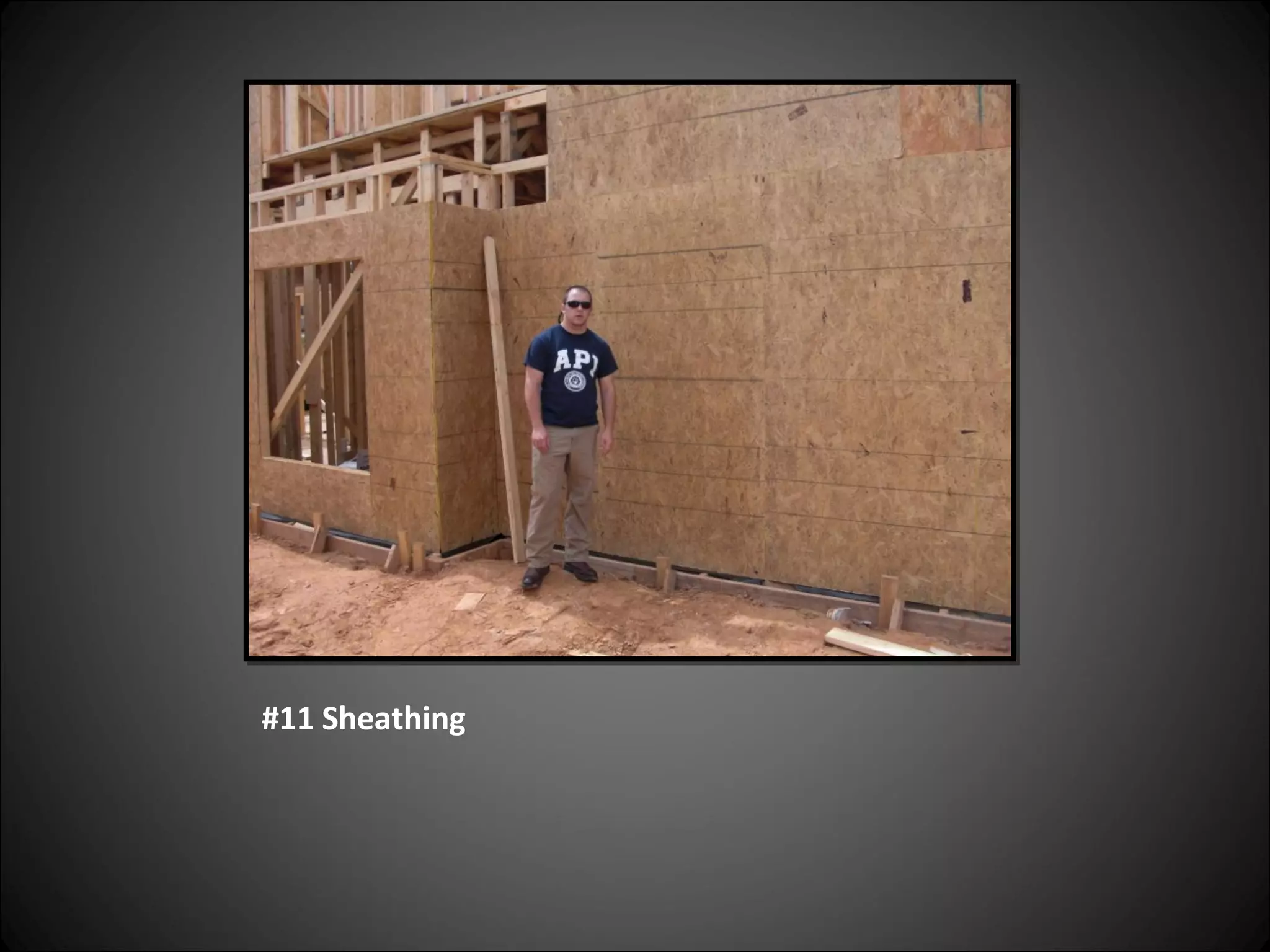
#11 Sheathing
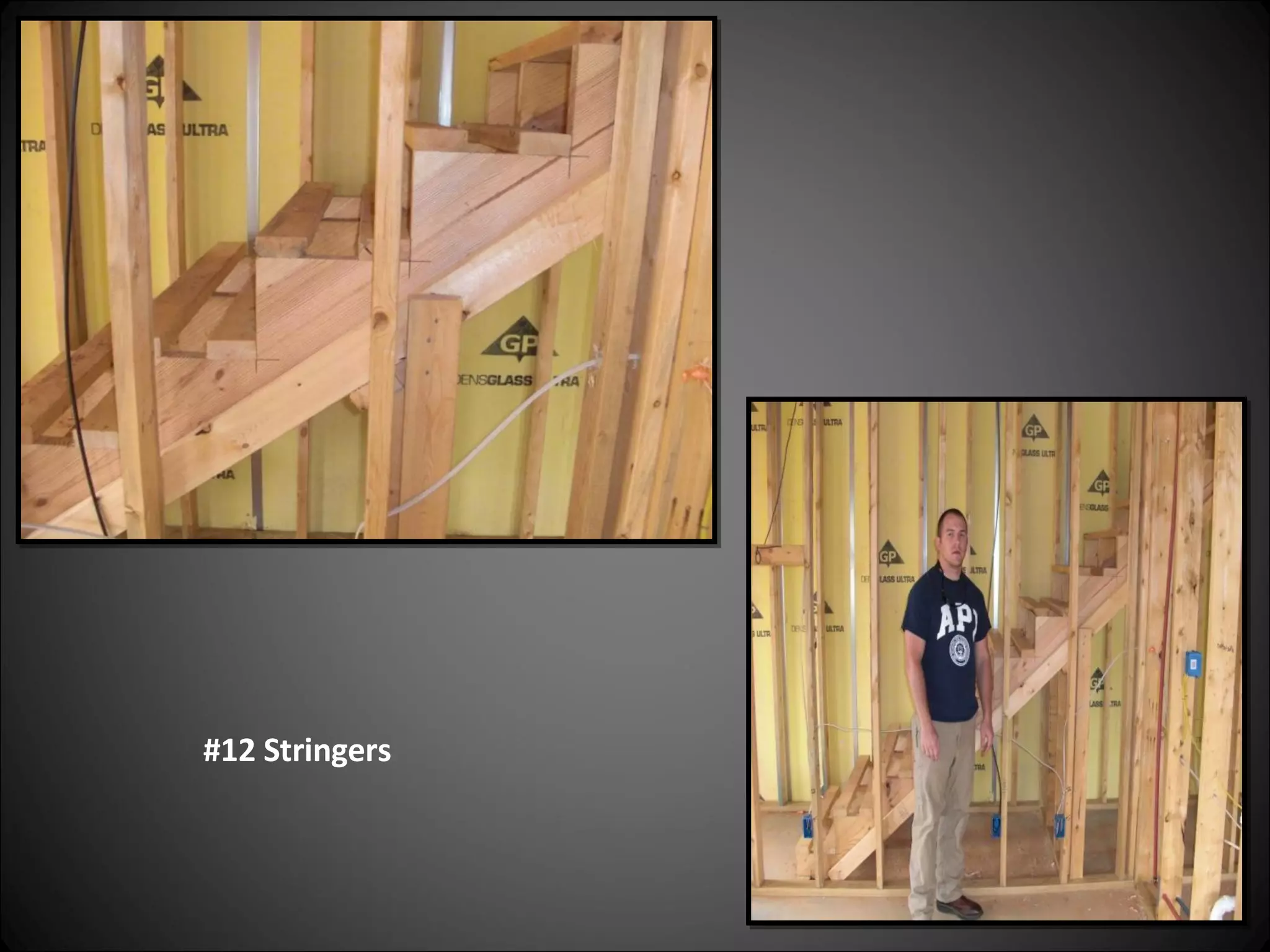
#12 Stringers
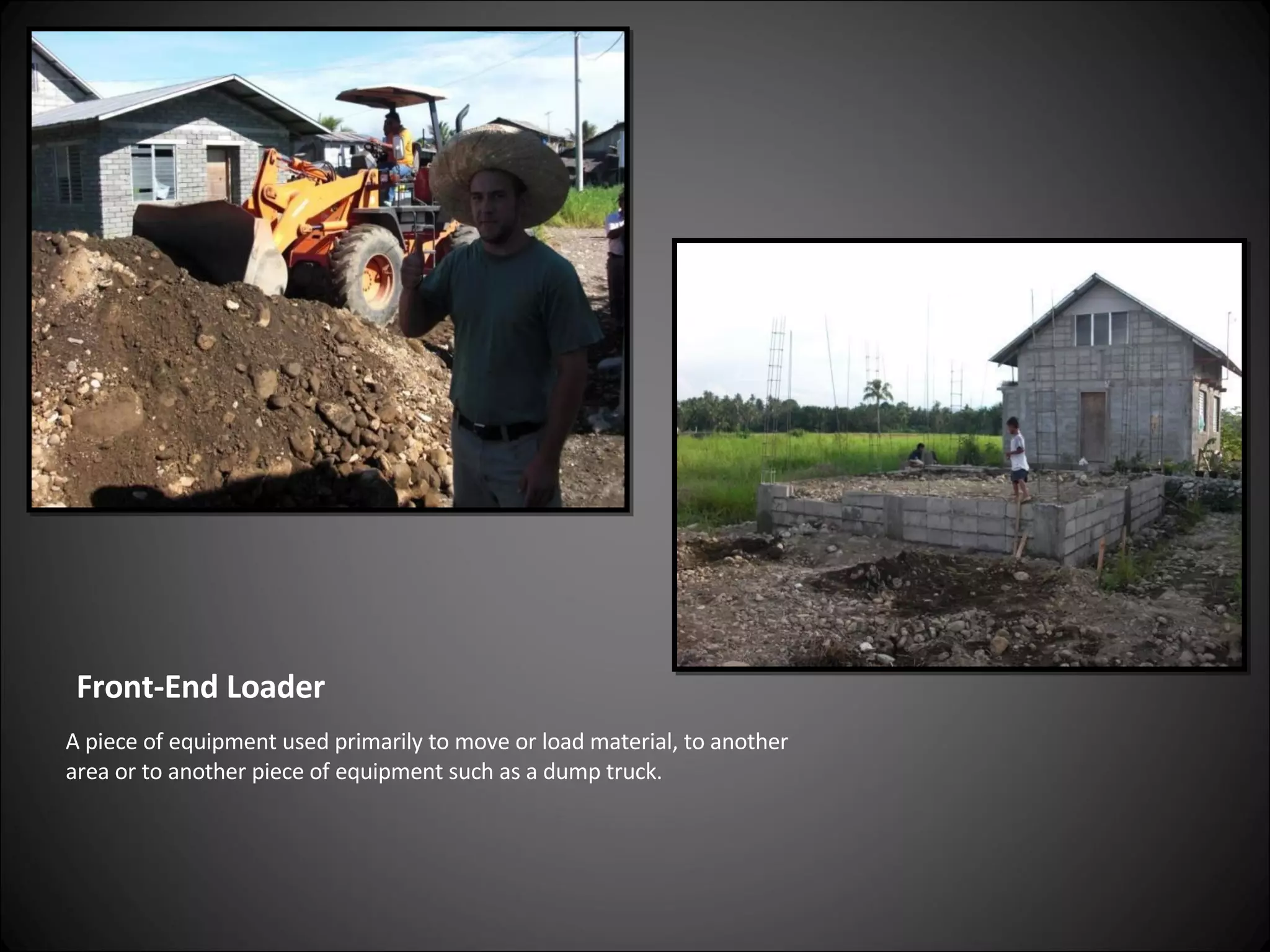
Front-End Loader A piece of equipment used primarily to move or load material, to another area or to another piece of equipment such as a dump truck.
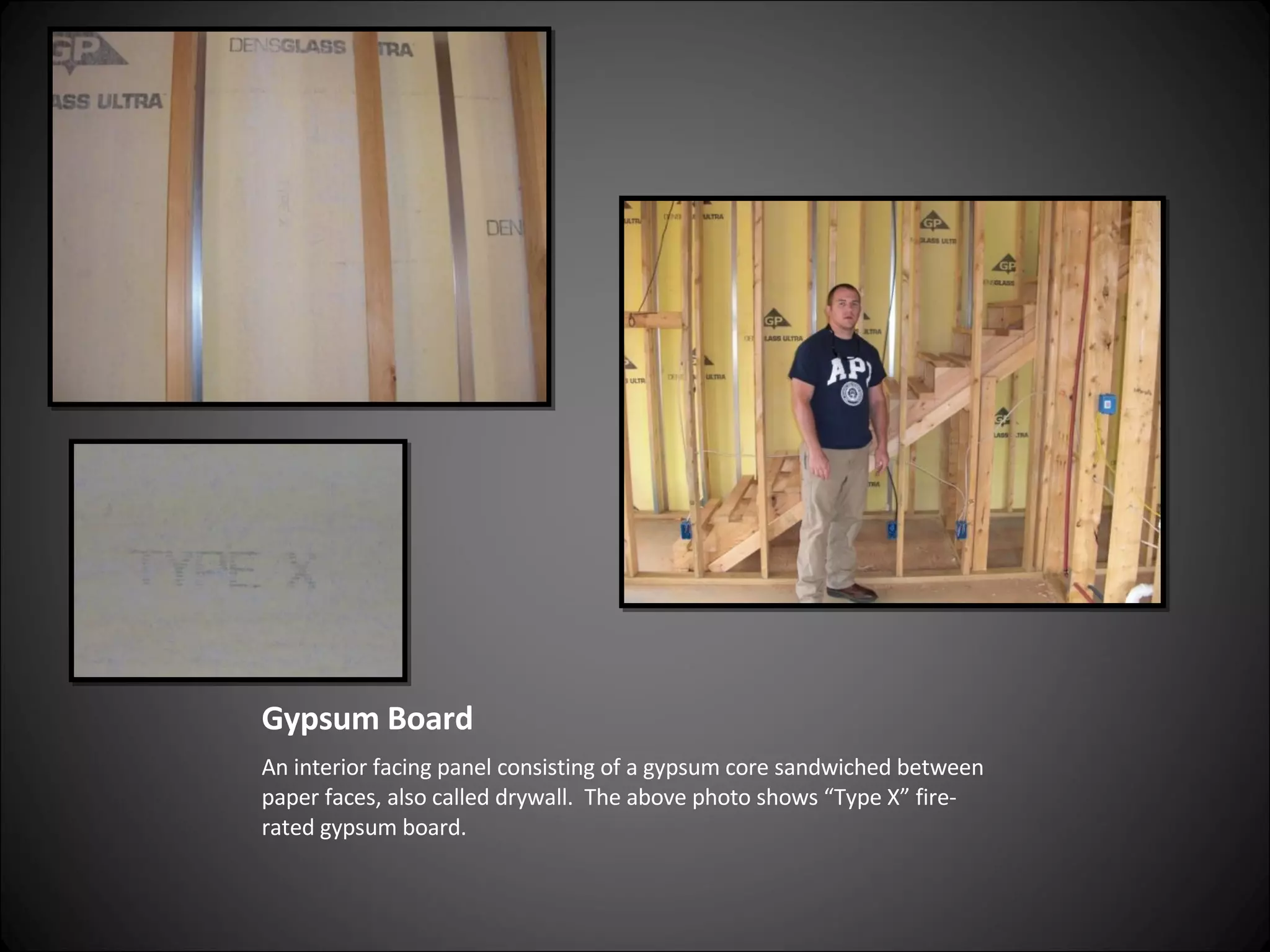
Gypsum Board An interior facing panel consisting of a gypsum core sandwiched between paper faces, also called drywall.  The above photo shows “Type X” fire-rated gypsum board.
Heat Pump
Insulation
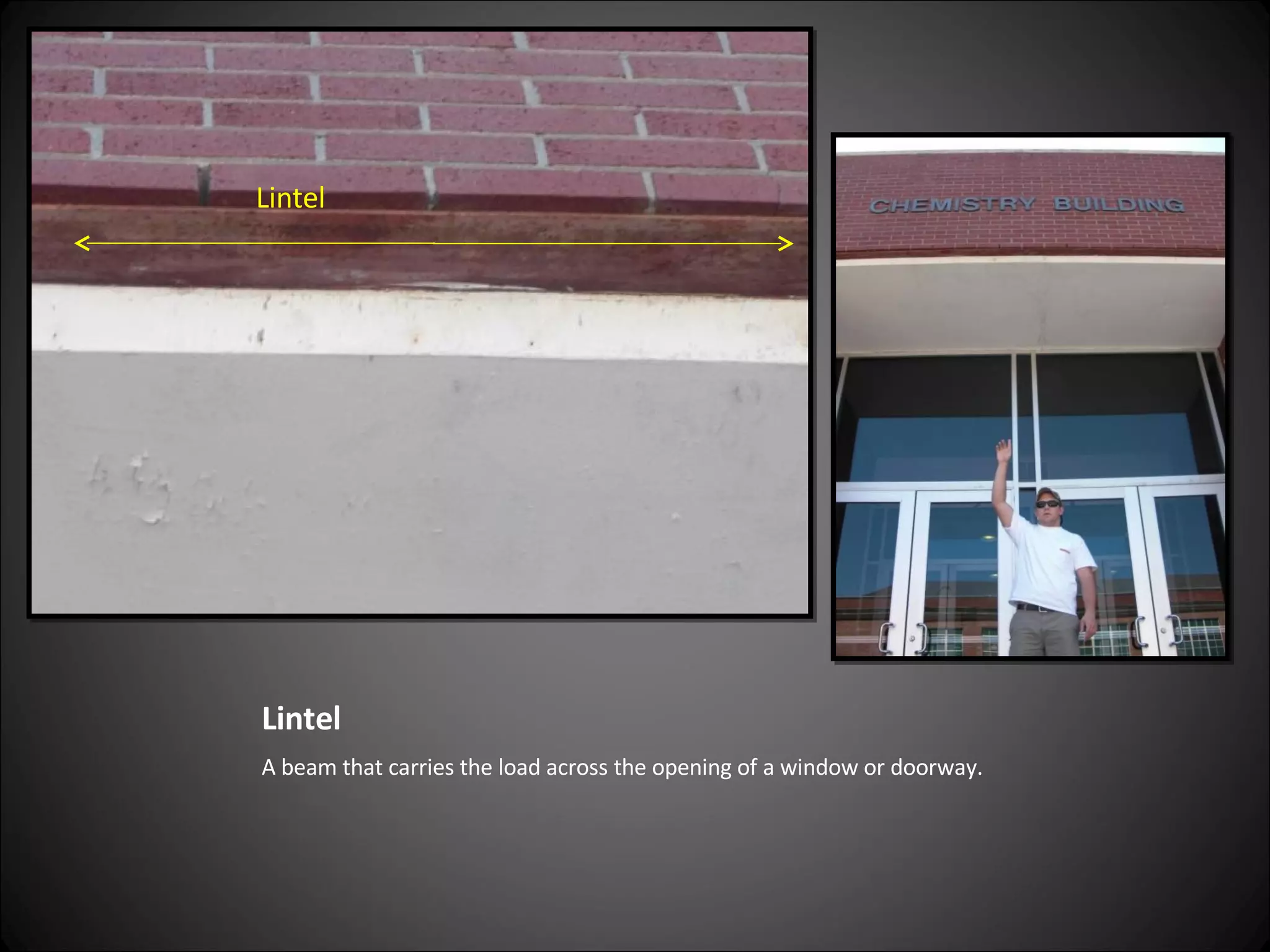
Lintel A beam that carries the load across the opening of a window or doorway. Lintel
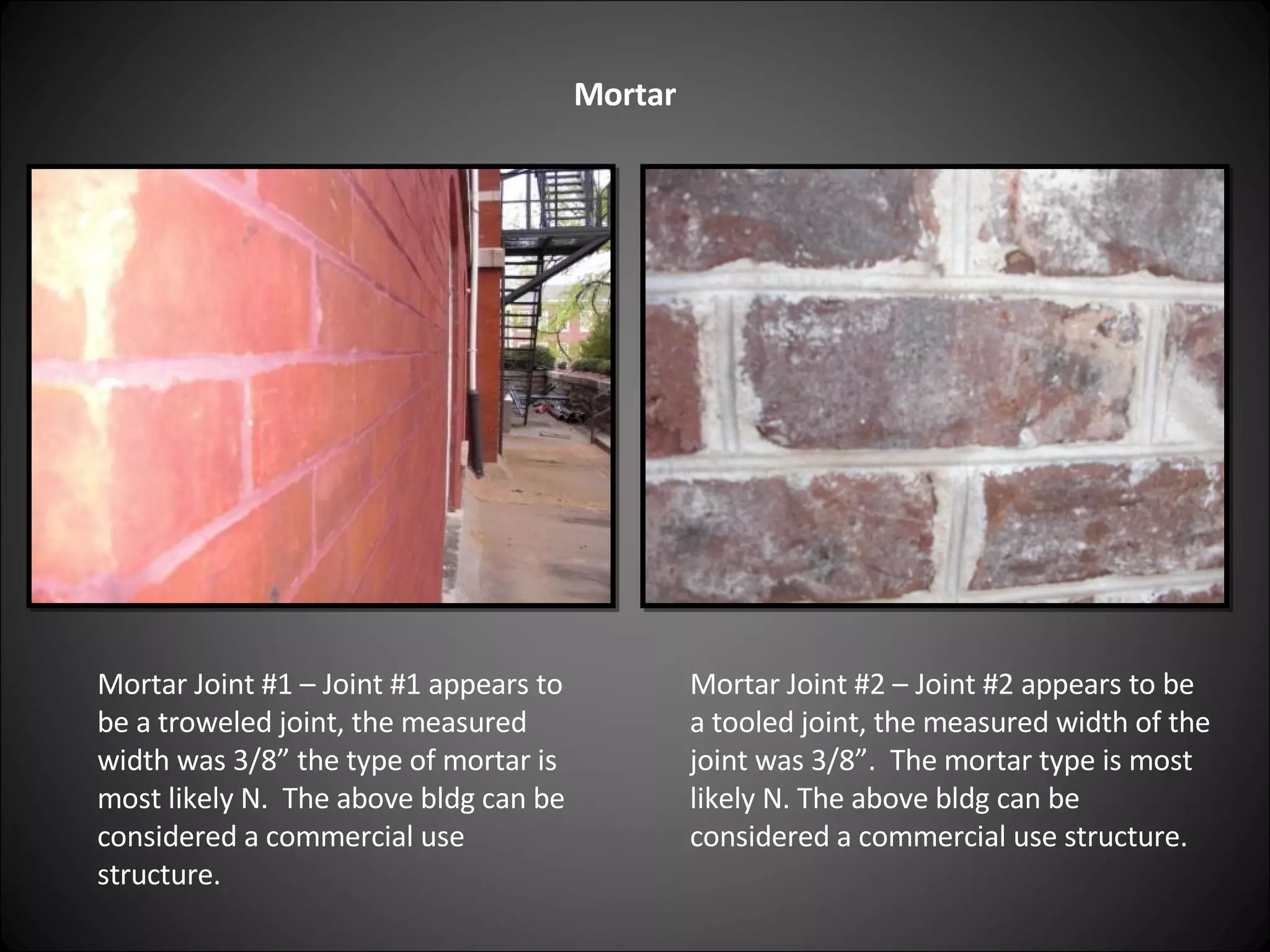
Mortar Mortar Joint #1 – Joint #1 appears to be a troweled joint, the measured width was 3/8” the type of mortar is most likely N.  The above bldg can be considered a commercial use structure. Mortar Joint #2 – Joint #2 appears to be a tooled joint, the measured width of the joint was 3/8”.  The mortar type is most likely N. The above bldg can be considered a commercial use structure.
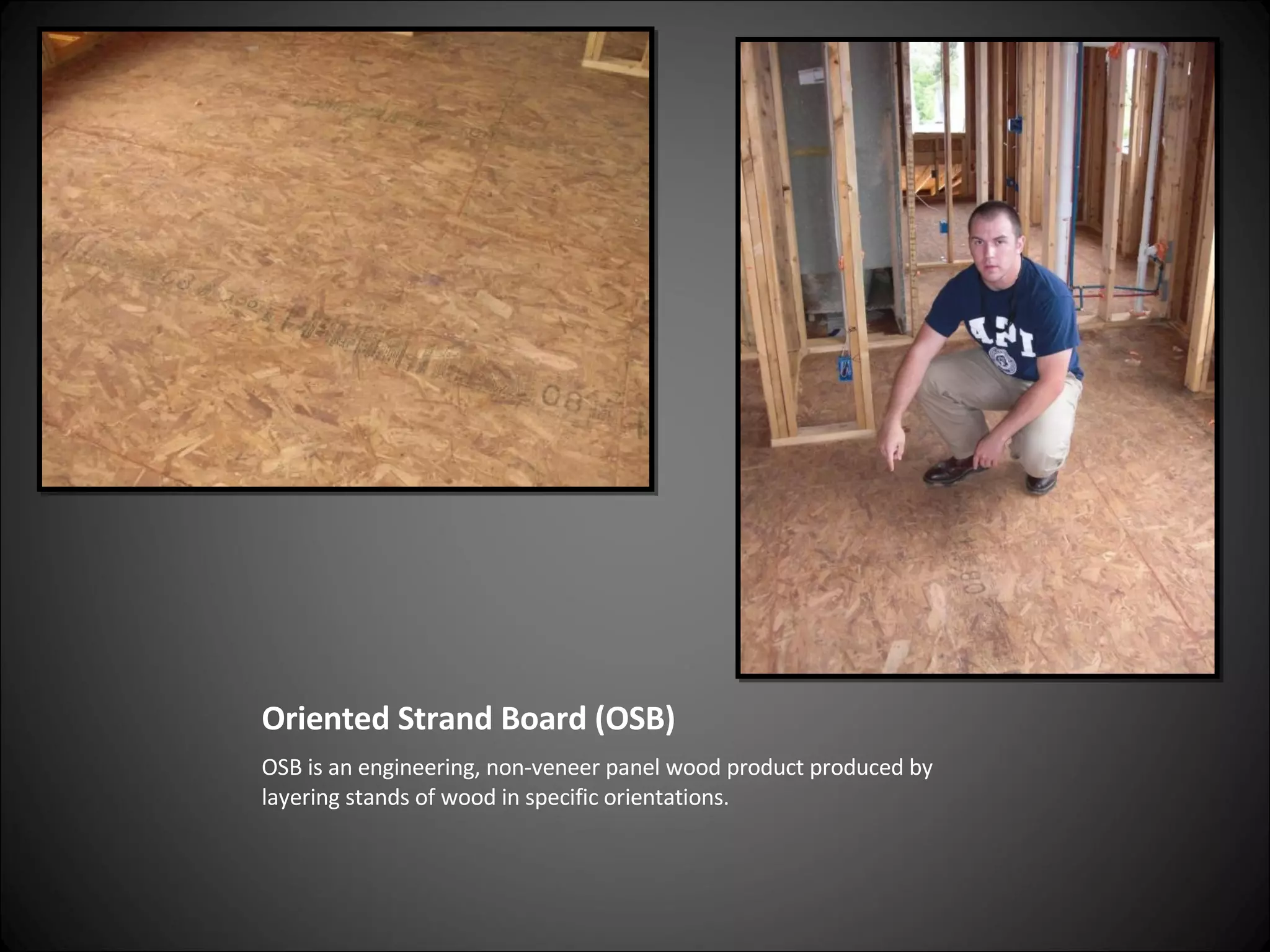
Oriented Strand Board (OSB) OSB is an engineering, non-veneer panel wood product produced by layering stands of wood in specific orientations.
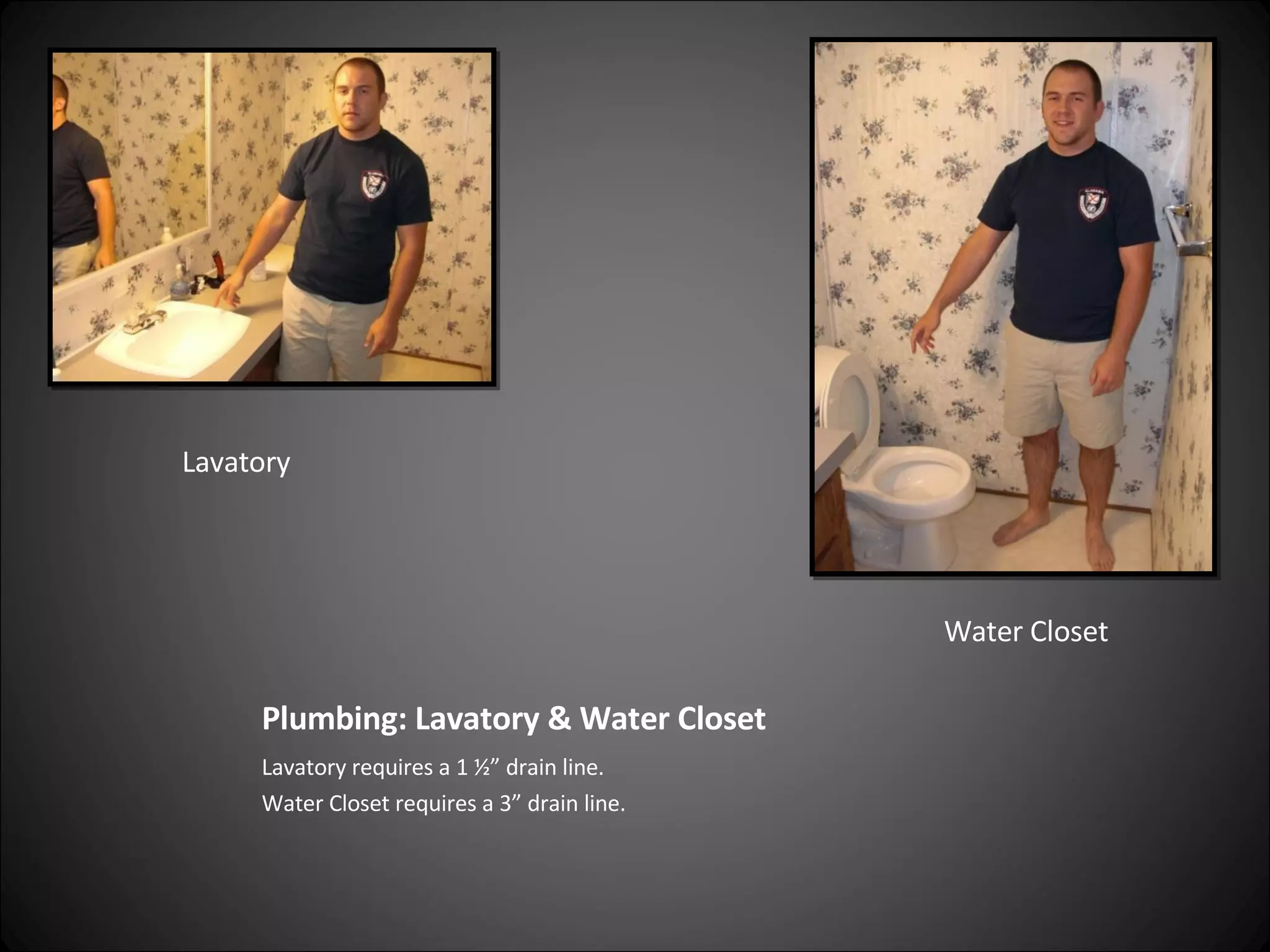
Plumbing: Lavatory & Water Closet Lavatory requires a 1 ½” drain line. Water Closet requires a 3” drain line. Lavatory Water Closet
Plumbing: Shower/Tub, VTR, & Bathroom Sink VTR- Vent Through Roof, allows the escape of gas from plumbing systems. Bathroom Sink is a “Drop-In” sink.
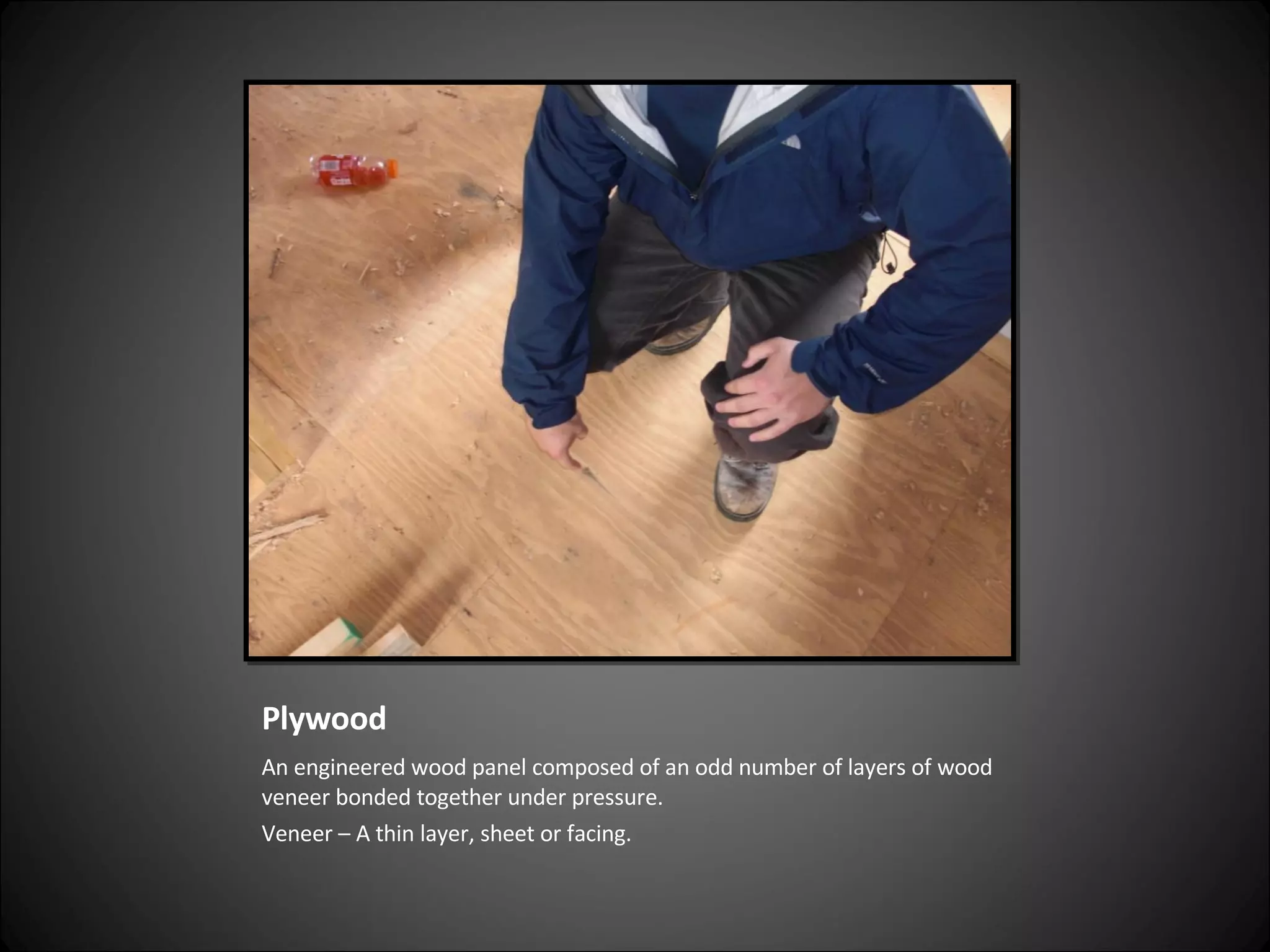
Plywood An engineered wood panel composed of an odd number of layers of wood veneer bonded together under pressure. Veneer – A thin layer, sheet or facing.
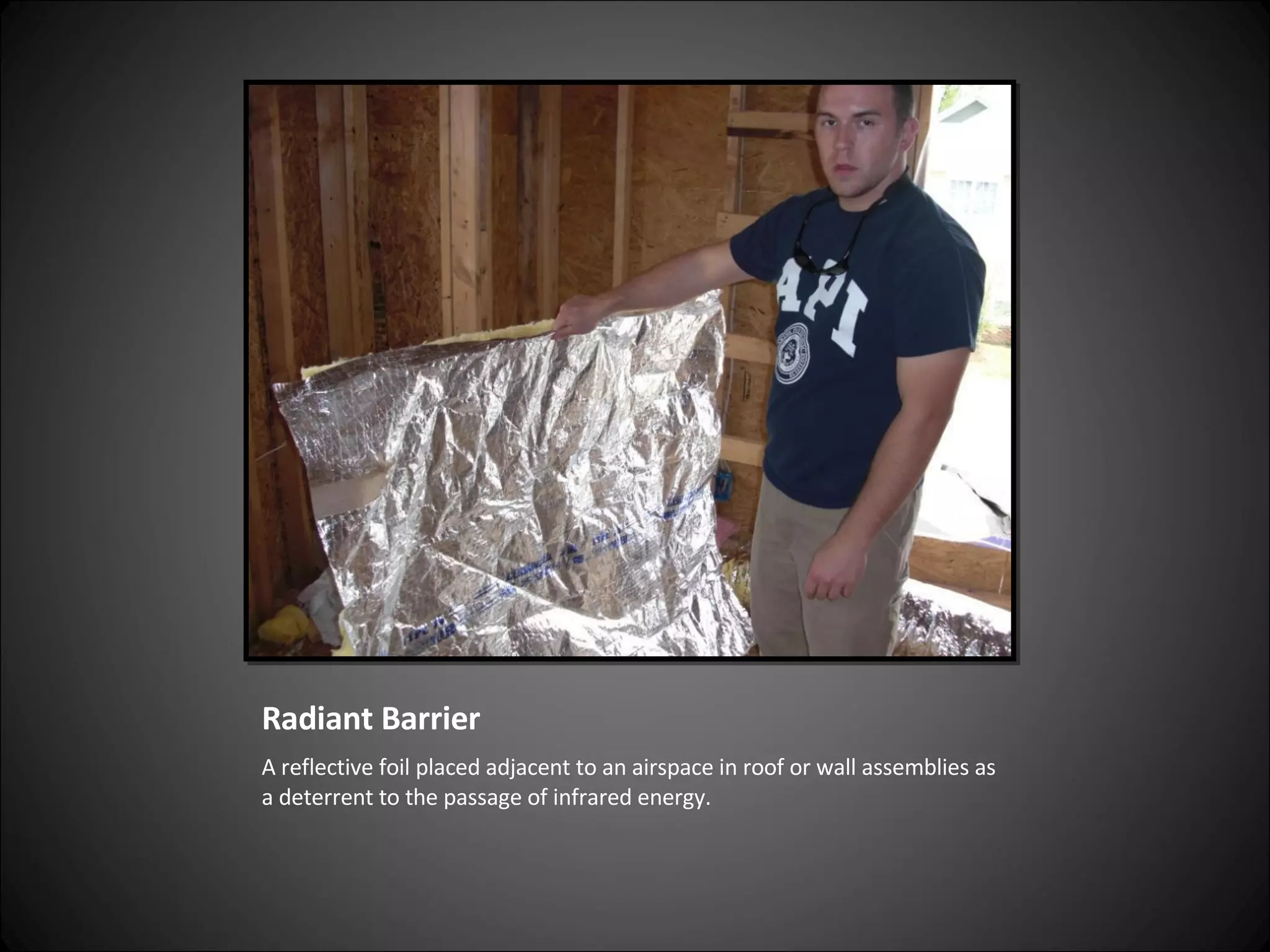
Radiant Barrier A reflective foil placed adjacent to an airspace in roof or wall assemblies as a deterrent to the passage of infrared energy.
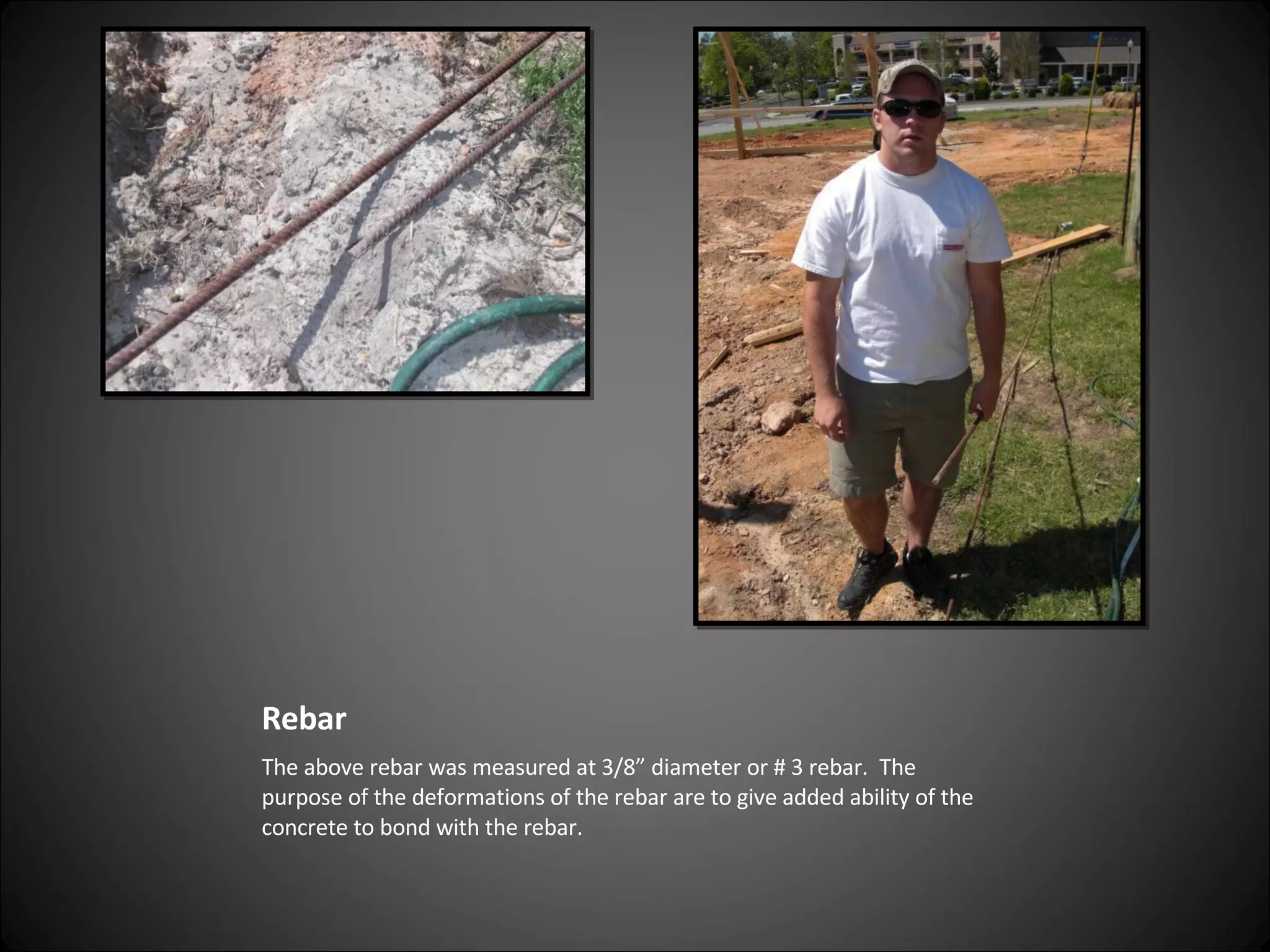
Rebar  The above rebar was measured at 3/8” diameter or # 3 rebar.  The purpose of the deformations of the rebar are to give added ability of the concrete to bond with the rebar.
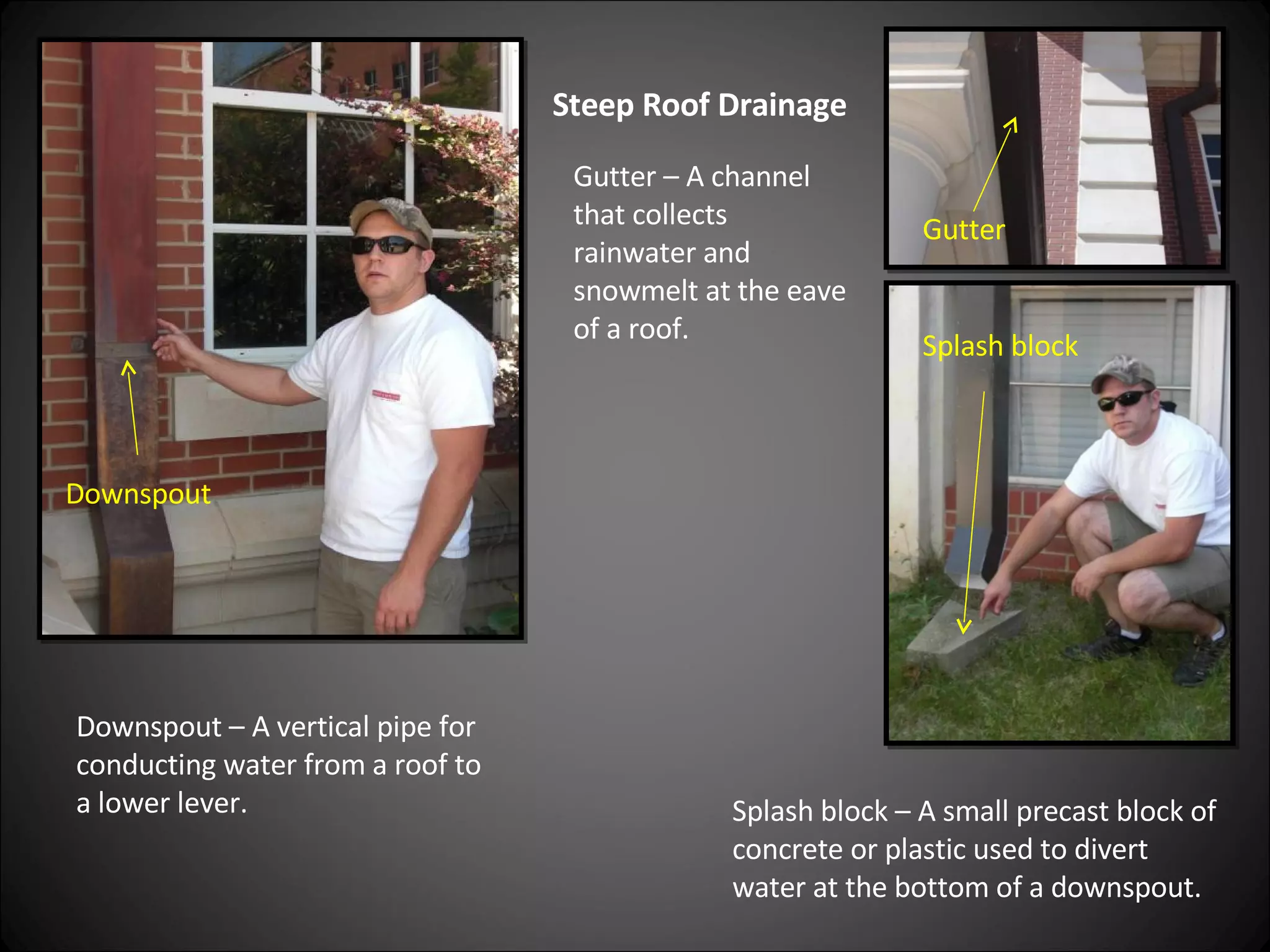
Steep Roof Drainage Gutter Splash block Downspout Downspout – A vertical pipe for conducting water from a roof to a lower lever. Gutter – A channel that collects rainwater and snowmelt at the eave of a roof. Splash block – A small precast block of concrete or plastic used to divert water at the bottom of a downspout.
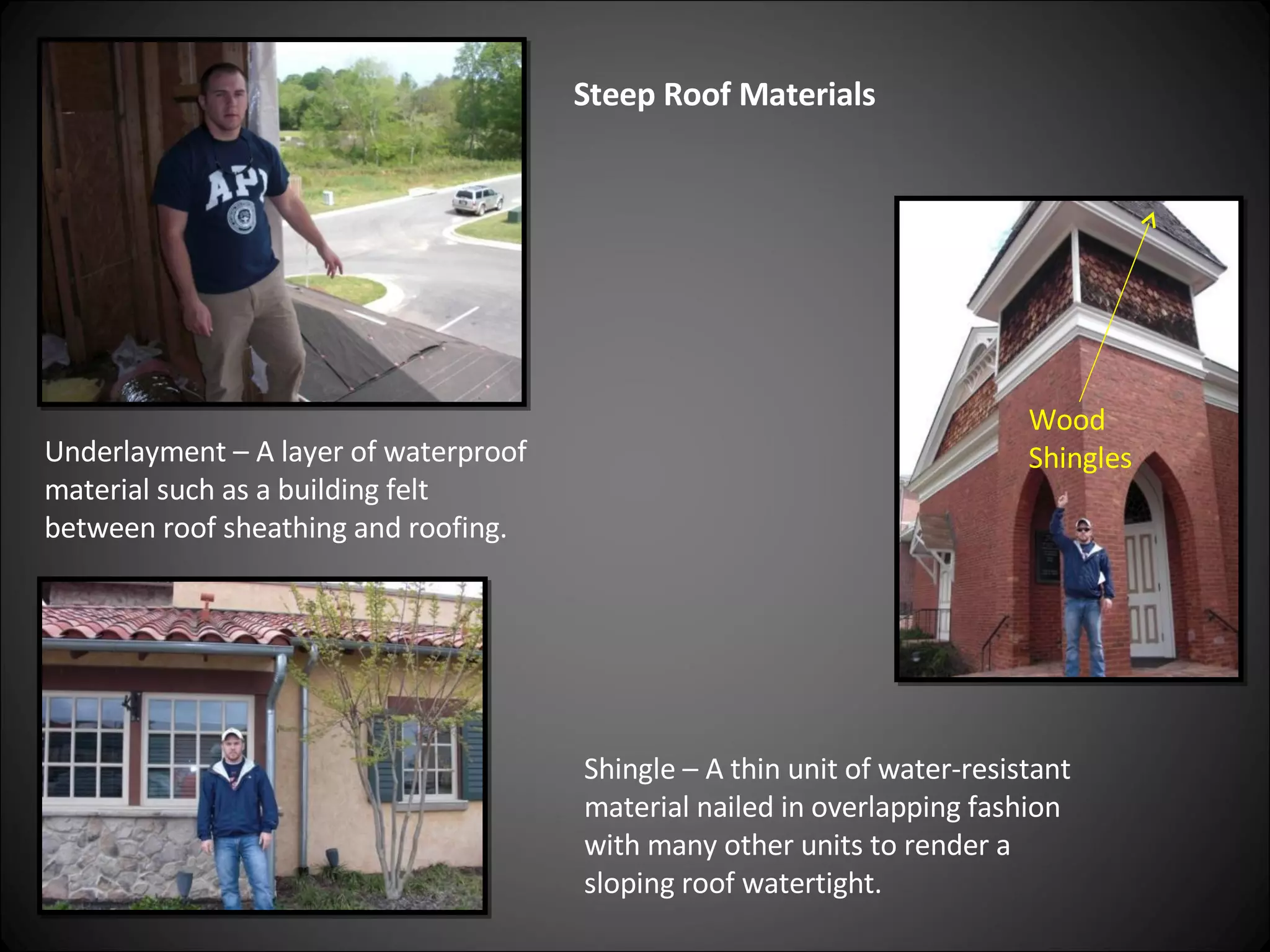
Steep Roof Materials Underlayment – A layer of waterproof material such as a building felt between roof sheathing and roofing. Shingle – A thin unit of water-resistant material nailed in overlapping fashion with many other units to render a sloping roof watertight. Wood Shingles
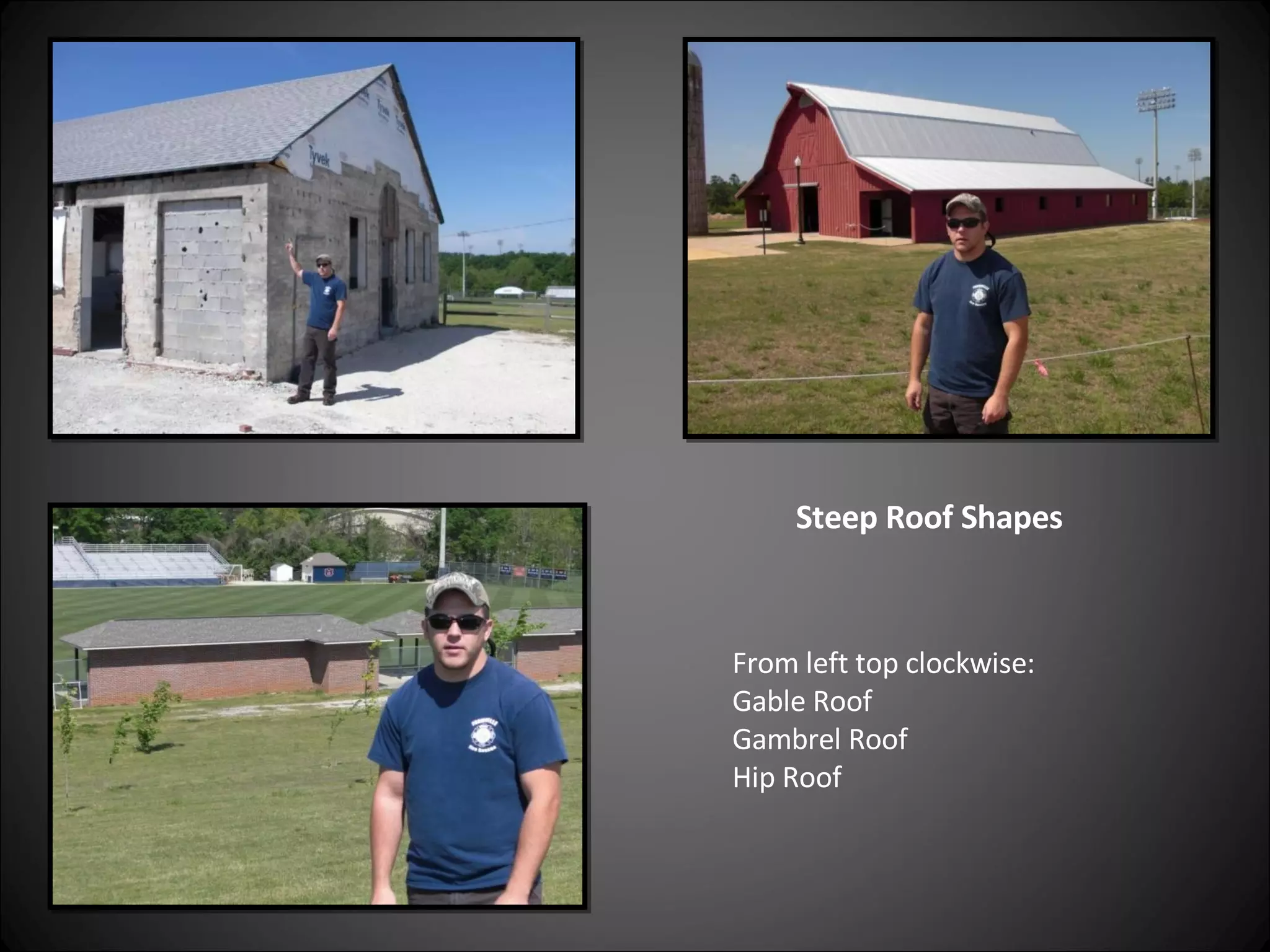
Steep Roof Shapes From left top clockwise:  Gable Roof Gambrel Roof Hip Roof
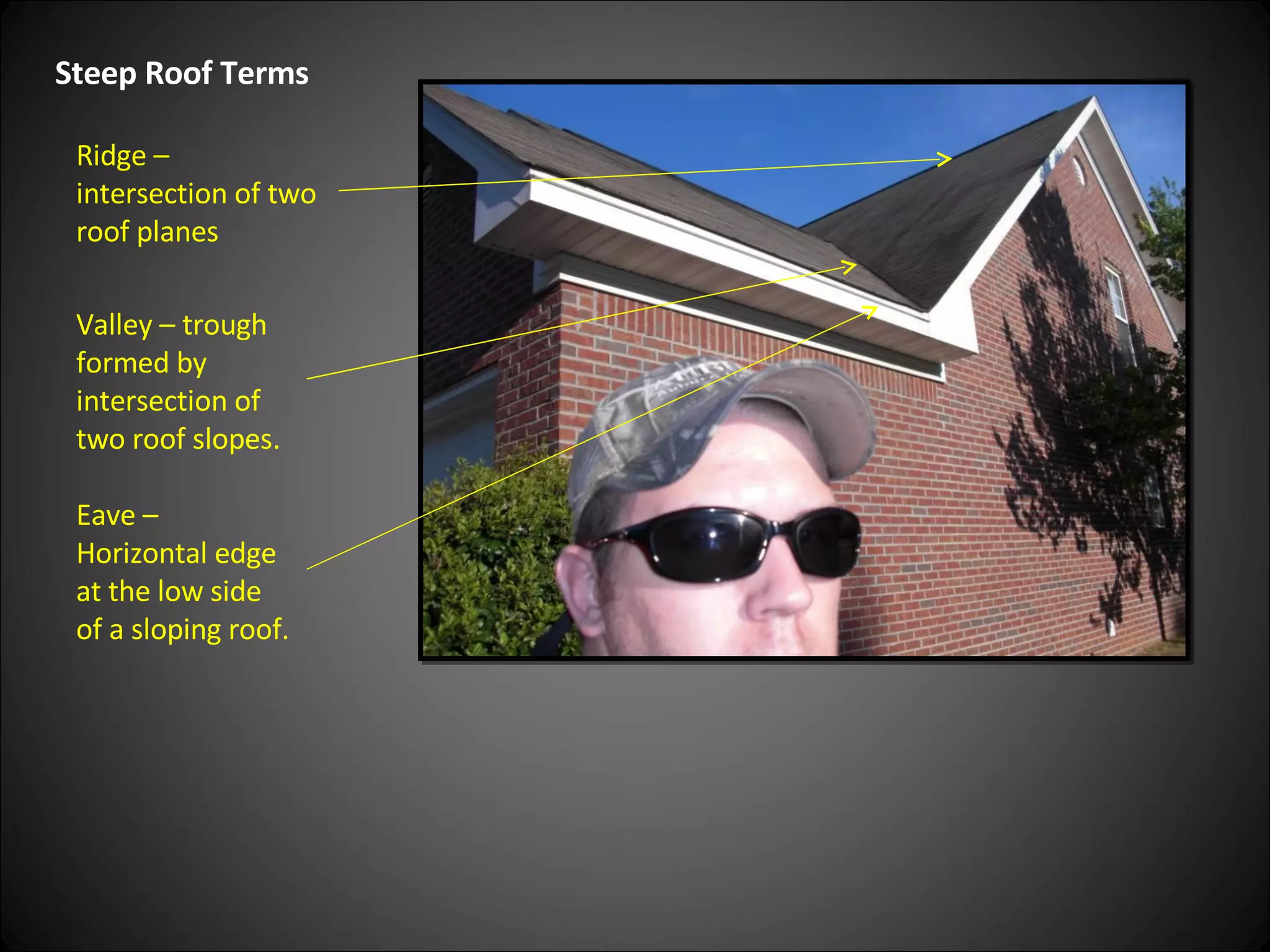
Steep Roof Terms Ridge – intersection of two roof planes Valley – trough formed by intersection of two roof slopes. Eave – Horizontal edge at the low side of a sloping roof.
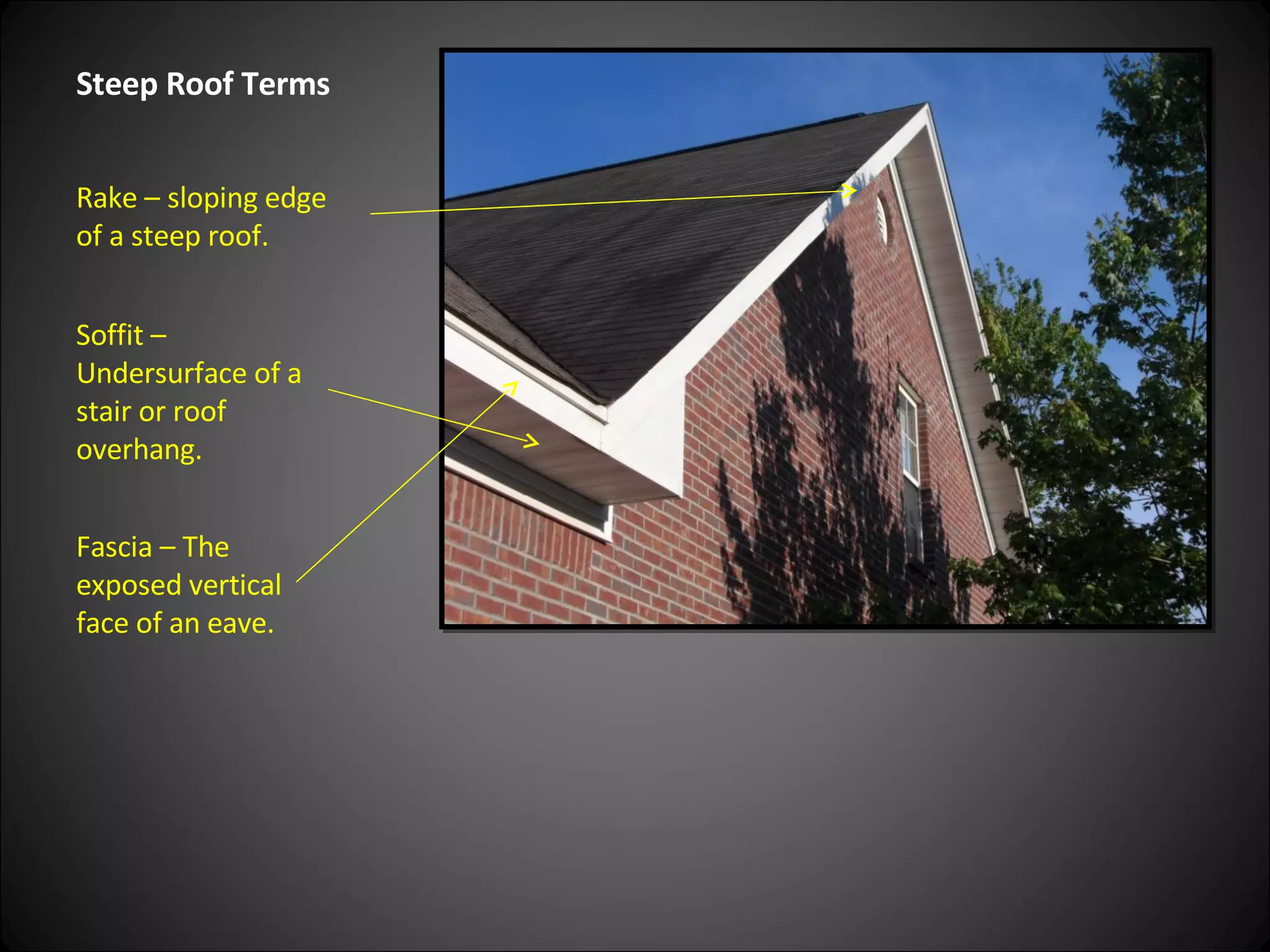
Steep Roof Terms Rake – sloping edge of a steep roof. Soffit – Undersurface of a stair or roof overhang. Fascia – The exposed vertical face of an eave.
 
Stone
Vapor Retarder
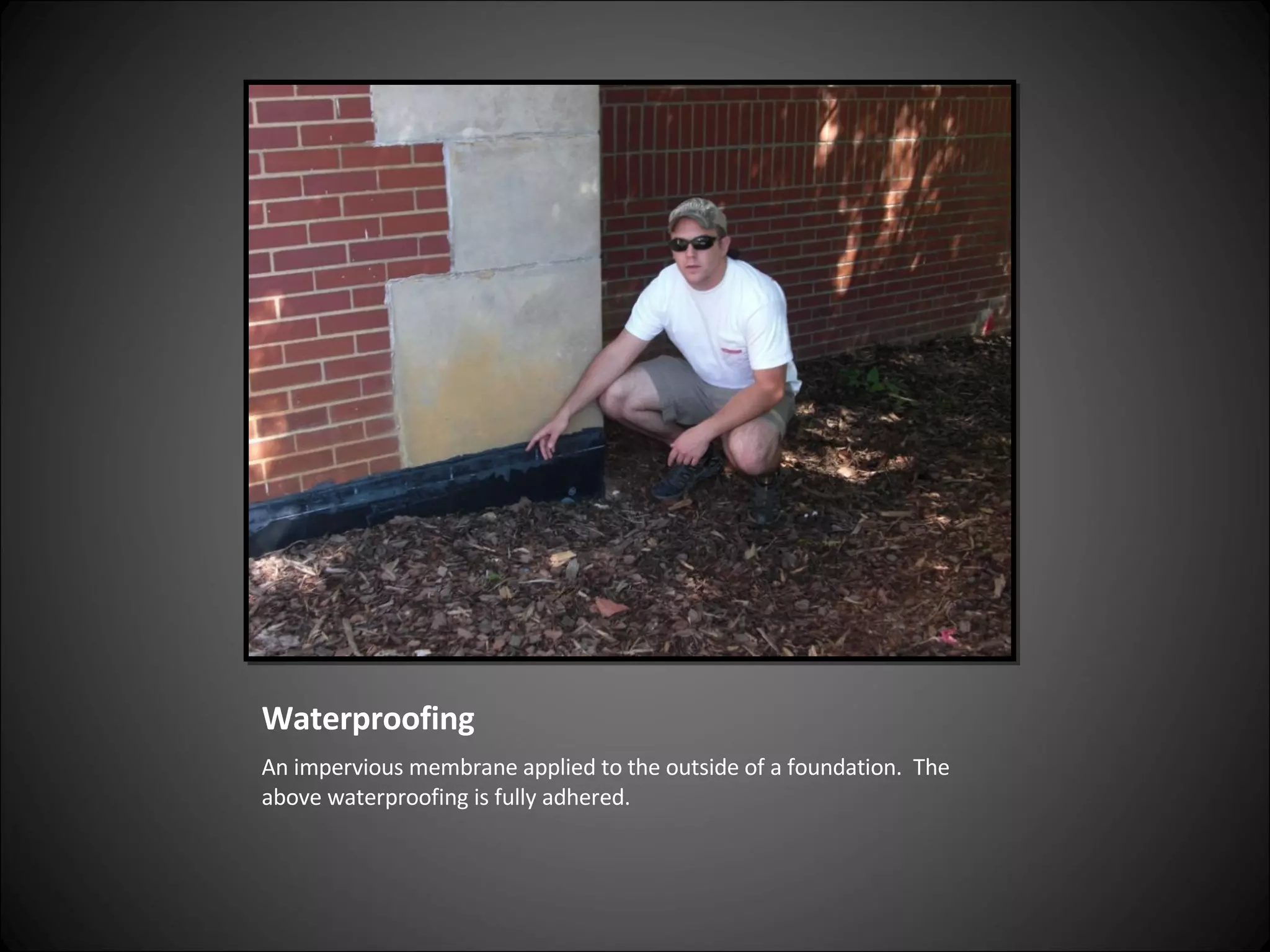
Waterproofing An impervious membrane applied to the outside of a foundation.  The above waterproofing is fully adhered.
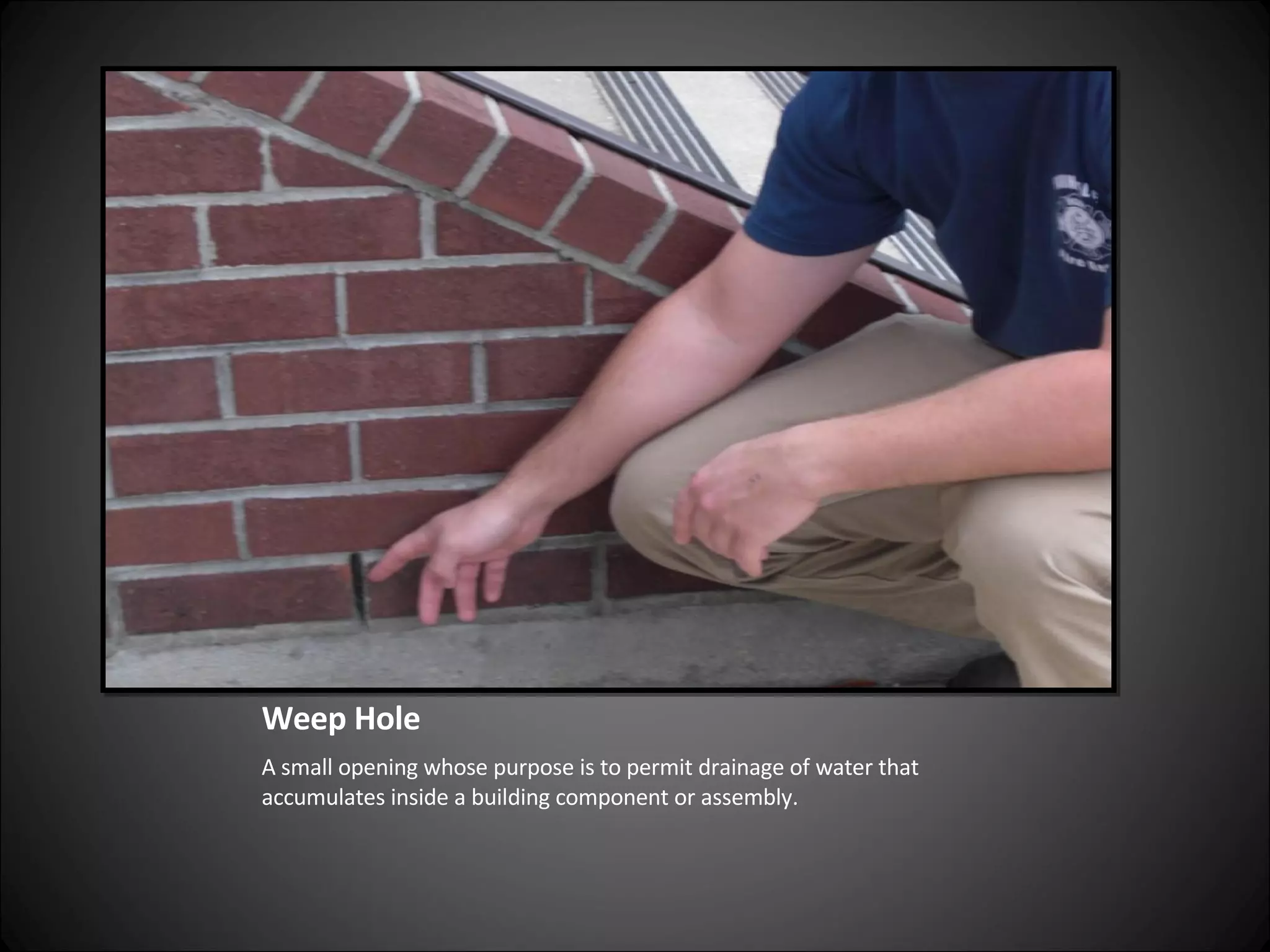
Weep Hole A small opening whose purpose is to permit drainage of water that accumulates inside a building component or assembly.
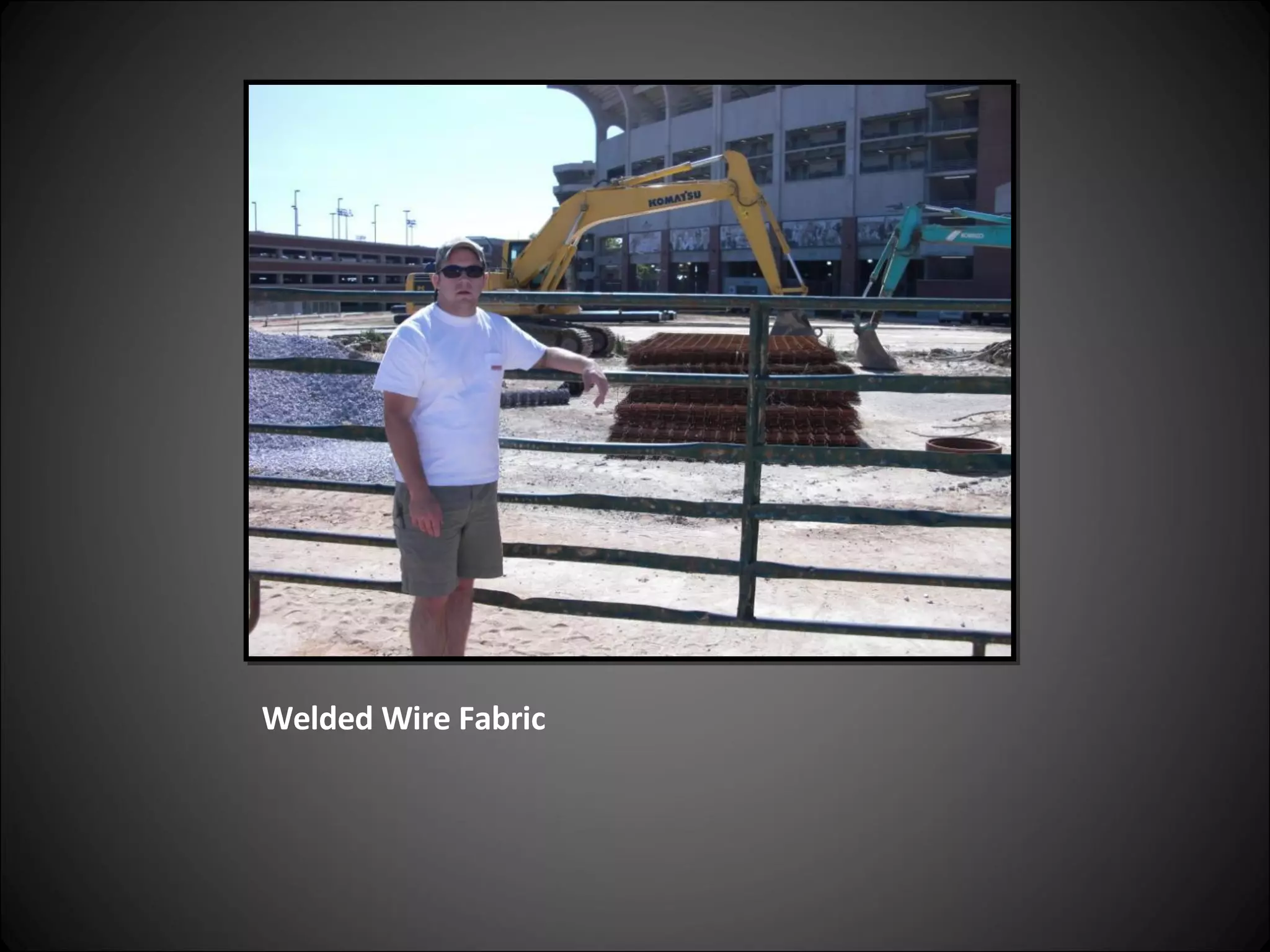
Welded Wire Fabric
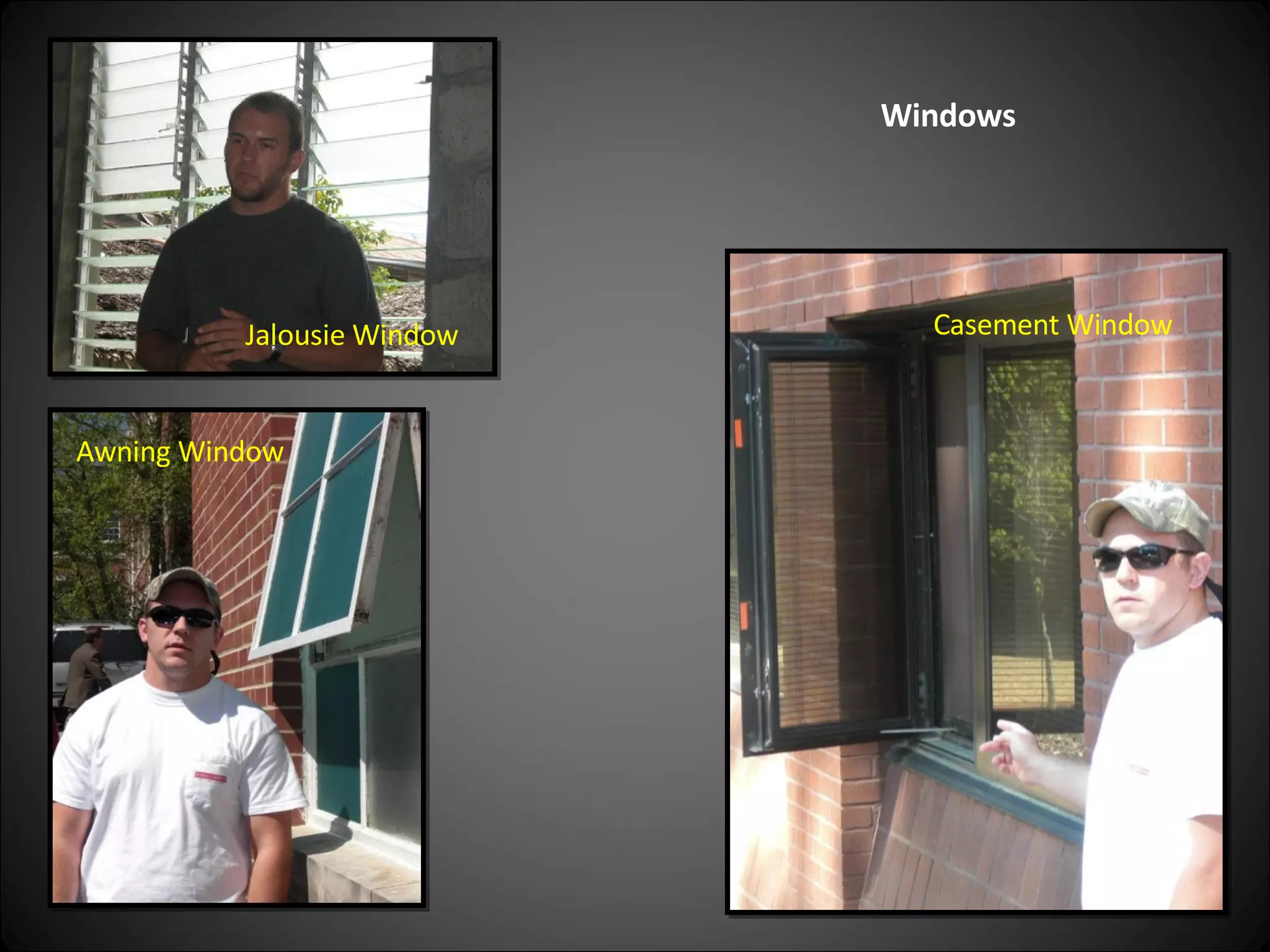
Windows Casement Window Awning Window Jalousie Window

Visual Dictionary - Chamfer

  • 1.
    Illustrated Construction DictionaryBSCI 2300-001 Spring 2009 Chamfer
  • 2.
    Air Barrier Paper/AirVapor Barrier A sheet material used as both a vapor retarder and an air barrier. When carefully taped at joints and sealed at edges, it is very effective.
  • 3.
    Attic Ventilation Atticsare ventilated not only to allow water vapor to escape, but also to keep the house cooler summer by preventing the buildup of solar heat.
  • 4.
    Soffit Vent Anopening under the eave of a roof, used to allow air to flow into the attic or the space below the roof sheathing.
  • 5.
    Ridge Vent Along, open assembly that allows air to circulate in and out of a gable roof at the ridge.
  • 6.
    Gable Vent Ascreened , louvered opening in a gable, used for exhausting excess heat and humidity from an attic.
  • 7.
    Roof Turbine Aturbine vent is a passive ventilation device that exhausts humid, hot air from an attic. Some forms of turbines are equipped with an electric motor (pictured above).
  • 8.
    Backhoe (24”)Piece of excavating equipment consisting of a digging bucket on the end of an hydraulic arm. Typically mounted on the rear of a front-end loader.
  • 9.
    Batter Boards Atemporary frame built just outside the corner of an excavation to carry marks that lie on the surface planes of the foundation that will be built within the site.
  • 10.
    Brick Arch A structural device that supports a vertical load by translating it into axial, inclined forces at its supports Segmental Arch Gothic Arch
  • 11.
    Arch with aKeystone Centering
  • 12.
    Brick Bonds (RunningBond & Stack Bond) Running Bond – Bricks that have been laid in alternating positions consisting entirely of stretchers. Stack Bond – Bricks that have been laid stacked directly on top of the previous course. Running Bond Stack Bond
  • 13.
  • 14.
  • 15.
    Brick Sizes Modular:3 5/8” x 7 5/8” x 2 3/8” Standard: 3 3/8” x 8” x 2 ¼”
  • 16.
    Bulldozer A pieceof excavating equipment used to push large quantities of soil, sand, or debris. Bulldozers are always equipped with large blade on the front.
  • 17.
  • 18.
  • 19.
    Stone Cladding &Wood Cladding A material used as the exterior wall covering of a building. This pattern in this stone cladding is coursed ashlar.
  • 20.
    Wood Shingle CladdingWood Shakes – Shingles that have been split from a block of wood. Wood Shingles – Shingles that have been cut and having a uniform thickness. Pictured above are Wood Shingles.
  • 21.
    Code Requirements: Egressfrom Window The IBC for emergency exit and rescue from a window requires that the net window area when open be equal to 5.7’. The window pictured above has net open area of 5.625’, and therefore does not meet the IBC.
  • 22.
    Code Requirements (ResidentialStairs) The stairs shown to the right were measured with a tread depth of 11” while the risers were at a height of 7 ½”. The IBC states that for residential stairs the treads shall measure a minimum of 10” and the risers shall measure a maximum of 7 ¾”. These stairs DO meet the IBC.
  • 23.
    Concrete Joints Anintentional linear discontinuity found in large concrete slabs and often sidewalks, for the purpose of controlled cracking in the material to minimize or eliminate cracking elsewhere.
  • 24.
    Isolation Joint Isolationjoints are used to help relieve stress, in this case of the precast column adjacent the slab-on-grade. Here the column is being isolated from the slab. Precast Concrete Column Slab-On-Grade Isolation Joint
  • 25.
    Concrete Masonry Unit(CMU) A block of hardened concrete, with or without hollow cores, designed to be laid in the same manner as a brick or stone. The most common block is nominally 8”x8”x16”.
  • 26.
    Decorative CMU RibbedConcrete Blocks Split – Face Block
  • 27.
  • 28.
    Exterior Panel DoorTop Rail Panel Stile Lock Rail Bottom Rail
  • 29.
    Transom & SidelightTransom - A small window directly above a door. Sidelight – A tall, narrow window alongside a door. Transom
  • 30.
    Electrical Components: Power Pole, Transformer, Service Head, & Meter
  • 31.
    Electrical Components: ServicePanel & Duplex Receptacle
  • 32.
  • 33.
  • 34.
    #3 Floor JoistThis home was constructed with a slab-on-grade foundation, therefore no floor joists were required. However, these pre-fabricated “bar joists” serve as the floor joists for the second story floor.
  • 35.
    #4 Subflooring Theload-bearing surface beneath a finish floor.
  • 36.
    #5 Sole PlateIn slab-on-grade construction the framing begins directly on top of the sill plate, in the above photo the sill plate doubles as the sole plate as well.
  • 37.
    #6 StudOne of many small, closely spaced, parallel wall framing members.
  • 38.
    #7 Top PlateThe horizontal member at the top of a stud wall.
  • 39.
  • 40.
  • 41.
  • 42.
  • 43.
  • 44.
    Front-End Loader Apiece of equipment used primarily to move or load material, to another area or to another piece of equipment such as a dump truck.
  • 45.
    Gypsum Board Aninterior facing panel consisting of a gypsum core sandwiched between paper faces, also called drywall. The above photo shows “Type X” fire-rated gypsum board.
  • 46.
  • 47.
  • 48.
    Lintel A beamthat carries the load across the opening of a window or doorway. Lintel
  • 49.
    Mortar Mortar Joint#1 – Joint #1 appears to be a troweled joint, the measured width was 3/8” the type of mortar is most likely N. The above bldg can be considered a commercial use structure. Mortar Joint #2 – Joint #2 appears to be a tooled joint, the measured width of the joint was 3/8”. The mortar type is most likely N. The above bldg can be considered a commercial use structure.
  • 50.
    Oriented Strand Board(OSB) OSB is an engineering, non-veneer panel wood product produced by layering stands of wood in specific orientations.
  • 51.
    Plumbing: Lavatory &Water Closet Lavatory requires a 1 ½” drain line. Water Closet requires a 3” drain line. Lavatory Water Closet
  • 52.
    Plumbing: Shower/Tub, VTR,& Bathroom Sink VTR- Vent Through Roof, allows the escape of gas from plumbing systems. Bathroom Sink is a “Drop-In” sink.
  • 53.
    Plywood An engineeredwood panel composed of an odd number of layers of wood veneer bonded together under pressure. Veneer – A thin layer, sheet or facing.
  • 54.
    Radiant Barrier Areflective foil placed adjacent to an airspace in roof or wall assemblies as a deterrent to the passage of infrared energy.
  • 55.
    Rebar Theabove rebar was measured at 3/8” diameter or # 3 rebar. The purpose of the deformations of the rebar are to give added ability of the concrete to bond with the rebar.
  • 56.
    Steep Roof DrainageGutter Splash block Downspout Downspout – A vertical pipe for conducting water from a roof to a lower lever. Gutter – A channel that collects rainwater and snowmelt at the eave of a roof. Splash block – A small precast block of concrete or plastic used to divert water at the bottom of a downspout.
  • 57.
    Steep Roof MaterialsUnderlayment – A layer of waterproof material such as a building felt between roof sheathing and roofing. Shingle – A thin unit of water-resistant material nailed in overlapping fashion with many other units to render a sloping roof watertight. Wood Shingles
  • 58.
    Steep Roof ShapesFrom left top clockwise: Gable Roof Gambrel Roof Hip Roof
  • 59.
    Steep Roof TermsRidge – intersection of two roof planes Valley – trough formed by intersection of two roof slopes. Eave – Horizontal edge at the low side of a sloping roof.
  • 60.
    Steep Roof TermsRake – sloping edge of a steep roof. Soffit – Undersurface of a stair or roof overhang. Fascia – The exposed vertical face of an eave.
  • 61.
  • 62.
  • 63.
  • 64.
    Waterproofing An imperviousmembrane applied to the outside of a foundation. The above waterproofing is fully adhered.
  • 65.
    Weep Hole Asmall opening whose purpose is to permit drainage of water that accumulates inside a building component or assembly.
  • 66.
  • 67.
    Windows Casement WindowAwning Window Jalousie Window