Vision Based Traffic Surveillance System Presented  By  S.maheswaran
Improvement of Pictorial Information To improve the contrast of the image To remove noise To remove blurring caused by movement of the  image acquisition devices To correct geometrical distortions caused by  the lens Why Digital Image Processing Automatic Machine perception for intelligent interpretation of scenes or pictures.
Different Fields of Applications Character Recognition & Signature Verification Industrial Process Monitoring Biometrics and Forensic ( Recognition and Verification  of persons using Face, Palm & Fingerprints ) Military surveillance and Target Identification Remote Sensing ( Satellite Image Processing) Safety and Security ( Night vision) Biomedical Engineering ( Diagnosis and Surgery )  Traffic monitoring
To  monitor the road To initiate automated vehicle tracking Lane Jam Detection  To measure the number of vehicles in the lane  To recognize number plates of the vehicles Need for Vision Based Traffic Control
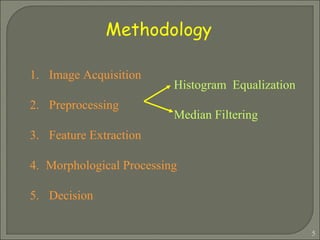
Image Acquisition Preprocessing Feature Extraction Morphological Processing Decision  Methodology Histogram  Equalization Median Filtering
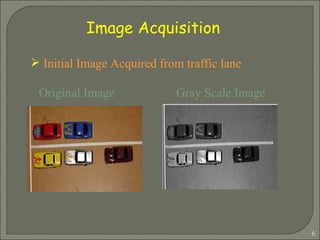
Image Acquisition Initial Image Acquired from traffic lane  Original Image  Gray Scale Image
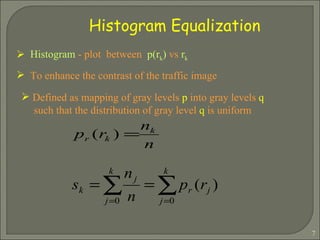
Histogram   -   plot  between   p(r k )   vs   r k  To enhance the contrast of the traffic image  Histogram Equalization Defined as mapping of gray levels  p  into gray levels  q  such that the distribution of gray level  q  is uniform
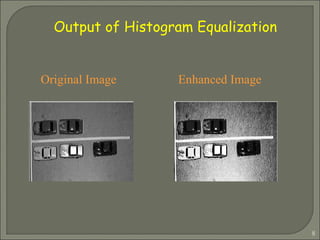
Output of Histogram Equalization Original Image  Enhanced Image
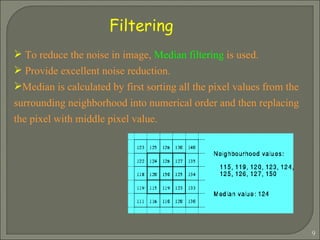
To reduce the noise in image,  Median filtering  is used. Provide excellent noise reduction. Median is calculated by first sorting all the pixel values from the surrounding neighborhood into numerical order and then replacing the pixel with middle pixel value. Filtering
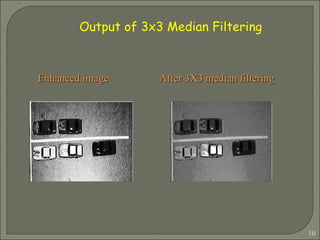
Output of 3x3 Median Filtering Enhanced image  After 3X3 median filtering
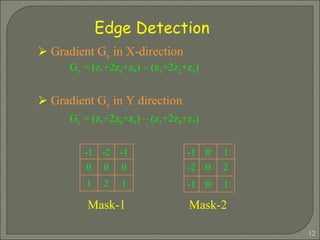
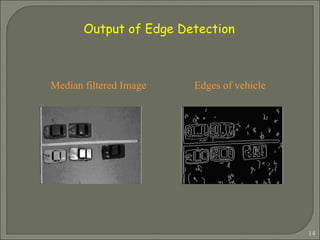
Segmentation -  Subdivides an image into its constituent regions or objects. Edge -  A set of connected pixels whose two-dimensional first order derivative is greater than a specified threshold. Edge Detection -  2-D gradient based approach is used. (Sobel Mask) Segmentation
Edge Detection Gradient G x  in X-direction  G x  = (z 7 +2z 8 +z 9 ) – (z 1 +2z 2 +z 3 ) Gradient G y  in Y direction  G y  = (z 3 +2z 6 +z 9 ) – (z 1 +2z 4 +z 7 ) Mask-1 Mask-2 -1 -2 -1 0 0 0 1 2 1 -1 0 1 -2 0 2 -1 0 1
Gradient of an image f(x,y) at location (x,y) is defined as the vector M = [G 2 x + G 2 y]  ½   The direction of the gradient vector of an image f(x, y) at location (x,y) is given as α (x,y) = tan -1 [Gy / Gx]   Cont..
Median filtered Image  Edges of vehicle Output of Edge Detection
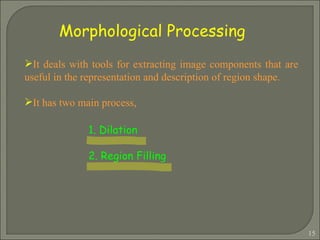
It deals with tools for extracting image components that are useful in the representation and description of region shape. It has two main process, 1. Dilation 2. Region Filling   Morphological Processing
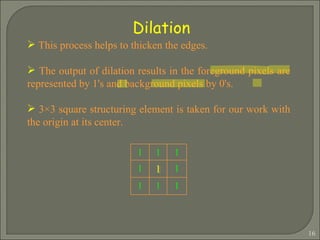
Dilation This process helps to thicken the edges. The output of dilation results in the foreground pixels are represented by 1's and background pixels by 0's. 3×3 square structuring element is taken for our work with the origin at its center.   1 1 1 1 1 1 1 1 1
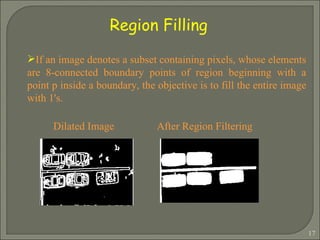
If an image denotes a subset containing pixels, whose elements are 8-connected boundary points of region beginning with a point p inside a boundary, the objective is to fill the entire image with 1's. Dilated Image  After Region Filtering  Region Filling
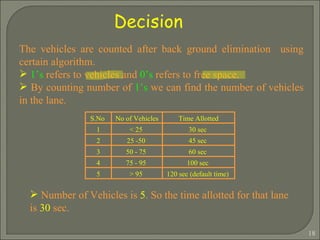
Decision  The vehicles are counted after back ground elimination  using certain algorithm.  1’s  refers to vehicles and  0’s  refers to free space. By counting number of  1’s  we can find the number of vehicles in the lane. Number of Vehicles is  5 . So the time allotted for that lane is  30  sec. 120 sec (default time)   > 95   5 100 sec   75 - 95   4 60 sec   50 - 75   3 45 sec   25 -50   2 30 sec   < 25   1 Time Allotted No of Vehicles S.No
Conclusion  20 lane image were taken for analysis. 90% accuracy was obtained. Time allotment to the channel is appropriate  &  better than existing  µ c   and  sensor  based system. Recognition of number plates and speed of the vehicles is  possible.
References  E. Atko¡ci unas1, R. Blake, A.Juozapavi¡cius, M. Kazimianec,  Nonlinear Analysis: Modelling and Control , 2005, Vol. 10, No. 4, 315–332  Image Processing in Road Traffic Analysis. 2. G.D. Sullivan, K. Baker, et al.  Model-based Vehicle Detection and Classification using Orthographic Approximations , in:  Proc. British Machine Vision AssociationConference,  1996. 3. D.A. Forsyth, J. Ponce.  Computer Vision. A Modern Approach ,  Prentice Hall, 2003.
4. D. Beymer, et al.  Computer Vision System Measuring Traffic Parameters , in:  Proc. IEEE Conf. On Computer Vision and Pattern Recognition, 1977. 5. L.G. Shapiro, G.C. Stockman.  Computer Vision ,  Prentice Hall, 2001. 6. L.A. B. Jähne, H. Haußecker, P. Geißler.  Computer Vision and Applications ,  Academic Press, 1999. Cont..
Open  For  Discussion
Thank you

Vision Based Traffic Surveillance System

  • 1.
    Vision Based TrafficSurveillance System Presented By S.maheswaran
  • 2.
    Improvement of PictorialInformation To improve the contrast of the image To remove noise To remove blurring caused by movement of the image acquisition devices To correct geometrical distortions caused by the lens Why Digital Image Processing Automatic Machine perception for intelligent interpretation of scenes or pictures.
  • 3.
    Different Fields ofApplications Character Recognition & Signature Verification Industrial Process Monitoring Biometrics and Forensic ( Recognition and Verification of persons using Face, Palm & Fingerprints ) Military surveillance and Target Identification Remote Sensing ( Satellite Image Processing) Safety and Security ( Night vision) Biomedical Engineering ( Diagnosis and Surgery ) Traffic monitoring
  • 4.
    To monitorthe road To initiate automated vehicle tracking Lane Jam Detection To measure the number of vehicles in the lane To recognize number plates of the vehicles Need for Vision Based Traffic Control
  • 5.
    Image Acquisition PreprocessingFeature Extraction Morphological Processing Decision Methodology Histogram Equalization Median Filtering
  • 6.
    Image Acquisition InitialImage Acquired from traffic lane Original Image Gray Scale Image
  • 7.
    Histogram - plot between p(r k ) vs r k To enhance the contrast of the traffic image Histogram Equalization Defined as mapping of gray levels p into gray levels q such that the distribution of gray level q is uniform
  • 8.
    Output of HistogramEqualization Original Image Enhanced Image
  • 9.
    To reduce thenoise in image, Median filtering is used. Provide excellent noise reduction. Median is calculated by first sorting all the pixel values from the surrounding neighborhood into numerical order and then replacing the pixel with middle pixel value. Filtering
  • 10.
    Output of 3x3Median Filtering Enhanced image After 3X3 median filtering
  • 11.
    Segmentation - Subdivides an image into its constituent regions or objects. Edge - A set of connected pixels whose two-dimensional first order derivative is greater than a specified threshold. Edge Detection - 2-D gradient based approach is used. (Sobel Mask) Segmentation
  • 12.
    Edge Detection GradientG x in X-direction G x = (z 7 +2z 8 +z 9 ) – (z 1 +2z 2 +z 3 ) Gradient G y in Y direction G y = (z 3 +2z 6 +z 9 ) – (z 1 +2z 4 +z 7 ) Mask-1 Mask-2 -1 -2 -1 0 0 0 1 2 1 -1 0 1 -2 0 2 -1 0 1
  • 13.
    Gradient of animage f(x,y) at location (x,y) is defined as the vector M = [G 2 x + G 2 y] ½ The direction of the gradient vector of an image f(x, y) at location (x,y) is given as α (x,y) = tan -1 [Gy / Gx] Cont..
  • 14.
    Median filtered Image Edges of vehicle Output of Edge Detection
  • 15.
    It deals withtools for extracting image components that are useful in the representation and description of region shape. It has two main process, 1. Dilation 2. Region Filling Morphological Processing
  • 16.
    Dilation This processhelps to thicken the edges. The output of dilation results in the foreground pixels are represented by 1's and background pixels by 0's. 3×3 square structuring element is taken for our work with the origin at its center. 1 1 1 1 1 1 1 1 1
  • 17.
    If an imagedenotes a subset containing pixels, whose elements are 8-connected boundary points of region beginning with a point p inside a boundary, the objective is to fill the entire image with 1's. Dilated Image After Region Filtering Region Filling
  • 18.
    Decision Thevehicles are counted after back ground elimination using certain algorithm. 1’s refers to vehicles and 0’s refers to free space. By counting number of 1’s we can find the number of vehicles in the lane. Number of Vehicles is 5 . So the time allotted for that lane is 30 sec. 120 sec (default time) > 95 5 100 sec 75 - 95 4 60 sec 50 - 75 3 45 sec 25 -50 2 30 sec < 25 1 Time Allotted No of Vehicles S.No
  • 19.
    Conclusion 20lane image were taken for analysis. 90% accuracy was obtained. Time allotment to the channel is appropriate & better than existing µ c and sensor based system. Recognition of number plates and speed of the vehicles is possible.
  • 20.
    References E.Atko¡ci unas1, R. Blake, A.Juozapavi¡cius, M. Kazimianec, Nonlinear Analysis: Modelling and Control , 2005, Vol. 10, No. 4, 315–332 Image Processing in Road Traffic Analysis. 2. G.D. Sullivan, K. Baker, et al. Model-based Vehicle Detection and Classification using Orthographic Approximations , in: Proc. British Machine Vision AssociationConference, 1996. 3. D.A. Forsyth, J. Ponce. Computer Vision. A Modern Approach , Prentice Hall, 2003.
  • 21.
    4. D. Beymer,et al. Computer Vision System Measuring Traffic Parameters , in: Proc. IEEE Conf. On Computer Vision and Pattern Recognition, 1977. 5. L.G. Shapiro, G.C. Stockman. Computer Vision , Prentice Hall, 2001. 6. L.A. B. Jähne, H. Haußecker, P. Geißler. Computer Vision and Applications , Academic Press, 1999. Cont..
  • 22.
    Open For Discussion
  • 23.