Wi-Counter: Smartphone-Based People
Counter
Using Crowd sourced Wi-Fi Signal
PRESENTATION ON EE4130
Published in: Human-Machine Systems, IEEE Transactions
on (Volume:45 , Issue: 4 )
DOI:10.1109/THMS.2015.2401391
TECHNICAL SEMINAR
ON
1
INTRODUCTION
 Objectives: Reliable people counting is crucial to many urban applications. However,
most existing people counting systems are sensor-based and can only work in some
fixed gateways or checkpoints where sensors have been installed. This high
dependence on the exact locations of sensors leads to low accuracy. To overcome
these limitations, we propose a smartphone-based people counting system, Wi-
Counter, by leveraging the pervasive Wi-Fi infrastructure. To collect comprehensive
Wi-Fi signals and people count information based on crowd source
2
AGENDA:
a) Proposed Procedure
b) System design
c) Project Overview
d) System Architecture
e) An Experiment on this Project
f) Result & Discussion
g) Advantages & Future work
h) Questions & Answer
3
PROPOSED PROCEDURE
 Wi-Counter first adopts a preprocessor to overcome the noisy, discrepant, and
fragile data based on the Wiener filter and Newton interpolation.
 It then makes use of the designated five-layer neural network to learn the relation
model between the Wi-Fi signals and the number of people.
 By analyzing the received Wi-Fi signals, Wi-Counter can estimate the number of
people based on the resulting model
4
SYSTEM DESIGN:
 The Wi-Counter system is built based on the existing WLAN infrastructure, and no
sensors or specific hardware are required.
 It consists of three phases: crowdsourcing, offline training, and online people
counting phase.
 In the crowdsourcing phase, a smartphone-based application is implemented to
collect the Wi-Fi RSS and people count information from different locations.
 The offline training phase first filters out the noisy crowdsourced data and uses
them to train a five-layer NN.
 Finally, the online people counting phase retrieves the NN to estimate the number
of people for that location.
5
PROJECT OVERVIEW:
6
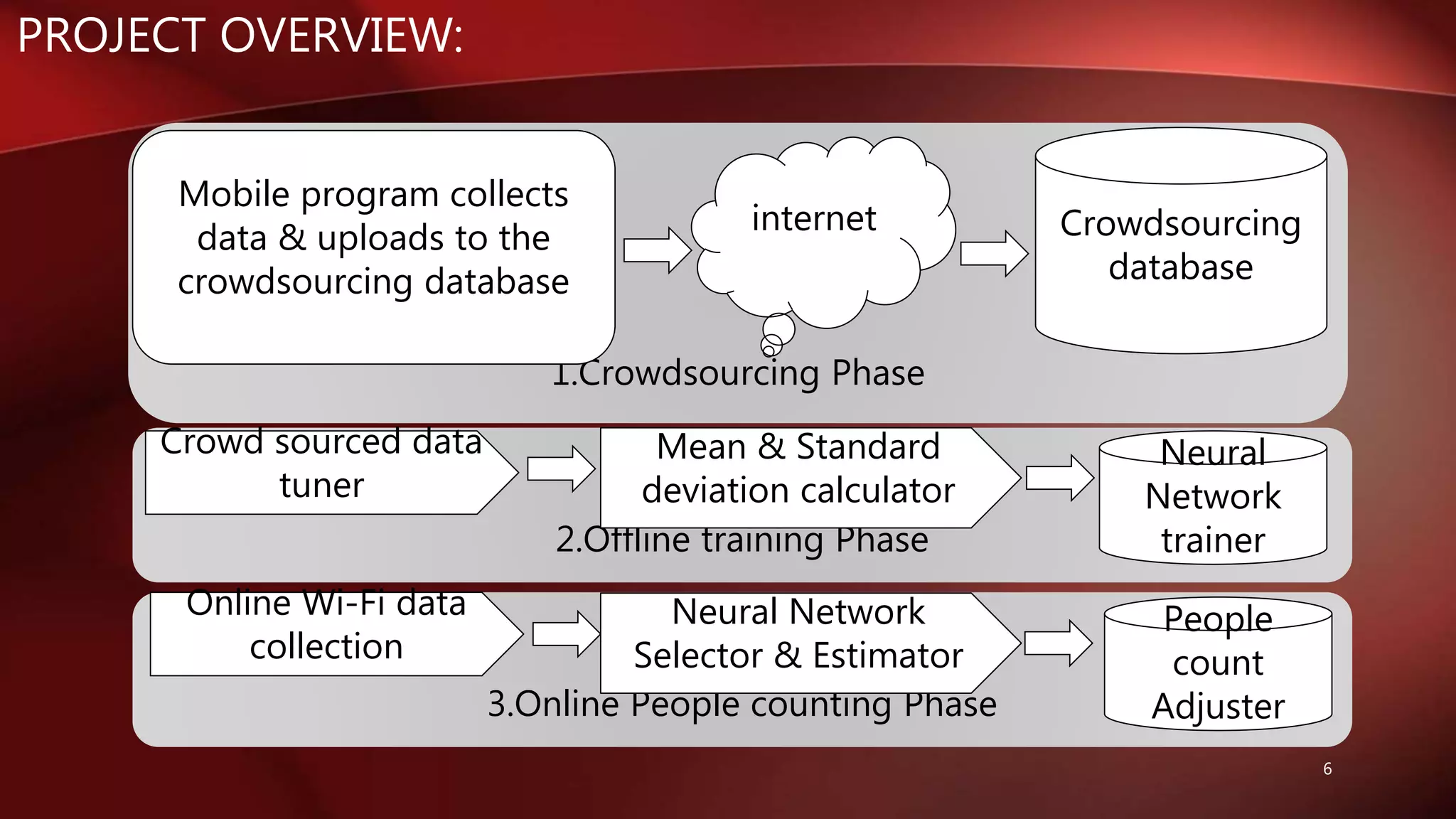
1.Crowdsourcing Phase
Mobile program collects
data & uploads to the
crowdsourcing database
internet Crowdsourcing
database
2.Offline training Phase
Crowd sourced data
tuner
Mean & Standard
deviation calculator
Neural
Network
trainer
3.Online People counting Phase
Online Wi-Fi data
collection
Neural Network
Selector & Estimator
People
count
Adjuster
1. SYSTEM ARCHITECTURE: CROWDSOURCING PHASE
7
 For crowdsourcing phase, an application on an Android platform is developed to
continuously collect crowdsourced data including basic service set ID (BSSID), RSS,
timestamp, and location crowdsourced from the lecturers’ smartphones. Student
attendance is inferred. This is used to construct a Wi-Fi people count training set
(i.e., Wi-Fi RSS measurements annotated with people count and location
information).
 The location information can be obtained by indoor positioning
 This app retrieves the location and Wi-Fi signal information, including RSS, BSSID,
SSID, encryption protocol, and channel information.
 The key idea behind this phase is to quickly establish a crowdsourcing database for
the Wi-Fi-based people counting system.
2. SYSTEM ARCHITECTURE: OFFLINE TRAINING PHASE
8
 The offline training phase constructs a training dataset from the crowdsourced
data.
 After the data tuning process, the mean and standard deviation of every AP’s RSS
with respect to the people count in a certain period will be computed and
normalized.
3. SYSTEM ARCHITECTURE: ONLINE PEOPLE COUNTING PHASE
9
 Finally, the normalized data are fed into our designated five-layer NN.
 The online people counting phase requires a set of online Wi-Fi data by a mobile
device to be collected.
 The current indoor position will be estimated in section.
 Wi-Counter selects the appropriate trained NN for that location. Similarly, the mean
and standard deviation will be derived and input to the trained NN.
 Finally, the people count will be estimated after the NN process
AN EXPERIMENT ON THIS PROJECT:
10
 To measure the received RSS(RSS) from an AP using a
receiver. The AP emits the signal at a carrier frequency
of 2.4 GHz.
 The distance between the AP and the receiver is
approximately 5 m with a person placed between them.
RSS was−30 dBm at 1 m away from the AP.
 An experiment was also carried out without the person
present.
 The sampling schedule is to collect the RSS data every
5 s over a period of 2 h.
 Fig. 1 shows the experimental setup. Fig. 2(a) shows the
histogram of RSS with no human present. Fig. 2(b)
shows the histogram of RSS with the human present
 With the presence of a human, the mean of the RSS
values decreases, while the variance of the RSS values
increases.
Fig:01
Fig:03
RESULT & DISCUSSION:
11
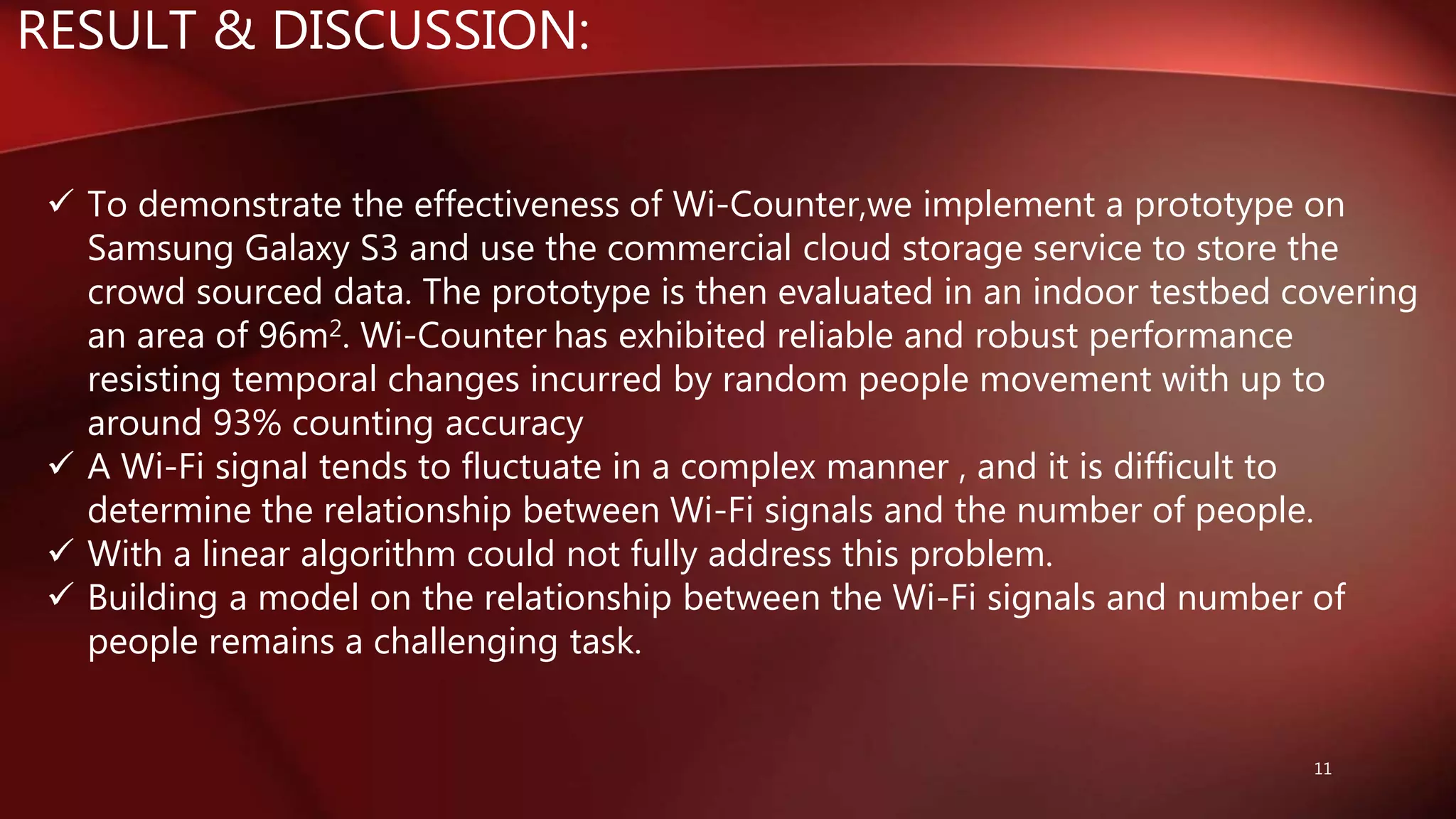
 To demonstrate the effectiveness of Wi-Counter,we implement a prototype on
Samsung Galaxy S3 and use the commercial cloud storage service to store the
crowd sourced data. The prototype is then evaluated in an indoor testbed covering
an area of 96m2. Wi-Counter has exhibited reliable and robust performance
resisting temporal changes incurred by random people movement with up to
around 93% counting accuracy
 A Wi-Fi signal tends to fluctuate in a complex manner , and it is difficult to
determine the relationship between Wi-Fi signals and the number of people.
 With a linear algorithm could not fully address this problem.
 Building a model on the relationship between the Wi-Fi signals and number of
people remains a challenging task.
ADVANTAGES & FUTURE WORK:
12
 Count of people in large area such as in market place, school, industries, theater
etc.
 Low power requirement & autonomous system
 Blocking network coverage (by adding much more noise in actual mobile signal) in
some places such as holy places e.g. mosque, while meeting etc.
13
THANKS TO ALL
‫شكرا‬‫للجميع‬
QUESTIONS & ANSWER:

Wi-Counter : Smartphone Based people counter

  • 1.
    Wi-Counter: Smartphone-Based People Counter UsingCrowd sourced Wi-Fi Signal PRESENTATION ON EE4130 Published in: Human-Machine Systems, IEEE Transactions on (Volume:45 , Issue: 4 ) DOI:10.1109/THMS.2015.2401391 TECHNICAL SEMINAR ON 1
  • 2.
    INTRODUCTION  Objectives: Reliablepeople counting is crucial to many urban applications. However, most existing people counting systems are sensor-based and can only work in some fixed gateways or checkpoints where sensors have been installed. This high dependence on the exact locations of sensors leads to low accuracy. To overcome these limitations, we propose a smartphone-based people counting system, Wi- Counter, by leveraging the pervasive Wi-Fi infrastructure. To collect comprehensive Wi-Fi signals and people count information based on crowd source 2
  • 3.
    AGENDA: a) Proposed Procedure b)System design c) Project Overview d) System Architecture e) An Experiment on this Project f) Result & Discussion g) Advantages & Future work h) Questions & Answer 3
  • 4.
    PROPOSED PROCEDURE  Wi-Counterfirst adopts a preprocessor to overcome the noisy, discrepant, and fragile data based on the Wiener filter and Newton interpolation.  It then makes use of the designated five-layer neural network to learn the relation model between the Wi-Fi signals and the number of people.  By analyzing the received Wi-Fi signals, Wi-Counter can estimate the number of people based on the resulting model 4
  • 5.
    SYSTEM DESIGN:  TheWi-Counter system is built based on the existing WLAN infrastructure, and no sensors or specific hardware are required.  It consists of three phases: crowdsourcing, offline training, and online people counting phase.  In the crowdsourcing phase, a smartphone-based application is implemented to collect the Wi-Fi RSS and people count information from different locations.  The offline training phase first filters out the noisy crowdsourced data and uses them to train a five-layer NN.  Finally, the online people counting phase retrieves the NN to estimate the number of people for that location. 5
  • 6.
    PROJECT OVERVIEW: 6 1.Crowdsourcing Phase Mobileprogram collects data & uploads to the crowdsourcing database internet Crowdsourcing database 2.Offline training Phase Crowd sourced data tuner Mean & Standard deviation calculator Neural Network trainer 3.Online People counting Phase Online Wi-Fi data collection Neural Network Selector & Estimator People count Adjuster
  • 7.
    1. SYSTEM ARCHITECTURE:CROWDSOURCING PHASE 7  For crowdsourcing phase, an application on an Android platform is developed to continuously collect crowdsourced data including basic service set ID (BSSID), RSS, timestamp, and location crowdsourced from the lecturers’ smartphones. Student attendance is inferred. This is used to construct a Wi-Fi people count training set (i.e., Wi-Fi RSS measurements annotated with people count and location information).  The location information can be obtained by indoor positioning  This app retrieves the location and Wi-Fi signal information, including RSS, BSSID, SSID, encryption protocol, and channel information.  The key idea behind this phase is to quickly establish a crowdsourcing database for the Wi-Fi-based people counting system.
  • 8.
    2. SYSTEM ARCHITECTURE:OFFLINE TRAINING PHASE 8  The offline training phase constructs a training dataset from the crowdsourced data.  After the data tuning process, the mean and standard deviation of every AP’s RSS with respect to the people count in a certain period will be computed and normalized.
  • 9.
    3. SYSTEM ARCHITECTURE:ONLINE PEOPLE COUNTING PHASE 9  Finally, the normalized data are fed into our designated five-layer NN.  The online people counting phase requires a set of online Wi-Fi data by a mobile device to be collected.  The current indoor position will be estimated in section.  Wi-Counter selects the appropriate trained NN for that location. Similarly, the mean and standard deviation will be derived and input to the trained NN.  Finally, the people count will be estimated after the NN process
  • 10.
    AN EXPERIMENT ONTHIS PROJECT: 10  To measure the received RSS(RSS) from an AP using a receiver. The AP emits the signal at a carrier frequency of 2.4 GHz.  The distance between the AP and the receiver is approximately 5 m with a person placed between them. RSS was−30 dBm at 1 m away from the AP.  An experiment was also carried out without the person present.  The sampling schedule is to collect the RSS data every 5 s over a period of 2 h.  Fig. 1 shows the experimental setup. Fig. 2(a) shows the histogram of RSS with no human present. Fig. 2(b) shows the histogram of RSS with the human present  With the presence of a human, the mean of the RSS values decreases, while the variance of the RSS values increases. Fig:01 Fig:03
  • 11.
    RESULT & DISCUSSION: 11 To demonstrate the effectiveness of Wi-Counter,we implement a prototype on Samsung Galaxy S3 and use the commercial cloud storage service to store the crowd sourced data. The prototype is then evaluated in an indoor testbed covering an area of 96m2. Wi-Counter has exhibited reliable and robust performance resisting temporal changes incurred by random people movement with up to around 93% counting accuracy  A Wi-Fi signal tends to fluctuate in a complex manner , and it is difficult to determine the relationship between Wi-Fi signals and the number of people.  With a linear algorithm could not fully address this problem.  Building a model on the relationship between the Wi-Fi signals and number of people remains a challenging task.
  • 12.
    ADVANTAGES & FUTUREWORK: 12  Count of people in large area such as in market place, school, industries, theater etc.  Low power requirement & autonomous system  Blocking network coverage (by adding much more noise in actual mobile signal) in some places such as holy places e.g. mosque, while meeting etc.
  • 13.