AUTOMATIC NUMBER PLATE
RECOGNITION
BYMEDHA GOYAL
ANJALI SANTOSHI
PRIYA SINGH
ANJALI MEHRA
AUTOMATIC NUMBER PLATE RECOGNITION
(ANPR)
INTRODUCTION
In most cases, vehicles are identified by their license plate
numbers, which are easily readable by humans but not
machines. For machines, a registration number plate is just a
dark spot that is within a region of an image with a certain
intensity and luminosity. Because of this, it is necessary to
design a robust mathematical system able to perceive and
extract what we want from the captured image.
The purpose of this is to build a real time application which
recognizes license plates from cars at a gate, for example at
the entrance of a parking area. The system, based on regular
PC with video camera, catches video frames which include
a visible car license plate and processes them. Once a license
plate is detected, its digits are recognized, displayed on the
User Interface or checked against a database.
The system will be based on a personal computer and
software packages available, MATLAB program and a digital
camera, which help to capture the images of the vehicle
license plate.
Input image
The initial phase of image processing for Vehicle License Plate
Recognition is to obtain images of vehicles. Electronic devices
such as optical (digital/video) camera, webcam etc can be
used to capture the acquired images
Pre-processing
The RGB image is then converted into a gray scale image for
easy analysis as it consists of only two colour channels.
Median filtering is then implemented for the effective
removal of speckle noise, salt and pepper noise (impulsive
noise). The aim of this process is to increase and improve the
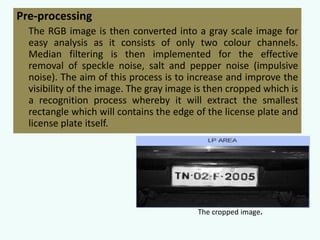
visibility of the image. The gray image is then cropped which is
a recognition process whereby it will extract the smallest
rectangle which will contains the edge of the license plate and
license plate itself.

The cropped image.
Plate Region Extraction
Morphological-dilation operation with rectangular structuring
element(SE) of sixe 3X3 is then performed on the binary
image. Dilation is a morphological transformation that
combines two sets by using vector addition of set SEs, and
Erosion can be obtained by dilating the complement of the
black pixels and the taking the complement of the resulting
point set.
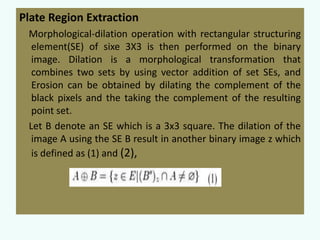
Let B denote an SE which is a 3x3 square. The dilation of the
image A using the SE B result in another binary image z which
is defined as (1) and (2),
Similarly, the erosion of the image A by SE B is the binary image z
defined by
Suppression of structures that are lighter than their surroundings
and that are connected to the image border was performed. The
area of each of the rectangle is then calculated. From the
experiments conducted with large number of real scene images
it was observed that the region representing the number plate
are of larger area in majority of the images. Therefore the
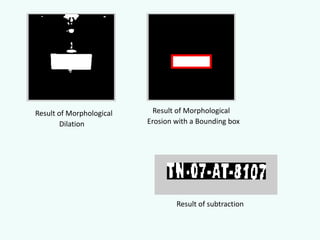
rectangle which is of maximum size is selected. Morphologicalerosion operation with rectangular structuring element of sixe
10X5 was then performed. In erosion, every object pixel that is
touching a background pixel is changed into a background pixel.
It makes the objects smaller. By subtracting the original image
from the eroded image, the number plate would be extracted as
there is a large difference between the two images.
Result of Morphological
Dilation

Result of Morphological
Erosion with a Bounding box

Result of subtraction
Segmentation of Individual Characters in the Number
Plate
The character segmentation acts as a bridge between the
number plate extraction and optical character recognition
modules. Its main function is to segment the characters on
the chosen candidate region(number plate) such that each
character can be sent to the optical character recognition
module individually for recognition. This was achieved by the
application of the edge operators and by the relaxation
labeling approach.
Four edge detection methods were used for comparison. They
are
1. Canny Edge Detection
2. Sobel Edge Detection
3. Prewitt edge detection.
4. Log edge detection
(a) Canny

(C) Prewitt

(b) Sobel

(d) LOG

Fig1: Result of application of the four different edge detectors
Labels are then assigned to the edges which are obtained as
the result of the application of the edge detection operators.
The characters are then extracted through the assigned labels.
Fill hole approach is then performed in order to facilitate the
labels for character recognition
Fig2: Result of Fill hole approach of Fig1(a).
Character Recognition
It is employed for the purpose of conversion of images of text
into characters. OCR Software and ICR Software technology
are analytical artificial intelligence systems that consider
sequences of characters rather than whole words or phrases.
Based on the analysis of sequential lines and curves, OCR and
ICR make 'best guesses' at characters using database look-up
tables to closely associate or match the strings of characters
that form words.
The number plates may be bent and/or tilted with respect to
the camera, characters extracted from such number plates
may be deformed. Furthermore, input characters may be
noisy, broken or incomplete.
Character recognition techniques should be able to tolerate
these defects. We developed our own character templates to
suit our particular application which are shown in Fig 3. The
topological features of the input character are computed and
are compared with those of prestored character templates.
The character template that best matches the input
characters are then displayed.

Fig.3 : OCR templates used for character
recognition.
CONCLUTION
In this paper, we presented application software designed for
the recognition of car number plate. Firstly we extracted the
plate location by performing the morphological operation and
area criteria tests, the edge detectors are then applied and
finally template matching based on optical character
recognition templates was applied to recognize the number
plate characters. A comparison of edge detectors sobel,
prewitt, canny, log operators was performed. The results
showed that the performance of the canny edge detector is
far better than the other three operators.
THANK YOU

Automatic no. plate recognition

  • 1.
    AUTOMATIC NUMBER PLATE RECOGNITION BYMEDHAGOYAL ANJALI SANTOSHI PRIYA SINGH ANJALI MEHRA
  • 2.
    AUTOMATIC NUMBER PLATERECOGNITION (ANPR)
  • 3.
    INTRODUCTION In most cases,vehicles are identified by their license plate numbers, which are easily readable by humans but not machines. For machines, a registration number plate is just a dark spot that is within a region of an image with a certain intensity and luminosity. Because of this, it is necessary to design a robust mathematical system able to perceive and extract what we want from the captured image.
  • 4.
    The purpose ofthis is to build a real time application which recognizes license plates from cars at a gate, for example at the entrance of a parking area. The system, based on regular PC with video camera, catches video frames which include a visible car license plate and processes them. Once a license plate is detected, its digits are recognized, displayed on the User Interface or checked against a database.
  • 5.
    The system willbe based on a personal computer and software packages available, MATLAB program and a digital camera, which help to capture the images of the vehicle license plate.
  • 7.
    Input image The initialphase of image processing for Vehicle License Plate Recognition is to obtain images of vehicles. Electronic devices such as optical (digital/video) camera, webcam etc can be used to capture the acquired images
  • 8.
    Pre-processing The RGB imageis then converted into a gray scale image for easy analysis as it consists of only two colour channels. Median filtering is then implemented for the effective removal of speckle noise, salt and pepper noise (impulsive noise). The aim of this process is to increase and improve the visibility of the image. The gray image is then cropped which is a recognition process whereby it will extract the smallest rectangle which will contains the edge of the license plate and license plate itself. The cropped image.
  • 9.
    Plate Region Extraction Morphological-dilationoperation with rectangular structuring element(SE) of sixe 3X3 is then performed on the binary image. Dilation is a morphological transformation that combines two sets by using vector addition of set SEs, and Erosion can be obtained by dilating the complement of the black pixels and the taking the complement of the resulting point set. Let B denote an SE which is a 3x3 square. The dilation of the image A using the SE B result in another binary image z which is defined as (1) and (2),
  • 10.
    Similarly, the erosionof the image A by SE B is the binary image z defined by Suppression of structures that are lighter than their surroundings and that are connected to the image border was performed. The area of each of the rectangle is then calculated. From the experiments conducted with large number of real scene images it was observed that the region representing the number plate are of larger area in majority of the images. Therefore the rectangle which is of maximum size is selected. Morphologicalerosion operation with rectangular structuring element of sixe 10X5 was then performed. In erosion, every object pixel that is touching a background pixel is changed into a background pixel. It makes the objects smaller. By subtracting the original image from the eroded image, the number plate would be extracted as there is a large difference between the two images.
  • 11.
    Result of Morphological Dilation Resultof Morphological Erosion with a Bounding box Result of subtraction
  • 12.
    Segmentation of IndividualCharacters in the Number Plate The character segmentation acts as a bridge between the number plate extraction and optical character recognition modules. Its main function is to segment the characters on the chosen candidate region(number plate) such that each character can be sent to the optical character recognition module individually for recognition. This was achieved by the application of the edge operators and by the relaxation labeling approach. Four edge detection methods were used for comparison. They are 1. Canny Edge Detection 2. Sobel Edge Detection 3. Prewitt edge detection. 4. Log edge detection
  • 13.
    (a) Canny (C) Prewitt (b)Sobel (d) LOG Fig1: Result of application of the four different edge detectors
  • 14.
    Labels are thenassigned to the edges which are obtained as the result of the application of the edge detection operators. The characters are then extracted through the assigned labels. Fill hole approach is then performed in order to facilitate the labels for character recognition
  • 15.
    Fig2: Result ofFill hole approach of Fig1(a).
  • 16.
    Character Recognition It isemployed for the purpose of conversion of images of text into characters. OCR Software and ICR Software technology are analytical artificial intelligence systems that consider sequences of characters rather than whole words or phrases. Based on the analysis of sequential lines and curves, OCR and ICR make 'best guesses' at characters using database look-up tables to closely associate or match the strings of characters that form words. The number plates may be bent and/or tilted with respect to the camera, characters extracted from such number plates may be deformed. Furthermore, input characters may be noisy, broken or incomplete.
  • 17.
    Character recognition techniquesshould be able to tolerate these defects. We developed our own character templates to suit our particular application which are shown in Fig 3. The topological features of the input character are computed and are compared with those of prestored character templates. The character template that best matches the input characters are then displayed. Fig.3 : OCR templates used for character recognition.
  • 18.
    CONCLUTION In this paper,we presented application software designed for the recognition of car number plate. Firstly we extracted the plate location by performing the morphological operation and area criteria tests, the edge detectors are then applied and finally template matching based on optical character recognition templates was applied to recognize the number plate characters. A comparison of edge detectors sobel, prewitt, canny, log operators was performed. The results showed that the performance of the canny edge detector is far better than the other three operators.
  • 19.