IMAGE PROCESSING APPLIED TO TRAFFIC QUEUE DETECTION ALGORITHM
INTRODUCTIONDigital processing is done with a digital computer or some special purpose digital hardware. The word Digital implies that the information in the computer is represented and sent by variables that taken limited number of discrete values.Increasing demand for road traffic data of all sorts.Variation of parameters in real-world traffic.
Aimed to measure queue parameters accurately.Queue detection algorithm has two operations :       vehicle detection
      motion detection.Motion detection is based on applying a differencing technique on the profiles of the images along the road.The vehicle detection is based on applying edge detection on these profiles.
         DIGITAL  IMAGE  PROCESSING:
IMAGE PROCESSING APPLIED TO TRAFFIC:Need for processing of traffic data: Traffic surveillance and control, traffic management, road safety and development of transport policy.Traffic parameters measurable: Traffic volumes, Speed, Headways, Inter-vehicle gaps, Vehicle classification, Origin and destination of traffic, Junction turning.
       Image analysis system structure  Stages of image analysis:Image sensors used:         Improved video cameras: automatic gain control, low SNRADC Conversion:         Analog video signal received from video camera is          converted to digital/binary form for processingPre-processing:High SNR of the camera output reduces the quantity of processing enormous data flow.
Two jobs to be done:Green light on:     Determine no. of vehicles moving along particular lanes and their classification by shape and size.Red light on:     Determine the backup length along with the possibility to track its dynamics and classify vehicles in backup.
Queue Detection AlgorithmApproach described here is a spatial-domain technique to detect queue  - implemented in real-time using low-cost system.
 For this purpose two different algorithms have been used,
         Motion detection operation
         Vehicle detection operation
Motion detection is first – as in this case vehicle detection mostly gives positive result, while in reality, there may not be any queue at allGeorge Bush Drive and Wellborn Road in College Station, TexasMotion detection operation: Differencing two consecutive frames.
Histogram of the key region parts of the frames is analyzed by comparing with the threshold value.
Key region should be at least 3-pixel-wide profile of the image along the road. .
A median filtering operation is firstly applied to the key region (profile) of each frame and one-pixel-wide profile is extracted.
Difference of two profiles is compared to detect for motion.
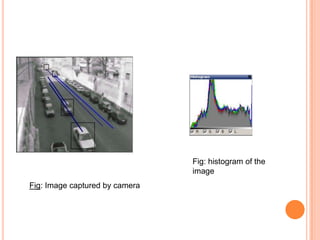
When there is motion, the differences of the profiles are larger than the case when there is no motion. The motion can be detected by selecting a threshold value.Vehicle detection algorithm:Following the application of the motion detection operation, a vehicle detection operation is applied on the profile of the unprocessed image.
To implement the algorithm in real time, two strategies are often applied:
  Key region processing
  Simple algorithms.Most of the vehicle detection algorithms developed so far are based on a background differencing technique, which is sensitive to variations of ambient lighting.
The method used here is based on applying edge detector operators to a profile of the image .

Image Processing Applied To Traffic Queue Detection Algorithm

  • 1.
    IMAGE PROCESSING APPLIEDTO TRAFFIC QUEUE DETECTION ALGORITHM
  • 2.
    INTRODUCTIONDigital processing isdone with a digital computer or some special purpose digital hardware. The word Digital implies that the information in the computer is represented and sent by variables that taken limited number of discrete values.Increasing demand for road traffic data of all sorts.Variation of parameters in real-world traffic.
  • 3.
    Aimed to measurequeue parameters accurately.Queue detection algorithm has two operations : vehicle detection
  • 4.
    motion detection.Motion detection is based on applying a differencing technique on the profiles of the images along the road.The vehicle detection is based on applying edge detection on these profiles.
  • 5.
    DIGITAL IMAGE PROCESSING:
  • 6.
    IMAGE PROCESSING APPLIEDTO TRAFFIC:Need for processing of traffic data: Traffic surveillance and control, traffic management, road safety and development of transport policy.Traffic parameters measurable: Traffic volumes, Speed, Headways, Inter-vehicle gaps, Vehicle classification, Origin and destination of traffic, Junction turning.
  • 7.
    Image analysis system structure  Stages of image analysis:Image sensors used: Improved video cameras: automatic gain control, low SNRADC Conversion: Analog video signal received from video camera is converted to digital/binary form for processingPre-processing:High SNR of the camera output reduces the quantity of processing enormous data flow.
  • 8.
    Two jobs tobe done:Green light on: Determine no. of vehicles moving along particular lanes and their classification by shape and size.Red light on: Determine the backup length along with the possibility to track its dynamics and classify vehicles in backup.
  • 9.
    Queue Detection AlgorithmApproachdescribed here is a spatial-domain technique to detect queue - implemented in real-time using low-cost system.
  • 10.
    For thispurpose two different algorithms have been used,
  • 11.
    Motion detection operation
  • 12.
    Vehicle detection operation
  • 13.
    Motion detection isfirst – as in this case vehicle detection mostly gives positive result, while in reality, there may not be any queue at allGeorge Bush Drive and Wellborn Road in College Station, TexasMotion detection operation: Differencing two consecutive frames.
  • 14.
    Histogram of thekey region parts of the frames is analyzed by comparing with the threshold value.
  • 15.
    Key region shouldbe at least 3-pixel-wide profile of the image along the road. .
  • 16.
    A median filteringoperation is firstly applied to the key region (profile) of each frame and one-pixel-wide profile is extracted.
  • 17.
    Difference of twoprofiles is compared to detect for motion.
  • 18.
    When there ismotion, the differences of the profiles are larger than the case when there is no motion. The motion can be detected by selecting a threshold value.Vehicle detection algorithm:Following the application of the motion detection operation, a vehicle detection operation is applied on the profile of the unprocessed image.
  • 19.
    To implement thealgorithm in real time, two strategies are often applied:
  • 20.
    Keyregion processing
  • 21.
    Simplealgorithms.Most of the vehicle detection algorithms developed so far are based on a background differencing technique, which is sensitive to variations of ambient lighting.
  • 22.
    The method usedhere is based on applying edge detector operators to a profile of the image .