Viscometer
PREPAREDBYATHEENAPANDIAN
Topic to Duscussed
Viscosity
Measuement
Viscometer
Types
U-Tube Viscometer
Falling Sphere Viscometer
Blood Viscosity
Conditions
Factors affecting Blood Viscosity
1.
2.
3.
4.
5.
6.
7.
8.
9.
Viscosity
Jean-Louis-Marie Poiseuille was a
French physicist and physiologist
whose interest in the circulation of
blood in the human body led him
to discover viscosity
What is
Viscosity?
The viscosity of a fluid is a
measure of its resistance to
deformation at a given rate.
For liquids, it corresponds to the
informal concept of "thickness":
for example, syrup has a higher
viscosity than water.
Dynamic viscosity, also
known as absolute viscosity
Kinematic viscosity
1.
2.
There are two
types of
viscosity
It's easier for your audience to follow
It is the tangential force per
unit area required to move one
horizontal plane with respect
to another horizontal plane at
a unit velocity when
maintained a unit distance
apart by the fluid.
Dynamic
viscosity
It's easier for your audience to follow
Dynamic viscosity
It's easier for your audience to follow
Kinematic viscosity is a measure of a fluid's internal
resistance to flow under gravitational forces. It is
determined by measuring the time in seconds,
required for a fixed volume of fluid to flow a known
distance by gravity through a capillary within a
calibrated viscometer at a closely controlled
temperature.
Kinematic viscosity
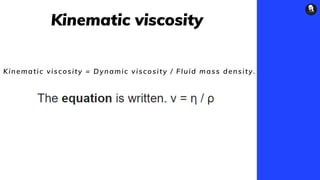
Kinematic viscosity is the ratio of dynamic viscosity to
density.Learn More About Viscosity
Kinematic viscosity = Dynamic viscosity / Fluid mass density.
Kinematic viscosity
Viscometer
A viscometer (also called viscosimeter) is an instrument used to
measure the viscosity of a fluid. For liquids with viscosities which vary
with flow conditions, an instrument called a rheometer is used.
Types of
Viscometers
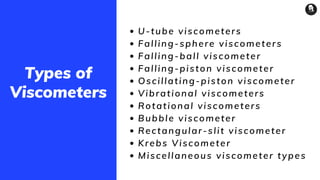
U-tube viscometers
Falling-sphere viscometers
Falling-ball viscometer
Falling-piston viscometer
Oscillating-piston viscometer
Vibrational viscometers
Rotational viscometers
Bubble viscometer
Rectangular-slit viscometer
Krebs Viscometer
Miscellaneous viscometer types
U-tube viscometers
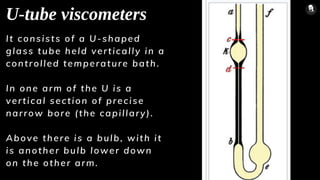
It consists of a U-shaped
glass tube held vertically in a
controlled temperature bath.
In one arm of the U is a
vertical section of precise
narrow bore (the capillary).
Above there is a bulb, with it
is another bulb lower down
on the other arm.
U-tube viscometers
The time required for the test
liquid to flow through a
capillary of a known diameter
of a certain factor between
two marked points is
measured
By multiplying the time taken
by the factor of the
viscometer, the kinematic
viscosity is obtained.
Falling-sphere viscometers
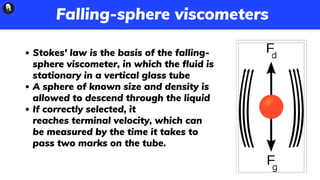
Stokes' law is the basis of the falling-
sphere viscometer, in which the fluid is
stationary in a vertical glass tube
A sphere of known size and density is
allowed to descend through the liquid
If correctly selected, it
reaches terminal velocity, which can
be measured by the time it takes to
pass two marks on the tube.
Falling-sphere viscometers
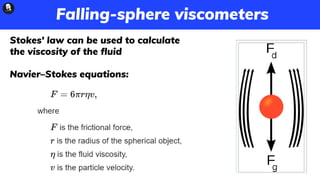
Stokes' law can be used to calculate
the viscosity of the fluid
Navier–Stokes equations:
Blood Viscosity
Blood viscosity is a measurement of the thickness and
stickiness of an individual's blood. It is a direct
measure of the ability of blood to flow through
the blood vessels.
Blood
viscosity
affect blood
flow
Increased viscosity increases
the resistance to blood
flow and thereby increases
the work of the heart and
impairs organ perfusion
Some patients with anemia
have low hematocrits, and
therefore
reduced blood viscosities.
Another important factor that
influences blood viscosity is
temperature.
Factors affect
blood
viscosity
Plasma viscosity
Red blood cell (RBC)
deformability and
aggregation
Depending on the vascular
compartment and the flow
conditions
Blood viscosity is influenced by
several other
hemorheological/hematological
parameters such as
Good luck!

Viscometer types - viscosity - blood viscosity

  • 1.
  • 2.
    Topic to Duscussed Viscosity Measuement Viscometer Types U-TubeViscometer Falling Sphere Viscometer Blood Viscosity Conditions Factors affecting Blood Viscosity 1. 2. 3. 4. 5. 6. 7. 8. 9.
  • 3.
    Viscosity Jean-Louis-Marie Poiseuille wasa French physicist and physiologist whose interest in the circulation of blood in the human body led him to discover viscosity
  • 4.
    What is Viscosity? The viscosityof a fluid is a measure of its resistance to deformation at a given rate. For liquids, it corresponds to the informal concept of "thickness": for example, syrup has a higher viscosity than water.
  • 5.
    Dynamic viscosity, also knownas absolute viscosity Kinematic viscosity 1. 2. There are two types of viscosity It's easier for your audience to follow
  • 6.
    It is thetangential force per unit area required to move one horizontal plane with respect to another horizontal plane at a unit velocity when maintained a unit distance apart by the fluid. Dynamic viscosity It's easier for your audience to follow
  • 7.
    Dynamic viscosity It's easierfor your audience to follow
  • 8.
    Kinematic viscosity is ameasure of a fluid's internal resistance to flow under gravitational forces. It is determined by measuring the time in seconds, required for a fixed volume of fluid to flow a known distance by gravity through a capillary within a calibrated viscometer at a closely controlled temperature. Kinematic viscosity Kinematic viscosity is the ratio of dynamic viscosity to density.Learn More About Viscosity
  • 9.
    Kinematic viscosity =Dynamic viscosity / Fluid mass density. Kinematic viscosity
  • 10.
    Viscometer A viscometer (also called viscosimeter) isan instrument used to measure the viscosity of a fluid. For liquids with viscosities which vary with flow conditions, an instrument called a rheometer is used.
  • 11.
    Types of Viscometers U-tube viscometers Falling-sphereviscometers Falling-ball viscometer Falling-piston viscometer Oscillating-piston viscometer Vibrational viscometers Rotational viscometers Bubble viscometer Rectangular-slit viscometer Krebs Viscometer Miscellaneous viscometer types
  • 12.
    U-tube viscometers It consistsof a U-shaped glass tube held vertically in a controlled temperature bath. In one arm of the U is a vertical section of precise narrow bore (the capillary). Above there is a bulb, with it is another bulb lower down on the other arm.
  • 13.
    U-tube viscometers The timerequired for the test liquid to flow through a capillary of a known diameter of a certain factor between two marked points is measured By multiplying the time taken by the factor of the viscometer, the kinematic viscosity is obtained.
  • 14.
    Falling-sphere viscometers Stokes' lawis the basis of the falling- sphere viscometer, in which the fluid is stationary in a vertical glass tube A sphere of known size and density is allowed to descend through the liquid If correctly selected, it reaches terminal velocity, which can be measured by the time it takes to pass two marks on the tube.
  • 15.
    Falling-sphere viscometers Stokes' lawcan be used to calculate the viscosity of the fluid Navier–Stokes equations:
  • 16.
    Blood Viscosity Blood viscosity isa measurement of the thickness and stickiness of an individual's blood. It is a direct measure of the ability of blood to flow through the blood vessels.
  • 17.
    Blood viscosity affect blood flow Increased viscosity increases the resistanceto blood flow and thereby increases the work of the heart and impairs organ perfusion Some patients with anemia have low hematocrits, and therefore reduced blood viscosities. Another important factor that influences blood viscosity is temperature.
  • 18.
    Factors affect blood viscosity Plasma viscosity Red blood cell (RBC) deformabilityand aggregation Depending on the vascular compartment and the flow conditions Blood viscosity is influenced by several other hemorheological/hematological parameters such as
  • 19.