Viruses & Malware
What is malware?The term malware is a combination of the words malicious and software. Malware is any type of software intended to cause harm to your computer that is installed without the user knowing.
Computer virusesWormsTrojan horsesSpywareAdwareAny other type of malicious & unwanted software.Types of malware
What is a computer virus?A virus is a computer program that has the ability to duplicate and infect a computer without the user knowing.
ResidentDirect ActionOverwriteBootMacroDirectoryPolymorphic File InfectorsCompanionFatLogic BombsTypes of Viruses
This type of virus is a permanent which dwells in the RAM memory. From there it can overcome and interrupt all of the operations executed by the system: corrupting files and programs that are opened, closed, copied, renamed etc. Examples include: Randex, CMJ, Meve, and MrKlunky.Resident Virus
The main purpose of this virus is to replicate and take action when it is executed. When a specific condition is met, the virus will go into action and infect files in the directory or folder that it is in and in directories that are specified in the AUTOEXEC.BAT file PATH. This batch file is always located in the root directory of the hard disk and carries out certain operations when the computer is booted.Direct Action Virus
Virus of this kind is characterized by the fact that it deletes the information contained in the files that it infects, rendering them partially or totally useless once they have been infected. The only way to clean a file infected by an overwrite virus is to delete the file completely, thus losing the original content. Examples of this virus include: Way, Trj.Reboot, Trivial.88.D.Overwrite Virus
This type of virus affects the boot sector of a floppy or hard disk. This is a crucial part of a disk, in which information on the disk itself is stored together with a program that makes it possible to boot (start) the computer from the disk. The best way of avoiding boot viruses is to ensure that floppy disks are write-protected and never start your computer with an unknown floppy disk in the disk drive. Examples of boot viruses include: Polyboot.B, AntiEXE.Boot Virus
Macro viruses infect files that are created using certain applications or programs that contain macros. These mini-programs make it possible to automate series of operations so that they are performed as a single action, thereby saving the user from having to carry them out one by one. Examples of macro viruses: Relax, Melissa.A, Bablas, O97M/Y2K.Macro Virus
Directory viruses change the paths that indicate the location of a file. By executing a program (file with the extension .EXE or .COM) which has been infected by a virus, you are unknowingly running the virus program, while the original file and program have been previously moved by the virus. Once infected it becomes impossible to locate the original files.Directory Virus
Polymorphic viruses encrypt or encode themselves in a different way (using different algorithms and encryption keys) every time they infect a system. This makes it impossible for anti-viruses to find them using string or signature searches (because they are different in each encryption) and also enables them to create a large number of copies of themselves. Examples include: Elkern, Marburg, Satan Bug, and Tuareg.Polymorphic Virus
This type of virus infects programs or executable files (files with an .EXE or .COM extension). When one of these programs is run, directly or indirectly, the virus is activated, producing the damaging effects it is programmed to carry out. The majority of existing viruses belong to this category, and can be classified depending on the actions that they carry out.File Infectors
Companion viruses can be considered file infector viruses like resident or direct action types. They are known as companion viruses because once they get into the system they "accompany" the other files that already exist. In other words, in order to carry out their infection routines, companion viruses can wait in memory until a program is run (resident viruses) or act immediately by making copies of themselves (direct action viruses). Some examples include: Stator, Asimov.1539, and Terrax.1069Companion Virus
The file allocation table or FAT is the part of a disk used to connect information and is a vital part of the normal functioning of the computer. This type of virus attack can be especially dangerous, by preventing access to certain sections of the disk where important files are stored. Damage caused can result in information losses from individual files or even entire directories.FAT Virus
What is a worm?A computer worm is a self-replicating computer program. It uses a network to send copies of itself to other nodes (computers on the network) and it may do so without any user intervention. Unlike a virus, it does not need to attach itself to an existing program. Worms almost always cause at least some harm to the network, if only by consuming bandwidth, whereas viruses almost always corrupt or modify files on a targeted computer.
What is a Trojan?The term Trojan refers to the classical story of the Trojan horse in the battle of Troy. A Trojan describes a class of computer threats (malware) that appears to perform a desirable function but in fact performs undisclosed malicious functions that allow unauthorized access to the host machine, giving them the ability to save their files on the user's computer or even watch the user's screen and control the computer.
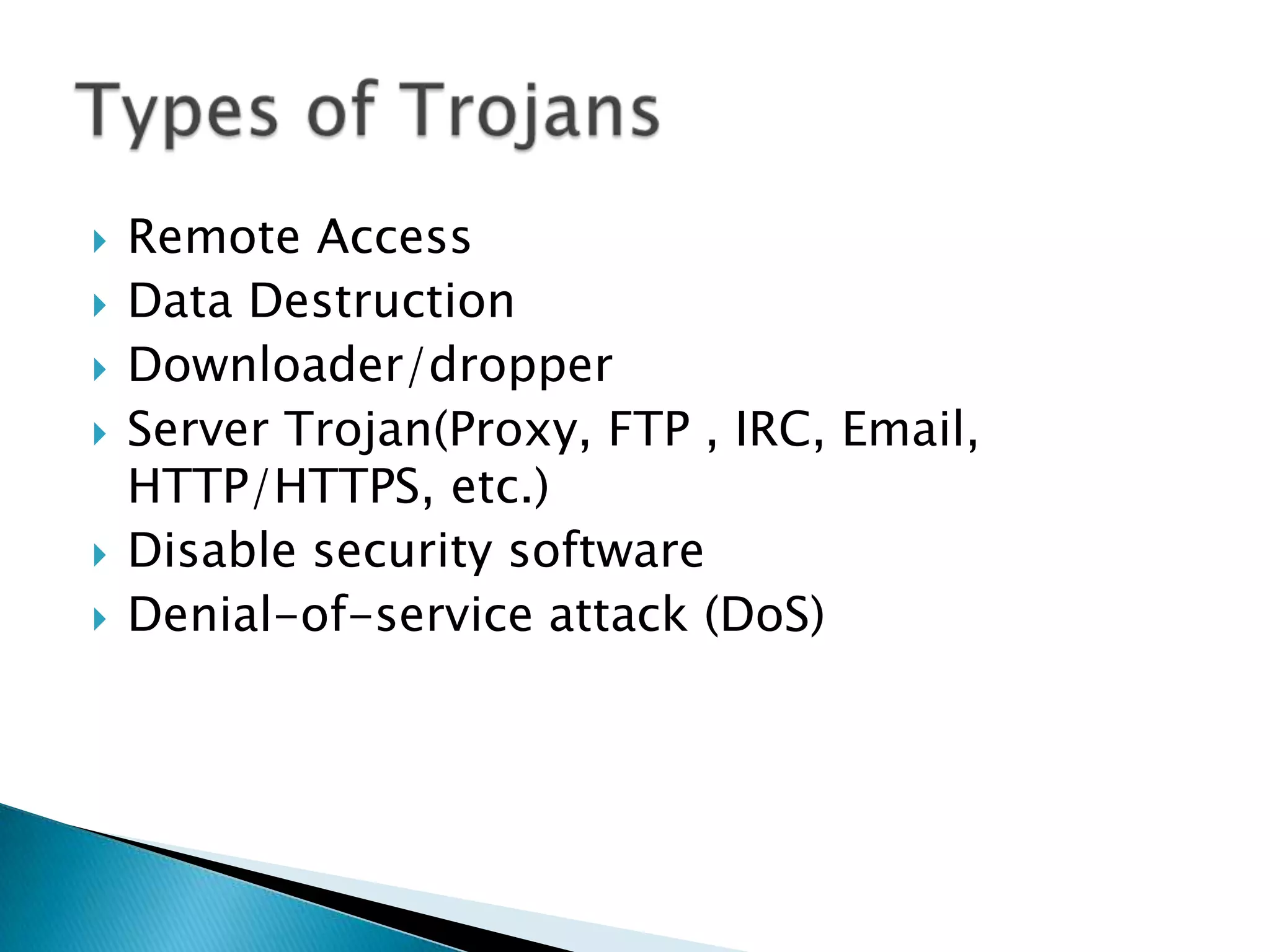
Remote Access Data Destruction Downloader/dropper Server Trojan(Proxy, FTP , IRC, Email, HTTP/HTTPS, etc.) Disable security software Denial-of-service attack (DoS)Types of Trojans
What is spyware?Spyware is computer software that is secretly installed on your computer to monitor your internet usage and behavior.
While the term spyware suggests software that secretly monitors the user's behavior, the functions of spyware extend well beyond simple monitoring. Spyware programs can collect various types of personal information, such as Internet surfing habits, sites that have been visited, but can also interfere with user control of the computer in other ways, such as installing additional software, and redirecting Web browser activity. Spyware is known to change computer settings, resulting in slow connection speeds, different home pages, and/or loss of Internet or functionality of other programs. In an attempt to increase the understanding of spyware, a more formal classification of its included software types is captured under the term privacy-invasive software.Spyware cont.
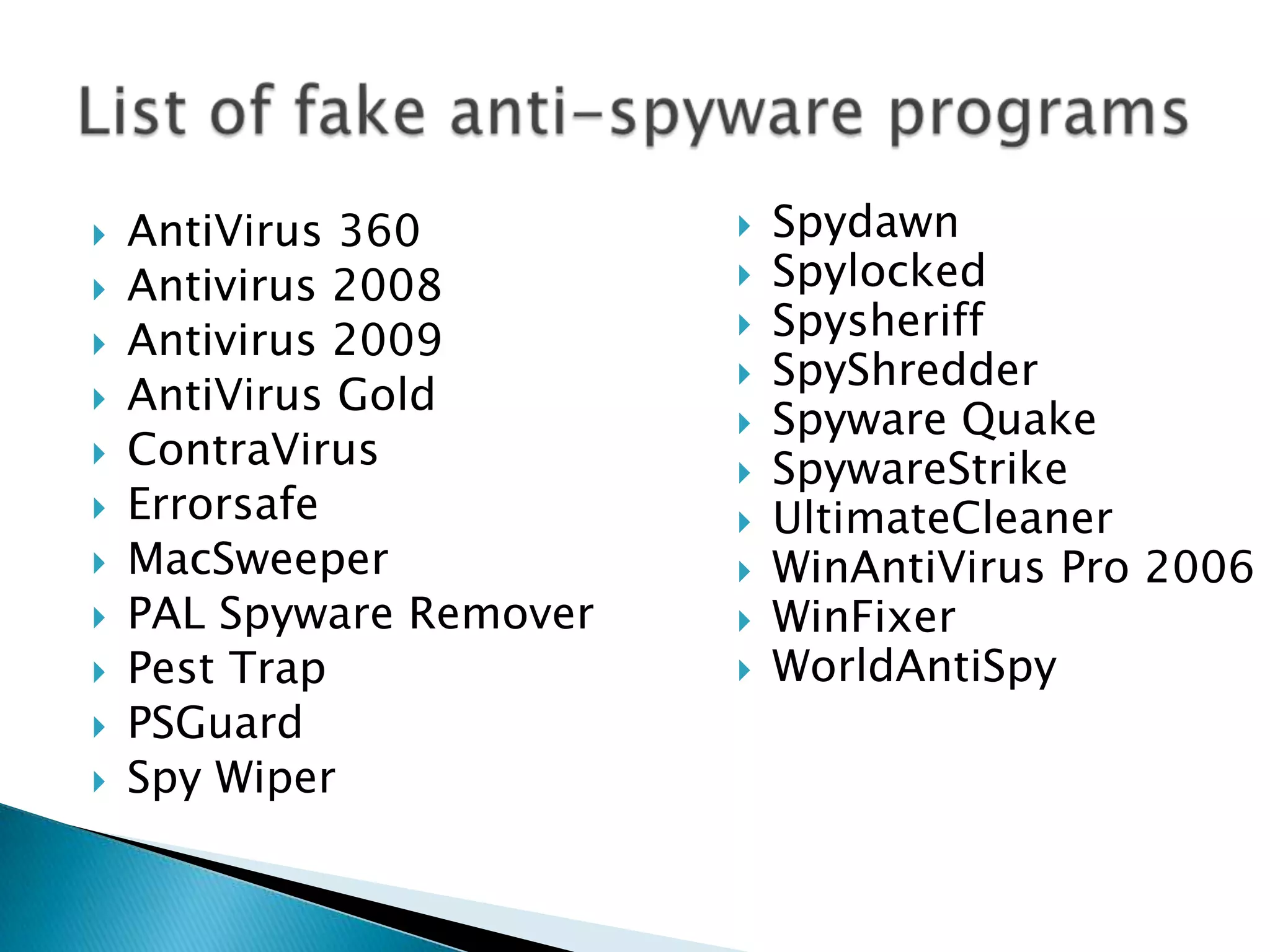
AntiVirus 360Antivirus 2008Antivirus 2009AntiVirus GoldContraVirusErrorsafeMacSweeperPAL Spyware RemoverPest TrapPSGuardSpy WiperList of fake anti-spyware programsSpydawnSpylockedSpysheriffSpyShredderSpyware QuakeSpywareStrikeUltimateCleanerWinAntiVirus Pro 2006WinFixerWorldAntiSpy
What is adware?Adware is any software package which automatically plays, displays, or downloads advertisements to a computer after the software is installed on it or while the application is being used. Some types of adware are also spyware and can be classified as privacy-invasive software.
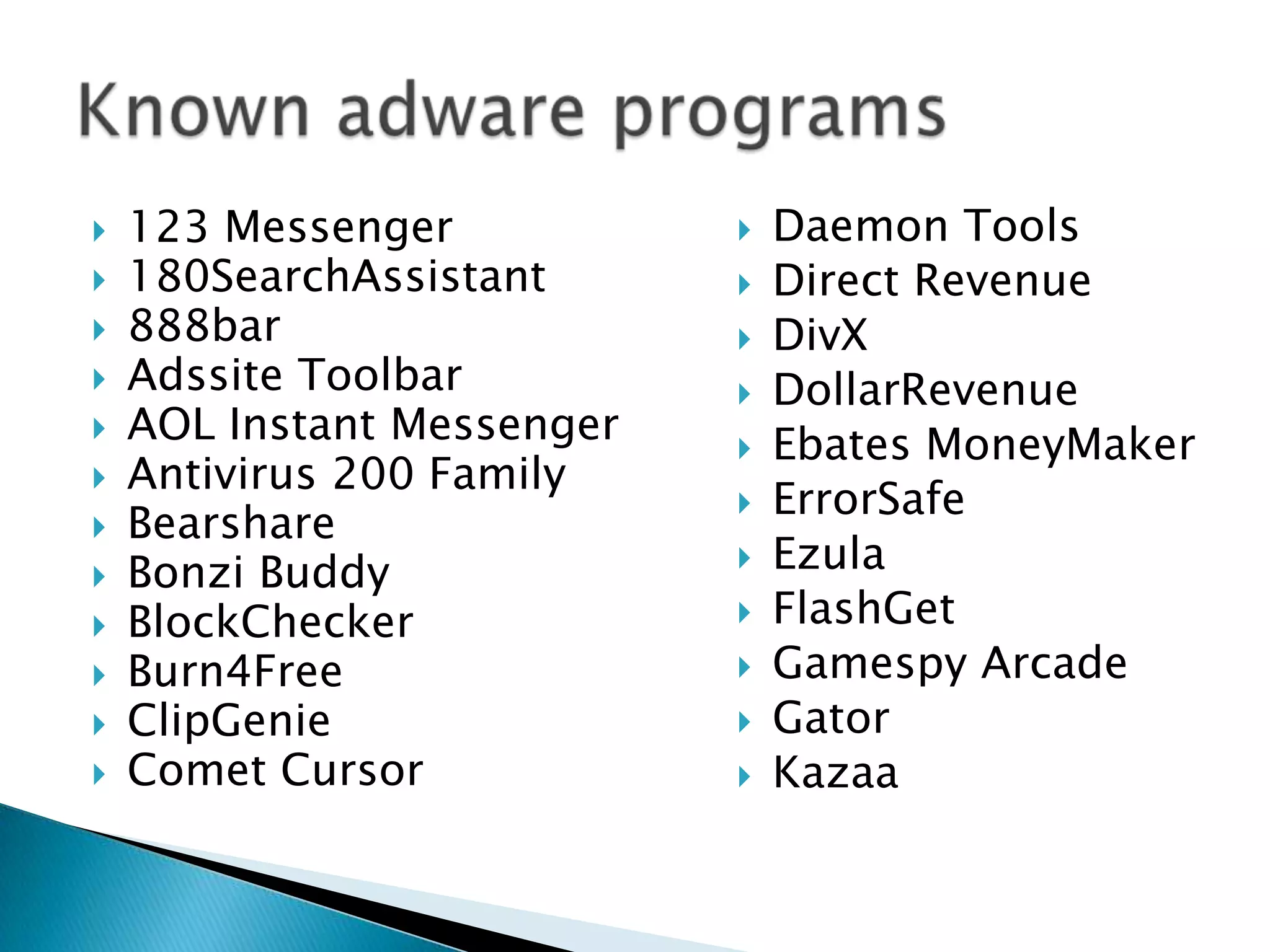
123 Messenger 180SearchAssistant 888bar Adssite Toolbar AOL Instant Messenger Antivirus 200 Family BearshareBonzi Buddy BlockCheckerBurn4Free ClipGenieComet Cursor  Known adware programsDaemon ToolsDirect Revenue DivXDollarRevenueEbatesMoneyMakerErrorSafeEzulaFlashGetGamespy Arcade Gator Kazaa
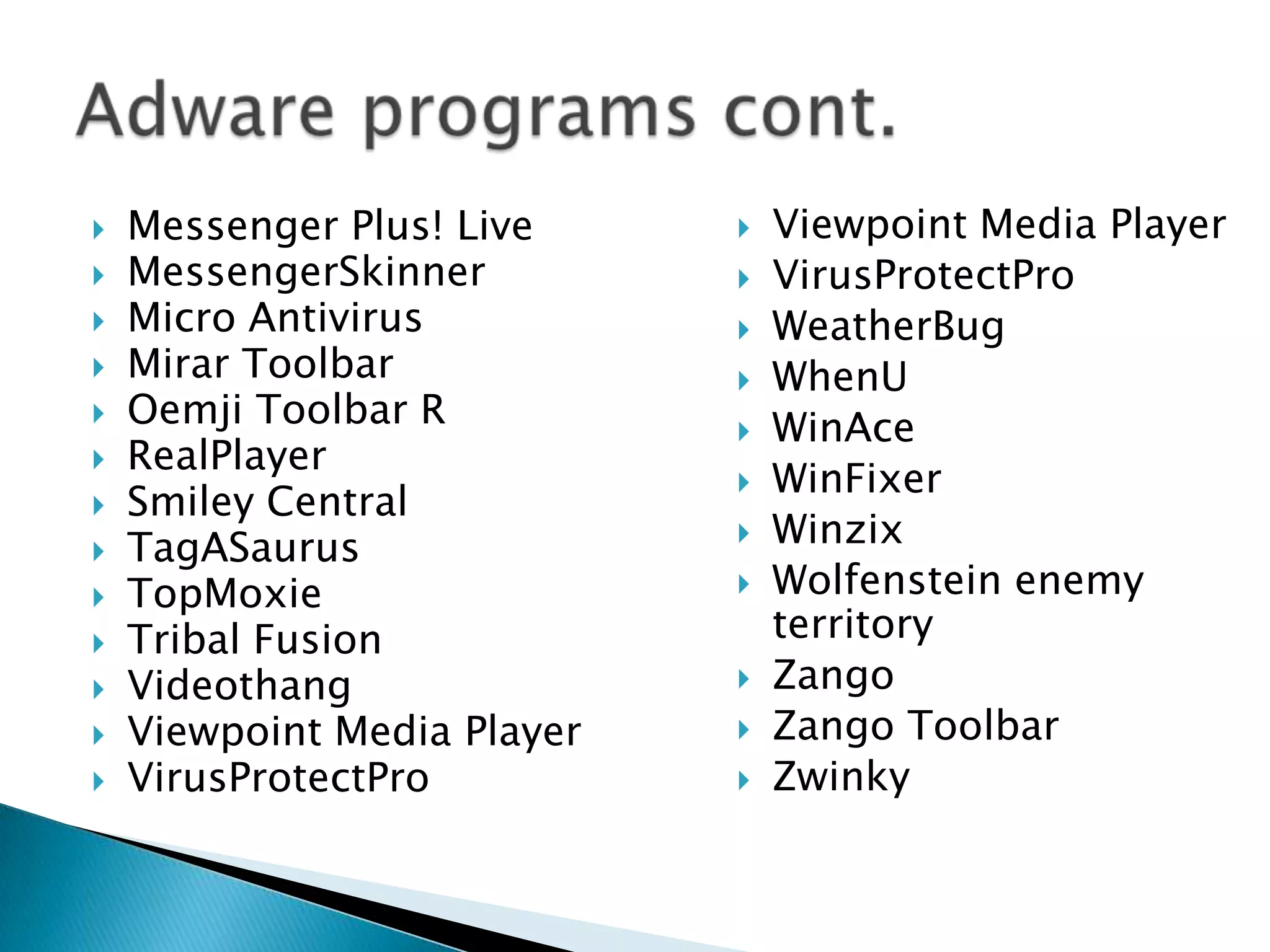
Messenger Plus! LiveMessengerSkinnerMicro Antivirus Mirar Toolbar Oemji Toolbar RRealPlayer Smiley Central TagASaurusTopMoxieTribal Fusion VideothangViewpoint Media Player VirusProtectProAdware programs cont.Viewpoint Media Player VirusProtectProWeatherBugWhenUWinAceWinFixerWinzixWolfenstein enemy territory ZangoZango Toolbar Zwinky

Viruses & Malware

  • 1.
  • 2.
    What is malware?Theterm malware is a combination of the words malicious and software. Malware is any type of software intended to cause harm to your computer that is installed without the user knowing.
  • 3.
    Computer virusesWormsTrojan horsesSpywareAdwareAnyother type of malicious & unwanted software.Types of malware
  • 4.
    What is acomputer virus?A virus is a computer program that has the ability to duplicate and infect a computer without the user knowing.
  • 5.
    ResidentDirect ActionOverwriteBootMacroDirectoryPolymorphic FileInfectorsCompanionFatLogic BombsTypes of Viruses
  • 6.
    This type ofvirus is a permanent which dwells in the RAM memory. From there it can overcome and interrupt all of the operations executed by the system: corrupting files and programs that are opened, closed, copied, renamed etc. Examples include: Randex, CMJ, Meve, and MrKlunky.Resident Virus
  • 7.
    The main purposeof this virus is to replicate and take action when it is executed. When a specific condition is met, the virus will go into action and infect files in the directory or folder that it is in and in directories that are specified in the AUTOEXEC.BAT file PATH. This batch file is always located in the root directory of the hard disk and carries out certain operations when the computer is booted.Direct Action Virus
  • 8.
    Virus of thiskind is characterized by the fact that it deletes the information contained in the files that it infects, rendering them partially or totally useless once they have been infected. The only way to clean a file infected by an overwrite virus is to delete the file completely, thus losing the original content. Examples of this virus include: Way, Trj.Reboot, Trivial.88.D.Overwrite Virus
  • 9.
    This type ofvirus affects the boot sector of a floppy or hard disk. This is a crucial part of a disk, in which information on the disk itself is stored together with a program that makes it possible to boot (start) the computer from the disk. The best way of avoiding boot viruses is to ensure that floppy disks are write-protected and never start your computer with an unknown floppy disk in the disk drive. Examples of boot viruses include: Polyboot.B, AntiEXE.Boot Virus
  • 10.
    Macro viruses infectfiles that are created using certain applications or programs that contain macros. These mini-programs make it possible to automate series of operations so that they are performed as a single action, thereby saving the user from having to carry them out one by one. Examples of macro viruses: Relax, Melissa.A, Bablas, O97M/Y2K.Macro Virus
  • 11.
    Directory viruses changethe paths that indicate the location of a file. By executing a program (file with the extension .EXE or .COM) which has been infected by a virus, you are unknowingly running the virus program, while the original file and program have been previously moved by the virus. Once infected it becomes impossible to locate the original files.Directory Virus
  • 12.
    Polymorphic viruses encryptor encode themselves in a different way (using different algorithms and encryption keys) every time they infect a system. This makes it impossible for anti-viruses to find them using string or signature searches (because they are different in each encryption) and also enables them to create a large number of copies of themselves. Examples include: Elkern, Marburg, Satan Bug, and Tuareg.Polymorphic Virus
  • 13.
    This type ofvirus infects programs or executable files (files with an .EXE or .COM extension). When one of these programs is run, directly or indirectly, the virus is activated, producing the damaging effects it is programmed to carry out. The majority of existing viruses belong to this category, and can be classified depending on the actions that they carry out.File Infectors
  • 14.
    Companion viruses canbe considered file infector viruses like resident or direct action types. They are known as companion viruses because once they get into the system they "accompany" the other files that already exist. In other words, in order to carry out their infection routines, companion viruses can wait in memory until a program is run (resident viruses) or act immediately by making copies of themselves (direct action viruses). Some examples include: Stator, Asimov.1539, and Terrax.1069Companion Virus
  • 15.
    The file allocationtable or FAT is the part of a disk used to connect information and is a vital part of the normal functioning of the computer. This type of virus attack can be especially dangerous, by preventing access to certain sections of the disk where important files are stored. Damage caused can result in information losses from individual files or even entire directories.FAT Virus
  • 16.
    What is aworm?A computer worm is a self-replicating computer program. It uses a network to send copies of itself to other nodes (computers on the network) and it may do so without any user intervention. Unlike a virus, it does not need to attach itself to an existing program. Worms almost always cause at least some harm to the network, if only by consuming bandwidth, whereas viruses almost always corrupt or modify files on a targeted computer.
  • 17.
    What is aTrojan?The term Trojan refers to the classical story of the Trojan horse in the battle of Troy. A Trojan describes a class of computer threats (malware) that appears to perform a desirable function but in fact performs undisclosed malicious functions that allow unauthorized access to the host machine, giving them the ability to save their files on the user's computer or even watch the user's screen and control the computer.
  • 18.
    Remote Access DataDestruction Downloader/dropper Server Trojan(Proxy, FTP , IRC, Email, HTTP/HTTPS, etc.) Disable security software Denial-of-service attack (DoS)Types of Trojans
  • 19.
    What is spyware?Spywareis computer software that is secretly installed on your computer to monitor your internet usage and behavior.
  • 20.
    While the termspyware suggests software that secretly monitors the user's behavior, the functions of spyware extend well beyond simple monitoring. Spyware programs can collect various types of personal information, such as Internet surfing habits, sites that have been visited, but can also interfere with user control of the computer in other ways, such as installing additional software, and redirecting Web browser activity. Spyware is known to change computer settings, resulting in slow connection speeds, different home pages, and/or loss of Internet or functionality of other programs. In an attempt to increase the understanding of spyware, a more formal classification of its included software types is captured under the term privacy-invasive software.Spyware cont.
  • 21.
    AntiVirus 360Antivirus 2008Antivirus2009AntiVirus GoldContraVirusErrorsafeMacSweeperPAL Spyware RemoverPest TrapPSGuardSpy WiperList of fake anti-spyware programsSpydawnSpylockedSpysheriffSpyShredderSpyware QuakeSpywareStrikeUltimateCleanerWinAntiVirus Pro 2006WinFixerWorldAntiSpy
  • 22.
    What is adware?Adwareis any software package which automatically plays, displays, or downloads advertisements to a computer after the software is installed on it or while the application is being used. Some types of adware are also spyware and can be classified as privacy-invasive software.
  • 23.
    123 Messenger 180SearchAssistant888bar Adssite Toolbar AOL Instant Messenger Antivirus 200 Family BearshareBonzi Buddy BlockCheckerBurn4Free ClipGenieComet Cursor Known adware programsDaemon ToolsDirect Revenue DivXDollarRevenueEbatesMoneyMakerErrorSafeEzulaFlashGetGamespy Arcade Gator Kazaa
  • 24.
    Messenger Plus! LiveMessengerSkinnerMicroAntivirus Mirar Toolbar Oemji Toolbar RRealPlayer Smiley Central TagASaurusTopMoxieTribal Fusion VideothangViewpoint Media Player VirusProtectProAdware programs cont.Viewpoint Media Player VirusProtectProWeatherBugWhenUWinAceWinFixerWinzixWolfenstein enemy territory ZangoZango Toolbar Zwinky