®
                                                     ®


   International Virtual Observatory
     System for Water Resources
              Information
          Lewis Leinenweber, Luis Bermudez
                   April 8, 2013
             EGU General Assembly 2013
                  Vienna, Austria


OGC ®            © 2013 Open Geospatial Consortium
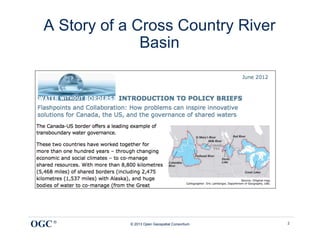
A Story of a Cross Country River
                Basin


OGC ®        © 2013 Open Geospatial Consortium   2
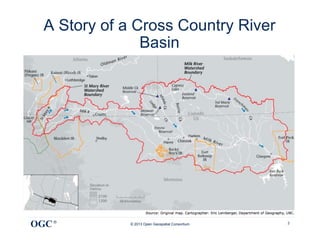
A Story of a Cross Country River
                Basin


OGC ®        © 2013 Open Geospatial Consortium   3
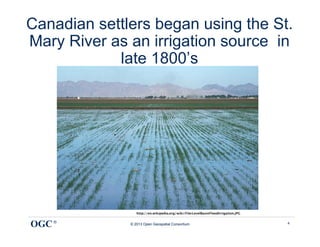
Canadian settlers began using the St.
Mary River as an irrigation source in
            late 1800’s


                 http://en.wikipedia.org/wiki/File:LevelBasinFloodIrrigation.JPG


OGC ®         © 2013 Open Geospatial Consortium                                     4
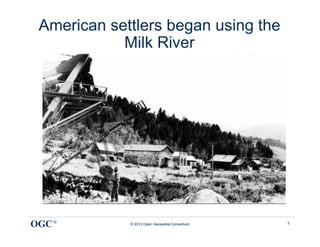
American settlers began using the
            Milk River


OGC ®        © 2013 Open Geospatial Consortium   5
Resource scarcity

When the Milk River’s unreliability
threatened the stability of the region, the
US made plans for a canal and dam to
divert St. Mary River water into the Milk
River for use in Montana


OGC ®           © 2013 Open Geospatial Consortium   6
Canada became concern

Early 1900s - Alberta built a “spite canal”
to show that it could siphon water
diverted from the Milk River back into
the St. Mary River further downstream.


OGC ®           © 2013 Open Geospatial Consortium   7
And on and on …

• …
• 1909 Boundary Waters Treaty
 – The two rivers should be treated as one for
   the purposes of irrigation and power
 – …


OGC ®            © 2013 Open Geospatial Consortium   8
2013

Can we build a collection of
interoperating data archives and
software tools which utilize the internet
to form a scientific research environment
in which hydrological research programs
can be conducted?


OGC ®          © 2013 Open Geospatial Consortium   9
2013

Can we build a collection of
interoperating data archives and
software tools which utilize the internet
to form a scientific research environment
in which hydrological research programs
can be conducted?

=> Virtual Observatory
OGC ®          © 2013 Open Geospatial Consortium   10
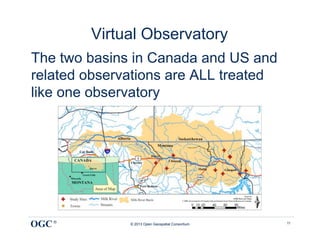
Virtual Observatory
The two basins in Canada and US and
related observations are ALL treated
like one observatory


                                                  !

OGC ®         © 2013 Open Geospatial Consortium       11
OGC CHISP-1 Pilot

• Climatology-Hydrology Information
  Sharing Pilot, Phase 1 (CHISP-1)
• Sponsors


OGC ®          © 2013 Open Geospatial Consortium   12
CHISP Pilot Schedule

• Project Kickoff: 13-14 November 2012
• Preliminary Design: 18 January 2013
• Project Demonstration: 16 April 2013
• Project Complete:        26 April 2013


OGC ®          © 2013 Open Geospatial Consortium   13
Main Goals

• Support Hydrologic Modeling
• Assessment of Nutrients Loading for
  Great Lakes (US and Canada)


OGC ®          © 2013 Open Geospatial Consortium   14
Hydrologic Modeling

Requires Integration of Stream flow and
Groundwater Wells

Requires Cross-border Integration of
River Networks
• US National Hydrography Dataset
• Canada National Hydro Network (NHN)

OGC ®          © 2013 Open Geospatial Consortium   15
Data Integration for Hydrologic
             Modeling

Use OGC Web Feature Service (WFS)
to find stream gauges and
groundwater wells within an area of
interest (bounding box)


OGC ®         © 2013 Open Geospatial Consortium   16
Data Integration for Hydrologic
             Modeling

Harvest sensor service metadata and
gauge metadata and time-series last-
value data and make it available via in a
ebRIM Catalog Services for the Web
(CSW).


OGC ®          © 2013 Open Geospatial Consortium   17
Data Integration for Hydrologic
             Modeling

Use Web Processing Service (WPS) to
find US and Canadian upstream river
segments from a point of interest.


OGC ®         © 2013 Open Geospatial Consortium   18
Data Integration for Hydrologic
             Modeling

Use Web Processing Service (WPS) to
find and associate stream gauges and
groundwater wells with upstream
segments returned from the WPS
upstream service.


OGC ®         © 2013 Open Geospatial Consortium   19
Data Integration for Hydrologic
             Modeling

Use Sensor Observation Service (SOS)
GetDataAvailabilty (GDA) operation to
retrieve time-series data for selected
stream gauges and wells for applicable
resources.


OGC ®         © 2013 Open Geospatial Consortium   20
Assessment of Nutrients Loading for
  Great Lakes (US and Canada)

• Integration of Great Lakes water quality
  data for US and Canada
 – USGS and EPA Water Quality Portal
   services
 – Water Quality Exchange (WQX) data


OGC ®           © 2013 Open Geospatial Consortium   21
Assessment of Nutrients Loading for
  Great Lakes (US and Canada)

• Integrating with stream flow (calculating
  nutrient loads)
 – Locate and associate water quality
   monitoring stations for a selected point of
   interest in the Great Lakes
 – Retrieve nutrient values for identified
   upstream stations using SOS


OGC ®             © 2013 Open Geospatial Consortium   22
Assessment of Nutrients Loading for
  Great Lakes (US and Canada)

• Integrating with stream flow (calculating
  nutrient loads)
 – Use WPS to calculate nutrient loads for the
   requested time period
   •  Execute a simplified nutrient load calculation
      model based on USGS Exploration for
      Graphics for River Trends (EGRET) for
      selected nutrients.


OGC ®               © 2013 Open Geospatial Consortium   23
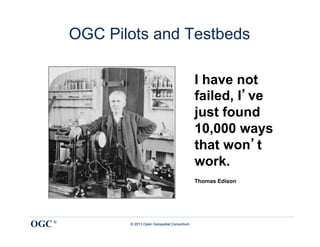
OGC Pilots and Testbeds

                                                   I have not
                                                   failed, I’ve
                                                   just found
                                                   10,000 ways
                                                   that won’t
                                                   work.
                                                   Thomas Edison


OGC ®          © 2013 Open Geospatial Consortium
Interoperability program

• Over 40 initiatives have been
  successfully completed since 1999.
• Most OGC standards are advanced
  through this process.


OGC ®          © 2013 Open Geospatial Consortium   25
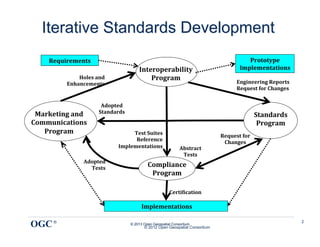
Iterative Standards Development
      Requirements	
                                                                                  Prototype	
  
                                                 Interoperability	
                                Implementations	
  
                 Holes	
  and	
                      Program	
  
             Enhancements	
                                                                      Engineering	
  Reports	
  
                                                                                                 Request	
  for	
  Changes	


                              Adopted	
  
 Marketing	
  and	
          Standards	
  
                                                                                                             Standards	
  
Communications	
                                                                                              Program	
  
   Program	
                               Test	
  Suites	
                             Request	
  for	
  
                                            Reference	
                                  Changes	
  
                                      Implementations
                  Abstract	
  
                                                                         Tests	
  
                     Adopted	
  
                       Tests	
  
                                                      Compliance	
  
                                                       Program	
  

                                                                  CertiAication	


  Implementations	
  

OGC ®                                        © 2013 Open Geospatial Consortium
                                                    © 2012 Open Geospatial Consortium
                                                                                                                                 26
Open Geospatial Consortium


 Only world organization, with
 industry members, focusing
    on location standards
OGC ®        © 2013 Open Geospatial Consortium
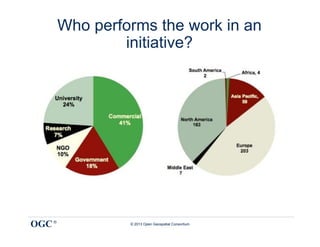
Who performs the work in an
                initiative?


OGC ®            © 2013 Open Geospatial Consortium
Questions?

CHISP Link:
http://www.opengeospatial.org/projects/initiatives/chisp

Becoming OGC member
http://www.opengeospatial.org/ogc/join/levels

                  Luis	
  Bermudez,	
  Ph.D.	
  
             lbermudez@opengeospa9al.org	
  
                   @berdez	
  on	
  Twi<er	
  
          h<p://www.linkedin.com/in/bermudez	


  OGC ®                © 2013 Open Geospatial Consortium   29

Virtual observatory water_final

  • 1.
    ® ® International Virtual Observatory System for Water Resources Information Lewis Leinenweber, Luis Bermudez April 8, 2013 EGU General Assembly 2013 Vienna, Austria OGC ® © 2013 Open Geospatial Consortium
  • 2.
    A Story ofa Cross Country River Basin OGC ® © 2013 Open Geospatial Consortium 2
  • 3.
    A Story ofa Cross Country River Basin OGC ® © 2013 Open Geospatial Consortium 3
  • 4.
    Canadian settlers beganusing the St. Mary River as an irrigation source in late 1800’s http://en.wikipedia.org/wiki/File:LevelBasinFloodIrrigation.JPG OGC ® © 2013 Open Geospatial Consortium 4
  • 5.
    American settlers beganusing the Milk River OGC ® © 2013 Open Geospatial Consortium 5
  • 6.
    Resource scarcity When theMilk River’s unreliability threatened the stability of the region, the US made plans for a canal and dam to divert St. Mary River water into the Milk River for use in Montana OGC ® © 2013 Open Geospatial Consortium 6
  • 7.
    Canada became concern Early1900s - Alberta built a “spite canal” to show that it could siphon water diverted from the Milk River back into the St. Mary River further downstream. OGC ® © 2013 Open Geospatial Consortium 7
  • 8.
    And on andon … • … • 1909 Boundary Waters Treaty – The two rivers should be treated as one for the purposes of irrigation and power – … OGC ® © 2013 Open Geospatial Consortium 8
  • 9.
    2013 Can we builda collection of interoperating data archives and software tools which utilize the internet to form a scientific research environment in which hydrological research programs can be conducted? OGC ® © 2013 Open Geospatial Consortium 9
  • 10.
    2013 Can we builda collection of interoperating data archives and software tools which utilize the internet to form a scientific research environment in which hydrological research programs can be conducted? => Virtual Observatory OGC ® © 2013 Open Geospatial Consortium 10
  • 11.
    Virtual Observatory The twobasins in Canada and US and related observations are ALL treated like one observatory ! OGC ® © 2013 Open Geospatial Consortium 11
  • 12.
    OGC CHISP-1 Pilot • Climatology-HydrologyInformation Sharing Pilot, Phase 1 (CHISP-1) • Sponsors OGC ® © 2013 Open Geospatial Consortium 12
  • 13.
    CHISP Pilot Schedule • ProjectKickoff: 13-14 November 2012 • Preliminary Design: 18 January 2013 • Project Demonstration: 16 April 2013 • Project Complete: 26 April 2013 OGC ® © 2013 Open Geospatial Consortium 13
  • 14.
    Main Goals • Support HydrologicModeling • Assessment of Nutrients Loading for Great Lakes (US and Canada) OGC ® © 2013 Open Geospatial Consortium 14
  • 15.
    Hydrologic Modeling Requires Integrationof Stream flow and Groundwater Wells Requires Cross-border Integration of River Networks • US National Hydrography Dataset • Canada National Hydro Network (NHN) OGC ® © 2013 Open Geospatial Consortium 15
  • 16.
    Data Integration forHydrologic Modeling Use OGC Web Feature Service (WFS) to find stream gauges and groundwater wells within an area of interest (bounding box) OGC ® © 2013 Open Geospatial Consortium 16
  • 17.
    Data Integration forHydrologic Modeling Harvest sensor service metadata and gauge metadata and time-series last- value data and make it available via in a ebRIM Catalog Services for the Web (CSW). OGC ® © 2013 Open Geospatial Consortium 17
  • 18.
    Data Integration forHydrologic Modeling Use Web Processing Service (WPS) to find US and Canadian upstream river segments from a point of interest. OGC ® © 2013 Open Geospatial Consortium 18
  • 19.
    Data Integration forHydrologic Modeling Use Web Processing Service (WPS) to find and associate stream gauges and groundwater wells with upstream segments returned from the WPS upstream service. OGC ® © 2013 Open Geospatial Consortium 19
  • 20.
    Data Integration forHydrologic Modeling Use Sensor Observation Service (SOS) GetDataAvailabilty (GDA) operation to retrieve time-series data for selected stream gauges and wells for applicable resources. OGC ® © 2013 Open Geospatial Consortium 20
  • 21.
    Assessment of NutrientsLoading for Great Lakes (US and Canada) • Integration of Great Lakes water quality data for US and Canada – USGS and EPA Water Quality Portal services – Water Quality Exchange (WQX) data OGC ® © 2013 Open Geospatial Consortium 21
  • 22.
    Assessment of NutrientsLoading for Great Lakes (US and Canada) • Integrating with stream flow (calculating nutrient loads) – Locate and associate water quality monitoring stations for a selected point of interest in the Great Lakes – Retrieve nutrient values for identified upstream stations using SOS OGC ® © 2013 Open Geospatial Consortium 22
  • 23.
    Assessment of NutrientsLoading for Great Lakes (US and Canada) • Integrating with stream flow (calculating nutrient loads) – Use WPS to calculate nutrient loads for the requested time period •  Execute a simplified nutrient load calculation model based on USGS Exploration for Graphics for River Trends (EGRET) for selected nutrients. OGC ® © 2013 Open Geospatial Consortium 23
  • 24.
    OGC Pilots andTestbeds I have not failed, I’ve just found 10,000 ways that won’t work. Thomas Edison OGC ® © 2013 Open Geospatial Consortium
  • 25.
    Interoperability program • Over 40initiatives have been successfully completed since 1999. • Most OGC standards are advanced through this process. OGC ® © 2013 Open Geospatial Consortium 25
  • 26.
    Iterative Standards Development Requirements   Prototype   Interoperability   Implementations   Holes  and   Program   Enhancements   Engineering  Reports   Request  for  Changes   Adopted   Marketing  and   Standards   Standards   Communications   Program   Program   Test  Suites   Request  for   Reference   Changes   Implementations Abstract   Tests   Adopted   Tests   Compliance   Program   CertiAication    Implementations   OGC ® © 2013 Open Geospatial Consortium © 2012 Open Geospatial Consortium 26
  • 27.
    Open Geospatial Consortium Only world organization, with industry members, focusing on location standards OGC ® © 2013 Open Geospatial Consortium
  • 28.
    Who performs thework in an initiative? OGC ® © 2013 Open Geospatial Consortium
  • 29.
    Questions? CHISP Link: http://www.opengeospatial.org/projects/initiatives/chisp Becoming OGCmember http://www.opengeospatial.org/ogc/join/levels Luis  Bermudez,  Ph.D.   lbermudez@opengeospa9al.org   @berdez  on  Twi<er   h<p://www.linkedin.com/in/bermudez     OGC ® © 2013 Open Geospatial Consortium 29