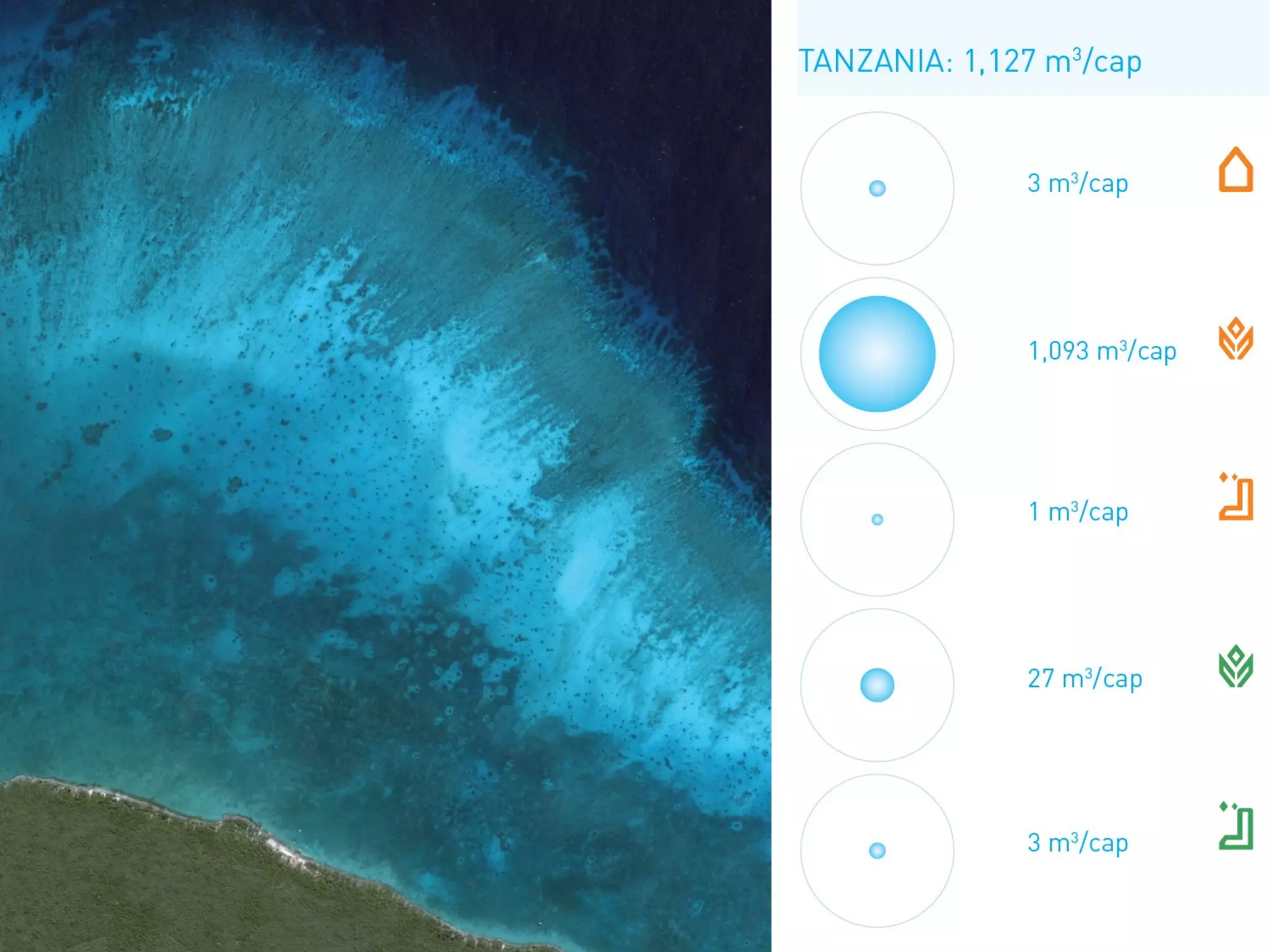
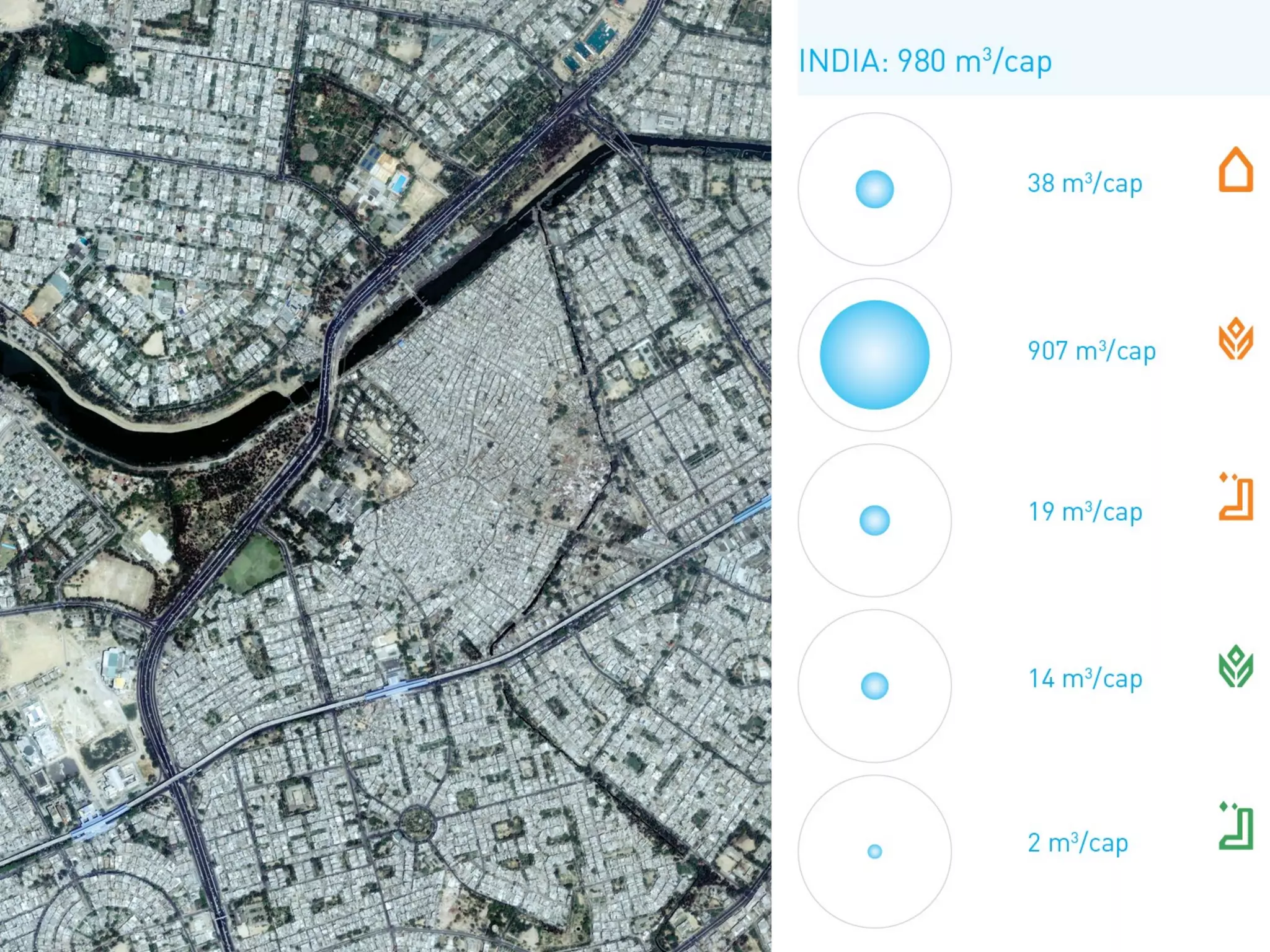
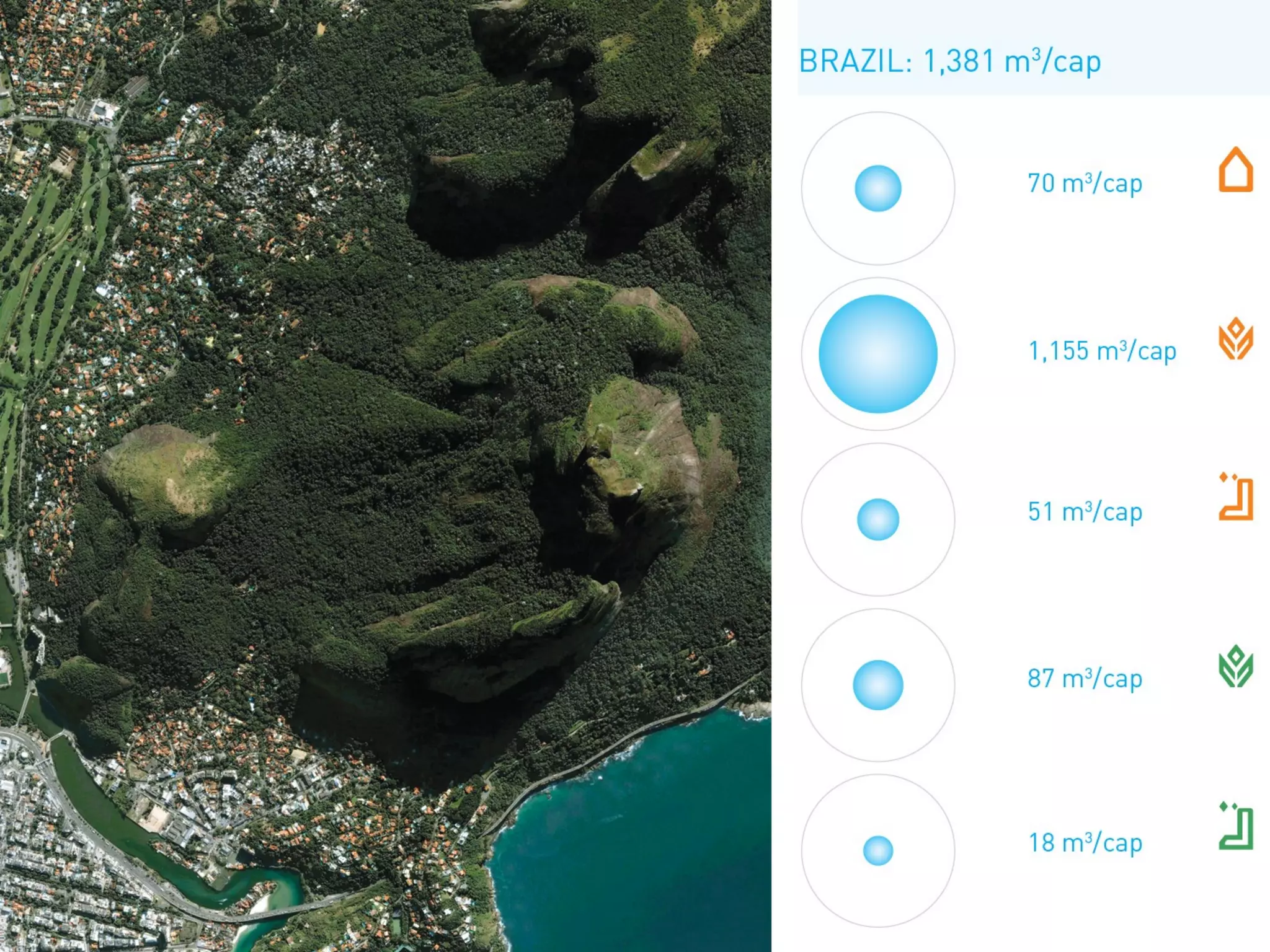
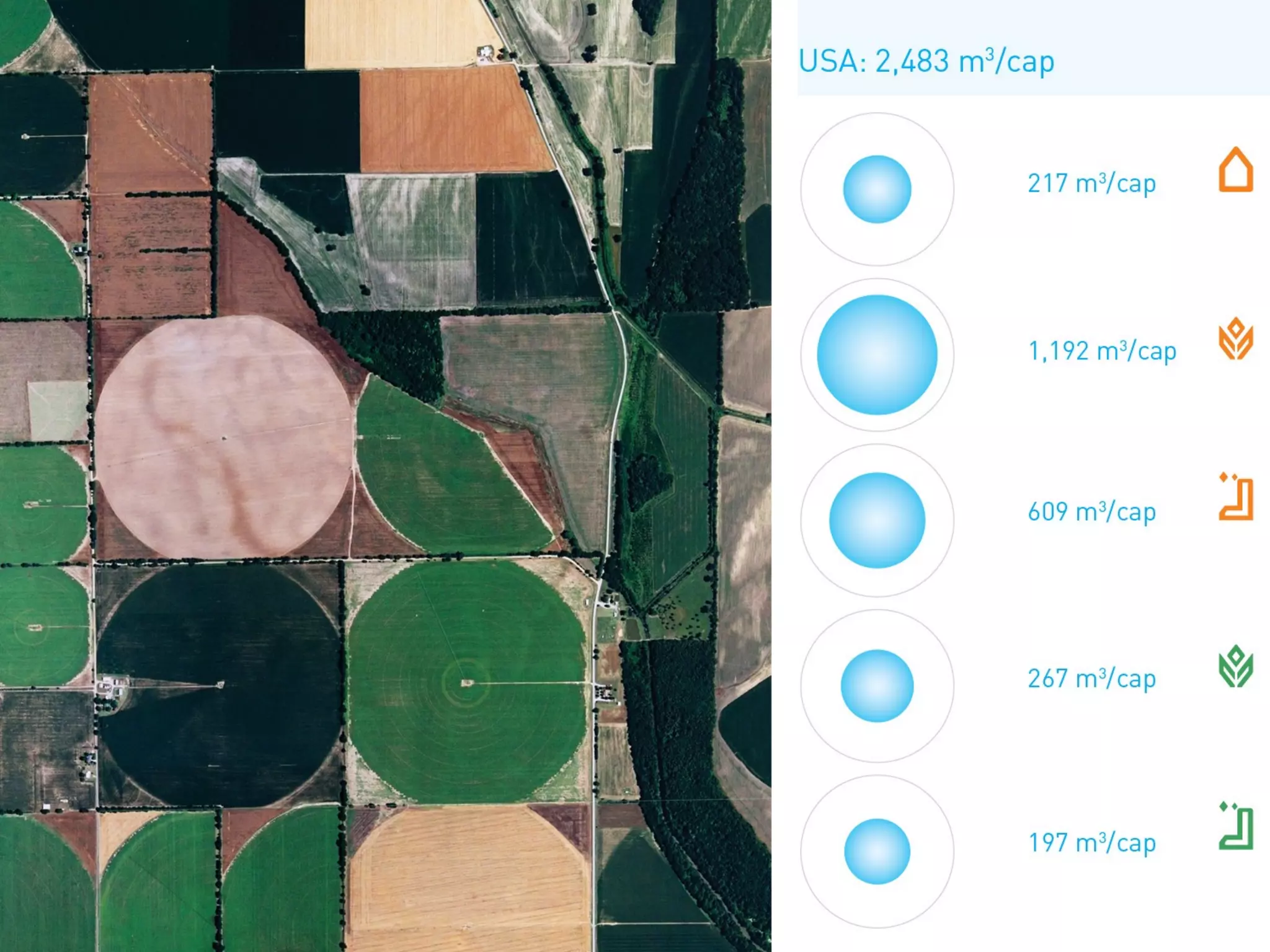
Water in Africa - CEAUP - Porto 2008
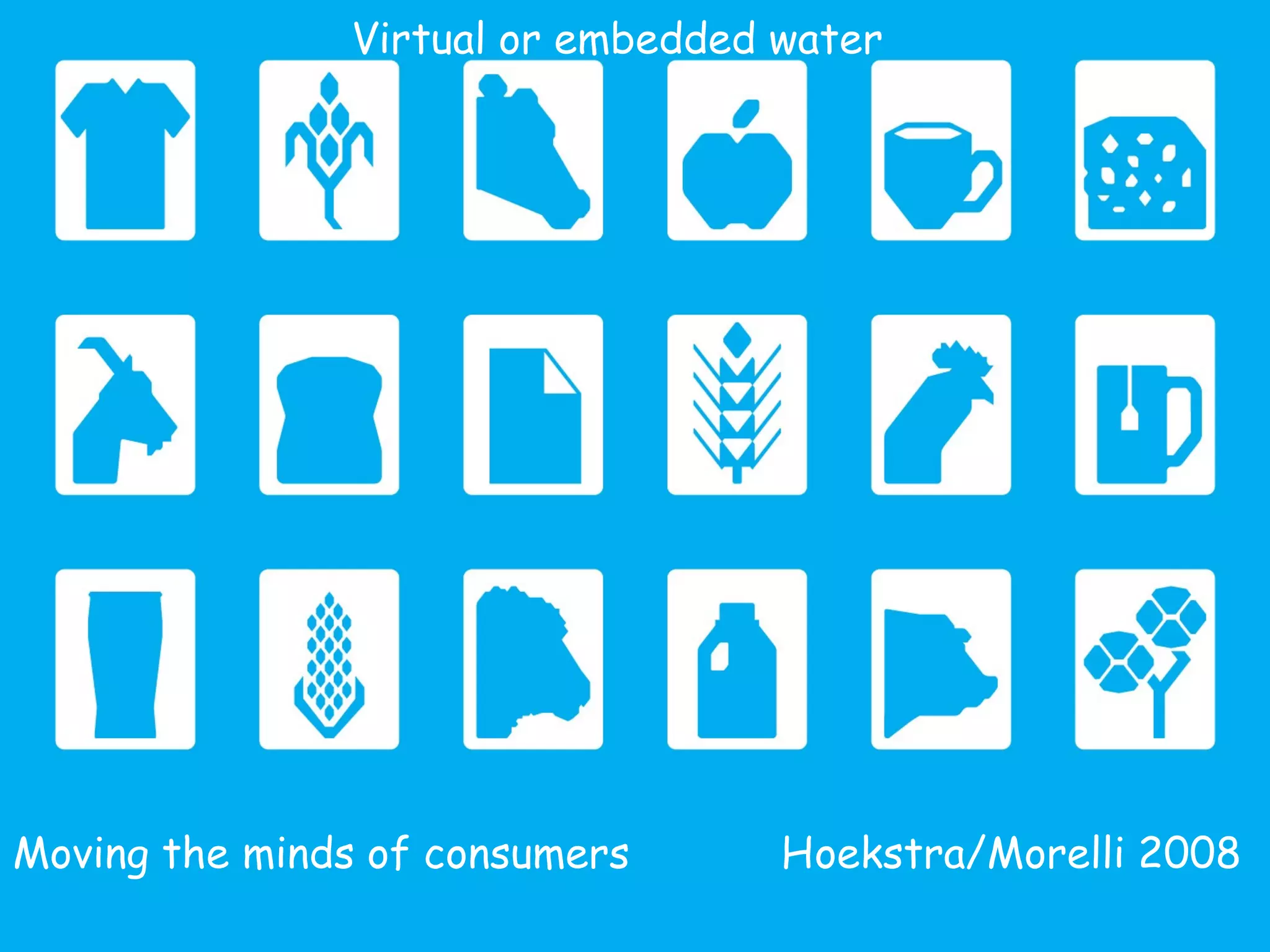
Water in Africa - CEAUP - Porto 2008 Moving the minds of consumers  Hoekstra/Morelli 2008 Virtual or embedded water
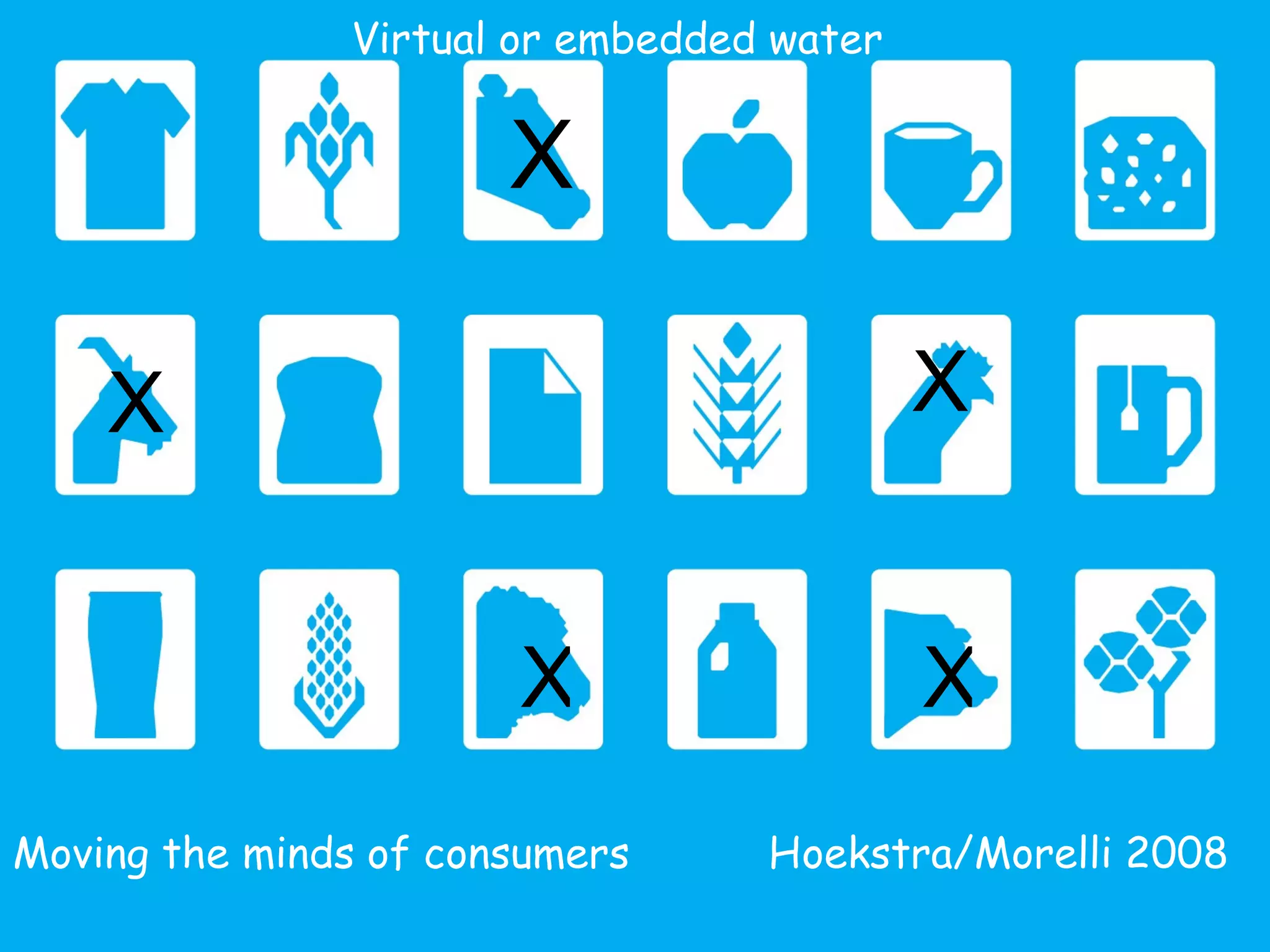
Water in Africa - CEAUP - Porto 2008 Moving the minds of consumers  Hoekstra/Morelli 2008 Virtual or embedded water X X X X X
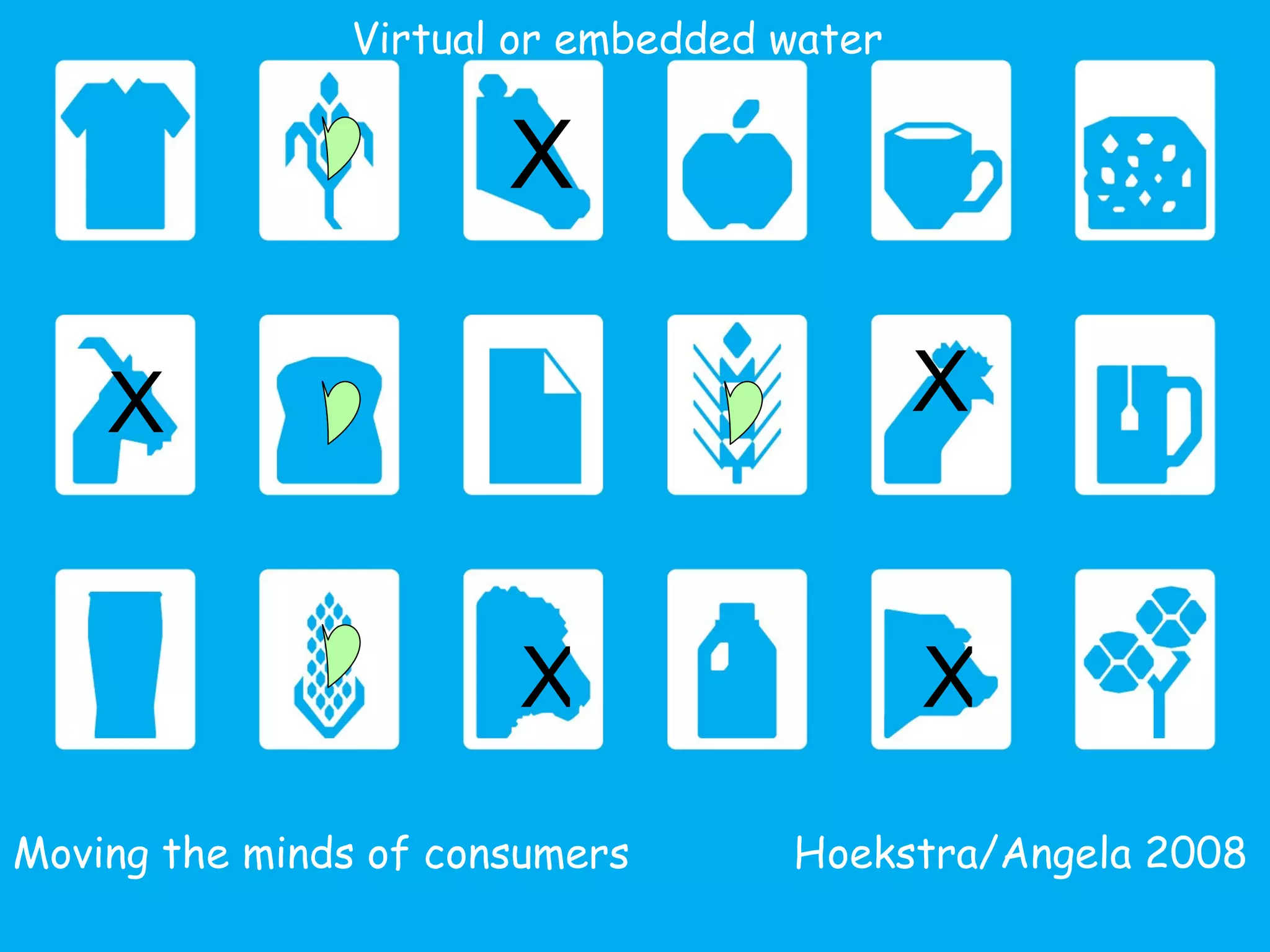
Water in Africa - CEAUP - Porto 2008 Moving the minds of consumers  Hoekstra/Angela 2008 Virtual or embedded water X X X X X
Virtual water   Capturing the invisible is easier  than communicating the invisible  to move the minds of consumers Tony Allan King’s College & SOAS London SIWI World Water Week 2008 Water in Africa - CEAUP - Porto 2008
Virtual water   Capturing the invisible is easier  than  COMMUNICATING  the invisible  to move the minds of  CONSUMERS  The importance of managing ourselves Water in Africa - CEAUP - Porto 2008
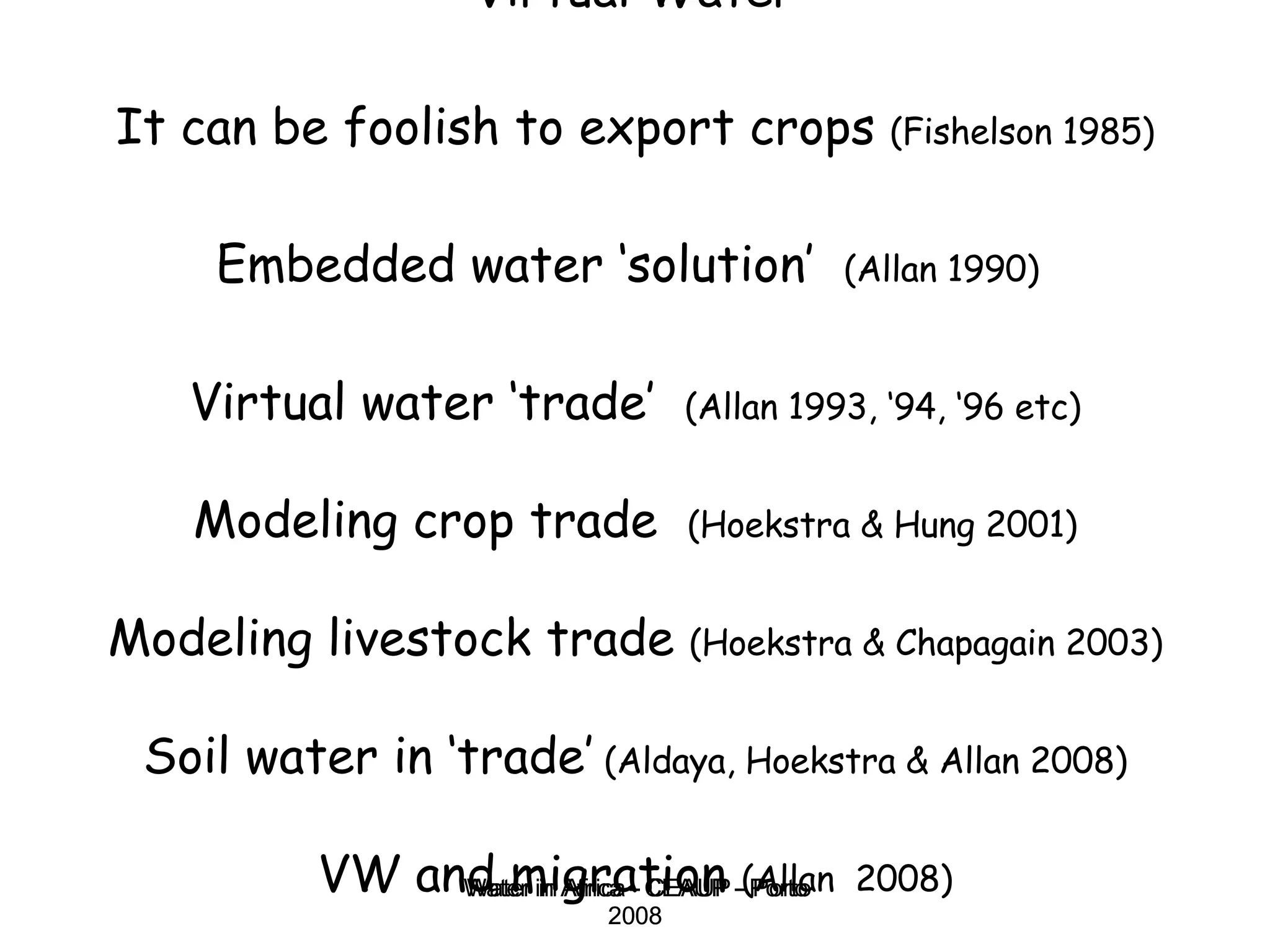
Virtual Water It can be foolish to export crops  (Fishelson 1985)   Embedded water ‘solution’  (Allan 1990)   Virtual water ‘trade’  (Allan 1993, ‘94, ‘96 etc) Modeling crop trade  (Hoekstra & Hung 2001) Modeling livestock trade  (Hoekstra & Chapagain 2003) Soil water in ‘trade’  (Aldaya, Hoekstra & Allan 2008) VW and migration  (Allan  2008) Water in Africa - CEAUP - Porto 2008
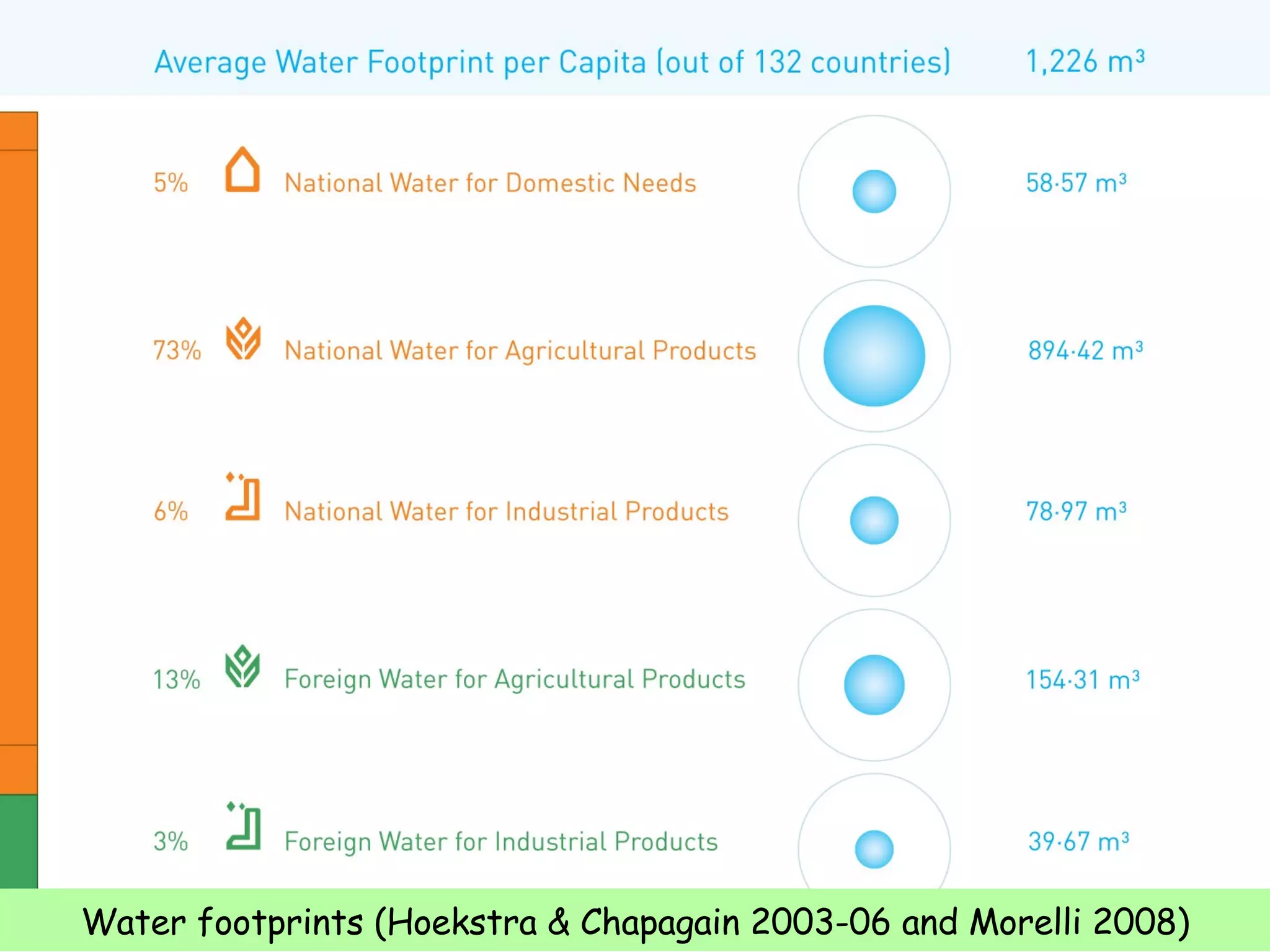
Water in Africa - CEAUP - Porto 2008 Water footprints (Hoekstra & Chapagain 2003-06 and Morelli 2008)
Water in Africa - CEAUP - Porto 2008
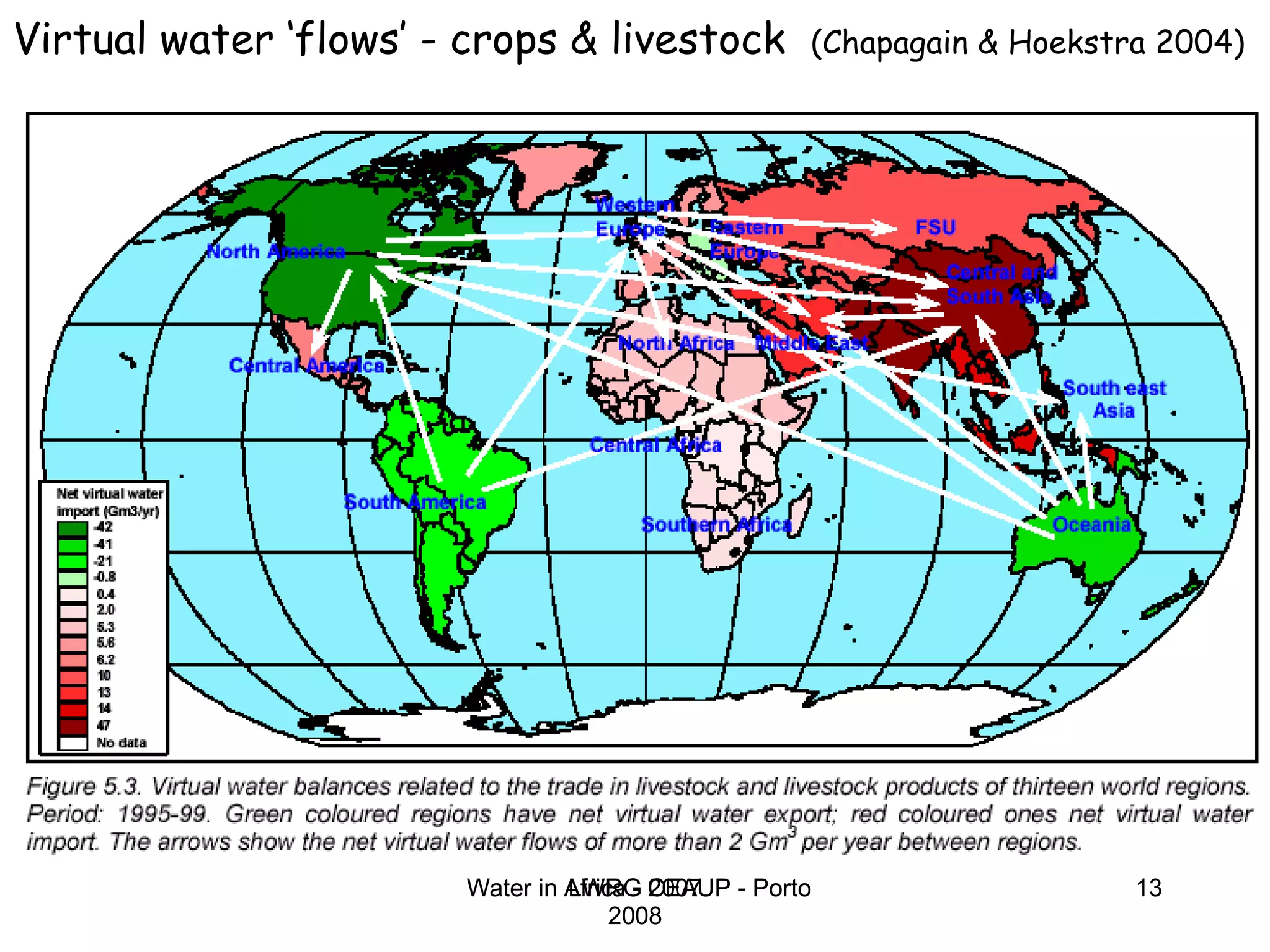
LWRG 2007 Virtual water ‘flows’ - crops & livestock  (Chapagain & Hoekstra 2004)
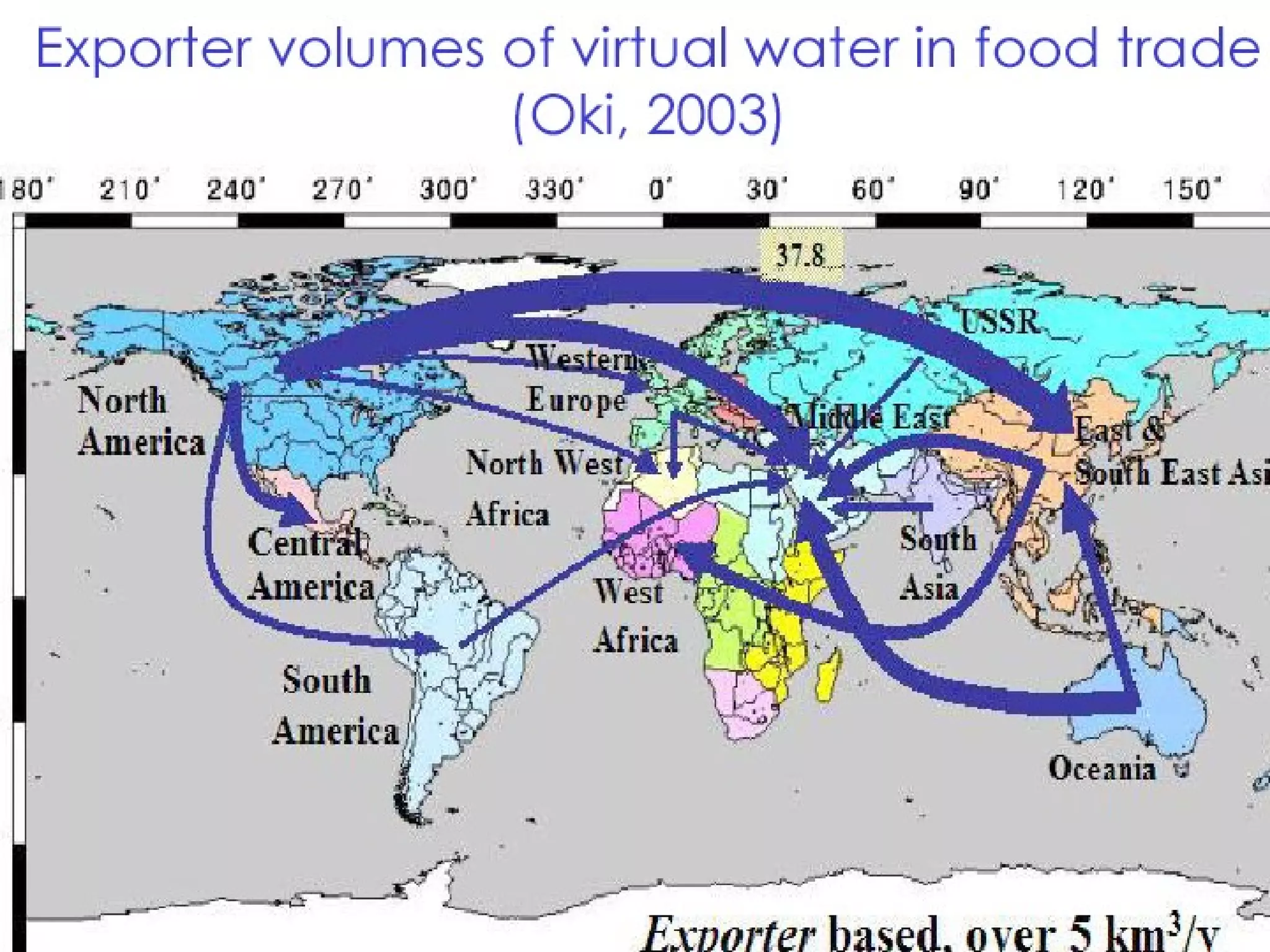
.   LWRG 2007
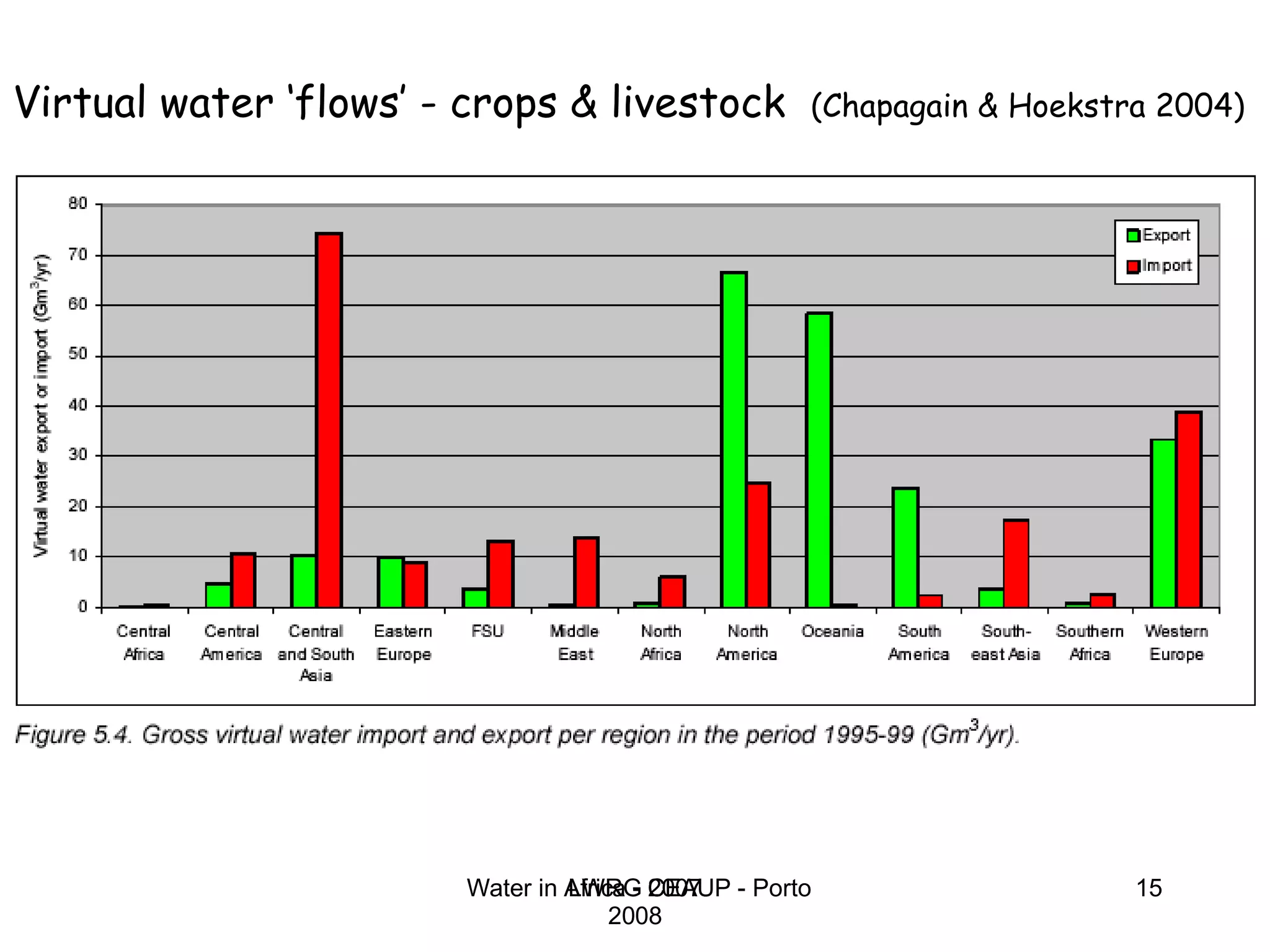
LWRG 2007 Virtual water ‘flows’ - crops & livestock  (Chapagain & Hoekstra 2004)
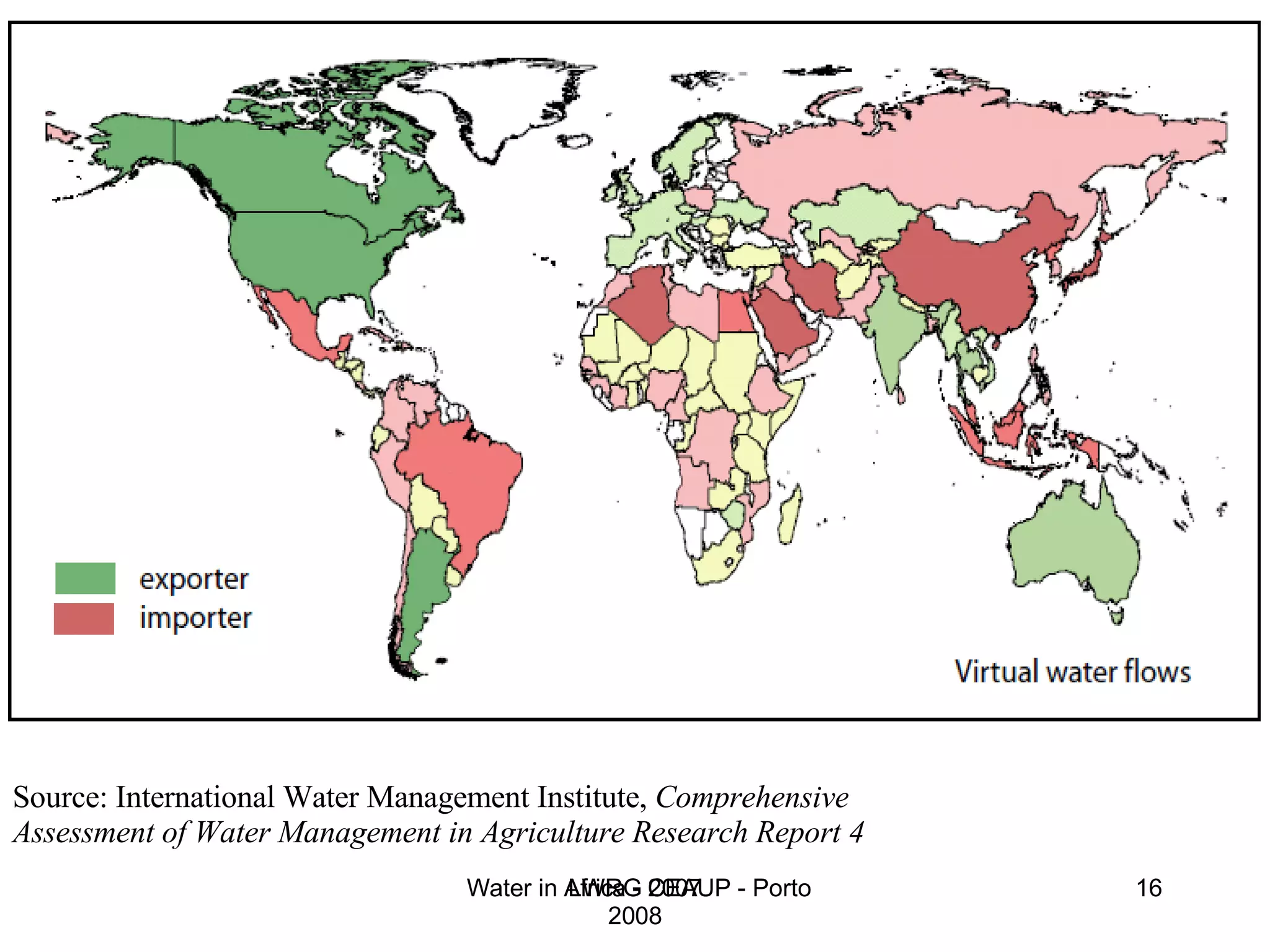
LWRG 2007 Source: International Water Management Institute,  Comprehensive Assessment of Water Management in Agriculture Research Report 4
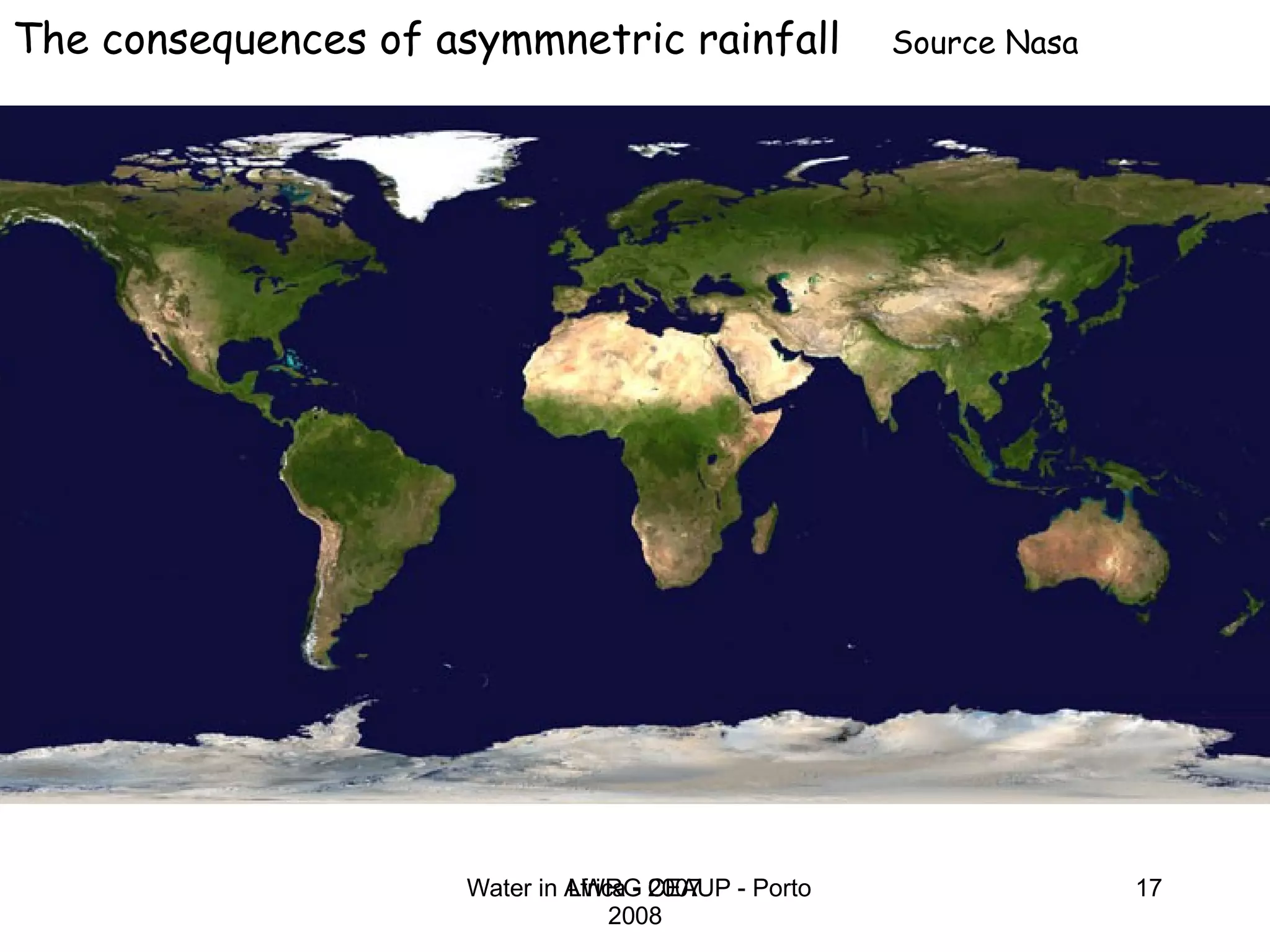
LWRG 2007 The consequences of asymmnetric rainfall  Source Nasa
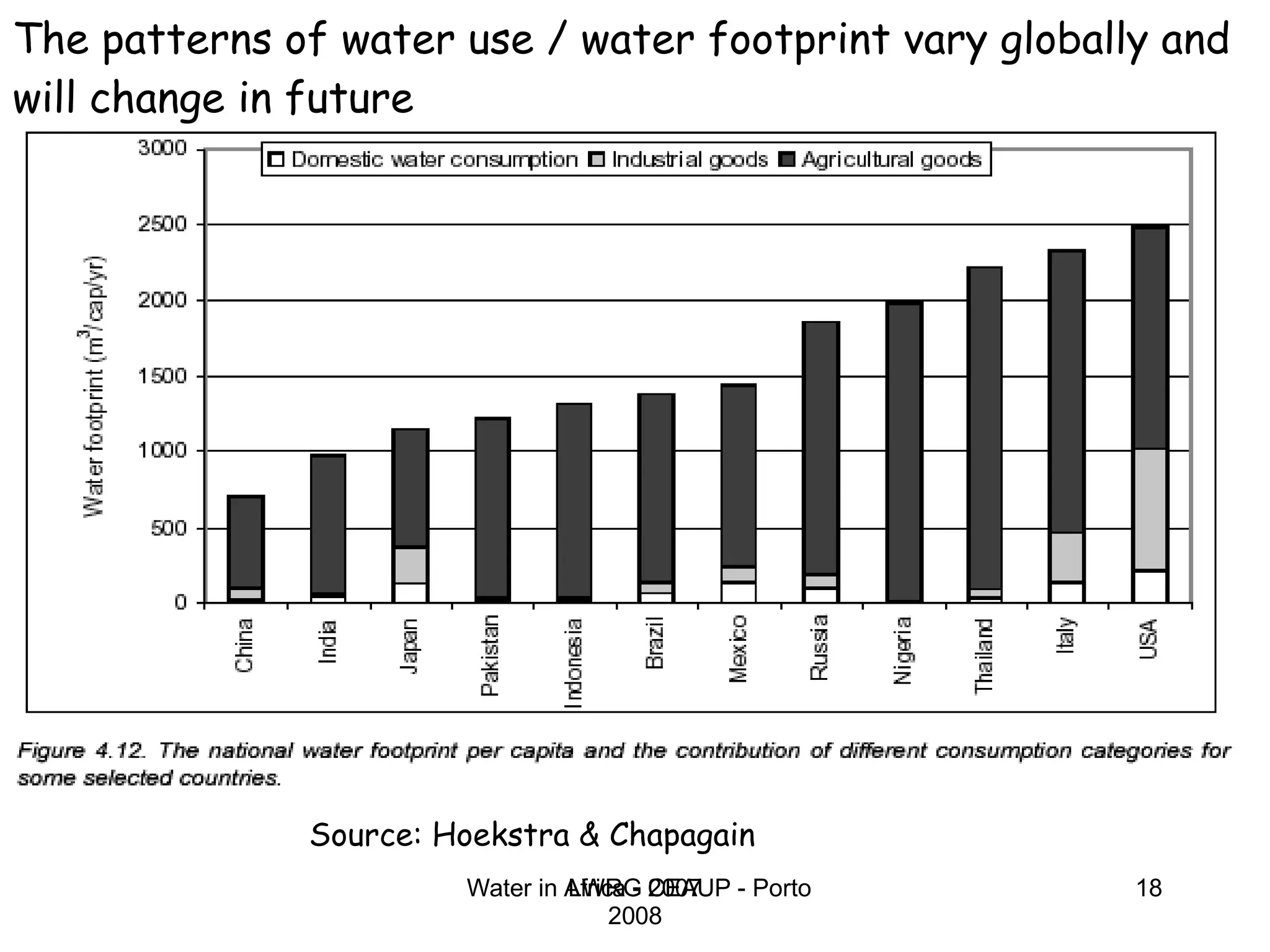
LWRG 2007 The patterns of water use / water footprint vary globally and will change in future  Source: Hoekstra & Chapagain
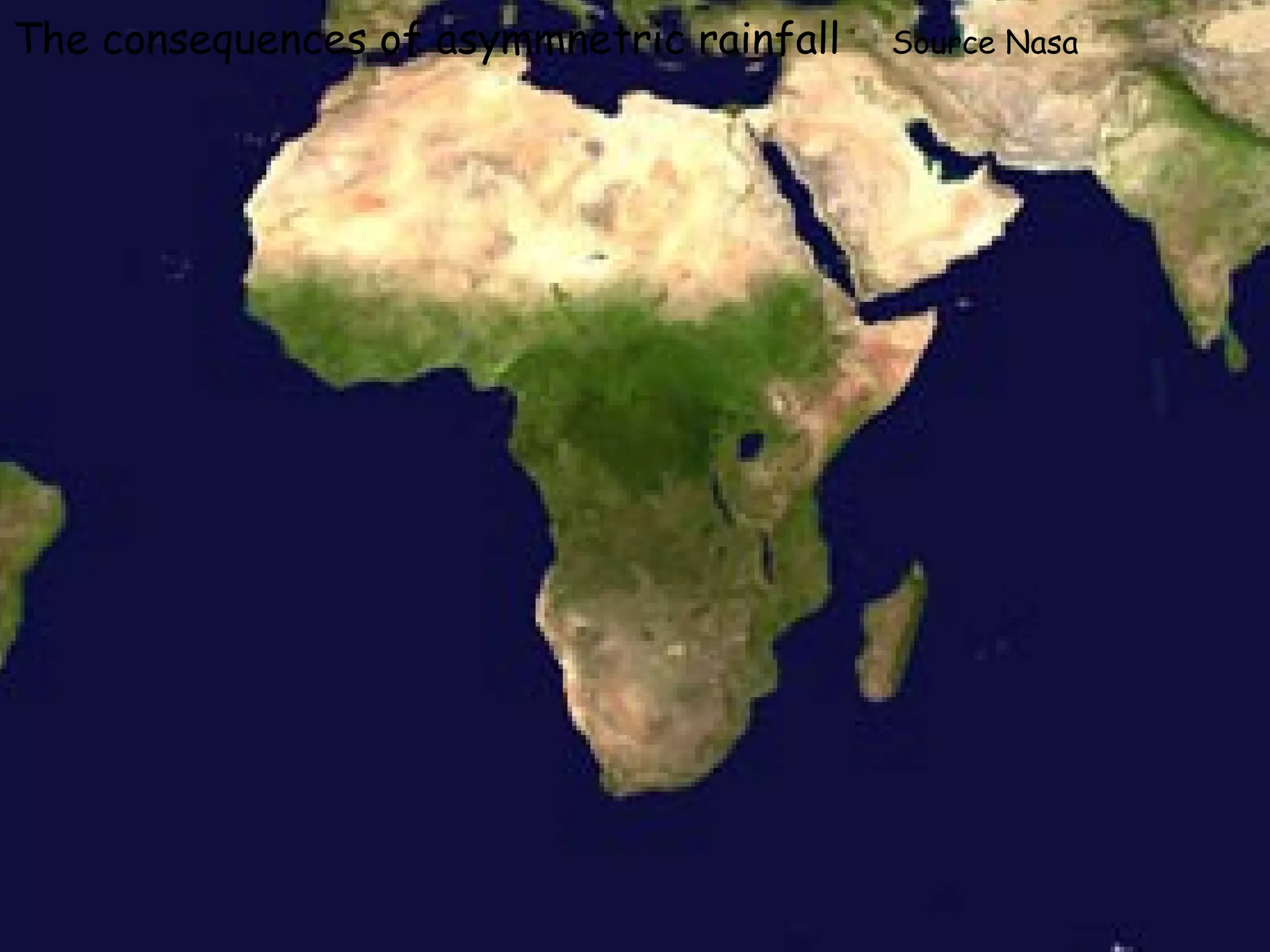
LWRG 2007 The consequences of asymmnetric rainfall  Source Nasa
LWRG 2007 RESPONSE  Global Irrigated Area Map  Source IWMI.org Look at the International Water Management Institute [IWMI] website
Global Irrigated Area Map  Source IWMI.org Look at the International Water Management Institute [IWMI] website
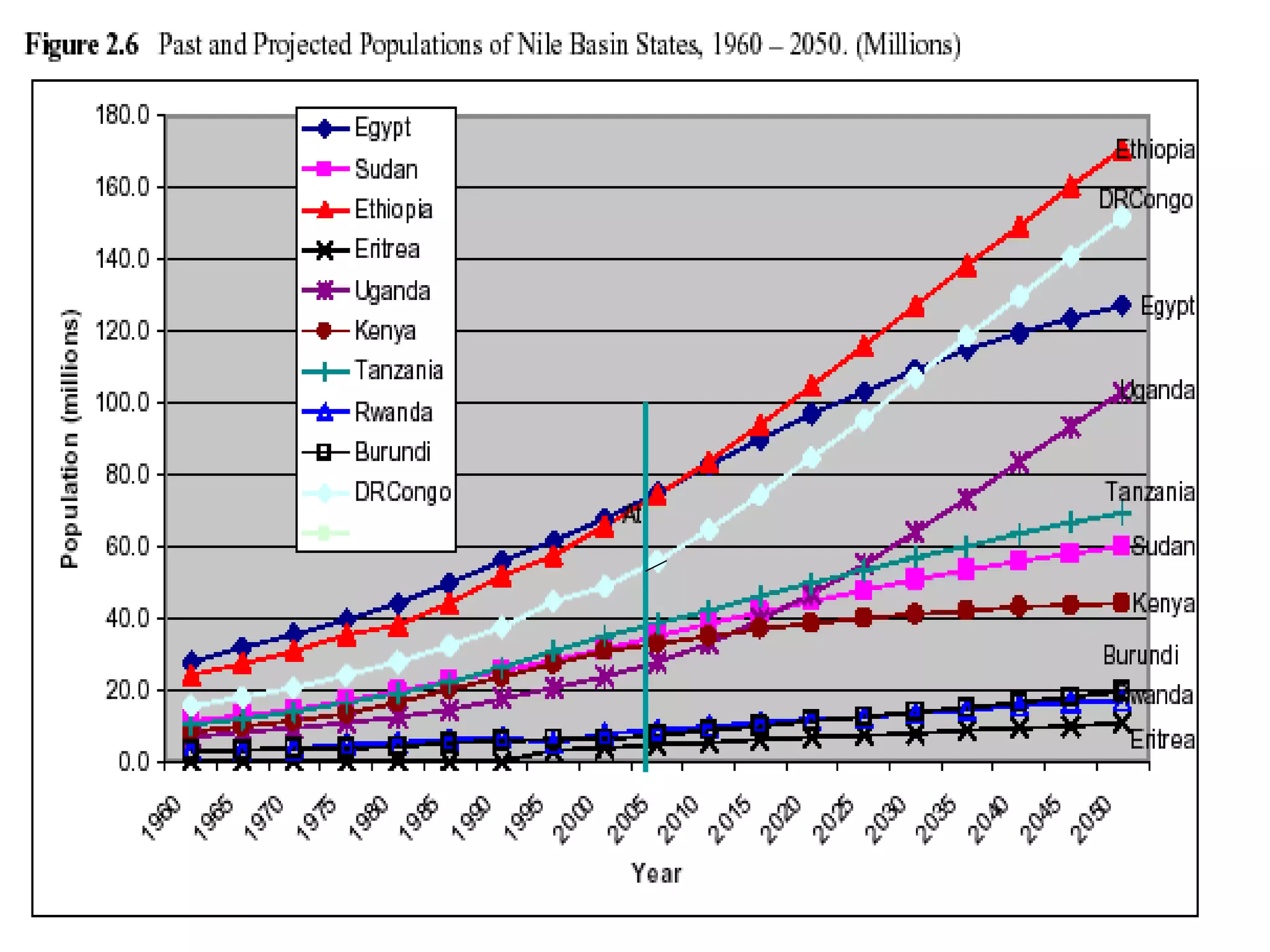
Important contexts & issues in Africa Southern economies: •  are in an early stage of the demographic transition with rising populations that need more food and jobs •  some of the poorest - in Africa - face very challenging demographic scenarios Globally the demographic challenges of the past 50 years will NOT be repeated. Population is levelling off.
LWRG 2007
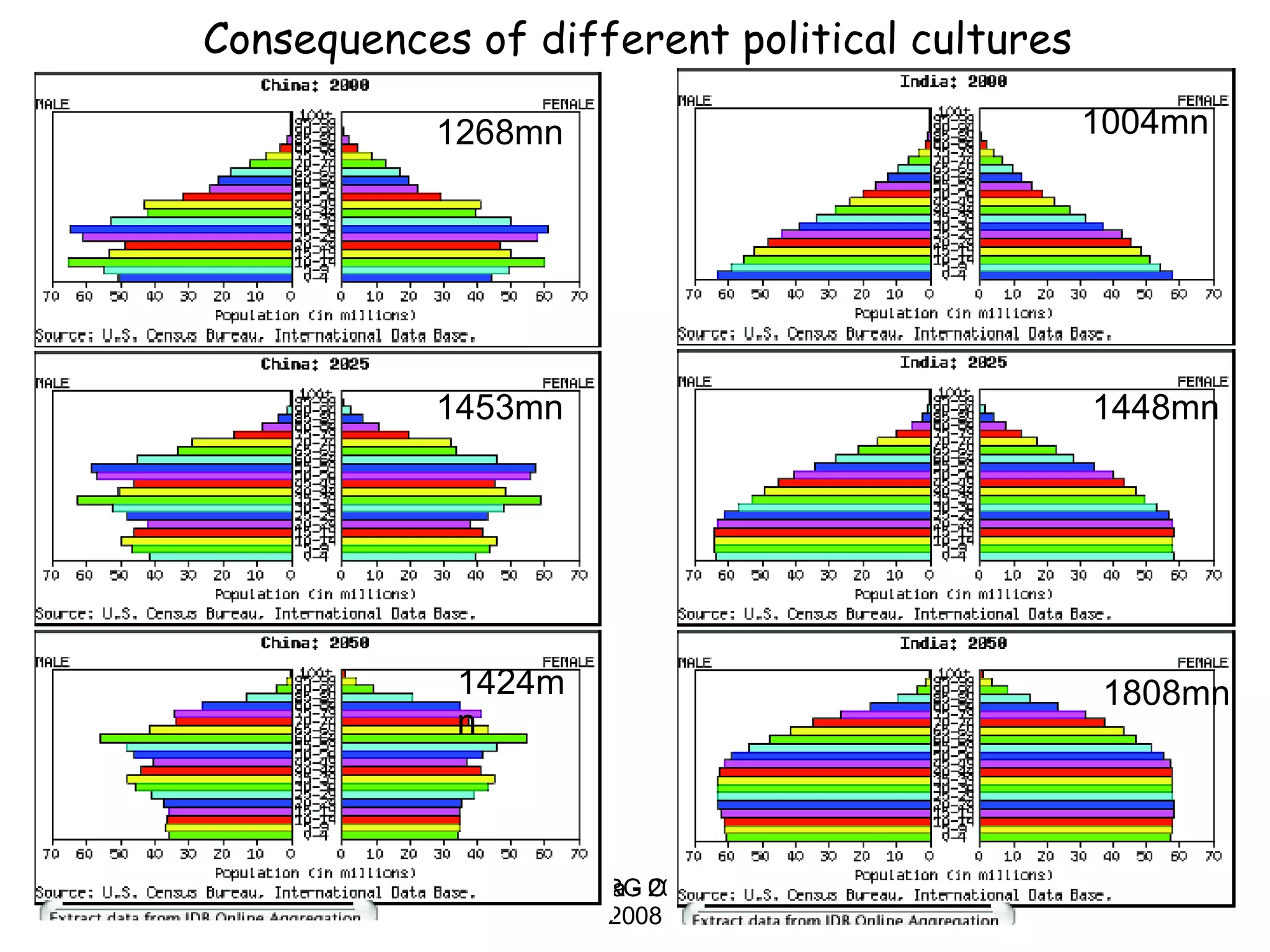
LWRG 2007 1268mn 1453mn 1424mn 1004mn 1448mn 1808mn Consequences of different political cultures
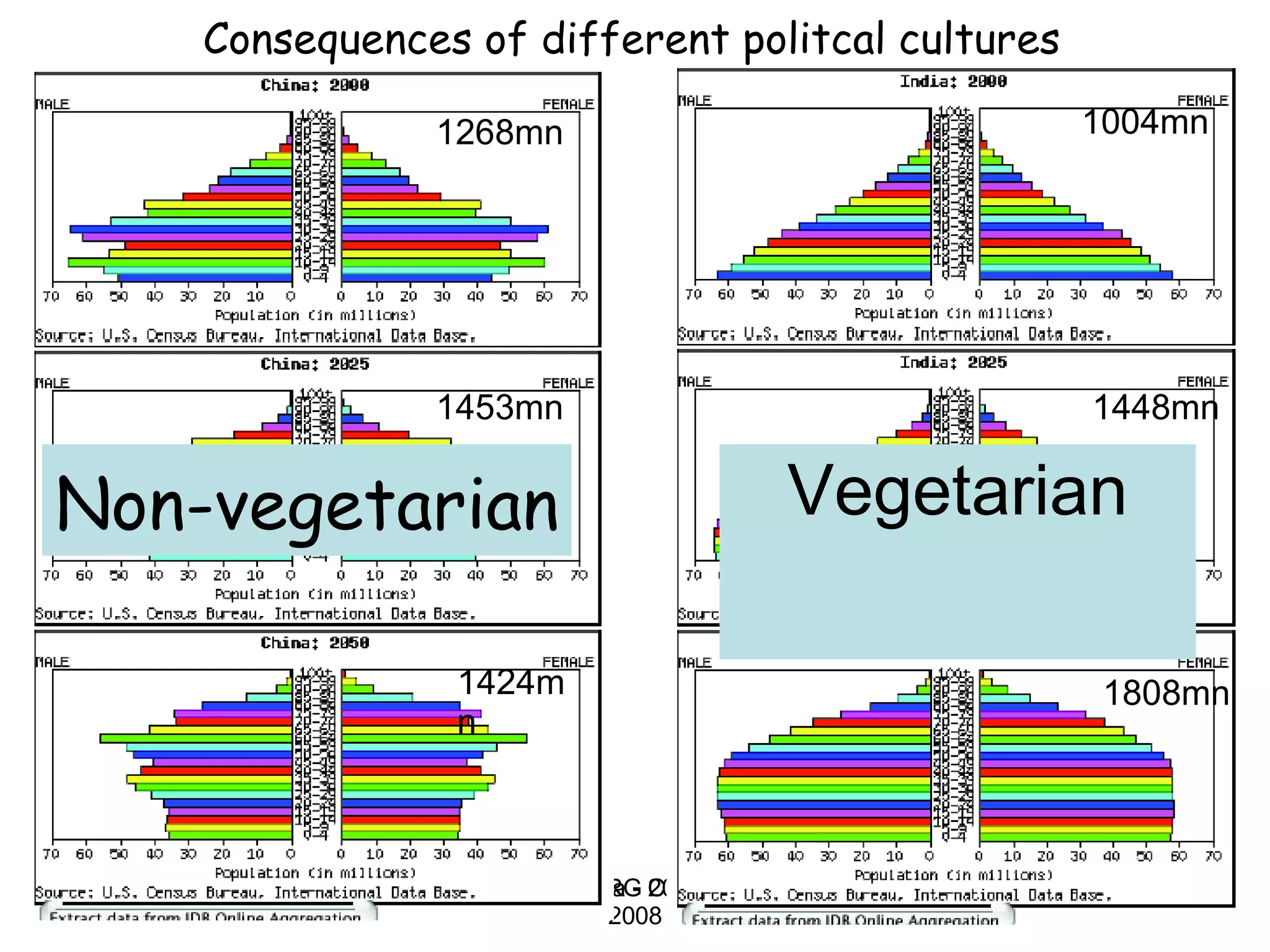
LWRG 2007 1268mn 1453mn 1424mn 1004mn 1448mn 1808mn Consequences of different politcal cultures Non-vegetarian Vegetarian
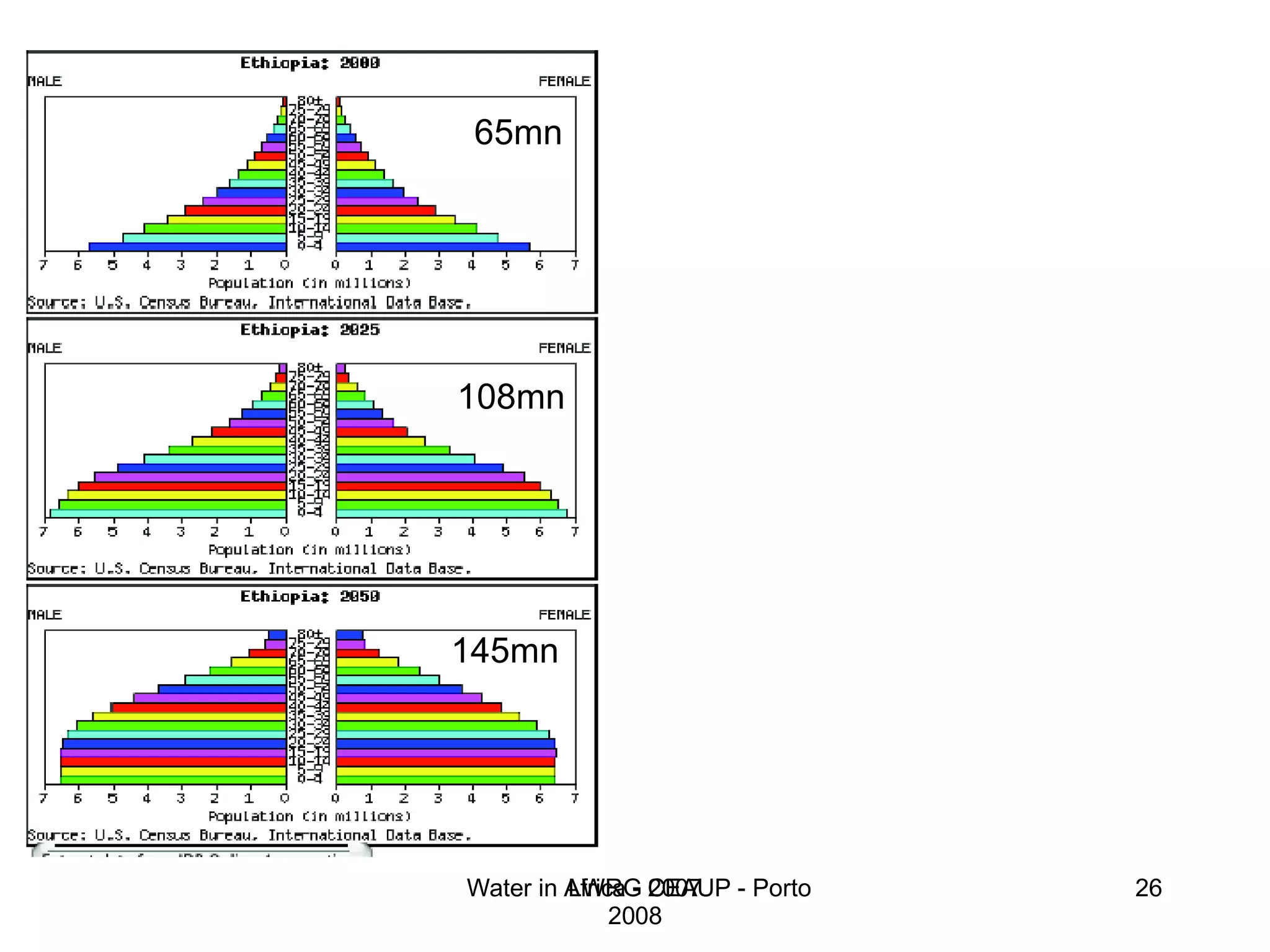
LWRG 2007 65mn 108mn 145mn
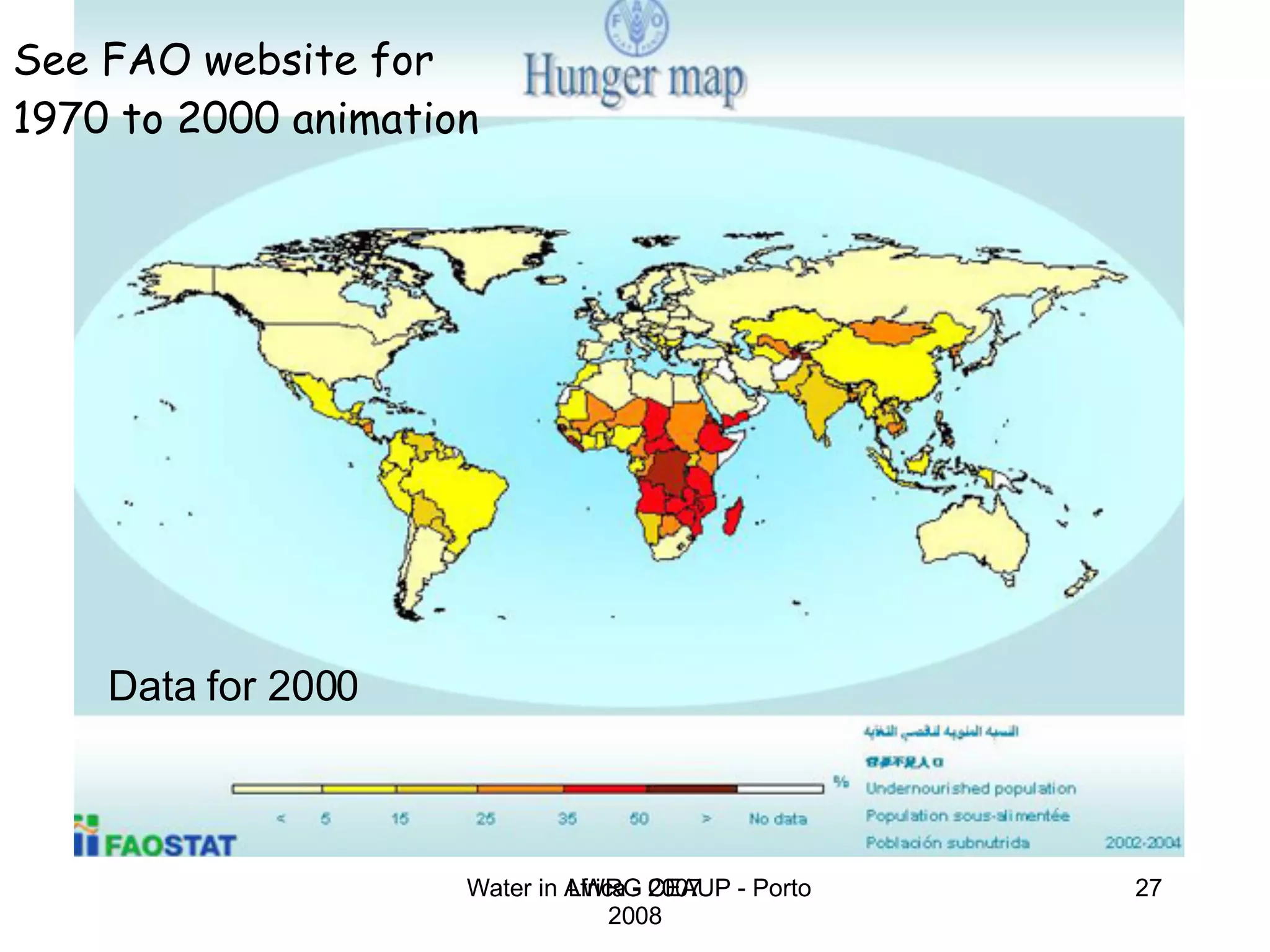
LWRG 2007 See FAO website for 1970 to 2000 animation Data for 2000
Important contexts & issues in Africa Southern economies:  • have limited adaptive capacity - economic diversification, infra- structures, capital, institutions, regulatory capacity • endure very negative terms of trade including the impacts of EU & US export prices for staple foods Virtual water ‘trade’ in an era of subsidised grain prices is a very mixed blessing especially in Africa WORLD PRICES PROBLEM?
Important contexts & issues in the South Southern economies:  • have very diverse political economies Consider China and India where there is significant poverty associated with rapid socio-economic transformation and the capacity to engage in, or avoid, VW ‘trade’ AND Africa - for example Ethiopia where its capacity to trade and transform are limited and world prices are a serious problem
Important contexts & issues in the South The POLITICS of resource use and allocation in Africa are hard to manage and regulatory measures are difficult to install. Economic efficiency and consideration of the environment are not high priorities. Virtual water ‘trade’ is a welcome ‘solution’ mainly because it is:   AN ECONOMICALLY INVISIBLE &    A POLITICALLY SILENT SOLUTION.  As a consequence if is not easily introduced into policy discourse.
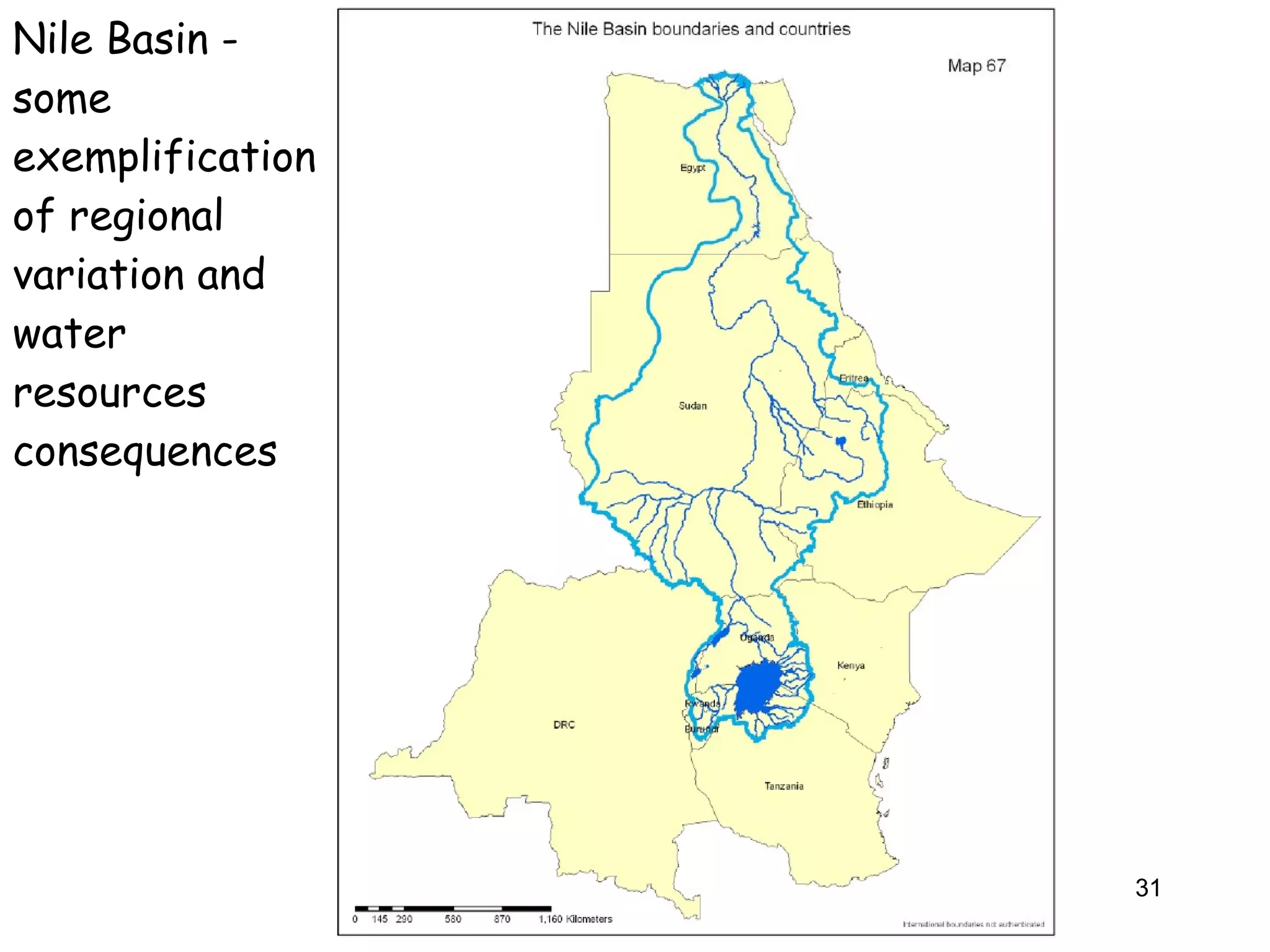
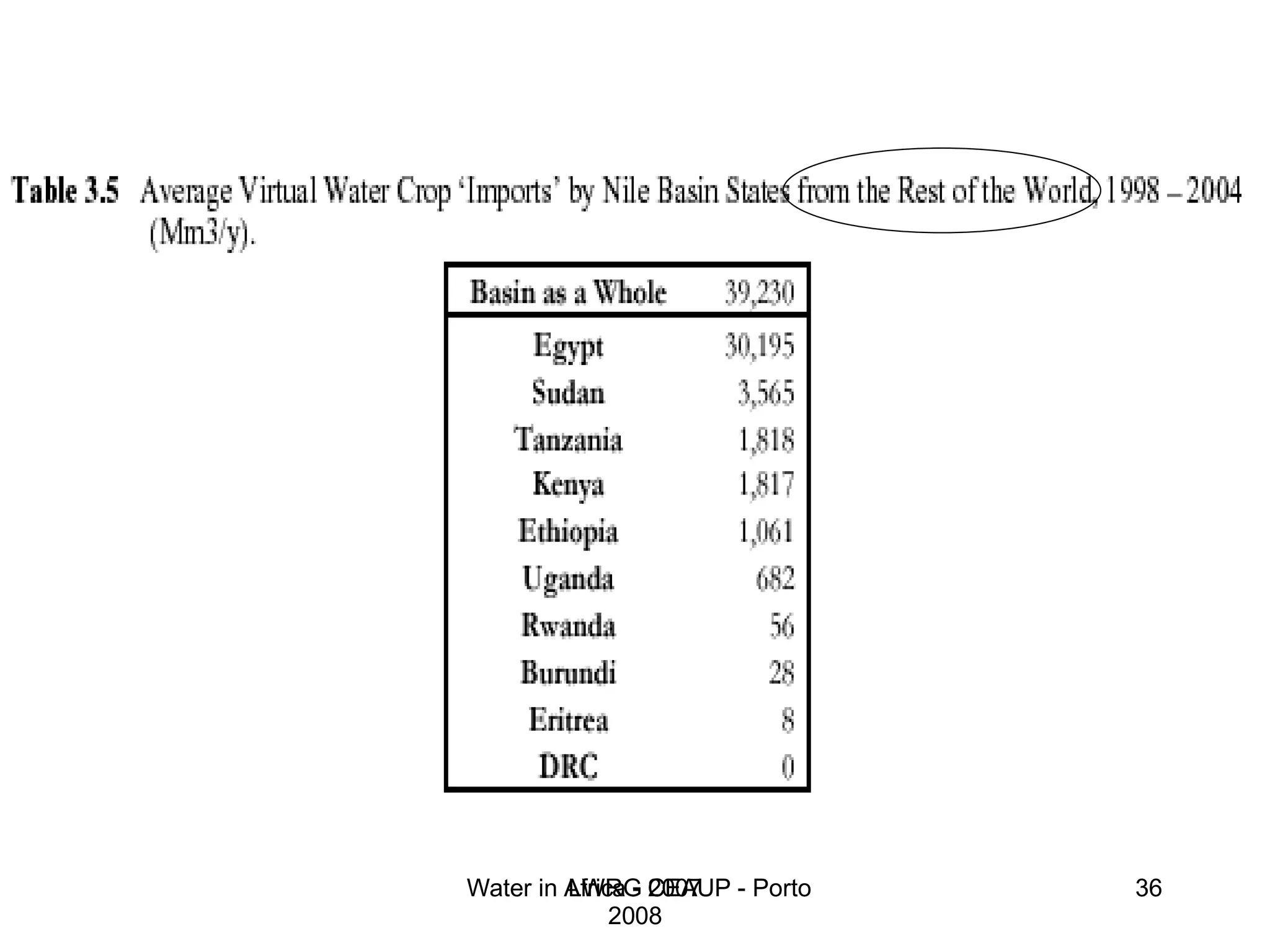
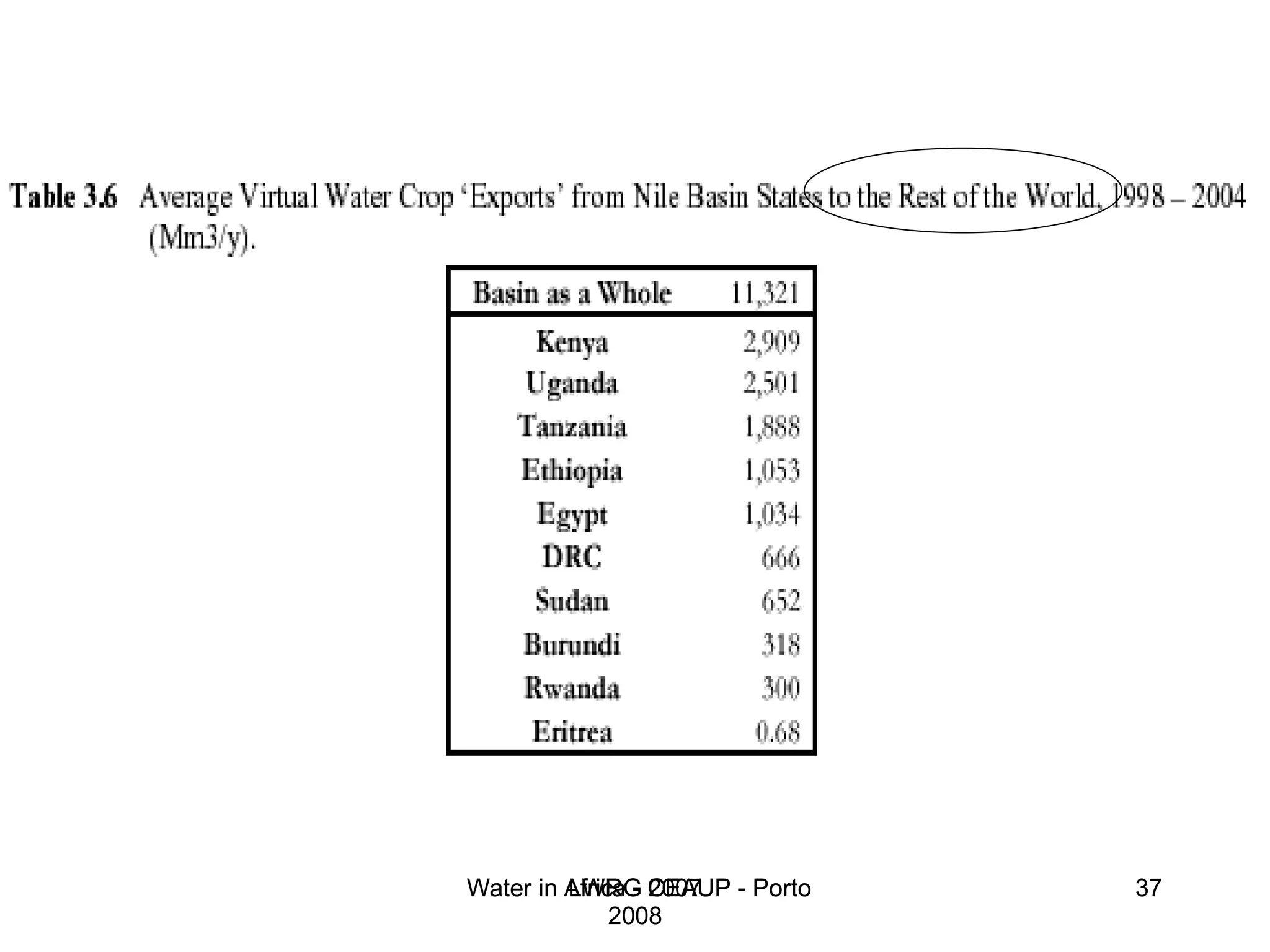
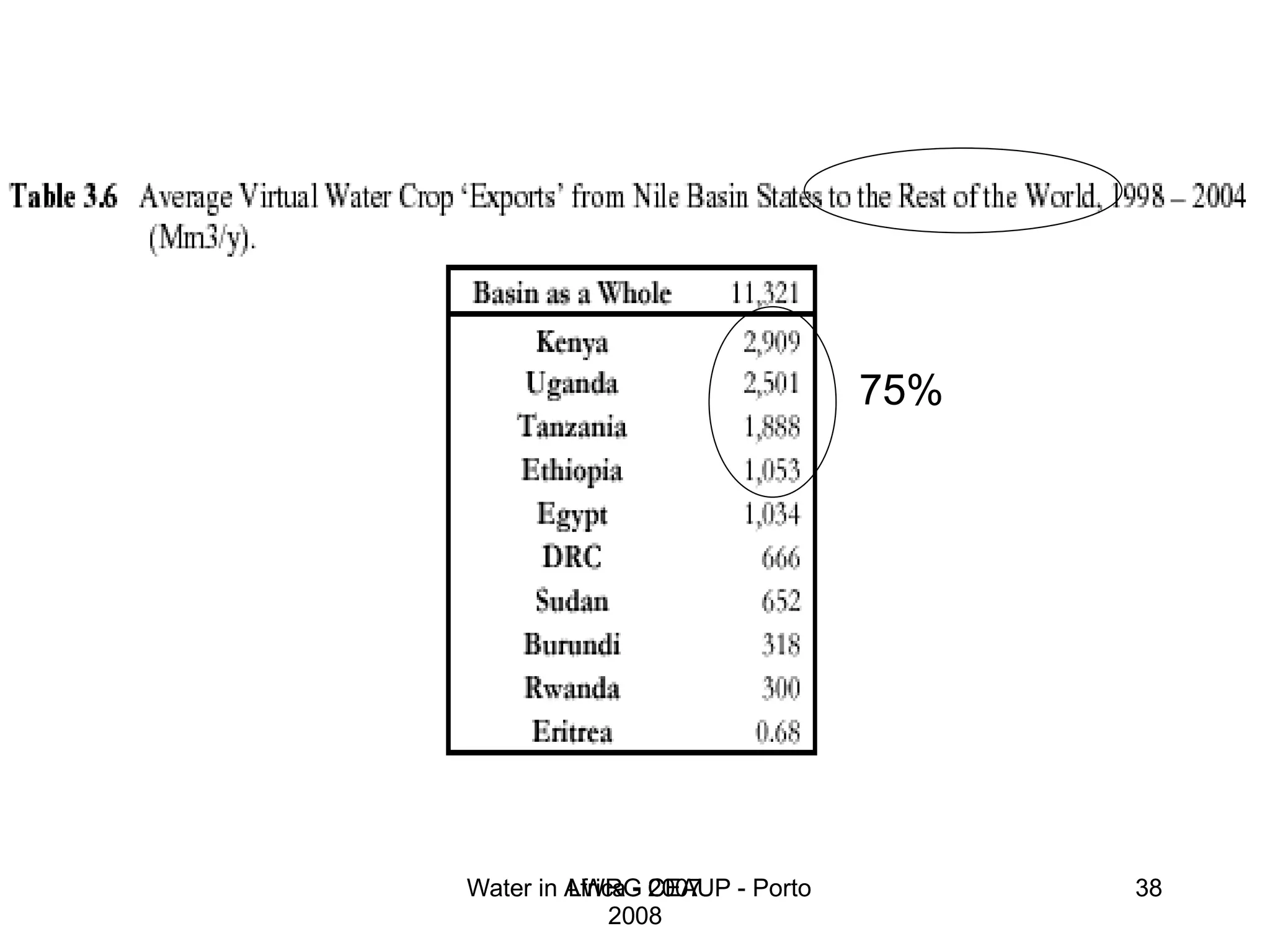
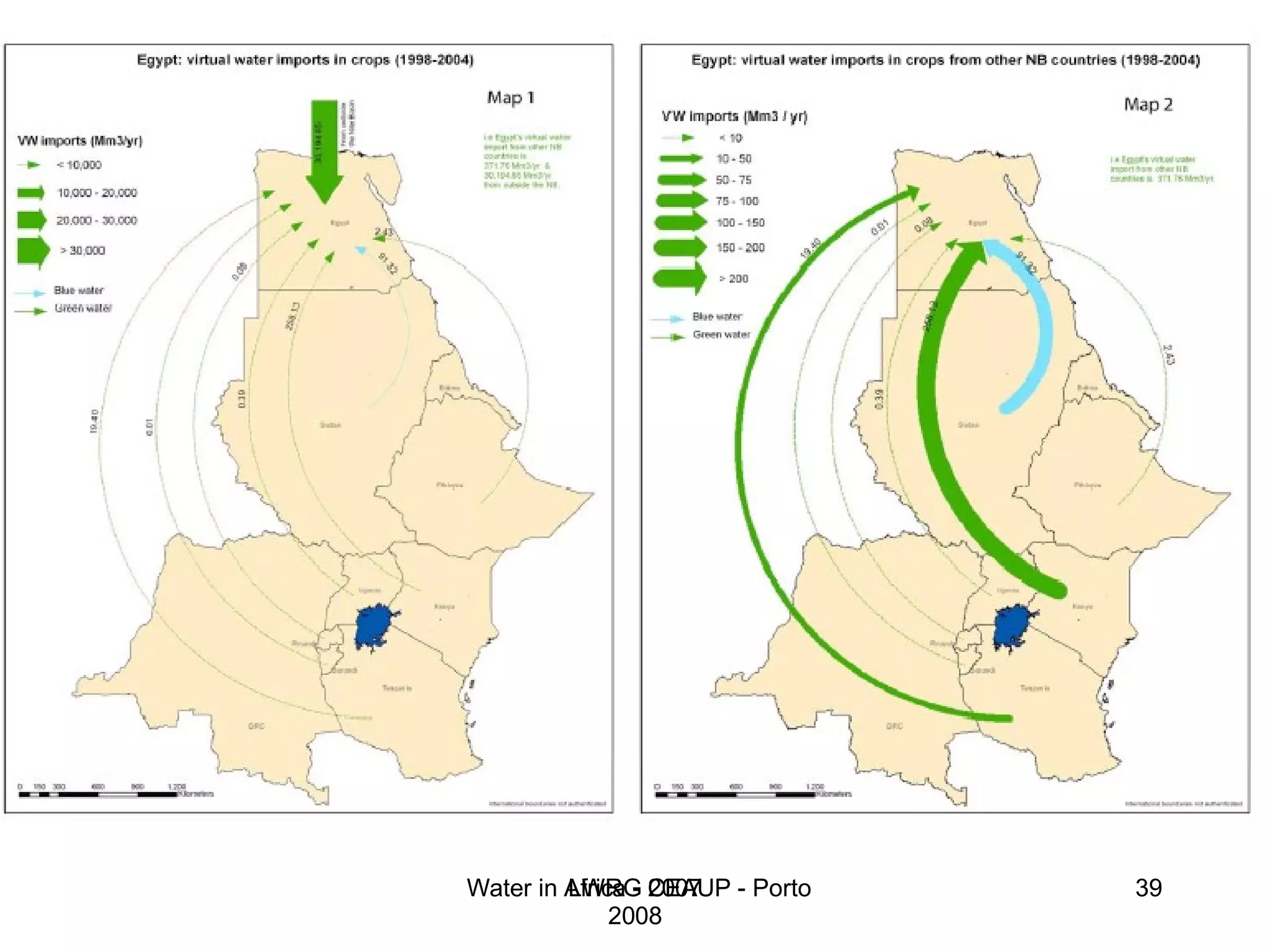
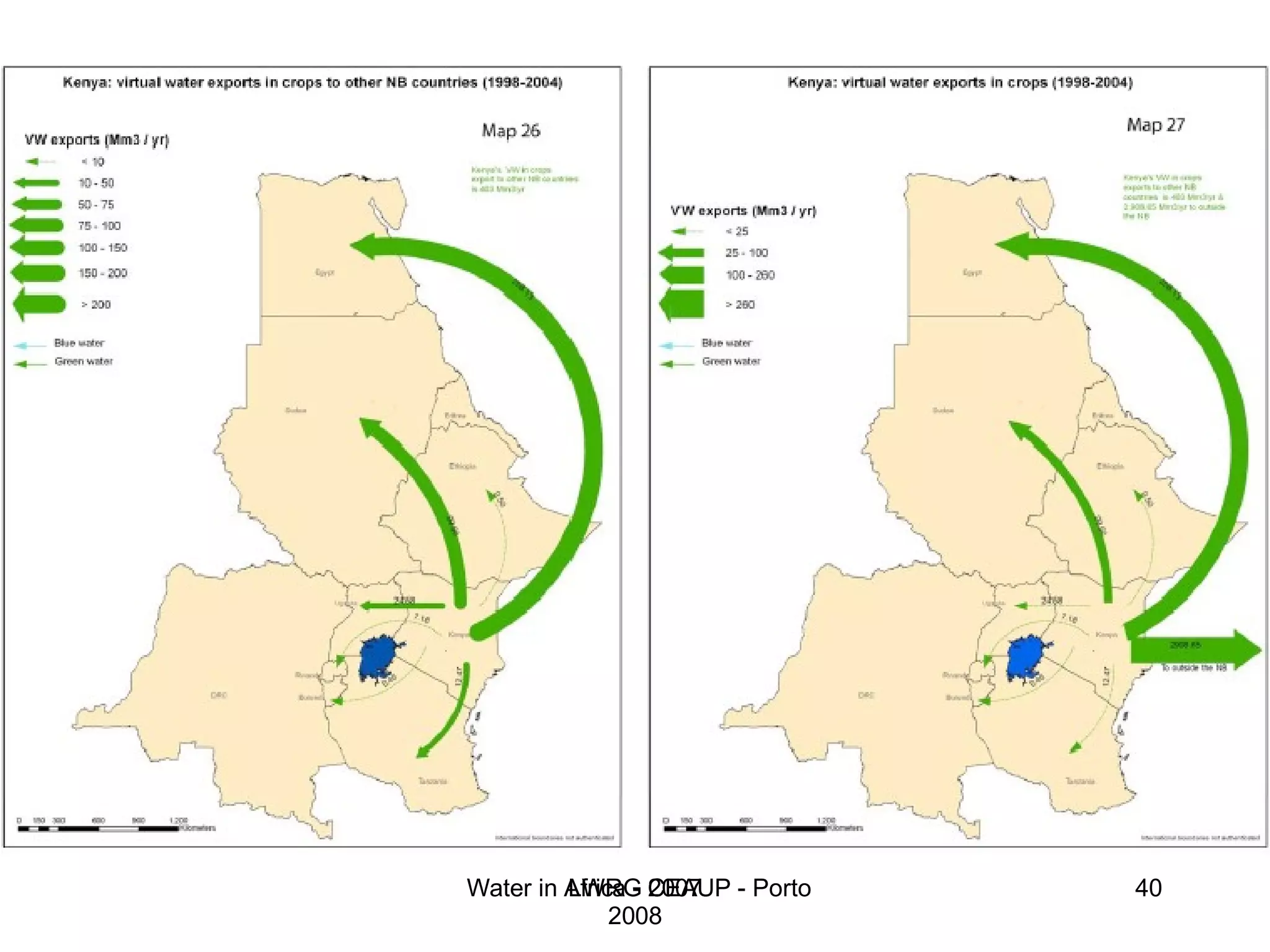
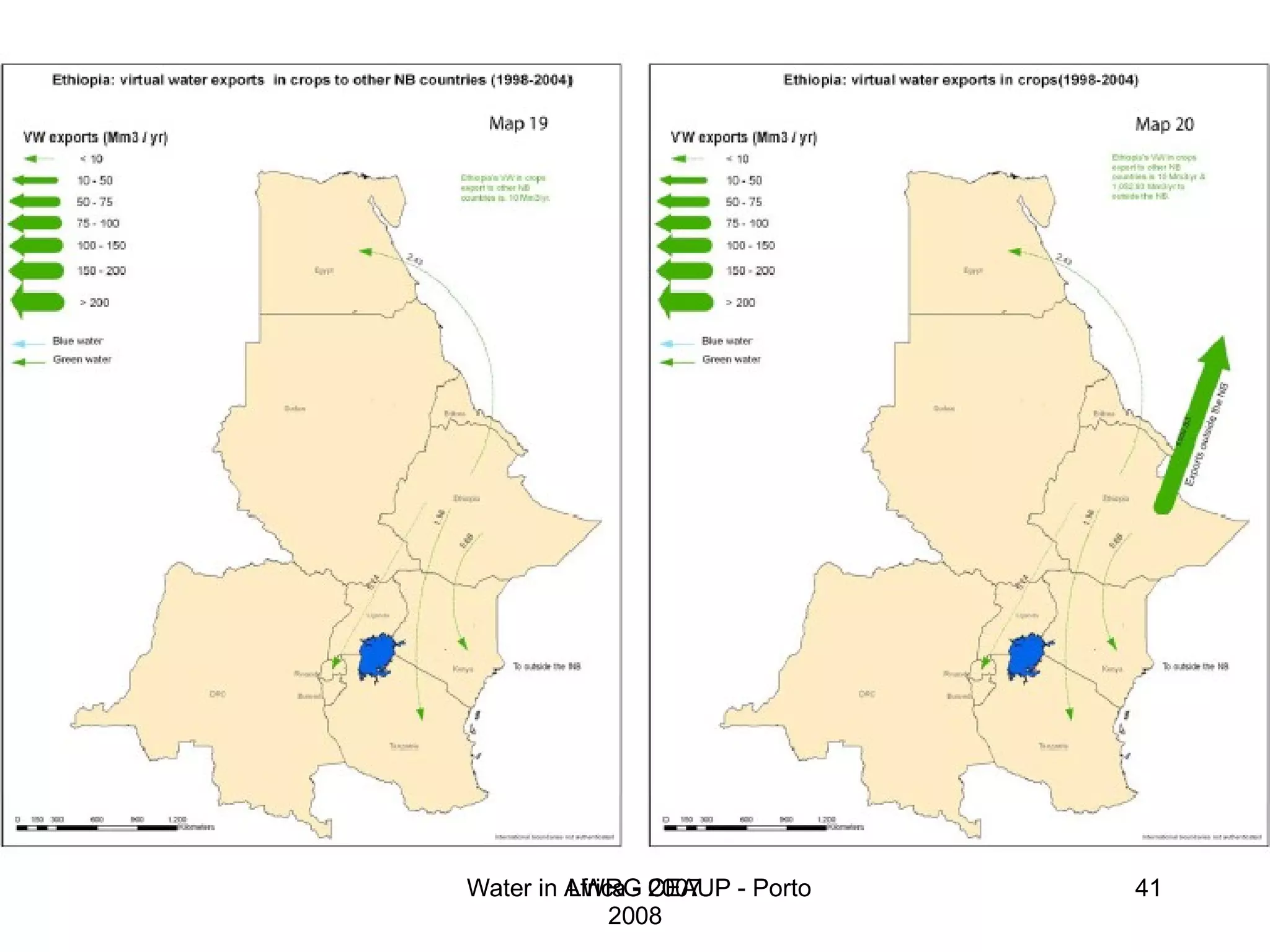
LWRG 2007 Nile Basin -  some  exemplification of regional variation and  water  resources  consequences
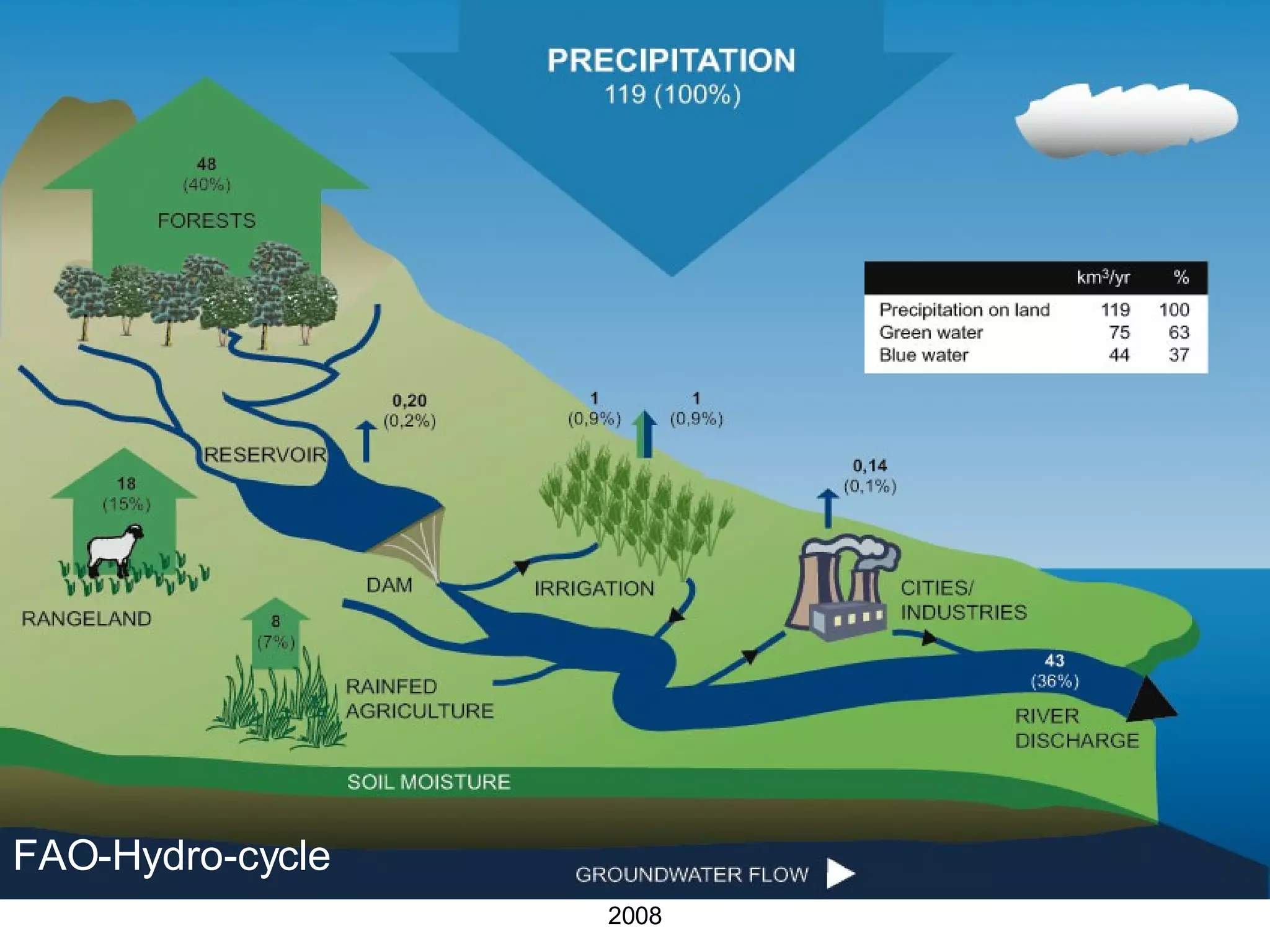
LWRG 2007 FAO-Hydro-cycle Types of water - green and blue water
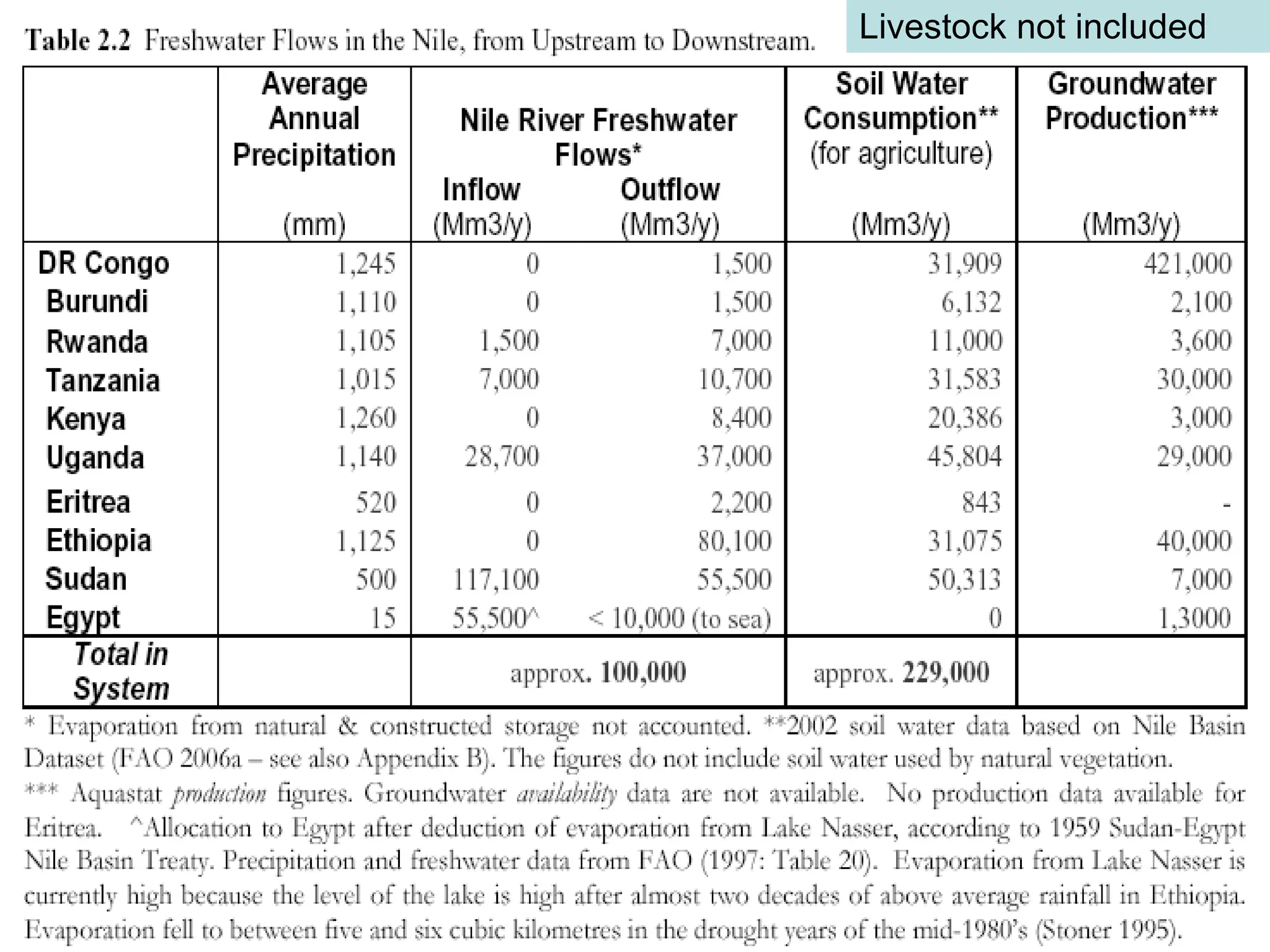
LWRG 2007 Livestock not included
LWRG 2007
LWRG 2007
LWRG 2007
LWRG 2007
LWRG 2007 75%
LWRG 2007
LWRG 2007
LWRG 2007
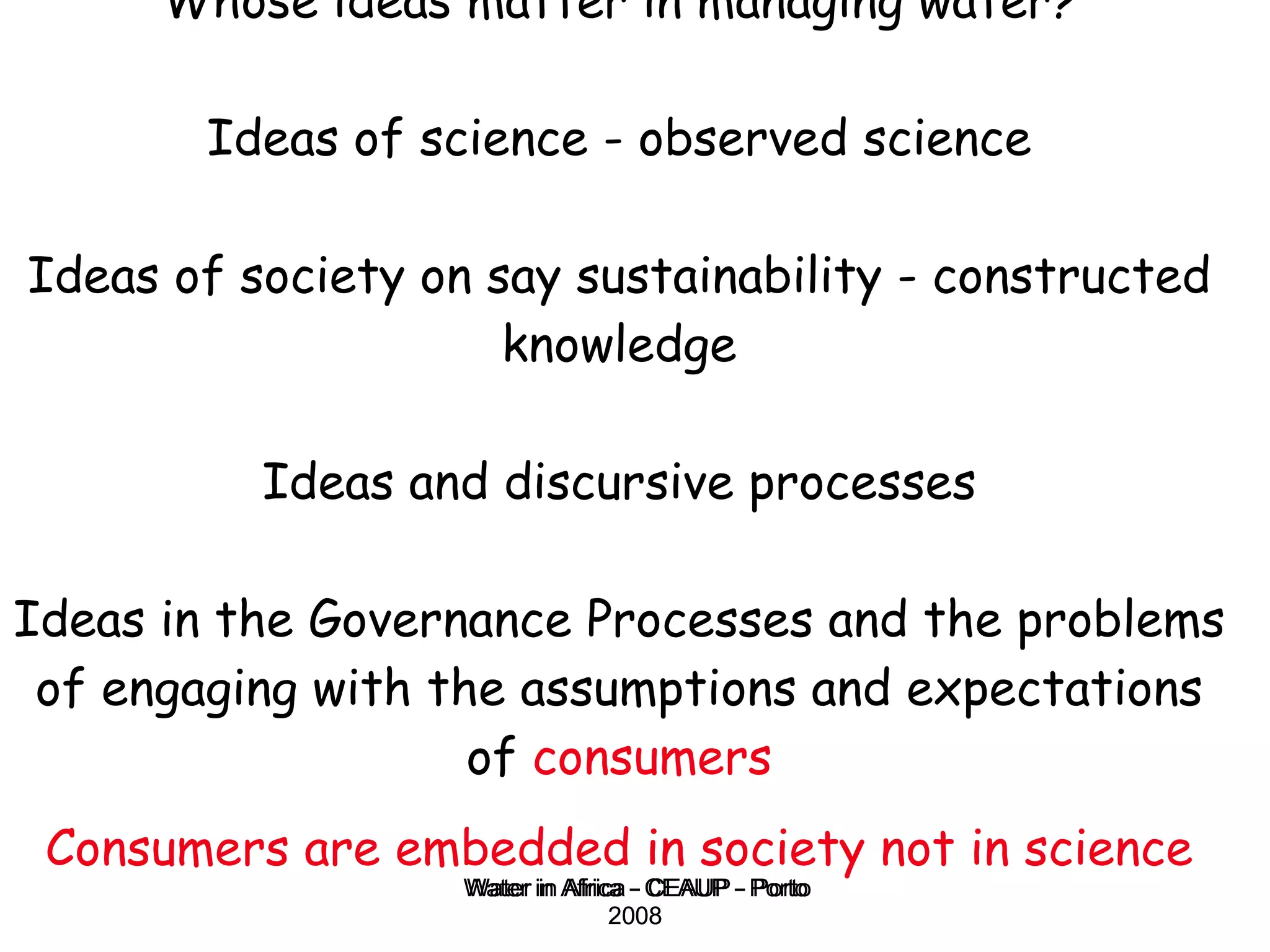
Whose ideas matter in managing water? Ideas of science - observed science Ideas of society on say sustainability - constructed knowledge Ideas and discursive processes Ideas in the Governance Processes and the problems of engaging with the assumptions and expectations of  consumers Consumers are embedded in society not in science Water in Africa - CEAUP - Porto 2008
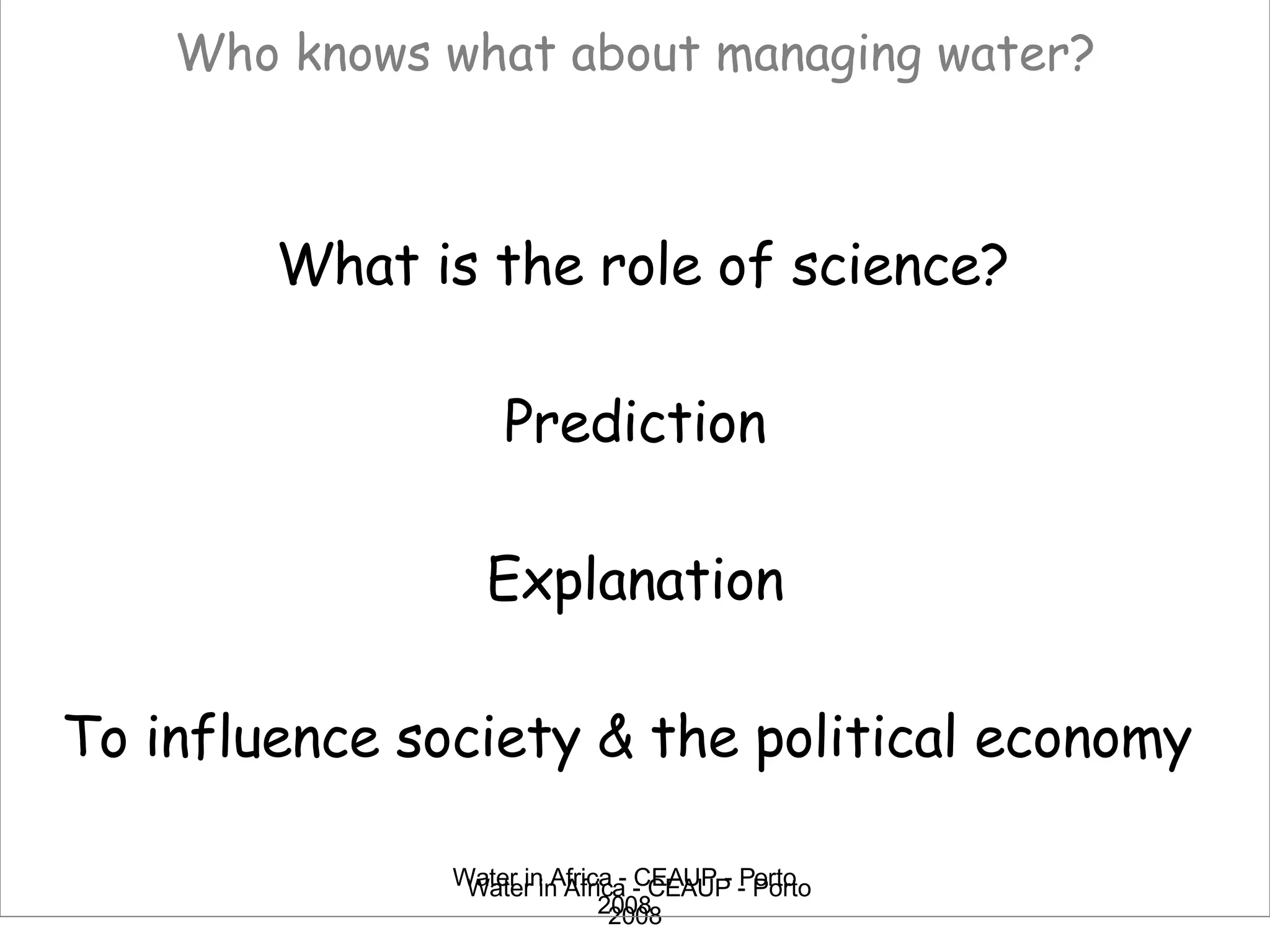
Who knows what about managing water?   What is the role of science? Prediction Explanation To influence society & the political economy  Water in Africa - CEAUP - Porto 2008
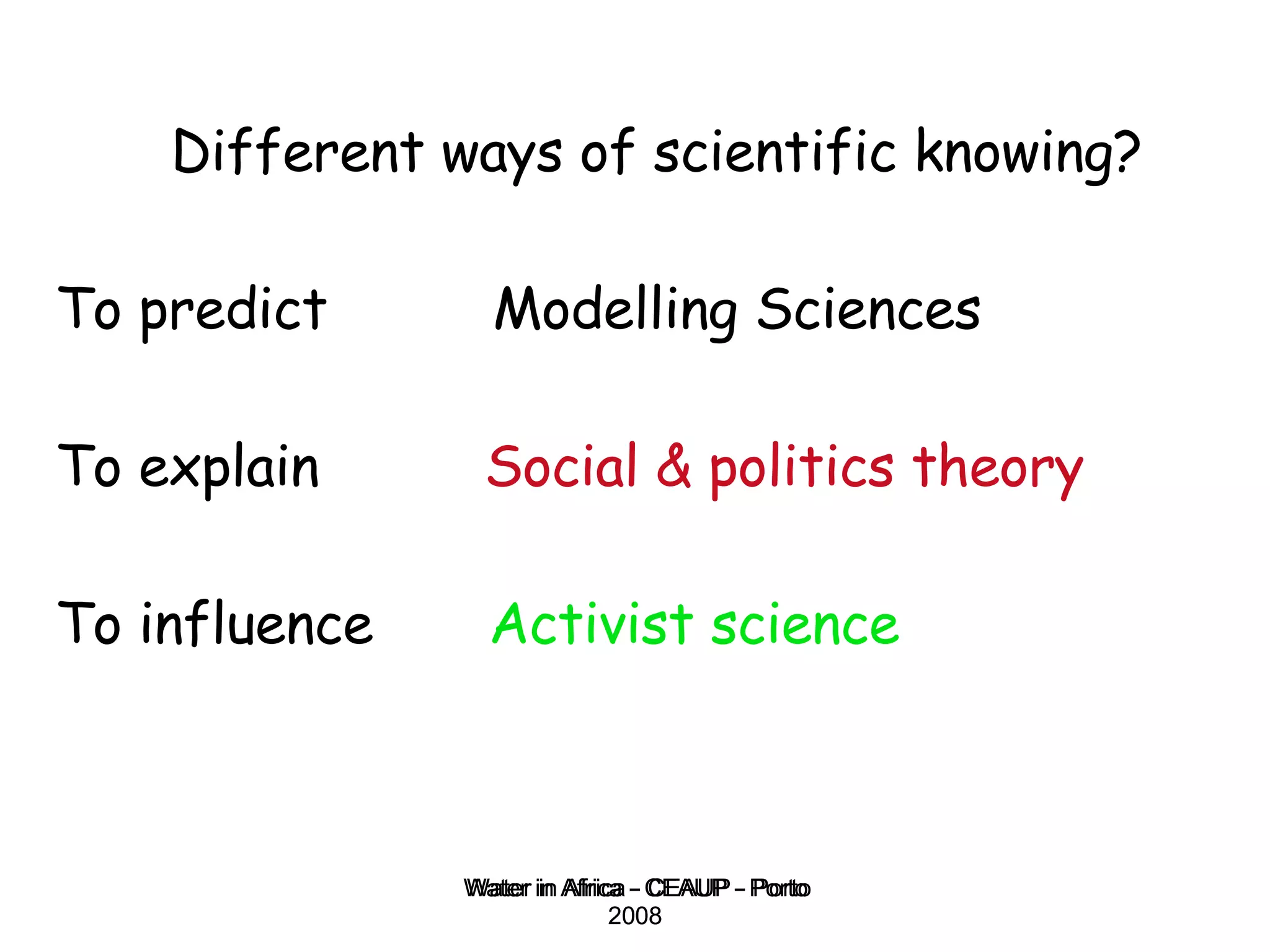
Different ways of scientific knowing? To predict  Modelling Sciences To explain  Social & politics theory   To influence  Activist science Water in Africa - CEAUP - Porto 2008
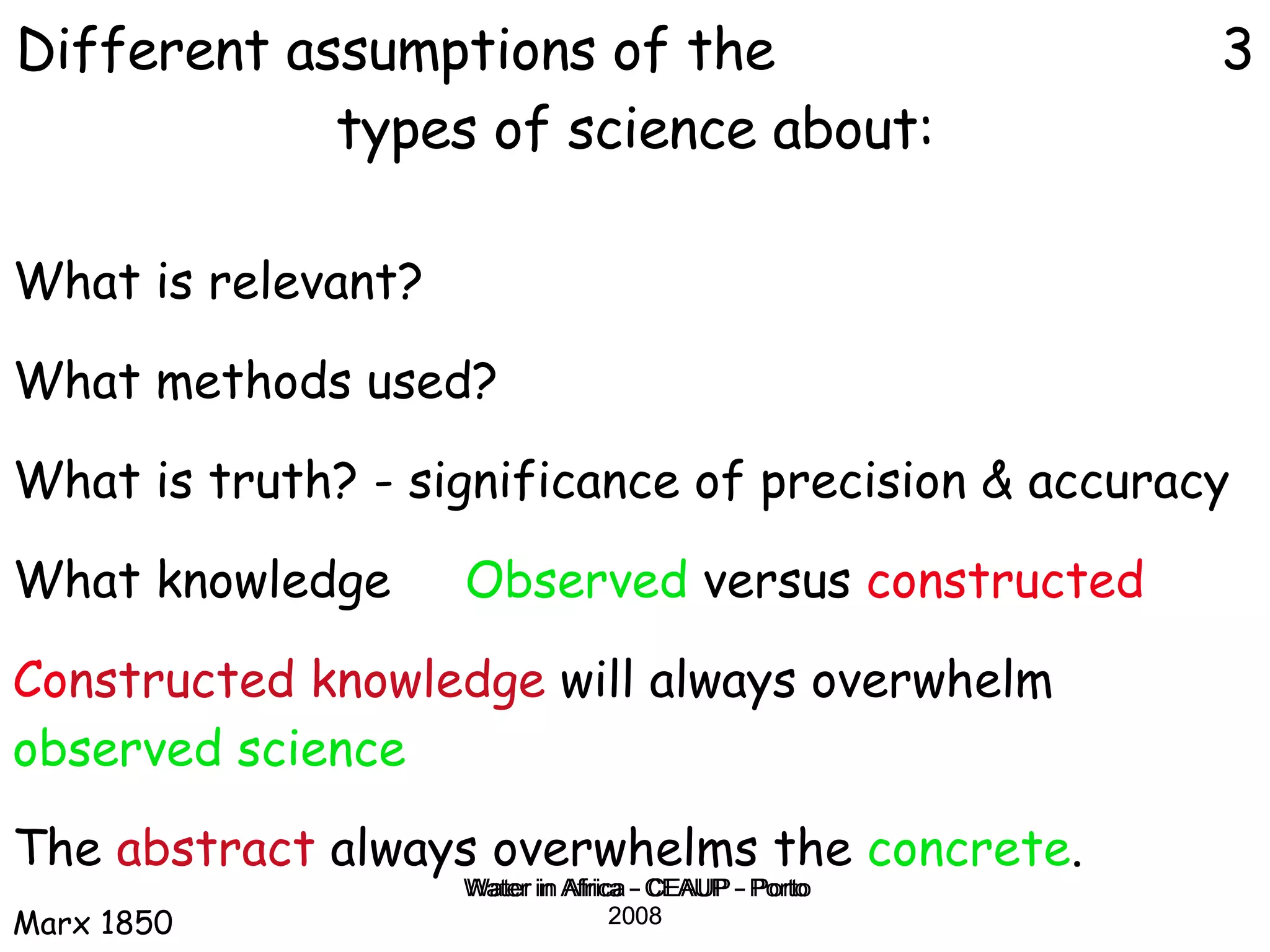
Water in Africa - CEAUP - Porto 2008 What is relevant? What methods used? What is truth? - significance of precision & accuracy What knowledge  Observed  versus  constructed   Co nstructed knowledge  will always overwhelm  observed science   The  abstract  always overwhelms the  concrete .  Marx 1850 Different assumptions of the  3 types of science about:
Water in Africa - CEAUP - Porto 2008 The  abstract  always overwhelms the  concrete .  Marx 1850 Politicians were invented to deal with  ambiguity  which is  always associated with  uncertainty Modeling scientists deal with  risk  which can be captured with the numbers and the language of  probability Politicians  know what the game is about and  accept  the excitement of uncertainty Most scientists   avoid  the excitement of uncertainty.
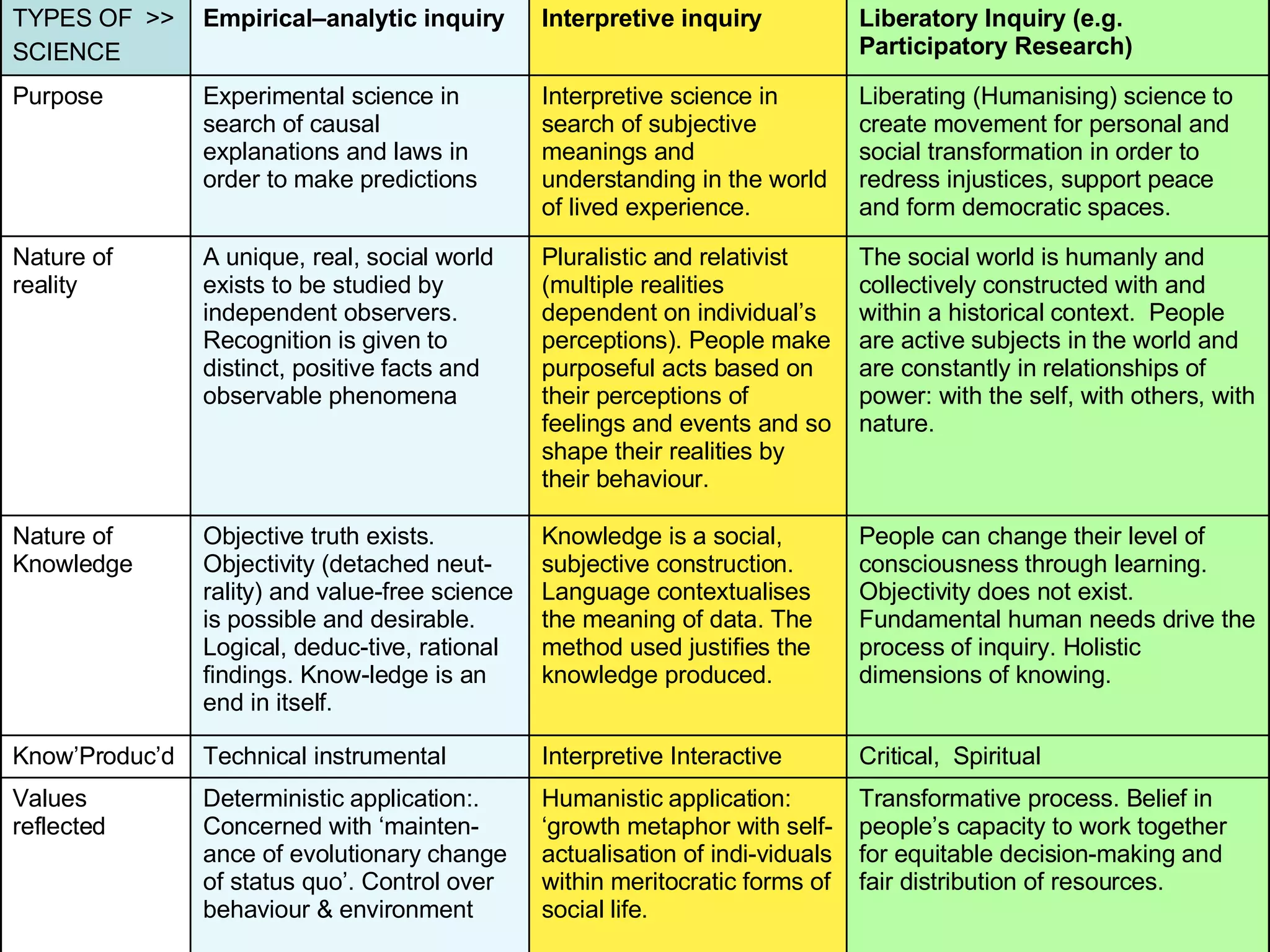
Water in Africa - CEAUP - Porto 2008 TYPES OF  >> SCIENCE Empirical–analytic inquiry Interpretive inquiry Liberatory Inquiry (e.g. Participatory Research) Purpose Experimental science in search of causal explanations and laws in order to make predictions Interpretive science in search of subjective meanings and understanding in the world of lived experience. Liberating (Humanising) science to create movement for personal and social transformation in order to redress injustices, support peace and form democratic spaces. Nature of reality A unique, real, social world exists to be studied by independent observers. Recognition is given to distinct, positive facts and observable phenomena Pluralistic and relativist (multiple realities dependent on individual’s perceptions). People make purposeful acts based on their perceptions of feelings and events and so shape their realities by their behaviour. The social world is humanly and collectively constructed with and within a historical context.  People are active subjects in the world and are constantly in relationships of power: with the self, with others, with nature. Nature of Knowledge Objective truth exists. Objectivity (detached neut-rality) and value-free science is possible and desirable. Logical, deduc-tive, rational findings. Know-ledge is an end in itself. Knowledge is a social, subjective construction. Language contextualises the meaning of data. The method used justifies the knowledge produced. People can change their level of consciousness through learning.  Objectivity does not exist. Fundamental human needs drive the process of inquiry. Holistic dimensions of knowing. Know’Produc’d Technical instrumental Interpretive Interactive Critical,  Spiritual Values reflected Deterministic application:.  Concerned with ‘mainten-ance of evolutionary change of status quo’. Control over behaviour & environment Humanistic application: ‘growth metaphor with self-actualisation of indi-viduals within meritocratic forms of social life. Transformative process. Belief in people’s capacity to work together for equitable decision-making and fair distribution of resources.
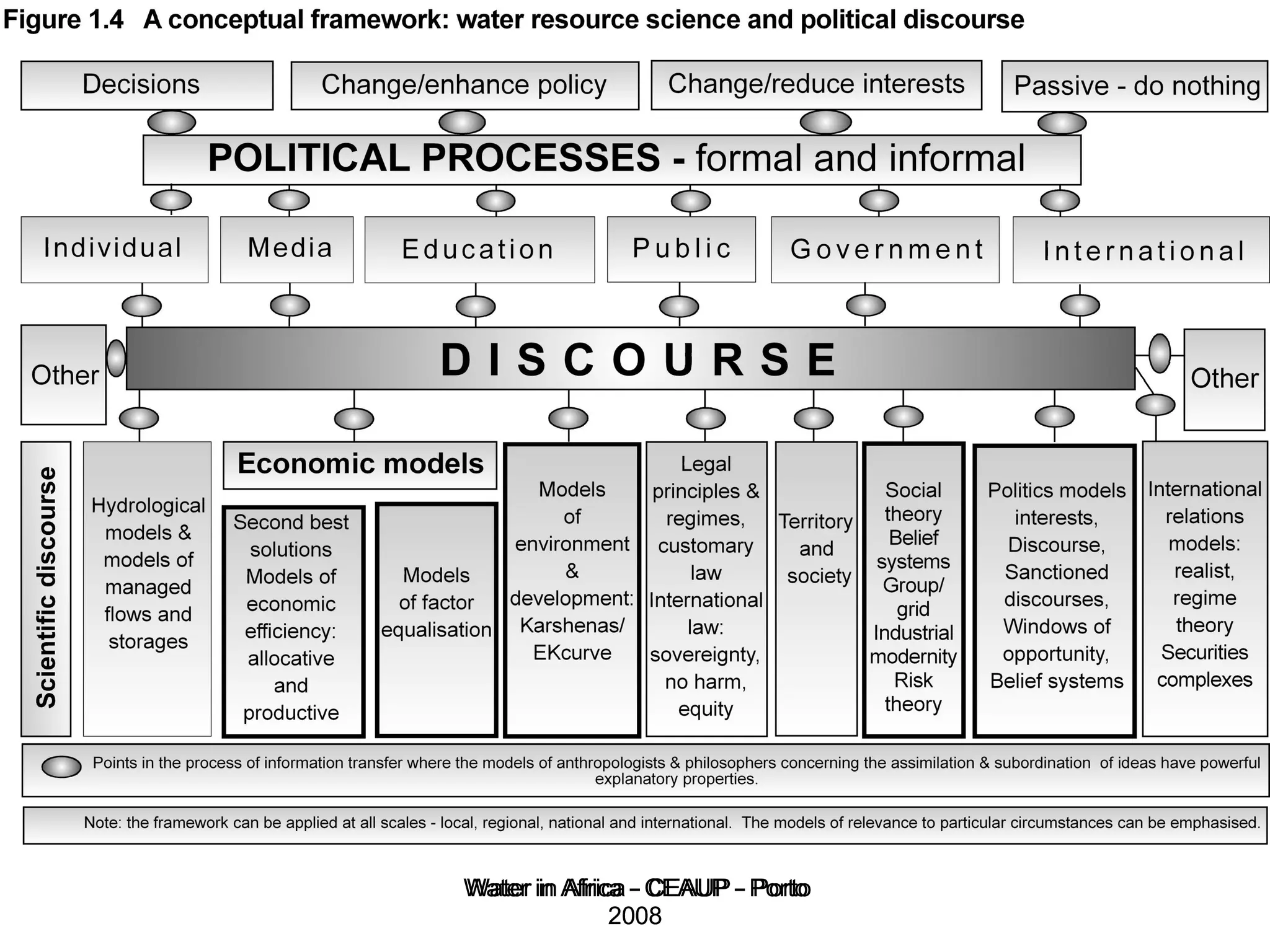
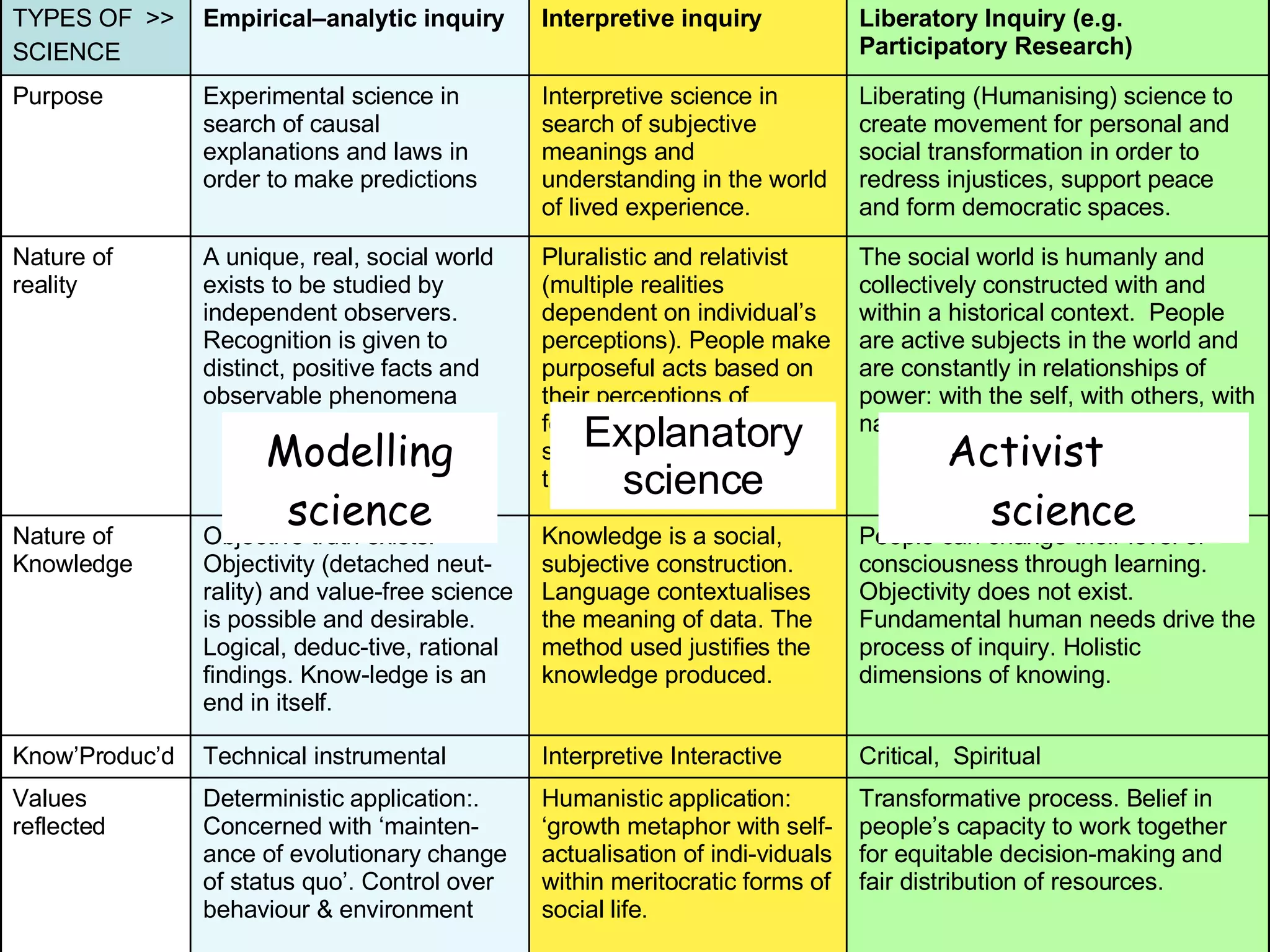
Water in Africa - CEAUP - Porto 2008 Modelling science Explanatory science Activist  science TYPES OF  >> SCIENCE Empirical–analytic inquiry Interpretive inquiry Liberatory Inquiry (e.g. Participatory Research) Purpose Experimental science in search of causal explanations and laws in order to make predictions Interpretive science in search of subjective meanings and understanding in the world of lived experience. Liberating (Humanising) science to create movement for personal and social transformation in order to redress injustices, support peace and form democratic spaces. Nature of reality A unique, real, social world exists to be studied by independent observers. Recognition is given to distinct, positive facts and observable phenomena Pluralistic and relativist (multiple realities dependent on individual’s perceptions). People make purposeful acts based on their perceptions of feelings and events and so shape their realities by their behaviour. The social world is humanly and collectively constructed with and within a historical context.  People are active subjects in the world and are constantly in relationships of power: with the self, with others, with nature. Nature of Knowledge Objective truth exists. Objectivity (detached neut-rality) and value-free science is possible and desirable. Logical, deduc-tive, rational findings. Know-ledge is an end in itself. Knowledge is a social, subjective construction. Language contextualises the meaning of data. The method used justifies the knowledge produced. People can change their level of consciousness through learning.  Objectivity does not exist. Fundamental human needs drive the process of inquiry. Holistic dimensions of knowing. Know’Produc’d Technical instrumental Interpretive Interactive Critical,  Spiritual Values reflected Deterministic application:.  Concerned with ‘mainten-ance of evolutionary change of status quo’. Control over behaviour & environment Humanistic application: ‘growth metaphor with self-actualisation of indi-viduals within meritocratic forms of social life. Transformative process. Belief in people’s capacity to work together for equitable decision-making and fair distribution of resources.
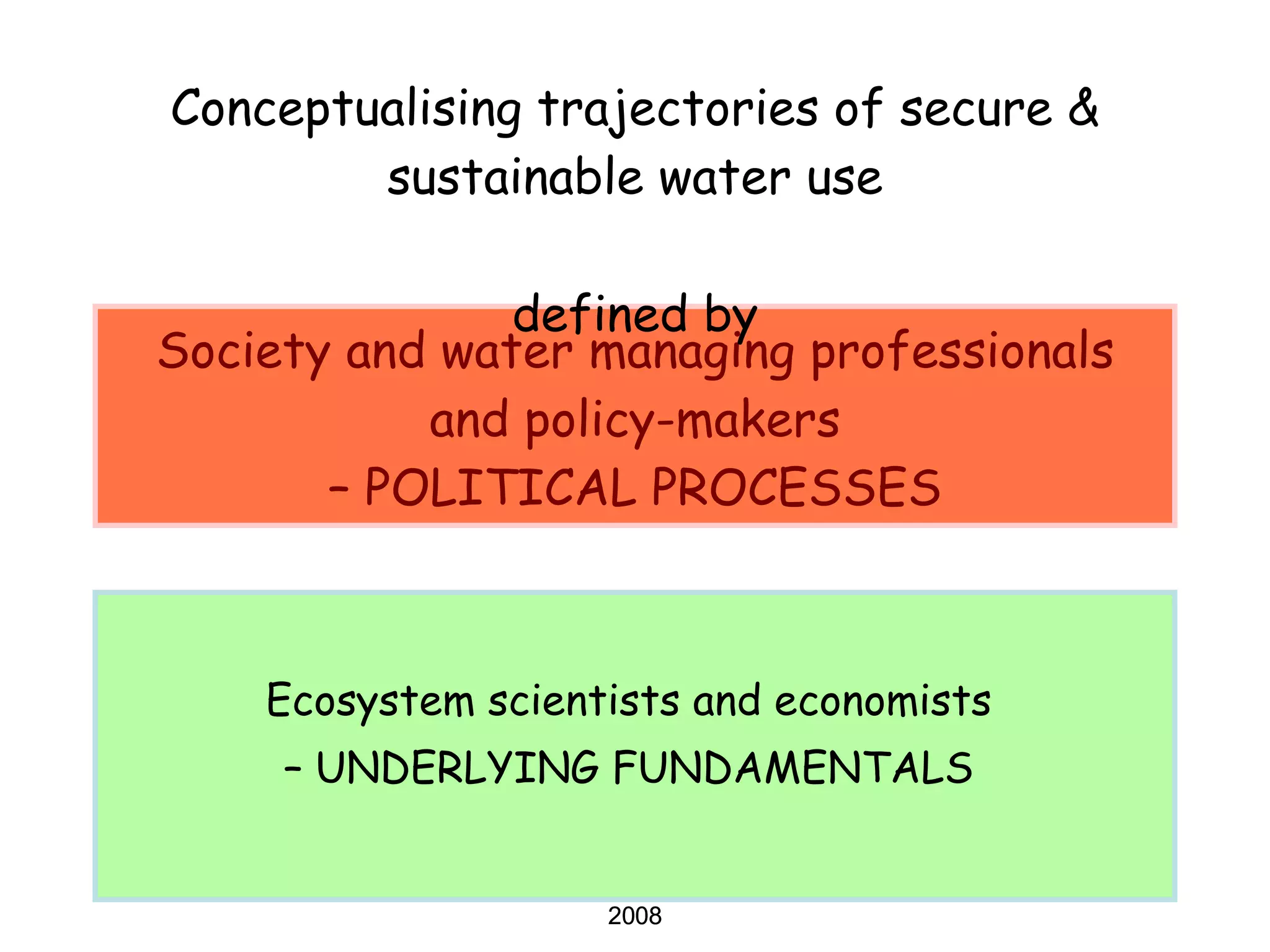
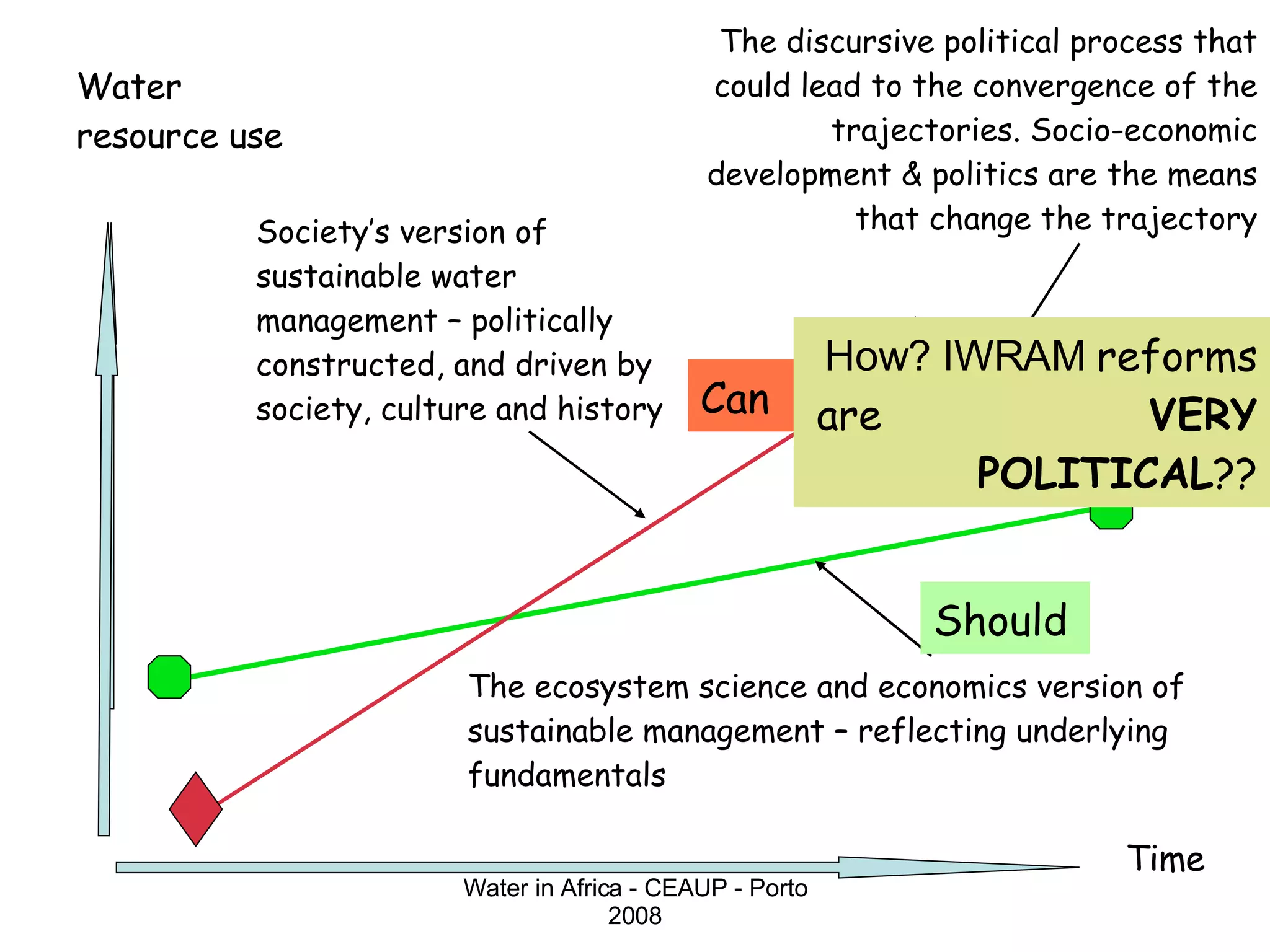
Society and water managing professionals  and policy-makers  – POLITICAL PROCESSES Ecosystem scientists and economists  –  UNDERLYING FUNDAMENTALS  Water in Africa - CEAUP - Porto 2008 Conceptualising trajectories of secure & sustainable water use defined by
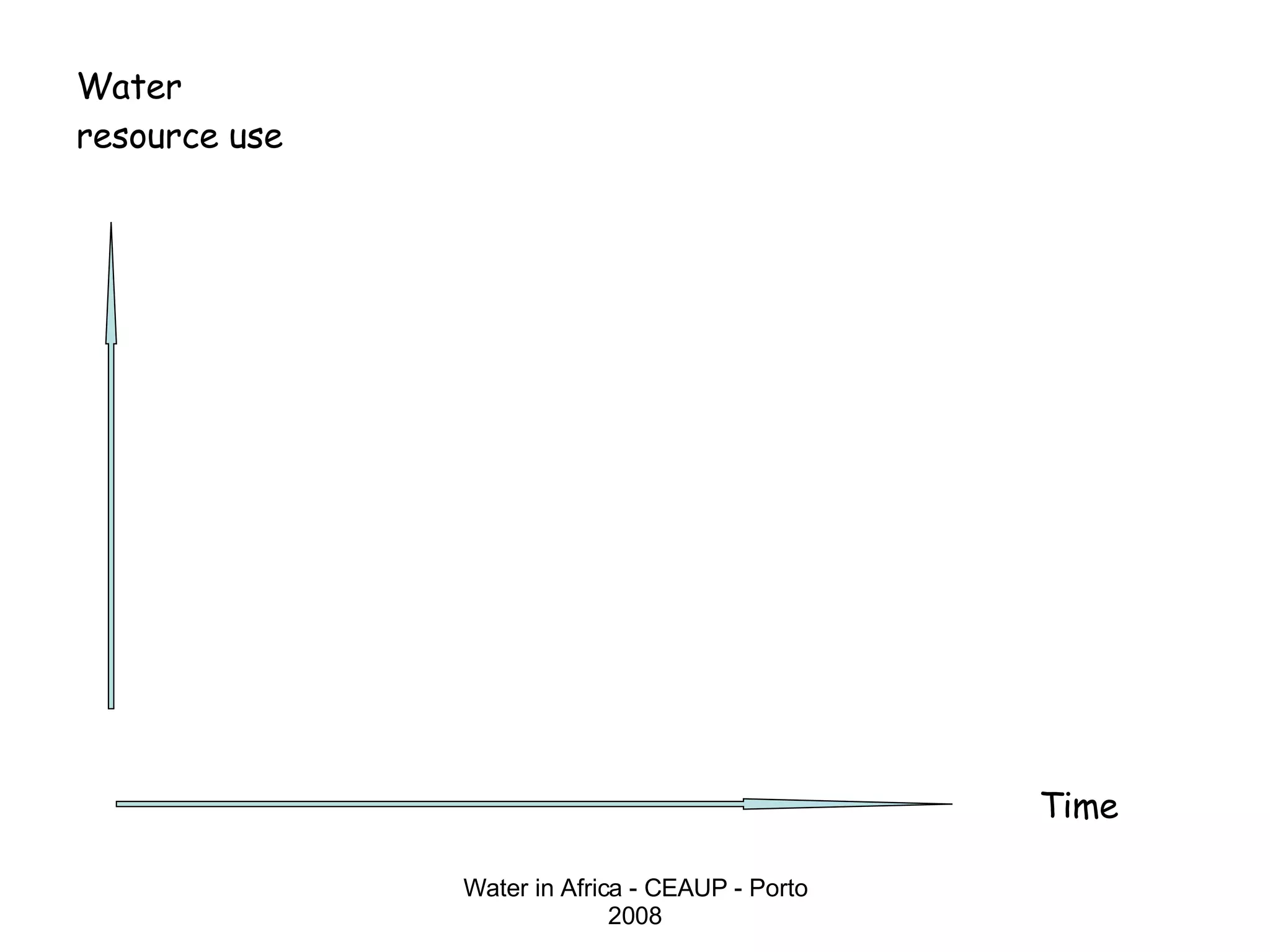
Water resource use Time Water in Africa - CEAUP - Porto 2008
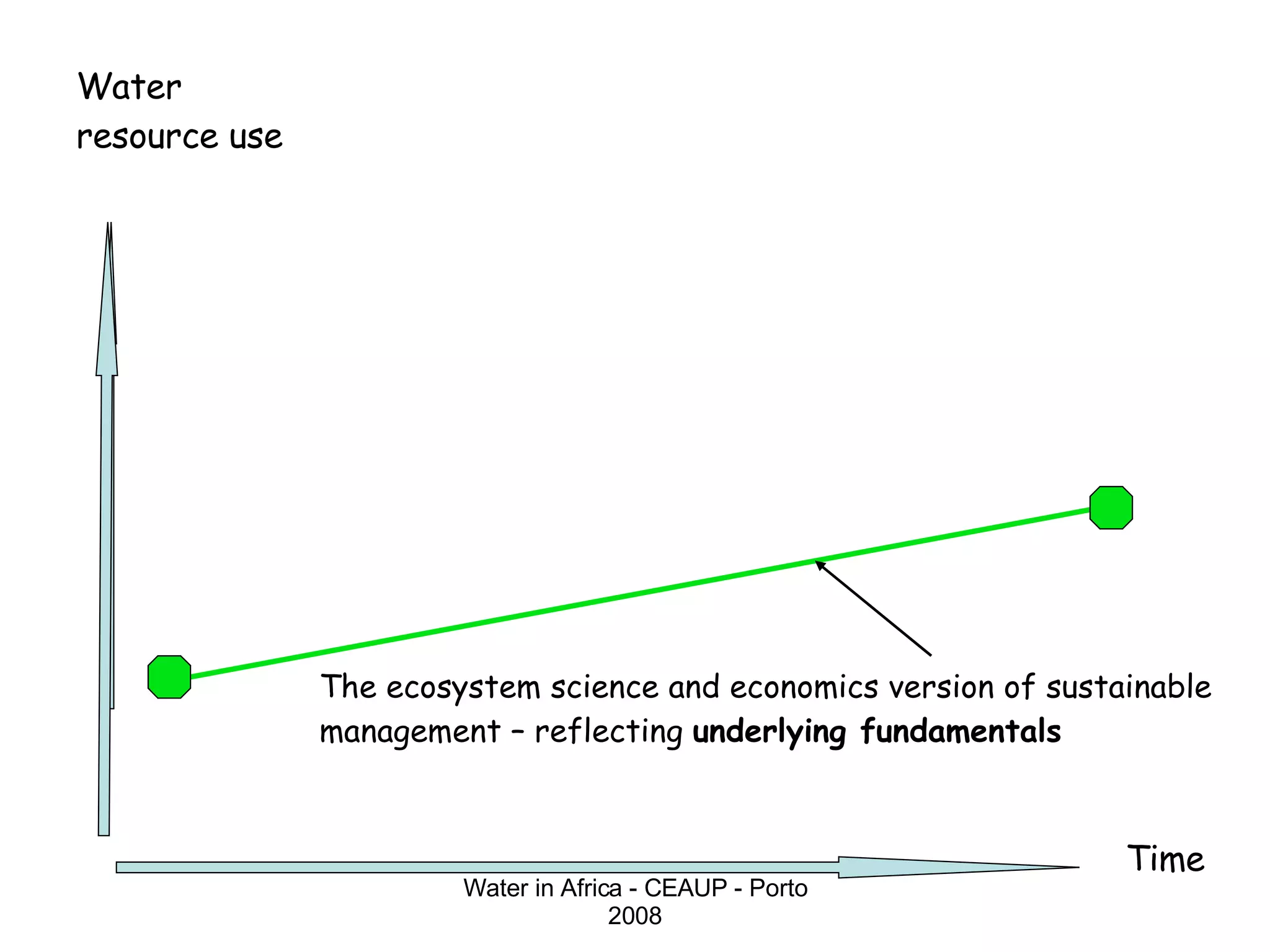
Water resource use Time The ecosystem science and economics version of sustainable management – reflecting  underlying fundamentals Water in Africa - CEAUP - Porto 2008
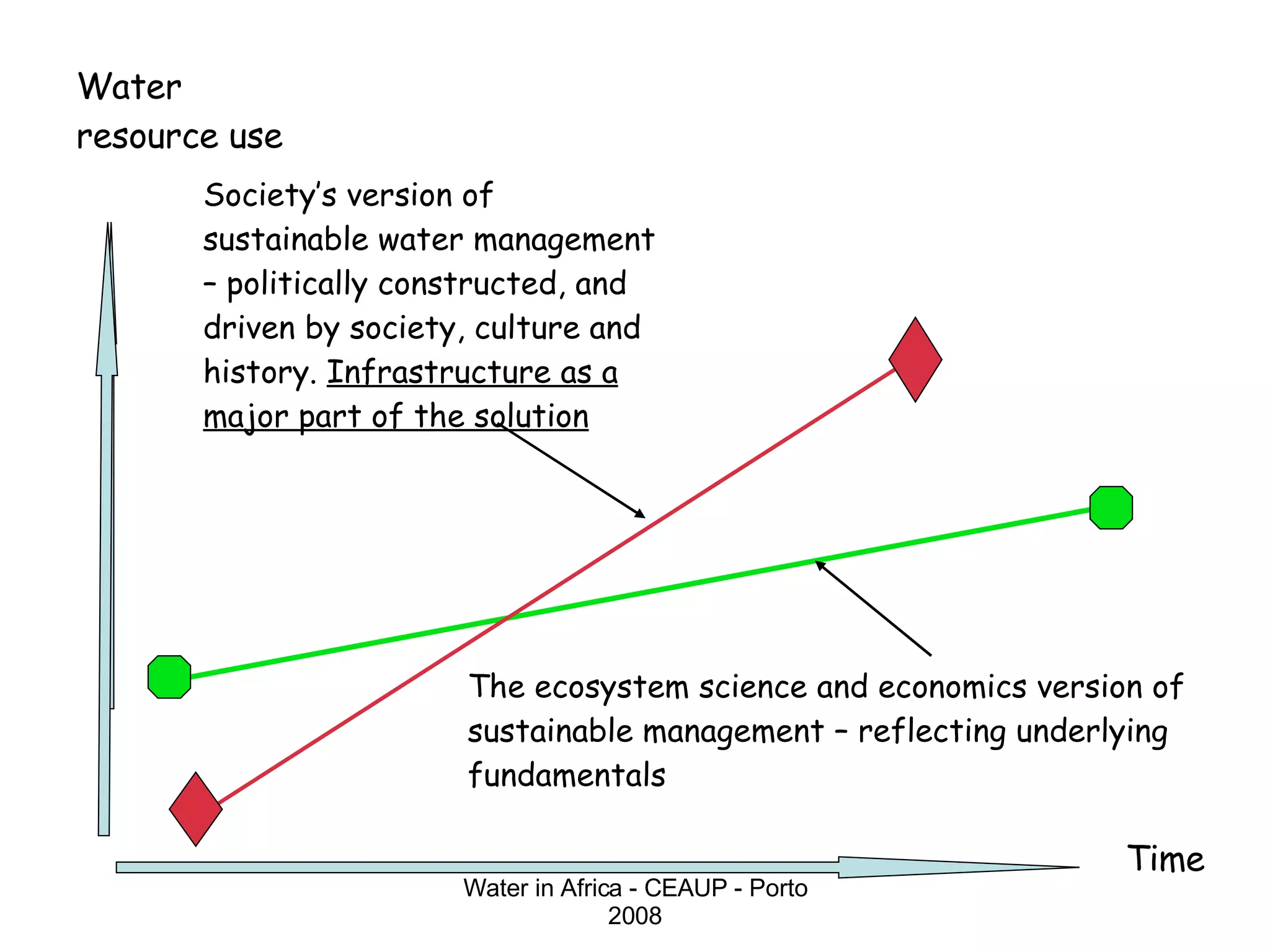
Water resource use Time The ecosystem science and economics version of sustainable management – reflecting underlying fundamentals Society’s version of sustainable water management – politically constructed, and driven by society, culture and history.  Infrastructure as a major part of the solution Water in Africa - CEAUP - Porto 2008
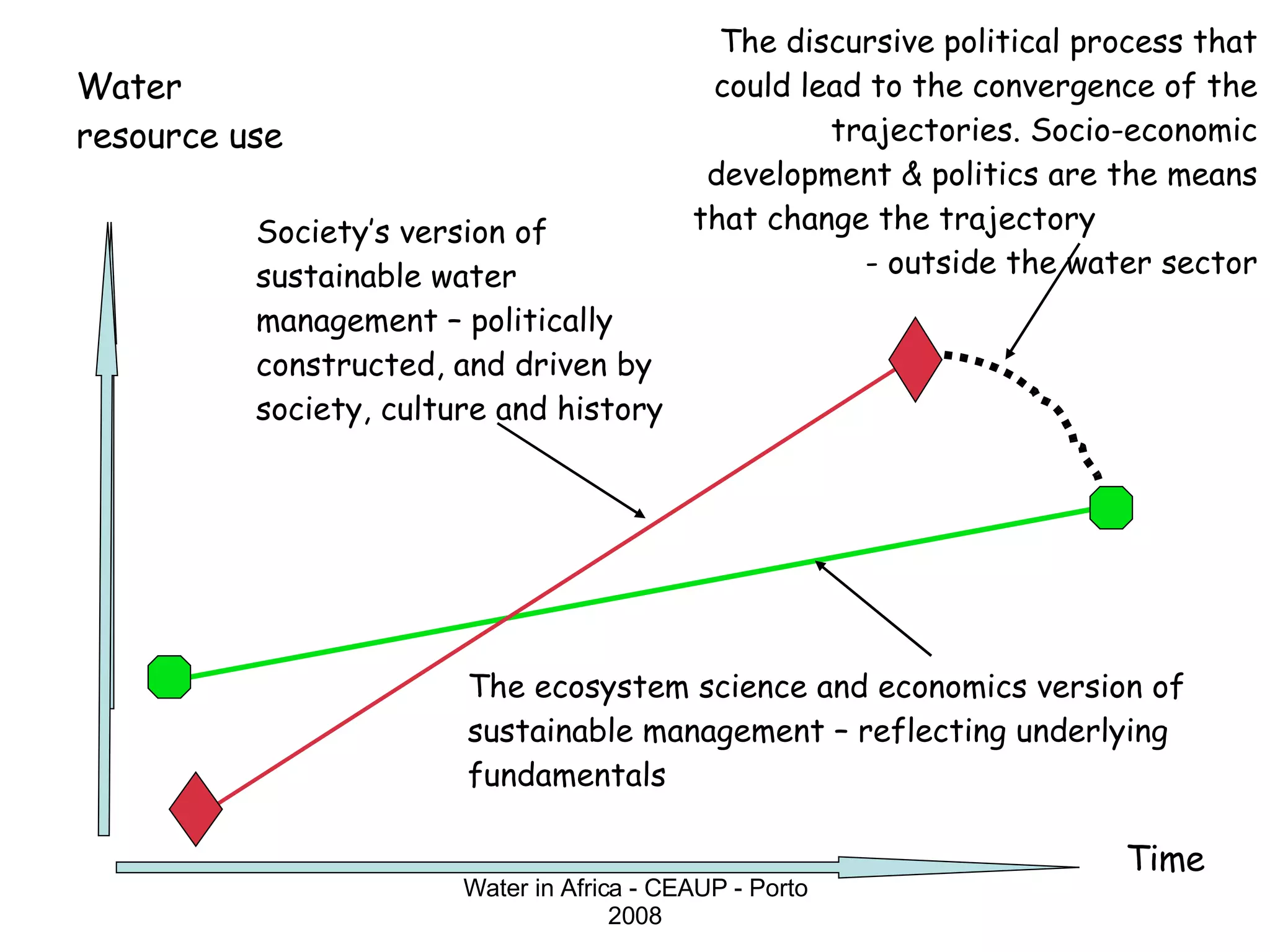
Water resource use Time The ecosystem science and economics version of sustainable management – reflecting underlying fundamentals Society’s version of sustainable water management – politically constructed, and driven by society, culture and history The discursive political process that could lead to the convergence of the trajectories. Socio-economic development & politics are the means that change the trajectory  - outside the water sector Water in Africa - CEAUP - Porto 2008
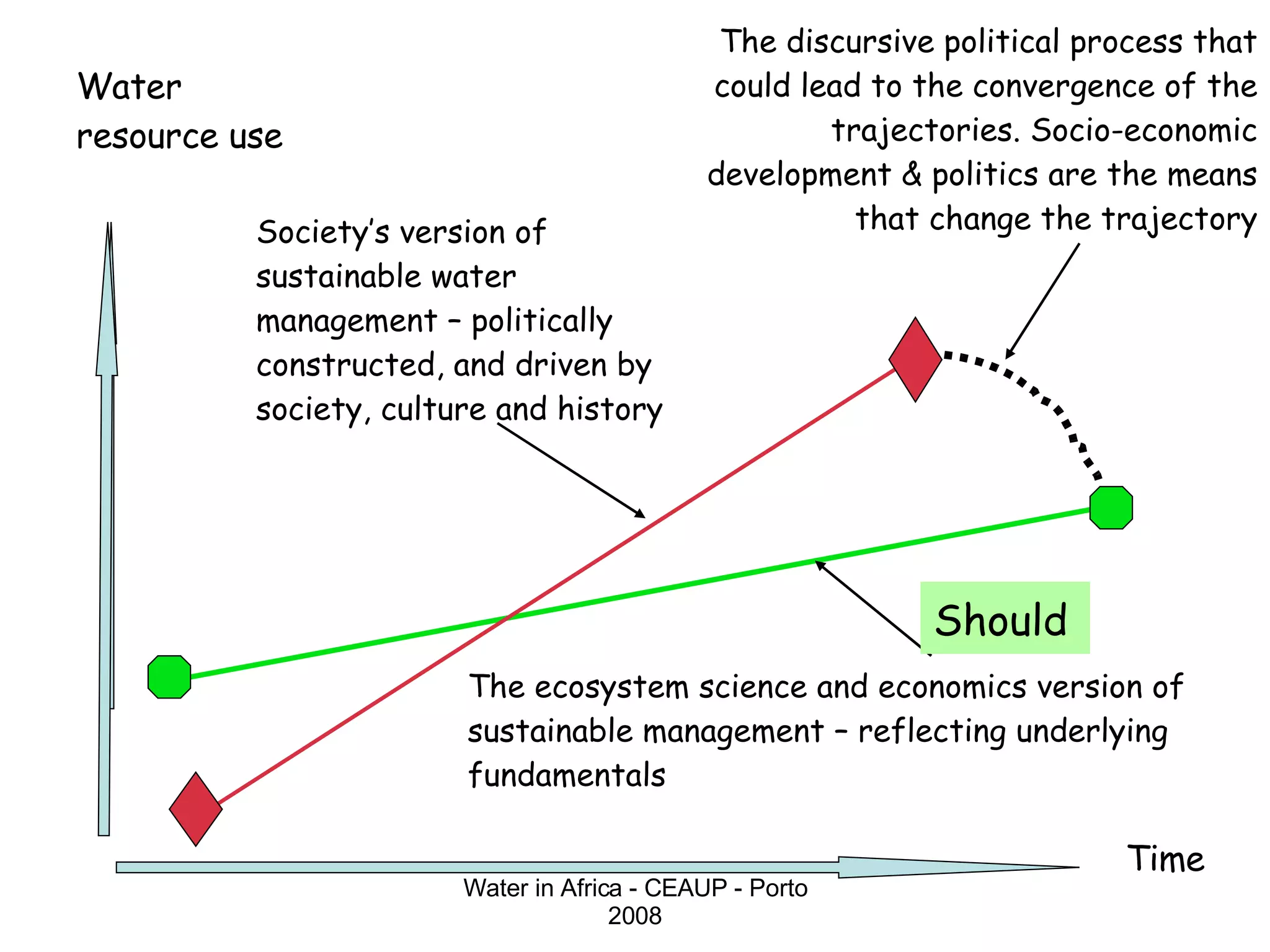
Water resource use Time The ecosystem science and economics version of sustainable management – reflecting underlying fundamentals Society’s version of sustainable water management – politically constructed, and driven by society, culture and history The discursive political process that could lead to the convergence of the trajectories. Socio-economic development & politics are the means that change the trajectory Should Water in Africa - CEAUP - Porto 2008
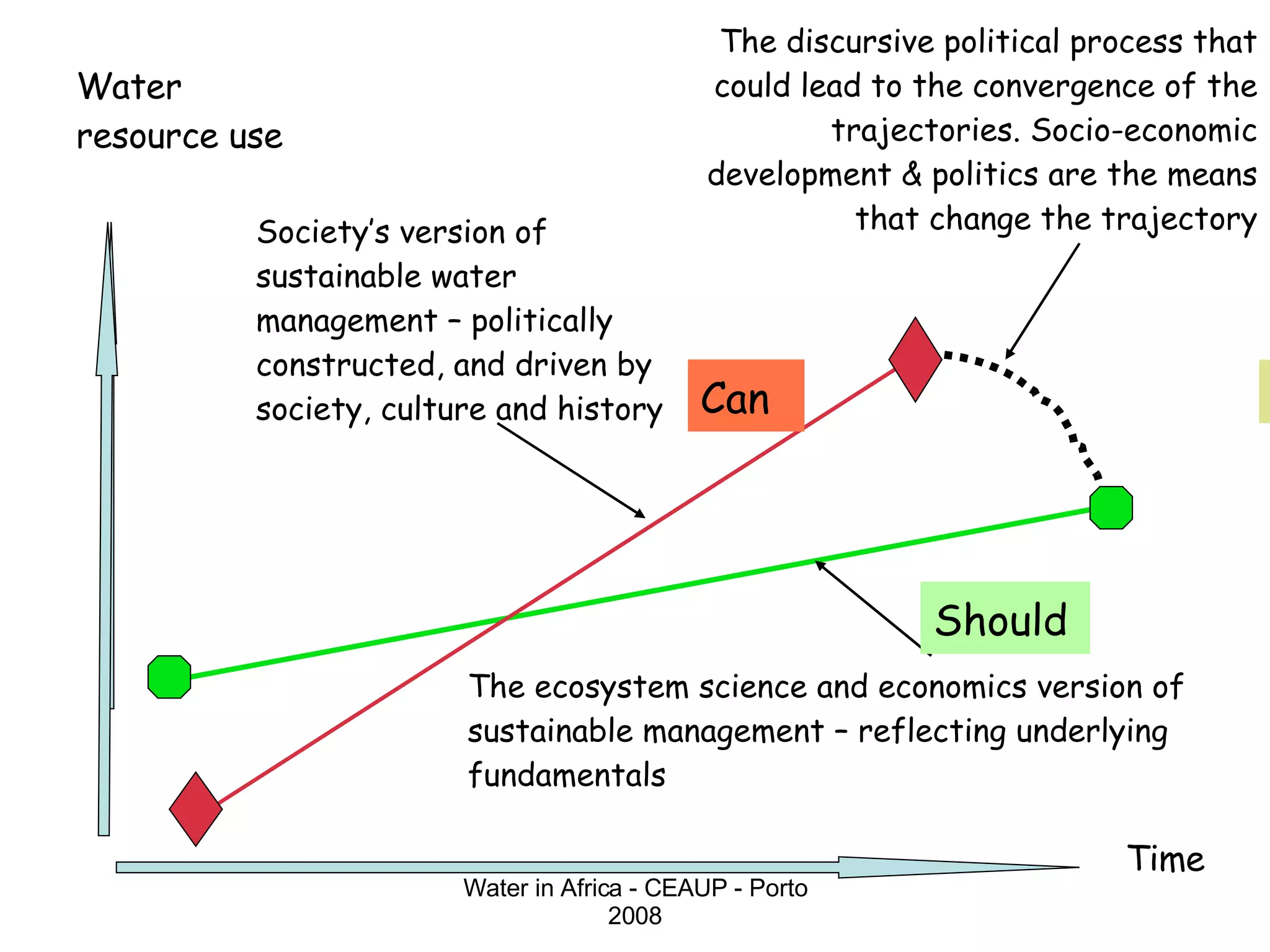
Water resource use Time The ecosystem science and economics version of sustainable management – reflecting underlying fundamentals Society’s version of sustainable water management – politically constructed, and driven by society, culture and history The discursive political process that could lead to the convergence of the trajectories. Socio-economic development & politics are the means that change the trajectory Should Can Water in Africa - CEAUP - Porto 2008
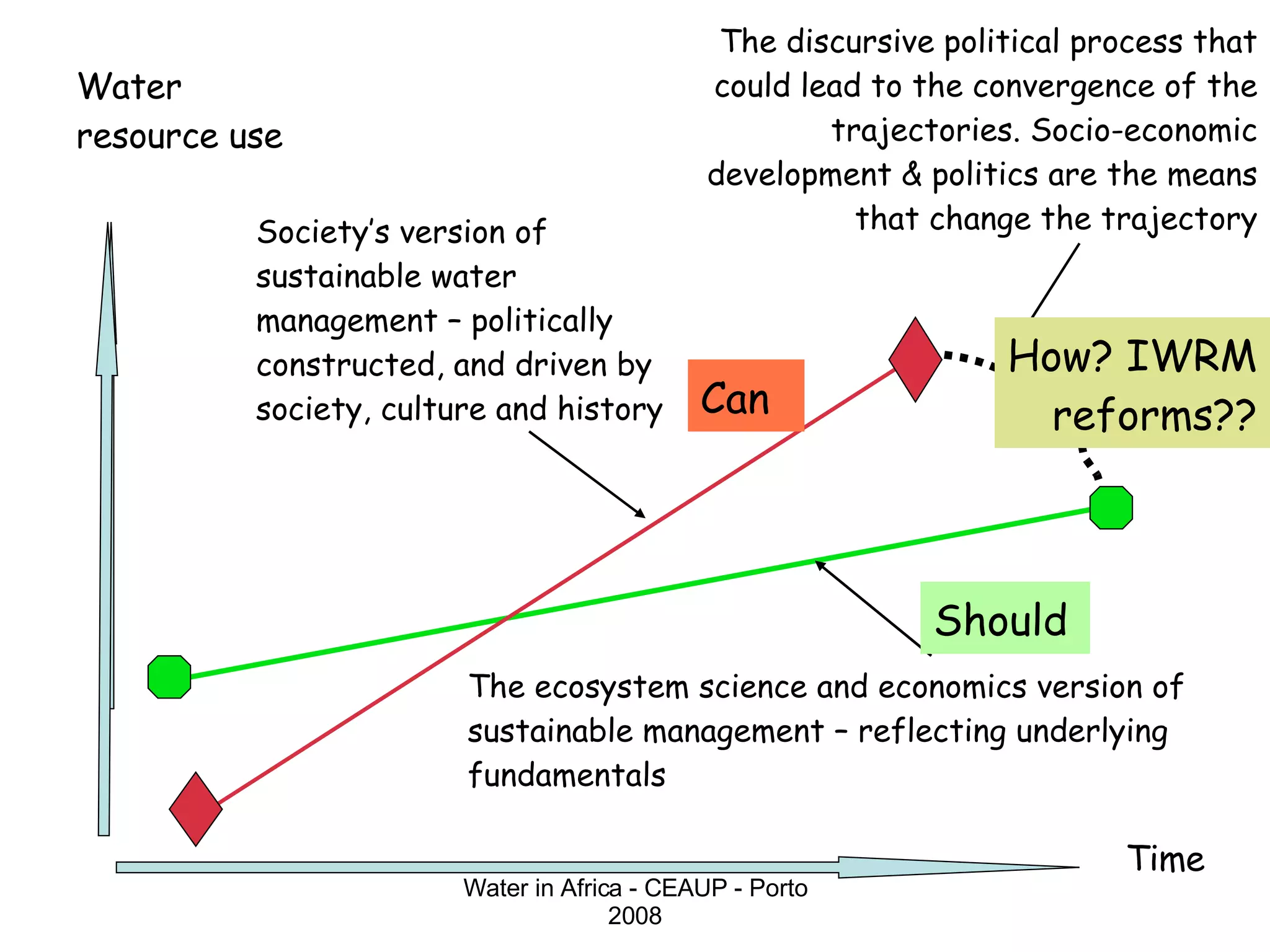
Water resource use Time The ecosystem science and economics version of sustainable management – reflecting underlying fundamentals Society’s version of sustainable water management – politically constructed, and driven by society, culture and history The discursive political process that could lead to the convergence of the trajectories. Socio-economic development & politics are the means that change the trajectory Should Can How? IWRM reforms?? Water in Africa - CEAUP - Porto 2008
Water resource use Time The ecosystem science and economics version of sustainable management – reflecting underlying fundamentals Society’s version of sustainable water management – politically constructed, and driven by society, culture and history The discursive political process that could lead to the convergence of the trajectories. Socio-economic development & politics are the means that change the trajectory Should Can How? IWRAM  reforms are  VERY POLITICAL ?? Water in Africa - CEAUP - Porto 2008
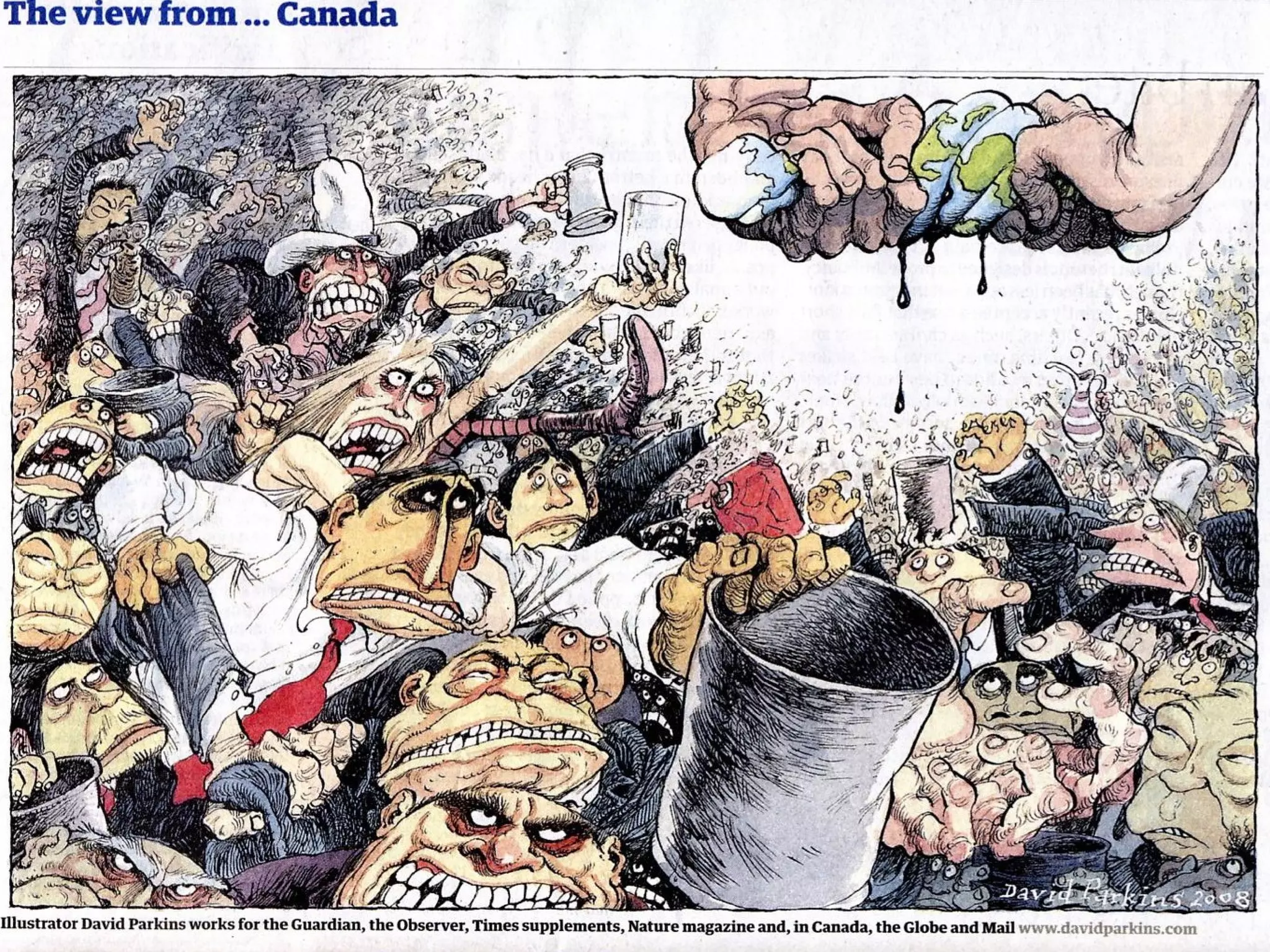
Water demand is  determined by  consumers   who have beliefs and expectations  that are based  on experience, cultural preferences, history  and  NOT  on science Consumers  and their assumptions are very important indeed The  extravagant consumers  in the North The  optionless irrigators  in the South Water in Africa - CEAUP - Porto 2008
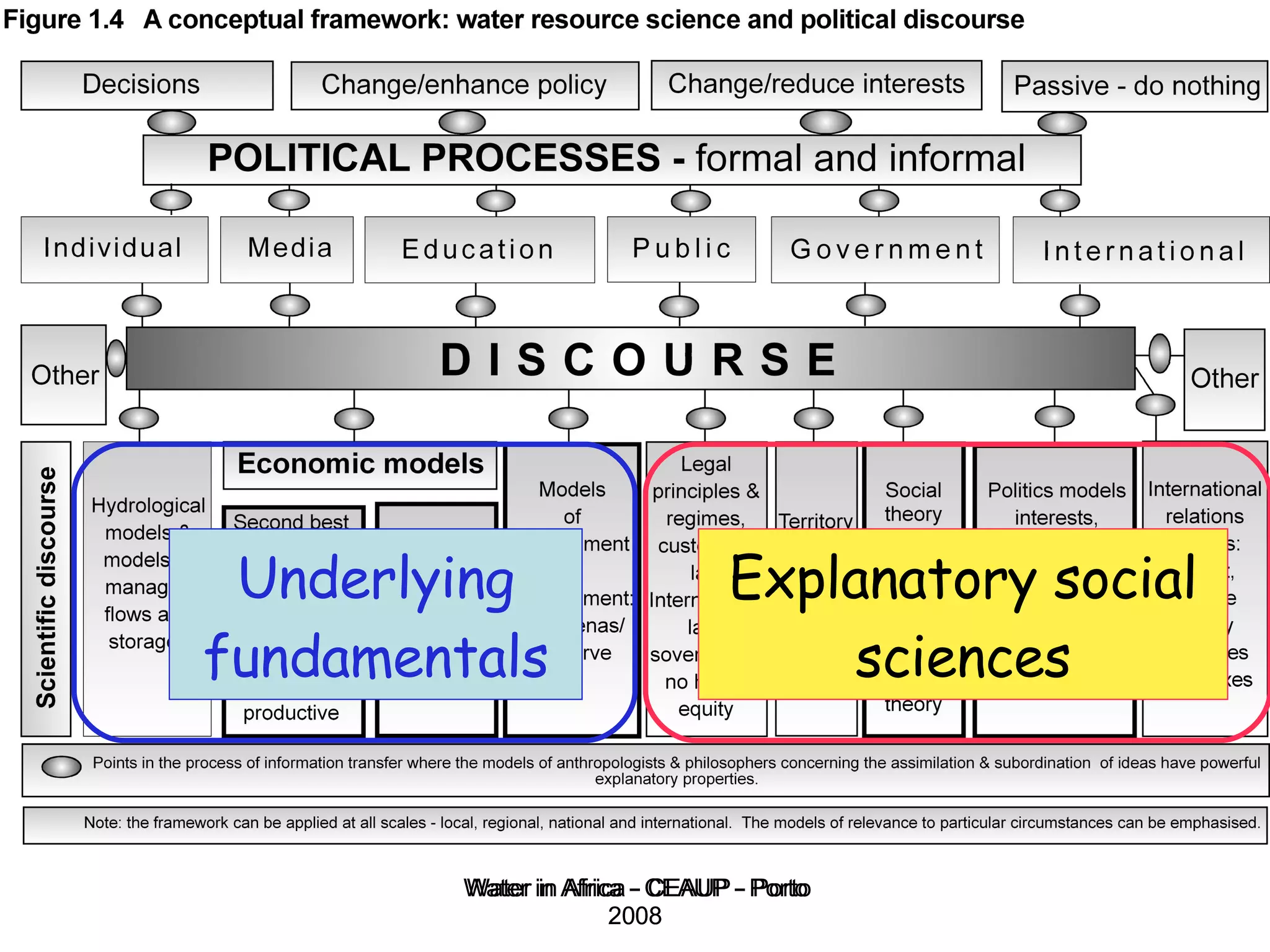
Water in Africa - CEAUP - Porto 2008
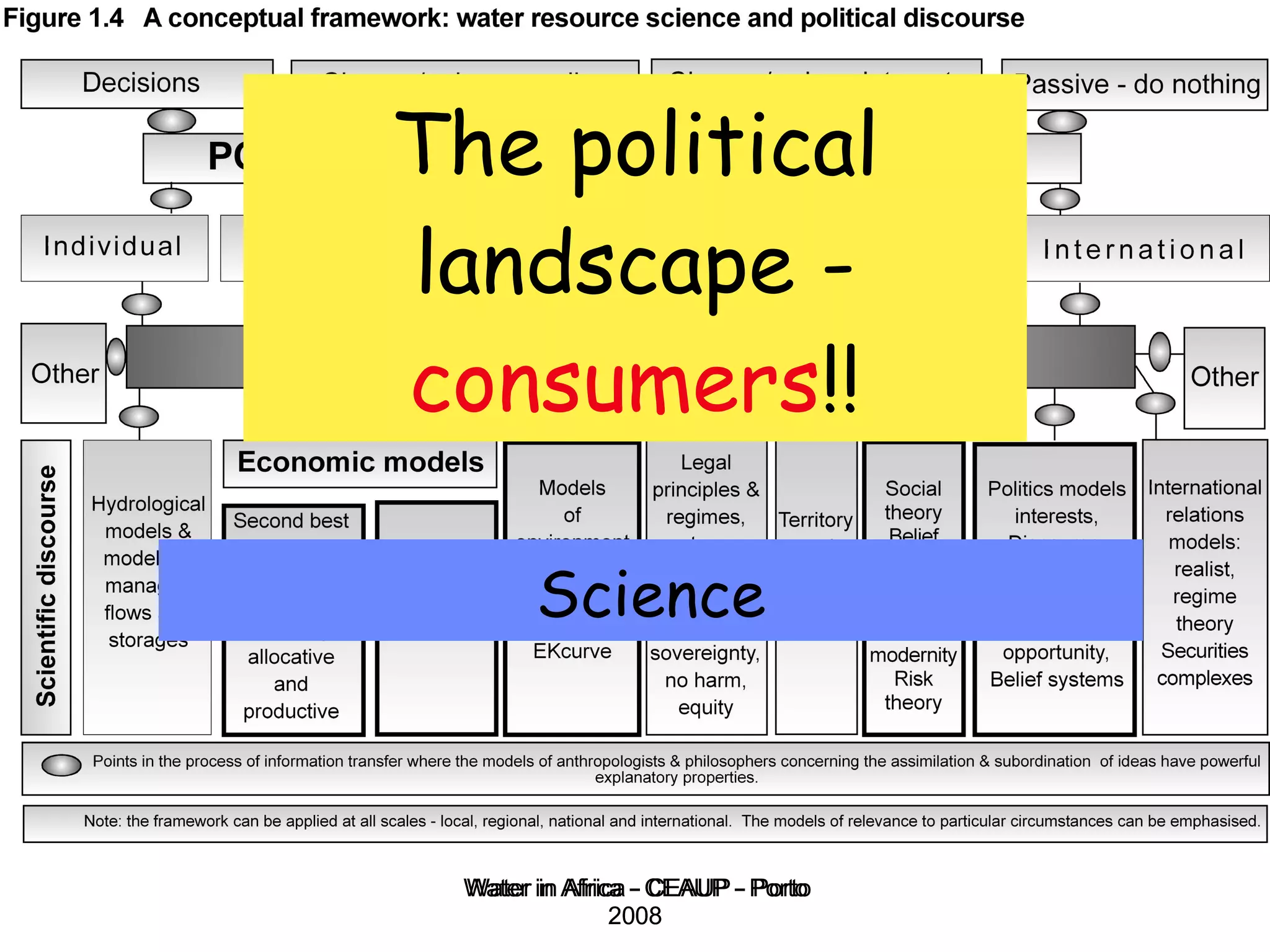
Water in Africa - CEAUP - Porto 2008 The political landscape -  consumers !! Science
Water in Africa - CEAUP - Porto 2008 Underlying fundamentals Explanatory social sciences
Water in Africa - CEAUP - Porto 2008 Science Policy
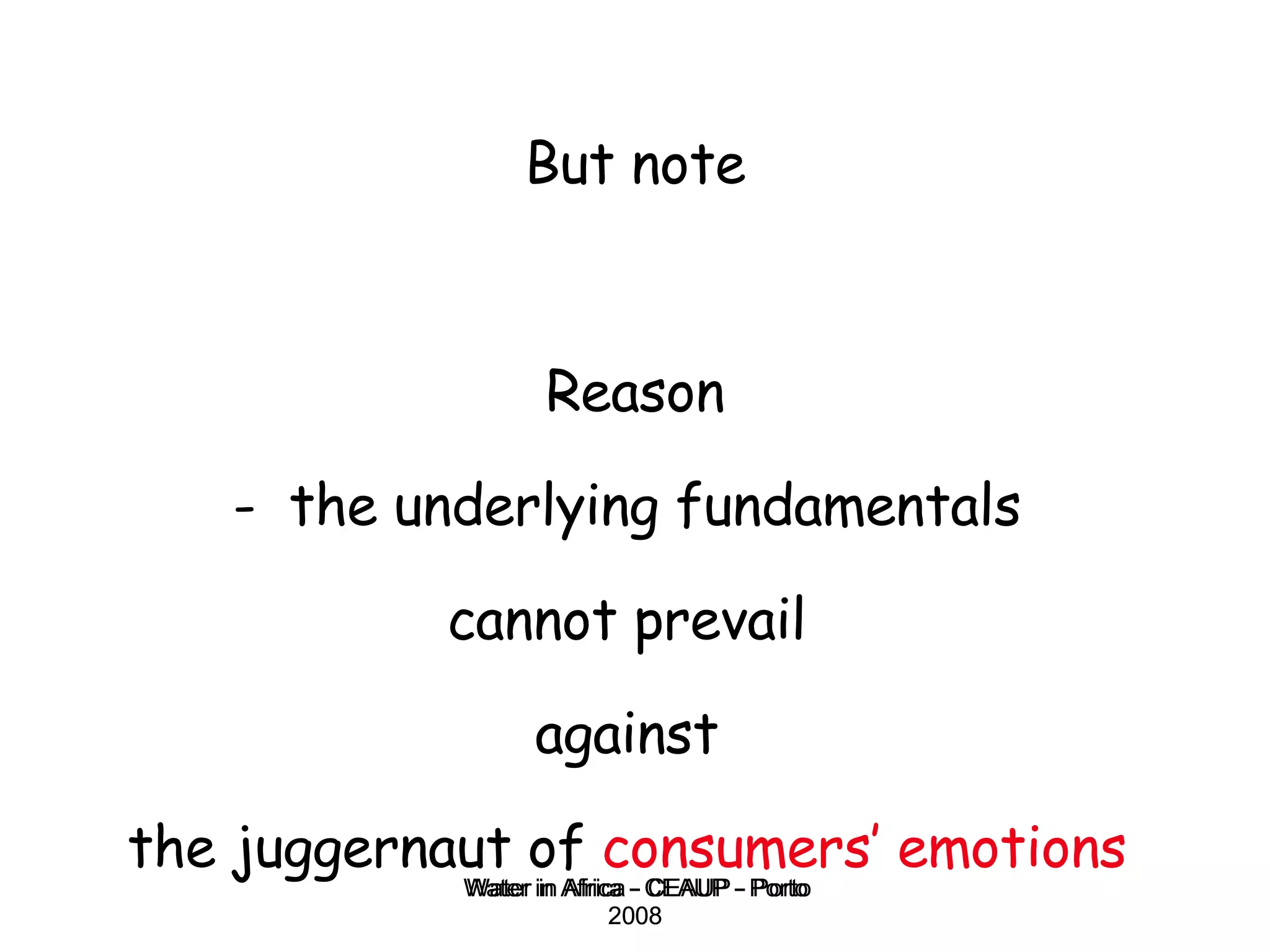
Water in Africa - CEAUP - Porto 2008 But note Reason -  the underlying fundamentals  cannot prevail  against  the juggernaut of  consumers’ emotions
Water in Africa - CEAUP - Porto 2008
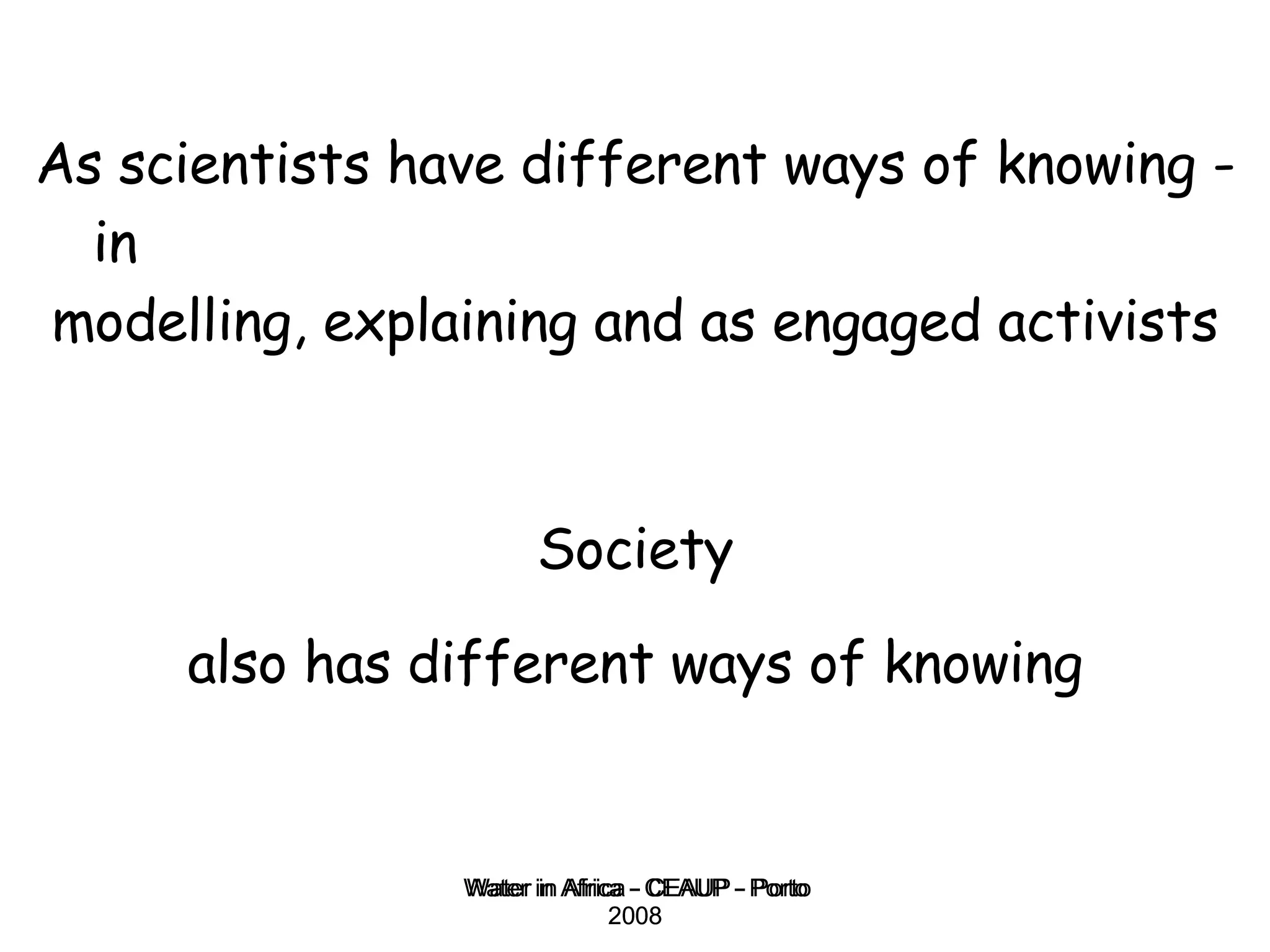
Water in Africa - CEAUP - Porto 2008 As scientists have different ways of knowing - in  modelling, explaining and as engaged activists Society also has different ways of knowing
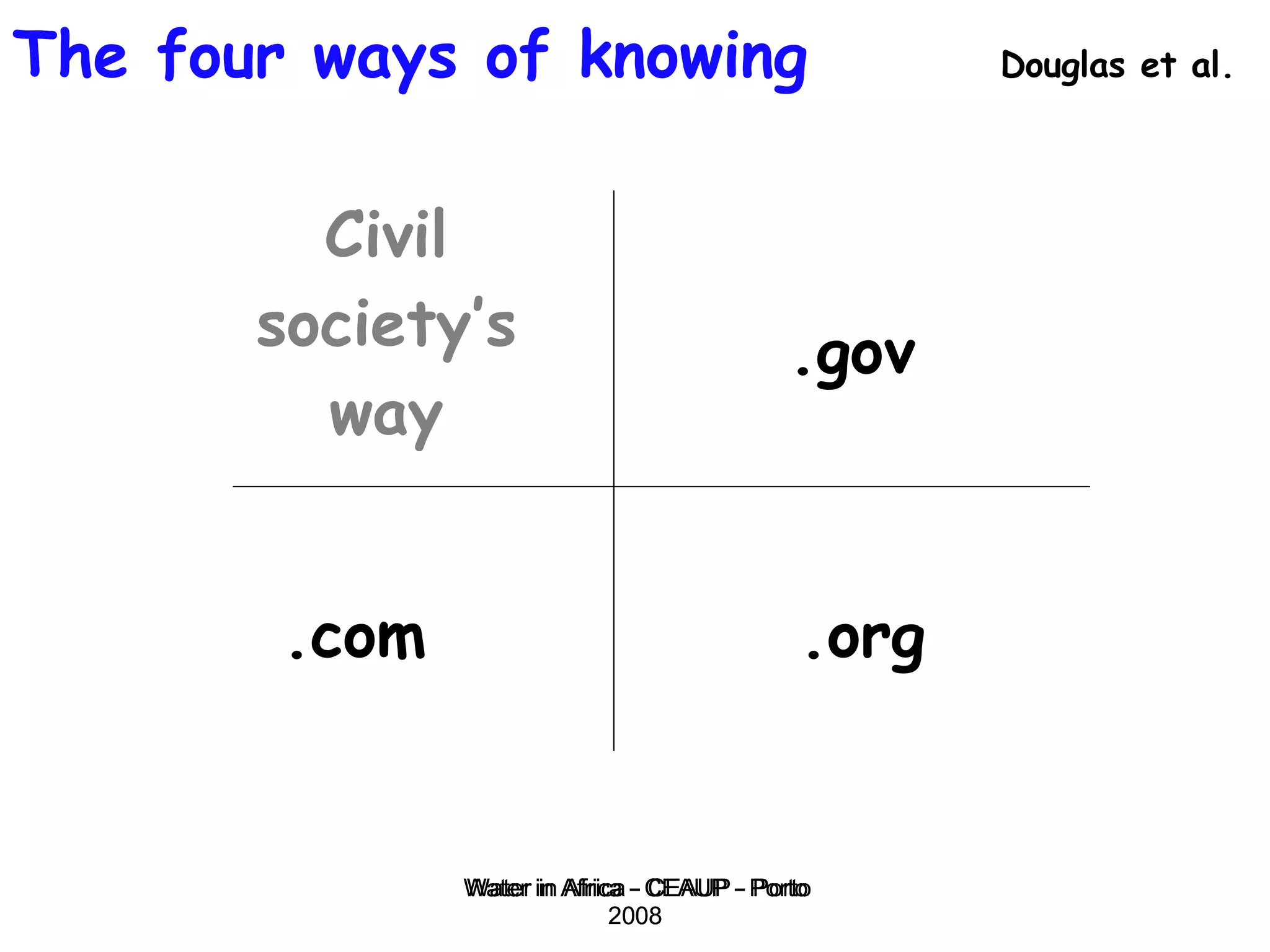
Water in Africa - CEAUP - Porto 2008 Civil society’s way .gov .org .com The four ways of knowing   Douglas et al.
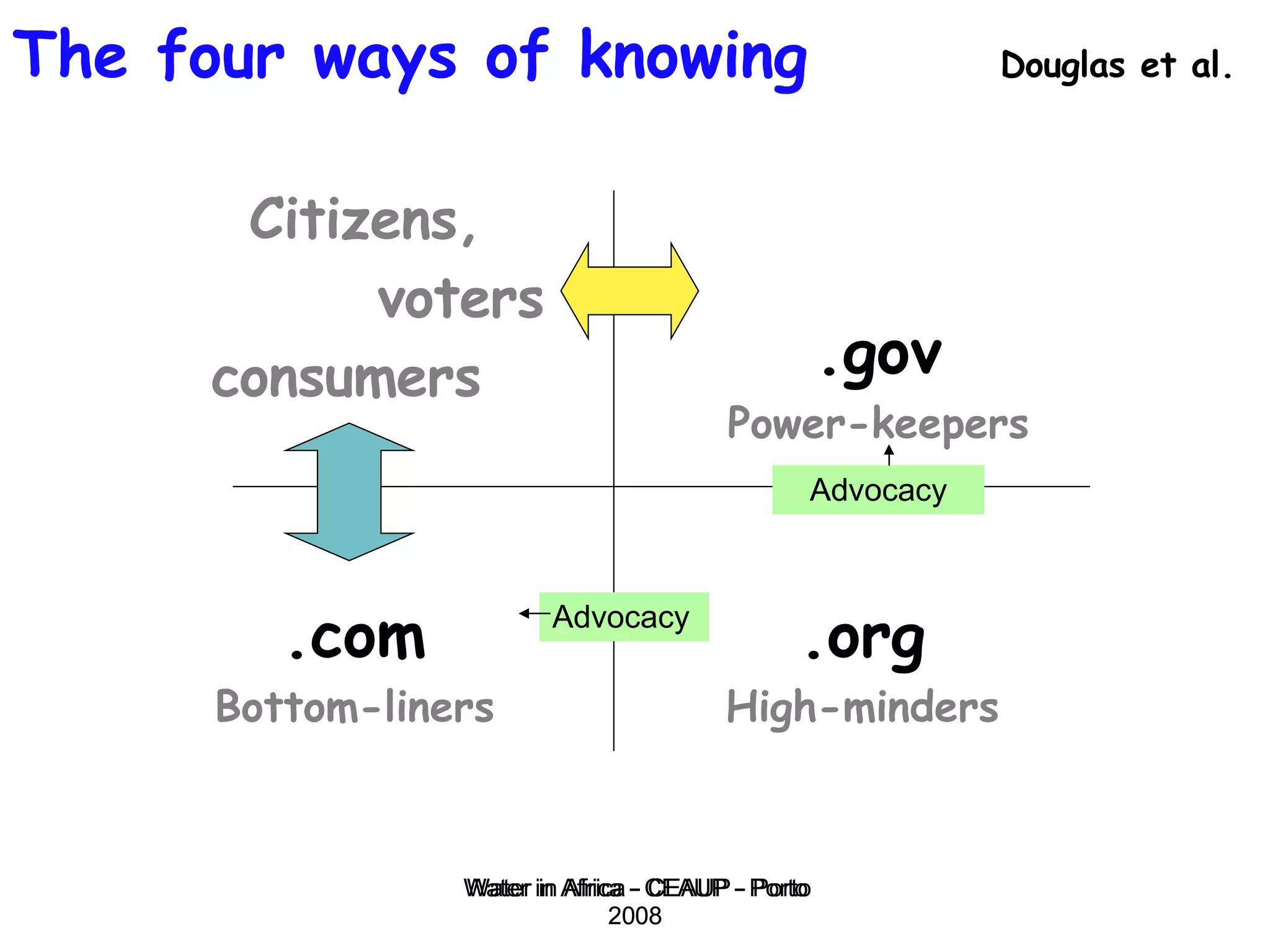
Water in Africa - CEAUP - Porto 2008 Citizens, voters consumers   .gov Power-keepers .org High-minders .com Bottom-liners The four ways of knowing   Douglas et al. Advocacy Advocacy
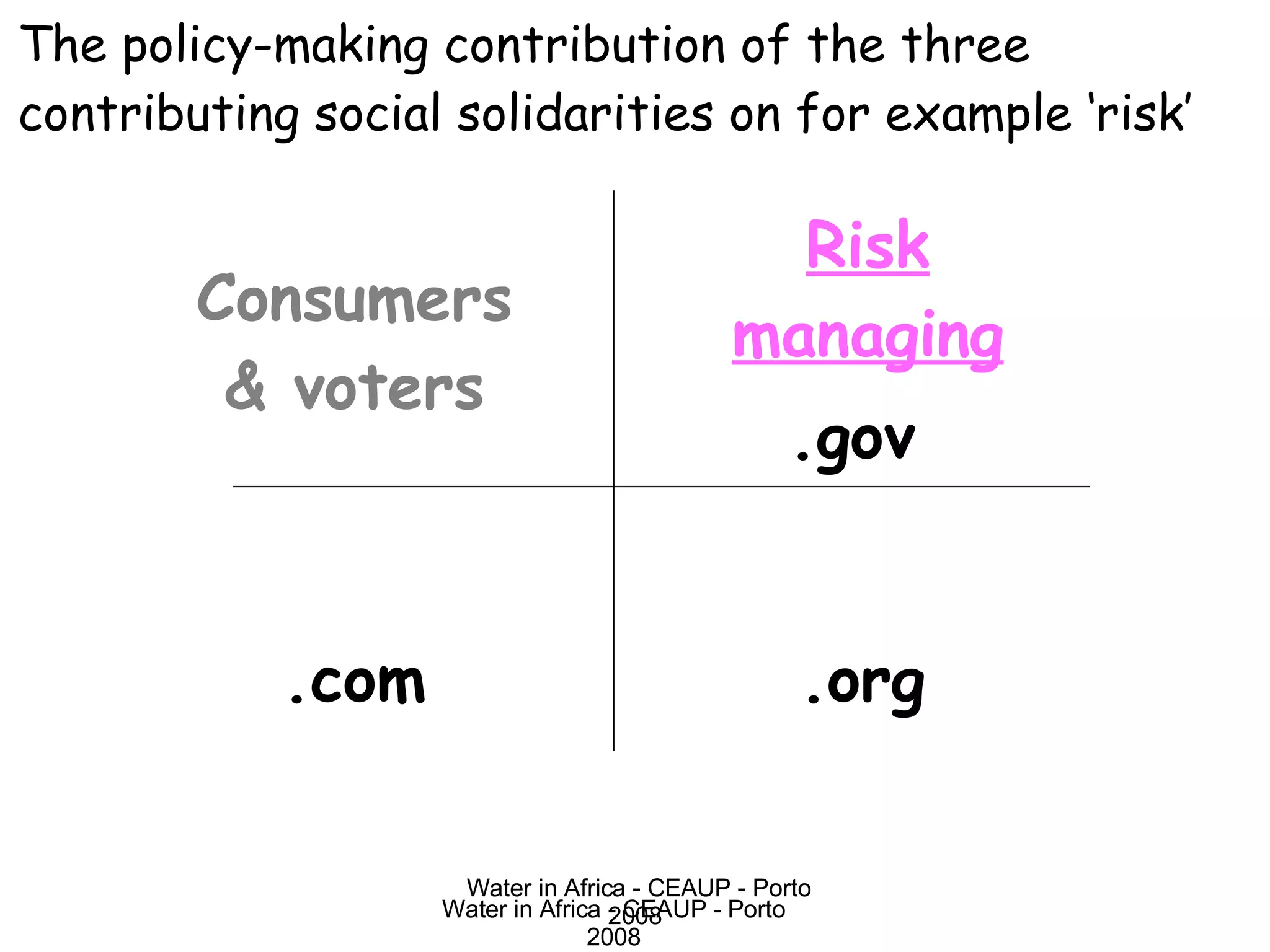
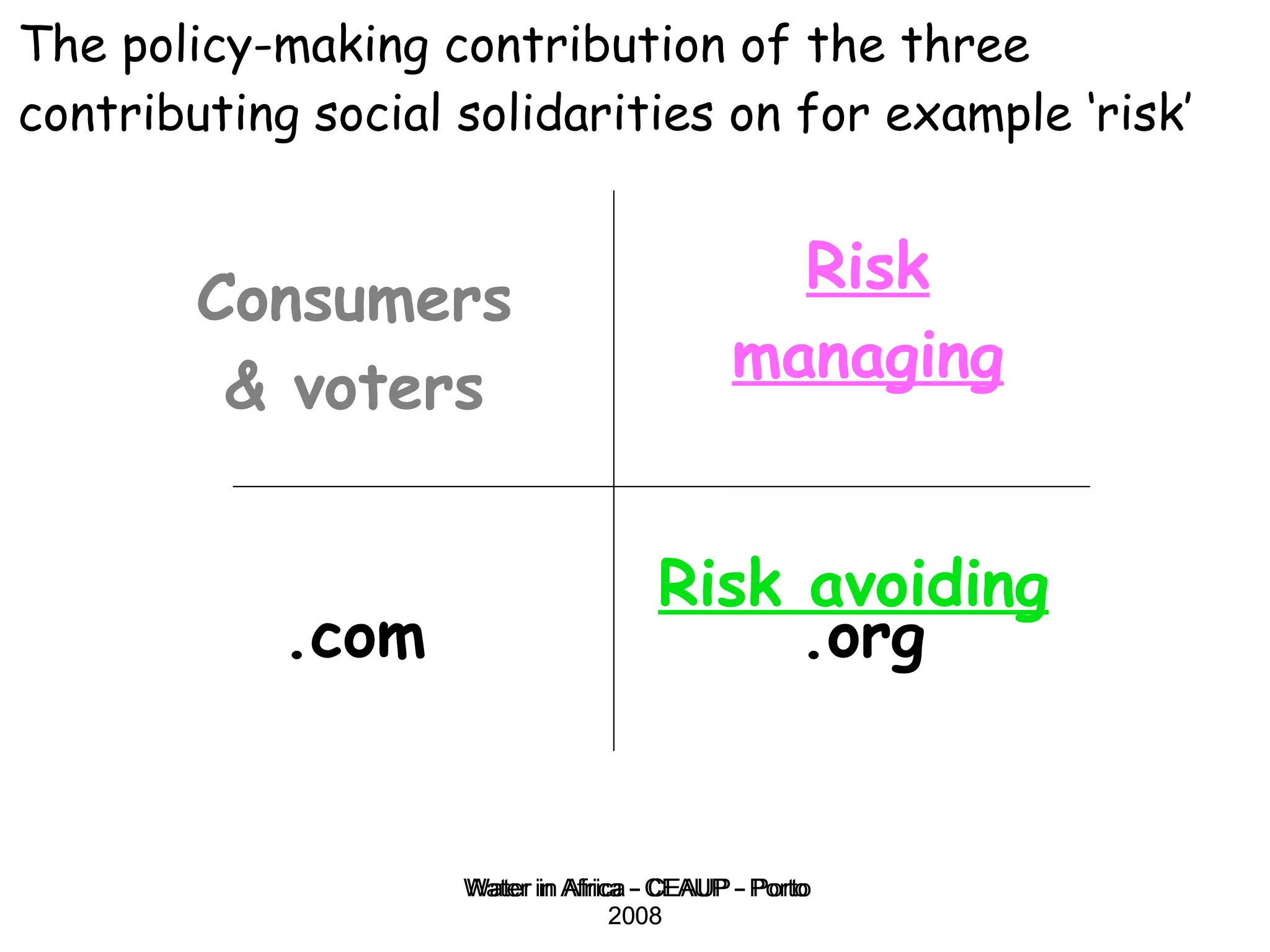
Water in Africa - CEAUP - Porto 2008 Consumers & voters .gov .org .com Risk managing The policy-making contribution of the three contributing social solidarities on for example ‘risk’
Water in Africa - CEAUP - Porto 2008 Consumers & voters .gov .org .com Risk managing Risk avoiding The policy-making contribution of the three contributing social solidarities on for example ‘risk’
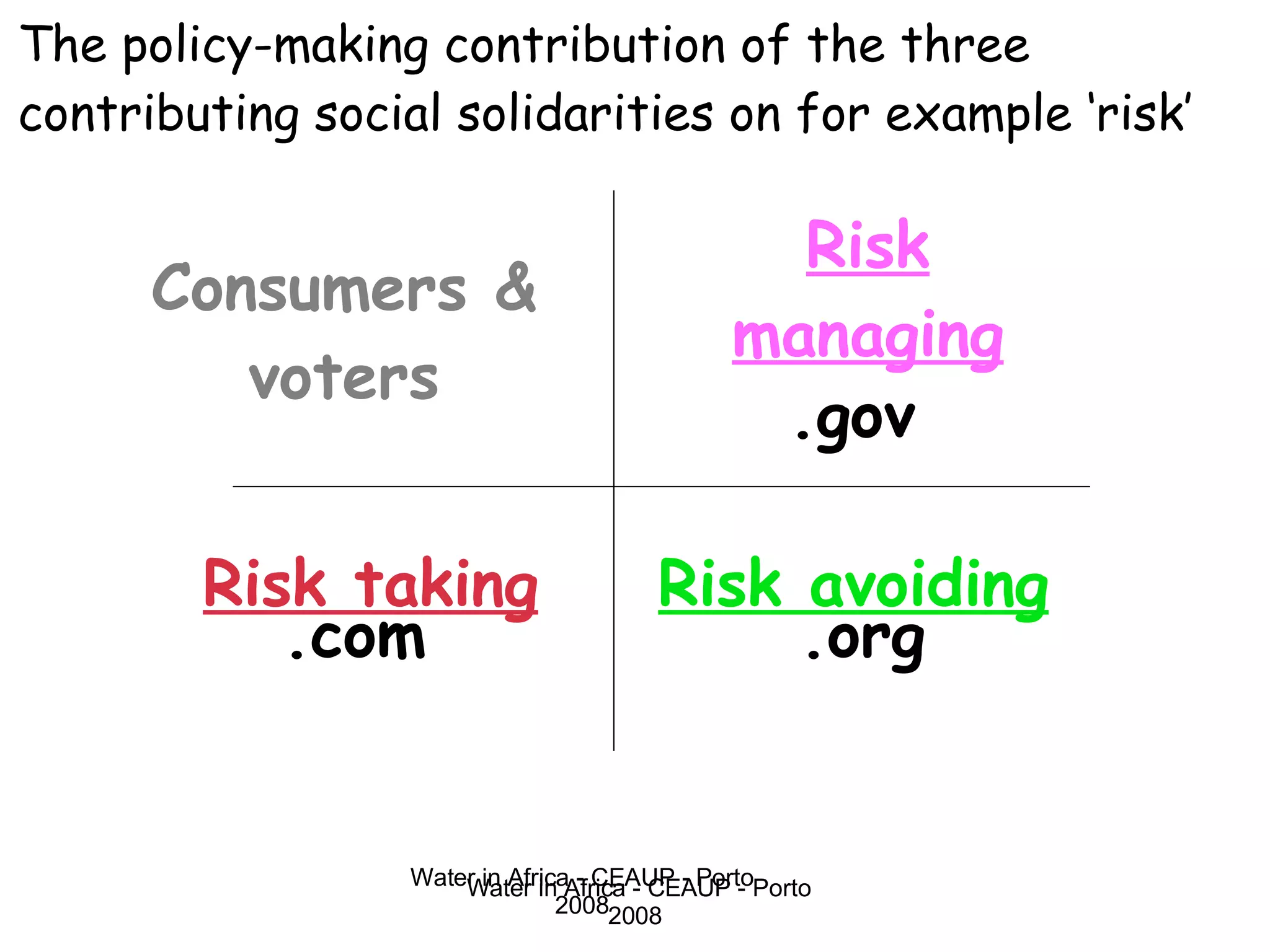
Water in Africa - CEAUP - Porto 2008 Consumers & voters .gov .org .com Risk managing Risk avoiding Risk taking The policy-making contribution of the three contributing social solidarities on for example ‘risk’
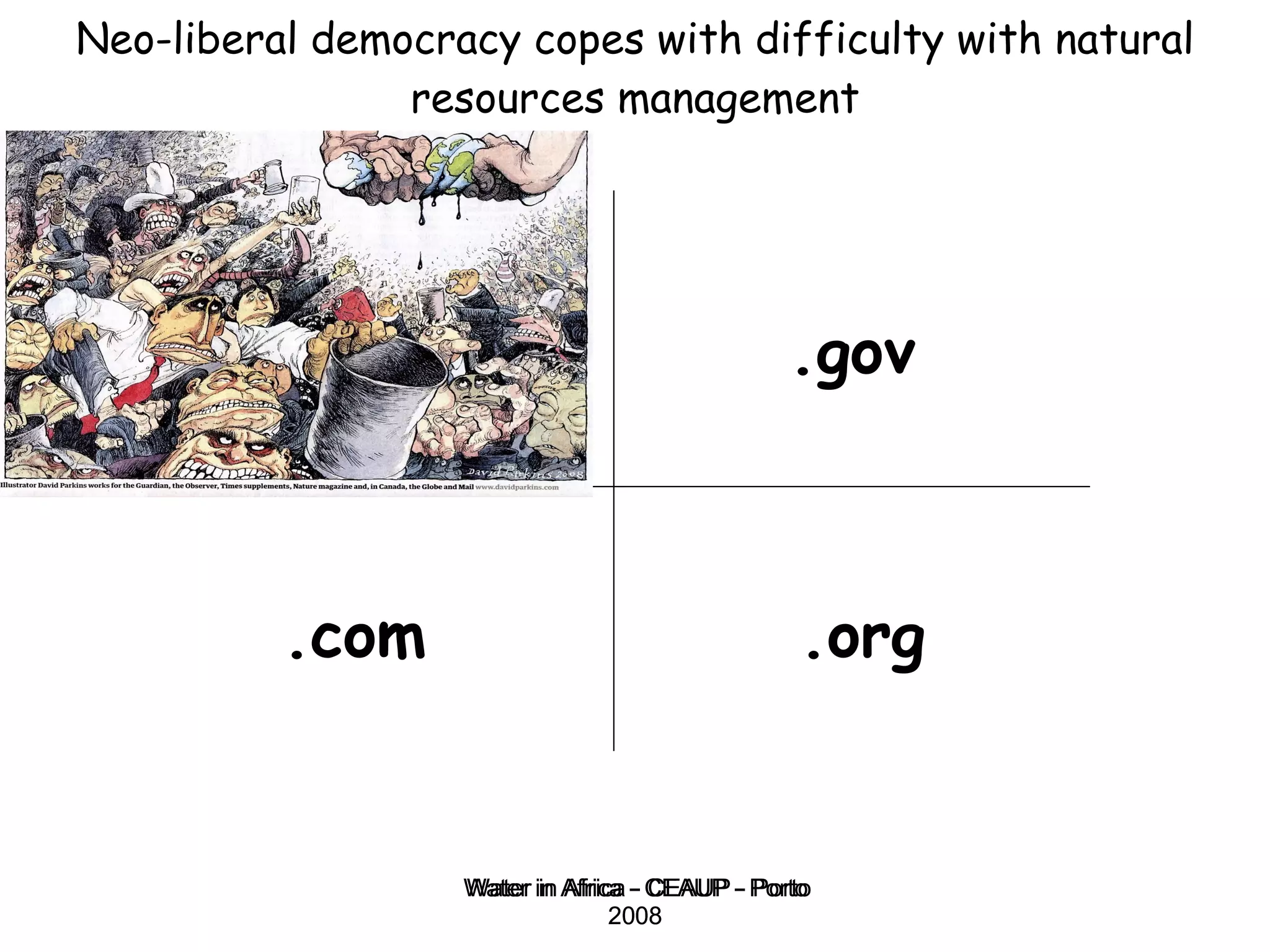
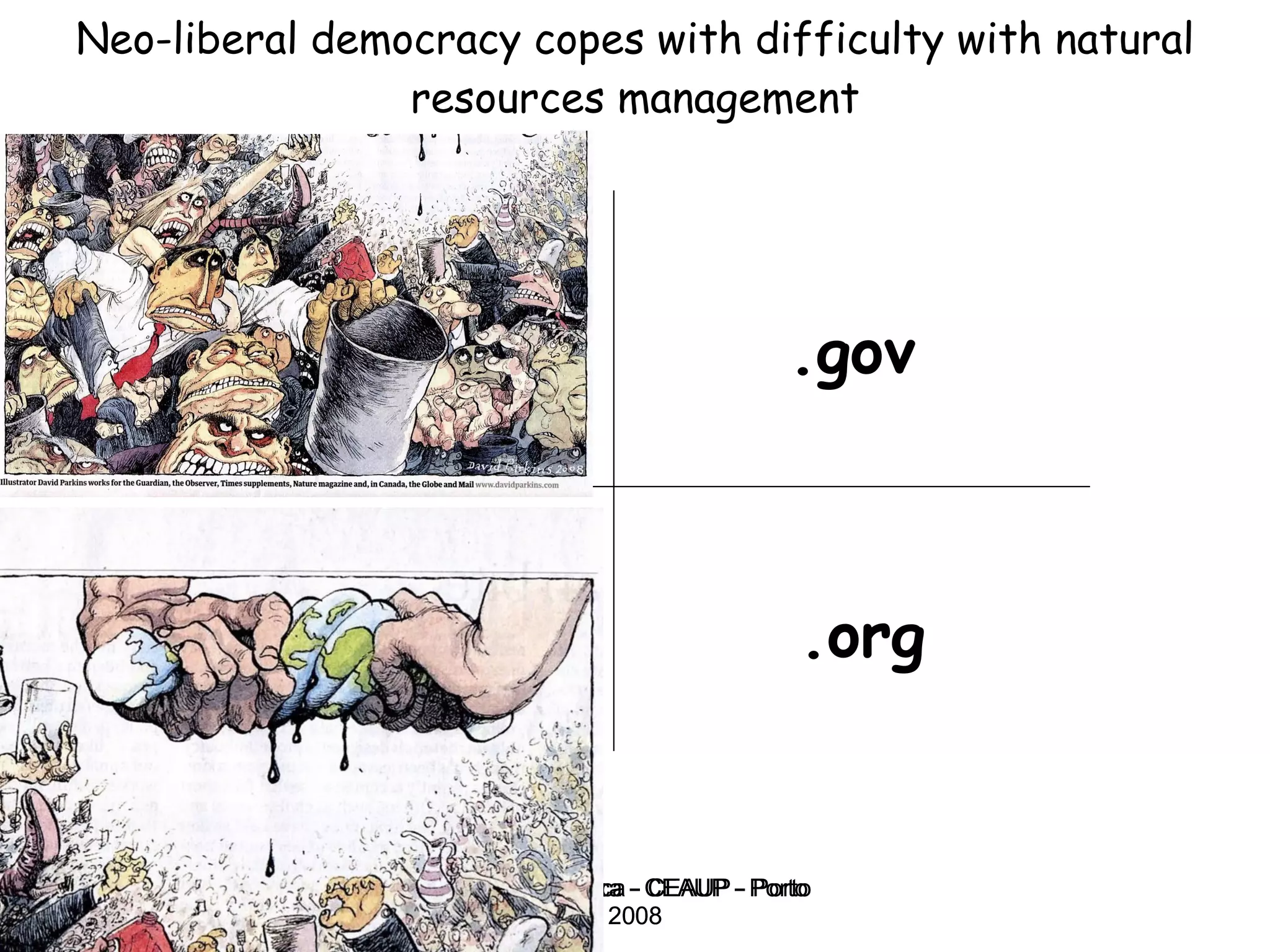
Water in Africa - CEAUP - Porto 2008 .??? Fatalists .gov .org .com Neo-liberal democracy copes with difficulty with natural resources management
Water in Africa - CEAUP - Porto 2008 .??? Fatalists .gov .org .com Entrepreneurs . Neo-liberal democracy copes with difficulty with natural resources management
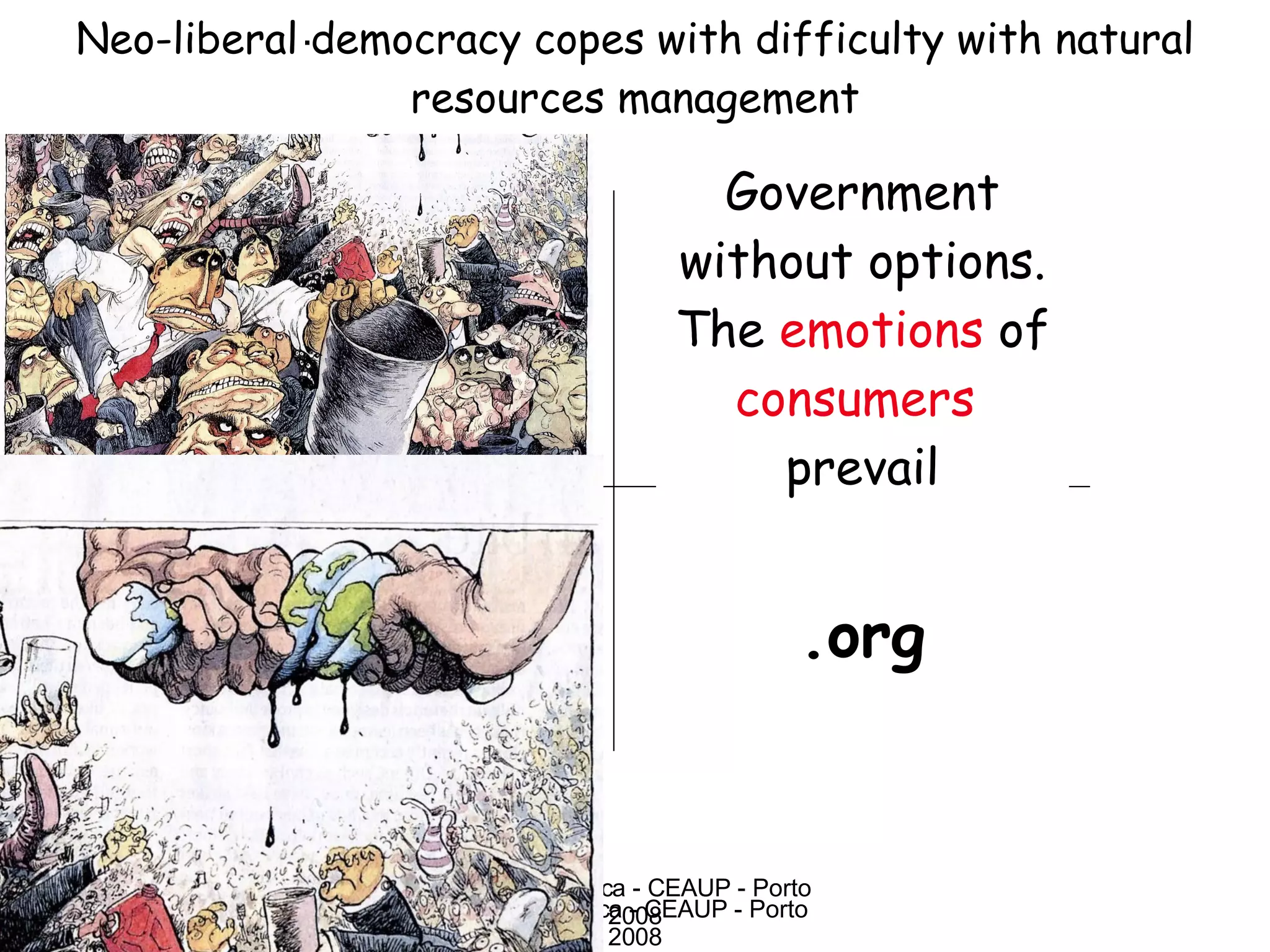
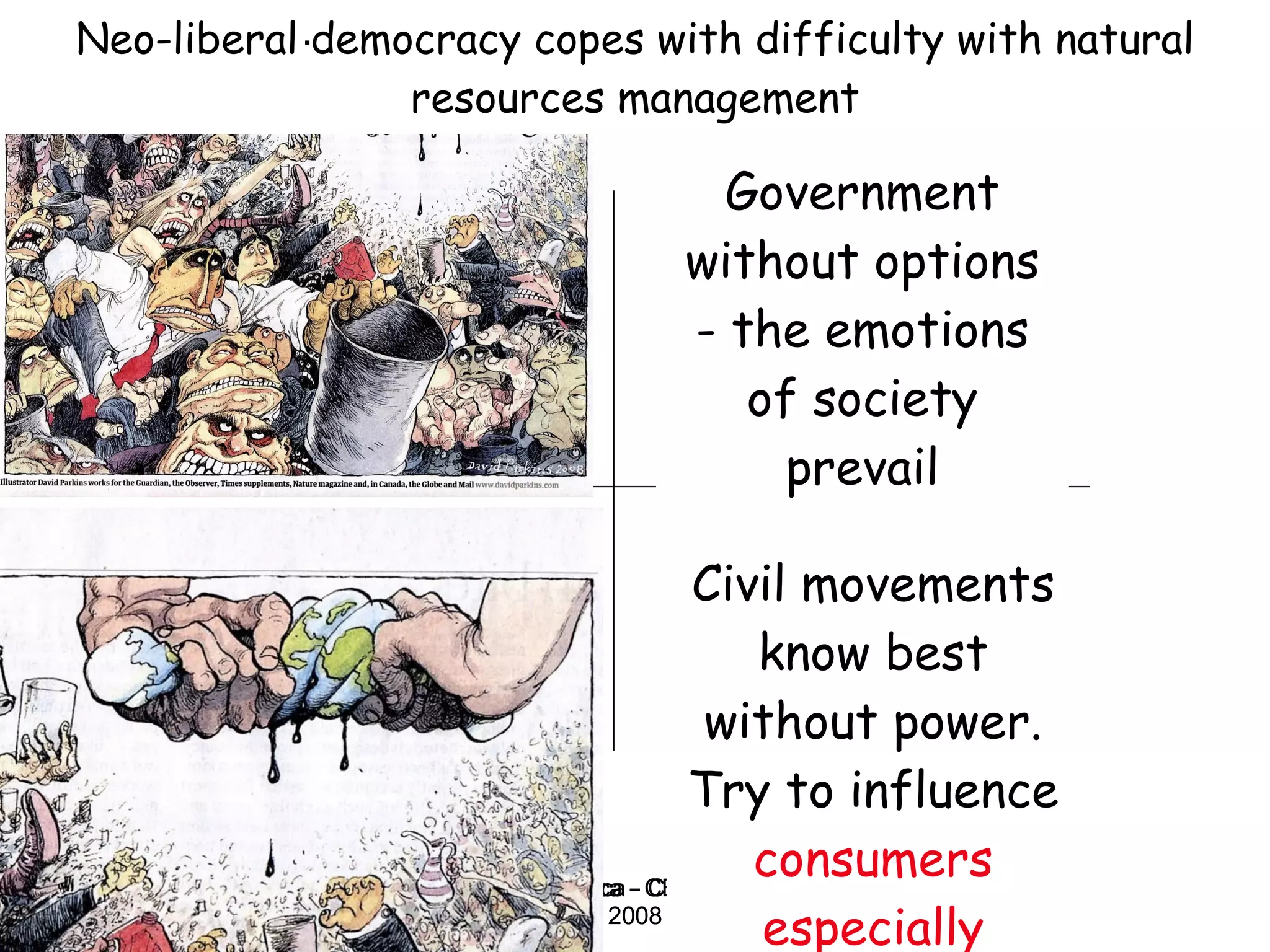
Water in Africa - CEAUP - Porto 2008 .??? Fatalists .gov Hierarchists .org .com Entrepreneurs . Government without options. The  emotions  of  consumers   prevail Neo-liberal democracy copes with difficulty with natural resources management
Water in Africa - CEAUP - Porto 2008 .??? Fatalists .gov Hierarchists .org Ethicists .com Entrepreneurs . Government without options - the emotions of society prevail Civil movements know best without power. Try to influence  consumers especially Neo-liberal democracy copes with difficulty with natural resources management
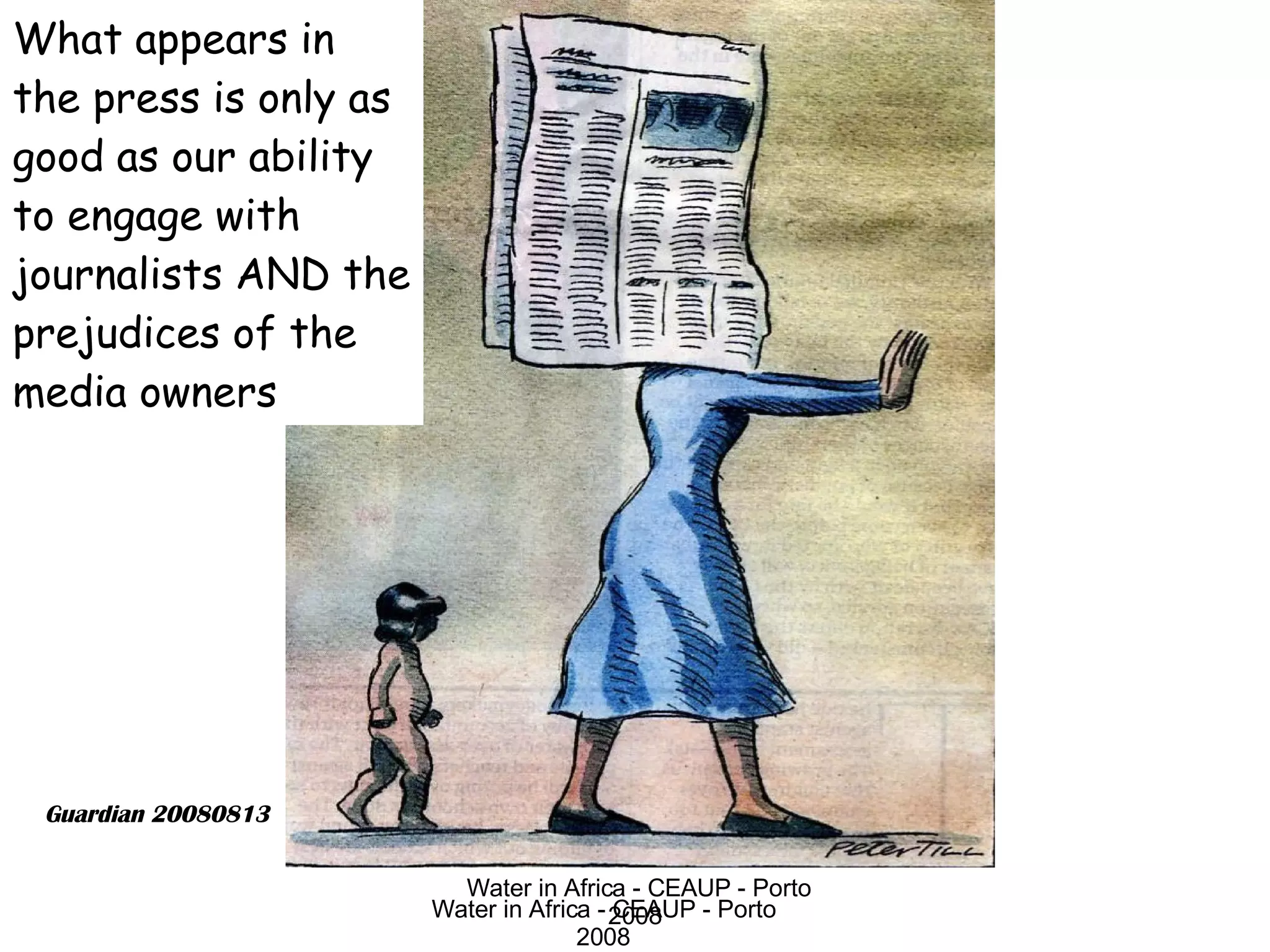
Some thoughts on  virtual water  and water footprints and How such new ideas engage  with society and politics. For example via the press?? Water in Africa - CEAUP - Porto 2008
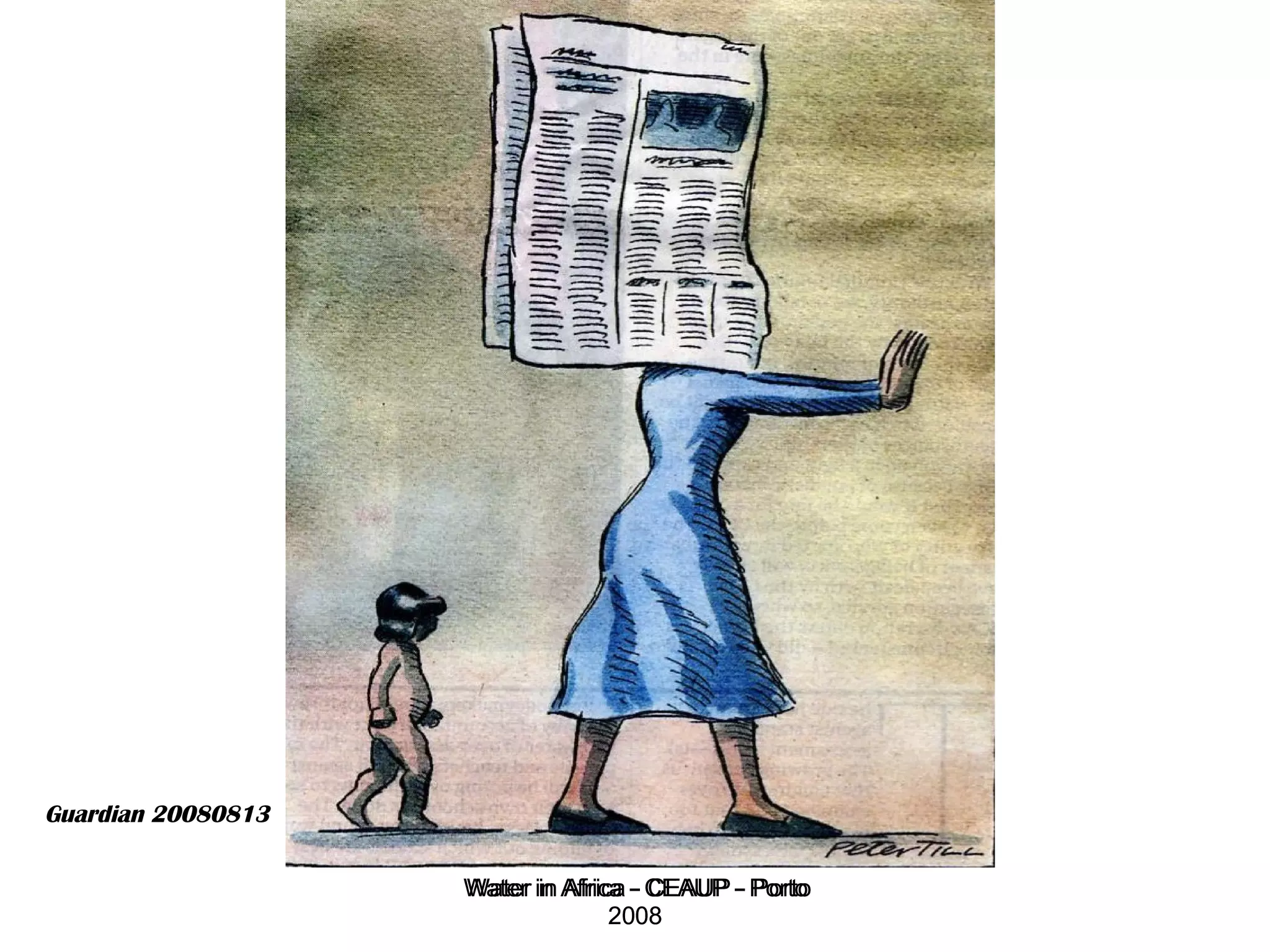
Water in Africa - CEAUP - Porto 2008 Guardian 20080813
Water in Africa - CEAUP - Porto 2008 Guardian 20080813 What appears in the press is only as good as our ability to engage with journalists AND the prejudices of the media owners
We must expect the political landscape  to be determining.  Consumers are embedded in this landscape. We must expect there to be  different types of governance  Water in Africa - CEAUP - Porto 2008
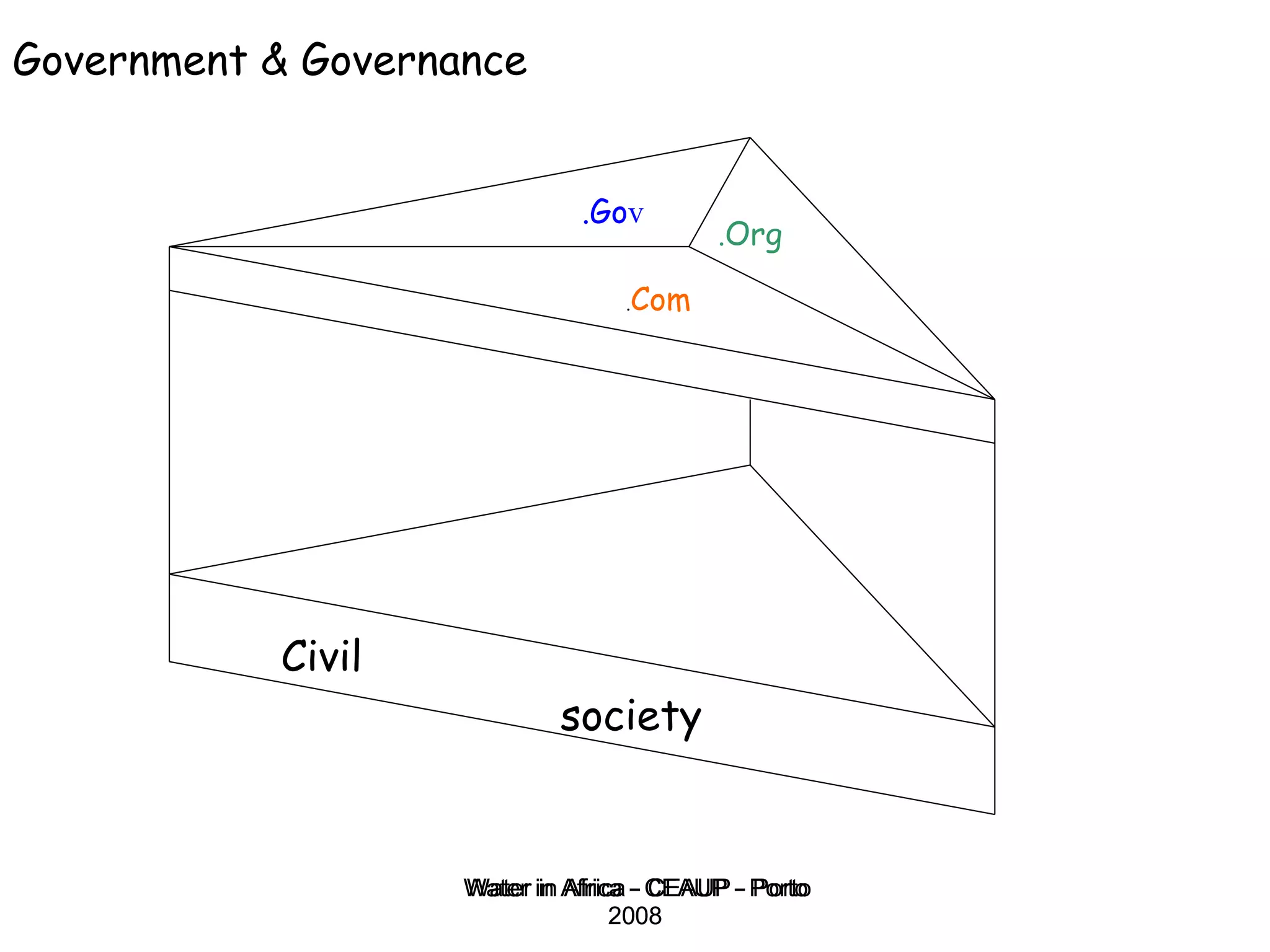
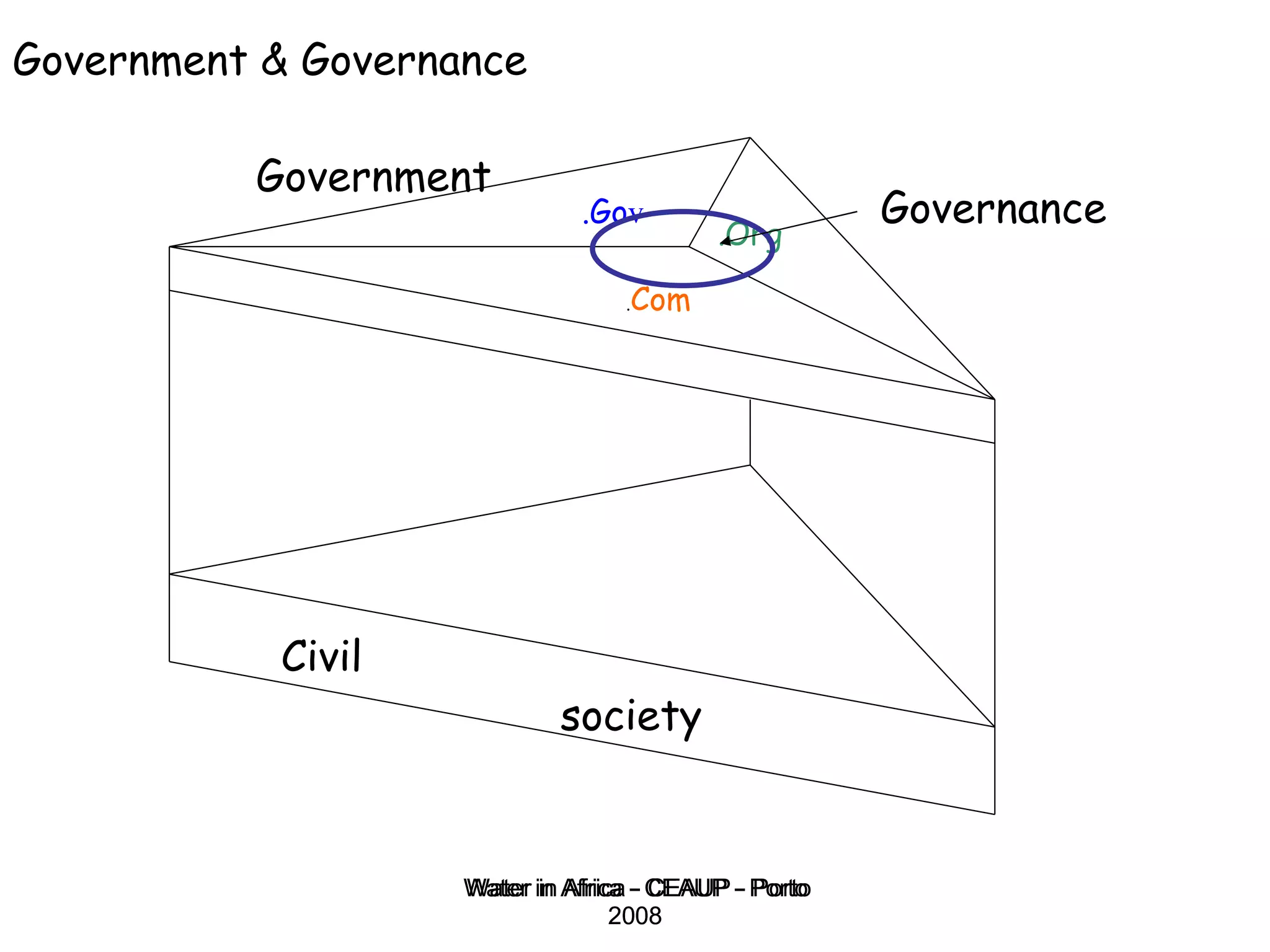
Water in Africa - CEAUP - Porto 2008 Government & Governance .Go v . Com . Org Civil society
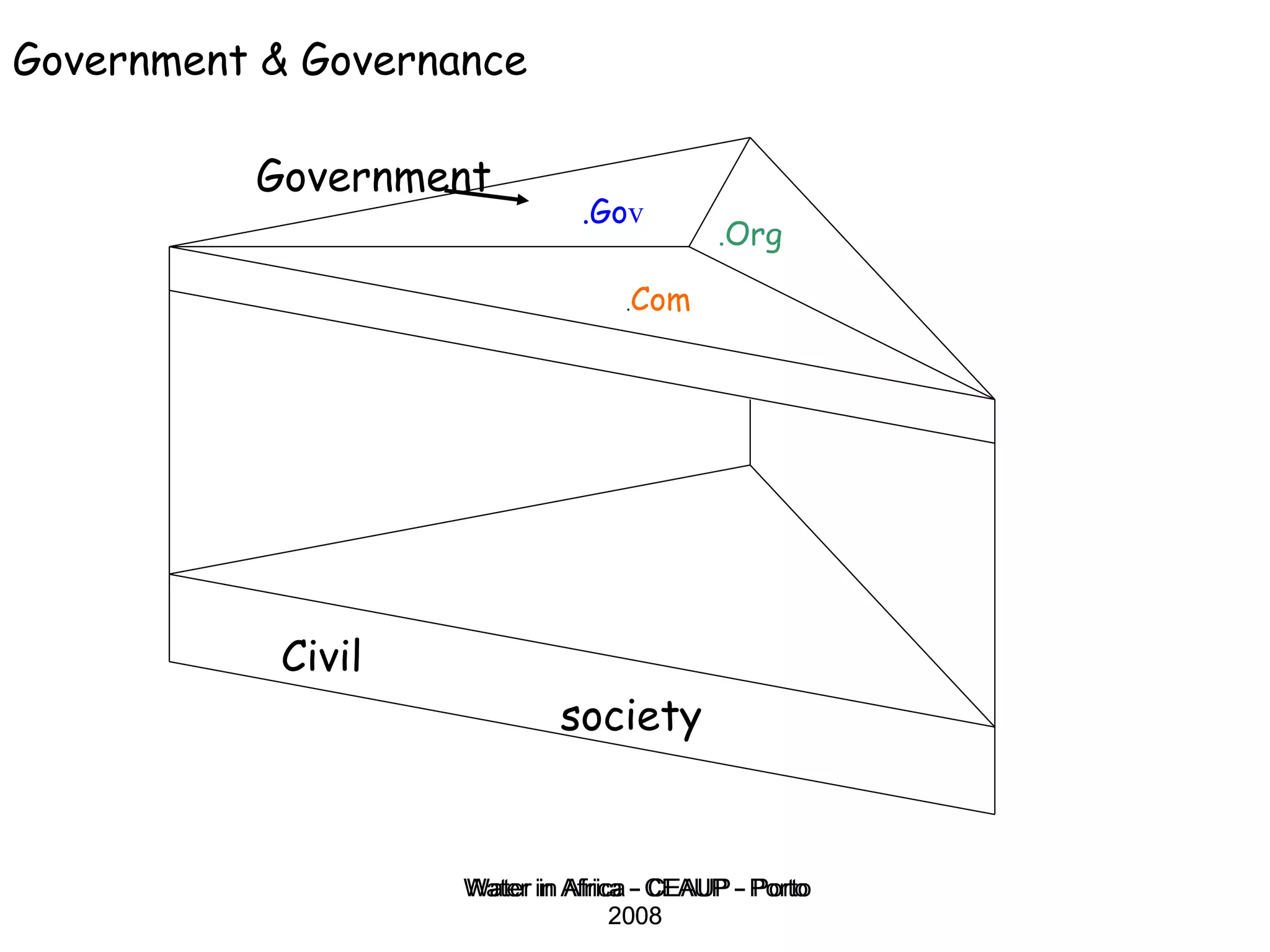
Water in Africa - CEAUP - Porto 2008 Government & Governance Government .Go v . Com . Org Civil society
Water in Africa - CEAUP - Porto 2008 Government & Governance Government Governance .Go v . Com . Org Civil society
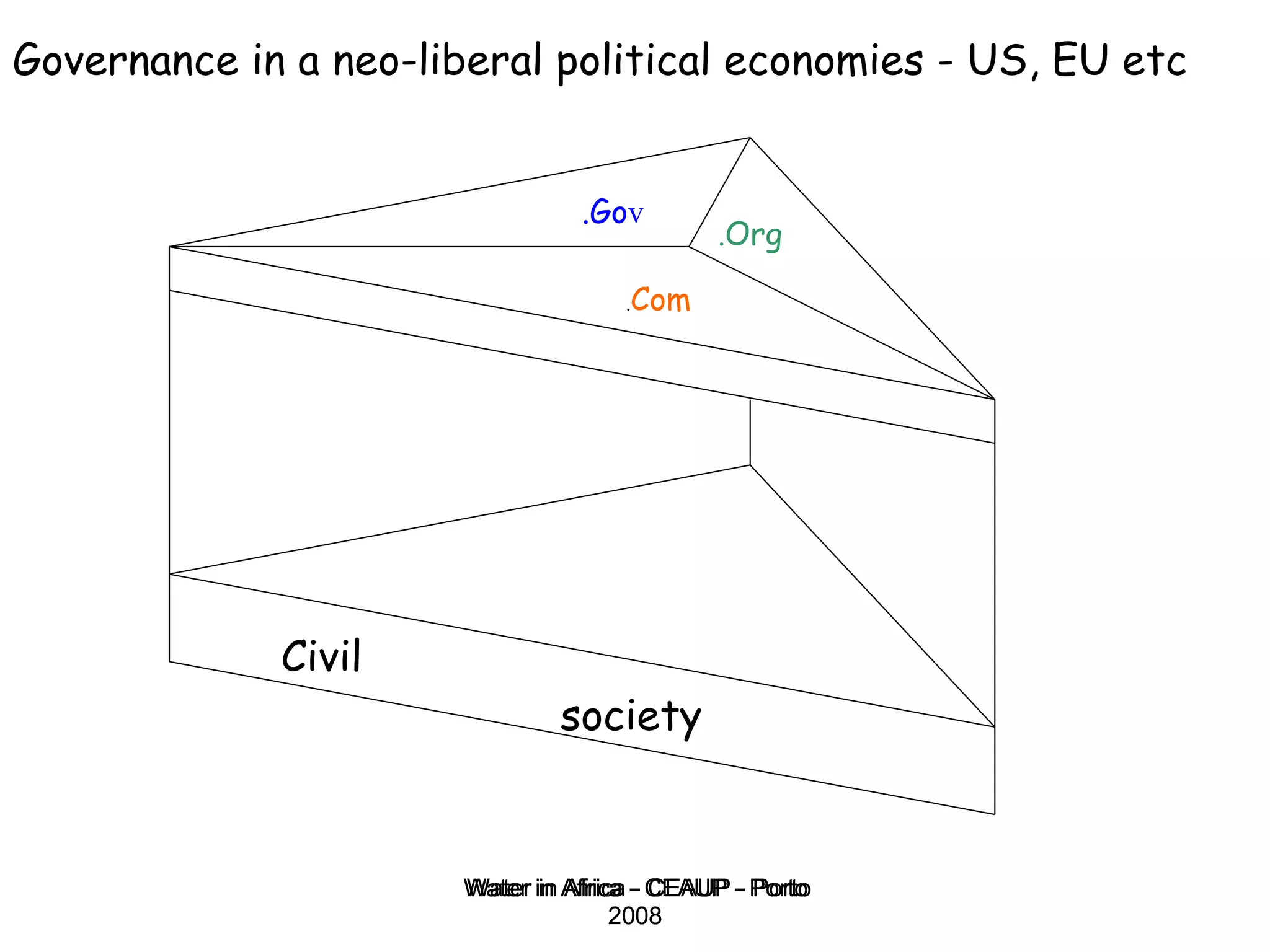
Water in Africa - CEAUP - Porto 2008 Governance in a neo-liberal political economies - US, EU etc .Go v . Com . Org Civil society
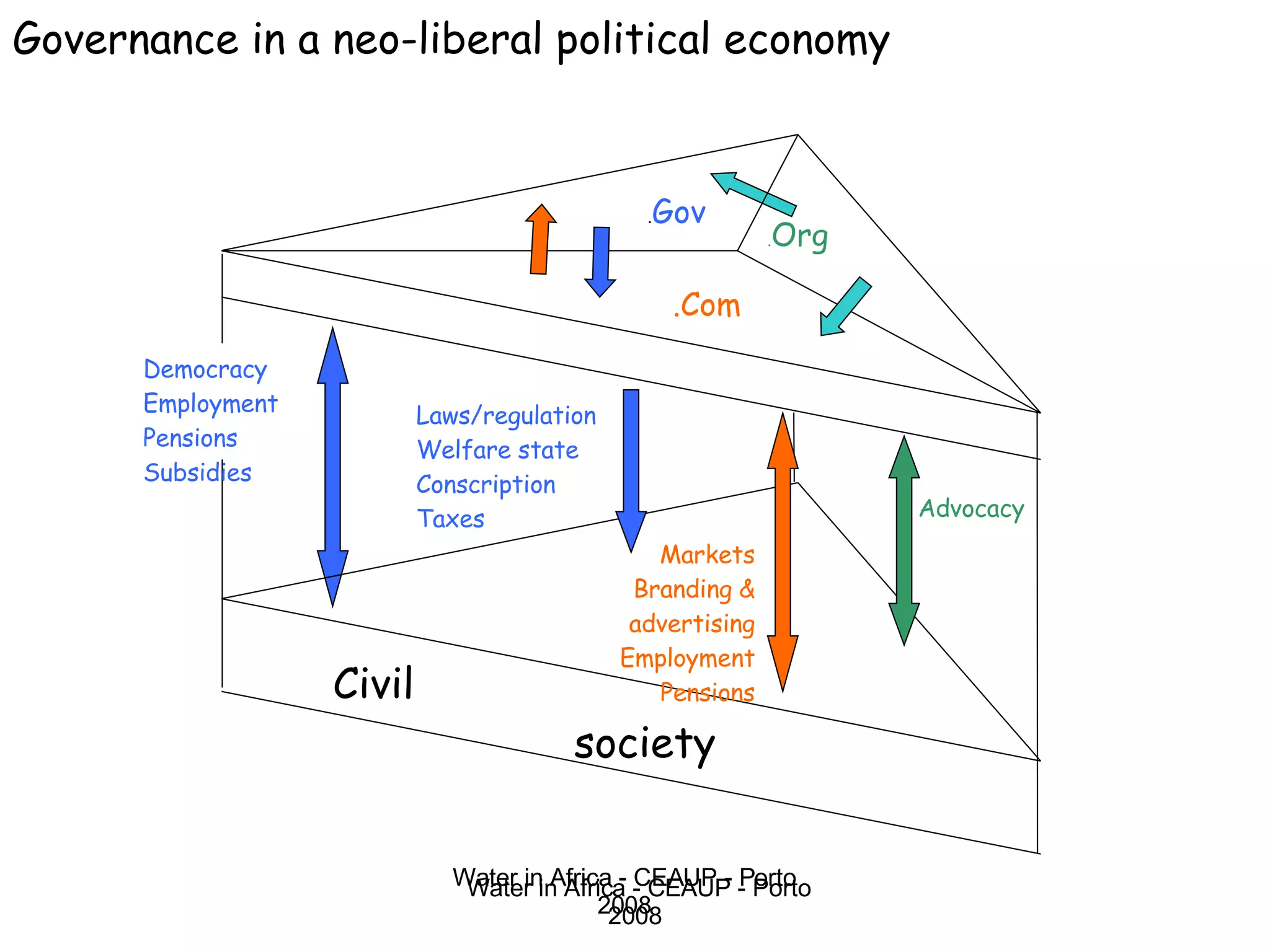
Water in Africa - CEAUP - Porto 2008 Governance in a neo-liberal political economy . Gov .Com . Org Civil society Democracy Employment Pensions Subsidies Laws/regulation Welfare state Conscription Taxes Advocacy Markets Branding & advertising Employment Pensions
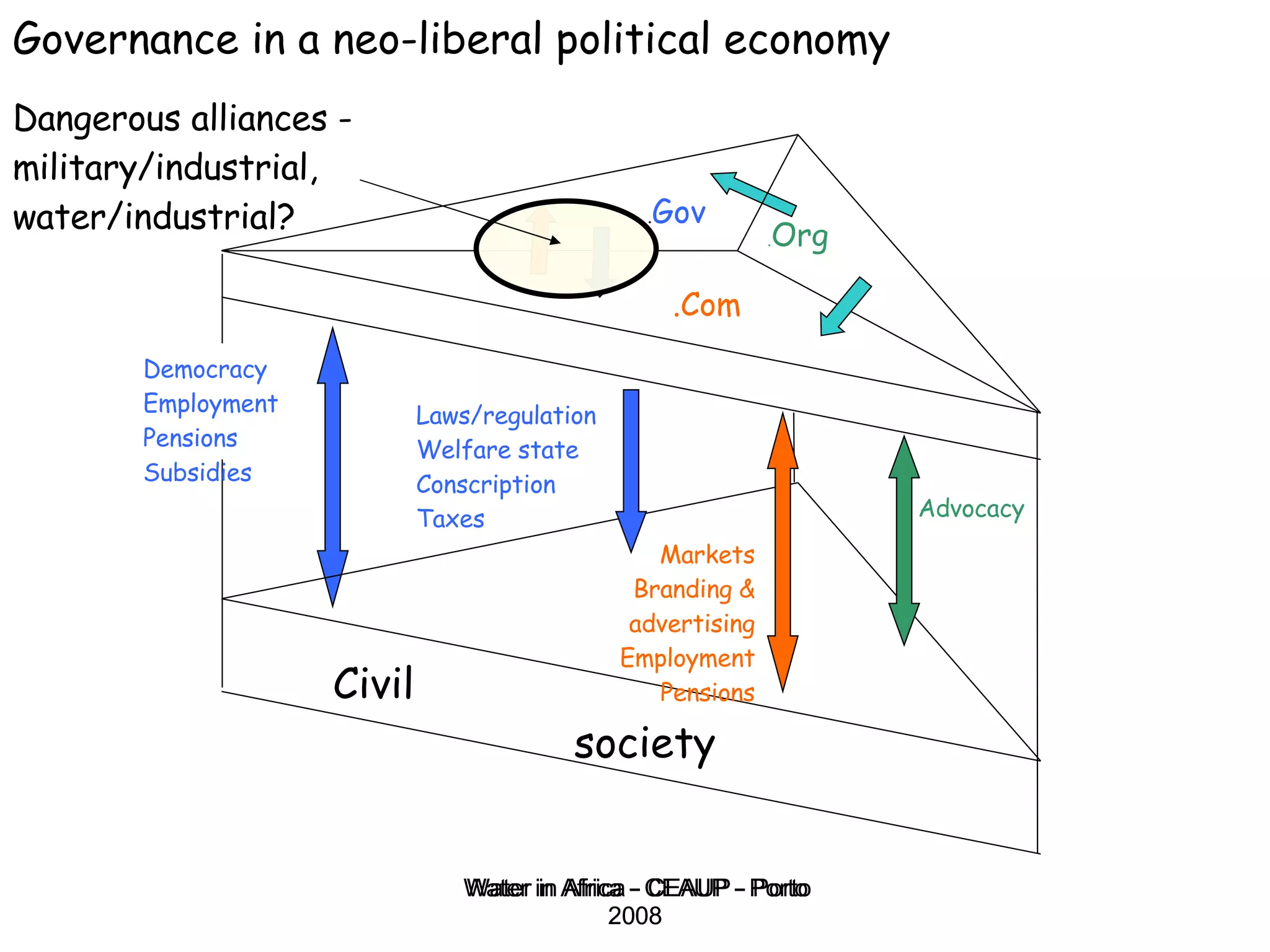
Water in Africa - CEAUP - Porto 2008 Governance in a neo-liberal political economy Dangerous alliances - military/industrial, water/industrial? . Gov .Com . Org Civil society Democracy Employment Pensions Subsidies Laws/regulation Welfare state Conscription Taxes Advocacy Markets Branding & advertising Employment Pensions
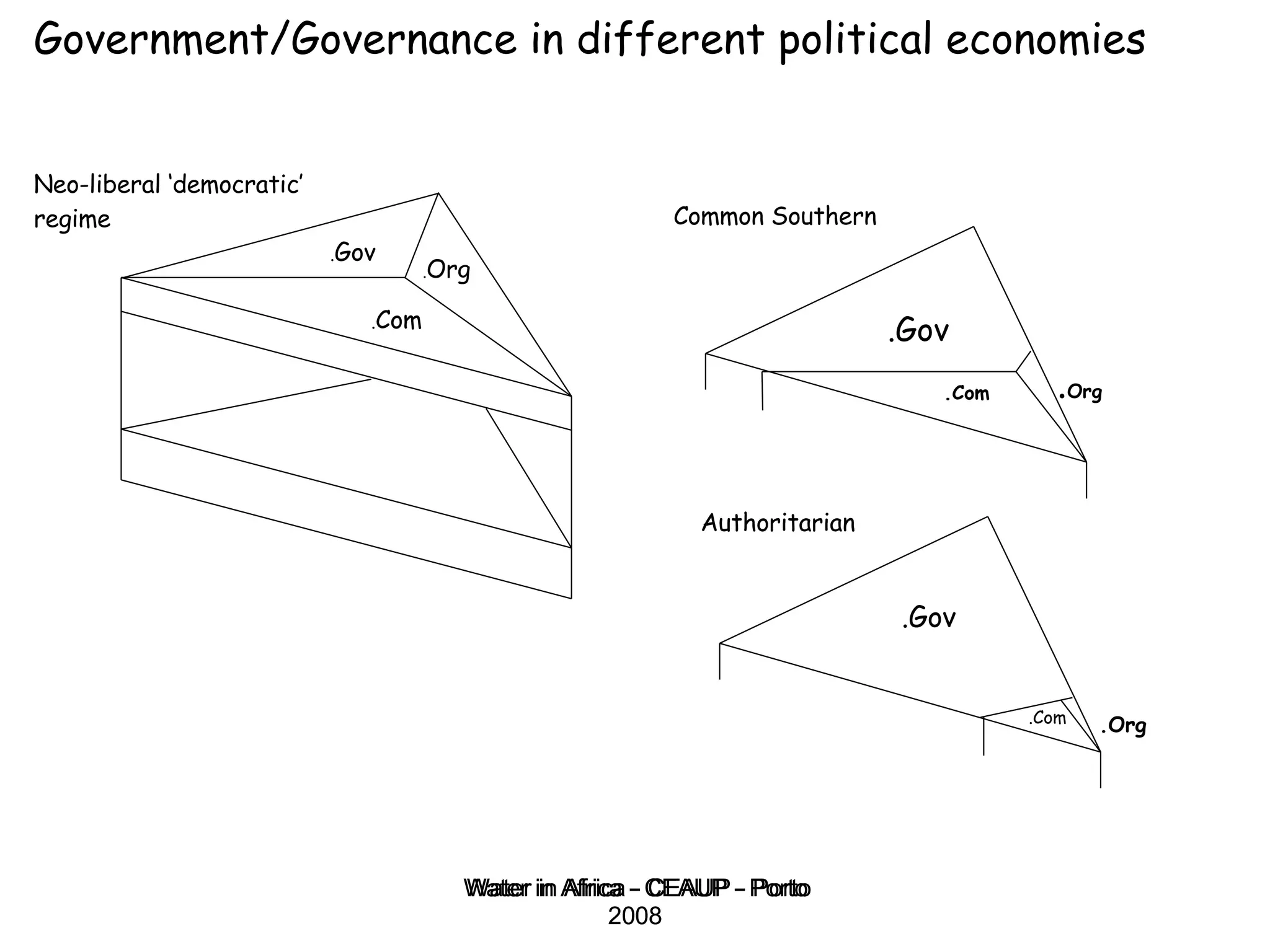
Water in Africa - CEAUP - Porto 2008 .Org Government/Governance in different political economies . Gov . Com . Org Neo-liberal ‘democratic’ regime .Gov .Com . Org .Gov .Com Common Southern Authoritarian
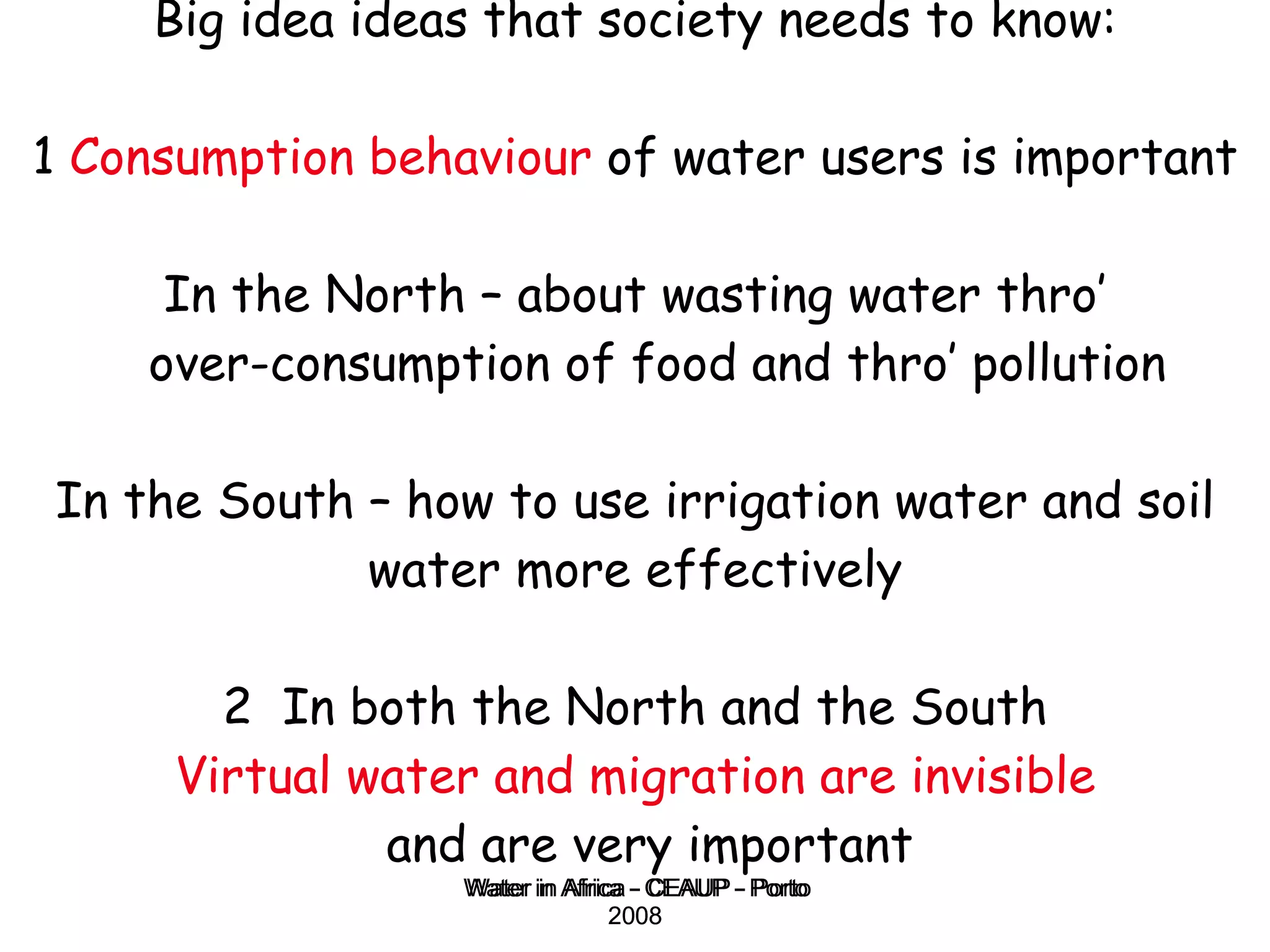
Big idea ideas that society needs to know: 1  Consumption behaviour  of water users is important   In the North – about wasting water thro’  over-consumption of food and thro’ pollution In the South – how to use irrigation water and soil water more effectively 2  In both the North and the South Virtual water and migration are invisible   and are very important Water in Africa - CEAUP - Porto 2008
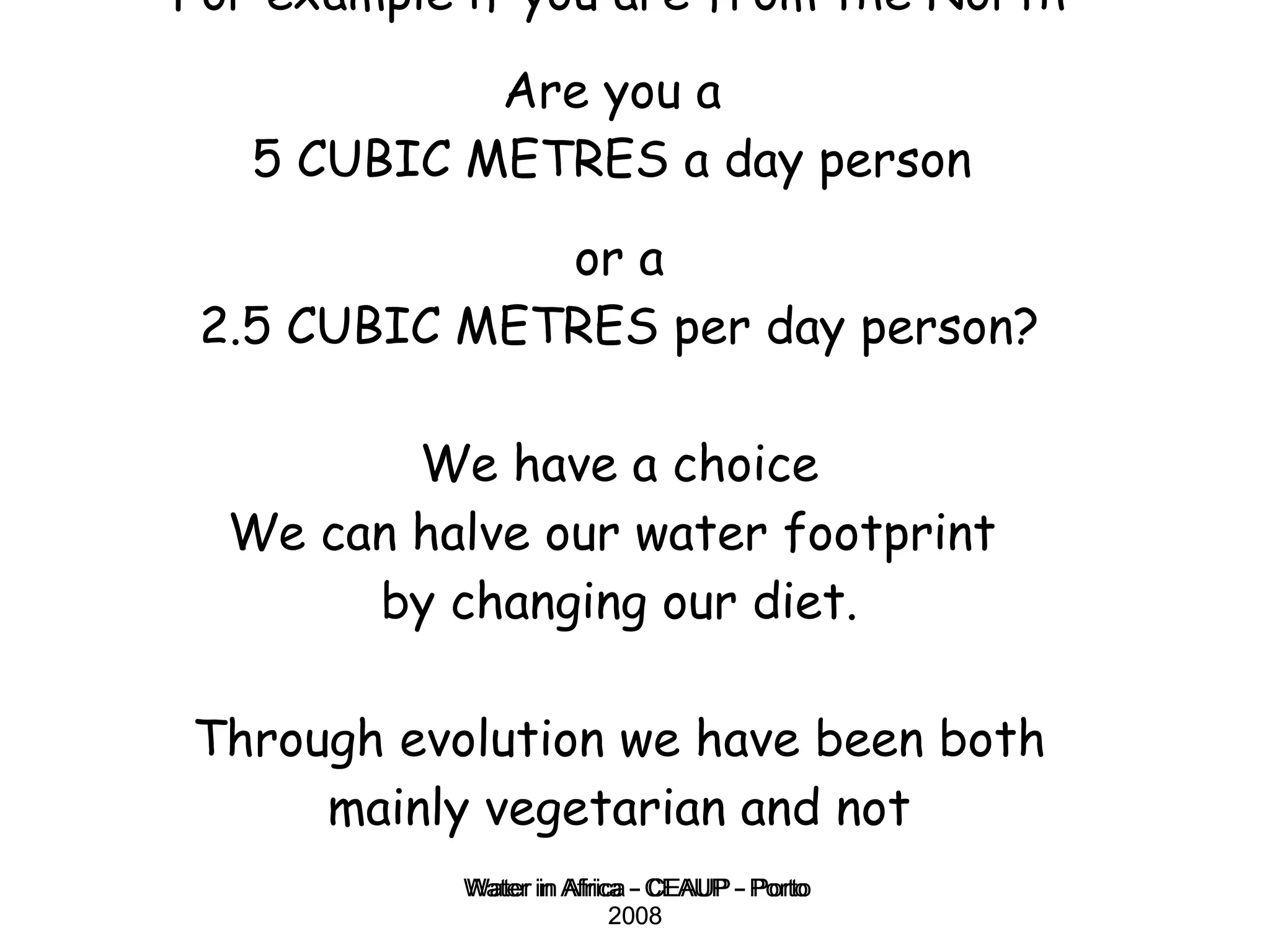
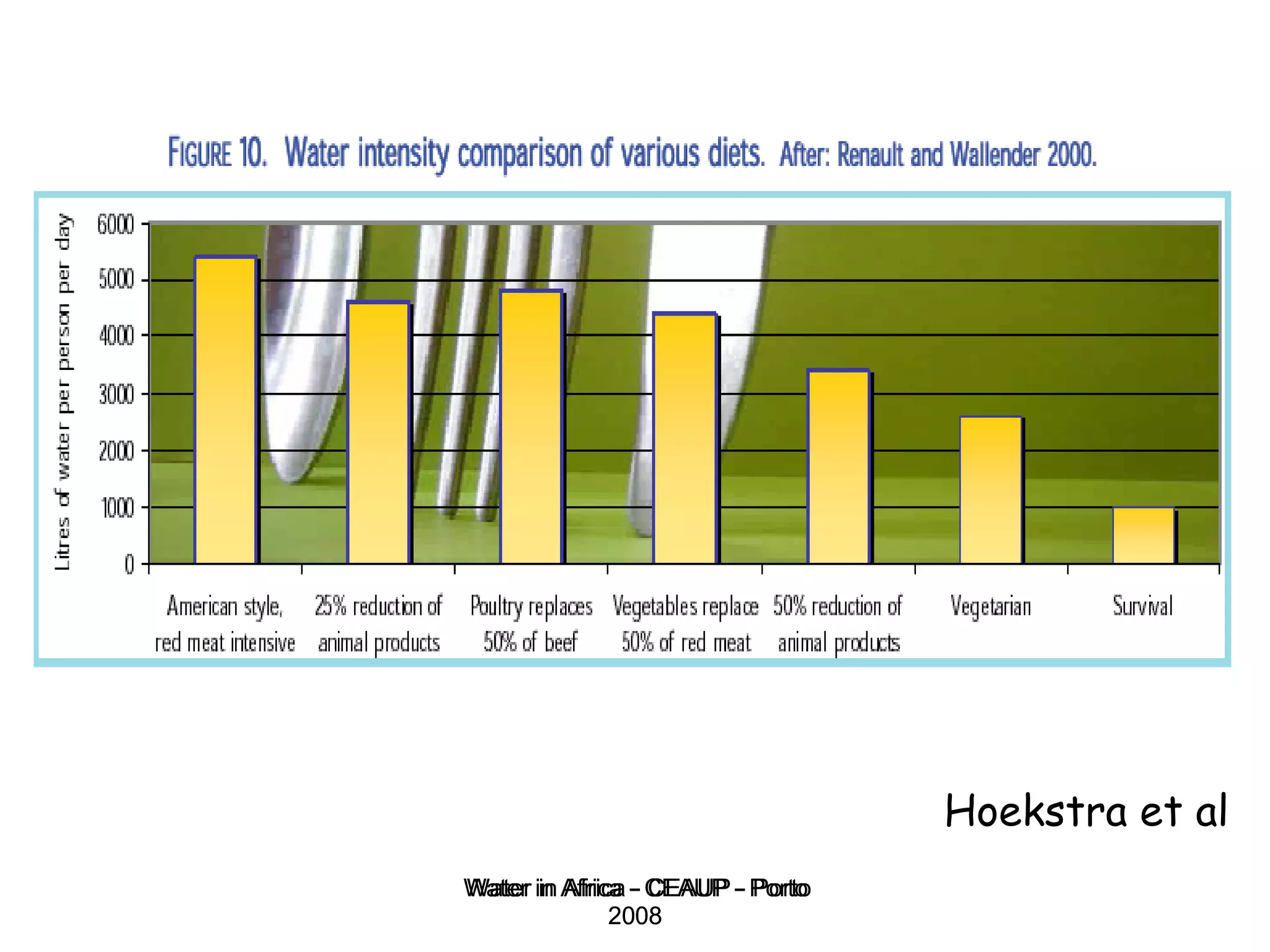
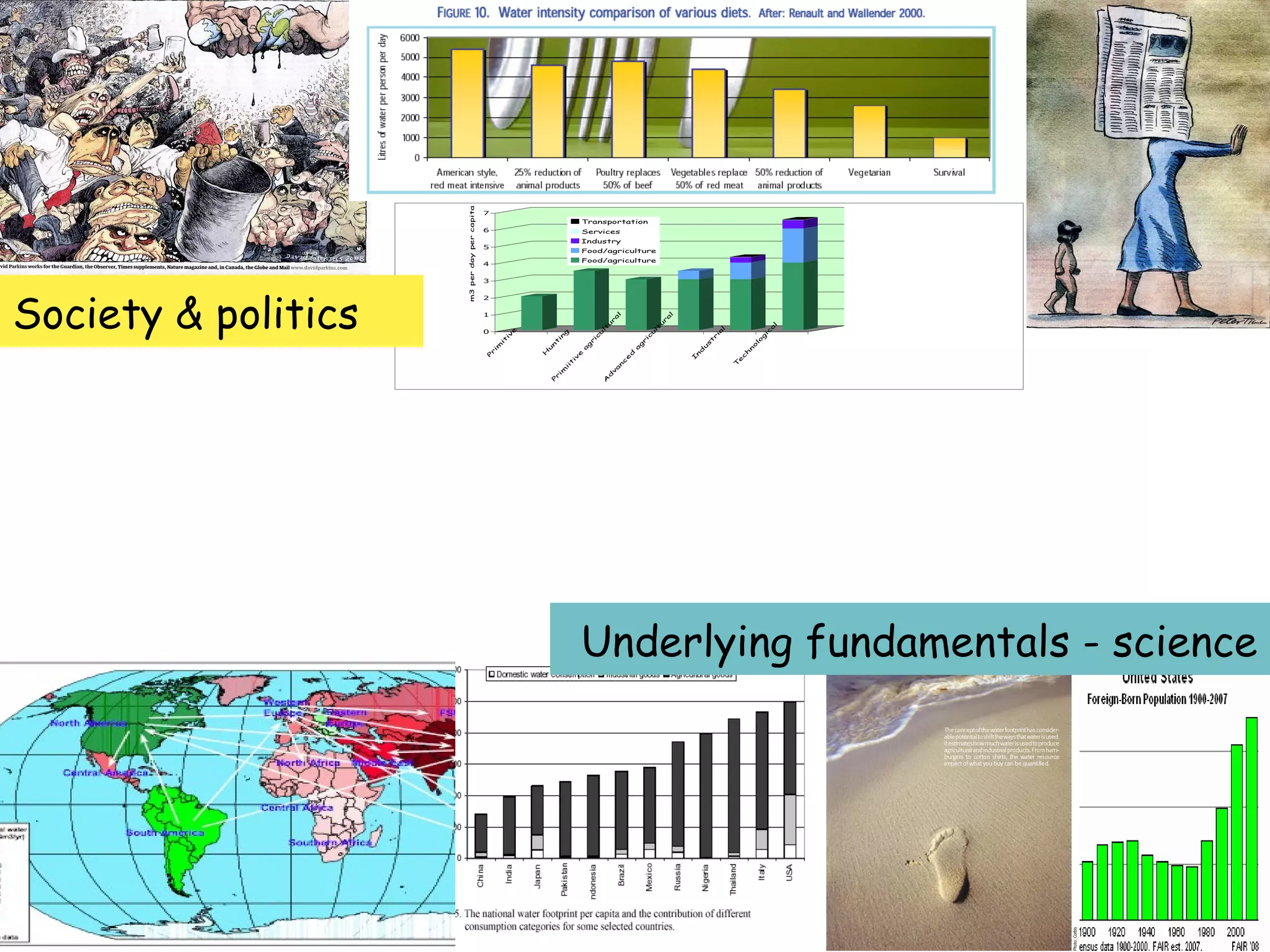
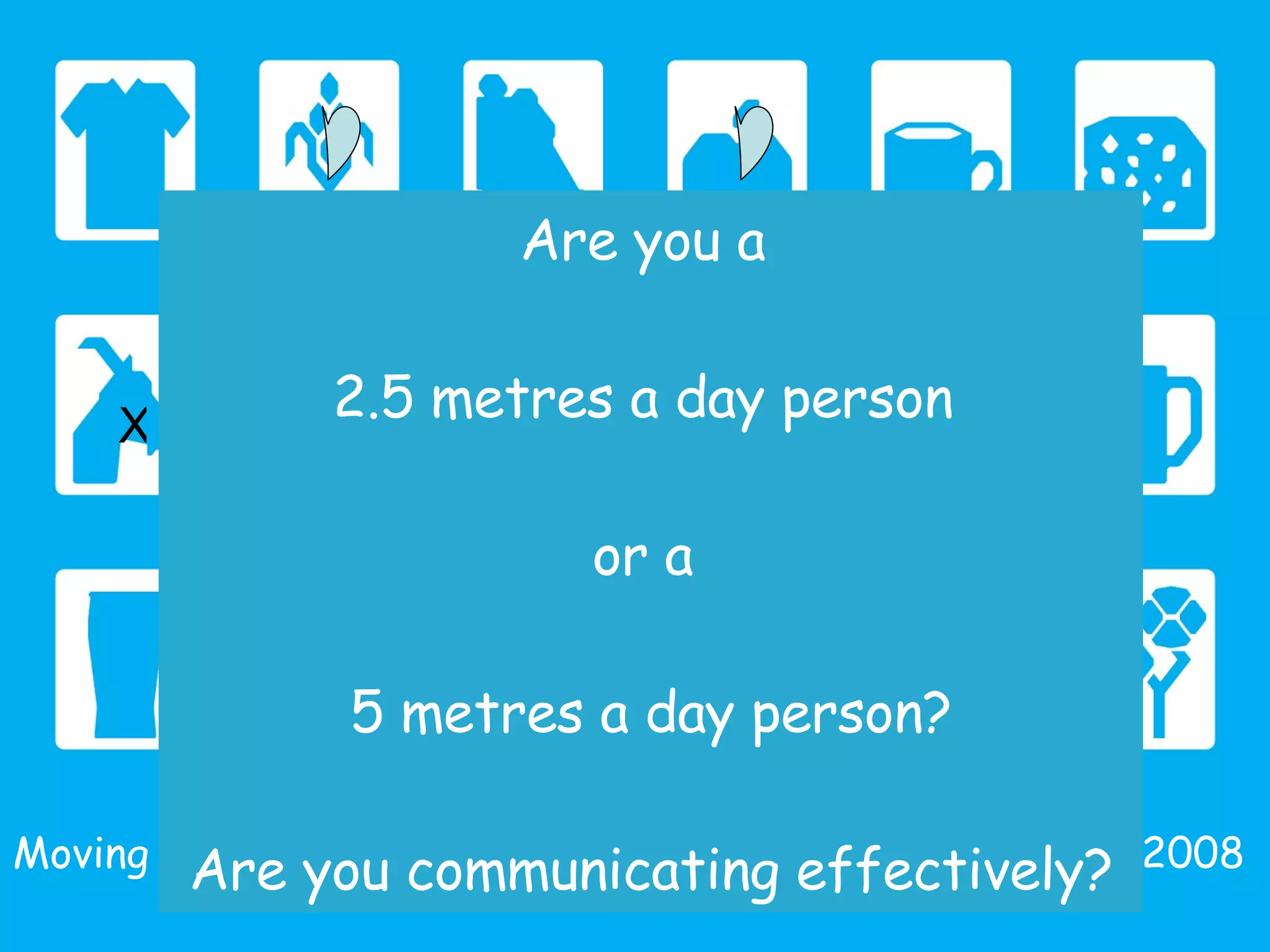
For example if you are from the North Are you a  5 CUBIC METRES a day person  or a 2.5 CUBIC METRES per day person? We have a choice We can halve our water footprint  by changing our diet.  Through evolution we have been both  mainly vegetarian and not Water in Africa - CEAUP - Porto 2008
Water in Africa - CEAUP - Porto 2008 Estimates of historical consumption of the different types of water Energy
Water in Africa - CEAUP - Porto 2008 Estimates of historical consumption of the different types of water Energy 500k 50k Years BP log scale 50 500 Half million years 200 years 5k
Water in Africa - CEAUP - Porto 2008 Comparison of historical consumption of energy  [1000kcal/day]   and water capita  [m3/day] Energy
So do you all use? 2.5 or 5.0 m3/day for food Water in Africa - CEAUP - Porto 2008
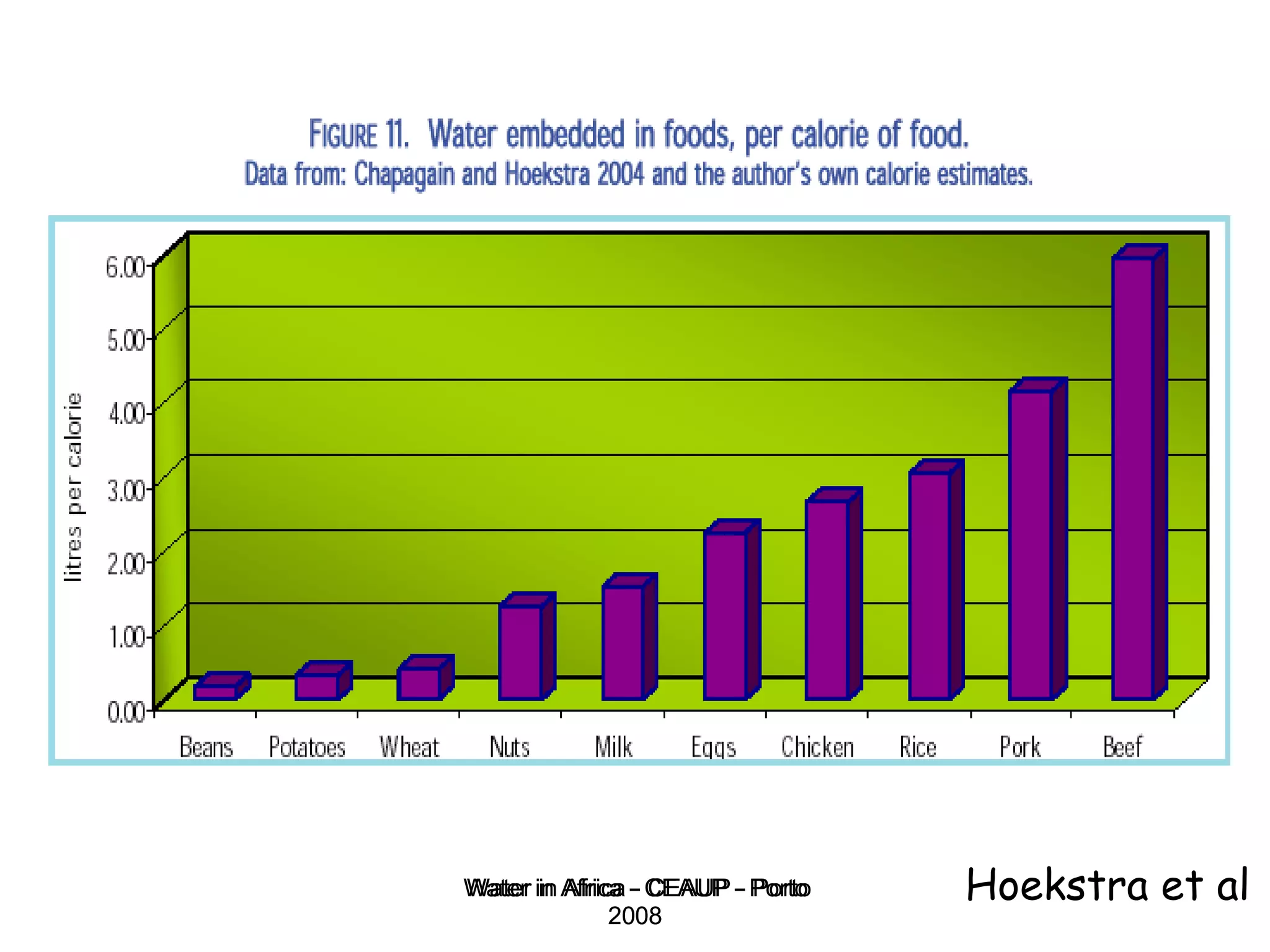
Water in Africa - CEAUP - Porto 2008 Hoekstra et al
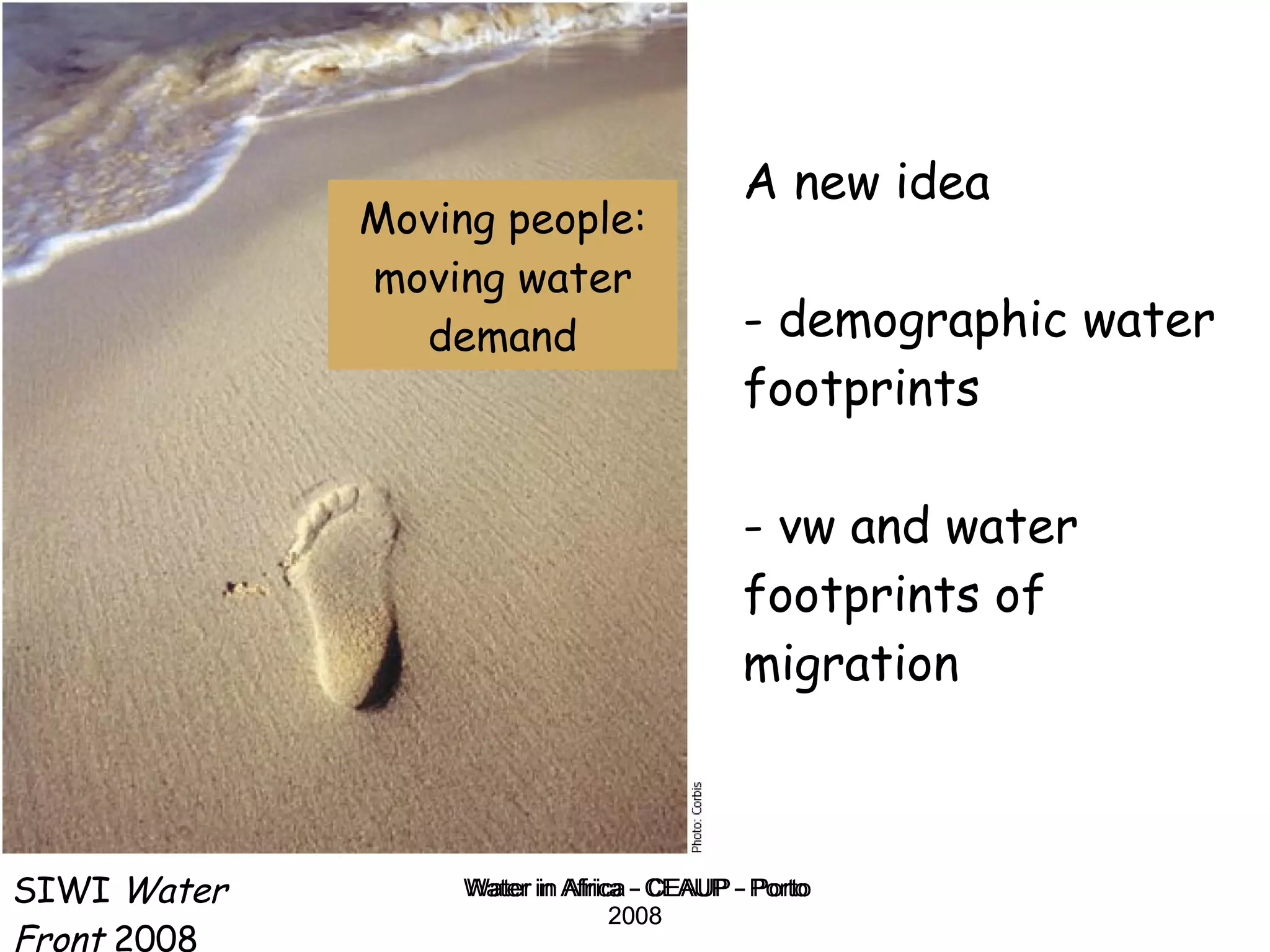
Water in Africa - CEAUP - Porto 2008 Moving people: moving water demand A new idea  - demographic water footprints  - vw and water footprints of migration SIWI  Water Front  2008
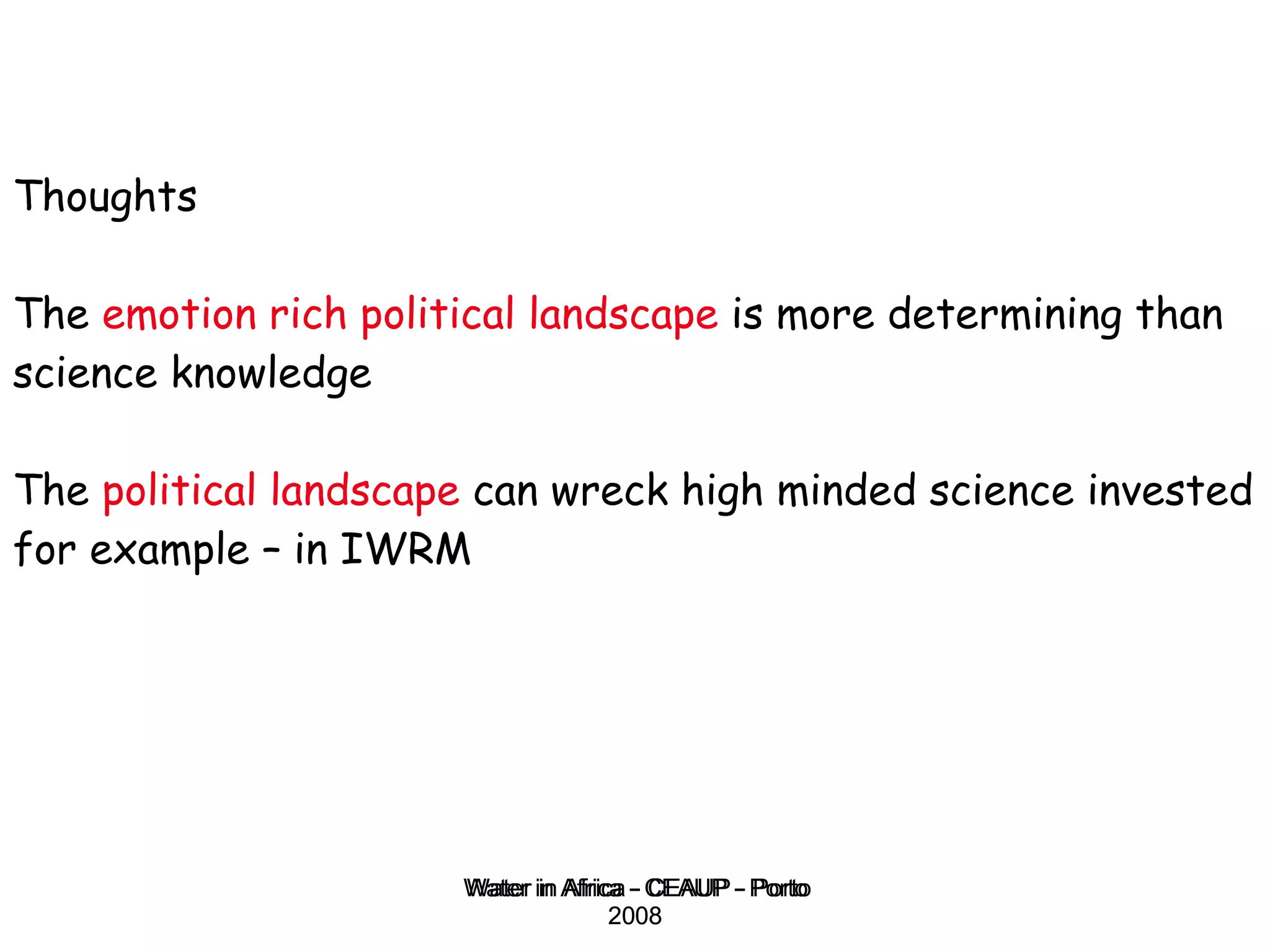
Thoughts The  emotion rich political landscape  is more determining than science knowledge The  political landscape  can wreck high minded science invested for example – in IWRM Water in Africa - CEAUP - Porto 2008
Key issues We must help each other: to learn about political landscapes to understand  consumption behaviour  - in the North & the South  to enhance human resources and create jobs with high returns to water . They solve the water and food problems of the water scarce.  If we all eat sensibly. Water in Africa - CEAUP - Porto 2008
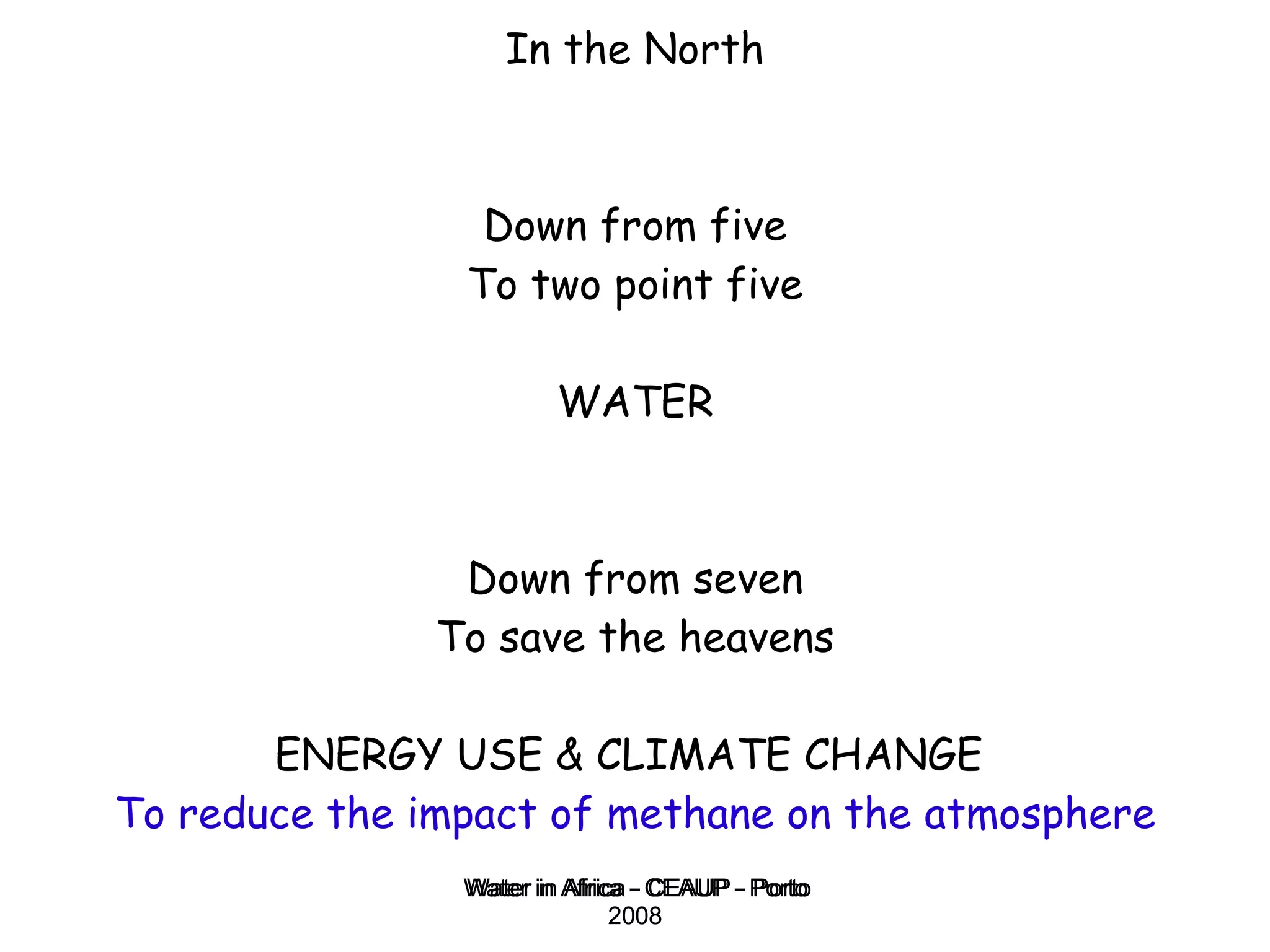
In the North Down from five To two point five WATER Down from seven To save the heavens ENERGY USE & CLIMATE CHANGE  To reduce the impact of methane on the atmosphere Water in Africa - CEAUP - Porto 2008
In Africa The challenge is to use existing water resources  blue water  - surface water and groundwater green water  - in the soil for rainfed crop & livestock production The yield gap  - controversial Increase storage  - also controversial Water in Africa - CEAUP - Porto 2008
Water in Africa - CEAUP - Porto 2008 Society & politics Underlying fundamentals - science
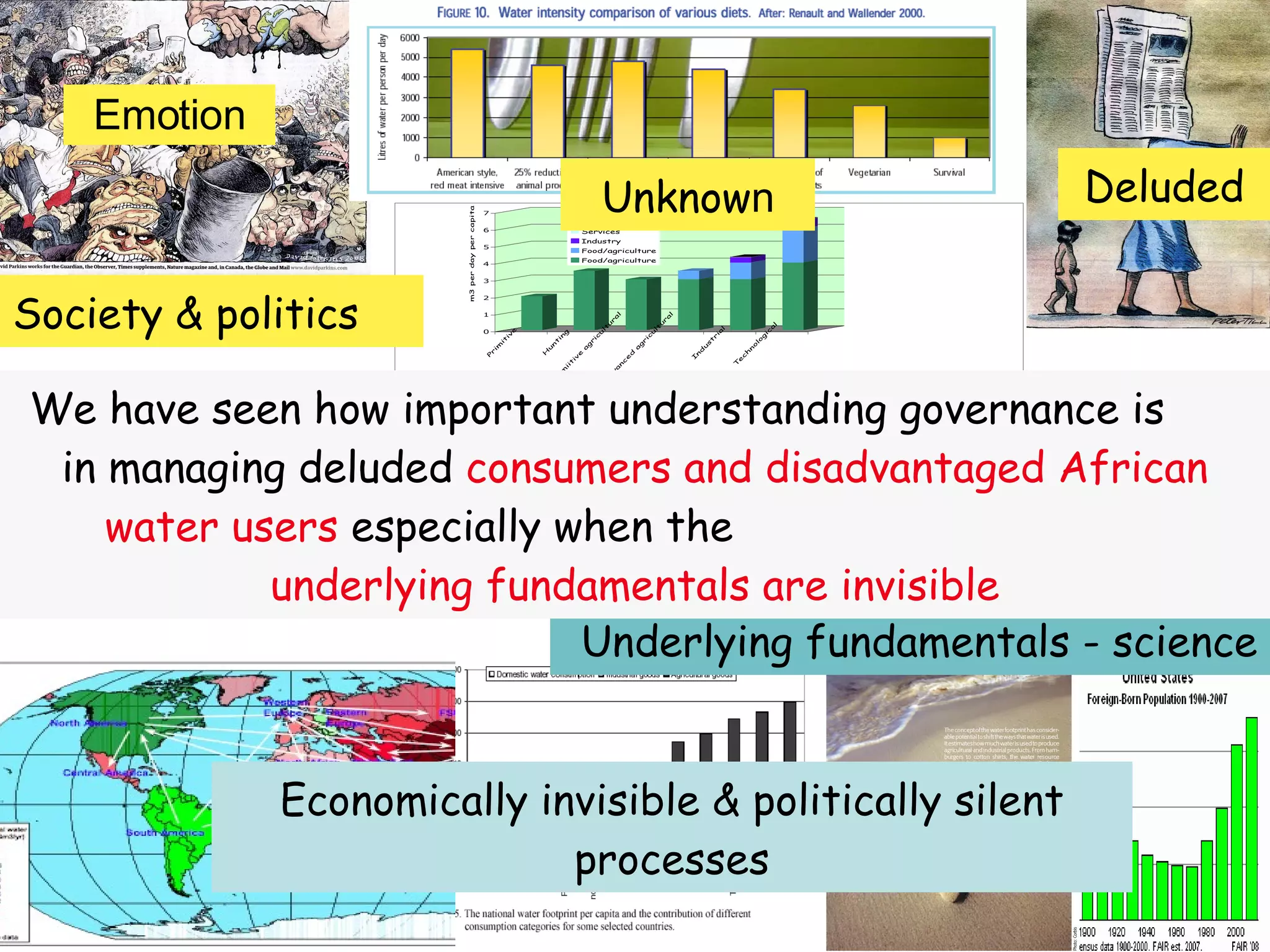
Water in Africa - CEAUP - Porto 2008 Society & politics Underlying fundamentals - science Emotion Unknow n Deluded Economically invisible & politically silent processes We have seen how important understanding governance is  in managing deluded  consumers and disadvantaged African water users  especially when the   underlying fundamentals are invisible
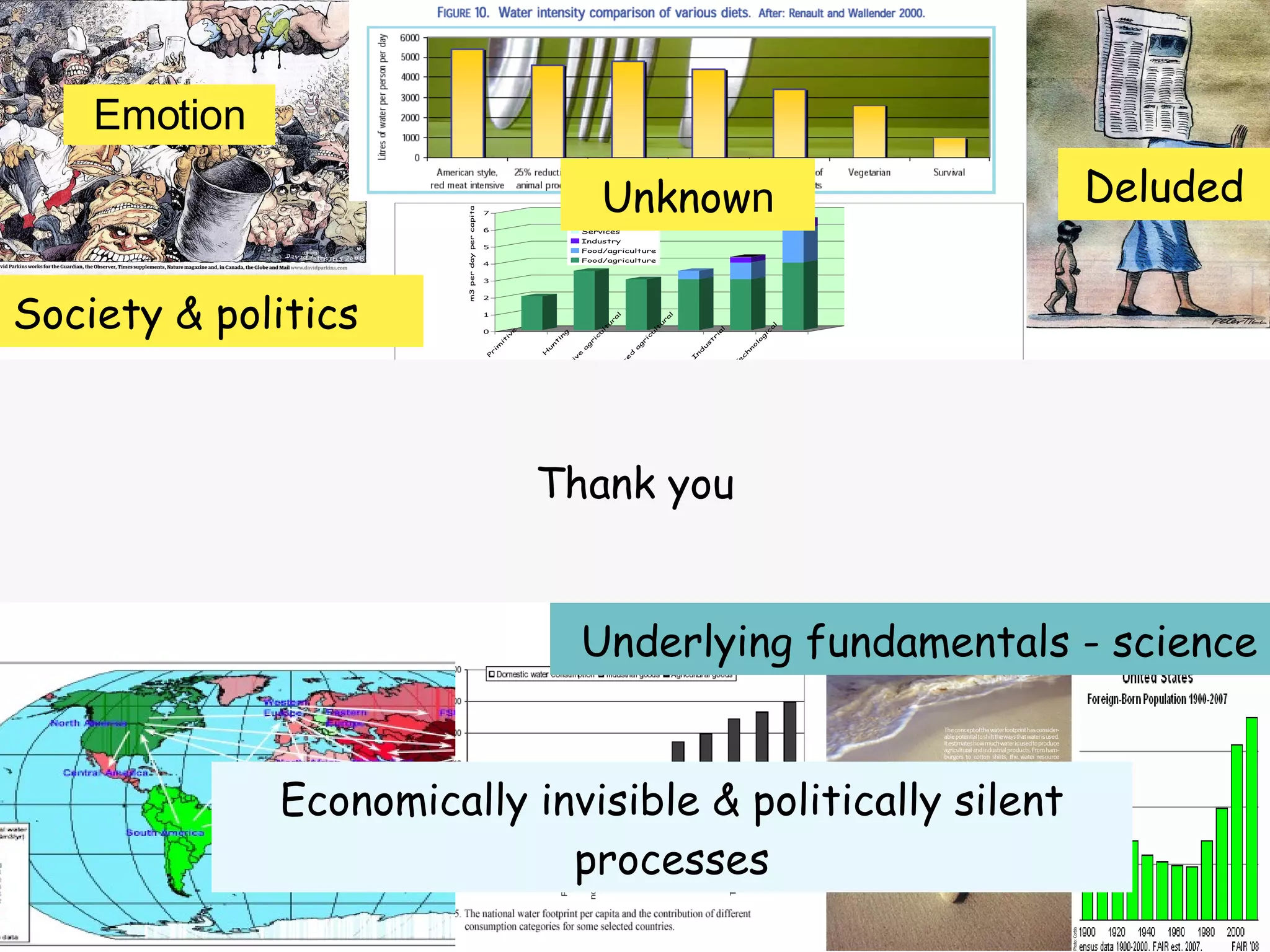
Water in Africa - CEAUP - Porto 2008 Society & politics Underlying fundamentals - science Emotion Unknow n Deluded Economically invisible & politically silent processes Thank you
Water in Africa - CEAUP - Porto 2008 Moving the minds of consumers  Angela Morelli 2008 Are you a  2.5 metres a day person  or a  5 metres a day person? Are you communicating effectively? X

Tony Allan Ppt

  • 1.
    Water in Africa- CEAUP - Porto 2008
  • 2.
    Water in Africa- CEAUP - Porto 2008 Moving the minds of consumers Hoekstra/Morelli 2008 Virtual or embedded water
  • 3.
    Water in Africa- CEAUP - Porto 2008 Moving the minds of consumers Hoekstra/Morelli 2008 Virtual or embedded water X X X X X
  • 4.
    Water in Africa- CEAUP - Porto 2008 Moving the minds of consumers Hoekstra/Angela 2008 Virtual or embedded water X X X X X
  • 5.
    Virtual water Capturing the invisible is easier than communicating the invisible to move the minds of consumers Tony Allan King’s College & SOAS London SIWI World Water Week 2008 Water in Africa - CEAUP - Porto 2008
  • 6.
    Virtual water Capturing the invisible is easier than COMMUNICATING the invisible to move the minds of CONSUMERS The importance of managing ourselves Water in Africa - CEAUP - Porto 2008
  • 7.
    Virtual Water Itcan be foolish to export crops (Fishelson 1985) Embedded water ‘solution’ (Allan 1990) Virtual water ‘trade’ (Allan 1993, ‘94, ‘96 etc) Modeling crop trade (Hoekstra & Hung 2001) Modeling livestock trade (Hoekstra & Chapagain 2003) Soil water in ‘trade’ (Aldaya, Hoekstra & Allan 2008) VW and migration (Allan 2008) Water in Africa - CEAUP - Porto 2008
  • 8.
    Water in Africa- CEAUP - Porto 2008 Water footprints (Hoekstra & Chapagain 2003-06 and Morelli 2008)
  • 9.
    Water in Africa- CEAUP - Porto 2008
  • 10.
    Water in Africa- CEAUP - Porto 2008
  • 11.
    Water in Africa- CEAUP - Porto 2008
  • 12.
    Water in Africa- CEAUP - Porto 2008
  • 13.
    LWRG 2007 Virtualwater ‘flows’ - crops & livestock (Chapagain & Hoekstra 2004)
  • 14.
    . LWRG 2007
  • 15.
    LWRG 2007 Virtualwater ‘flows’ - crops & livestock (Chapagain & Hoekstra 2004)
  • 16.
    LWRG 2007 Source:International Water Management Institute, Comprehensive Assessment of Water Management in Agriculture Research Report 4
  • 17.
    LWRG 2007 Theconsequences of asymmnetric rainfall Source Nasa
  • 18.
    LWRG 2007 Thepatterns of water use / water footprint vary globally and will change in future Source: Hoekstra & Chapagain
  • 19.
    LWRG 2007 Theconsequences of asymmnetric rainfall Source Nasa
  • 20.
    LWRG 2007 RESPONSE Global Irrigated Area Map Source IWMI.org Look at the International Water Management Institute [IWMI] website
  • 21.
    Global Irrigated AreaMap Source IWMI.org Look at the International Water Management Institute [IWMI] website
  • 22.
    Important contexts &issues in Africa Southern economies: • are in an early stage of the demographic transition with rising populations that need more food and jobs • some of the poorest - in Africa - face very challenging demographic scenarios Globally the demographic challenges of the past 50 years will NOT be repeated. Population is levelling off.
  • 23.
  • 24.
    LWRG 2007 1268mn1453mn 1424mn 1004mn 1448mn 1808mn Consequences of different political cultures
  • 25.
    LWRG 2007 1268mn1453mn 1424mn 1004mn 1448mn 1808mn Consequences of different politcal cultures Non-vegetarian Vegetarian
  • 26.
    LWRG 2007 65mn108mn 145mn
  • 27.
    LWRG 2007 SeeFAO website for 1970 to 2000 animation Data for 2000
  • 28.
    Important contexts &issues in Africa Southern economies: • have limited adaptive capacity - economic diversification, infra- structures, capital, institutions, regulatory capacity • endure very negative terms of trade including the impacts of EU & US export prices for staple foods Virtual water ‘trade’ in an era of subsidised grain prices is a very mixed blessing especially in Africa WORLD PRICES PROBLEM?
  • 29.
    Important contexts &issues in the South Southern economies: • have very diverse political economies Consider China and India where there is significant poverty associated with rapid socio-economic transformation and the capacity to engage in, or avoid, VW ‘trade’ AND Africa - for example Ethiopia where its capacity to trade and transform are limited and world prices are a serious problem
  • 30.
    Important contexts &issues in the South The POLITICS of resource use and allocation in Africa are hard to manage and regulatory measures are difficult to install. Economic efficiency and consideration of the environment are not high priorities. Virtual water ‘trade’ is a welcome ‘solution’ mainly because it is: AN ECONOMICALLY INVISIBLE & A POLITICALLY SILENT SOLUTION. As a consequence if is not easily introduced into policy discourse.
  • 31.
    LWRG 2007 NileBasin - some exemplification of regional variation and water resources consequences
  • 32.
    LWRG 2007 FAO-Hydro-cycleTypes of water - green and blue water
  • 33.
    LWRG 2007 Livestocknot included
  • 34.
  • 35.
  • 36.
  • 37.
  • 38.
  • 39.
  • 40.
  • 41.
  • 42.
    Whose ideas matterin managing water? Ideas of science - observed science Ideas of society on say sustainability - constructed knowledge Ideas and discursive processes Ideas in the Governance Processes and the problems of engaging with the assumptions and expectations of consumers Consumers are embedded in society not in science Water in Africa - CEAUP - Porto 2008
  • 43.
    Who knows whatabout managing water? What is the role of science? Prediction Explanation To influence society & the political economy Water in Africa - CEAUP - Porto 2008
  • 44.
    Different ways ofscientific knowing? To predict Modelling Sciences To explain Social & politics theory To influence Activist science Water in Africa - CEAUP - Porto 2008
  • 45.
    Water in Africa- CEAUP - Porto 2008 What is relevant? What methods used? What is truth? - significance of precision & accuracy What knowledge Observed versus constructed Co nstructed knowledge will always overwhelm observed science The abstract always overwhelms the concrete . Marx 1850 Different assumptions of the 3 types of science about:
  • 46.
    Water in Africa- CEAUP - Porto 2008 The abstract always overwhelms the concrete . Marx 1850 Politicians were invented to deal with ambiguity which is always associated with uncertainty Modeling scientists deal with risk which can be captured with the numbers and the language of probability Politicians know what the game is about and accept the excitement of uncertainty Most scientists avoid the excitement of uncertainty.
  • 47.
    Water in Africa- CEAUP - Porto 2008 TYPES OF >> SCIENCE Empirical–analytic inquiry Interpretive inquiry Liberatory Inquiry (e.g. Participatory Research) Purpose Experimental science in search of causal explanations and laws in order to make predictions Interpretive science in search of subjective meanings and understanding in the world of lived experience. Liberating (Humanising) science to create movement for personal and social transformation in order to redress injustices, support peace and form democratic spaces. Nature of reality A unique, real, social world exists to be studied by independent observers. Recognition is given to distinct, positive facts and observable phenomena Pluralistic and relativist (multiple realities dependent on individual’s perceptions). People make purposeful acts based on their perceptions of feelings and events and so shape their realities by their behaviour. The social world is humanly and collectively constructed with and within a historical context. People are active subjects in the world and are constantly in relationships of power: with the self, with others, with nature. Nature of Knowledge Objective truth exists. Objectivity (detached neut-rality) and value-free science is possible and desirable. Logical, deduc-tive, rational findings. Know-ledge is an end in itself. Knowledge is a social, subjective construction. Language contextualises the meaning of data. The method used justifies the knowledge produced. People can change their level of consciousness through learning. Objectivity does not exist. Fundamental human needs drive the process of inquiry. Holistic dimensions of knowing. Know’Produc’d Technical instrumental Interpretive Interactive Critical, Spiritual Values reflected Deterministic application:. Concerned with ‘mainten-ance of evolutionary change of status quo’. Control over behaviour & environment Humanistic application: ‘growth metaphor with self-actualisation of indi-viduals within meritocratic forms of social life. Transformative process. Belief in people’s capacity to work together for equitable decision-making and fair distribution of resources.
  • 48.
    Water in Africa- CEAUP - Porto 2008 Modelling science Explanatory science Activist science TYPES OF >> SCIENCE Empirical–analytic inquiry Interpretive inquiry Liberatory Inquiry (e.g. Participatory Research) Purpose Experimental science in search of causal explanations and laws in order to make predictions Interpretive science in search of subjective meanings and understanding in the world of lived experience. Liberating (Humanising) science to create movement for personal and social transformation in order to redress injustices, support peace and form democratic spaces. Nature of reality A unique, real, social world exists to be studied by independent observers. Recognition is given to distinct, positive facts and observable phenomena Pluralistic and relativist (multiple realities dependent on individual’s perceptions). People make purposeful acts based on their perceptions of feelings and events and so shape their realities by their behaviour. The social world is humanly and collectively constructed with and within a historical context. People are active subjects in the world and are constantly in relationships of power: with the self, with others, with nature. Nature of Knowledge Objective truth exists. Objectivity (detached neut-rality) and value-free science is possible and desirable. Logical, deduc-tive, rational findings. Know-ledge is an end in itself. Knowledge is a social, subjective construction. Language contextualises the meaning of data. The method used justifies the knowledge produced. People can change their level of consciousness through learning. Objectivity does not exist. Fundamental human needs drive the process of inquiry. Holistic dimensions of knowing. Know’Produc’d Technical instrumental Interpretive Interactive Critical, Spiritual Values reflected Deterministic application:. Concerned with ‘mainten-ance of evolutionary change of status quo’. Control over behaviour & environment Humanistic application: ‘growth metaphor with self-actualisation of indi-viduals within meritocratic forms of social life. Transformative process. Belief in people’s capacity to work together for equitable decision-making and fair distribution of resources.
  • 49.
    Society and watermanaging professionals and policy-makers – POLITICAL PROCESSES Ecosystem scientists and economists – UNDERLYING FUNDAMENTALS Water in Africa - CEAUP - Porto 2008 Conceptualising trajectories of secure & sustainable water use defined by
  • 50.
    Water resource useTime Water in Africa - CEAUP - Porto 2008
  • 51.
    Water resource useTime The ecosystem science and economics version of sustainable management – reflecting underlying fundamentals Water in Africa - CEAUP - Porto 2008
  • 52.
    Water resource useTime The ecosystem science and economics version of sustainable management – reflecting underlying fundamentals Society’s version of sustainable water management – politically constructed, and driven by society, culture and history. Infrastructure as a major part of the solution Water in Africa - CEAUP - Porto 2008
  • 53.
    Water resource useTime The ecosystem science and economics version of sustainable management – reflecting underlying fundamentals Society’s version of sustainable water management – politically constructed, and driven by society, culture and history The discursive political process that could lead to the convergence of the trajectories. Socio-economic development & politics are the means that change the trajectory - outside the water sector Water in Africa - CEAUP - Porto 2008
  • 54.
    Water resource useTime The ecosystem science and economics version of sustainable management – reflecting underlying fundamentals Society’s version of sustainable water management – politically constructed, and driven by society, culture and history The discursive political process that could lead to the convergence of the trajectories. Socio-economic development & politics are the means that change the trajectory Should Water in Africa - CEAUP - Porto 2008
  • 55.
    Water resource useTime The ecosystem science and economics version of sustainable management – reflecting underlying fundamentals Society’s version of sustainable water management – politically constructed, and driven by society, culture and history The discursive political process that could lead to the convergence of the trajectories. Socio-economic development & politics are the means that change the trajectory Should Can Water in Africa - CEAUP - Porto 2008
  • 56.
    Water resource useTime The ecosystem science and economics version of sustainable management – reflecting underlying fundamentals Society’s version of sustainable water management – politically constructed, and driven by society, culture and history The discursive political process that could lead to the convergence of the trajectories. Socio-economic development & politics are the means that change the trajectory Should Can How? IWRM reforms?? Water in Africa - CEAUP - Porto 2008
  • 57.
    Water resource useTime The ecosystem science and economics version of sustainable management – reflecting underlying fundamentals Society’s version of sustainable water management – politically constructed, and driven by society, culture and history The discursive political process that could lead to the convergence of the trajectories. Socio-economic development & politics are the means that change the trajectory Should Can How? IWRAM reforms are VERY POLITICAL ?? Water in Africa - CEAUP - Porto 2008
  • 58.
    Water demand is determined by consumers who have beliefs and expectations that are based on experience, cultural preferences, history and NOT on science Consumers and their assumptions are very important indeed The extravagant consumers in the North The optionless irrigators in the South Water in Africa - CEAUP - Porto 2008
  • 59.
    Water in Africa- CEAUP - Porto 2008
  • 60.
    Water in Africa- CEAUP - Porto 2008 The political landscape - consumers !! Science
  • 61.
    Water in Africa- CEAUP - Porto 2008 Underlying fundamentals Explanatory social sciences
  • 62.
    Water in Africa- CEAUP - Porto 2008 Science Policy
  • 63.
    Water in Africa- CEAUP - Porto 2008 But note Reason - the underlying fundamentals cannot prevail against the juggernaut of consumers’ emotions
  • 64.
    Water in Africa- CEAUP - Porto 2008
  • 65.
    Water in Africa- CEAUP - Porto 2008 As scientists have different ways of knowing - in modelling, explaining and as engaged activists Society also has different ways of knowing
  • 66.
    Water in Africa- CEAUP - Porto 2008 Civil society’s way .gov .org .com The four ways of knowing Douglas et al.
  • 67.
    Water in Africa- CEAUP - Porto 2008 Citizens, voters consumers .gov Power-keepers .org High-minders .com Bottom-liners The four ways of knowing Douglas et al. Advocacy Advocacy
  • 68.
    Water in Africa- CEAUP - Porto 2008 Consumers & voters .gov .org .com Risk managing The policy-making contribution of the three contributing social solidarities on for example ‘risk’
  • 69.
    Water in Africa- CEAUP - Porto 2008 Consumers & voters .gov .org .com Risk managing Risk avoiding The policy-making contribution of the three contributing social solidarities on for example ‘risk’
  • 70.
    Water in Africa- CEAUP - Porto 2008 Consumers & voters .gov .org .com Risk managing Risk avoiding Risk taking The policy-making contribution of the three contributing social solidarities on for example ‘risk’
  • 71.
    Water in Africa- CEAUP - Porto 2008 .??? Fatalists .gov .org .com Neo-liberal democracy copes with difficulty with natural resources management
  • 72.
    Water in Africa- CEAUP - Porto 2008 .??? Fatalists .gov .org .com Entrepreneurs . Neo-liberal democracy copes with difficulty with natural resources management
  • 73.
    Water in Africa- CEAUP - Porto 2008 .??? Fatalists .gov Hierarchists .org .com Entrepreneurs . Government without options. The emotions of consumers prevail Neo-liberal democracy copes with difficulty with natural resources management
  • 74.
    Water in Africa- CEAUP - Porto 2008 .??? Fatalists .gov Hierarchists .org Ethicists .com Entrepreneurs . Government without options - the emotions of society prevail Civil movements know best without power. Try to influence consumers especially Neo-liberal democracy copes with difficulty with natural resources management
  • 75.
    Some thoughts on virtual water and water footprints and How such new ideas engage with society and politics. For example via the press?? Water in Africa - CEAUP - Porto 2008
  • 76.
    Water in Africa- CEAUP - Porto 2008 Guardian 20080813
  • 77.
    Water in Africa- CEAUP - Porto 2008 Guardian 20080813 What appears in the press is only as good as our ability to engage with journalists AND the prejudices of the media owners
  • 78.
    We must expectthe political landscape to be determining. Consumers are embedded in this landscape. We must expect there to be different types of governance Water in Africa - CEAUP - Porto 2008
  • 79.
    Water in Africa- CEAUP - Porto 2008 Government & Governance .Go v . Com . Org Civil society
  • 80.
    Water in Africa- CEAUP - Porto 2008 Government & Governance Government .Go v . Com . Org Civil society
  • 81.
    Water in Africa- CEAUP - Porto 2008 Government & Governance Government Governance .Go v . Com . Org Civil society
  • 82.
    Water in Africa- CEAUP - Porto 2008 Governance in a neo-liberal political economies - US, EU etc .Go v . Com . Org Civil society
  • 83.
    Water in Africa- CEAUP - Porto 2008 Governance in a neo-liberal political economy . Gov .Com . Org Civil society Democracy Employment Pensions Subsidies Laws/regulation Welfare state Conscription Taxes Advocacy Markets Branding & advertising Employment Pensions
  • 84.
    Water in Africa- CEAUP - Porto 2008 Governance in a neo-liberal political economy Dangerous alliances - military/industrial, water/industrial? . Gov .Com . Org Civil society Democracy Employment Pensions Subsidies Laws/regulation Welfare state Conscription Taxes Advocacy Markets Branding & advertising Employment Pensions
  • 85.
    Water in Africa- CEAUP - Porto 2008 .Org Government/Governance in different political economies . Gov . Com . Org Neo-liberal ‘democratic’ regime .Gov .Com . Org .Gov .Com Common Southern Authoritarian
  • 86.
    Big idea ideasthat society needs to know: 1 Consumption behaviour of water users is important In the North – about wasting water thro’ over-consumption of food and thro’ pollution In the South – how to use irrigation water and soil water more effectively 2 In both the North and the South Virtual water and migration are invisible and are very important Water in Africa - CEAUP - Porto 2008
  • 87.
    For example ifyou are from the North Are you a 5 CUBIC METRES a day person or a 2.5 CUBIC METRES per day person? We have a choice We can halve our water footprint by changing our diet. Through evolution we have been both mainly vegetarian and not Water in Africa - CEAUP - Porto 2008
  • 88.
    Water in Africa- CEAUP - Porto 2008 Estimates of historical consumption of the different types of water Energy
  • 89.
    Water in Africa- CEAUP - Porto 2008 Estimates of historical consumption of the different types of water Energy 500k 50k Years BP log scale 50 500 Half million years 200 years 5k
  • 90.
    Water in Africa- CEAUP - Porto 2008 Comparison of historical consumption of energy [1000kcal/day] and water capita [m3/day] Energy
  • 91.
    So do youall use? 2.5 or 5.0 m3/day for food Water in Africa - CEAUP - Porto 2008
  • 92.
    Water in Africa- CEAUP - Porto 2008 Hoekstra et al
  • 93.
    Water in Africa- CEAUP - Porto 2008 Hoekstra et al
  • 94.
    Water in Africa- CEAUP - Porto 2008 Moving people: moving water demand A new idea - demographic water footprints - vw and water footprints of migration SIWI Water Front 2008
  • 95.
    Thoughts The emotion rich political landscape is more determining than science knowledge The political landscape can wreck high minded science invested for example – in IWRM Water in Africa - CEAUP - Porto 2008
  • 96.
    Key issues Wemust help each other: to learn about political landscapes to understand consumption behaviour - in the North & the South to enhance human resources and create jobs with high returns to water . They solve the water and food problems of the water scarce. If we all eat sensibly. Water in Africa - CEAUP - Porto 2008
  • 97.
    In the NorthDown from five To two point five WATER Down from seven To save the heavens ENERGY USE & CLIMATE CHANGE To reduce the impact of methane on the atmosphere Water in Africa - CEAUP - Porto 2008
  • 98.
    In Africa Thechallenge is to use existing water resources blue water - surface water and groundwater green water - in the soil for rainfed crop & livestock production The yield gap - controversial Increase storage - also controversial Water in Africa - CEAUP - Porto 2008
  • 99.
    Water in Africa- CEAUP - Porto 2008 Society & politics Underlying fundamentals - science
  • 100.
    Water in Africa- CEAUP - Porto 2008 Society & politics Underlying fundamentals - science Emotion Unknow n Deluded Economically invisible & politically silent processes We have seen how important understanding governance is in managing deluded consumers and disadvantaged African water users especially when the underlying fundamentals are invisible
  • 101.
    Water in Africa- CEAUP - Porto 2008 Society & politics Underlying fundamentals - science Emotion Unknow n Deluded Economically invisible & politically silent processes Thank you
  • 102.
    Water in Africa- CEAUP - Porto 2008 Moving the minds of consumers Angela Morelli 2008 Are you a 2.5 metres a day person or a 5 metres a day person? Are you communicating effectively? X