VIRGINITY,
PREGNANCY AND
DELIVERY
Lecture by: Dr Jaffer
Contributor : Harshavardhan Reddy Y S
FMT CIMS
VIRGINITY
● Virgin (virgo intacta) is a female who has not experienced sexual
intercourse.
Defloration means loss of virginity.
●The question of virginity arises in case of
(1) nullity of marriage
(2) divorce
(3) defamation
(4) rape.
NULLITY OF MARRIAGE, (8.12, Hindu Marriage
Act), i.e. marriage never to have existed in law. A
marriage can be nullified:
(1) When either party was under the age of marriage
contract.
(2) When one party was of unsound mind or a mental
defective at the time of marriage.
(3) When one party was already validly married.
(4) Where the marriage has not been consummated due
to impotence or wilful refusal.
(5) Where the woman was pregnant by another man at
the time of marriage.
EXTERNAL GENITALIA
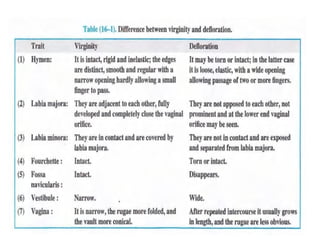
• The labia majora are the two elongated folds of skin
projecting downwards and backwards from the mons veneris.
• In a virgin they are thick, firm, elastic and rounded, and lie in
apposition so as to completely close the vaginal orifice
• The labia minora (4 cm long) are two thin folds of skin just
within the labia majora. The lower portions of labia minora
fuse in midline and form a fold called fourchette
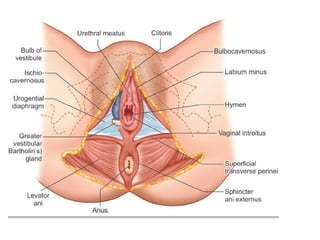
• The depression between fourchette and the vaginal orifice is
called fossa navicularis.
• The clitoris is small and the vestibule is narrow.
• The vestibule is the triangular surface which extends from
the clitoris above to the anterior margin of the hymen below.
• Vulva includes the mons veneris , clitoris, labia majora and
minora, vestibule, hymen and urethral opening.
• The vaginal passage is a pocket irregular in shape, rather than
cylindrical tube
• In women who have borne children labia are open and the
vaginal canal is exposed
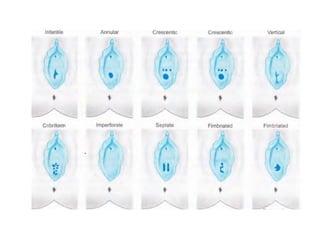
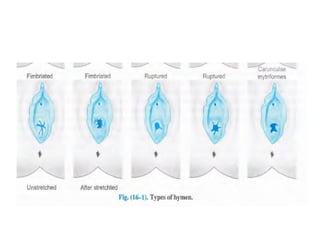
HYMEN
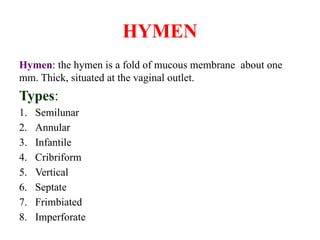
Hymen: the hymen is a fold of mucous membrane about one
mm. Thick, situated at the vaginal outlet.
Types:
1. Semilunar
2. Annular
3. Infantile
4. Cribriform
5. Vertical
6. Septate
7. Frimbiated
8. Imperforate
CAUSES OF RUPTURE OF
HYMEN:
1. An accident
2. Masturbation
3. Surgical operation
4. foreign bodies
5. Ulceration
6. scratching
7. sanitary tampoon
MEDICOLEGALASPECTS
• The presence of unruptured hymen is not an absolute proof of
virginity.
• With an intact hymen, there are true virgins and false virgins.
• The hymen is usually ruptured at the time of the first coitus,
and at first only presents a torn appearance.
• Hymen may not be ruptured even after repeated acts of coitus
if it is loose, lax, folded and elastic, or thick, tough and fleshy,
which permit displacement, distortion and stretching without
rupture .
• Cases have been recorded of women having sexual relations,
of pregnant women and even prostitutes in whom the hymen
was intact.
PREGNANCY
• Pregnancy is the condition of having a developing
embryo or foetus in the female, when an ovum is
fertilized by a spermatozoon.
Medico legal importance of
pregnancy
• Pregnancy may need to be medically verified in the following
situation
• When a woman pleads pregnancy to avoid appearing as a
witness allowed only if advanced or risky.
• The high court has the power to postpone the execution of
death sentence until 6 months after delivery or to commute it.
Sec.456 BNSS(sec. 416, Cr.P.C.).
• To claim higher compensation after husband’s death due to
negligence
• Blackmail Cases:When a woman falsely alleges pregnancy
to compel marriage.
• Illegitimacy Allegations:When an unmarried woman, widow,
or estranged wife is suspected of pregnancy.
• Crime Investigation :Pregnancy alleged as motive for
suicide or murder of an unmarried woman or widow.
• In cases of divorce, the woman may claim to be pregnant to
receive more alimony.
• To assess damages in a seduction or breach of promise of
marriage case.
• When pregnancy is alleged to be motive for suicide or murder
of unmarried woman or widow.
• In cases of alleged concealment of birth or pregnancy and
infanticide.
DIAGNOSIS OF PREGNANCY
• The signs and symptoms are usually classified into
three groups:
(1)The presumptive signs.
(2) The probable signs.
(3) The positive signs.
(I) PRESUMPTIVE SIGN:
(1)Amenorrhoea:
• This is the earliest and one of the most important symptom of
pregnancy.
• Women who have never menstruated may become pregnant,
and pregnancy may also occur in a woman during the
amenorrhoea of lactation.
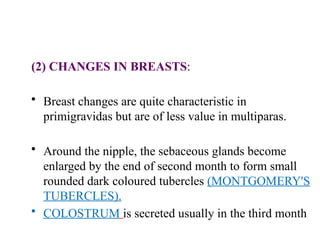
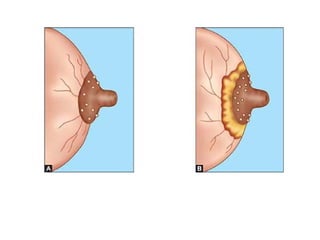
(2) CHANGES IN BREASTS:
• Breast changes are quite characteristic in
primigravidas but are of less value in multiparas.
• Around the nipple, the sebaceous glands become
enlarged by the end of second month to form small
rounded dark coloured tubercles (MONTGOMERY'S
TUBERCLES).
• COLOSTRUM is secreted usually in the third month
(3) MORNING SICKNESS :
It usually appears about the end of the first month and
disappears 6 to 8 weeks later.
(4) QUICKENING :
From about the 16th to 20th
week, the pregnant woman
feels slight fluttering movements in her abdomen, which
gradually increase in intensity.
(5) PIGMENTATION OF THE SKIN
The vulva, abdomen and axillae become darker due to
the deposit of pigment.
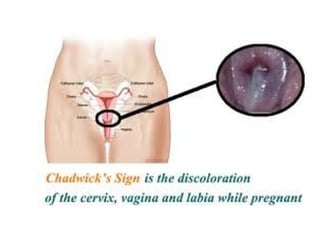
(6) CHANGES IN THE VAGINA :
The mucous membrane of the vagina changes from pink
to violet, deepening to blue as a result of venous
obstruction, after the fourth week. This is known as
Jackquemier's sign or Chadwick's sign.
(7) URINARY DISTURBANCES :
During the early weeks of pregnancy, the enlarging
uterus exerts pressure on the bladder and produces
frequent micturition. This gradually disappears after few
months.
(8) FATIGUE: Easy fatigue is very frequent.
(9) SYMPATHETIC DISTURBANCES:
Salivation, perverted appetite and irritable temper are
common .
(II) PROBABLE SIGNS OF
PREGNANCY :
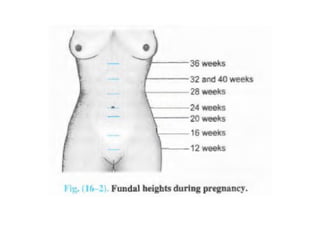
(1) ENLARGEMENT OF THE ABDOMEN :
• During pregnancy, abdomen gradually enlarges in size after
the twelfth week.
• By the end of third month, the uterus fills the pelvis.
• Between third and fourth months appears over the brim.
• At the fifth month, it is midway between the symphysis and
umbilicus.
• At the end of sixth month, it is at the level of the umbilicus,
• At the seventh month it is midway between the umbilicus and
the xiphisternum
(2) UTERUS :
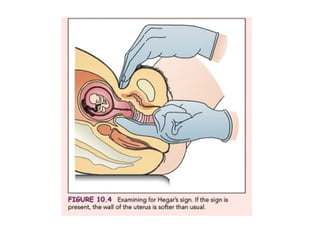
• Hegar's sign is positive at about the sixth week,
• If one hand is placed on the abdomen and two fingers of other
hand in the vagina, the firm hard cervix is felt and above it the
elastic body of the uterus
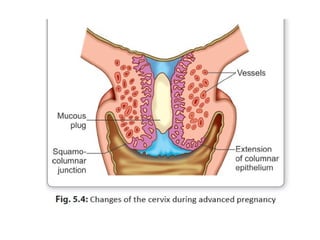
(3) CERVIX:
• From the second month, the cervix progressively softens from
below upward, which is well marked by fourth month. This is
known as Goodell's sign.
(4) INTERMITTENT UTERINE CONTRACTIONS
(Braxton-Hick's sign) :
• Intermittent, painless uterine contractions are difficult to be
observed before the third month, but are easily felt after the fourth
month.
(5) BALLOTTEMENT :
• This is positive during the fourth and fifth months of pregnancy as
the foetus is small in relation to the amount of amniotic fluid
present.
• To obtain vaginal ballottement, two fingers are inserted into the
anterior fornix and a sudden upward motion given.
(6) UTERINE SOUFFLE
It is soft blowing murmur, which is synchronous with mother's
pulse
(7) BIOLOGICAL TESTS:
(1) The rapid rat test.
(2) The Aschheim- Zondek test.
(3) Freidman test.
(4) Hogben or female toad test.
(5) Male frog test.
(6) Galli-Mainini test.
(8) IMMUNOLOGICAL TESTS :
• The hormone chorionic gonadotropin (HCG) and human
chorionic somatomamnotropin (HCS) are secreted by the
syncytial trophoblastic cells
• An early morning urine specimen will contain the highest
level of HCG and is preferable for testing.
• Tests are positive 12 to 15 days after implantation
(1) INHIBITION (INDIRECT) LATEX SLIDE TEST
(2) DIRECT LATEX SLIDE TEST
(3) HAEMAGGLUTINATION INHIBITION TUBE TEST.
(Ill) Positive Signs of
Pregnancy
(1) Foetal Parts and Movements :
• Foetal movements are felt by placing the hands on the
abdomen by 24 weeks.
• Foetal parts can be identified by abdominal palpation by 36
weeks.
(2) Foetal Heart Sounds :
• They are important and definite sign of pregnancy. They are
heard between 1 to 20 weeks for the first time.
• The sounds are like the ticking of a watch placed under a
pillow.
Foetal heart sounds are not heard:
(1) when the foetus is dead.
(2) when there is excessive quantity of liquor amnii.
(3) when abdominal wall is very fat.
(4) when examination is made before 18 weeks of
pregnancy.
(3) Placental Souffle :
This is a soft murmur heard over the placental site, the rate of
which corresponds to that of foetal heart sounds.
(4) Funic or Umbilical Souffle:
This is a blowing murmur synchronous with foetal heart sounds
and supposed to be produced in the umbilical cord.
(5) Radiological examination:
The shadows are searched in the pelvis of the mother
• Crescentic or annular shadows of the skull.
• A series of small dots in a linear arrangement
of the vertebral column.
• A series of fine curved parallel lines of the ribs,
• Linear shadows of the limbs.
(6) Ultrasonography: three dimensional scanning
• Gestational sac is seen as white ring by sixth week.
• Foetal heart beat can be made out by tenth week.
• Foetal head and thorax by 30th week.
Signs of Pregnancy in the Dead
• The presence of product of conception is a positive
proof.
• The uterus is thickened and increased in size
• A well formed corpus luteum is found in one of the
ovaries
• foetal bones will be found in the remains
PSEUDOCYESIS (SPURIOUS
OR PHANTOM PREGNANCY)
• It is usually observed in patients nearing the menopause or in
younger women who intensely desire children.
• Most of the women suffer from some form of psychic or
hormonal disorder
• Such patients may present all the subjective symptoms of
pregnancy
• Increase in the size of the abdomen which may be due to
abnormal deposition of fat or to tympanites or occasionally
due to ascites.
• Changes in breast are sometimes present .
• In many cases, the woman may imagine foetal movements.
• In some cases, pregnancy had gone to "full term" and frank
labour pains occurred which ceased abruptly
POSTHUMOUS CHILD
• It is a child born after the death of its father, the
mother being conceived by the said father.
Legal issues involved are:
• legitimacy,
• inheritance of property,
• compensation case for slander against the mother.
SUPERFECUNDATION
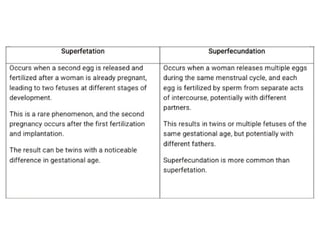
• It means the fertilisation of two ova which have been
discharged from the ovary at the same period ,by two separate
acts of coitus committed at short intervals.
• incidence of twin pregnancies is about one-andhalf percent,
and of these about 70% are binovular twins resulting from
separate fertilisation of two" ova formed in the same menstrual
cycle
• Development of twins in utero is parallel but not equal,
depending on the relative blood supplies from the separately
formed placentae.
• Both ova do not always develop to maturity. One foetus may
be aborted early or die and retained until the labour that expels
the other.
• The spermatozoa causing fertilisation may be from different
men.
• The rare cases wherein two ova are fertilised by a white and
black person or persons with entirely different blood groups
are the only certain examples of this condition.
SUPERFOETATION
• This means the fertilisation of a second ovum in a woman who
is already pregnant.
• Ovulation may occur during first trimester of pregnancy until
decidua vera comes into apposition with decidua reflexa and
decidual cavity gets obliterated.
• Later, two foetuses are born either at the same time showing
different stages of development, or two fully developed
foetuses are born at different periods varying from one to three
months.
DELIVERY
• Series of events that take place in the genital organs in
an effort to expel the viable products of conception
(fetus, placenta and the membranes) out of the womb
through the vagina into the outer world is called Labor.
• The question of delivery arises in
1. abortion,
2. infanticide,
3. concealment of birth,
4. Feigned delivery,
5. Legitimacy,
6. Nullity of marriage,
7. Divorce,
8. Chastity,
9. Blackmail.
Signs of Recent Delivery in the Living:
(1) General Indisposition :
• For the first two or three days the woman is pale,
exhausted and ill-looking with increase in pulse
and slight fever.
(2) Breast Changes :
• These are full, enlarged and tender with a knotty
feeling, and colostrum or milk may be expressed.
• The areolae are dark, nipples enlarged, and
superficial veins prominent, striae gravidarum and
Montgomery's tubercles are present.
• The presence of colostrum corpuscles in milk
strongly indicates that delivery has taken place
within a few days.
(3) The Abdomen :
• The abdominal walls are pendulous, wrinkled and show linea
albicantes, especially in flanks.
• They are irregular, white or silvery subcutaneous scars. They
are simply evidence of previous prolonged distension of the
abdomen.
• They are not formed always and if formed they may disappear.
(4) The Perineum:
• It is sometimes lacerated and the age of tear
may be of value in fixing the date of the delivery.
(5) The Labia:
• They are tender, swollen and bruised or lacerated.
(6) The Vagina:
• It is smooth-walled, relaxed,capacious and may
show recent tears which usually heal by the 7th day.
Cont...
• The rugae begin to reappear about the third week.
(7) The Uterus :
• Immediately after delivery, the contracted and
retracted body of uterus feels like hard muscular
tumour, the upper border of which lies about 3cm
below the umbilicus.
(9)The Lochia :
• It is a discharge from the uterus which lasts for
two or three weeks.
• During the first 4 to 5 days, the discharge is bright-red
and contains large clots (lochia rubra).
• During the next four days, it becomes serous and paler
in colour (lochia serosa).
• After the ninth day colour becomes yellowish-grey or
turbid (lochia alba) until its final disappearance.
(10) Intermittent Uterine Contractions:
• They are usually present for the first 4 to 5 days.
(11) If blood or urine gives a positive pregnancy test,
• It is strong corroborative evidence that pregnancy has
recently terminated.
• They are likely to be negative in a week or ten days.
SIGNS OF RECENT DELIVERY
IN THE DEAD:
• All the local signs mentioned above may be present.
• The findings in the internal genitalia will vary with
the period of gestation and the time after delivery at
which death occurred.
• It is flabby for a day or two, and then gradually
shrinks and resumes its firmness.
• Immediately after delivery the uterine wall is 4 to 5
cm thick.
• The uterine cavity is almost obliterated by apposition
of the anterior and posterior walls;
• It's total length is 20 cm and the length of its cavity 15
cm.
• In the first 2 or 3 days after delivery, the length is 17.5
cm and breadth 10 cm.
• At the end of a week 13 to 14 cm long and 5 cm in
thickness.
• At the end of a fortnight it is less than 12 cm., and
returns to normal size, i.e., 7 to 8 cm length, 5 cm in
breadth, and 2 cm in thickness in about 6 weeks.
• After delivery at term, the uterus weighs about 1000g.
• At the end of first week 500g.
• At the end of second week about 350 g.
• At the end of 6 weeks 100 to 120 g.
• Shortly after delivery the placental site appears as
an irregular, nodular elevated area 15 cm in diameter
and is covered with clotted blood, lymph and portions
of decidua.
• The placental site measures 3 to 4 cm in diameter.
• At the end of the second week, only one to two cm at
the end of six weeks.
Cont...
• The ovaries and Fallopian tubes are usually
congested, but may become normal within a few days.
• A large corpus luteum is usually found in one of the
ovaries.
• For the first few days after delivery, the peritoneum
covering the lower part of the uterus is arranged in
folds which soon disappears.
• Soon after delivery, the bladder shows oedema and
hyperaemia and frequently submucous extravasation of
blood.
SIGNS OF REMOTE DELIVERY IN THE LIVING:
• A previous pregnancy usually leaves permanent
marks on a woman, especially when it has gone to
full term.
• If however, there has been one pregnancy only and
if this has not been of full duration, little or no
indication of the previous pregnancy state may be
left.
(1) ABDOMEN:
• The abdominal walls tend to be lax and show multiple
white scars on the lateral aspects.
• Linea nigra is commonly present.
(2) BREASTS :
• The breasts are lax, soft and pendulous frequently
wrinkled if the woman has nursed her baby, and
occasionally show linea albicantes.
Cont...
• The nipples are enlarged, the areolae dark, and
Montgomery's tubercles are usually present.
(3) VULVA :
• The vagina is partially open as the labia do not
completely close the orifice.
• The perineum may show the scar of an old tear.
• The vaginal rugae are absent and walls are relaxed.
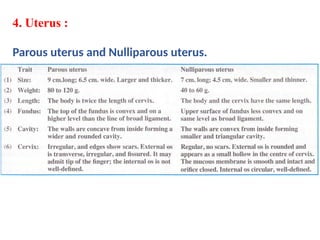
4. Uterus :
Parous uterus and Nulliparous uterus.
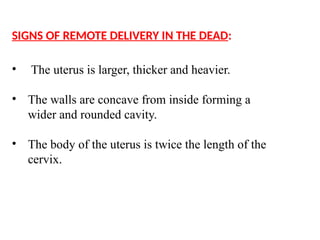
SIGNS OF REMOTE DELIVERY IN THE DEAD:
• The uterus is larger, thicker and heavier.
• The walls are concave from inside forming a
wider and rounded cavity.
• The body of the uterus is twice the length of the
cervix.
Thank you

40 Virginity .pptx forensic medicine presentation

  • 1.
    VIRGINITY, PREGNANCY AND DELIVERY Lecture by:Dr Jaffer Contributor : Harshavardhan Reddy Y S FMT CIMS
  • 2.
    VIRGINITY ● Virgin (virgointacta) is a female who has not experienced sexual intercourse. Defloration means loss of virginity. ●The question of virginity arises in case of (1) nullity of marriage (2) divorce (3) defamation (4) rape.
  • 3.
    NULLITY OF MARRIAGE,(8.12, Hindu Marriage Act), i.e. marriage never to have existed in law. A marriage can be nullified: (1) When either party was under the age of marriage contract. (2) When one party was of unsound mind or a mental defective at the time of marriage. (3) When one party was already validly married. (4) Where the marriage has not been consummated due to impotence or wilful refusal. (5) Where the woman was pregnant by another man at the time of marriage.
  • 4.
    EXTERNAL GENITALIA • Thelabia majora are the two elongated folds of skin projecting downwards and backwards from the mons veneris. • In a virgin they are thick, firm, elastic and rounded, and lie in apposition so as to completely close the vaginal orifice • The labia minora (4 cm long) are two thin folds of skin just within the labia majora. The lower portions of labia minora fuse in midline and form a fold called fourchette
  • 5.
    • The depressionbetween fourchette and the vaginal orifice is called fossa navicularis. • The clitoris is small and the vestibule is narrow. • The vestibule is the triangular surface which extends from the clitoris above to the anterior margin of the hymen below. • Vulva includes the mons veneris , clitoris, labia majora and minora, vestibule, hymen and urethral opening.
  • 7.
    • The vaginalpassage is a pocket irregular in shape, rather than cylindrical tube • In women who have borne children labia are open and the vaginal canal is exposed
  • 9.
    HYMEN Hymen: the hymenis a fold of mucous membrane about one mm. Thick, situated at the vaginal outlet. Types: 1. Semilunar 2. Annular 3. Infantile 4. Cribriform 5. Vertical 6. Septate 7. Frimbiated 8. Imperforate
  • 12.
    CAUSES OF RUPTUREOF HYMEN: 1. An accident 2. Masturbation 3. Surgical operation 4. foreign bodies 5. Ulceration 6. scratching 7. sanitary tampoon
  • 13.
    MEDICOLEGALASPECTS • The presenceof unruptured hymen is not an absolute proof of virginity. • With an intact hymen, there are true virgins and false virgins. • The hymen is usually ruptured at the time of the first coitus, and at first only presents a torn appearance.
  • 14.
    • Hymen maynot be ruptured even after repeated acts of coitus if it is loose, lax, folded and elastic, or thick, tough and fleshy, which permit displacement, distortion and stretching without rupture . • Cases have been recorded of women having sexual relations, of pregnant women and even prostitutes in whom the hymen was intact.
  • 16.
    PREGNANCY • Pregnancy isthe condition of having a developing embryo or foetus in the female, when an ovum is fertilized by a spermatozoon.
  • 17.
    Medico legal importanceof pregnancy • Pregnancy may need to be medically verified in the following situation • When a woman pleads pregnancy to avoid appearing as a witness allowed only if advanced or risky. • The high court has the power to postpone the execution of death sentence until 6 months after delivery or to commute it. Sec.456 BNSS(sec. 416, Cr.P.C.).
  • 18.
    • To claimhigher compensation after husband’s death due to negligence • Blackmail Cases:When a woman falsely alleges pregnancy to compel marriage. • Illegitimacy Allegations:When an unmarried woman, widow, or estranged wife is suspected of pregnancy. • Crime Investigation :Pregnancy alleged as motive for suicide or murder of an unmarried woman or widow.
  • 19.
    • In casesof divorce, the woman may claim to be pregnant to receive more alimony. • To assess damages in a seduction or breach of promise of marriage case. • When pregnancy is alleged to be motive for suicide or murder of unmarried woman or widow. • In cases of alleged concealment of birth or pregnancy and infanticide.
  • 20.
    DIAGNOSIS OF PREGNANCY •The signs and symptoms are usually classified into three groups: (1)The presumptive signs. (2) The probable signs. (3) The positive signs.
  • 21.
    (I) PRESUMPTIVE SIGN: (1)Amenorrhoea: •This is the earliest and one of the most important symptom of pregnancy. • Women who have never menstruated may become pregnant, and pregnancy may also occur in a woman during the amenorrhoea of lactation.
  • 22.
    (2) CHANGES INBREASTS: • Breast changes are quite characteristic in primigravidas but are of less value in multiparas. • Around the nipple, the sebaceous glands become enlarged by the end of second month to form small rounded dark coloured tubercles (MONTGOMERY'S TUBERCLES). • COLOSTRUM is secreted usually in the third month
  • 24.
    (3) MORNING SICKNESS: It usually appears about the end of the first month and disappears 6 to 8 weeks later. (4) QUICKENING : From about the 16th to 20th week, the pregnant woman feels slight fluttering movements in her abdomen, which gradually increase in intensity.
  • 26.
    (5) PIGMENTATION OFTHE SKIN The vulva, abdomen and axillae become darker due to the deposit of pigment. (6) CHANGES IN THE VAGINA : The mucous membrane of the vagina changes from pink to violet, deepening to blue as a result of venous obstruction, after the fourth week. This is known as Jackquemier's sign or Chadwick's sign.
  • 28.
    (7) URINARY DISTURBANCES: During the early weeks of pregnancy, the enlarging uterus exerts pressure on the bladder and produces frequent micturition. This gradually disappears after few months. (8) FATIGUE: Easy fatigue is very frequent. (9) SYMPATHETIC DISTURBANCES: Salivation, perverted appetite and irritable temper are common .
  • 29.
    (II) PROBABLE SIGNSOF PREGNANCY : (1) ENLARGEMENT OF THE ABDOMEN : • During pregnancy, abdomen gradually enlarges in size after the twelfth week. • By the end of third month, the uterus fills the pelvis. • Between third and fourth months appears over the brim. • At the fifth month, it is midway between the symphysis and umbilicus. • At the end of sixth month, it is at the level of the umbilicus, • At the seventh month it is midway between the umbilicus and the xiphisternum
  • 31.
    (2) UTERUS : •Hegar's sign is positive at about the sixth week, • If one hand is placed on the abdomen and two fingers of other hand in the vagina, the firm hard cervix is felt and above it the elastic body of the uterus (3) CERVIX: • From the second month, the cervix progressively softens from below upward, which is well marked by fourth month. This is known as Goodell's sign.
  • 34.
    (4) INTERMITTENT UTERINECONTRACTIONS (Braxton-Hick's sign) : • Intermittent, painless uterine contractions are difficult to be observed before the third month, but are easily felt after the fourth month. (5) BALLOTTEMENT : • This is positive during the fourth and fifth months of pregnancy as the foetus is small in relation to the amount of amniotic fluid present. • To obtain vaginal ballottement, two fingers are inserted into the anterior fornix and a sudden upward motion given.
  • 35.
    (6) UTERINE SOUFFLE Itis soft blowing murmur, which is synchronous with mother's pulse (7) BIOLOGICAL TESTS: (1) The rapid rat test. (2) The Aschheim- Zondek test. (3) Freidman test. (4) Hogben or female toad test. (5) Male frog test. (6) Galli-Mainini test.
  • 36.
    (8) IMMUNOLOGICAL TESTS: • The hormone chorionic gonadotropin (HCG) and human chorionic somatomamnotropin (HCS) are secreted by the syncytial trophoblastic cells • An early morning urine specimen will contain the highest level of HCG and is preferable for testing. • Tests are positive 12 to 15 days after implantation (1) INHIBITION (INDIRECT) LATEX SLIDE TEST (2) DIRECT LATEX SLIDE TEST (3) HAEMAGGLUTINATION INHIBITION TUBE TEST.
  • 37.
    (Ill) Positive Signsof Pregnancy (1) Foetal Parts and Movements : • Foetal movements are felt by placing the hands on the abdomen by 24 weeks. • Foetal parts can be identified by abdominal palpation by 36 weeks. (2) Foetal Heart Sounds : • They are important and definite sign of pregnancy. They are heard between 1 to 20 weeks for the first time. • The sounds are like the ticking of a watch placed under a pillow.
  • 38.
    Foetal heart soundsare not heard: (1) when the foetus is dead. (2) when there is excessive quantity of liquor amnii. (3) when abdominal wall is very fat. (4) when examination is made before 18 weeks of pregnancy.
  • 39.
    (3) Placental Souffle: This is a soft murmur heard over the placental site, the rate of which corresponds to that of foetal heart sounds. (4) Funic or Umbilical Souffle: This is a blowing murmur synchronous with foetal heart sounds and supposed to be produced in the umbilical cord.
  • 40.
    (5) Radiological examination: Theshadows are searched in the pelvis of the mother • Crescentic or annular shadows of the skull. • A series of small dots in a linear arrangement of the vertebral column. • A series of fine curved parallel lines of the ribs, • Linear shadows of the limbs. (6) Ultrasonography: three dimensional scanning • Gestational sac is seen as white ring by sixth week. • Foetal heart beat can be made out by tenth week. • Foetal head and thorax by 30th week.
  • 41.
    Signs of Pregnancyin the Dead • The presence of product of conception is a positive proof. • The uterus is thickened and increased in size • A well formed corpus luteum is found in one of the ovaries • foetal bones will be found in the remains
  • 42.
    PSEUDOCYESIS (SPURIOUS OR PHANTOMPREGNANCY) • It is usually observed in patients nearing the menopause or in younger women who intensely desire children. • Most of the women suffer from some form of psychic or hormonal disorder • Such patients may present all the subjective symptoms of pregnancy
  • 43.
    • Increase inthe size of the abdomen which may be due to abnormal deposition of fat or to tympanites or occasionally due to ascites. • Changes in breast are sometimes present . • In many cases, the woman may imagine foetal movements. • In some cases, pregnancy had gone to "full term" and frank labour pains occurred which ceased abruptly
  • 44.
    POSTHUMOUS CHILD • Itis a child born after the death of its father, the mother being conceived by the said father. Legal issues involved are: • legitimacy, • inheritance of property, • compensation case for slander against the mother.
  • 45.
    SUPERFECUNDATION • It meansthe fertilisation of two ova which have been discharged from the ovary at the same period ,by two separate acts of coitus committed at short intervals. • incidence of twin pregnancies is about one-andhalf percent, and of these about 70% are binovular twins resulting from separate fertilisation of two" ova formed in the same menstrual cycle
  • 46.
    • Development oftwins in utero is parallel but not equal, depending on the relative blood supplies from the separately formed placentae. • Both ova do not always develop to maturity. One foetus may be aborted early or die and retained until the labour that expels the other. • The spermatozoa causing fertilisation may be from different men. • The rare cases wherein two ova are fertilised by a white and black person or persons with entirely different blood groups are the only certain examples of this condition.
  • 47.
    SUPERFOETATION • This meansthe fertilisation of a second ovum in a woman who is already pregnant. • Ovulation may occur during first trimester of pregnancy until decidua vera comes into apposition with decidua reflexa and decidual cavity gets obliterated. • Later, two foetuses are born either at the same time showing different stages of development, or two fully developed foetuses are born at different periods varying from one to three months.
  • 50.
    DELIVERY • Series ofevents that take place in the genital organs in an effort to expel the viable products of conception (fetus, placenta and the membranes) out of the womb through the vagina into the outer world is called Labor. • The question of delivery arises in 1. abortion, 2. infanticide, 3. concealment of birth,
  • 51.
    4. Feigned delivery, 5.Legitimacy, 6. Nullity of marriage, 7. Divorce, 8. Chastity, 9. Blackmail.
  • 52.
    Signs of RecentDelivery in the Living: (1) General Indisposition : • For the first two or three days the woman is pale, exhausted and ill-looking with increase in pulse and slight fever. (2) Breast Changes : • These are full, enlarged and tender with a knotty feeling, and colostrum or milk may be expressed.
  • 53.
    • The areolaeare dark, nipples enlarged, and superficial veins prominent, striae gravidarum and Montgomery's tubercles are present. • The presence of colostrum corpuscles in milk strongly indicates that delivery has taken place within a few days.
  • 54.
    (3) The Abdomen: • The abdominal walls are pendulous, wrinkled and show linea albicantes, especially in flanks. • They are irregular, white or silvery subcutaneous scars. They are simply evidence of previous prolonged distension of the abdomen. • They are not formed always and if formed they may disappear.
  • 55.
    (4) The Perineum: •It is sometimes lacerated and the age of tear may be of value in fixing the date of the delivery. (5) The Labia: • They are tender, swollen and bruised or lacerated. (6) The Vagina: • It is smooth-walled, relaxed,capacious and may show recent tears which usually heal by the 7th day.
  • 56.
    Cont... • The rugaebegin to reappear about the third week. (7) The Uterus : • Immediately after delivery, the contracted and retracted body of uterus feels like hard muscular tumour, the upper border of which lies about 3cm below the umbilicus.
  • 57.
    (9)The Lochia : •It is a discharge from the uterus which lasts for two or three weeks. • During the first 4 to 5 days, the discharge is bright-red and contains large clots (lochia rubra). • During the next four days, it becomes serous and paler in colour (lochia serosa). • After the ninth day colour becomes yellowish-grey or turbid (lochia alba) until its final disappearance.
  • 58.
    (10) Intermittent UterineContractions: • They are usually present for the first 4 to 5 days. (11) If blood or urine gives a positive pregnancy test, • It is strong corroborative evidence that pregnancy has recently terminated. • They are likely to be negative in a week or ten days.
  • 59.
    SIGNS OF RECENTDELIVERY IN THE DEAD: • All the local signs mentioned above may be present. • The findings in the internal genitalia will vary with the period of gestation and the time after delivery at which death occurred.
  • 60.
    • It isflabby for a day or two, and then gradually shrinks and resumes its firmness. • Immediately after delivery the uterine wall is 4 to 5 cm thick. • The uterine cavity is almost obliterated by apposition of the anterior and posterior walls; • It's total length is 20 cm and the length of its cavity 15 cm. • In the first 2 or 3 days after delivery, the length is 17.5 cm and breadth 10 cm.
  • 61.
    • At theend of a week 13 to 14 cm long and 5 cm in thickness. • At the end of a fortnight it is less than 12 cm., and returns to normal size, i.e., 7 to 8 cm length, 5 cm in breadth, and 2 cm in thickness in about 6 weeks. • After delivery at term, the uterus weighs about 1000g. • At the end of first week 500g. • At the end of second week about 350 g. • At the end of 6 weeks 100 to 120 g.
  • 62.
    • Shortly afterdelivery the placental site appears as an irregular, nodular elevated area 15 cm in diameter and is covered with clotted blood, lymph and portions of decidua. • The placental site measures 3 to 4 cm in diameter. • At the end of the second week, only one to two cm at the end of six weeks.
  • 63.
    Cont... • The ovariesand Fallopian tubes are usually congested, but may become normal within a few days. • A large corpus luteum is usually found in one of the ovaries. • For the first few days after delivery, the peritoneum covering the lower part of the uterus is arranged in folds which soon disappears.
  • 64.
    • Soon afterdelivery, the bladder shows oedema and hyperaemia and frequently submucous extravasation of blood. SIGNS OF REMOTE DELIVERY IN THE LIVING: • A previous pregnancy usually leaves permanent marks on a woman, especially when it has gone to full term. • If however, there has been one pregnancy only and if this has not been of full duration, little or no indication of the previous pregnancy state may be left.
  • 65.
    (1) ABDOMEN: • Theabdominal walls tend to be lax and show multiple white scars on the lateral aspects. • Linea nigra is commonly present. (2) BREASTS : • The breasts are lax, soft and pendulous frequently wrinkled if the woman has nursed her baby, and occasionally show linea albicantes.
  • 66.
    Cont... • The nipplesare enlarged, the areolae dark, and Montgomery's tubercles are usually present. (3) VULVA : • The vagina is partially open as the labia do not completely close the orifice. • The perineum may show the scar of an old tear. • The vaginal rugae are absent and walls are relaxed.
  • 67.
    4. Uterus : Parousuterus and Nulliparous uterus.
  • 68.
    SIGNS OF REMOTEDELIVERY IN THE DEAD: • The uterus is larger, thicker and heavier. • The walls are concave from inside forming a wider and rounded cavity. • The body of the uterus is twice the length of the cervix.
  • 69.