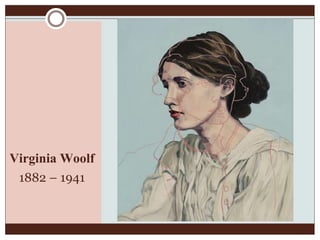
Virginia Woolf
1882 – 1941
BIOGRAPHY
• Adeline Virginia Woolf was an English writer, considered
one of the most important modernist 20th-century
authors and also a pioneer in the use of stream of
consciousness as a narrative device.
• Virginia Woolf was born in London: her father was a
famous author and mountaineer, and her mother a well-
known model.
• Her family hosted many of the most influential and
important members of Victorian literary society.
• Woolf and her sister weren’t allowed to go to Cambridge
like their brothers, but had to steal an education in their
father’s study.
• After her mother ‘s death at 13, Woolf had the first of a
series of mental breakdowns that were to plague her for
the rest of her life – partly caused by the sexual abuse she
suffered at the hands of her half-brother George
Duckworth.
• Despite her illness, she became a journalist and then a
novelist – and a central figure in the Bloomsbury group.
She married one of the members, the writer and journalist
Leonard Woolf.
• She and Leonard bought a small hand-printing press,
named it The Hogarth Press, and published books from
their dining room.
• They printed Woolf’s radical novels and political essays
when no one else would; and produced the first full
English edition of Freud’s works.
• During the interwar period, Woolf was an important part
of London's literary and artistic society
• Woolf became one of the central subjects of the 1970s
movement of feminist criticism and her works have since
garnered much attention and widespread commentary
for "inspiring feminism.“
• In just four short years between World Wars I and II,
Woolf wrote four of her most famous works
FAMOUS
WORKS
Is a novel that details
a day in the life of
Clarissa Dalloway, a
fictional high-society
woman in post–First
World War England.
It is one of Woolf's
best-known novels.
Is a novel about the
Ramsay family’s trip
to the Isle of Skye in
Scotland.
The novel is semi-
autobiographical and
was inspired by the
Stephen family trips
to Cornwall when
Woolf was a child.
Focuses on the
private thoughts of
its characters and is
a key example of the
stream-of-
consciousness
A novel inspired by
Woolf’s aristocratic
friend Vita Sackville-
West.
The story follows a
poet as he changes
gender and lives for
centuries, often
meeting famous
people in English
literature.
The book is
considered a feminist
classic and is often
cited in transgender
studies.
Is an extended
essay that
discusses many
feminist issues,
such as: women’s
lack of educational
opportunities and
their economic and
social dependence
on men.
The book is
considered a
feminist classic
and forever
cemented Woolf’s
reputation as a
feminist writer.
THEMES
• War
• Shell Shock
• Witchcraft
• Role of social class in
contemporary modern
British society
• Death
• Alienation/depression
• Mental illness
• Fascism
• Feminism
• Homosexuality
• Experimental themes
Woolf as a Feminist
• Woolf's changing representation of feminism in
publications from 1920 to 1940 parallels her involvement
with the contemporary women's movement (suffragists
and its descendants, and the pacifist, working-class
Women's Co-operative Guild).
• Before the Second World War and long before the second
wave of feminism, Virginia Woolf argued that women's
experience, particularly in the women's movement, could
be the basis for transformative social change.
• Woolf was deeply aware that men and women fit
themselves into rigid gender roles, and as they do so,
overlook their fuller personalities.
• In her eyes, in order to grow, we need to do some gender-
bending; we need to seek experiences that blur what it
means to be “a real man” or “a real woman.”
• Woolf wished desperately to raise the status of women in
her society.
• She advised women to write in order to move to the public
sphere
• She recognized that the problem was largely down to
money.
• Women didn’t have freedom, especially freedom of the
spirit, because they didn’t control their own income:
‘Women have always been poor, not for two hundred years
merely, but from the beginning of time. Women have had
less intellectual freedom than the sons of Athenian slaves.
Women have not had a dog’s chance of writing poetry.’
• Her great feminist rallying cry, A Room of One’s Own,
culminated in a specific, political demand: in order to
stand on the same intellectual footing as men, women
needed not only dignity, but also equal rights to
education, an income of “five hundred pounds a year”
and “a room of one’s own.”
• She states that the rights given to men about working
with equal rights as men, fair wages or equal pay, having
equal right in education and sex equality should be given
to women, as well.
Presented by:
Sakina Ali Asghar
Mir Nayab Waheed

Virginia wooolf

  • 1.
  • 2.
    BIOGRAPHY • Adeline VirginiaWoolf was an English writer, considered one of the most important modernist 20th-century authors and also a pioneer in the use of stream of consciousness as a narrative device. • Virginia Woolf was born in London: her father was a famous author and mountaineer, and her mother a well- known model. • Her family hosted many of the most influential and important members of Victorian literary society. • Woolf and her sister weren’t allowed to go to Cambridge like their brothers, but had to steal an education in their father’s study.
  • 3.
    • After hermother ‘s death at 13, Woolf had the first of a series of mental breakdowns that were to plague her for the rest of her life – partly caused by the sexual abuse she suffered at the hands of her half-brother George Duckworth. • Despite her illness, she became a journalist and then a novelist – and a central figure in the Bloomsbury group. She married one of the members, the writer and journalist Leonard Woolf. • She and Leonard bought a small hand-printing press, named it The Hogarth Press, and published books from their dining room. • They printed Woolf’s radical novels and political essays when no one else would; and produced the first full English edition of Freud’s works.
  • 4.
    • During theinterwar period, Woolf was an important part of London's literary and artistic society • Woolf became one of the central subjects of the 1970s movement of feminist criticism and her works have since garnered much attention and widespread commentary for "inspiring feminism.“ • In just four short years between World Wars I and II, Woolf wrote four of her most famous works
  • 5.
    FAMOUS WORKS Is a novelthat details a day in the life of Clarissa Dalloway, a fictional high-society woman in post–First World War England. It is one of Woolf's best-known novels.
  • 6.
    Is a novelabout the Ramsay family’s trip to the Isle of Skye in Scotland. The novel is semi- autobiographical and was inspired by the Stephen family trips to Cornwall when Woolf was a child. Focuses on the private thoughts of its characters and is a key example of the stream-of- consciousness
  • 7.
    A novel inspiredby Woolf’s aristocratic friend Vita Sackville- West. The story follows a poet as he changes gender and lives for centuries, often meeting famous people in English literature. The book is considered a feminist classic and is often cited in transgender studies.
  • 8.
    Is an extended essaythat discusses many feminist issues, such as: women’s lack of educational opportunities and their economic and social dependence on men. The book is considered a feminist classic and forever cemented Woolf’s reputation as a feminist writer.
  • 9.
    THEMES • War • ShellShock • Witchcraft • Role of social class in contemporary modern British society • Death • Alienation/depression • Mental illness • Fascism • Feminism • Homosexuality • Experimental themes
  • 10.
    Woolf as aFeminist • Woolf's changing representation of feminism in publications from 1920 to 1940 parallels her involvement with the contemporary women's movement (suffragists and its descendants, and the pacifist, working-class Women's Co-operative Guild). • Before the Second World War and long before the second wave of feminism, Virginia Woolf argued that women's experience, particularly in the women's movement, could be the basis for transformative social change. • Woolf was deeply aware that men and women fit themselves into rigid gender roles, and as they do so, overlook their fuller personalities.
  • 11.
    • In hereyes, in order to grow, we need to do some gender- bending; we need to seek experiences that blur what it means to be “a real man” or “a real woman.” • Woolf wished desperately to raise the status of women in her society. • She advised women to write in order to move to the public sphere • She recognized that the problem was largely down to money. • Women didn’t have freedom, especially freedom of the spirit, because they didn’t control their own income: ‘Women have always been poor, not for two hundred years merely, but from the beginning of time. Women have had less intellectual freedom than the sons of Athenian slaves. Women have not had a dog’s chance of writing poetry.’
  • 12.
    • Her greatfeminist rallying cry, A Room of One’s Own, culminated in a specific, political demand: in order to stand on the same intellectual footing as men, women needed not only dignity, but also equal rights to education, an income of “five hundred pounds a year” and “a room of one’s own.” • She states that the rights given to men about working with equal rights as men, fair wages or equal pay, having equal right in education and sex equality should be given to women, as well.
  • 13.
    Presented by: Sakina AliAsghar Mir Nayab Waheed

Editor's Notes

  • #2 Adeline Virginia Woolf (/wʊlf/;[2] née Stephen; 25 January 1882 – 28 March 1941) was an English writer, considered one of the most important modernist 20th-century authors and also a pioneer in the use of stream of consciousness as a narrative device.