GEORGE ELIOT
Prepared by Trushali Dodiya, Semester 1
A student of the department of English, MKBH Presentation
preparation
Task assigned by Yesha ma’am
Points to be discussed
◦ Introduction
◦ Life
◦ Works
◦ Novels
◦ Style of writing
◦ Concusion
According to William J. Long,
“She is more obviously, more consciously a preacher and moralizer than any of her great
contemporaries. Though profoundly religious at heart, she largely occupied by the scientific
spirit of the age and finding no religious creed or political system satisfactory, she fell back
upon duty as the supreme lawof life.”
Like Dickens portrays picture of City streets and Thackeray the vanities of the
society, Eliot reflected the country life in England. She holds the high rank in
English novel.(Long)
Introduction:-
◦ In the history of literature from Beowulf to Swineburne, Andrew Lane notes that
In 1857 “BlackWoods magazine” began to publish “Scenes from clerical life”. At
that time there was question of “Were they by a man or a woman? Dickens noted that
She is a woman and he was right.
All the writers of The Victorian age are having two tendencies in their writings:-
1. To analyse problems of life
2. To teach or explain to main the method by which this problems may be solved
In George Eliot’s novels, both this tendencies are at the climax. She is a preacher and
moralizer. Her novels have two aims,
1. To show individuals the play of universal moral forces
2. To established the moral law as the basis of Human society
Life
• Name :- Mary Ann Evan
• Pseudonym:- George Eliot
• Born:- 22 November, 1819 In Chilvers
Coton, Warwickshire, England
• Died:- 22 November, 1880, London
• Writer, Editor, Novelist, Essayist
• Nationality:- English
• Spouse:- George Henry Lewes, John
Cross
• Period:- Victorian
• Languages:- German, French, Italian,
Greek and Latin
◦ She began to write late in her life when she was 40 years old.
◦ Belongs from farmer class
◦ After her birth her family moved to Darish of Griff.
◦ Schooling from two private schools - Nuneartan and
Conventry
◦ Her family life and territory of Midland is reflected in her
works. Like, She as Maggie and her brother as a Tom
Tulliver in The Mills of the Floss, her aunt as Dinah Morris
and her mother as Mrs. Poyse in Adam Bade and his father
as Caleb Garth in Middlemarch.
◦ Her mother died when she was 17 year old and she quits her
study. There after her education was gained wholly by the
reading.
◦ Her family moved to Foleshill Road, near Conventry when
she was 21 year old. Here she met Charles Bray’s Family,
whose house was gathering place for the freethinkers.
◦ In 1849, her Father died and the Brays Family took her to
the tour.
◦ On her return she wrote articles for the Westminster Review.
She later on became assistant editor of this magazine.
Major eventsof her life
• Family moves to
Darish Griff
• Death of her mother
• Family moves to
Foleshill Road
• Death of his father
• Tour to Italy
• Marriage to George
Henry Lewe and later
on with John Walton
Cross
◦ She became aquinted with Spenser and Mill and through Mill she came in contact with
George Henry Lewes, which whom she afterwards married.
◦ Her first story was Amos Barton(1857). It was later on published in the Scenes of
Clerical Life(,1859).
◦ Till the publication of The Mill of the Foss, her writing were limited to the country life,
but now she started to write Historical Novel.
◦ In 1860, she went to the tour of Italy and started to write Romila, but she later visited
Spain to collect material for Romola.
◦ She came back again into favour by the publication of Middlemarch (1871-72)
◦ After the death of Lewes, she got married to John Walton Cross. He quotes,
◦ “Deep down below, there is a river of sadness, but I am able to enjoy my newly re opened life.”
◦ She died in December, 1880. And buried at Highgate Cemetery.
Works
◦ According to William J. Long, her works are divided into three groups.
1. Her early essays and Work.
Her translation of Strauss’s Leben Jesu(1846) to her union with
Lewes in 1854
2. Her own life experience
The Scenes of Clerical Life, Adam Bede, Mill on the Floss, Silas
Marner, (published between 1858-1861)
3. More laboured and less interesting
. Romola(1862-63), Felix Holy(1866),. Middlemarch (1871-72), Daniel
Deronda(1876), The Spanish Gypsy(1868) and her essay collection named
The Impression of Theophrastus Such(1879).
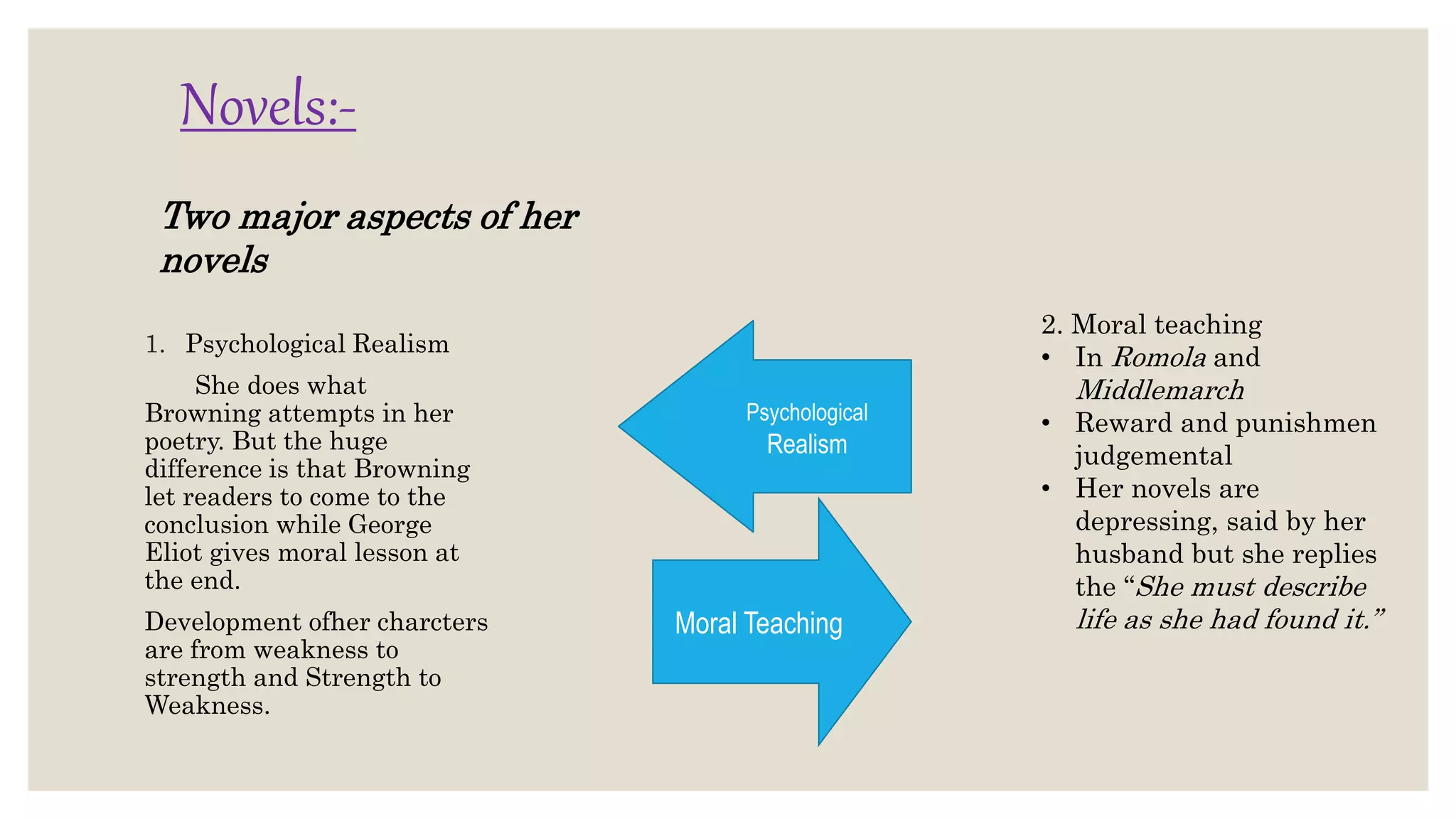
Novels:-
1. Psychological Realism
She does what
Browning attempts in her
poetry. But the huge
difference is that Browning
let readers to come to the
conclusion while George
Eliot gives moral lesson at
the end.
Development ofher charcters
are from weakness to
strength and Strength to
Weakness.
2. Moral teaching
• In Romola and
Middlemarch
• Reward and punishmen
judgemental
• Her novels are
depressing, said by her
husband but she replies
the “She must describe
life as she had found it.”
Two major aspects of her
novels
Moral Teaching
Psychological
Realism
Style of writing:-
◦ Pure and strong
◦ Not only broad in its power but intense in its description of characters and situations
◦ No novelist knew the English character especially in the Midlands so well as she, could
analyse it with so much subtlety and truth.
◦ “She is entirely mistress of the country dialects”. (Meiklejohn)
◦ Central theme of her writings were,
◦ The conflict between the higher and the lower life
◦ Duty and inclination
Conclusion:-
To conclude, George Eliot has gained a prominent position
in the Victorian literature, especially in the field of Novels.
Though some of his works are not much qualitative, her
early and later works embodied her as an important
literary figure of the Victorian Era.
Work Cited:-
◦ “George Eliot.” Encyclopædia Britannica, Encyclopædia Britannica, Inc.,
www.britannica.com/biography/George-Eliot.
◦ Lang, Andrew. History of English Literature from Beowulf to Swinburne. United
States, Wildside Press, 2003.
◦ Long, William J.. English Literature. India, Copia Interactive, LLC, 2021.
◦ Meiklejohn, John Miller Dow. A Brief History of the English Language and
Literature. United States, Heath, 1892.
Thank you

George Eliot

  • 1.
    GEORGE ELIOT Prepared byTrushali Dodiya, Semester 1 A student of the department of English, MKBH Presentation preparation Task assigned by Yesha ma’am
  • 2.
    Points to bediscussed ◦ Introduction ◦ Life ◦ Works ◦ Novels ◦ Style of writing ◦ Concusion
  • 3.
    According to WilliamJ. Long, “She is more obviously, more consciously a preacher and moralizer than any of her great contemporaries. Though profoundly religious at heart, she largely occupied by the scientific spirit of the age and finding no religious creed or political system satisfactory, she fell back upon duty as the supreme lawof life.” Like Dickens portrays picture of City streets and Thackeray the vanities of the society, Eliot reflected the country life in England. She holds the high rank in English novel.(Long) Introduction:-
  • 4.
    ◦ In thehistory of literature from Beowulf to Swineburne, Andrew Lane notes that In 1857 “BlackWoods magazine” began to publish “Scenes from clerical life”. At that time there was question of “Were they by a man or a woman? Dickens noted that She is a woman and he was right. All the writers of The Victorian age are having two tendencies in their writings:- 1. To analyse problems of life 2. To teach or explain to main the method by which this problems may be solved In George Eliot’s novels, both this tendencies are at the climax. She is a preacher and moralizer. Her novels have two aims, 1. To show individuals the play of universal moral forces 2. To established the moral law as the basis of Human society
  • 5.
    Life • Name :-Mary Ann Evan • Pseudonym:- George Eliot • Born:- 22 November, 1819 In Chilvers Coton, Warwickshire, England • Died:- 22 November, 1880, London • Writer, Editor, Novelist, Essayist • Nationality:- English • Spouse:- George Henry Lewes, John Cross • Period:- Victorian • Languages:- German, French, Italian, Greek and Latin
  • 6.
    ◦ She beganto write late in her life when she was 40 years old. ◦ Belongs from farmer class ◦ After her birth her family moved to Darish of Griff. ◦ Schooling from two private schools - Nuneartan and Conventry ◦ Her family life and territory of Midland is reflected in her works. Like, She as Maggie and her brother as a Tom Tulliver in The Mills of the Floss, her aunt as Dinah Morris and her mother as Mrs. Poyse in Adam Bade and his father as Caleb Garth in Middlemarch. ◦ Her mother died when she was 17 year old and she quits her study. There after her education was gained wholly by the reading. ◦ Her family moved to Foleshill Road, near Conventry when she was 21 year old. Here she met Charles Bray’s Family, whose house was gathering place for the freethinkers. ◦ In 1849, her Father died and the Brays Family took her to the tour. ◦ On her return she wrote articles for the Westminster Review. She later on became assistant editor of this magazine. Major eventsof her life • Family moves to Darish Griff • Death of her mother • Family moves to Foleshill Road • Death of his father • Tour to Italy • Marriage to George Henry Lewe and later on with John Walton Cross
  • 7.
    ◦ She becameaquinted with Spenser and Mill and through Mill she came in contact with George Henry Lewes, which whom she afterwards married. ◦ Her first story was Amos Barton(1857). It was later on published in the Scenes of Clerical Life(,1859). ◦ Till the publication of The Mill of the Foss, her writing were limited to the country life, but now she started to write Historical Novel. ◦ In 1860, she went to the tour of Italy and started to write Romila, but she later visited Spain to collect material for Romola. ◦ She came back again into favour by the publication of Middlemarch (1871-72) ◦ After the death of Lewes, she got married to John Walton Cross. He quotes, ◦ “Deep down below, there is a river of sadness, but I am able to enjoy my newly re opened life.” ◦ She died in December, 1880. And buried at Highgate Cemetery.
  • 8.
    Works ◦ According toWilliam J. Long, her works are divided into three groups. 1. Her early essays and Work. Her translation of Strauss’s Leben Jesu(1846) to her union with Lewes in 1854 2. Her own life experience The Scenes of Clerical Life, Adam Bede, Mill on the Floss, Silas Marner, (published between 1858-1861) 3. More laboured and less interesting . Romola(1862-63), Felix Holy(1866),. Middlemarch (1871-72), Daniel Deronda(1876), The Spanish Gypsy(1868) and her essay collection named The Impression of Theophrastus Such(1879).
  • 9.
    Novels:- 1. Psychological Realism Shedoes what Browning attempts in her poetry. But the huge difference is that Browning let readers to come to the conclusion while George Eliot gives moral lesson at the end. Development ofher charcters are from weakness to strength and Strength to Weakness. 2. Moral teaching • In Romola and Middlemarch • Reward and punishmen judgemental • Her novels are depressing, said by her husband but she replies the “She must describe life as she had found it.” Two major aspects of her novels Moral Teaching Psychological Realism
  • 10.
    Style of writing:- ◦Pure and strong ◦ Not only broad in its power but intense in its description of characters and situations ◦ No novelist knew the English character especially in the Midlands so well as she, could analyse it with so much subtlety and truth. ◦ “She is entirely mistress of the country dialects”. (Meiklejohn) ◦ Central theme of her writings were, ◦ The conflict between the higher and the lower life ◦ Duty and inclination
  • 11.
    Conclusion:- To conclude, GeorgeEliot has gained a prominent position in the Victorian literature, especially in the field of Novels. Though some of his works are not much qualitative, her early and later works embodied her as an important literary figure of the Victorian Era.
  • 12.
    Work Cited:- ◦ “GeorgeEliot.” Encyclopædia Britannica, Encyclopædia Britannica, Inc., www.britannica.com/biography/George-Eliot. ◦ Lang, Andrew. History of English Literature from Beowulf to Swinburne. United States, Wildside Press, 2003. ◦ Long, William J.. English Literature. India, Copia Interactive, LLC, 2021. ◦ Meiklejohn, John Miller Dow. A Brief History of the English Language and Literature. United States, Heath, 1892.
  • 13.