
The Waste Land
- T. S. Eliot
Yesha Bhatt
T. S. Eliot - Introduction
 Thomas Stearns Eliot (26 September
1888 – 4 January 1965) was a poet,
essayist, publisher, playwright, and
literary and social critic.
 Considered one of the twentieth
century's major poets, Eliot attracted
widespread attention for his poem
"The Love Song of J. Alfred Prufrock"
(1915), which was seen as a
masterpiece of
the Modernist movement.
 He was awarded the Nobel Prize in
Literature in 1948, "for his
outstanding, pioneer contribution to
present-day poetry".
The Waste Land (1922) - Introduction
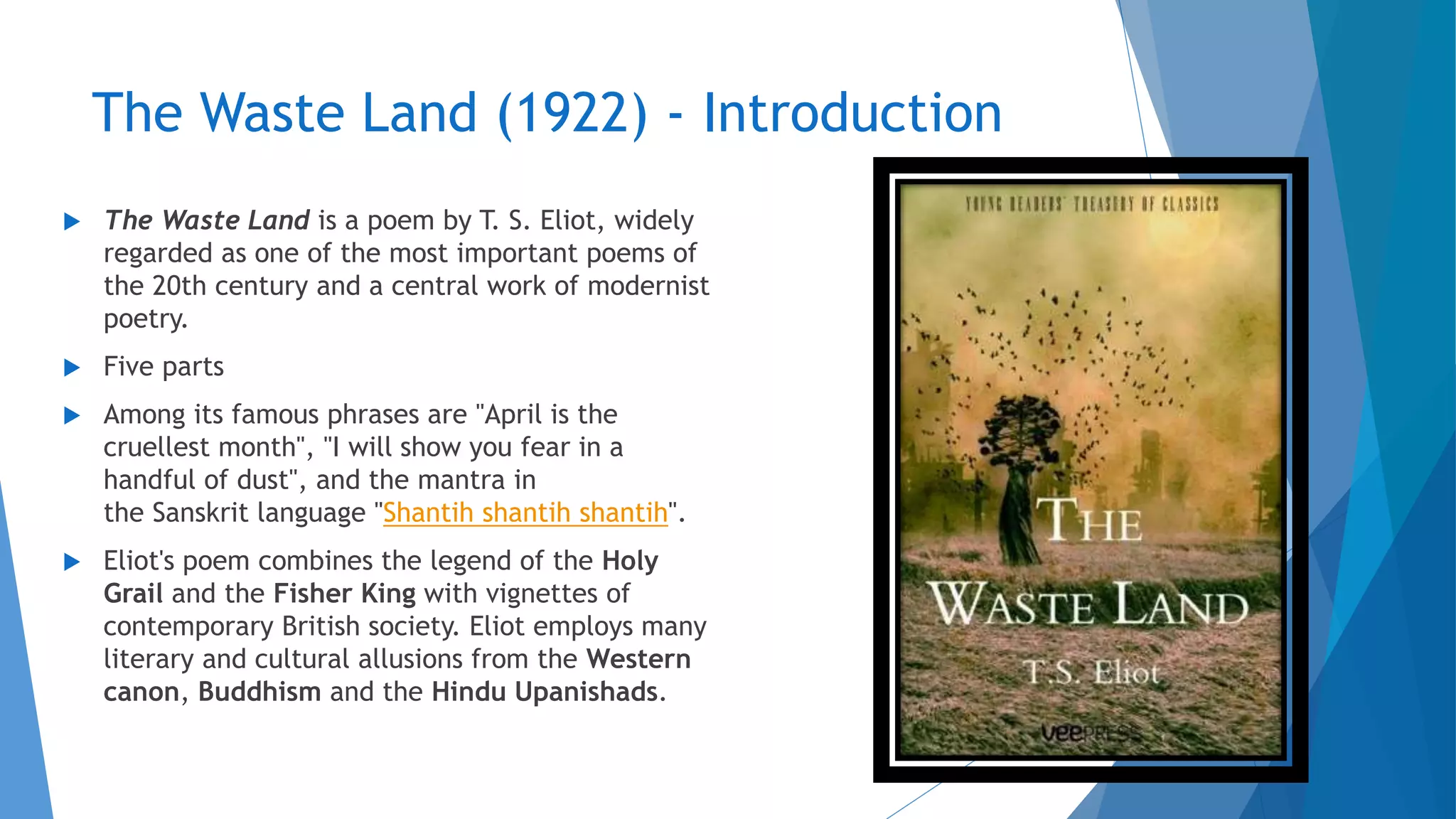
 The Waste Land is a poem by T. S. Eliot, widely
regarded as one of the most important poems of
the 20th century and a central work of modernist
poetry.
 Five parts
 Among its famous phrases are "April is the
cruellest month", "I will show you fear in a
handful of dust", and the mantra in
the Sanskrit language "Shantih shantih shantih".
 Eliot's poem combines the legend of the Holy
Grail and the Fisher King with vignettes of
contemporary British society. Eliot employs many
literary and cultural allusions from the Western
canon, Buddhism and the Hindu Upanishads.
Five parts of The Waste Land
1. The Burial of the Dead
2. A Game of Chess
3. The Fire Sermon
4. Death by Water
5. What the Thunder Said
1. The Burial of the Dead
 Title – Anglican burial service
 Dramatic monologue
 Four speakers – finding audience – surrounded by dead (frustrated by
wars)
 First part: Chaucer’s “Canterbury Tales” – “April is the cruellest month”
April is the cruellest month, Winter kept us warn, Summer surprised us”
 Second part: Marie in the mountains,
“In mountains, there you feel free.” (refers to intense sexual excitement)
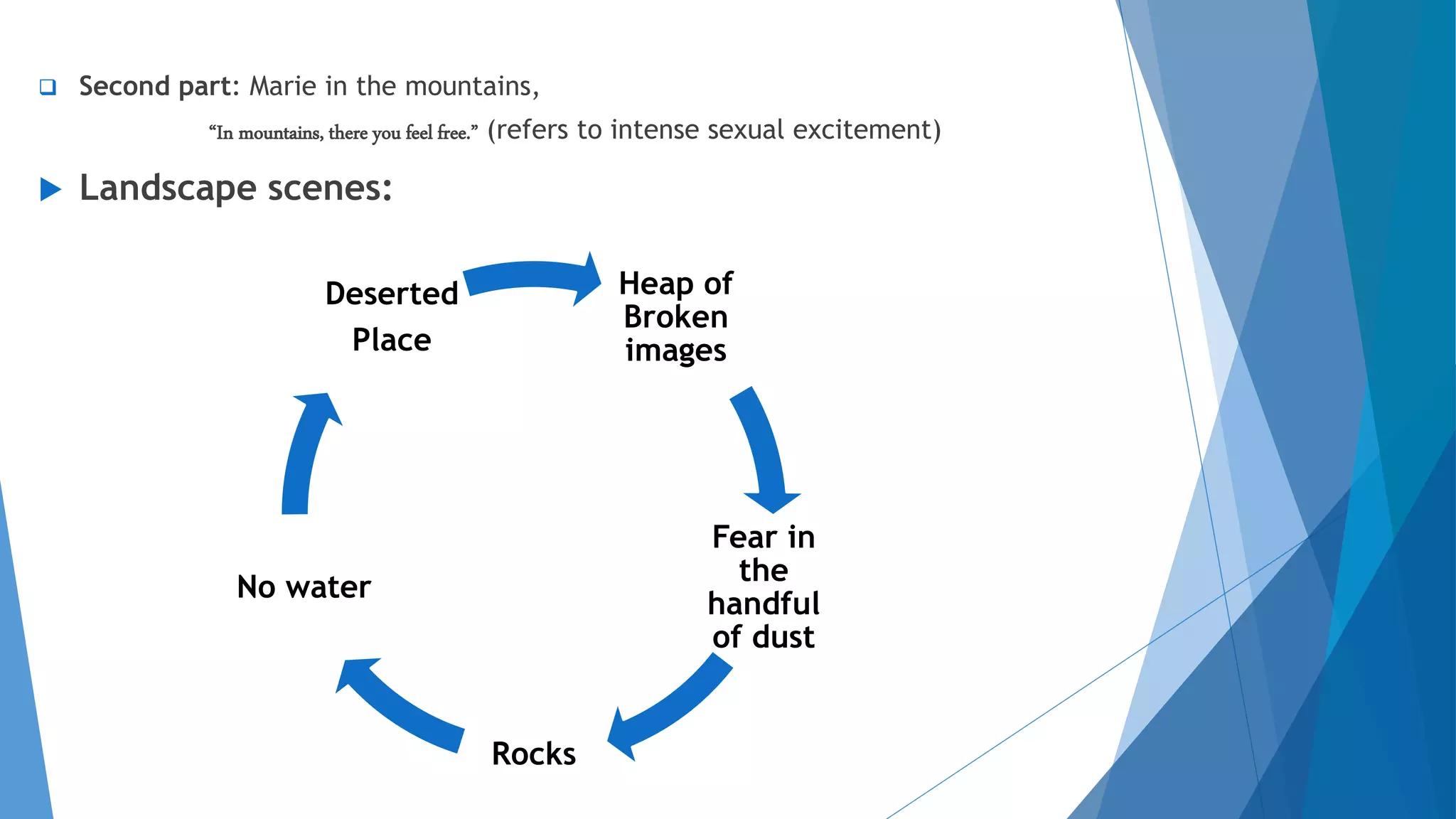
 Landscape scenes:
Heap of
Broken
images
Fear in
the
handful
of dust
Rocks
No water
Deserted
Place
 Third part: Hyacinth girl
Hyacinth – Flower of sensuous love
“You gave me hyacinth first a year ago”
 Fourth part: Madame Sosostris – fortune teller
1. The Drowned Phoenician Sailor – Symbol of fertility –
drowned in rivers – Purification
2. Belladonna – The lady of the Rocks
3. The Man with three staves – Fisher king – three staves Da,
Da, Da.
4. The hanged man – Sacrificed fertility – God – Christ
 Fifth Part: Unreal city -
- Baudelaire’ Paris
- Dickens’ London
- Dante’s Hell
- Reference to Dog (Webster’s White devil)
2. A Game of Chess
 Title – Middleton's play – Women beware
Women
1. Xylograph in Lady’s chamber
2. Myth of Philomela – Nightingale – Jug…Jug..
To dirty ears
Philomela – Swallow
Nightingale – Procne
3. Conversation:
“Why do you never speak? Speak.”
 Lil’s Episode:
“Hurry up please time”
3. The Fire Sermon
1. River Thames: Sweet thames
2. Fisher king: Ferdinand (Tiresias’ pain)
3. Unreal city: Human engine – throbbing
like taxi
4. Episode of typist and girl: Well now
that’s done
5. The song of Thames daughters: (river
sweats oil and tar)
6. “Burning…burning….burning…”
4. Death by Water
 Phlebas the Phoenician:
“a fortnight dead”
5. What the thunder said?
1. Crucification:
“He who was living is now dead”
2. Two disciple of Christ goes to Emmas
“Who is the third who walks always beside you?”
3. Wisdom of India for spiritual salvation – modern humanity Then
spoken the thunder
Da, Da, Da,
Themes
 Spiritual Degradation
 Sexual Perversion
 Good vs Evil
 Life in death and death in life
 Present and Past
 Breakdown of civilization
 Changing nature of gender roles
Myths
1. Sibyl – Oracle – By divine inspiration from deities
2. Holy Grail – A Cup – Wine - Blood
3. Tiresias – Blind prophet of Apollo and Thebes
4. Phlebas – The Phonetian
5. The Fisher King – Wounded king – kept Holy Grail –
Percival – his impotence affecting his country
6. Vegetation – Birth - Rebirth
7. Philomela – (Nightingale) Princess of Athenes – Procne –
Tereus
8. Tristan and Isolde – Affair between Knight Tristan and
Irish princess Isolde
Universal Laws
Autobiographical Elements
 Language – (dialects – his bornplace)
 His Teachers (George Santayana – Irving Babbitt) – Allegory –
Dante – Eastern religion – Sanskrit – French literary criticism
 Contemporary poets – Ezra Pound
 Childhood – Physical limitations (active in discussions)
 Marriage life – Vivienne Haigh-Wood (disastrous marriage) – She
started dating Russell
 In a private paper written in his sixties, Eliot
confessed:
 "I came to persuade myself that I was in love with
Vivienne simply because I wanted to burn my boats
and commit myself to staying in England. And she
persuaded herself (also under the influence of [Ezra]
Pound) that she would save the poet by keeping him
in England. To her, the marriage brought no
happiness. To me, it brought the state of mind out
of which came The Waste Land.”
 Virginia Woolf once said: "He was one of those poets
who live by scratching, and his wife was his itch."
 Biographical scholarship emerging at the end of the
twentieth century, however, has focused on the unhappiness
of his first marriage, particularly on his own sexual
impotence and his wife’s nervous agitation and sexual
promiscuity. • Bloom, Harold. The Story Behind the Story.
Bloom’s Guides T.S. Eliot’s The Waste Land. 2007. Bloom’s
Literary Criticism. New York
 Is the Phlebas, Jean Verdenal, his friend? • Similarly, the
intensity of Eliot’s friendship with Jean Verdenal, who was
killed in 1915 in the war, in Paris in 1911 may have affected
the composition of “Death by Water” and the elegiac
(mournful) tone of the poem as a whole.
 It is well said that “Honest criticism and sensitive
appreciation is directed not upon the poet but
upon the poetry” . . . and . . . “Poetry is not a
turning loose of emotion, but an escape from
emotion; it is not the expression of personality,
but an escape from personality”.
Thank You.

The waste land ppt

  • 1.
    The Waste Land -T. S. Eliot Yesha Bhatt
  • 2.
    T. S. Eliot- Introduction  Thomas Stearns Eliot (26 September 1888 – 4 January 1965) was a poet, essayist, publisher, playwright, and literary and social critic.  Considered one of the twentieth century's major poets, Eliot attracted widespread attention for his poem "The Love Song of J. Alfred Prufrock" (1915), which was seen as a masterpiece of the Modernist movement.  He was awarded the Nobel Prize in Literature in 1948, "for his outstanding, pioneer contribution to present-day poetry".
  • 3.
    The Waste Land(1922) - Introduction  The Waste Land is a poem by T. S. Eliot, widely regarded as one of the most important poems of the 20th century and a central work of modernist poetry.  Five parts  Among its famous phrases are "April is the cruellest month", "I will show you fear in a handful of dust", and the mantra in the Sanskrit language "Shantih shantih shantih".  Eliot's poem combines the legend of the Holy Grail and the Fisher King with vignettes of contemporary British society. Eliot employs many literary and cultural allusions from the Western canon, Buddhism and the Hindu Upanishads.
  • 4.
    Five parts ofThe Waste Land 1. The Burial of the Dead 2. A Game of Chess 3. The Fire Sermon 4. Death by Water 5. What the Thunder Said
  • 5.
    1. The Burialof the Dead  Title – Anglican burial service  Dramatic monologue  Four speakers – finding audience – surrounded by dead (frustrated by wars)  First part: Chaucer’s “Canterbury Tales” – “April is the cruellest month” April is the cruellest month, Winter kept us warn, Summer surprised us”
  • 6.
     Second part:Marie in the mountains, “In mountains, there you feel free.” (refers to intense sexual excitement)  Landscape scenes: Heap of Broken images Fear in the handful of dust Rocks No water Deserted Place
  • 7.
     Third part:Hyacinth girl Hyacinth – Flower of sensuous love “You gave me hyacinth first a year ago”  Fourth part: Madame Sosostris – fortune teller 1. The Drowned Phoenician Sailor – Symbol of fertility – drowned in rivers – Purification 2. Belladonna – The lady of the Rocks 3. The Man with three staves – Fisher king – three staves Da, Da, Da. 4. The hanged man – Sacrificed fertility – God – Christ
  • 8.
     Fifth Part:Unreal city - - Baudelaire’ Paris - Dickens’ London - Dante’s Hell - Reference to Dog (Webster’s White devil)
  • 9.
    2. A Gameof Chess  Title – Middleton's play – Women beware Women 1. Xylograph in Lady’s chamber 2. Myth of Philomela – Nightingale – Jug…Jug.. To dirty ears Philomela – Swallow Nightingale – Procne 3. Conversation: “Why do you never speak? Speak.”  Lil’s Episode: “Hurry up please time”
  • 10.
    3. The FireSermon 1. River Thames: Sweet thames 2. Fisher king: Ferdinand (Tiresias’ pain) 3. Unreal city: Human engine – throbbing like taxi 4. Episode of typist and girl: Well now that’s done 5. The song of Thames daughters: (river sweats oil and tar) 6. “Burning…burning….burning…”
  • 11.
    4. Death byWater  Phlebas the Phoenician: “a fortnight dead”
  • 12.
    5. What thethunder said? 1. Crucification: “He who was living is now dead” 2. Two disciple of Christ goes to Emmas “Who is the third who walks always beside you?” 3. Wisdom of India for spiritual salvation – modern humanity Then spoken the thunder Da, Da, Da,
  • 13.
    Themes  Spiritual Degradation Sexual Perversion  Good vs Evil  Life in death and death in life  Present and Past  Breakdown of civilization  Changing nature of gender roles
  • 14.
    Myths 1. Sibyl –Oracle – By divine inspiration from deities 2. Holy Grail – A Cup – Wine - Blood 3. Tiresias – Blind prophet of Apollo and Thebes 4. Phlebas – The Phonetian 5. The Fisher King – Wounded king – kept Holy Grail – Percival – his impotence affecting his country 6. Vegetation – Birth - Rebirth 7. Philomela – (Nightingale) Princess of Athenes – Procne – Tereus 8. Tristan and Isolde – Affair between Knight Tristan and Irish princess Isolde
  • 15.
  • 16.
    Autobiographical Elements  Language– (dialects – his bornplace)  His Teachers (George Santayana – Irving Babbitt) – Allegory – Dante – Eastern religion – Sanskrit – French literary criticism  Contemporary poets – Ezra Pound  Childhood – Physical limitations (active in discussions)  Marriage life – Vivienne Haigh-Wood (disastrous marriage) – She started dating Russell
  • 17.
     In aprivate paper written in his sixties, Eliot confessed:  "I came to persuade myself that I was in love with Vivienne simply because I wanted to burn my boats and commit myself to staying in England. And she persuaded herself (also under the influence of [Ezra] Pound) that she would save the poet by keeping him in England. To her, the marriage brought no happiness. To me, it brought the state of mind out of which came The Waste Land.”  Virginia Woolf once said: "He was one of those poets who live by scratching, and his wife was his itch."
  • 18.
     Biographical scholarshipemerging at the end of the twentieth century, however, has focused on the unhappiness of his first marriage, particularly on his own sexual impotence and his wife’s nervous agitation and sexual promiscuity. • Bloom, Harold. The Story Behind the Story. Bloom’s Guides T.S. Eliot’s The Waste Land. 2007. Bloom’s Literary Criticism. New York  Is the Phlebas, Jean Verdenal, his friend? • Similarly, the intensity of Eliot’s friendship with Jean Verdenal, who was killed in 1915 in the war, in Paris in 1911 may have affected the composition of “Death by Water” and the elegiac (mournful) tone of the poem as a whole.
  • 19.
     It iswell said that “Honest criticism and sensitive appreciation is directed not upon the poet but upon the poetry” . . . and . . . “Poetry is not a turning loose of emotion, but an escape from emotion; it is not the expression of personality, but an escape from personality”.
  • 20.