Requirement    For    EDP 111 Prepared by:  Orville Troy Somcio
Computer   System     Hardware
Input Devices enable a user to input data and commands to the computer to be processed is any peripheral (piece of computer hardware equipment) used to provide data and control signals to an information processing system (such as a computer).
Examples   of  Input Devices
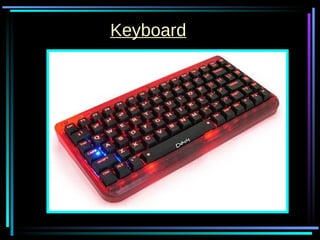
Keyboard is the most widely used input device uses an arrangement of buttons or keys, to act as mechanical levers or electronic switches.  Keyboards are divided into sections
Sections of Keyboards Typewriter keys The standard alphabetic and numeric characters you would find on a typewriter Function keys Special keys that perform some specific function for the application being run
Sections of Keyboard Numeric keypad Used for mathematical operations Directional keys Used to move the cursor around the screen
Keyboard
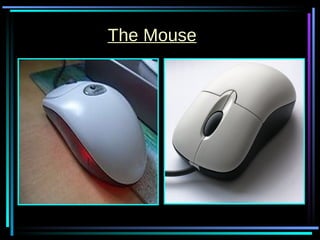
The Mouse is a pointing device that rolls around on a flat surface and controls the location of the pointer on the screen is a pointing device that functions by detecting two-dimensional motion relative to its supporting surface
Mouse Functions Pointing Placing the on-screen pointer at a specific place Clicking Pressing and releasing the  mouse button
Dragging Holding down the mouse button and dragging an object to a new location by dragging the mouse Double-clicking Pressing and releasing the mouse button twice very quickly Right-clicking Pressing the right  mouse button
The Mouse
Other     Pointing     Devices
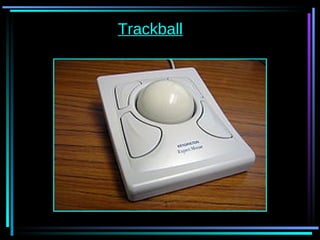
Trackball This is like a mouse turned upside down  You roll a ball around with your fingers to control the location of the pointer frequently are found on notebook computers.
Trackball
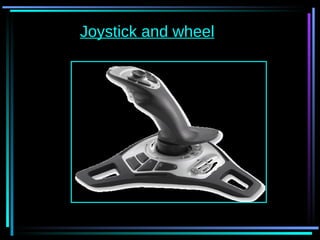
Joystick and Wheel consist of a metal or plastic handle mounted on a base that you can move in any direction to move the pointer or other object typically are used for video games Most have buttons that can be pushed or clicked to control input/output
Joystick and wheel
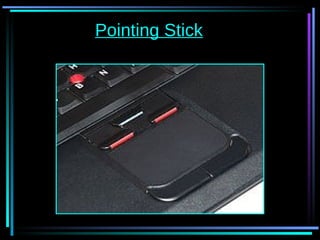
Pointing Stick A pressure-sensitive device that resembles a pencil eraser  found mostly on notebook computers has a replaceable rubber cap, traditionally red on the ThinkPad but also found in other colors on other machines
Pointing Stick
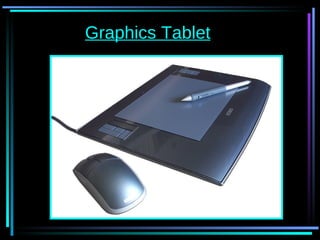
Graphics Tablet A flat drawing surface connected to the computer The user draws on the surface, and the figures or writing on the tablet can be input to the computer for processing These tablets may also be used to capture data or handwritten signatures
Graphics Tablet
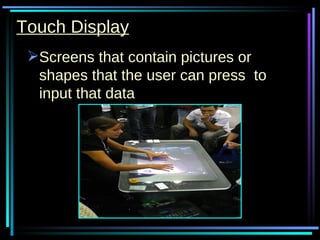
Touch Display Screens that contain pictures or shapes that the user can press  to input that data
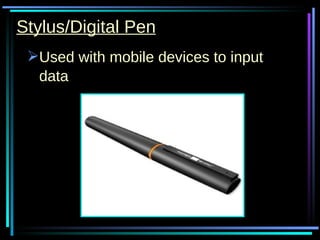
Stylus/Digital Pen Used with mobile devices to input data
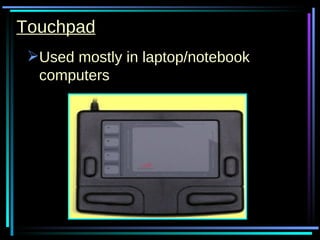
Touchpad Used mostly in laptop/notebook computers
Audio/Voice Input Inputting sound and/or voice These usually require a microphone and special voice recognition software to be installed on the computer Video Input Input from a camcorder or VCR using video capture cards
Scanners Devices that can convert a graphical image into a digital image and input it to the computer are types of source data entry machines to input automatically data (i.e. prices, code, etc.) in digital form from external sources like bar code to the computer
Types    of    Scanners
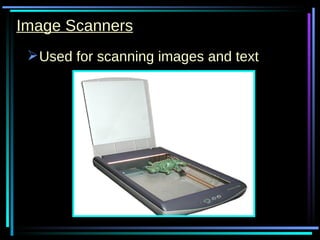
Image Scanners Used for scanning images and text
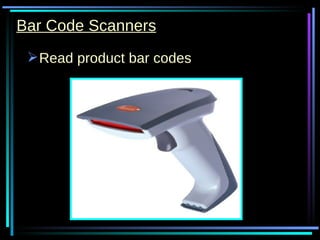
Bar Code Scanners Read product bar codes
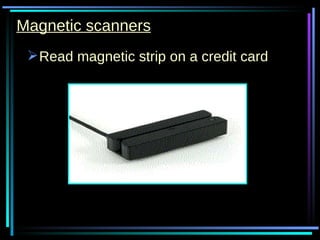
Magnetic scanners Read magnetic strip on a credit card
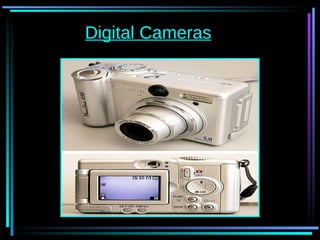
Digital Cameras Used to take pictures and store them on a magnetic disk instead of on film Their images can be input directly into the computer a camera that takes video or still photographs, or both, digitally by recording images via an electronic image sensor
Digital Cameras
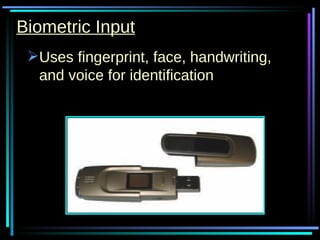
Biometric Input Uses fingerprint, face, handwriting, and voice for identification
Magnetic   Storage   Devices
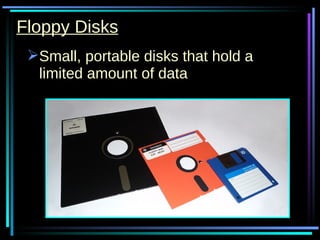
Floppy Disks Small, portable disks that hold a limited amount of data
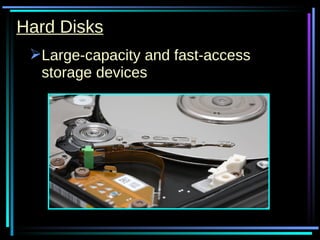
Hard Disks Large-capacity and fast-access storage devices
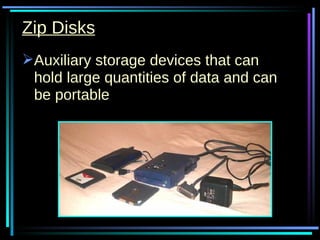
Zip Disks Auxiliary storage devices that can hold large quantities of data and can be portable
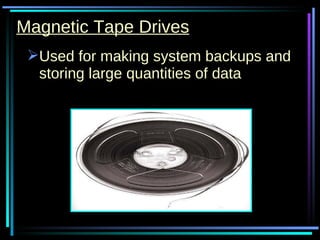
Magnetic Tape Drives Used for making system backups and storing large quantities of data
Solid-State   Storage   Media
Solid-State Storage Media Non-volatile removable media Miniature mobile media Uses integrated circuits USB flash drive Connects to the computer via a USB port
Caring for Storage Media To safeguard your data from damage, follow these tips when dealing with removable media: Keep away from magnetic fields. Avoid extreme temperatures. Never try to disassemble the case. Remove media from drive when not being used.
Tips for dealing with Storage Media Write-protect important data. Hold optical disks at their edges. Never remove the media from the drive if the access light is on. Keep disks in a sturdy case when transporting them.
Output Devices is any piece of computer hardware equipment used to communicate the results of data processing carried out by an information processing system (such as a computer) to the outside world.
  Examples   of  Output Devices
Monitors are used to display video output to user a device that displays images or symbols generated by computers  Maybe monochromatic or color Monochromatic monitors display output in a single-color display.
Factors that influence the quality of a monitor Screen size: The diagonal measurement in inches of the display area Resolution: The number of pixels that can be displayed in the display area Dot pitch: The distance between each pixel in the display area
Printers are used to create hard copy of a document or image It varies by speed, quality and price a computer peripheral that reproduces text and/or pictures on paper or other kind of printable surface
Types    of    Printers
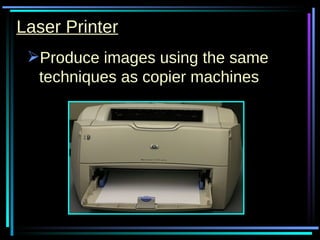
Laser Printer Produce images using the same techniques as copier machines
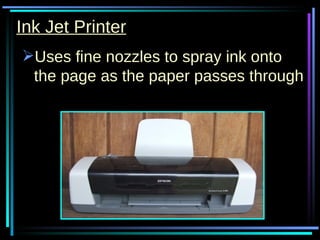
Ink Jet Printer Uses fine nozzles to spray ink onto the page as the paper passes through
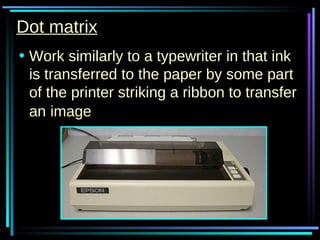
Dot matrix Work similarly to a typewriter in that ink is transferred to the paper by some part of the printer striking a ribbon to transfer an   image
Other Types   Of   Output Devices
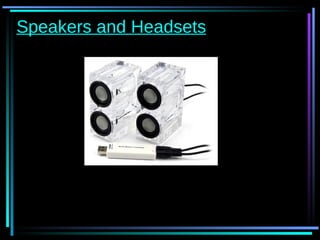
Speakers and Headsets
Fax machines and Fax Modems A device you can attach to a personal computer that enables you to transmit and receive electronic documents as faxes
Data Projectors A device that projects computer output onto a white or silver fabric screen that is wall, ceiling or tripod mounted.  It is widely used in classrooms and auditoriums for instruction and slide presentations.
Connecting I/O devices to the computer Input and output devices must be connected to the computer before they can be used Plug the device into an existing socket or port on the back of the computer.
Connecting I/O devices to the computer Install an expansion card with the port you need included on the back of the card. Connect wirelessly.

Villepoint

  • 1.
    Requirement For EDP 111 Prepared by: Orville Troy Somcio
  • 2.
    Computer System Hardware
  • 3.
    Input Devices enablea user to input data and commands to the computer to be processed is any peripheral (piece of computer hardware equipment) used to provide data and control signals to an information processing system (such as a computer).
  • 4.
    Examples of Input Devices
  • 5.
    Keyboard is themost widely used input device uses an arrangement of buttons or keys, to act as mechanical levers or electronic switches. Keyboards are divided into sections
  • 6.
    Sections of KeyboardsTypewriter keys The standard alphabetic and numeric characters you would find on a typewriter Function keys Special keys that perform some specific function for the application being run
  • 7.
    Sections of KeyboardNumeric keypad Used for mathematical operations Directional keys Used to move the cursor around the screen
  • 8.
  • 9.
    The Mouse isa pointing device that rolls around on a flat surface and controls the location of the pointer on the screen is a pointing device that functions by detecting two-dimensional motion relative to its supporting surface
  • 10.
    Mouse Functions PointingPlacing the on-screen pointer at a specific place Clicking Pressing and releasing the mouse button
  • 11.
    Dragging Holding downthe mouse button and dragging an object to a new location by dragging the mouse Double-clicking Pressing and releasing the mouse button twice very quickly Right-clicking Pressing the right mouse button
  • 12.
  • 13.
    Other Pointing Devices
  • 14.
    Trackball This islike a mouse turned upside down You roll a ball around with your fingers to control the location of the pointer frequently are found on notebook computers.
  • 15.
  • 16.
    Joystick and Wheelconsist of a metal or plastic handle mounted on a base that you can move in any direction to move the pointer or other object typically are used for video games Most have buttons that can be pushed or clicked to control input/output
  • 17.
  • 18.
    Pointing Stick Apressure-sensitive device that resembles a pencil eraser found mostly on notebook computers has a replaceable rubber cap, traditionally red on the ThinkPad but also found in other colors on other machines
  • 19.
  • 20.
    Graphics Tablet Aflat drawing surface connected to the computer The user draws on the surface, and the figures or writing on the tablet can be input to the computer for processing These tablets may also be used to capture data or handwritten signatures
  • 21.
  • 22.
    Touch Display Screensthat contain pictures or shapes that the user can press to input that data
  • 23.
    Stylus/Digital Pen Usedwith mobile devices to input data
  • 24.
    Touchpad Used mostlyin laptop/notebook computers
  • 25.
    Audio/Voice Input Inputtingsound and/or voice These usually require a microphone and special voice recognition software to be installed on the computer Video Input Input from a camcorder or VCR using video capture cards
  • 26.
    Scanners Devices thatcan convert a graphical image into a digital image and input it to the computer are types of source data entry machines to input automatically data (i.e. prices, code, etc.) in digital form from external sources like bar code to the computer
  • 27.
    Types of Scanners
  • 28.
    Image Scanners Usedfor scanning images and text
  • 29.
    Bar Code ScannersRead product bar codes
  • 30.
    Magnetic scanners Readmagnetic strip on a credit card
  • 31.
    Digital Cameras Usedto take pictures and store them on a magnetic disk instead of on film Their images can be input directly into the computer a camera that takes video or still photographs, or both, digitally by recording images via an electronic image sensor
  • 32.
  • 33.
    Biometric Input Usesfingerprint, face, handwriting, and voice for identification
  • 34.
    Magnetic Storage Devices
  • 35.
    Floppy Disks Small,portable disks that hold a limited amount of data
  • 36.
    Hard Disks Large-capacityand fast-access storage devices
  • 37.
    Zip Disks Auxiliarystorage devices that can hold large quantities of data and can be portable
  • 38.
    Magnetic Tape DrivesUsed for making system backups and storing large quantities of data
  • 39.
    Solid-State Storage Media
  • 40.
    Solid-State Storage MediaNon-volatile removable media Miniature mobile media Uses integrated circuits USB flash drive Connects to the computer via a USB port
  • 41.
    Caring for StorageMedia To safeguard your data from damage, follow these tips when dealing with removable media: Keep away from magnetic fields. Avoid extreme temperatures. Never try to disassemble the case. Remove media from drive when not being used.
  • 42.
    Tips for dealingwith Storage Media Write-protect important data. Hold optical disks at their edges. Never remove the media from the drive if the access light is on. Keep disks in a sturdy case when transporting them.
  • 43.
    Output Devices isany piece of computer hardware equipment used to communicate the results of data processing carried out by an information processing system (such as a computer) to the outside world.
  • 44.
    Examples of Output Devices
  • 45.
    Monitors are usedto display video output to user a device that displays images or symbols generated by computers Maybe monochromatic or color Monochromatic monitors display output in a single-color display.
  • 46.
    Factors that influencethe quality of a monitor Screen size: The diagonal measurement in inches of the display area Resolution: The number of pixels that can be displayed in the display area Dot pitch: The distance between each pixel in the display area
  • 47.
    Printers are usedto create hard copy of a document or image It varies by speed, quality and price a computer peripheral that reproduces text and/or pictures on paper or other kind of printable surface
  • 48.
    Types of Printers
  • 49.
    Laser Printer Produceimages using the same techniques as copier machines
  • 50.
    Ink Jet PrinterUses fine nozzles to spray ink onto the page as the paper passes through
  • 51.
    Dot matrix Worksimilarly to a typewriter in that ink is transferred to the paper by some part of the printer striking a ribbon to transfer an image
  • 52.
    Other Types Of Output Devices
  • 53.
  • 54.
    Fax machines andFax Modems A device you can attach to a personal computer that enables you to transmit and receive electronic documents as faxes
  • 55.
    Data Projectors Adevice that projects computer output onto a white or silver fabric screen that is wall, ceiling or tripod mounted. It is widely used in classrooms and auditoriums for instruction and slide presentations.
  • 56.
    Connecting I/O devicesto the computer Input and output devices must be connected to the computer before they can be used Plug the device into an existing socket or port on the back of the computer.
  • 57.
    Connecting I/O devicesto the computer Install an expansion card with the port you need included on the back of the card. Connect wirelessly.