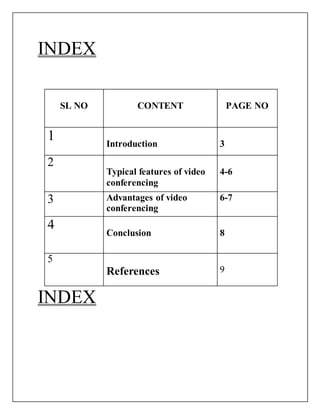
Video conferencing allows people at different locations to communicate simultaneously through two-way video and audio. It has several typical features including full duplex voice communication, text chat, streaming video exchange, whiteboard sharing, file transfer, and application sharing. The main advantages of video conferencing are significant travel savings, improved communication through visual cues, increased productivity through shorter more effective meetings and collaborative tools, and conferencing quality is improving with advances in technology. While not a replacement for all teaching, video conferencing can supplement asynchronous distance education when used appropriately.


![Netex Webinar | Adaptive Learning, the future of learning? [EN]](https://cdn.slidesharecdn.com/ss_thumbnails/netexwebinaradaptivelearningthefutureoflearningen-160714154837-thumbnail.jpg?width=640&height=640&fit=bounds)


![Netex Webinar | Mobile Learning: nuevos retos, nuevas soluciones [ES]](https://cdn.slidesharecdn.com/ss_thumbnails/mobilelearning02062015-150603144750-lva1-app6892-thumbnail.jpg?width=640&height=640&fit=bounds)


