ONLINE 
ASSIGNMENT 
SUBMITTED BY 
SURYA SUNDARESAN 
SOCIAL SCIENCE 
REG.NO 13973030 
KUCTE, KOLLAM
TITLE: 
THE IMPORTANCE OF 
VIDEO 
CONFERENCING IN 
SOCIAL SCIENCE
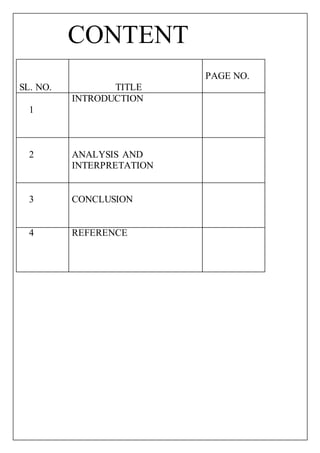
CONTENT 
SL. NO. 
TITLE 
PAGE NO. 
1 
INTRODUCTION 
2 
ANALYSIS AND 
INTERPRETATION 
3 
CONCLUSION 
4 REFERENCE
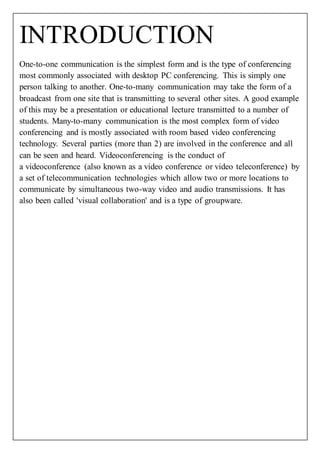
INTRODUCTION 
One-to-one communication is the simplest form and is the type of conferencing 
most commonly associated with desktop PC conferencing. This is simply one 
person talking to another. One-to-many communication may take the form of a 
broadcast from one site that is transmitting to several other sites. A good example 
of this may be a presentation or educational lecture transmitted to a number of 
students. Many-to-many communication is the most complex form of video 
conferencing and is mostly associated with room based video conferencing 
technology. Several parties (more than 2) are involved in the conference and all 
can be seen and heard. Videoconferencing is the conduct of 
a videoconference (also known as a video conference or video teleconference) by 
a set of telecommunication technologies which allow two or more locations to 
communicate by simultaneous two-way video and audio transmissions. It has 
also been called 'visual collaboration' and is a type of groupware.
ANALYSIS AND 
INTERPRETATION 
Video conferencing provides educators and businesses with the opportunity to 
learn, share and interact across distances. Video conferencing technology utilizes 
both the telephone and a video camera. The camera is often connected to a laptop 
or desktop computer. Video conferencing improves productivity and reduces 
travel time. Individuals using video conferencing can share data with each other 
and transfer information such as photos or documents 
If we teach geography the areas like atmosphere , ozone, water then we can 
conduct video conference with subject experts from science 
Videoconferencing differs from videophone calls in that it's designed to serve a 
conference or multiple locations rather than individuals.[1] It is an intermediate 
form of video telephony, first used commercially in Germany during the late- 
1930s and later in the United States during the early 1970s. 
With the introduction of relatively low cost, high capacity 
broadband telecommunication services in the late 1990s, coupled with powerful 
computing processors and video compression techniques, videoconferencing has 
made significant inroads in business, education, medicine and media. Like all 
long distance communications technologies (such as phone and Internet), by 
reducing the need to travel. 
Indonesian and U.S. students participating in an educational videoconference (2010).
There are many benefits of using video conferencing: 
1. you can communicate regularly with people in other districts, states or 
countries, which would usually be costly or impossible if you had to 
travel 
2. you can video conference with many more people than would fit into a 
single meeting room because each party will be using their own 
facilities 
3. Video conference communication and meetings take much less time as 
no travel is involved. A meeting that may take you away from work for 
four hours (due to travel), may take only one or two hours using a video 
conference 
4. Using video conferencing saves money by lowering your expenses - 
there is no need for all the costs involved with traveling. 
5. A telephone call or e-mail is not always the best way to communicate 
with another person. Interactive meetings can help to generate ideas and 
enable people to read and react to others' sensitivities 
6. Video conferencing allows collaboration by document sharing. Many 
people in different areas can work on the same project and make 
contributions 
7. Many institutions can receive the same broadcast simultaneously and 
thus a much greater level of participation can be gained. For example, a 
lecture being broadcast to students at many different educational 
institutions 
Video conferencing technology enables students to attend classes 
remotely. Some colleges and universities offer full degree programs 
completely online. This offers greater flexibility to students and 
professors. Students and lecturers can meet individually through video 
conferencing and lecturers can hold classes online. Students with video 
cameras can see the professors and other students equipped with similar 
video equipment. 
Video conferencing helping the students to get information from 
experts persons. In social science it has great importance. Teachers and 
students can conduct group discussions at any time by this facility.
If the facility for video conferencing in class teacher can control the 
whole class and gave directions to the children. 
Students can also ask doubts to their teacher. 
We all know that social science is a very wide areas of subject like 
history, geography, political science, economics, anthropology, 
philosophy, sociology etc. social science subject matter indirectly 
connected with all other science subject.so a single teacher know all 
these subject thoroughly is impossible. Here the importance of video 
conferencing .social science teacher can ask doubts to subject experts 
.And make discussions with political leaders ,eminent persons like 
Abdul kalam, these will help the students to studies make interesting 
and effective learning. 
Now a days, video conferencing also available social networking sites. 
There are many reasons to engage in a video conference. Video 
conferencing allows people to work from home, make international 
business deals, collaborate with others and keep up with family and 
friends. Even though there are benefits to using this technology, there 
are also some drawbacks. 
It's Impersonal 
For some, video conferencing can’t replace the benefits of face-to-face 
contact. When meeting with someone over video, you can’t shake 
hands, make proper eye contact or fully observe body language. This 
can be a turn-off for people who are used to more personal forms of 
communication. 
Learning Curve 
 Every new technology has a learning curve. Learning how to use and 
implement video conferencing hardware and software can be 
cumbersome. It can also be expensive if you need to hire an outside 
party to install the equipment and provide training. It can also be 
frustrating if you experience delays in your conference because of 
technical difficulties. If a business is working with a new client or trying 
to close a deal, this type of delay can seem unprofessional. 
Network Difficulties
 Depending on the equipment and network connection, users can 
experience quality issues. For instance, sometimes people can appear 
pixilated or there can be lighting issues which make it hard to see the 
other party. There can also be sound-quality issues. These types of 
problems can make a video conference seem like a very unattractive 
option. 
Expense 
 Depending on your needs, video conferencing hardware and software 
can be expensive. In general, the more features that are offered, the 
more expensive it will be. If you need to have a video conference for 
personal reasons, then you may be able to find less expensive options 
such as free web conferencing software. However, business users may 
find that the less-expensive options don’t suit their needs.
CONCLUSION: We all know that social science is an integrated subject. Also up to 
secondary level we follow an integrated curriculum. So applying of video 
conferencing helping both teachers and students simultaneously. educational 
lecture transmitted to a number of students. Many-to-many communication is the 
most complex form of video conferencing and is mostly associated with room 
based video conferencing technology. Using video conferencing saves money by 
lowering your expenses - there is no need for all the costs involved with 
traveling. A telephone call or e-mail is not always the best way to communicate 
with another person. Interactive meetings can help to generate ideas and enable 
people to read and react to others' sensitivities .Video conferencing allows 
collaboration by document sharing. Many people in different areas can work on 
the same project and make contributions. Video conferencing advantages 
definitely outweigh its disadvantages. It can help stimulate better 
brainstorming, knowledge, fact and information sharing and gathering. 
The possibilities for different kinds of communication, for a better life 
seem to be endless due to this technology.
REFERENCE: 
• Madhukumar Indira. (2005). Internet based distance learning . New Delhi: 
Global Network. 
• Mayer Richard E(2001); Multimedia Learning, Cambridge University Press, 
UK.McDonald &Evans Ltd. 1975 
• Prasad Janardan, (2007). Audio Visual education. Teaching innovative 
technique. NewDelhi: Kanishka Publishers. 
• Rejesekaran S. (2007) Computer Education and Educational Computing, New 
Delhi: Neel Kamal Publishing Pvt. Ltd. 
• Roblyer, M.D. (2008). Integrating educational technology into teaching. New 
Delhi: Pearson. 
• Sagar Krishna, (2005). ICT Teacher training. New Delhi : Global Network 
• Kumar, S.P.K &Noushad,P.P.(2009). Social Studies in the Classroom: Trends 
and Methods. 
http://www.ehow.com/list_7232049_disadvantages-video-conferencing.html 
Read more at Buzzle: http://www.buzzle.com/articles/advantages-and-disadvantages-of-video-conferencing.html 
.

Assignment

  • 1.
    ONLINE ASSIGNMENT SUBMITTEDBY SURYA SUNDARESAN SOCIAL SCIENCE REG.NO 13973030 KUCTE, KOLLAM
  • 2.
    TITLE: THE IMPORTANCEOF VIDEO CONFERENCING IN SOCIAL SCIENCE
  • 3.
    CONTENT SL. NO. TITLE PAGE NO. 1 INTRODUCTION 2 ANALYSIS AND INTERPRETATION 3 CONCLUSION 4 REFERENCE
  • 4.
    INTRODUCTION One-to-one communicationis the simplest form and is the type of conferencing most commonly associated with desktop PC conferencing. This is simply one person talking to another. One-to-many communication may take the form of a broadcast from one site that is transmitting to several other sites. A good example of this may be a presentation or educational lecture transmitted to a number of students. Many-to-many communication is the most complex form of video conferencing and is mostly associated with room based video conferencing technology. Several parties (more than 2) are involved in the conference and all can be seen and heard. Videoconferencing is the conduct of a videoconference (also known as a video conference or video teleconference) by a set of telecommunication technologies which allow two or more locations to communicate by simultaneous two-way video and audio transmissions. It has also been called 'visual collaboration' and is a type of groupware.
  • 5.
    ANALYSIS AND INTERPRETATION Video conferencing provides educators and businesses with the opportunity to learn, share and interact across distances. Video conferencing technology utilizes both the telephone and a video camera. The camera is often connected to a laptop or desktop computer. Video conferencing improves productivity and reduces travel time. Individuals using video conferencing can share data with each other and transfer information such as photos or documents If we teach geography the areas like atmosphere , ozone, water then we can conduct video conference with subject experts from science Videoconferencing differs from videophone calls in that it's designed to serve a conference or multiple locations rather than individuals.[1] It is an intermediate form of video telephony, first used commercially in Germany during the late- 1930s and later in the United States during the early 1970s. With the introduction of relatively low cost, high capacity broadband telecommunication services in the late 1990s, coupled with powerful computing processors and video compression techniques, videoconferencing has made significant inroads in business, education, medicine and media. Like all long distance communications technologies (such as phone and Internet), by reducing the need to travel. Indonesian and U.S. students participating in an educational videoconference (2010).
  • 6.
    There are manybenefits of using video conferencing: 1. you can communicate regularly with people in other districts, states or countries, which would usually be costly or impossible if you had to travel 2. you can video conference with many more people than would fit into a single meeting room because each party will be using their own facilities 3. Video conference communication and meetings take much less time as no travel is involved. A meeting that may take you away from work for four hours (due to travel), may take only one or two hours using a video conference 4. Using video conferencing saves money by lowering your expenses - there is no need for all the costs involved with traveling. 5. A telephone call or e-mail is not always the best way to communicate with another person. Interactive meetings can help to generate ideas and enable people to read and react to others' sensitivities 6. Video conferencing allows collaboration by document sharing. Many people in different areas can work on the same project and make contributions 7. Many institutions can receive the same broadcast simultaneously and thus a much greater level of participation can be gained. For example, a lecture being broadcast to students at many different educational institutions Video conferencing technology enables students to attend classes remotely. Some colleges and universities offer full degree programs completely online. This offers greater flexibility to students and professors. Students and lecturers can meet individually through video conferencing and lecturers can hold classes online. Students with video cameras can see the professors and other students equipped with similar video equipment. Video conferencing helping the students to get information from experts persons. In social science it has great importance. Teachers and students can conduct group discussions at any time by this facility.
  • 7.
    If the facilityfor video conferencing in class teacher can control the whole class and gave directions to the children. Students can also ask doubts to their teacher. We all know that social science is a very wide areas of subject like history, geography, political science, economics, anthropology, philosophy, sociology etc. social science subject matter indirectly connected with all other science subject.so a single teacher know all these subject thoroughly is impossible. Here the importance of video conferencing .social science teacher can ask doubts to subject experts .And make discussions with political leaders ,eminent persons like Abdul kalam, these will help the students to studies make interesting and effective learning. Now a days, video conferencing also available social networking sites. There are many reasons to engage in a video conference. Video conferencing allows people to work from home, make international business deals, collaborate with others and keep up with family and friends. Even though there are benefits to using this technology, there are also some drawbacks. It's Impersonal For some, video conferencing can’t replace the benefits of face-to-face contact. When meeting with someone over video, you can’t shake hands, make proper eye contact or fully observe body language. This can be a turn-off for people who are used to more personal forms of communication. Learning Curve  Every new technology has a learning curve. Learning how to use and implement video conferencing hardware and software can be cumbersome. It can also be expensive if you need to hire an outside party to install the equipment and provide training. It can also be frustrating if you experience delays in your conference because of technical difficulties. If a business is working with a new client or trying to close a deal, this type of delay can seem unprofessional. Network Difficulties
  • 8.
     Depending onthe equipment and network connection, users can experience quality issues. For instance, sometimes people can appear pixilated or there can be lighting issues which make it hard to see the other party. There can also be sound-quality issues. These types of problems can make a video conference seem like a very unattractive option. Expense  Depending on your needs, video conferencing hardware and software can be expensive. In general, the more features that are offered, the more expensive it will be. If you need to have a video conference for personal reasons, then you may be able to find less expensive options such as free web conferencing software. However, business users may find that the less-expensive options don’t suit their needs.
  • 9.
    CONCLUSION: We allknow that social science is an integrated subject. Also up to secondary level we follow an integrated curriculum. So applying of video conferencing helping both teachers and students simultaneously. educational lecture transmitted to a number of students. Many-to-many communication is the most complex form of video conferencing and is mostly associated with room based video conferencing technology. Using video conferencing saves money by lowering your expenses - there is no need for all the costs involved with traveling. A telephone call or e-mail is not always the best way to communicate with another person. Interactive meetings can help to generate ideas and enable people to read and react to others' sensitivities .Video conferencing allows collaboration by document sharing. Many people in different areas can work on the same project and make contributions. Video conferencing advantages definitely outweigh its disadvantages. It can help stimulate better brainstorming, knowledge, fact and information sharing and gathering. The possibilities for different kinds of communication, for a better life seem to be endless due to this technology.
  • 10.
    REFERENCE: • MadhukumarIndira. (2005). Internet based distance learning . New Delhi: Global Network. • Mayer Richard E(2001); Multimedia Learning, Cambridge University Press, UK.McDonald &Evans Ltd. 1975 • Prasad Janardan, (2007). Audio Visual education. Teaching innovative technique. NewDelhi: Kanishka Publishers. • Rejesekaran S. (2007) Computer Education and Educational Computing, New Delhi: Neel Kamal Publishing Pvt. Ltd. • Roblyer, M.D. (2008). Integrating educational technology into teaching. New Delhi: Pearson. • Sagar Krishna, (2005). ICT Teacher training. New Delhi : Global Network • Kumar, S.P.K &Noushad,P.P.(2009). Social Studies in the Classroom: Trends and Methods. http://www.ehow.com/list_7232049_disadvantages-video-conferencing.html Read more at Buzzle: http://www.buzzle.com/articles/advantages-and-disadvantages-of-video-conferencing.html .