TOPIC :-
MULTIMEDIA ELEMENTS &
USES
PRESENT BY :- DHRUMIL
MEHTA
150510101043
Parul University
Multimedia
 The Multimedia Is a Collection Of Text ,
Graphics , Images , Music , Videos , Movie
And More..
 Multi = Multiple
Media = Mediums Of Communication
 Information Which Is Represent By Audio ,
Video , Graphics , Animation In Traditional &
Effective Way.
 The Multimedia Is a One Way To Give a
Entertainment To Human Beings.
Multimedia Elements
Multimedia Elements
 Text
 Graphics
 Animation
 Audio
 Video
 Menus
 Hyperlinks
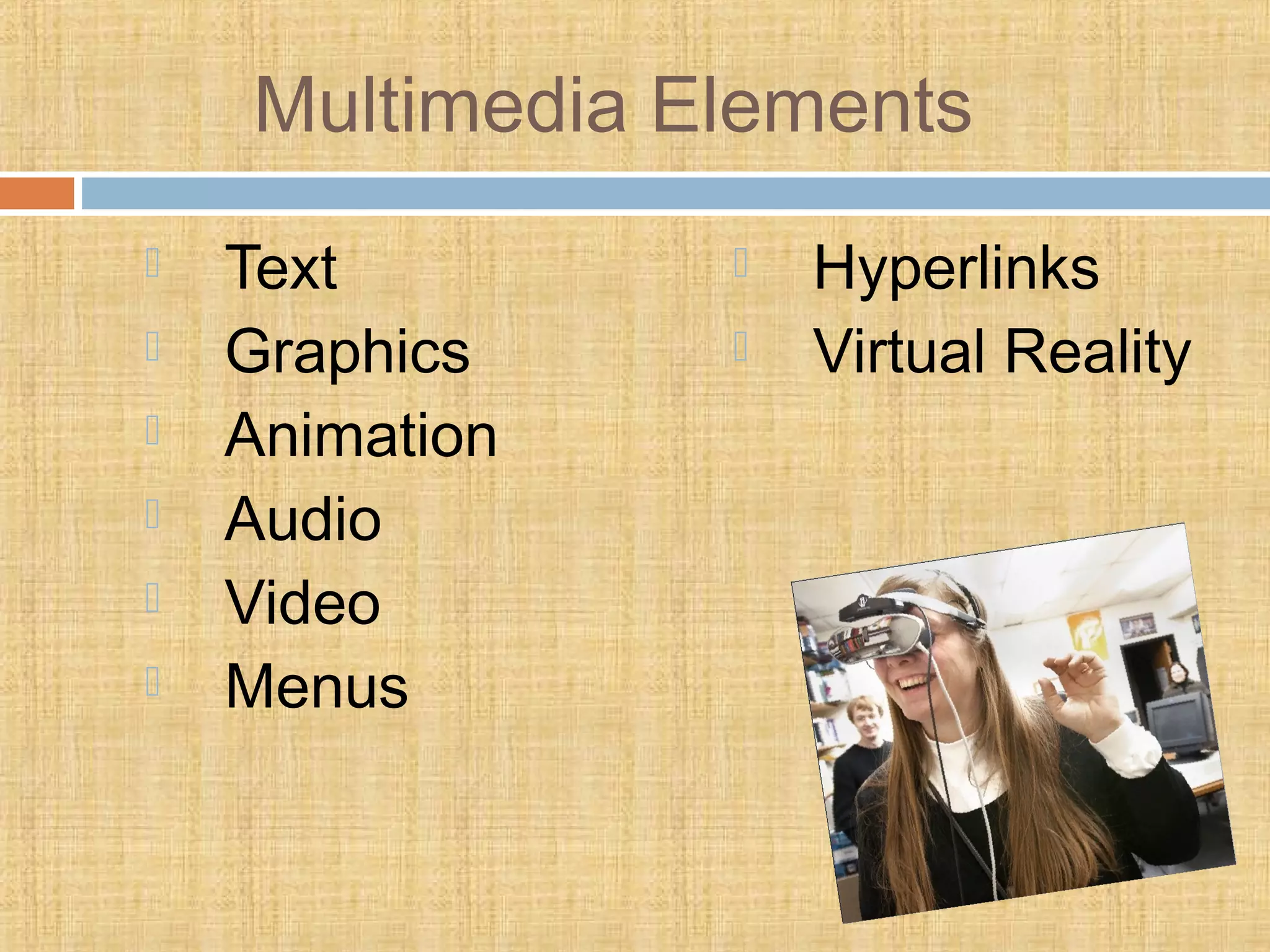
 Virtual Reality
Multimedia Elements: Text
Text should be:
 Appropriate for the target audience.
 Easy to read.
 Serif typefaces are preferred for printed material.
 Sans serif typefaces are preferred for on-screen
display.
 Formatted consistently throughout the
presentation.
Multimedia Elements: Graphics
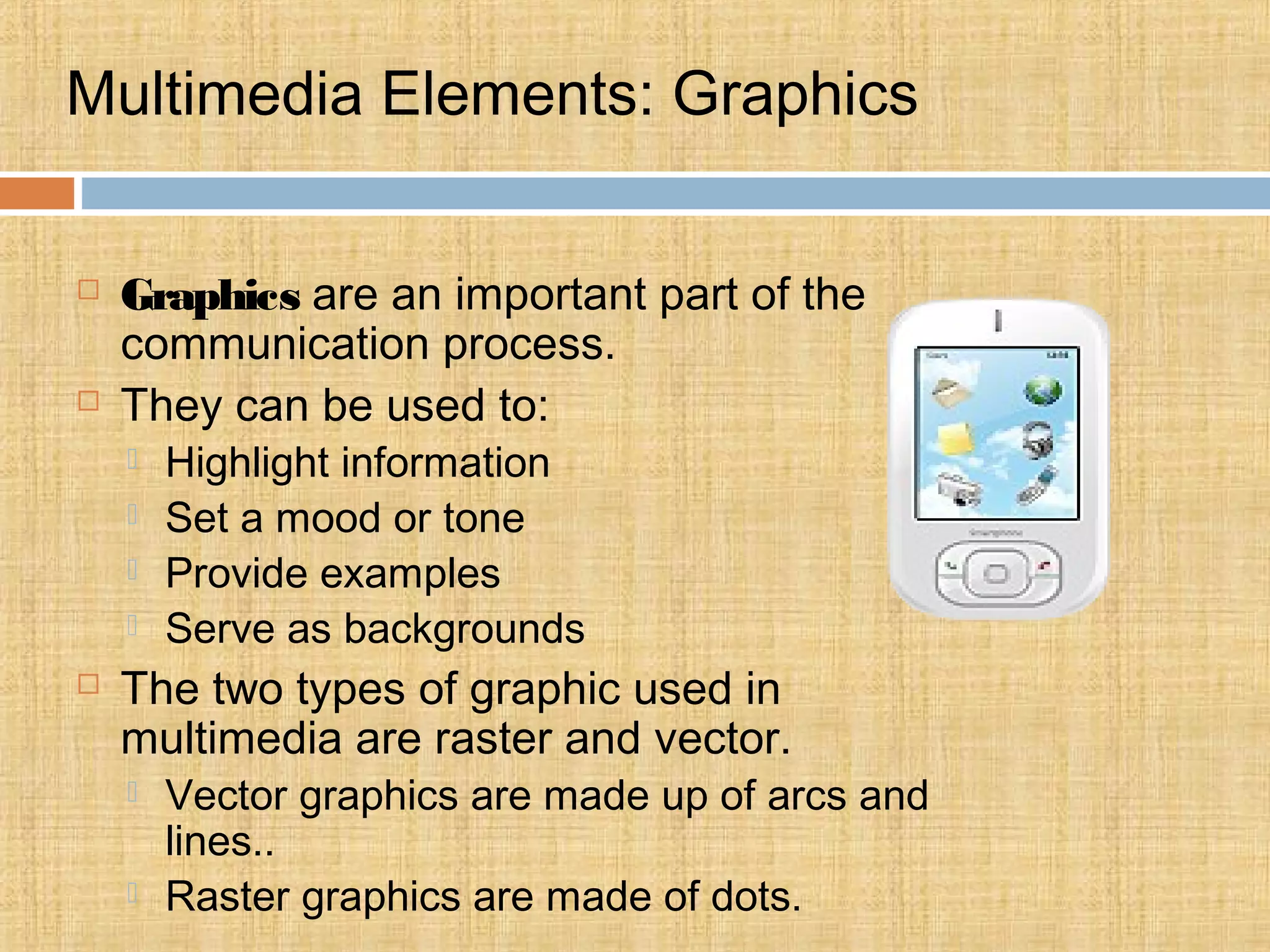
 Graphics are an important part of the
communication process.
 They can be used to:
 Highlight information
 Set a mood or tone
 Provide examples
 Serve as backgrounds
 The two types of graphic used in
multimedia are raster and vector.
 Vector graphics are made up of arcs and
lines..
 Raster graphics are made of dots.
Multimedia Elements: Graphics
When using graphics, the multimedia designer must:
 Determine the best balance between the size and quality.
 Use appropriate graphics for the intended purpose and
audience.
 Choose appropriate file formats
 Standard for the internet:
 JPEG (Joint Photographer Experts Group)
 GIF (Graphics Interchange file format)
 PNG (Portable Network Graphics)
 Most popular
 TIFF - Tagged Image File Format
 BMP – Bitmap
 PCX - Windows Paint
 PICT - Macintosh
Multimedia Elements:
Graphics
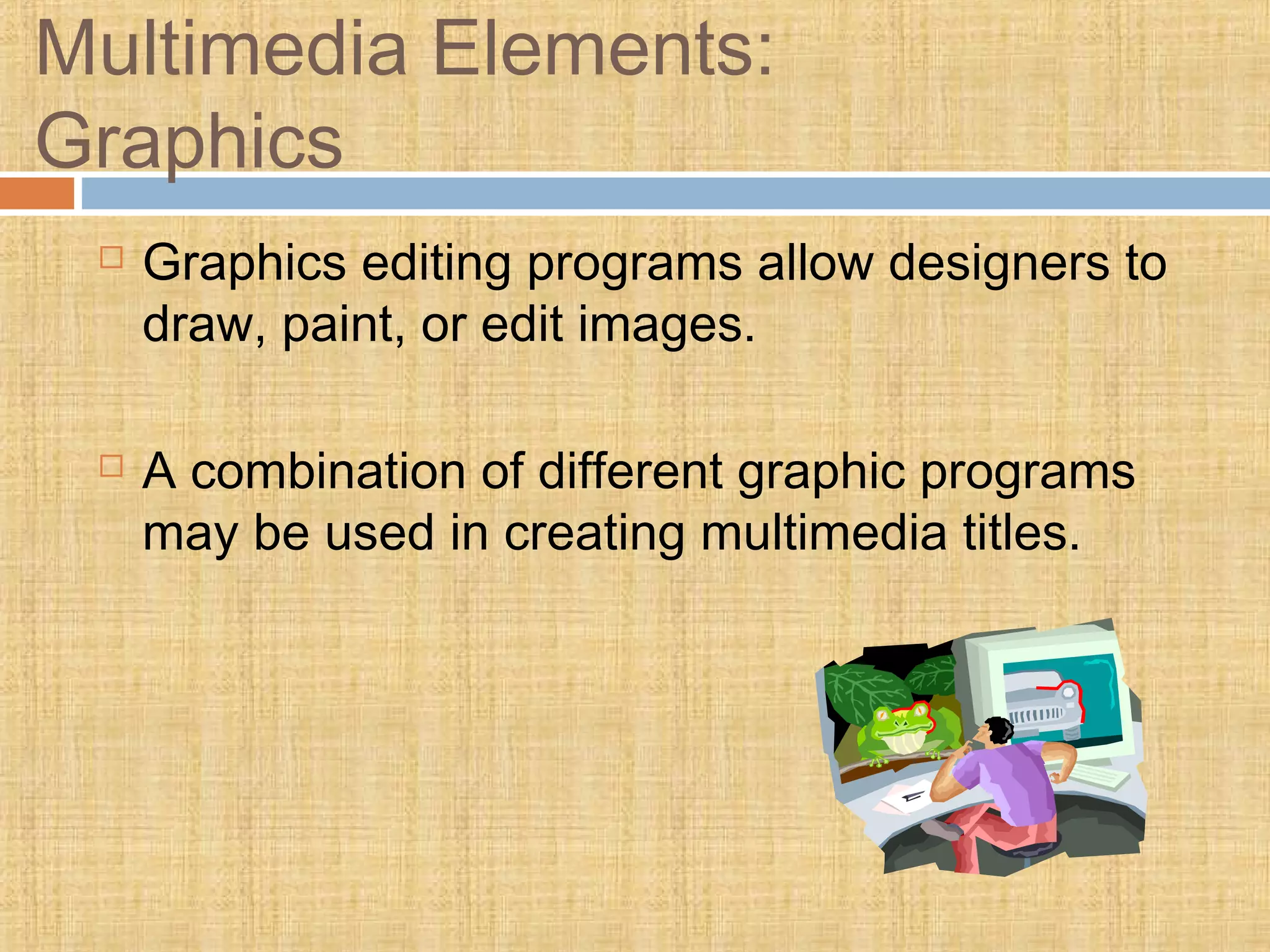
 Graphics editing programs allow designers to
draw, paint, or edit images.
 A combination of different graphic programs
may be used in creating multimedia titles.
Multimedia Elements: Animation
 2-D and 3-D animations are useful in multimedia in
the areas of entertainment, education, and training.
 They can be used to create simplified illustrations of
a simulation or dramatization.
 They can be much easier to understand because
they are less complex than video.
 2-D animations have smaller file sizes that video
files which means quicker loading or downloading of
the files.
Multimedia Elements: Sound
 Sounds in multimedia titles could include:
 Music.
 Narrations.
 Sound effects.
 Original recordings.
 Sound waves are vibrations that are created
when we speak.
 Sound waves are analog signals because they
are continuous, fluctuating waves with no
interruptions.
Multimedia Elements: Sound
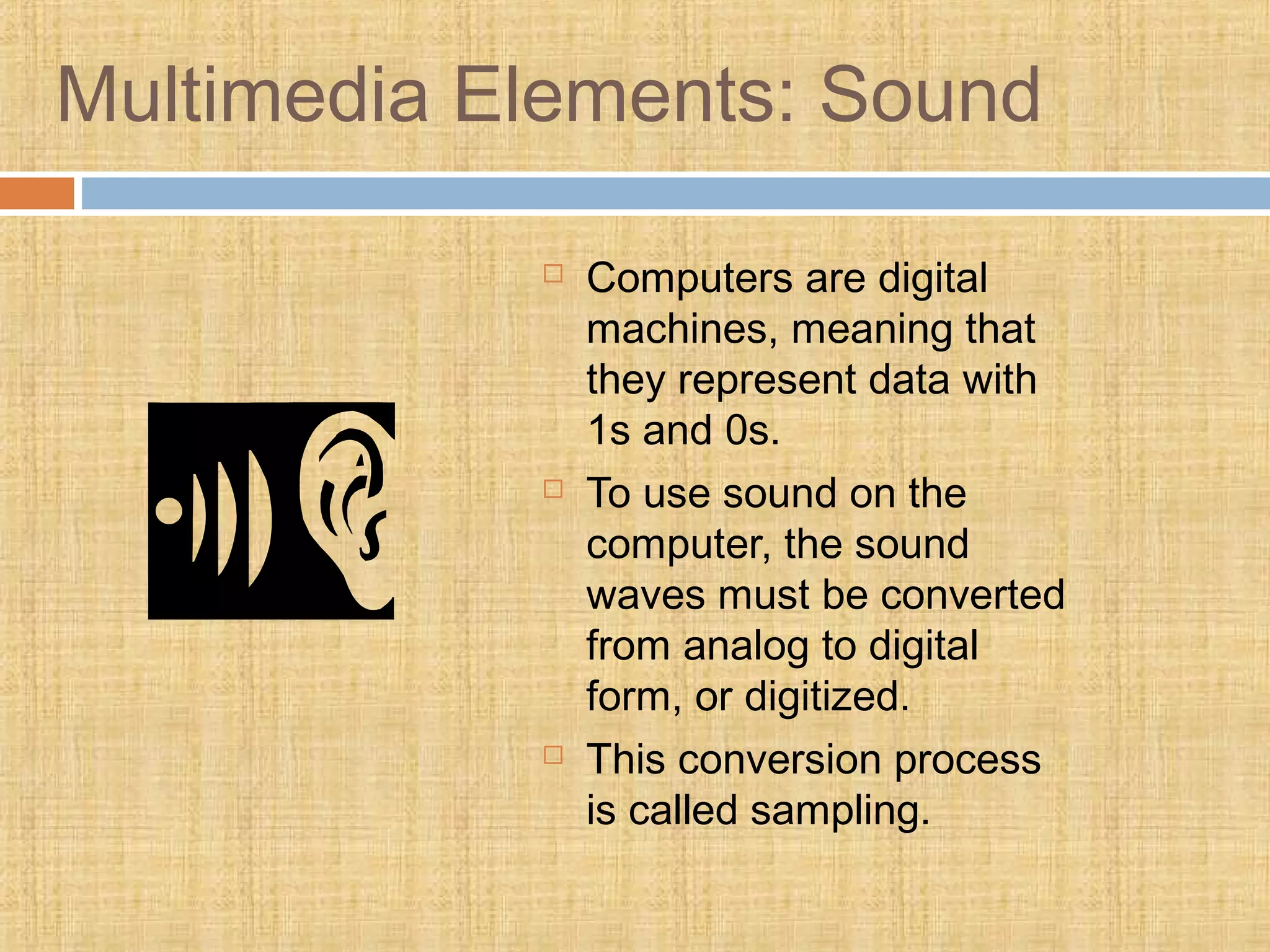
 Computers are digital
machines, meaning that
they represent data with
1s and 0s.
 To use sound on the
computer, the sound
waves must be converted
from analog to digital
form, or digitized.
 This conversion process
is called sampling.
Sampling
 Sampling is a means of reproducing a
continuous event, such as sound or motion, by
recording many fragments of it.
 It involves taking “snapshots” of a sound wave
in rapid intervals.
 These samples, or bits of information, are
saved as numbers to allow the computer to
process them.
Sample Rate
 The sample rate is the number of samples
taken per second.
 It is typically expressed in hertz (Hz), or
samples per second.
 16,000 samples per second = 16 kHz
 44,100 samples per second = 44.1 kHz
(CD quality sound)
Sample Rate (continued)
 The higher the sampling rate, the more
samples taken per second.
 This means:
 The digital sound will more closely match the
analog sound.
 The quality of the audio will be better.
Sample Size
 Sample size is the number of bits used to store one
sample.
 It is also called resolution.
 The more bits used per sample, the closer the digital
copy sounds to the original analog sound.
 The larger the sample size, the bigger the file size
but the better the quality of the sound.
 CD-quality sound has a sample size of 16 bits.
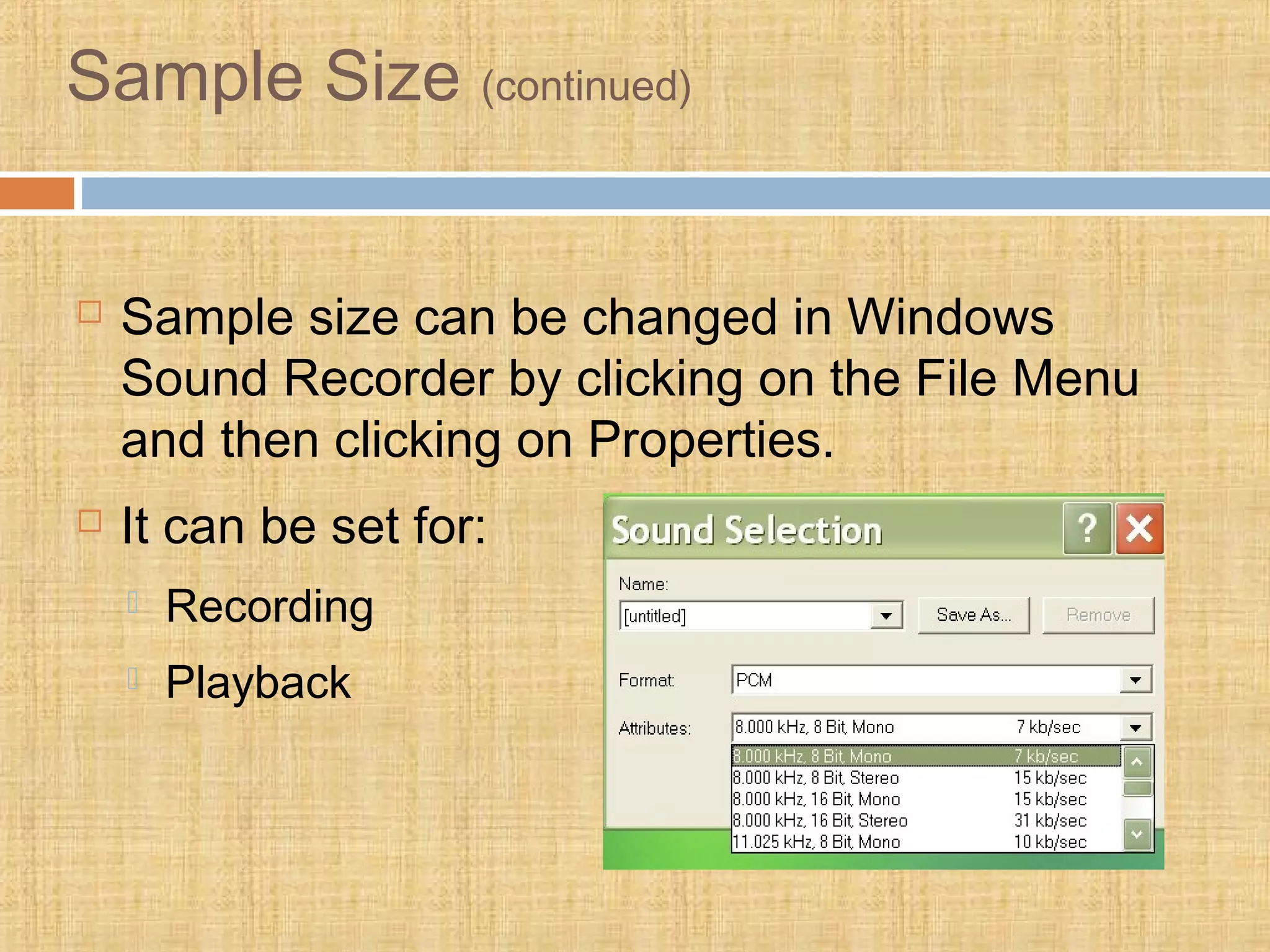
Sample Size (continued)
 Sample size can be changed in Windows
Sound Recorder by clicking on the File Menu
and then clicking on Properties.
 It can be set for:
 Recording
 Playback
Audio File Size is Determined By:
 Sampling rate – the number of samples per
second.
 Sample size – the number of bits used to save
one sample.
 Channels recorded – mono or stereo.
Audio File Formats
 AU – (Audio) file created by Sun Microsystems and
used on computers running the UNIX operating
system.
 MP3 – (Mpeg-1 Audio Layer 3) very compressed
file that is popular for music stored on portable
players and on the Internet because it can
reproduce near-CD quality audio in small file sizes.
 MIDI – (Musical Instrument Digital Interface) file
format for creating and/or playing music with
instruments using synthesizers and sound cards.
Audio File Formats (continued)
 WAV – (Waveform) file format developed jointly by
IBM and Microsoft as the native format for Windows
sound files.
 Produces high-quality sound.
 Generates large file sizes because it is uncompressed.
 Commonly used to edit sound which is then saved in a
different compressed format for distribution.
 WMA (Windows Media Audio) proprietary file format
developed by Microsoft originally to compete with
the .MP3 format.
 Produces high-quality sound.
 More compressed than .WAV files.
Multimedia Elements: Video
 Videos allow the audience to view actual events
instead of just reading about or listening to them.
 Sources for videos include web sites and stock film
companies.
Multimedia Elements: Video
 Videos can be used in:
 CD-ROMS
 Games
 Presentations
 Video simulations
 Videoconferences
 Websites.
 Videos vary in quality.
The Video Format
The file format of the video determines:
 Which programs can open and play it.
 How much storage space it occupies.
 How fast it travels over an Internet connection.
Video File Formats
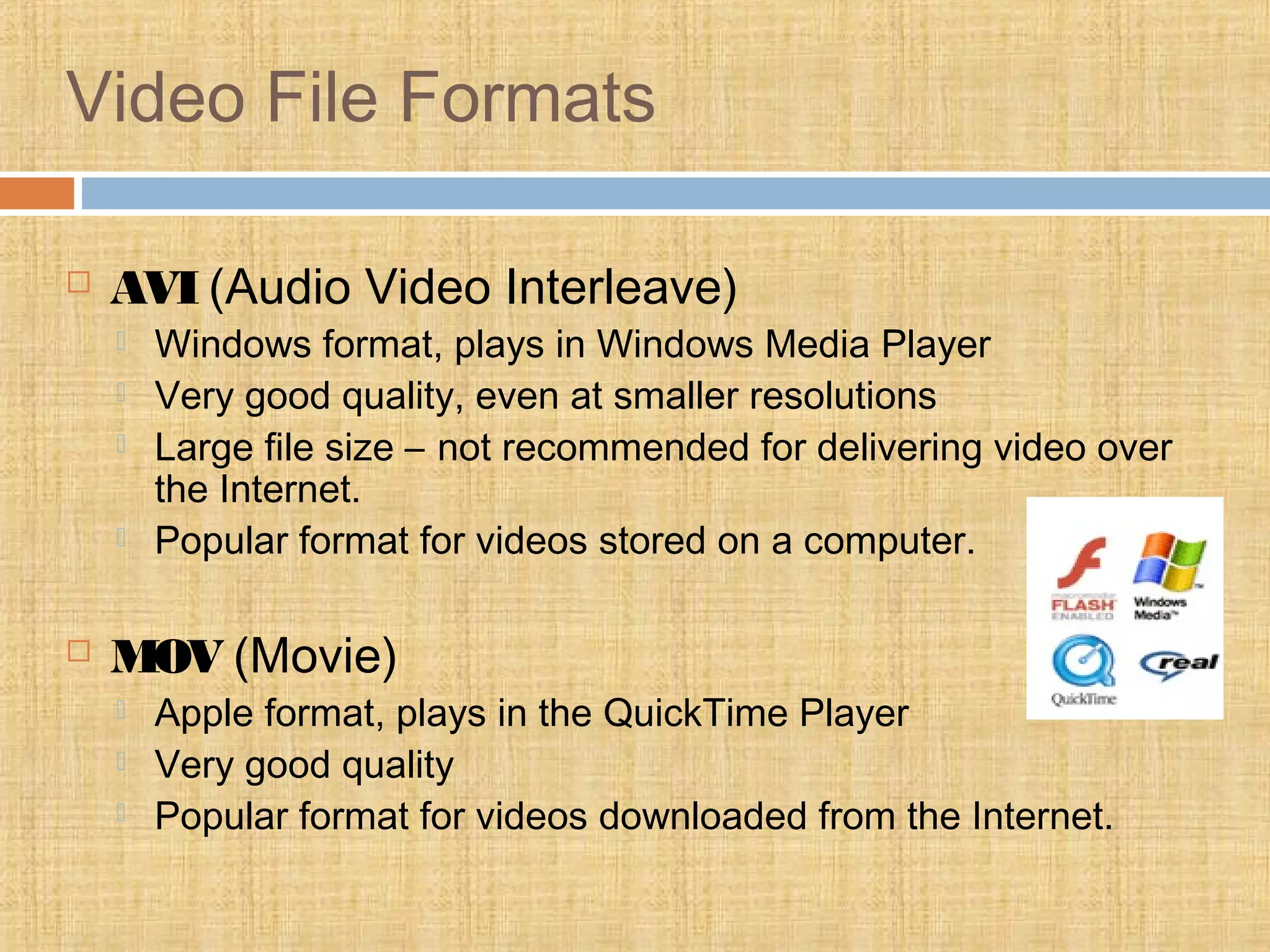
 AVI (Audio Video Interleave)
 Windows format, plays in Windows Media Player
 Very good quality, even at smaller resolutions
 Large file size – not recommended for delivering video over
the Internet.
 Popular format for videos stored on a computer.
 MOV (Movie)
 Apple format, plays in the QuickTime Player
 Very good quality
 Popular format for videos downloaded from the Internet.
Video File Formats
 MPEG (Moving Pictures Expert Group)
 The standard for compression and storage of audio and
motion video for use on the World Wide Web.
 Creates video small file sizes.
 Popular format for videos downloaded from the Internet.
 Its biggest advantage is that It will play in many different media
players.
 RM(RealMedia)
 Plays in the RealPlayer player.
 Typically contains a movie clip.
 Popular format for streaming video viewed over the Internet.
 Real Player is generally supported by many different
computers and operating systems.
Video File Formats
 WMV (Windows Media Video)
 Proprietary video format developed by Microsoft.
 Plays in Windows Media Player.
 Popular format for streaming video viewed over the Internet.
 FLV (Flash Video)
 New file format widely used on the Internet.
 Plays in Adobe Flash Player.
 Very small file size.
 Popular format for streaming video viewed over the Internet
Multimedia Element: Virtual Reality
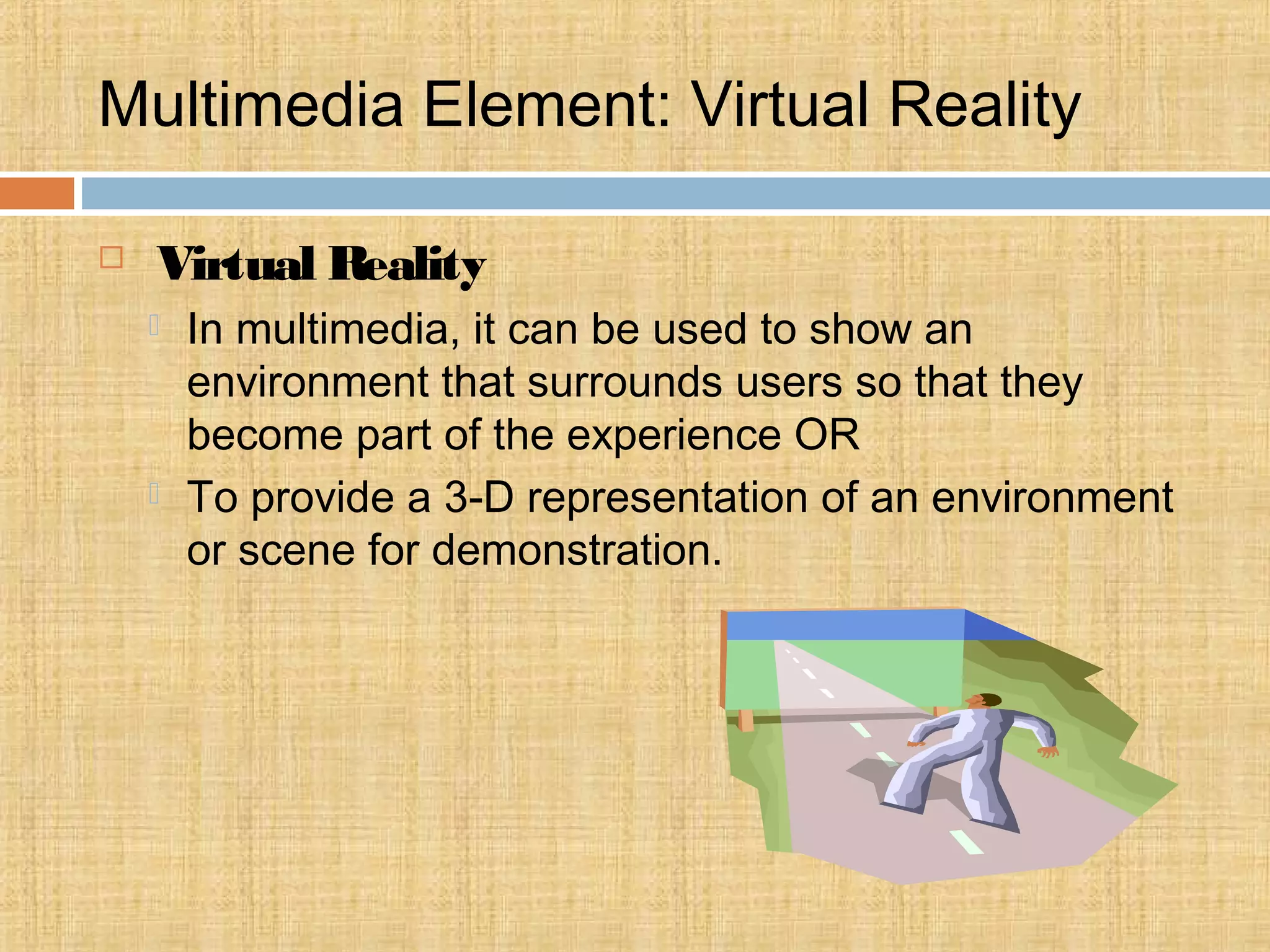
 Virtual Reality
 In multimedia, it can be used to show an
environment that surrounds users so that they
become part of the experience OR
 To provide a 3-D representation of an environment
or scene for demonstration.
Multimedia Elements:
Availability
Stock clips of animation, sound, and video are:
 Available for free or for a fee:
 On CD’s which can be purchased.
 In presentation software programs.
 On web sites.
 Made available by vendors (for sale) or individuals
(created as a hobby).
 Available in several formats such as MPEG1,
Quicktime or Streaming Quicktime.
Multimedia Uses At
 Creative Industries
 Commercial
 Entertainment
 Education
 Engineering
 Industry
 Mathematical & Scientific Research
 Medicine
 Multimedia at home
 Multimedia at Public Place
Multimedia Uses At
 1. Creative Industry :- Fine-arts , Media and
Software Service.
 2. Commercial :- Business Like Training ,
Marketing , Advertising , Product Demo.
 3. Entertainment & Fine-arts :- Special For
Movie Effects , Animation , Gaming's.
 4. Education :- E Learning , Digital Videos ,
Study Material Online , Lectures Videos.
 5. Engineering :- Machine Drawing , Graph
Represents , Military Purpose.
Multimedia Uses At
 6. Industry :- Training To Workers , Selling
Products , Motivating By Videos
 7. Mathematical & Scientific Research :-
Mathematical Solutions And Research
Projects.
 8. Medicine :-Doctor get trained by looking for
virtual surgery by online video.
 9. Multimedia at Home :- Television ,
Cooking , Movies , Computers .
 10. Multimedia at Public Place :- Product
Demo On Digital Screen , Hotels , Railway
 These Are The Elements & Uses Of
Multimedia.
Thank You

The Multimedia & It's Uses

  • 1.
    TOPIC :- MULTIMEDIA ELEMENTS& USES PRESENT BY :- DHRUMIL MEHTA 150510101043 Parul University
  • 2.
    Multimedia  The MultimediaIs a Collection Of Text , Graphics , Images , Music , Videos , Movie And More..  Multi = Multiple Media = Mediums Of Communication  Information Which Is Represent By Audio , Video , Graphics , Animation In Traditional & Effective Way.  The Multimedia Is a One Way To Give a Entertainment To Human Beings.
  • 3.
  • 4.
    Multimedia Elements  Text Graphics  Animation  Audio  Video  Menus  Hyperlinks  Virtual Reality
  • 5.
    Multimedia Elements: Text Textshould be:  Appropriate for the target audience.  Easy to read.  Serif typefaces are preferred for printed material.  Sans serif typefaces are preferred for on-screen display.  Formatted consistently throughout the presentation.
  • 6.
    Multimedia Elements: Graphics Graphics are an important part of the communication process.  They can be used to:  Highlight information  Set a mood or tone  Provide examples  Serve as backgrounds  The two types of graphic used in multimedia are raster and vector.  Vector graphics are made up of arcs and lines..  Raster graphics are made of dots.
  • 7.
    Multimedia Elements: Graphics Whenusing graphics, the multimedia designer must:  Determine the best balance between the size and quality.  Use appropriate graphics for the intended purpose and audience.  Choose appropriate file formats  Standard for the internet:  JPEG (Joint Photographer Experts Group)  GIF (Graphics Interchange file format)  PNG (Portable Network Graphics)  Most popular  TIFF - Tagged Image File Format  BMP – Bitmap  PCX - Windows Paint  PICT - Macintosh
  • 8.
    Multimedia Elements: Graphics  Graphicsediting programs allow designers to draw, paint, or edit images.  A combination of different graphic programs may be used in creating multimedia titles.
  • 9.
    Multimedia Elements: Animation 2-D and 3-D animations are useful in multimedia in the areas of entertainment, education, and training.  They can be used to create simplified illustrations of a simulation or dramatization.  They can be much easier to understand because they are less complex than video.  2-D animations have smaller file sizes that video files which means quicker loading or downloading of the files.
  • 10.
    Multimedia Elements: Sound Sounds in multimedia titles could include:  Music.  Narrations.  Sound effects.  Original recordings.  Sound waves are vibrations that are created when we speak.  Sound waves are analog signals because they are continuous, fluctuating waves with no interruptions.
  • 11.
    Multimedia Elements: Sound Computers are digital machines, meaning that they represent data with 1s and 0s.  To use sound on the computer, the sound waves must be converted from analog to digital form, or digitized.  This conversion process is called sampling.
  • 12.
    Sampling  Sampling isa means of reproducing a continuous event, such as sound or motion, by recording many fragments of it.  It involves taking “snapshots” of a sound wave in rapid intervals.  These samples, or bits of information, are saved as numbers to allow the computer to process them.
  • 13.
    Sample Rate  Thesample rate is the number of samples taken per second.  It is typically expressed in hertz (Hz), or samples per second.  16,000 samples per second = 16 kHz  44,100 samples per second = 44.1 kHz (CD quality sound)
  • 14.
    Sample Rate (continued) The higher the sampling rate, the more samples taken per second.  This means:  The digital sound will more closely match the analog sound.  The quality of the audio will be better.
  • 15.
    Sample Size  Samplesize is the number of bits used to store one sample.  It is also called resolution.  The more bits used per sample, the closer the digital copy sounds to the original analog sound.  The larger the sample size, the bigger the file size but the better the quality of the sound.  CD-quality sound has a sample size of 16 bits.
  • 16.
    Sample Size (continued) Sample size can be changed in Windows Sound Recorder by clicking on the File Menu and then clicking on Properties.  It can be set for:  Recording  Playback
  • 17.
    Audio File Sizeis Determined By:  Sampling rate – the number of samples per second.  Sample size – the number of bits used to save one sample.  Channels recorded – mono or stereo.
  • 18.
    Audio File Formats AU – (Audio) file created by Sun Microsystems and used on computers running the UNIX operating system.  MP3 – (Mpeg-1 Audio Layer 3) very compressed file that is popular for music stored on portable players and on the Internet because it can reproduce near-CD quality audio in small file sizes.  MIDI – (Musical Instrument Digital Interface) file format for creating and/or playing music with instruments using synthesizers and sound cards.
  • 19.
    Audio File Formats(continued)  WAV – (Waveform) file format developed jointly by IBM and Microsoft as the native format for Windows sound files.  Produces high-quality sound.  Generates large file sizes because it is uncompressed.  Commonly used to edit sound which is then saved in a different compressed format for distribution.  WMA (Windows Media Audio) proprietary file format developed by Microsoft originally to compete with the .MP3 format.  Produces high-quality sound.  More compressed than .WAV files.
  • 20.
    Multimedia Elements: Video Videos allow the audience to view actual events instead of just reading about or listening to them.  Sources for videos include web sites and stock film companies.
  • 21.
    Multimedia Elements: Video Videos can be used in:  CD-ROMS  Games  Presentations  Video simulations  Videoconferences  Websites.  Videos vary in quality.
  • 22.
    The Video Format Thefile format of the video determines:  Which programs can open and play it.  How much storage space it occupies.  How fast it travels over an Internet connection.
  • 23.
    Video File Formats AVI (Audio Video Interleave)  Windows format, plays in Windows Media Player  Very good quality, even at smaller resolutions  Large file size – not recommended for delivering video over the Internet.  Popular format for videos stored on a computer.  MOV (Movie)  Apple format, plays in the QuickTime Player  Very good quality  Popular format for videos downloaded from the Internet.
  • 24.
    Video File Formats MPEG (Moving Pictures Expert Group)  The standard for compression and storage of audio and motion video for use on the World Wide Web.  Creates video small file sizes.  Popular format for videos downloaded from the Internet.  Its biggest advantage is that It will play in many different media players.  RM(RealMedia)  Plays in the RealPlayer player.  Typically contains a movie clip.  Popular format for streaming video viewed over the Internet.  Real Player is generally supported by many different computers and operating systems.
  • 25.
    Video File Formats WMV (Windows Media Video)  Proprietary video format developed by Microsoft.  Plays in Windows Media Player.  Popular format for streaming video viewed over the Internet.  FLV (Flash Video)  New file format widely used on the Internet.  Plays in Adobe Flash Player.  Very small file size.  Popular format for streaming video viewed over the Internet
  • 26.
    Multimedia Element: VirtualReality  Virtual Reality  In multimedia, it can be used to show an environment that surrounds users so that they become part of the experience OR  To provide a 3-D representation of an environment or scene for demonstration.
  • 27.
    Multimedia Elements: Availability Stock clipsof animation, sound, and video are:  Available for free or for a fee:  On CD’s which can be purchased.  In presentation software programs.  On web sites.  Made available by vendors (for sale) or individuals (created as a hobby).  Available in several formats such as MPEG1, Quicktime or Streaming Quicktime.
  • 28.
    Multimedia Uses At Creative Industries  Commercial  Entertainment  Education  Engineering  Industry  Mathematical & Scientific Research  Medicine  Multimedia at home  Multimedia at Public Place
  • 29.
    Multimedia Uses At 1. Creative Industry :- Fine-arts , Media and Software Service.  2. Commercial :- Business Like Training , Marketing , Advertising , Product Demo.  3. Entertainment & Fine-arts :- Special For Movie Effects , Animation , Gaming's.  4. Education :- E Learning , Digital Videos , Study Material Online , Lectures Videos.  5. Engineering :- Machine Drawing , Graph Represents , Military Purpose.
  • 30.
    Multimedia Uses At 6. Industry :- Training To Workers , Selling Products , Motivating By Videos  7. Mathematical & Scientific Research :- Mathematical Solutions And Research Projects.  8. Medicine :-Doctor get trained by looking for virtual surgery by online video.  9. Multimedia at Home :- Television , Cooking , Movies , Computers .  10. Multimedia at Public Place :- Product Demo On Digital Screen , Hotels , Railway
  • 31.
     These AreThe Elements & Uses Of Multimedia.
  • 32.