RAMAKRISHNA MISSION
SHILPAMANDIRA
GROUP-B
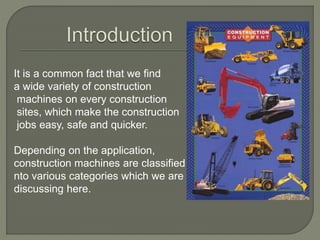
It is a common fact that we find
a wide variety of construction
machines on every construction
sites, which make the construction
jobs easy, safe and quicker.
Depending on the application,
construction machines are classified I
nto various categories which we are
discussing here.
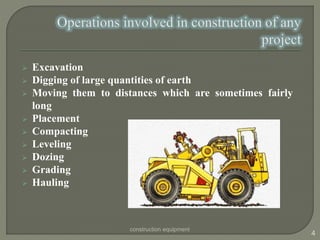
 Excavation
 Digging of large quantities of earth
 Moving them to distances which are sometimes fairly
long
 Placement
 Compacting
 Leveling
 Dozing
 Grading
 Hauling
construction equipment
4
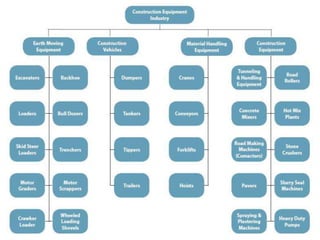
*Earthmoving equipment is used in the construction
industry to :
- shift large amounts of earth,
- dig foundations and landscape areas.
*Types of earthmoving equipment include hydraulic
excavators, bulldozers, compressors and loaders.
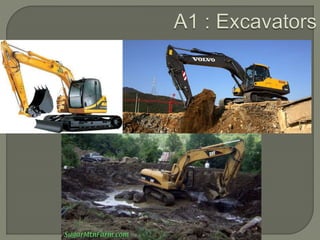
 Excavators are heavy construction equipment consisting of a
boom, stick, bucket and cab on a rotating platform (known as the
"house").
 The house sits atop an undercarriage with tracks or wheels.
 Excavators are also called diggers
 Excavators are used in many ways:
• Digging of trenches, holes, foundations
• Material handling
• Brush cutting with hydraulic attachments
• Forestry work
• Demolition
• General grading/landscaping
• Heavy lift, e.g. lifting and placing of pipes
• Mining, especially, but not only open-pit mining
• River dredging
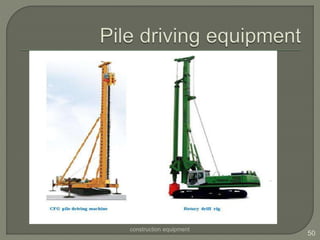
• Driving piles, in conjunction with a pile driver
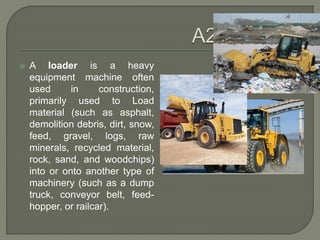
 A loader is a heavy
equipment machine often
used in construction,
primarily used to Load
material (such as asphalt,
demolition debris, dirt, snow,
feed, gravel, logs, raw
minerals, recycled material,
rock, sand, and woodchips)
into or onto another type of
machinery (such as a dump
truck, conveyor belt, feed-
hopper, or railcar).
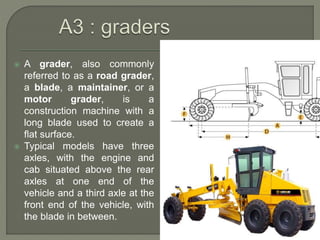
 A grader, also commonly
referred to as a road grader,
a blade, a maintainer, or a
motor grader, is a
construction machine with a
long blade used to create a
flat surface.
 Typical models have three
axles, with the engine and
cab situated above the rear
axles at one end of the
vehicle and a third axle at the
front end of the vehicle, with
the blade in between.
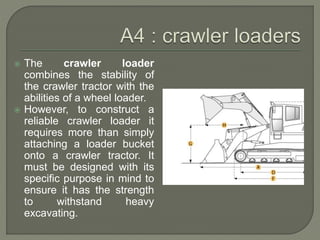
 The crawler loader
combines the stability of
the crawler tractor with the
abilities of a wheel loader.
 However, to construct a
reliable crawler loader it
requires more than simply
attaching a loader bucket
onto a crawler tractor. It
must be designed with its
specific purpose in mind to
ensure it has the strength
to withstand heavy
excavating.
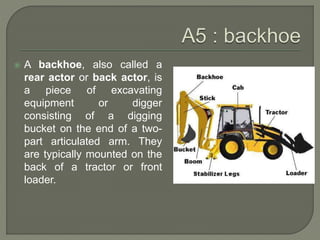
 A backhoe, also called a
rear actor or back actor, is
a piece of excavating
equipment or digger
consisting of a digging
bucket on the end of a two-
part articulated arm. They
are typically mounted on the
back of a tractor or front
loader.
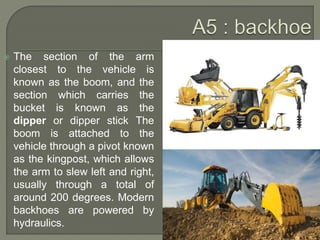
 The section of the arm
closest to the vehicle is
known as the boom, and the
section which carries the
bucket is known as the
dipper or dipper stick The
boom is attached to the
vehicle through a pivot known
as the kingpost, which allows
the arm to slew left and right,
usually through a total of
around 200 degrees. Modern
backhoes are powered by
hydraulics.
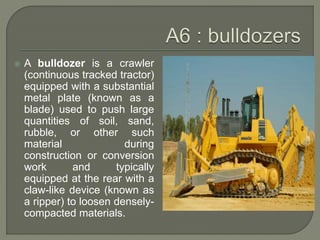
 A bulldozer is a crawler
(continuous tracked tractor)
equipped with a substantial
metal plate (known as a
blade) used to push large
quantities of soil, sand,
rubble, or other such
material during
construction or conversion
work and typically
equipped at the rear with a
claw-like device (known as
a ripper) to loosen densely-
compacted materials.
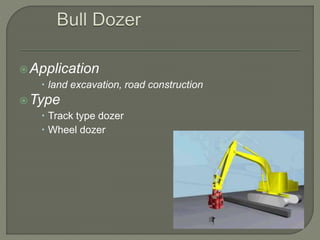
Application
 land excavation, road construction
Type
 Track type dozer
 Wheel dozer
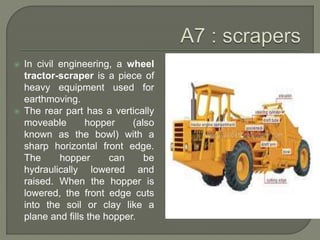
 In civil engineering, a wheel
tractor-scraper is a piece of
heavy equipment used for
earthmoving.
 The rear part has a vertically
moveable hopper (also
known as the bowl) with a
sharp horizontal front edge.
The hopper can be
hydraulically lowered and
raised. When the hopper is
lowered, the front edge cuts
into the soil or clay like a
plane and fills the hopper.
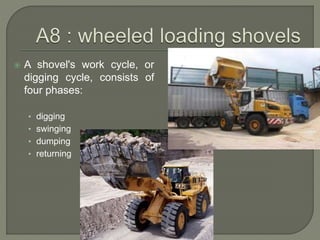
 A shovel's work cycle, or
digging cycle, consists of
four phases:
• digging
• swinging
• dumping
• returning
* Engineering or Construction vehicles are heavy-duty vehicles,
specially designed for executing construction (Civil engineering) tasks,
most frequently, ones involving earth moving.
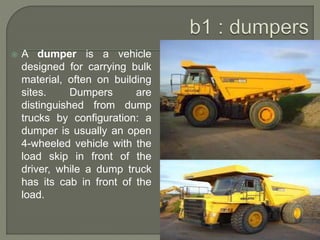
 A dumper is a vehicle
designed for carrying bulk
material, often on building
sites. Dumpers are
distinguished from dump
trucks by configuration: a
dumper is usually an open
4-wheeled vehicle with the
load skip in front of the
driver, while a dump truck
has its cab in front of the
load.
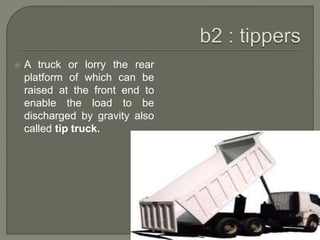
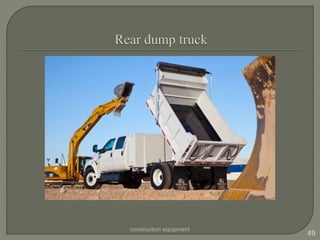
 A truck or lorry the rear
platform of which can be
raised at the front end to
enable the load to be
discharged by gravity also
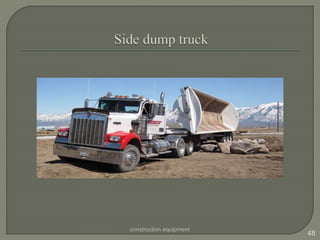
called tip truck.
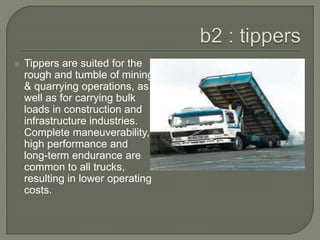
 Tippers are suited for the
rough and tumble of mining
& quarrying operations, as
well as for carrying bulk
loads in construction and
infrastructure industries.
Complete maneuverability,
high performance and
long-term endurance are
common to all trucks,
resulting in lower operating
costs.
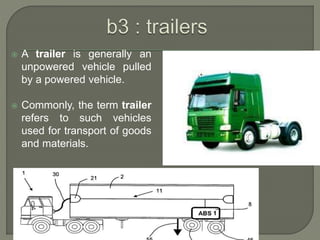
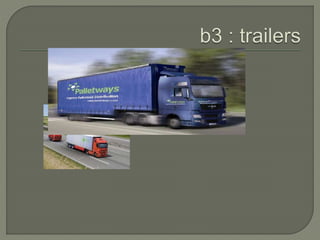
 A trailer is generally an
unpowered vehicle pulled
by a powered vehicle.
 Commonly, the term trailer
refers to such vehicles
used for transport of goods
and materials.
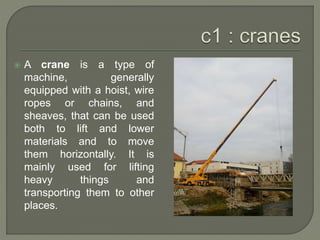
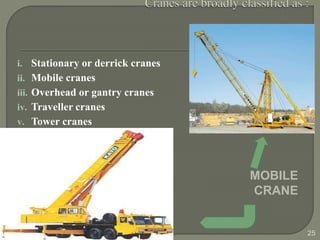
 A crane is a type of
machine, generally
equipped with a hoist, wire
ropes or chains, and
sheaves, that can be used
both to lift and lower
materials and to move
them horizontally. It is
mainly used for lifting
heavy things and
transporting them to other
places.
MOBILE
CRANE
25
i. Stationary or derrick cranes
ii. Mobile cranes
iii. Overhead or gantry cranes
iv. Traveller cranes
v. Tower cranes
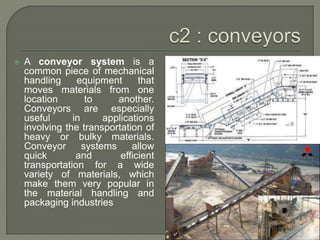
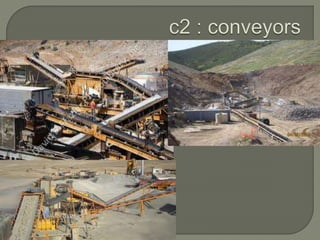
 A conveyor system is a
common piece of mechanical
handling equipment that
moves materials from one
location to another.
Conveyors are especially
useful in applications
involving the transportation of
heavy or bulky materials.
Conveyor systems allow
quick and efficient
transportation for a wide
variety of materials, which
make them very popular in
the material handling and
packaging industries
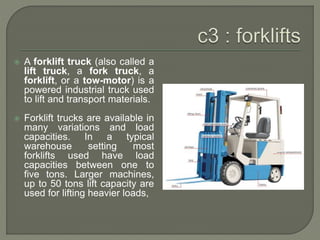
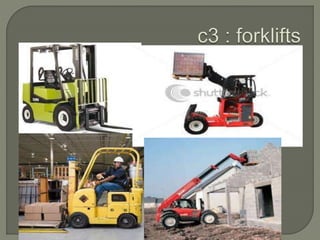
 A forklift truck (also called a
lift truck, a fork truck, a
forklift, or a tow-motor) is a
powered industrial truck used
to lift and transport materials.
 Forklift trucks are available in
many variations and load
capacities. In a typical
warehouse setting most
forklifts used have load
capacities between one to
five tons. Larger machines,
up to 50 tons lift capacity are
used for lifting heavier loads,
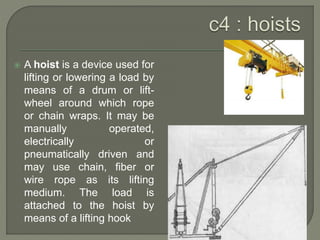
 A hoist is a device used for
lifting or lowering a load by
means of a drum or lift-
wheel around which rope
or chain wraps. It may be
manually operated,
electrically or
pneumatically driven and
may use chain, fiber or
wire rope as its lifting
medium. The load is
attached to the hoist by
means of a lifting hook
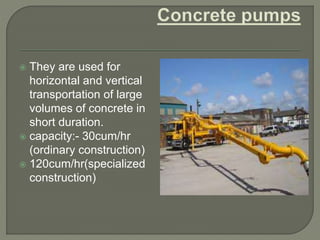
 They are used for
horizontal and vertical
transportation of large
volumes of concrete in
short duration.
 capacity:- 30cum/hr
(ordinary construction)
 120cum/hr(specialized
construction)
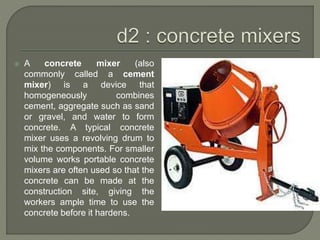
 A concrete mixer (also
commonly called a cement
mixer) is a device that
homogeneously combines
cement, aggregate such as sand
or gravel, and water to form
concrete. A typical concrete
mixer uses a revolving drum to
mix the components. For smaller
volume works portable concrete
mixers are often used so that the
concrete can be made at the
construction site, giving the
workers ample time to use the
concrete before it hardens.
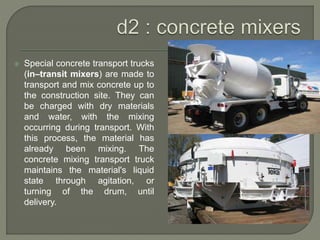
 Special concrete transport trucks
(in–transit mixers) are made to
transport and mix concrete up to
the construction site. They can
be charged with dry materials
and water, with the mixing
occurring during transport. With
this process, the material has
already been mixing. The
concrete mixing transport truck
maintains the material's liquid
state through agitation, or
turning of the drum, until
delivery.
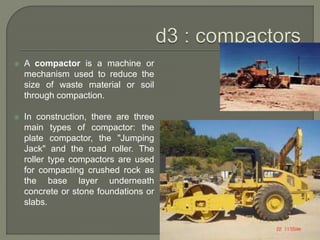
 A compactor is a machine or
mechanism used to reduce the
size of waste material or soil
through compaction.
 In construction, there are three
main types of compactor: the
plate compactor, the "Jumping
Jack" and the road roller. The
roller type compactors are used
for compacting crushed rock as
the base layer underneath
concrete or stone foundations or
slabs.
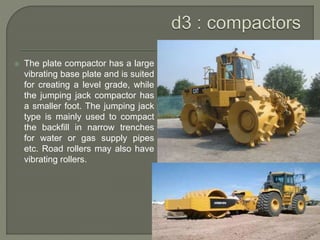
 The plate compactor has a large
vibrating base plate and is suited
for creating a level grade, while
the jumping jack compactor has
a smaller foot. The jumping jack
type is mainly used to compact
the backfill in narrow trenches
for water or gas supply pipes
etc. Road rollers may also have
vibrating rollers.
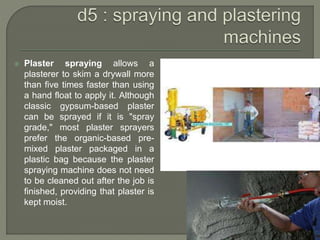
 Plaster spraying allows a
plasterer to skim a drywall more
than five times faster than using
a hand float to apply it. Although
classic gypsum-based plaster
can be sprayed if it is "spray
grade," most plaster sprayers
prefer the organic-based pre-
mixed plaster packaged in a
plastic bag because the plaster
spraying machine does not need
to be cleaned out after the job is
finished, providing that plaster is
kept moist.
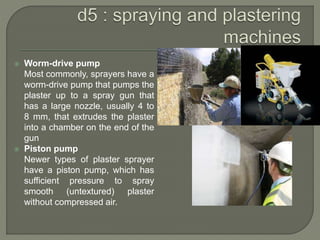
 Worm-drive pump
Most commonly, sprayers have a
worm-drive pump that pumps the
plaster up to a spray gun that
has a large nozzle, usually 4 to
8 mm, that extrudes the plaster
into a chamber on the end of the
gun
 Piston pump
Newer types of plaster sprayer
have a piston pump, which has
sufficient pressure to spray
smooth (untextured) plaster
without compressed air.
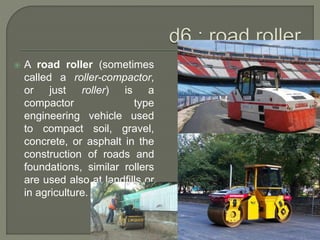
 A road roller (sometimes
called a roller-compactor,
or just roller) is a
compactor type
engineering vehicle used
to compact soil, gravel,
concrete, or asphalt in the
construction of roads and
foundations, similar rollers
are used also at landfills or
in agriculture.
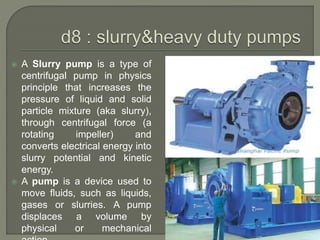
 A Slurry pump is a type of
centrifugal pump in physics
principle that increases the
pressure of liquid and solid
particle mixture (aka slurry),
through centrifugal force (a
rotating impeller) and
converts electrical energy into
slurry potential and kinetic
energy.
 A pump is a device used to
move fluids, such as liquids,
gases or slurries. A pump
displaces a volume by
physical or mechanical
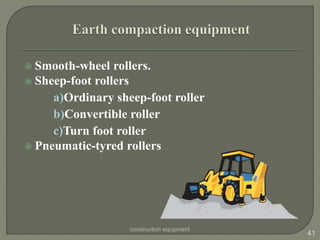
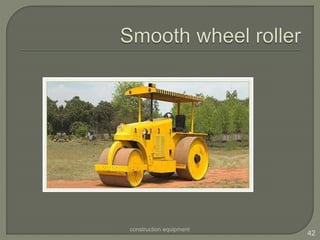
 Smooth-wheel rollers.
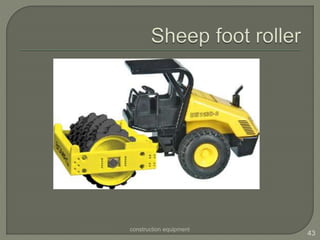
 Sheep-foot rollers
a)Ordinary sheep-foot roller
b)Convertible roller
c)Turn foot roller
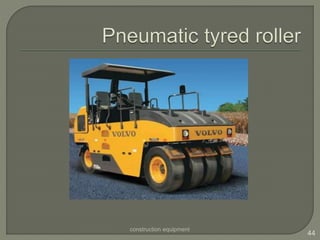
 Pneumatic-tyred rollers
construction equipment
41
construction equipment
42
construction equipment
43
construction equipment
44
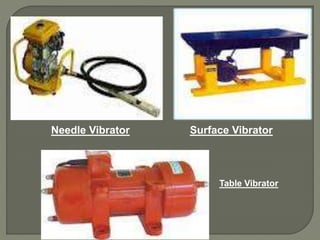
 For compacting the concrete after its placement
concrete vibrator is used. It help volume of
concrete quickly placed, give high density ,
reduce air voids.
 Internal vibrators-Use on large work for flat slab.
 External or form vibrators-uses for thin section of
walls.
 Surface vibrator-used to finish concrete surface
such as bridge floor, road slab, section platform.
 Table Vibrator-used for consolidation of precast
units.
Needle Vibrator Surface Vibrator
Table Vibrator
 The equipment used for transportation of material are
known as hauling equipment or simply haulers.
 Haulers may operate on the roadways or railways
 It involve
transportation of building materials,
carriage and disposal of excavated earth
haulage of heavy construction equipment.
construction equipment
47
construction equipment
48
construction equipment
49
construction equipment
50
construction equipment
51

construction equipment by suman

  • 1.
  • 2.
    It is acommon fact that we find a wide variety of construction machines on every construction sites, which make the construction jobs easy, safe and quicker. Depending on the application, construction machines are classified I nto various categories which we are discussing here.
  • 4.
     Excavation  Diggingof large quantities of earth  Moving them to distances which are sometimes fairly long  Placement  Compacting  Leveling  Dozing  Grading  Hauling construction equipment 4
  • 5.
    *Earthmoving equipment isused in the construction industry to : - shift large amounts of earth, - dig foundations and landscape areas. *Types of earthmoving equipment include hydraulic excavators, bulldozers, compressors and loaders.
  • 6.
     Excavators areheavy construction equipment consisting of a boom, stick, bucket and cab on a rotating platform (known as the "house").  The house sits atop an undercarriage with tracks or wheels.  Excavators are also called diggers  Excavators are used in many ways: • Digging of trenches, holes, foundations • Material handling • Brush cutting with hydraulic attachments • Forestry work • Demolition • General grading/landscaping • Heavy lift, e.g. lifting and placing of pipes • Mining, especially, but not only open-pit mining • River dredging • Driving piles, in conjunction with a pile driver
  • 8.
     A loaderis a heavy equipment machine often used in construction, primarily used to Load material (such as asphalt, demolition debris, dirt, snow, feed, gravel, logs, raw minerals, recycled material, rock, sand, and woodchips) into or onto another type of machinery (such as a dump truck, conveyor belt, feed- hopper, or railcar).
  • 9.
     A grader,also commonly referred to as a road grader, a blade, a maintainer, or a motor grader, is a construction machine with a long blade used to create a flat surface.  Typical models have three axles, with the engine and cab situated above the rear axles at one end of the vehicle and a third axle at the front end of the vehicle, with the blade in between.
  • 10.
     The crawlerloader combines the stability of the crawler tractor with the abilities of a wheel loader.  However, to construct a reliable crawler loader it requires more than simply attaching a loader bucket onto a crawler tractor. It must be designed with its specific purpose in mind to ensure it has the strength to withstand heavy excavating.
  • 11.
     A backhoe,also called a rear actor or back actor, is a piece of excavating equipment or digger consisting of a digging bucket on the end of a two- part articulated arm. They are typically mounted on the back of a tractor or front loader.
  • 12.
     The sectionof the arm closest to the vehicle is known as the boom, and the section which carries the bucket is known as the dipper or dipper stick The boom is attached to the vehicle through a pivot known as the kingpost, which allows the arm to slew left and right, usually through a total of around 200 degrees. Modern backhoes are powered by hydraulics.
  • 13.
     A bulldozeris a crawler (continuous tracked tractor) equipped with a substantial metal plate (known as a blade) used to push large quantities of soil, sand, rubble, or other such material during construction or conversion work and typically equipped at the rear with a claw-like device (known as a ripper) to loosen densely- compacted materials.
  • 14.
    Application  land excavation,road construction Type  Track type dozer  Wheel dozer
  • 15.
     In civilengineering, a wheel tractor-scraper is a piece of heavy equipment used for earthmoving.  The rear part has a vertically moveable hopper (also known as the bowl) with a sharp horizontal front edge. The hopper can be hydraulically lowered and raised. When the hopper is lowered, the front edge cuts into the soil or clay like a plane and fills the hopper.
  • 16.
     A shovel'swork cycle, or digging cycle, consists of four phases: • digging • swinging • dumping • returning
  • 17.
    * Engineering orConstruction vehicles are heavy-duty vehicles, specially designed for executing construction (Civil engineering) tasks, most frequently, ones involving earth moving.
  • 18.
     A dumperis a vehicle designed for carrying bulk material, often on building sites. Dumpers are distinguished from dump trucks by configuration: a dumper is usually an open 4-wheeled vehicle with the load skip in front of the driver, while a dump truck has its cab in front of the load.
  • 19.
     A truckor lorry the rear platform of which can be raised at the front end to enable the load to be discharged by gravity also called tip truck.
  • 20.
     Tippers aresuited for the rough and tumble of mining & quarrying operations, as well as for carrying bulk loads in construction and infrastructure industries. Complete maneuverability, high performance and long-term endurance are common to all trucks, resulting in lower operating costs.
  • 21.
     A traileris generally an unpowered vehicle pulled by a powered vehicle.  Commonly, the term trailer refers to such vehicles used for transport of goods and materials.
  • 24.
     A craneis a type of machine, generally equipped with a hoist, wire ropes or chains, and sheaves, that can be used both to lift and lower materials and to move them horizontally. It is mainly used for lifting heavy things and transporting them to other places.
  • 25.
    MOBILE CRANE 25 i. Stationary orderrick cranes ii. Mobile cranes iii. Overhead or gantry cranes iv. Traveller cranes v. Tower cranes
  • 26.
     A conveyorsystem is a common piece of mechanical handling equipment that moves materials from one location to another. Conveyors are especially useful in applications involving the transportation of heavy or bulky materials. Conveyor systems allow quick and efficient transportation for a wide variety of materials, which make them very popular in the material handling and packaging industries
  • 28.
     A forklifttruck (also called a lift truck, a fork truck, a forklift, or a tow-motor) is a powered industrial truck used to lift and transport materials.  Forklift trucks are available in many variations and load capacities. In a typical warehouse setting most forklifts used have load capacities between one to five tons. Larger machines, up to 50 tons lift capacity are used for lifting heavier loads,
  • 30.
     A hoistis a device used for lifting or lowering a load by means of a drum or lift- wheel around which rope or chain wraps. It may be manually operated, electrically or pneumatically driven and may use chain, fiber or wire rope as its lifting medium. The load is attached to the hoist by means of a lifting hook
  • 32.
     They areused for horizontal and vertical transportation of large volumes of concrete in short duration.  capacity:- 30cum/hr (ordinary construction)  120cum/hr(specialized construction)
  • 33.
     A concretemixer (also commonly called a cement mixer) is a device that homogeneously combines cement, aggregate such as sand or gravel, and water to form concrete. A typical concrete mixer uses a revolving drum to mix the components. For smaller volume works portable concrete mixers are often used so that the concrete can be made at the construction site, giving the workers ample time to use the concrete before it hardens.
  • 34.
     Special concretetransport trucks (in–transit mixers) are made to transport and mix concrete up to the construction site. They can be charged with dry materials and water, with the mixing occurring during transport. With this process, the material has already been mixing. The concrete mixing transport truck maintains the material's liquid state through agitation, or turning of the drum, until delivery.
  • 35.
     A compactoris a machine or mechanism used to reduce the size of waste material or soil through compaction.  In construction, there are three main types of compactor: the plate compactor, the "Jumping Jack" and the road roller. The roller type compactors are used for compacting crushed rock as the base layer underneath concrete or stone foundations or slabs.
  • 36.
     The platecompactor has a large vibrating base plate and is suited for creating a level grade, while the jumping jack compactor has a smaller foot. The jumping jack type is mainly used to compact the backfill in narrow trenches for water or gas supply pipes etc. Road rollers may also have vibrating rollers.
  • 37.
     Plaster sprayingallows a plasterer to skim a drywall more than five times faster than using a hand float to apply it. Although classic gypsum-based plaster can be sprayed if it is "spray grade," most plaster sprayers prefer the organic-based pre- mixed plaster packaged in a plastic bag because the plaster spraying machine does not need to be cleaned out after the job is finished, providing that plaster is kept moist.
  • 38.
     Worm-drive pump Mostcommonly, sprayers have a worm-drive pump that pumps the plaster up to a spray gun that has a large nozzle, usually 4 to 8 mm, that extrudes the plaster into a chamber on the end of the gun  Piston pump Newer types of plaster sprayer have a piston pump, which has sufficient pressure to spray smooth (untextured) plaster without compressed air.
  • 39.
     A roadroller (sometimes called a roller-compactor, or just roller) is a compactor type engineering vehicle used to compact soil, gravel, concrete, or asphalt in the construction of roads and foundations, similar rollers are used also at landfills or in agriculture.
  • 40.
     A Slurrypump is a type of centrifugal pump in physics principle that increases the pressure of liquid and solid particle mixture (aka slurry), through centrifugal force (a rotating impeller) and converts electrical energy into slurry potential and kinetic energy.  A pump is a device used to move fluids, such as liquids, gases or slurries. A pump displaces a volume by physical or mechanical
  • 41.
     Smooth-wheel rollers. Sheep-foot rollers a)Ordinary sheep-foot roller b)Convertible roller c)Turn foot roller  Pneumatic-tyred rollers construction equipment 41
  • 42.
  • 43.
  • 44.
  • 45.
     For compactingthe concrete after its placement concrete vibrator is used. It help volume of concrete quickly placed, give high density , reduce air voids.  Internal vibrators-Use on large work for flat slab.  External or form vibrators-uses for thin section of walls.  Surface vibrator-used to finish concrete surface such as bridge floor, road slab, section platform.  Table Vibrator-used for consolidation of precast units.
  • 46.
    Needle Vibrator SurfaceVibrator Table Vibrator
  • 47.
     The equipmentused for transportation of material are known as hauling equipment or simply haulers.  Haulers may operate on the roadways or railways  It involve transportation of building materials, carriage and disposal of excavated earth haulage of heavy construction equipment. construction equipment 47
  • 48.
  • 49.
  • 50.
  • 51.