VETEROLEGAL
NECROPSY
• Handling of veterolegal cases
• Proper documentation: body parts history, , sketching or mapping, writing the notes,
collection of evidence, entire photography & videography
• Collection of evidences : physical (objects) & biological evidences (blood, saliva, hair,
sperms, bones ,teeth etc.)
• We should collect sample in duplicates {multiple copies}
• Illegal criminal cases
• Incudes livestock, wildlife, pet animals
• We should get written request from officials of wildlife department.
• Routine cases of livestock: written request from police.
• No unauthorized person is required.
• Wildlife carcass : only burning {wildlife poaching to smuggling}
• Appear in front of law
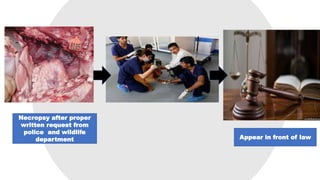
Appear in front of law
Necropsy after proper
written request from
police and wildlife
department
VETEROLEGAL SCIENCE: Time of death & cause of
death
Assessment of time of death
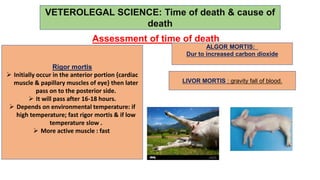
Rigor mortis
 Initially occur in the anterior portion {cardiac
muscle & papillary muscles of eye} then later
pass on to the posterior side.
 It will pass after 16-18 hours.
 Depends on environmental temperature: if
high temperature; fast rigor mortis & if low
temperature slow .
 More active muscle : fast
ALGOR MORTIS:
Dur to increased carbon dioxide
LIVOR MORTIS : gravity fall of blood.
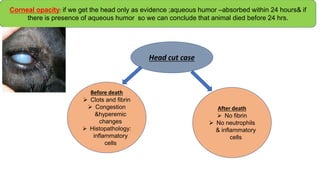
Corneal opacity: if we get the head only as evidence ;aqueous humor –absorbed within 24 hours& if
there is presence of aqueous humor so we can conclude that animal died before 24 hrs.
Head cut case
Before death
 Clots and fibrin
 Congestion
&hyperemic
changes
 Histopathology:
inflammatory
cells
After death
 No fibrin
 No neutrophils
& inflammatory
cells
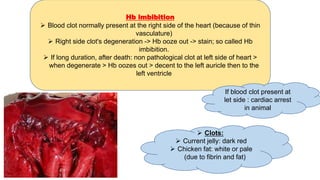
Hb imbibition
 Blood clot normally present at the right side of the heart (because of thin
vasculature)
 Right side clot's degeneration -> Hb ooze out -> stain; so called Hb
imbibition.
 If long duration, after death: non pathological clot at left side of heart >
when degenerate > Hb oozes out > decent to the left auricle then to the
left ventricle
If blood clot present at
let side : cardiac arrest
in animal
 Clots:
 Current jelly: dark red
 Chicken fat: white or pale
(due to fibrin and fat)
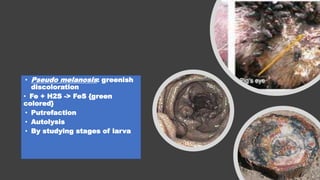
• Pseudo melanosis: greenish
discoloration
• Fe + H2S -> FeS {green
colored}
• Putrefaction
• Autolysis
• By studying stages of larva
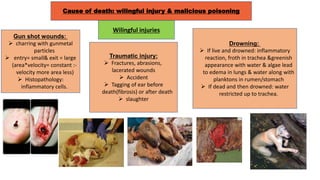
Cause of death: wilingful injury & malicious poisoning
Wilingful injuries
Gun shot wounds:
 charring with gunmetal
particles
 entry= small& exit = large
(area*velocity= constant :-
velocity more area less)
 Histopathology:
inflammatory cells.
Traumatic injury:
 Fractures, abrasions,
lacerated wounds
 Accident
 Tagging of ear before
death(fibrosis) or after death
 slaughter
Drowning:
 If live and drowned: inflammatory
reaction, froth in trachea &greenish
appearance with water & algae lead
to edema in lungs & water along with
planktons in rumen/stomach
 If dead and then drowned: water
restricted up to trachea.
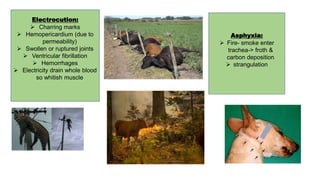
Electrocution:
 Charring marks
 Hemopericardium (due to
permeability)
 Swollen or ruptured joints
 Ventricular fibrillation
 Hemorrhages
 Electricity drain whole blood
so whitish muscle
Asphyxia:
 Fire- smoke enter
trachea-> froth &
carbon deposition
 strangulation
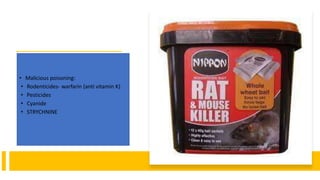
• Malicious poisoning:
• Rodenticides- warfarin (anti vitamin K)
• Pesticides
• Cyanide
• STRYCHNINE
Veteroleagal Necropsy. ppt

Veteroleagal Necropsy. ppt

  • 1.
  • 2.
    • Handling ofveterolegal cases • Proper documentation: body parts history, , sketching or mapping, writing the notes, collection of evidence, entire photography & videography • Collection of evidences : physical (objects) & biological evidences (blood, saliva, hair, sperms, bones ,teeth etc.) • We should collect sample in duplicates {multiple copies} • Illegal criminal cases • Incudes livestock, wildlife, pet animals • We should get written request from officials of wildlife department. • Routine cases of livestock: written request from police. • No unauthorized person is required. • Wildlife carcass : only burning {wildlife poaching to smuggling} • Appear in front of law
  • 3.
    Appear in frontof law Necropsy after proper written request from police and wildlife department
  • 4.
    VETEROLEGAL SCIENCE: Timeof death & cause of death Assessment of time of death Rigor mortis  Initially occur in the anterior portion {cardiac muscle & papillary muscles of eye} then later pass on to the posterior side.  It will pass after 16-18 hours.  Depends on environmental temperature: if high temperature; fast rigor mortis & if low temperature slow .  More active muscle : fast ALGOR MORTIS: Dur to increased carbon dioxide LIVOR MORTIS : gravity fall of blood.
  • 5.
    Corneal opacity: ifwe get the head only as evidence ;aqueous humor –absorbed within 24 hours& if there is presence of aqueous humor so we can conclude that animal died before 24 hrs. Head cut case Before death  Clots and fibrin  Congestion &hyperemic changes  Histopathology: inflammatory cells After death  No fibrin  No neutrophils & inflammatory cells
  • 6.
    Hb imbibition  Bloodclot normally present at the right side of the heart (because of thin vasculature)  Right side clot's degeneration -> Hb ooze out -> stain; so called Hb imbibition.  If long duration, after death: non pathological clot at left side of heart > when degenerate > Hb oozes out > decent to the left auricle then to the left ventricle If blood clot present at let side : cardiac arrest in animal  Clots:  Current jelly: dark red  Chicken fat: white or pale (due to fibrin and fat)
  • 7.
    • Pseudo melanosis:greenish discoloration • Fe + H2S -> FeS {green colored} • Putrefaction • Autolysis • By studying stages of larva
  • 8.
    Cause of death:wilingful injury & malicious poisoning Wilingful injuries Gun shot wounds:  charring with gunmetal particles  entry= small& exit = large (area*velocity= constant :- velocity more area less)  Histopathology: inflammatory cells. Traumatic injury:  Fractures, abrasions, lacerated wounds  Accident  Tagging of ear before death(fibrosis) or after death  slaughter Drowning:  If live and drowned: inflammatory reaction, froth in trachea &greenish appearance with water & algae lead to edema in lungs & water along with planktons in rumen/stomach  If dead and then drowned: water restricted up to trachea.
  • 9.
    Electrocution:  Charring marks Hemopericardium (due to permeability)  Swollen or ruptured joints  Ventricular fibrillation  Hemorrhages  Electricity drain whole blood so whitish muscle Asphyxia:  Fire- smoke enter trachea-> froth & carbon deposition  strangulation
  • 10.
    • Malicious poisoning: •Rodenticides- warfarin (anti vitamin K) • Pesticides • Cyanide • STRYCHNINE