VIRTUAL TRIALS,
FED V/S FASTED SATES
Dr. Rajan Swami
VIRTUAL TRIALS
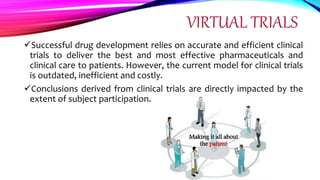
Successful drug development relies on accurate and efficient clinical
trials to deliver the best and most effective pharmaceuticals and
clinical care to patients. However, the current model for clinical trials
is outdated, inefficient and costly.
Conclusions derived from clinical trials are directly impacted by the
extent of subject participation.
VIRTUAL TRIALS
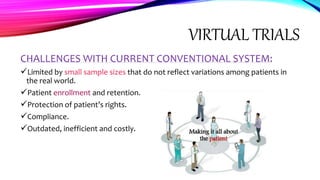
CHALLENGES WITH CURRENT CONVENTIONAL SYSTEM:
Limited by small sample sizes that do not reflect variations among patients in
the real world.
Patient enrollment and retention.
Protection of patient’s rights.
Compliance.
Outdated, inefficient and costly.
WHAT ARE VIRTUAL CLINICAL
TRIALS (VCT)?
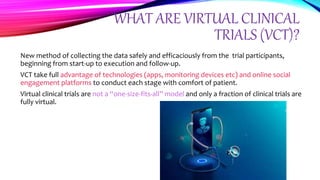
New method of collecting the data safely and efficaciously from the trial participants,
beginning from start-up to execution and follow-up.
VCT take full advantage of technologies (apps, monitoring devices etc) and online social
engagement platforms to conduct each stage with comfort of patient.
Virtual clinical trials are not a “one-size-fits-all” model and only a fraction of clinical trials are
fully virtual.
RISKS OF VCT
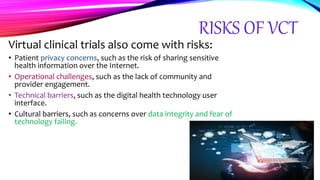
Virtual clinical trials also come with risks:
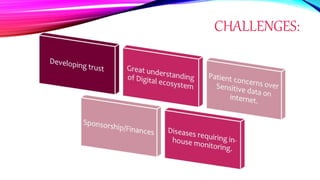
• Patient privacy concerns, such as the risk of sharing sensitive
health information over the Internet.
• Operational challenges, such as the lack of community and
provider engagement.
• Technical barriers, such as the digital health technology user
interface.
• Cultural barriers, such as concerns over data integrity and fear of
technology failing.
IDEAL VCT’S:
A quality clinical trial is one that generates the minimal amount of credible, replicable,
and evaluable data needed to answer meaningful questions with the least time and cost
burdens on participants.
Virtual clinical trials can be used to improve the comfort, convenience, and
confidentiality for research participants compared with what they might receive in a
more traditional site-based clinical trial.
Additionally, they offer an opportunity to foster ongoing relationships between
researchers and research participants to better understand conditions longitudinally,
and generate new and relevant questions.
Mining data in new ways to better understand which patient populations can and should
be enrolled in trials would lead to more realistic inclusion/exclusion criteria and improve
patient recruitment and retention.
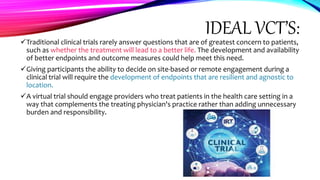
IDEAL VCT’S:
Traditional clinical trials rarely answer questions that are of greatest concern to patients,
such as whether the treatment will lead to a better life. The development and availability
of better endpoints and outcome measures could help meet this need.
Giving participants the ability to decide on site-based or remote engagement during a
clinical trial will require the development of endpoints that are resilient and agnostic to
location.
A virtual trial should engage providers who treat patients in the health care setting in a
way that complements the treating physician's practice rather than adding unnecessary
burden and responsibility.
VIRTUAL TRIALS
COMPONENTS AND PROCESS OVERVIEW:
OPEN ENROLLMENT:
Through online avenues.
VIRTUAL TRIALS
COMPONENTS AND PROCESS OVERVIEW:
CENTRALIZED:
Single study coordination centres under
direction of PI’s. PI reviews and
monitors the collected data.
VIRTUAL TRIALS
COMPONENTS AND PROCESS OVERVIEW:
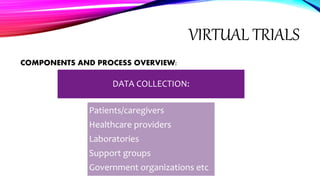
DATA COLLECTION:
Patients/caregivers
Healthcare providers
Laboratories
Support groups
Government organizations etc
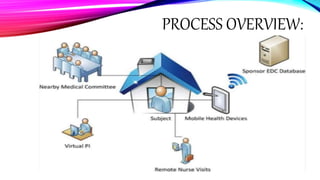
PROCESS OVERVIEW:
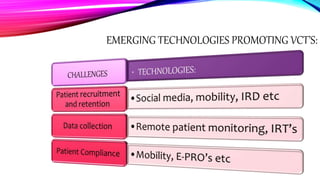
EMERGING TECHNOLOGIES PROMOTING VCT’S:
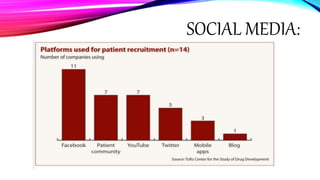
SOCIAL MEDIA:
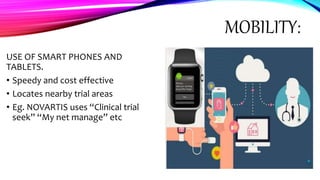
MOBILITY:
USE OF SMART PHONES AND
TABLETS.
• Speedy and cost effective
• Locates nearby trial areas
• Eg. NOVARTIS uses “Clinical trial
seek” “My net manage” etc
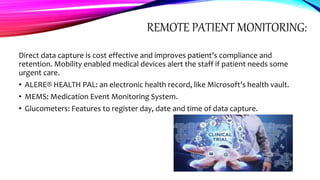
REMOTE PATIENT MONITORING:
Direct data capture is cost effective and improves patient’s compliance and
retention. Mobility enabled medical devices alert the staff if patient needs some
urgent care.
• ALERE® HEALTH PAL: an electronic health record, like Microsoft’s health vault.
• MEMS: Medication Event Monitoring System.
• Glucometers: Features to register day, date and time of data capture.
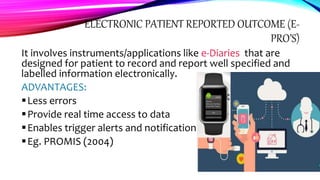
ELECTRONIC PATIENT REPORTED OUTCOME (E-
PRO’S)
It involves instruments/applications like e-Diaries that are
designed for patient to record and report well specified and
labelled information electronically.
ADVANTAGES:
Less errors
Provide real time access to data
Enables trigger alerts and notifications
Eg. PROMIS (2004)
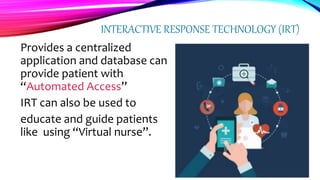
INTERACTIVE RESPONSE TECHNOLOGY (IRT)
Provides a centralized
application and database can
provide patient with
“Automated Access”
IRT can also be used to
educate and guide patients
like using “Virtual nurse”.
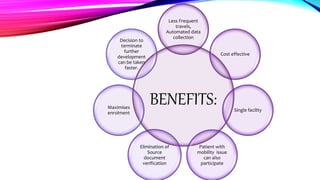
BENEFITS:
Less Frequent
travels,
Automated data
collection
Cost effective
Single facility
Patient with
mobility issue
can also
participate
Elimination of
Source
document
verification
Maximises
enrolment
Decision to
terminate
further
development
can be taken
faster.
CHALLENGES:
FED VS. FASTED STATE
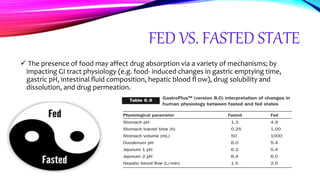
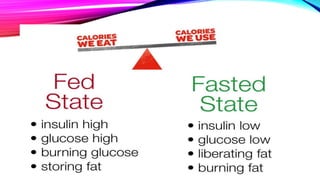
 The presence of food may affect drug absorption via a variety of mechanisms; by
impacting GI tract physiology (e.g. food- induced changes in gastric emptying time,
gastric pH, intestinal fluid composition, hepatic blood fl ow), drug solubility and
dissolution, and drug permeation.
FED VS. FASTED STATE
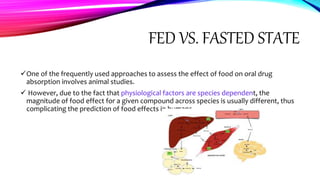
One of the frequently used approaches to assess the effect of food on oral drug
absorption involves animal studies.
 However, due to the fact that physiological factors are species dependent, the
magnitude of food effect for a given compound across species is usually different, thus
complicating the prediction of food effects in humans.
FED VS. FASTED STATE
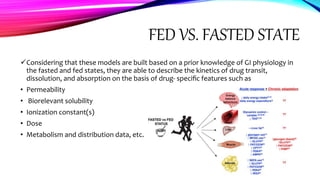
Considering that these models are built based on a prior knowledge of GI physiology in
the fasted and fed states, they are able to describe the kinetics of drug transit,
dissolution, and absorption on the basis of drug- specific features such as
• Permeability
• Biorelevant solubility
• Ionization constant(s)
• Dose
• Metabolism and distribution data, etc.
FED VS. FASTED STATE
Gastroplus™ uses default physiology parameters, which differ between fasted and
fed states.
The food effect for each drug was estimated by comparing AUC or C max between
fasted, fed, and/or high- fat conditions.
Predicted and observed plasma concentration-time profiles and food effects were
compared for a range of doses to assess the accuracy of the simulations.
FED VS. FASTED STATE
The obtained results demonstrated that GI simulation using GastroPlus™ was able to
correctly predict the observed plasma exposure in fasted, fed, and high-fat conditions
for all six compounds.
Also, the applied method was able to accurately distinguish between minor and
significant food effects.
Therefore, it was concluded that biorelevant solubility tests, in conjunction with
physiologically based absorption modeling, can be used to predict food effects caused
by solubility and dissolution rate limitations, and/or degradation.
REFERENCES
• Virtual Clinical Trials: Challenges and Opportunities: Proceedings of a Workshop.
Editors:National Academies of Sciences, Engineering, and Medicine; Health and Medicine
Division; Board on Health Sciences Policy; Forum on Drug Discovery, Development, and
Translation; Shore C, Khandekar E, Alper J, editors.
• Computer- aided biopharmaceutical characterization: gastrointestinal absorption
simulation Sandra Grbic, Jelena Parojcic, and Zorica Djuric, Department of
Pharmaceutical Technology and Cosmetology, Faculty of Pharmacy, University of
Belgrade
virtual trial FED and fasted state.pptx

virtual trial FED and fasted state.pptx

  • 1.
    VIRTUAL TRIALS, FED V/SFASTED SATES Dr. Rajan Swami
  • 2.
    VIRTUAL TRIALS Successful drugdevelopment relies on accurate and efficient clinical trials to deliver the best and most effective pharmaceuticals and clinical care to patients. However, the current model for clinical trials is outdated, inefficient and costly. Conclusions derived from clinical trials are directly impacted by the extent of subject participation.
  • 3.
    VIRTUAL TRIALS CHALLENGES WITHCURRENT CONVENTIONAL SYSTEM: Limited by small sample sizes that do not reflect variations among patients in the real world. Patient enrollment and retention. Protection of patient’s rights. Compliance. Outdated, inefficient and costly.
  • 4.
    WHAT ARE VIRTUALCLINICAL TRIALS (VCT)? New method of collecting the data safely and efficaciously from the trial participants, beginning from start-up to execution and follow-up. VCT take full advantage of technologies (apps, monitoring devices etc) and online social engagement platforms to conduct each stage with comfort of patient. Virtual clinical trials are not a “one-size-fits-all” model and only a fraction of clinical trials are fully virtual.
  • 5.
    RISKS OF VCT Virtualclinical trials also come with risks: • Patient privacy concerns, such as the risk of sharing sensitive health information over the Internet. • Operational challenges, such as the lack of community and provider engagement. • Technical barriers, such as the digital health technology user interface. • Cultural barriers, such as concerns over data integrity and fear of technology failing.
  • 6.
    IDEAL VCT’S: A qualityclinical trial is one that generates the minimal amount of credible, replicable, and evaluable data needed to answer meaningful questions with the least time and cost burdens on participants. Virtual clinical trials can be used to improve the comfort, convenience, and confidentiality for research participants compared with what they might receive in a more traditional site-based clinical trial. Additionally, they offer an opportunity to foster ongoing relationships between researchers and research participants to better understand conditions longitudinally, and generate new and relevant questions. Mining data in new ways to better understand which patient populations can and should be enrolled in trials would lead to more realistic inclusion/exclusion criteria and improve patient recruitment and retention.
  • 7.
    IDEAL VCT’S: Traditional clinicaltrials rarely answer questions that are of greatest concern to patients, such as whether the treatment will lead to a better life. The development and availability of better endpoints and outcome measures could help meet this need. Giving participants the ability to decide on site-based or remote engagement during a clinical trial will require the development of endpoints that are resilient and agnostic to location. A virtual trial should engage providers who treat patients in the health care setting in a way that complements the treating physician's practice rather than adding unnecessary burden and responsibility.
  • 8.
    VIRTUAL TRIALS COMPONENTS ANDPROCESS OVERVIEW: OPEN ENROLLMENT: Through online avenues.
  • 9.
    VIRTUAL TRIALS COMPONENTS ANDPROCESS OVERVIEW: CENTRALIZED: Single study coordination centres under direction of PI’s. PI reviews and monitors the collected data.
  • 10.
    VIRTUAL TRIALS COMPONENTS ANDPROCESS OVERVIEW: DATA COLLECTION: Patients/caregivers Healthcare providers Laboratories Support groups Government organizations etc
  • 11.
  • 12.
  • 13.
  • 14.
    MOBILITY: USE OF SMARTPHONES AND TABLETS. • Speedy and cost effective • Locates nearby trial areas • Eg. NOVARTIS uses “Clinical trial seek” “My net manage” etc
  • 15.
    REMOTE PATIENT MONITORING: Directdata capture is cost effective and improves patient’s compliance and retention. Mobility enabled medical devices alert the staff if patient needs some urgent care. • ALERE® HEALTH PAL: an electronic health record, like Microsoft’s health vault. • MEMS: Medication Event Monitoring System. • Glucometers: Features to register day, date and time of data capture.
  • 16.
    ELECTRONIC PATIENT REPORTEDOUTCOME (E- PRO’S) It involves instruments/applications like e-Diaries that are designed for patient to record and report well specified and labelled information electronically. ADVANTAGES: Less errors Provide real time access to data Enables trigger alerts and notifications Eg. PROMIS (2004)
  • 17.
    INTERACTIVE RESPONSE TECHNOLOGY(IRT) Provides a centralized application and database can provide patient with “Automated Access” IRT can also be used to educate and guide patients like using “Virtual nurse”.
  • 18.
    BENEFITS: Less Frequent travels, Automated data collection Costeffective Single facility Patient with mobility issue can also participate Elimination of Source document verification Maximises enrolment Decision to terminate further development can be taken faster.
  • 19.
  • 20.
    FED VS. FASTEDSTATE  The presence of food may affect drug absorption via a variety of mechanisms; by impacting GI tract physiology (e.g. food- induced changes in gastric emptying time, gastric pH, intestinal fluid composition, hepatic blood fl ow), drug solubility and dissolution, and drug permeation.
  • 22.
    FED VS. FASTEDSTATE One of the frequently used approaches to assess the effect of food on oral drug absorption involves animal studies.  However, due to the fact that physiological factors are species dependent, the magnitude of food effect for a given compound across species is usually different, thus complicating the prediction of food effects in humans.
  • 23.
    FED VS. FASTEDSTATE Considering that these models are built based on a prior knowledge of GI physiology in the fasted and fed states, they are able to describe the kinetics of drug transit, dissolution, and absorption on the basis of drug- specific features such as • Permeability • Biorelevant solubility • Ionization constant(s) • Dose • Metabolism and distribution data, etc.
  • 24.
    FED VS. FASTEDSTATE Gastroplus™ uses default physiology parameters, which differ between fasted and fed states. The food effect for each drug was estimated by comparing AUC or C max between fasted, fed, and/or high- fat conditions. Predicted and observed plasma concentration-time profiles and food effects were compared for a range of doses to assess the accuracy of the simulations.
  • 25.
    FED VS. FASTEDSTATE The obtained results demonstrated that GI simulation using GastroPlus™ was able to correctly predict the observed plasma exposure in fasted, fed, and high-fat conditions for all six compounds. Also, the applied method was able to accurately distinguish between minor and significant food effects. Therefore, it was concluded that biorelevant solubility tests, in conjunction with physiologically based absorption modeling, can be used to predict food effects caused by solubility and dissolution rate limitations, and/or degradation.
  • 26.
    REFERENCES • Virtual ClinicalTrials: Challenges and Opportunities: Proceedings of a Workshop. Editors:National Academies of Sciences, Engineering, and Medicine; Health and Medicine Division; Board on Health Sciences Policy; Forum on Drug Discovery, Development, and Translation; Shore C, Khandekar E, Alper J, editors. • Computer- aided biopharmaceutical characterization: gastrointestinal absorption simulation Sandra Grbic, Jelena Parojcic, and Zorica Djuric, Department of Pharmaceutical Technology and Cosmetology, Faculty of Pharmacy, University of Belgrade