WELCOMREADINGS 
BITTERS 
Bitters are alcohol that's been heavily flavoured with herbs, 
peels, bark, spices, and bitter tasting roots. 
History 
Many brands were developed in the 1800s as elixirs that were 
supposed to cure indigestion, jaundice, and a variety of other 
ailments. Due to these "medicinal" properties, bitters allowed
drinkers to avoid both liquor taxes and social stigma. The Authorities 
put a stop to the medicinal claims in the early 1900s, and bitters 
quickly fell out of favour, except for a brief comeback during 
Prohibition. 
Numerous Herbs, Plants, Barks of trees impart bitterness to these 
bitters. Gentian is common, Gentian is a flavouring alpine plant that 
has been used as a tonic and anti fever remedy for ages. Quinine 
was the new world alternative to gentian, it is a bark of the Cinchona 
tree , a native of South America. Bitters were taken as restoratives 
and remedies for diverse conditions ranging from indigestion to 
painful joints 
Today, they're used to flavour cocktails, coffee, and various dishes. 
Addition of more than a dash or two of bitters can easily overpower 
other flavours. Bitters come in with the base of Spirits and Wines. 
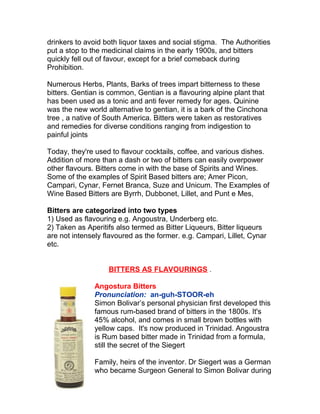
Some of the examples of Spirit Based bitters are; Amer Picon, 
Campari, Cynar, Fernet Branca, Suze and Unicum. The Examples of 
Wine Based Bitters are Byrrh, Dubbonet, Lillet, and Punt e Mes, 
Bitters are categorized into two types 
1) Used as flavouring e.g. Angoustra, Underberg etc. 
2) Taken as Aperitifs also termed as Bitter Liqueurs, Bitter liqueurs 
are not intensely flavoured as the former. e.g. Campari, Lillet, Cynar 
etc. 
BITTERS AS FLAVOURINGS . 
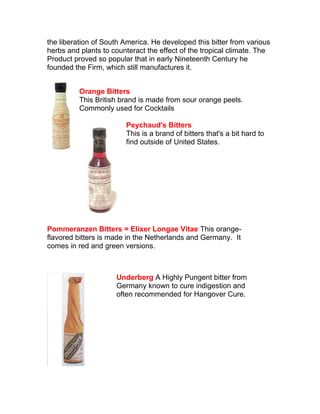
Angostura Bitters 
Pronunciation: an-guh-STOOR-eh 
Simon Bolivar’s personal physician first developed this 
famous rum-based brand of bitters in the 1800s. It's 
45% alcohol, and comes in small brown bottles with 
yellow caps. It's now produced in Trinidad. Angoustra 
is Rum based bitter made in Trinidad from a formula, 
still the secret of the Siegert 
Family, heirs of the inventor. Dr Siegert was a German 
who became Surgeon General to Simon Bolivar during
the liberation of South America. He developed this bitter from various 
herbs and plants to counteract the effect of the tropical climate. The 
Product proved so popular that in early Nineteenth Century he 
founded the Firm, which still manufactures it. 
Orange Bitters 
This British brand is made from sour orange peels. 
Commonly used for Cocktails 
Peychaud's Bitters 
This is a brand of bitters that's a bit hard to 
find outside of United States. 
Pommeranzen Bitters = Elixer Longae Vitae This orange-flavored 
bitters is made in the Netherlands and Germany. It 
comes in red and green versions. 
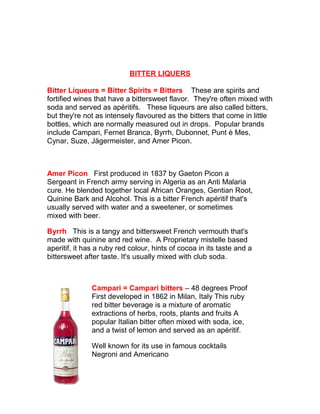
Underberg A Highly Pungent bitter from 
Germany known to cure indigestion and 
often recommended for Hangover Cure.
BITTER LIQUERS 
Bitter Liqueurs = Bitter Spirits = Bitters These are spirits and 
fortified wines that have a bittersweet flavor. They're often mixed with 
soda and served as apéritifs. These liqueurs are also called bitters, 
but they're not as intensely flavoured as the bitters that come in little 
bottles, which are normally measured out in drops. Popular brands 
include Campari, Fernet Branca, Byrrh, Dubonnet, Punt è Mes, 
Cynar, Suze, Jägermeister, and Amer Picon. 
Amer Picon First produced in 1837 by Gaeton Picon a 
Sergeant in French army serving in Algeria as an Anti Malaria 
cure. He blended together local African Oranges, Gentian Root, 
Quinine Bark and Alcohol. This is a bitter French apéritif that's 
usually served with water and a sweetener, or sometimes 
mixed with beer. 
Byrrh This is a tangy and bittersweet French vermouth that's 
made with quinine and red wine. A Proprietary mistelle based 
aperitif, it has a ruby red colour, hints of cocoa in its taste and a 
bittersweet after taste. It's usually mixed with club soda. 
Campari = Campari bitters – 48 degrees Proof 
First developed in 1862 in Milan, Italy This ruby 
red bitter beverage is a mixture of aromatic 
extractions of herbs, roots, plants and fruits A 
popular Italian bitter often mixed with soda, ice, 
and a twist of lemon and served as an apéritif. 
Well known for its use in famous cocktails 
Negroni and Americano
Cynar 
Pronunciation: CHEE-nar 
This is a syrupy Italian liqueur that's made with artichokes, 
giving it a bittersweet flavor. It's best served over ice with a 
twist of lemon 
Dubonnet 
Pronunciation: due-bun-NAY 
This is a French apéritif made with white or red 
wine and flavored with quinine and other herbs and 
spices. The white version is drier than the 
red. Both the versions are full bodied flavour. Best 
served when Chilled in refrigerator or over ice with 
a twist of lemon 
Fernet Branca = Fernet Branca bitters 
Pronunciation: fer-NET BRAHN-kah 
A very dark brown-black extremely bitter beverage 
This is a famous Italian brand of bitters that's 
supposed to ease hangovers. It's flavored with 
over 40 herbs and spices. Best served at Room 
Temperature. Branca Menta is a mint-flavored 
version.
Gammel Dansk This Danish liqueur is flavored 
with 29 herbs and spices. It's usually served at 
room temperature. 
Lillet 
Pronunciation: lee-LAY 
Lillet was founded by Paul and 
Raymond Lillet . This is an expensive 
and light French apéritif made with wine and 
brandy. Th ere are two versions: Lillet Blonde 
(white) and Lillet Rouge (red). Both are dry, full 
bodied, with a fruity bouquet and a trace of citrus 
essence, it has a slightly astringent flavour. Best 
served well chilled, on the rocks with a twist of 
lemon or slice of an orange with a slash of 
tonic. 
Punt è Mes = Punt e Mes 
Pronunciation: POONT eh MESS 
This is a bitter form of red vermouth. It's often mixed with 
soda 
Suze This is a very popular French apéritif , 
yellow bitter based on Gentian extract.Suze
is owned by Pastis the makers of Pernod-Ricard , it is based on 
wine and its flavour is so dry and bitter that even when mixed 
with little water and ice it acts as an extraordinary powerful 
appetite rouser. Best served with little chilled water or ice. 
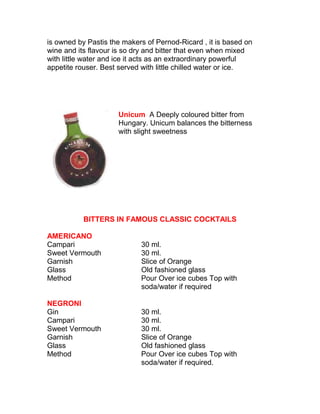
Unicum A Deeply coloured bitter from 
Hungary. Unicum balances the bitterness 
with slight sweetness 
BITTERS IN FAMOUS CLASSIC COCKTAILS 
AMERICANO 
Campari 30 ml. 
Sweet Vermouth 30 ml. 
Garnish Slice of Orange 
Glass Old fashioned glass 
Method Pour Over ice cubes Top with 
soda/water if required 
NEGRONI 
Gin 30 ml. 
Campari 30 ml. 
Sweet Vermouth 30 ml. 
Garnish Slice of Orange 
Glass Old fashioned glass 
Method Pour Over ice cubes Top with 
soda/water if required.
PINK GIN 
Gin 60 ml. 
Angoustra Bitters 3 to 4 Dashes 
Glass Cocktail glass 
Method Stir with ice cubes.

Welcomreadings bitters

  • 1.
    WELCOMREADINGS BITTERS Bittersare alcohol that's been heavily flavoured with herbs, peels, bark, spices, and bitter tasting roots. History Many brands were developed in the 1800s as elixirs that were supposed to cure indigestion, jaundice, and a variety of other ailments. Due to these "medicinal" properties, bitters allowed
  • 2.
    drinkers to avoidboth liquor taxes and social stigma. The Authorities put a stop to the medicinal claims in the early 1900s, and bitters quickly fell out of favour, except for a brief comeback during Prohibition. Numerous Herbs, Plants, Barks of trees impart bitterness to these bitters. Gentian is common, Gentian is a flavouring alpine plant that has been used as a tonic and anti fever remedy for ages. Quinine was the new world alternative to gentian, it is a bark of the Cinchona tree , a native of South America. Bitters were taken as restoratives and remedies for diverse conditions ranging from indigestion to painful joints Today, they're used to flavour cocktails, coffee, and various dishes. Addition of more than a dash or two of bitters can easily overpower other flavours. Bitters come in with the base of Spirits and Wines. Some of the examples of Spirit Based bitters are; Amer Picon, Campari, Cynar, Fernet Branca, Suze and Unicum. The Examples of Wine Based Bitters are Byrrh, Dubbonet, Lillet, and Punt e Mes, Bitters are categorized into two types 1) Used as flavouring e.g. Angoustra, Underberg etc. 2) Taken as Aperitifs also termed as Bitter Liqueurs, Bitter liqueurs are not intensely flavoured as the former. e.g. Campari, Lillet, Cynar etc. BITTERS AS FLAVOURINGS . Angostura Bitters Pronunciation: an-guh-STOOR-eh Simon Bolivar’s personal physician first developed this famous rum-based brand of bitters in the 1800s. It's 45% alcohol, and comes in small brown bottles with yellow caps. It's now produced in Trinidad. Angoustra is Rum based bitter made in Trinidad from a formula, still the secret of the Siegert Family, heirs of the inventor. Dr Siegert was a German who became Surgeon General to Simon Bolivar during
  • 3.
    the liberation ofSouth America. He developed this bitter from various herbs and plants to counteract the effect of the tropical climate. The Product proved so popular that in early Nineteenth Century he founded the Firm, which still manufactures it. Orange Bitters This British brand is made from sour orange peels. Commonly used for Cocktails Peychaud's Bitters This is a brand of bitters that's a bit hard to find outside of United States. Pommeranzen Bitters = Elixer Longae Vitae This orange-flavored bitters is made in the Netherlands and Germany. It comes in red and green versions. Underberg A Highly Pungent bitter from Germany known to cure indigestion and often recommended for Hangover Cure.
  • 4.
    BITTER LIQUERS BitterLiqueurs = Bitter Spirits = Bitters These are spirits and fortified wines that have a bittersweet flavor. They're often mixed with soda and served as apéritifs. These liqueurs are also called bitters, but they're not as intensely flavoured as the bitters that come in little bottles, which are normally measured out in drops. Popular brands include Campari, Fernet Branca, Byrrh, Dubonnet, Punt è Mes, Cynar, Suze, Jägermeister, and Amer Picon. Amer Picon First produced in 1837 by Gaeton Picon a Sergeant in French army serving in Algeria as an Anti Malaria cure. He blended together local African Oranges, Gentian Root, Quinine Bark and Alcohol. This is a bitter French apéritif that's usually served with water and a sweetener, or sometimes mixed with beer. Byrrh This is a tangy and bittersweet French vermouth that's made with quinine and red wine. A Proprietary mistelle based aperitif, it has a ruby red colour, hints of cocoa in its taste and a bittersweet after taste. It's usually mixed with club soda. Campari = Campari bitters – 48 degrees Proof First developed in 1862 in Milan, Italy This ruby red bitter beverage is a mixture of aromatic extractions of herbs, roots, plants and fruits A popular Italian bitter often mixed with soda, ice, and a twist of lemon and served as an apéritif. Well known for its use in famous cocktails Negroni and Americano
  • 5.
    Cynar Pronunciation: CHEE-nar This is a syrupy Italian liqueur that's made with artichokes, giving it a bittersweet flavor. It's best served over ice with a twist of lemon Dubonnet Pronunciation: due-bun-NAY This is a French apéritif made with white or red wine and flavored with quinine and other herbs and spices. The white version is drier than the red. Both the versions are full bodied flavour. Best served when Chilled in refrigerator or over ice with a twist of lemon Fernet Branca = Fernet Branca bitters Pronunciation: fer-NET BRAHN-kah A very dark brown-black extremely bitter beverage This is a famous Italian brand of bitters that's supposed to ease hangovers. It's flavored with over 40 herbs and spices. Best served at Room Temperature. Branca Menta is a mint-flavored version.
  • 6.
    Gammel Dansk ThisDanish liqueur is flavored with 29 herbs and spices. It's usually served at room temperature. Lillet Pronunciation: lee-LAY Lillet was founded by Paul and Raymond Lillet . This is an expensive and light French apéritif made with wine and brandy. Th ere are two versions: Lillet Blonde (white) and Lillet Rouge (red). Both are dry, full bodied, with a fruity bouquet and a trace of citrus essence, it has a slightly astringent flavour. Best served well chilled, on the rocks with a twist of lemon or slice of an orange with a slash of tonic. Punt è Mes = Punt e Mes Pronunciation: POONT eh MESS This is a bitter form of red vermouth. It's often mixed with soda Suze This is a very popular French apéritif , yellow bitter based on Gentian extract.Suze
  • 7.
    is owned byPastis the makers of Pernod-Ricard , it is based on wine and its flavour is so dry and bitter that even when mixed with little water and ice it acts as an extraordinary powerful appetite rouser. Best served with little chilled water or ice. Unicum A Deeply coloured bitter from Hungary. Unicum balances the bitterness with slight sweetness BITTERS IN FAMOUS CLASSIC COCKTAILS AMERICANO Campari 30 ml. Sweet Vermouth 30 ml. Garnish Slice of Orange Glass Old fashioned glass Method Pour Over ice cubes Top with soda/water if required NEGRONI Gin 30 ml. Campari 30 ml. Sweet Vermouth 30 ml. Garnish Slice of Orange Glass Old fashioned glass Method Pour Over ice cubes Top with soda/water if required.
  • 8.
    PINK GIN Gin60 ml. Angoustra Bitters 3 to 4 Dashes Glass Cocktail glass Method Stir with ice cubes.